
Click the link below the picture
.
Is the midlife crisis a common rite of passage—or just a mythical concept that makes for grabby headlines? Research measuring well-being has typically provided solid evidence for such a period of soul searching. Over the course of a lifetime, happiness tends to start out high early in adulthood and decline in middle age, only to rise later in life. Unhappiness follows a mirror pattern—with the youngest and oldest tending to be the least unhappy and those in middle age being the most unhappy.
Plotting both qualities against age, the happiness curve is U-shaped (with the left and right peaks of the “U” corresponding to youth and old age), and the graph for unhappiness is depicted as a hump shape. Reduced to simpler terms, the midlife crisis seems to be real: happiness reaches its low point at around age 50, with peaks at age 30 and after age 70. This finding has been replicated in 146 countries and has held true for data reaching as far back as 1973—and does not just apply to Homo sapiens. Researchers have even identified similar patterns in nonhuman apes.
Is the midlife crisis a common rite of passage—or just a mythical concept that makes for grabby headlines? Research measuring well-being has typically provided solid evidence for such a period of soul searching. Over the course of a lifetime, happiness tends to start out high early in adulthood and decline in middle age, only to rise later in life. Unhappiness follows a mirror pattern—with the youngest and oldest tending to be the least unhappy and those in middle age being the most unhappy.
Plotting both qualities against age, the happiness curve is U-shaped (with the left and right peaks of the “U” corresponding to youth and old age), and the graph for unhappiness is depicted as a hump shape. Reduced to simpler terms, the midlife crisis seems to be real: happiness reaches its low point at around age 50, with peaks at age 30 and after age 70. This finding has been replicated in 146 countries and has held true for data reaching as far back as 1973—and does not just apply to Homo sapiens. Researchers have even identified similar patterns in nonhuman apes.
“We have to focus on the people at the extremes,” Blanchflower says. “Think about those who are most susceptible to commit suicide, to have deaths of despair. These are the people who say, ‘Every day of my life is a bad mental health day.’” Between 2020 and 2022, more than half of respondents reported no bad mental health days. But 7 percent acknowledged exactly 30. The proportion of those with this response nearly doubled from 1993 to 2023. That rate has grown most quickly among the young, especially women 18 to 25 years old. “This fact alone is the most striking and scary: my estimates are that 11 percent of … young women are in despair,” Blanchflower says.
Carol Graham, a senior fellow at the Brookings Institution whose work focuses on well-being, acknowledges the seriousness of this finding. “We never really thought about the lowest point being in youth,” she says. “That is when people are just starting their lives. It shouldn’t be when they are most anxious, are most depressed, and have no hope for the future. There is something profoundly wrong there.”
These trends have resulted in an altered relationship between age and ill-being. Between 2009 and 2018, despair remained hump-shaped, jibing with the preexisting research. A rapid rise in despair before age 45, especially before age 25, however, means that in 2019 unhappiness showed up more frequently at younger ages. “Danny Blanchflower has been hell-bent on showing the U-curve in so many countries…, and all of a sudden he’s writing a paper that’s showing the opposite,” Graham says.
.

Antonio Hugo Photo/Getty Images
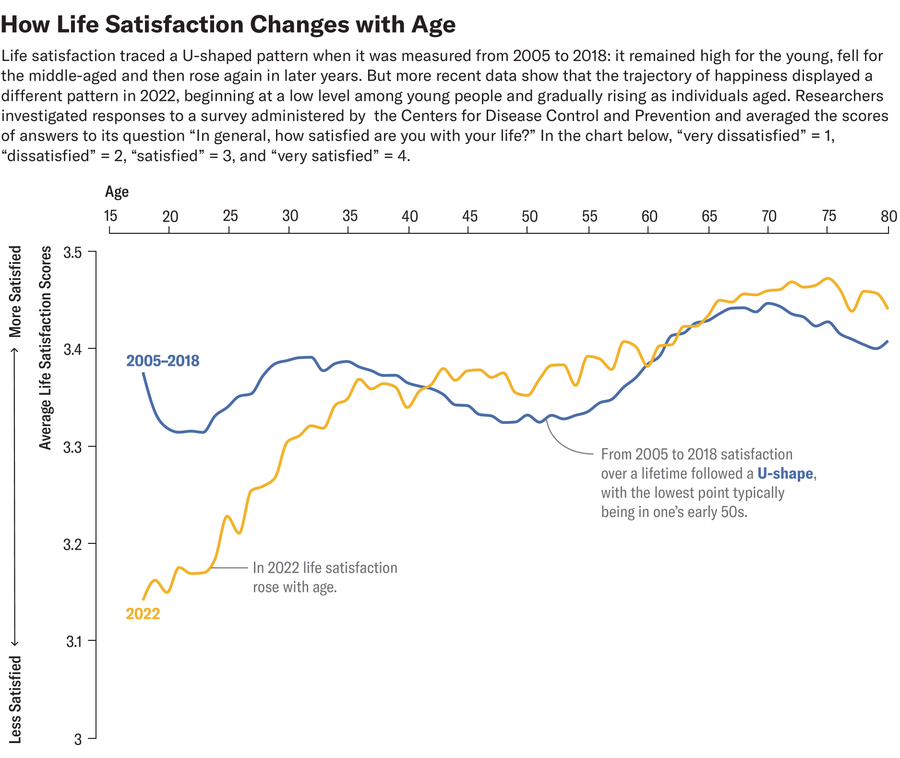
Shuyao Xiao; Source: “The Global Loss of the U-Shaped Curve of Happiness,” by David Blanchflower and Alex Bryson. Posted online June 6, 2024
.
.
Click the link below for the article:
https://www.scientificamerican.com/article/young-adulthood-is-no-longer-one-of-lifes-happiest-times/
.
__________________________________________
 James' World 2
Jul 15, 2024 @ 20:55:03
Too much unhealthy stress….
LikeLiked by 2 people