The ancient Babylonians were a remarkable bunch. Among many extraordinary achievements, they found a now-famous mathematical solution to an unpleasant challenge: paying tax.
The particular problem for the ordinary working Babylonian was this: Given a tax bill that has to be paid in crops, by how much should I increase the size of my field to pay it?
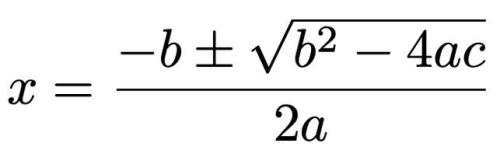
This problem can be written down as a quadratic equation of the form Ax2+Bx+C=0. And it is solved with this formula:
Today, over 4,000 years later, millions of people have the quadratic formula etched into their minds thanks to the way mathematics is taught across the planet.
But far fewer people can derive this expression. That’s also due to the way mathematics is taught—the usual derivation relies on a mathematical trick, called “completing the square,” that is far from intuitive. Indeed, after the Babylonians, it took mathematicians many centuries to stumble across this proof.
Before and since, mathematicians have found a wide range of other ways to derive the formula. But all of them are also tricky and non-intuitive.
So it’s easy to imagine that mathematicians must have exhausted the problem. There just can’t be a better way to derive the quadratic formula.
Enter Po-Shen Loh, a mathematician at Carnegie Mellon University in Pittsburgh, who has found a simpler way—one that appears to have gone unnoticed these 4,000 years.
Film and Writing Festival for Comedy. Showcasing best of comedy short films at the FEEDBACK Film Festival. Plus, showcasing best of comedy novels, short stories, poems, screenplays (TV, short, feature) at the festival performed by professional actors.


 ??
?? James' World 2
Leave a comment