
Police Shoot & Kill Unarmed Black Veteran After Argument with White Bar Owner
Assorted human interest posts.
November 5, 2025
Business, Food For Thought, Human Interest, Political, Science, Technical amazon, business, Business News, current-events, Future, Hotels, human-rights, medicine, mental-health, research, Science, Science News, technology, Technology News, travel, vacation Leave a comment

Click the link below the picture
.
Tuesday night was a far cry from the shell-shocked scenes in Democrats’ election headquarters a year ago this November.
In three key races, for Virginia governor, New Jersey governor, and New York City mayor, the party’s nominees drew in huge numbers of the electorate by attacking President Donald Trump and offering plans to tackle what exit polls showed was voters’ top concern: affordability.
The Democratic wins come as Trump and Republicans have seen sinking approval ratings 10 months into his second term.
Here are some of the key takeaways from Tuesday’s election — one year to the 2026 midterms:
Democrats turn the tide
The national spotlight was on Abigail Spanberger in Virginia, Mikie Sherrill, in New Jersey, and Zohran Mamdani in New York City as the first true tests for the Democrats after the party’s punishing defeat in the 2024 nationwide election.
Tuesday’s results showed the party is on the offensive, with all three candidates projected to score sizable wins over their opponents.
“We sent a message to the whole world that in 2025, Virginia chose pragmatism over partisanship. We chose our commonwealth over chaos,” Spanbrger said.
It’s the economy, again
Preliminary exit poll data compiled by ABC News in the three races showed that the majority of Americans were concerned about the cost of living.
Nearly half of Virginia voters said that the economy was the most important issue facing the commonwealth.
In New Jersey, six in 10 voters said that the economy in the state was doing “not so good” or “poor,” while about four in 10 said it was “excellent” or “good.”More than half of voters in New York City said the cost of living was the most important issue they faced
Spanberger, Sherrill and Mamdani all campaigned with affordability as the main focus.
Although each candidate has different proposals to lower costs — with Mamdani being the most vocal with raising the tax rate on the wealthiest to pay for services such as child care — voters in huge numbers were attracted to their messages.
Voters are not happy with the state of the country
Just as with last year’s elections, where nearly every Democratic led state shifted red, voters appeared to want change from the status quo.
A large majority of voters who said they were angry supported Sherrill, saying they were unhappy with how things were going on in the country. New Jersey has never elected a governor from the same party in three cycles in a row.
Record turnout helps propel Mamdani
More than 2 million voters turned out Tuesday in New York City, the first time a mayoral election crossed that threshold since 1969.
Mamdani collected over 1.03 million votes as of 10 p.m. Tuesday, which is larger than the population of five states, according to U.S. Census figures.
The New York turnout mirrored the increased turnout seen during an off-year election.
Historic wins for Muslim candidates
Mamdani and Virginia Lt. Gov.-elect Ghazala Hashmi both made history as the first Muslim Americans elected to their respective offices.
Both had faced anti-Islamic attacks from their opponents and critics from around the country.
Wins sends message to Trump
Trump got indirectly involved in the three races, especially New York City, as he tried to maintain and grow the GOP’s influence following his win.
The president was particularly tied to the New Jersey race as Republican Jack Ciattarelli vocally embraced and welcomed Trump’s support, despite the president’s low approval ratings.
Sherrill took several opportunities to criticize Trump while looking to tie the president and Ciattarelli tightly together. Mamdani and Spanberger also tied their opponents to Trump’s influence.
Mamdani also addressed Trump directly during his victory speech.
“I have four words for you: turn the volume up,” he mayor-elect said to a roar of supporters’ cheers.
The president reacted angrily to the wins on social media, arguing that the ongoing government shutdown and the fact that he was not on the ballot as the reasons Republicans lost.
.

.
.
Click the link below for the complete article:
.
__________________________________________
November 5, 2025
Business, Food For Thought, Human Interest, Political, Science, Technical amazon, business, Business News, current-events, Future, Hotels, human-rights, medicine, mental-health, research, Science, Science News, technology, Technology News, travel, vacation Leave a comment

Click the link below the picture
.
Human spaceflight is on the cusp of an intriguing new dawn. For 25 years, astronauts have lived and worked onboard the International Space Station (ISS), starting with the arrival of its first occupants on November 2, 2000. Built through a partnership between the U.S. and Russia in the aftermath of the cold war, the ISS has now witnessed five presidential administrations, the advent and demise of the iPod, and even the lofting of another orbital habitat, China’s Tiangong space station. But the ISS’s days are numbered. By 2031, NASA plans to deorbit the space station. Citing aging hardware and rising costs, the agency will bring it back through Earth’s atmosphere for a fiery plunge into the Pacific Ocean.
If all goes as planned, commercial space stations—outposts operated not by government agencies but instead by private companies—will take the ISS’s place to build on its success. The first of these is set to launch next year, with a slew of others scheduled to follow soon after. All of them have the same goal of fostering a vibrant, human-centered economy in Earth orbit—and ultimately beyond.
“We hope to build habitats for the moon [and] Mars and eventually even an artificial-gravity space station,” says Max Haot, CEO of Vast, a Long Beach, Calif.–based company at the forefront of the private-sector spacefaring push. Vast plans to launch its Haven-1 space station as soon as May 2026. On Haven-1’s heels will be several other habitats from Axiom Space, Blue Origin, and Starlab Space. All of them are intended to reach orbit by the end of the decade (and are still somewhat reliant on NASA as a paying customer).
The ISS will leave behind an important legacy, says Bill Nelson, who was formerly a U.S. senator and a space shuttle crew member, as well as NASA’s administrator from 2021 to 2025, and formalized the timeline for the nation’s pivot to commercial space stations. “The station has done incredible things,” he says, from establishing how to live safely in space to exploring the promise and peril of microgravity environments. All the while, the ISS has been a shining beacon of global cooperation.
NASA’s shift from “operator” of the ISS to a “tenant” on space stations, Nelson says, should help the agency focus on more innovative and daring explorations deeper in the solar system. “It’s part of the evolution of space,” he adds. “It used to be all government. Now we have commercial partners and international partners.”
Some have argued that the ISS could still have a long life ahead if it were to be boosted to a higher orbit, where it could endure intact for decades or centuries. “I think it’s the most amazing thing that humanity has ever constructed,” says Greg Autry, a space policy expert at the University of Central Florida. “It’s kind of like deorbiting Buckingham Palace. It’s an amazing historical structure, and it should be recognized for that.” NASA, however, determined that rescuing the ISS would be too costly and complex. Instead, the space agency opted to pay SpaceX nearly $1 billion to develop a vehicle that will push the station back into Earth’s atmosphere in 2031, leaving China’s Tiangong space station as the only government-run outpost in orbit.
By the time that happens, multiple commercial space stations could be active. Haven-1, the first of them, is a singular, shipping-container-sized structure that will be launched on a SpaceX Falcon 9 rocket. Initially lofted uncrewed, the station will offer stays of up to 10 days for both governmental and private-sector visitors, all of whom are planned to reach Haven-1 via a SpaceX Dragon capsule. The cost of a private booking is undisclosed at present.
“Our core business model is 85 percent sovereign space agencies, including NASA, and then maybe 15 percent private individuals,” Haot says. Onboard, four occupants will have private sleeping berths with inflatable beds, a domed window to observe Earth, and high-speed Internet provided by SpaceX’s Starlink service. A built-in science lab will allow them to conduct research at the station.
Haven-1 is a precursor to a much bigger construct planned by Vast called Haven-2, which is expected to launch by the time the ISS is abandoned. Haven-2 will comprise multiple Haven-1-style modules arranged in a cross shape to enable a continuous human presence in orbit, rather than short stays like Haven-1 will host. It will be joined by the other commercial ventures—Axiom Station, Blue Origin’s Orbital Reef, and Starlab.
New priorities may come with any new private era in Earth orbit. Whereas the ISS was notionally a station focused on science, private habitats will inevitably have a broader purview, from acting as proverbial space hotels to being manufacturing hubs for products imported back to Earth. “You can make much better silicon crystals [for semiconductors] in space,” says Autry, listing one of several perennial arguments for more industrial activity in orbit. “[There are] a lot of different economic drivers that I think will eventually pay off,” and the space tourism business “will be much larger than most people believe.”
Autry points to Blue Origin’s New Shepard rocket, which launches paying customers straight up and down on suborbital rides lasting just 10 minutes but has already flown about 80 people (including some repeat customers). “There’s a really strong demand,” he says, arguing that an increase in rides to space—and destinations to reach—shows space tourism can “absolutely” be as accessible as other extreme environments, such as the deep sea. “There’s no reason you can’t get suborbital ticket prices into the thousands of dollars and orbital ticket prices under $1 million,” he says. “I think it will happen in the next 10 to 20 years.”What role science will play on commercial space stations will, to some degree, depend on the tools customers can use onboard. Already, the major players have suggested an assortment of relevant, high-grade laboratory equipment will be the norm. Fabrizio Fiore, an astrophysicist at the Astronomical Observatory of Trieste in Italy, says this means more opportunities for scientists to conduct research that was logistically impossible on the ISS. “Even putting a small thing on [the ISS] is very, very time-consuming and difficult,” he says. “If we are going to have space stations that are not dedicated to governmental astronauts, it will be much easier to build experiments on them.”
.

The International Space Station, as seen from the SpaceX Crew Dragon Endeavour spacecraft on November 8, 2021. NASA
.
.
Click the link below for the complete article:
.
__________________________________________
November 5, 2025
Business, Food For Thought, Human Interest, Political, Science, Technical amazon, business, Business News, current-events, Future, Hotels, human-rights, medicine, mental-health, research, Science, Science News, technology, Technology News, travel, vacation Leave a comment

Click the link below the picture
.
A year ago, President Trump won the White House, promising to fix the economy. On Tuesday, Republican losses delivered a reminder of the high political price that the party in power pays when voters are still feeling squeezed.
Mr. Trump himself was not on the ballot, and he never held rallies in either of the states where new governors were elected on Tuesday. But the president was still a central character in the campaigns, a mainstay of the Democrats’ advertising and their arguments on the stump.
Democratic victories in New Jersey and Virginia were built on promises to address the sky-high cost of living in those states while blaming Mr. Trump and his allies for all that ails those places. In New York City, the sudden rise of Mayor-elect Zohran Mamdani, the democratic socialist with an ambitious agenda to lower the cost of living, put a punctuation mark on affordability as a political force in 2025.
The results on Tuesday came after a drumbeat of polls showing that Mr. Trump and the Republican Party have seen their longtime edge on management of the economy evaporate.
“Exactly one year ago, we had that big beautiful victory, exactly one year,” Mr. Trump said on Wednesday at a breakfast with Republican senators at the White House. “And last night it was not expected to be a victory — it was very Democrat areas — but I don’t think it was good for Republicans.”
Mr. Trump’s own meandering focus on the economy has given plenty of fodder to Democrats. He tore down the East Wing for a new ballroom, lavishly remodeled the Lincoln bathroom, paved over the Rose Garden for a patio like the one at Mar-a-Lago, and threw a “Great Gatsby”-esque Halloween party with the theme “a little party never killed nobody” during a government shutdown and on the eve of cuts to food assistance.
“Trump is indifferent to the pain American families are feeling,” said Representative Suzan DelBene of Washington, who is leading the campaign arm of House Democrats headed into the 2026 midterms.
Only 30 percent of voters believe Mr. Trump has lived up to their expectations for tackling inflation and the cost of living, according to a recent NBC News poll, his lowest mark for any issue asked. And a meager 27 percent of voters in a CNN poll in late October said Mr. Trump’s policies had improved the country’s economic conditions — less than half of those who thought he had made matters worse.
“Trump promised to lower costs on Day 1,” Ms. DelBene said. “It’s a big broken promise from the Republican Party.”
Abigail Spanberger, a Democratic former congresswoman, flipped the governorship of Virginia with a campaign highlighting the fallout for the state’s economy from Mr. Trump’s efforts to dismantle parts of the federal government. Mikie Sherrill, a four-term congresswoman, won with a platform that prominently included a Day 1 promise to declare a state of emergency on utility costs and freeze rates.
Both won by double digits.
The New Jersey race was especially revealing because the Republican nominee, Jack Ciattarelli, had tried to tap into the same frustration that voters have about the economic status quo — and direct that rage at Democrats who control the state government. But ads that had attacked Ms. Sherrill as “more of the same but worse” ultimately fell flat.
Kiersten Pels, a Republican National Committee spokeswoman, said that “these off-year races in deep-blue states aren’t predictors of 2026.” She insisted that voters still trusted Mr. Trump and that Democrats had gone “far left.”
Mr. Mamdani’s rise from obscurity to national stardom showed the mobilizing power of affordability for Democrats. He used a campaign centered on specific and sweeping promises to defeat a once-powerful former governor, Andrew M. Cuomo.
And Mr. Mamdani contrasted his own economic focus with the president’s wandering eye on the topic, at times saying that Mr. Trump had won on three promises in 2024 — to punish his enemies, do mass deportations and ease the cost of living — but only followed through on the first two.
Robert Blizzard, a Republican pollster, warned his party not to dismiss Mr. Mamdani and his “laserlike focus on” affordability, even as Republican strategists were eager to make the 34-year-old democratic socialist the next face of the Democratic Party.
“Don’t just chalk up a Mamdani win to a woke candidate winning a woke city,” Mr. Blizzard said. “This is the wake-up call for policymakers on both sides of the aisle about the importance of focusing your campaigns on cost and affordability.”
In Washington, congressional Democrats have opened a front in the affordability wars through a government shutdown that is now the longest in American history. Senate Democrats are so far refusing to vote to reopen the government unless Republicans and Mr. Trump agree to address health care costs that are rising as federal subsidies lapse.
But the political dynamics at play on Tuesday were simple and familiar.
Voters are unhappy about the economy and are starting to blame Republicans instead of Democrats.
.
 President Trump was a central character in this week’s elections, even though he never held rallies in Virginia or New Jersey, where key elections for governor unfolded. Credit…Anna Rose Layden for The New York Times
.
.
Click the link below for the complete article:
.
__________________________________________
November 5, 2025
Business, Food For Thought, Human Interest, Political, Science, Technical amazon, business, Business News, current-events, Future, Hotels, human-rights, medicine, mental-health, research, Science, Science News, technology, Technology News, travel, vacation Leave a comment

Click the link below the picture
.
In many parts of the country, home prices are still climbing, and inventory remains historically low. But the Federal Reserve has cut rates twice this year, and with more cuts expected, home sales and mortgage refinancing could soon pick up. That also means sellers will need to up their game in a more competitive market.
Fixing that leaky shower or replacing an aging roof could make all the difference. We’ve rounded up the top 13 features today’s buyers want most, according to a National Association of Home Builders (NAHB) survey. Some updates are quick and inexpensive DIY projects, while others require more time, money, and professional help, a challenge in the midst of ongoing labor and material shortages.
Overall, buyers are opting for smaller homes with design touches important to them, like a master bath on the main floor or a front porch. Buyers want to have plenty of comfortable, well-lit outdoor space. They also value nearby parks and walkability.
Want a higher sale price? Invest in the right upgrades
As the housing market continues to rebound, would-be sellers should think twice before skipping out on areas of their homes in need of serious upgrades. Home buyers are willing to spend more on homes with higher-quality finishes in sought-after neighborhoods. Ensure your home is in top condition to get the most attention and the highest possible price.
With a few exceptions, you’re unlikely to recoup all your remodeling costs when you sell. According to Remodeling magazine’s 2025 Cost vs. Value report, sellers were estimated to recoup 18% to 268% of the cost of the 23 projects considered in the report. For example, the average cost of a mid-range bathroom remodel is $26,138 (up from $24,424 in 2021). You’d recoup about $18,613 (74%) of that amount within a year.
The cost of doing nothing to your home can be far greater than the small loss you’ll incur on any home improvement project. “Getting stuck in time with your home isn’t a smart move and is rarely rewarded financially at sale time,” said Compass broker Brian K. Lewis. “In fact, it may cause your house to linger longer on the market longer. As a result, you’ll likely have to pay ongoing mortgage, maintenance, and staging costs.”
If you want to get the most bang for your buck, focus on features that most home buyers really want to see and that you’ll enjoy for as long as you live in the home. Home improvements can be expensive, but the right upgrades could help you command a higher sale price when it’s time to move.
If you’ve built up equity, consider using a home equity line of credit (HELOC) or a cash-out refinance to reinvest in your property and boost its long-term value.
Use the tool below to explore and compare today’s top home equity loan and HELOC offers to see how much you could borrow from your home’s value, powered by Bankrate:
Selling your home? Here are the 13 home features buyers want most.
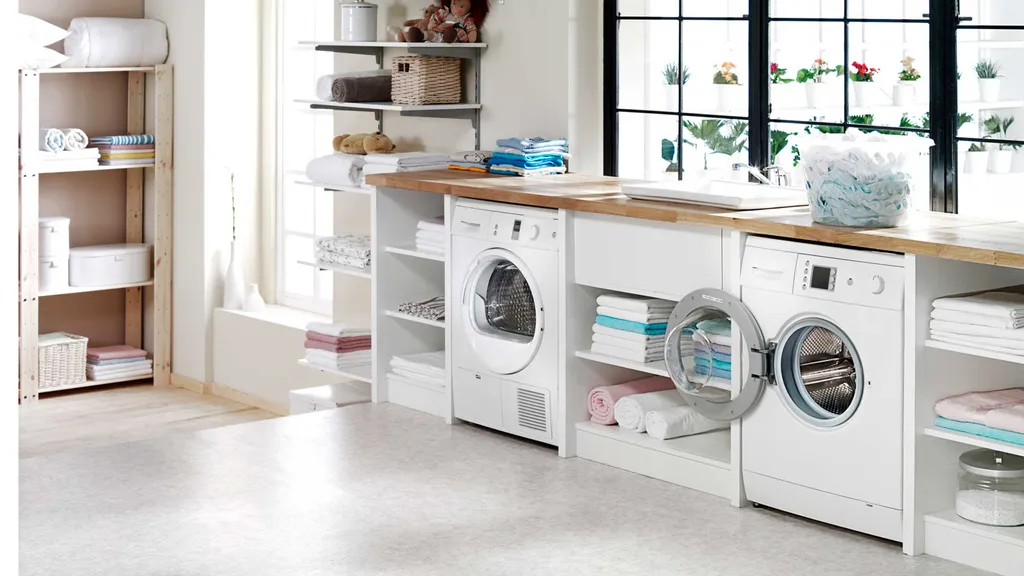
1. Laundry room
- Cost of laundry room addition: $8,000 to $30,000
- Minimum cost of a laundry room renovation: $1,300
More than anything else, homeowners want a dedicated laundry room where they can hide the dirty clothes and stack the clean ones until they get put away. A separate laundry room tops the National Association of Home Builders’ (NAHB) list of most-wanted home features by buyers.
If you don’t have an existing laundry room and want to add one, the basement is usually the easiest (and cheapest) place to put it. The utility lines are already there, and in many cases, the basement is unfinished, so you won’t have to demolish anything first.
If you’re investing in a new washer and dryer, look for Energy Star-certified models that will save you energy and money. Add good lighting and a utility sink, where you can wash out or presoak heavily stained or dirty items. Depending on your budget and space, you can add stock or custom cabinetry, a folding table or countertops.
2. Patio
- Small patio (about 49 sq. ft.): $250 to $2,500
- Medium patio (about 144 sq. ft.): $750 to $7,200
- Large patio (400+ sq. ft.): $2,000 to $20,000
In today’s housing market, outdoor living spaces have become one of the most coveted outdoor home features.
It’s important for homeowners not to neglect the backyard area when prepping for resale, says Mike McGrew, chairman and CEO of McGrew Real Estate, a Lawrence, Kansas-based realty firm.
“When most buyers see a house with a really nice backyard, they start to envision themselves sitting outdoors with friends having drinks,” McGrew adds. Also, outdoor areas offer more living space without the cost of a large-scale home addition.
With the popularity of home renovation reality shows, many buyers have come to expect the eye-catching exterior features. The more expensive the home, the more buyers desire exterior features, such as an outdoor kitchen or fireplace.
Because patios are generally made of concrete or pavers, they tend to cost less than a wood deck or porch to construct and are generally easier to maintain, say, with powerwashing versus periodic staining and resealing or painting. However, their resale value will likely be less than a deck or porch.
3. Energy Star windows
- The average cost to replace windows is $7,359
- Most homeowners spend between $3,443 and $11,839
- About $750 per window, with a range of $300 to $2,500 per window
Would-be buyers looking to lower utility bills will be drawn to properties with Energy Star-qualified windows and appliances. If you don’t already have these features, including new windows, examine your remodeling budget and decide what you’ll need to spend to upgrade.
Be sure to check the Department of Energy website for federal and local rebates and other offers.
Energy Star-qualified windows have two or three panes of glass with vacuum-sealed spaces filled with air or inert gas between panes, sturdier weather stripping than regular windows, and improved framing materials — all of which reduce undesirable heat gain and loss in the home. They can trim heating and cooling costs by 12%.
.
.
.
Click the link below for the complete article (for the complete list):
.
__________________________________________
November 5, 2025
November 5, 2025
November 4, 2025
Business, Food For Thought, Human Interest, Political, Science, Technical amazon, business, Business News, current-events, Future, Hotels, human-rights, medicine, mental-health, research, Science, Science News, technology, Technology News, travel, vacation Leave a comment
Click the link below the picture
.
We come into the world screaming and vulnerable—entirely dependent on adult caregivers to keep us safe and teach us how to connect with others. The nature of these earliest relationships influences how we behave towards others and see the world long after we’ve grown, but in more complex and nuanced ways than researchers previously thought, according to the results of a large, decades-long study examining how the quality of children’s interactions with parents and close peers went on to influence their relationships in adulthood.
In particular, early dynamics with mothers predicted future attachment styles for all the primary relationships in participants’ lives, including with their parents, best friends, and romantic partners, the study found. “People who felt closer to their mothers and had less conflict with their mothers in childhood tended to feel more secure in all of their relationships in adulthood,” says Keely Dugan, an assistant professor of social personality psychology at the University of Missouri and lead author of the study, which was published in October in the Journal of Personality and Social Psychology. “That’s a really striking finding because it demonstrates the enduring impact of that first person who is supposed to be there for you.”
Early childhood friends also played a strong role in predicting how participants approached their future close friendships—and their romantic connections. “When you have those first friendships at school, that’s when you practice give-and-take dynamics,” Dugan says. “Relationships in adulthood then mirror those dynamics.”
The idea that earliest relationships have an outsized impact on our lives was popularized in psychology by Sigmund Freud. British psychiatrist John Bowlby later incorporated some core Freudian elements to create attachment theory, which helps explain variations in how people approach close relationships. “Some people are quite comfortable depending on others, opening up to them and using them as a secure base, whereas other people lack that confidence and trust,” says the new study’s co-author, R. Chris Fraley, a professor of psychology at the University of Illinois at Urbana-Champaign.
Researchers today define attachment styles by where people fall along two dimensions, each shaped by early experiences with caregivers. The first, attachment anxiety, measures your level of confidence in the availability and responsiveness of those you are close to. People high in attachment anxiety might have more intense fears of abandonment or need for reassurance. The second factor, attachment avoidance, involves how comfortable you feel opening up to others and depending on them for support. Those high in avoidance may believe that people cannot be counted on or trusted, so they avoid asking for help or emotional support—even if they need it. A relationship with high attachment anxiety, avoidance, or both is defined as more insecure, while a relationship that is low in both attachment anxiety and avoidance is considered to be secure: “You feel comfortable and close to the other person, you trust them to be there for you, and you feel supported,” Dugan says.
It can be difficult to study exactly how early relationships go on to influence attachment style, though, because people’s retrospective reports of what happened to them in childhood are skewed by memory failings and emotional and cognitive biases, Dugan notes. Of the relatively few studies that have examined associations between early caregiving experiences and adult attachment styles, she adds, all have focused almost exclusively on a single early relationship: the maternal one.
To more deeply understand how early relationships with a wider variety of people impact attachment styles, Dugan, Fraley, and their colleagues turned to a landmark longitudinal study of 1,364 children and their families from around the U.S. It began when the children were infants and ended when they were 15 years old. Once the young participants were old enough to speak, they were surveyed about the quality of their relationships with their fathers, mothers, and best friends. Researchers also surveyed participants’ primary caregivers—who were mostly their mothers—and observed them interacting with their children. That study showed robust evidence that early experiences with caregivers matter for social development.
Between 2018 and 2022, 705 of the original participants, who by then were 26 to 31 years old, agreed to a follow-up study to collect information about their current relationships with their parents, best friends, and romantic partners. For those 705 participants, Dugan and her colleagues analyzed associations between the quality of early relationships and later attachment styles in adulthood. They found several notable patterns. First, a person’s relationship with their mother tended to set the stage for their later attachment style in general, as well as for their specific approaches to individual relationships with friends, romantic partners, and fathers. For instance, people who had more conflict with their mothers, were less close to their mothers, or had mothers who were reportedly harsher and showed less warmth during childhood and adolescence, tended to feel more insecure in their adult relationships.
The researchers didn’t find many associations between participants’ relationships with their fathers and their future attachment styles—perhaps because most identified their mother as their primary caregiver. “This cohort’s first assessment was in 1991, and even though the burden of caregiving still heavily falls on mothers, fathers were even less involved back then, on average,” Dugan says. “In cases where a father was the primary caregiver, the results might be flipped—but we don’t have that data.”
Early experiences with close friends, though, were an even stronger predicter than maternal relationships for determining participants’ approach to—specifically—romantic relationships and friendships in adulthood. “In general, if you had high-quality friendships and felt connected to your friends in childhood, then you felt more secure in romantic relationships and friendships at age 30,” Dugan says. People who enjoyed increasingly close and deepening friendships across childhood and adolescence also showed significant gains in those departments as adults, she adds.
.
 Malte Mueller/Getty Images
.
.
Click the link below for the complete article:
.
__________________________________________
November 4, 2025
Business, Food For Thought, Human Interest, Political, Science, Technical amazon, business, Business News, current-events, Future, Hotels, human-rights, medicine, mental-health, research, Science, Science News, technology, Technology News, travel, vacation Leave a comment

Click the link below the picture
.
Last month, Eliud Kipchoge finished a marathon in 1 hour, 59 minutes and 40 seconds – an audacious feat that no one had ever accomplished before. Kipchoge is from the Kenyan Rift Valley region.
A day after he made history, Brigid Kosgei destroyed the women’s world record at the Chicago Marathon. She’s also from the Kenyan Rift Valley.
And in the New York Marathon on Sunday, a Kenyan rookie took down her country’s rock star in the women’s race. Joyciline Jepkosgei ruined countrywoman Mary Keitany’s chance at a fifth women’s title in the contest, but the latter came in second. And Kenyan Geoffrey Kamworor won the men’s race, his second NYC Marathon victory.
They’re all from the Rift Valley region. And people are taking note – marathoners from all over the world go there to train before major races.
East Africans – especially Kenyans and Ethiopians – have dominated marathons for decades, dashing across finish lines as their exhausted competitors barely made it. In the process, they’ve toppled their own records or those of their fellow citizens.
Kenyan marathon runners are such a phenomenon that research organizations have done studies on why they dominate long-distance races.
And experts say it’s mixture of several things.
Most of the elite runners are from the same region
Most Kenyan elite runners hail from the same ethnic groups known as the Kalenjins and the Nandis. The groups make up just 10% of the nation’s population of 50 million – but bring in a majority of the nation’s marathon medals.
“Internationally, Kalenjin runners have won close to 73% of all Kenyan gold medals and a similar percentage of silver medals at major international running competitions,” says Vincent O. Onywera, a professor of exercise and sports science at Kenyatta University in Nairobi.
They’ve passed on the passion for running across generations, turning the Rift Valley – especially the small town of Iten – into a mecca for the nation’s elite long-distance runners. There, children start running at a young age.
A lot of the young people from these areas grow up surrounded by successful runners. Most of them look at running as a way to make money, says coach Bernard Ouma, who trains elite Kenyan runners.
“You see your neighbor run and win, it motivates you to run and win,” he says. As a result, their communities have a deep tradition of running excellence built over the years.
They train and live in a high-altitude area
Most of the Kenyan runners who dominate marathons worldwide train and live in the high-altitude Rift Valley.
Iten, one of the towns that produces elite runners, sits nearly 8,000 feet above sea level in western Kenya. Training at high altitudes contributes to a running dominance that makes running at lower elevation child’s play, Onywera says.
“There is a widespread belief in the athletic community that altitude training can enhance sea level athletic performance, with at least three independent studies demonstrating that altitude training increases both sea level maximal oxygen consumption and running performance,” he says.
Then there’s diet and constant motivation
Iten has become known internationally as the place where long distance champions are made. So much so, runners from around the world go there to train before major races.
Running aficionado and author Adharanand Finn spent a lot of time in the town trying to find out the secret to Kenyan marathon runners. “I had a lifelong fascination with the uninhibited running style of the Kenyans and had always wanted to know the story behind their incredible athletes – I wanted to know what their lives were like. And when I saw there was no book, or at that time no films, on the subject, I decided to go there and write one.”
His book, “Running with the Kenyans,” gives more insight into what he found out. And there is no one major secret, he says.
“As the famed coach of David Rudisha, Brother Colm O’Connell, says, the only secret is that there’s no secret. It’s not one thing but a perfect storm of elements that come together in Kenya’s Rift Valley region to make the people there so strong at distance running,” Finn says.
There’s the location, the way of life, the environment.
“For a start, you have the altitude, the tough rural upbringing, and the fact that children run around everywhere. Then there is the simple diet, the lack of junk food, and the perfect running terrain — rolling hills, dirt roads — all over the place,” he says.
And if that doesn’t lure you in, there’s the proximity to international elite runners to motivate anyone.
“Running offers a great chance to make good money, to transform lives, even to transform whole communities,” Finn says. “This is compounded by the hundreds of role models everywhere. Almost every village has someone who has come back from ‘abroad’ with winnings, and these stars are very accessible and open to supporting the younger athletes.”
As a result, everyone who can run, aspires to be a runner, he says.
“You end up with thousands of people training together, pushing each other, helping each other, inspiring each other. This attracts agents, sponsors, coaches … and it keeps getting bigger. With all this impetus, some great athletes are going to emerge out the other end,” he says. “So really, it’s not a simple answer.”
Some have wondered whether genes play a role
There’s so much speculation on why Kenyans and Ethiopians keep crushing marathon competitions, the phenomenon has long been a subject of study. Organizations such as the British Journal of Sports Medicine have concluded that it’s unclear whether genes have anything to do with it.
“The periodic domination of middle and long distance running by different regions of the world is not a new phenomenon,” it says. “Researchers are yet to confirm a genetic or physiological advantage in being a middle or long distance runner of East African origin, and it is most likely that the reasons for their success are many.”
And while many physiological and anatomical factors have been suggested to explain the East African dominance, research has not revealed any definitive advantage, the study says.
.

Kenyan runners dominate 2019 New York City Marathon
.
.
Click the link below for the complete article:
.
__________________________________________
November 4, 2025
Business, Food For Thought, Human Interest, Political, Science, Technical amazon, business, Business News, current-events, Future, Hotels, human-rights, medicine, mental-health, research, Science, Science News, technology, Technology News, travel, vacation Leave a comment

Click the link below the picture
.
It is also a sign of how sloppy the thieves were in the end, after pulling off what seemed like a well-planned robbery in one of the world’s most famous museums in broad daylight. Among the objects they left behind in their haste to evade the police and security guards were a glove, a crown that they dropped, and the truck with the mechanical ladder, which they had tried unsuccessfully to set on fire.
Investigators have processed 150 forensic samples related to the crime, from the scene and from objects the thieves left behind. All three people who were arrested already had their DNA on file because of their criminal histories, mostly for theft.
“I am convinced that we would not have found these people if the DNA that was found at this theft hadn’t matched with this database,” said Gaëtan Poitevin, a criminal lawyer in Marseille whose master’s thesis was on France’s DNA database.
How does the DNA database work?
France’s database, the National Automated Genetic Fingerprint File, had 4.4 million DNA profiles at the end of last year. Those profiles have been collected over almost three decades from people suspected or convicted of crimes, as well as people killed in natural disasters.
It has become a staple of police investigations, with forensic investigators collecting bits of saliva, sweat, hair, skin, semen, and blood, then sending them to be sequenced at public and certified private labs. The labs send the results to be compared to the contents of the enormous database, looking for exact matches.
“In just a few hours now, we can have a positive DNA result,” said Olivier Halnais, the head of the national union of forensic police officers.
How did France’s DNA database start?
France began its DNA database in 1998, after the serial killer Guy Georges, known as the “Eastern Paris killer,” was finally arrested.
Mr. Georges had been imprisoned for assaulting a woman with a weapon, and the police collected his DNA. But France had no centralized database at the time, so officers were unable to check his DNA against that found at the scenes of five murders of women who had also been raped.
After his release from prison, Mr. Georges went on to rape and kill two more women. He was arrested again and eventually convicted of the murders of seven women. The case spurred the creation of a national DNA database.
Initially, the database contained only the DNA of sexual offenders. But, over the next five years, it grew to include people convicted — or merely suspected — of a much wider range of crimes, including murder, terrorism, drug trafficking, assault, theft, and property damage.
The process of being removed from the DNA database is so onerous that few pursue it, Mr. Poitevin said. Those who refuse to give a DNA sample face at least a year in prison and a fine of at least 15,000 euros, almost $17,400.
From 2018 to 2022, an average of 680 people a year were convicted of refusing to provide DNA, less than one percent of people charged each year, according to the Justice Ministry.
“Among my clients, absolutely zero refuse, because for them, it’s an admission of guilt,” said Mr. Poitevin.
As a result, the database has continued to grow. And French investigators can check the collected DNA against more than 30 other European national DNA databases, as well as others, including one kept by the United States.
The database and cold cases
While the databank is used regularly for basic investigations, it has proved particularly useful in cold cases.
Investigators said DNA linked Dominique Pelicot, who was convicted last year of drugging his wife, Gisele, and inviting dozens of men to rape her, to an attempted rape committed more than two decades earlier. The 1999 attempted rape case had been dormant for years until the police arrested Mr. Pelicot in 2020, collected his DNA sample, and ran it through the database, matching it to long-held samples collected at the crime scene. (Mr. Pelicot has been indicted in the attempted rape.)
.
 Members of a forensic team inspect a window at the site where burglars broke into the Louvre and made off with eight of France’s historic crown jewels last month. Credit…Gonzalo Fuentes/Reuters
.
.
Click the link below for the complete article:
.
__________________________________________
¡Bienvenido de vuelta viajero!
so looking to the sky ¡ will sing and from my heart to YOU ¡ bring...
CEO and Founder of Nsight Health
https://www.tangietwoods
Catholic News, Prayers, HD Images, Rosary, Music, Videos, Holy Mass, Homily, Saints, Lyrics, Novenas, Retreats, Talks, Devotionals and Many More
Decoding Power. Defying Narratives.
A creative collaboration introducing the art of nature and nature's art.
The Home Of Entertainment News, Reviews and Reactions
Hollow Earth Society
•Whenever you are confronted with an opponent, conquer him with love.(Gandhi)
Algotrader at TRADING-CLUBS.COM
Film and Writing Festival for Comedy. Showcasing best of comedy short films at the FEEDBACK Film Festival. Plus, showcasing best of comedy novels, short stories, poems, screenplays (TV, short, feature) at the festival performed by professional actors.
Peace. Tranquility. Insanity.
Take a ride on the wild side
Découvre des musiques prometteuses (principalement) dans la sphère musicale française.
No tiene que Ser una Pesadilla.
Life in Kana-text (er... CONtext)
Tracking money, power, and meaning across borders.
Where feelings meet metaphors and make questionable choices.
Finding hope and peace through writing, art, photography, and faith in Jesus.
Eyasu
The Community for Wounded Healers: Former Medical Students, Disabled Nurses, and Faith-Fueled Pivots
love each other like you're the lyric to their music
Comprendere il mondo per cambiarlo.
Mid-Life Ponderings
Travel,Tourism, Life style "Now in hundreds of languages for you."
I speak the honest truth. I share my honest opinions. I share my thoughts. A platform to grow and get surprised.
User-generated ratings for ethical consumerism
Travel and Lifestyle Blog
Questo è un piccolo angolo di poesie, canzoni, immagini, video che raccontano le nostre emozioni
“Log your journey to success.” “Where goals turn into progress.”
scrivo per dare forma ai silenzi e anima alle storie che il mondo dimentica.
“Dream deeper. Believe bolder. Live transformed.”
Vichar, Motivation, Kadwi Baat ( विचार दर्शनम्)
Traum zur Realität
Savor. Style. See the world.
معا نحو النجاح
Best Forex Broker Ratings & Reviews
art, writing and music by James McFarlane and other musicians
living life in conscious reality
Freelance poetry writing
Peace 🕊️ | Spiritual 🌠 | 📚 Non-fiction | Motivation🔥 | Self-Love💕
 James' World 2