
Nathaniel Trives (1934/35- ), First African American Mayor of Santa Monica, CA
Assorted human interest posts.
May 19, 2026
Business, Food For Thought, Human Interest, Political, Science, Technical amazon, business, Business News, current-events, Future, Hotels, human-rights, medicine, mental-health, research, Science, Science News, technology, Technology News, travel, vacation Leave a comment

Click the link below the picture
.
Does a ginkgo tree have an inner world? In the film Silent Friend, the protagonist, a neurologist who studies brain activity in infants, attempts to quantify the internal signaling of a ginkgo tree on a university campus. By the end of the movie, he’s using computer-generated visualizations to look at how the tree responds to its environment—not exactly becoming its “friend” but getting a touch closer to understanding the tree’s experience of its surroundings. The film isn’t based on a real study—if plants do have anything like consciousness, scientists have yet to formally describe it—but it’s an imaginative exploration of how consciousness might manifest in different forms of life.
Ildikó Enyedi—Silent Friend’s writer and director, and a self-described amateur science enthusiast—says that the film was largely inspired by real research that has shown that consciousness isn’t solely a human phenomenon. Coming closer to the internal worlds of plants, Enyedi says, “helps us to move out from this instinctive position that our perception is the default.”
Researchers tend to define consciousness loosely as the ability to experience—the subjective, ineffable feeling of being alive. This involves some combination of being awake and aware, having internal awareness (such as mental imagery and inner thoughts), and being connected to the world with an ability to perceive stimuli.
Many cultures around the world have long thought of nonhuman animals as having something like consciousness; some even presume plants have it, too. But in the Western scientific tradition, starting with philosopher René Descartes, the idea of nonhuman consciousness has been questioned—and frequently dismissed.
When the New Age movement started to take hold internationally in the 1970s, some scientists tried to test whether plants really could “think.” Documented and popularized by the 1973 book The Secret Life of Plants, this research came to some far-fetched conclusions, purporting to show that plants “enjoy” classical music and can “read your mind.” Many of the studies referred to in the book weren’t reproducible, though, and scientists rejected them for their lack of rigor. Some claim the studies severely damaged the credibility of future investigations of how plants sense and react to their environments. Still, Enyedi says that this wave of research, which occurred when she was a teenager in the 1970s, got her interested in different definitions of consciousness that could apply outside of the animal kingdom.
The start of the 21st century saw a shift in consciousness research, when scientists began using the tools of neuroscience to try to understand consciousness. Techniques such as electroencephalography (EEG), which relies on electrical signals, and functional magnetic resonance imaging (fMRI), which utilizes blood flow, were employed to measure how the brain responds to its environment. With this data, scientists can draw inferences about consciousness.
Today, researchers understand that plants, animals, human adults, and young children have different perceptive worlds. Maybe plants don’t hear or see like humans do, but studies show that they can respond to sounds and mimic shapes and colors. Plants can even “communicate” with one another using underground fungi networks, according to recent research; these hidden networks convey nutrients from one plant to another and transfer messages that initiate chemical defense responses against pests. Other tantalizing clues—such as early evidence that plants can “pay attention” to stimuli via the synchronization of internal electric signals, causing them to activate resilience during a drought or identify potential hosts, among other responses—are pushing scientists to continue investigating how plants experience the world.
Anil Seth is a neurologist at the University of Sussex in England whose work focuses on the cognitive processes of consciousness. He says that just because plenty of creatures can’t, for instance, speak or recognize themselves in a mirror, that doesn’t mean scientists should assume they’re not conscious in their own way.
“We’re trying to get indicators [of consciousness] that are meaningful for the populations we might apply them to,” Seth says. Brain activity, speech or movement are indicators of consciousness in humans. But “different indicators might be more meaningful for nonhuman animals, plants, AI systems, synthetic biology systems like organoids, and so on.”
Silent Friend attempts to link the mysteries of human and plant sensory worlds using the trappings of science, but with an added creative component. While the film embraces artistic embellishments of the science, Seth, with whom Enyedi consulted during the early creative phases of the film, feels it’s an example of how the arts can push the consciousness conversation in new directions.
The fundamental challenge of studying consciousness remains: it’s hard to tell what consciousness is when you can only experience your own version of it. Scientists, in their quest to gather reliable data, have had to boil down consciousness to only factors that can be measured through experiments. “The data about experiences are necessarily indirect,” Seth says. “Part of the reason why film and books are so good [is] because they can do more to flesh out the nature of experiences, in some ways.”
.

Actor Tony Leung in Silent Friend. Courtesy 1-2 Special
.
.
Click the link below for the complete article:
.
__________________________________________
May 19, 2026
Business, Food For Thought, Human Interest, Political, Science, Technical amazon, business, Business News, current-events, Future, Hotels, human-rights, medicine, mental-health, research, Science, Science News, technology, Technology News, travel, vacation 2 Comments

Click the link below the picture
.
Xi Jinping welcomed Russian president Vladimir Putin with pomp and pageantry as the pair kicked off talks in the Great Hall of the People on Wednesday morning, days after the Chinese leader hosted Donald Trump in the same location.
Chinese soldiers stood in position as a military band played the Russian and Chinese national anthems for the leaders in central Beijing. Children waving Russian and Chinese flags and cheered “Welcome, welcome!” in Chinese, before the pair entered the Great Hall.
The scene was reminiscent of Trump’s high-profile meeting with Xi in Beijing last week, when the leaders of the world’s two largest economies discussed issues from trade and investment, to the Iran conflict and Taiwan.
Talks between Xi and Putin began with a shorter so-called “narrow format meeting”, featuring fewer delegates to discuss sensitive issues, before both leaders held a “wide format meeting” with their delegations. China’s foreign minister Wang Yi, who greeted Putin when he landed in Beijing on Tuesday evening, is also expected to hold talks with his Russian counterpart Sergei Lavrov.
Chinese state media reported that Xi, in his opening remarks, said the two countries should help one another with national development and revitalisation, adding that the world is in danger of reverting back to the “law of the jungle”.
In his opening remarks, Putin hailed the countries’ relationship as being at an unprecedented level, as he stated that Moscow remained a “reliable energy supplier” amid the ongoing Middle East crisis. Putin also invited Xi to visit Russia next year.
Xi said further hostilities in the Middle East were “inadvisable”, and that a “comprehensive ceasefire is of utmost urgency”, state media reported.
Reciprocal trade and investment are likely to be top of the agenda for Putin as his sanctions-hit economy suffers under the growing cost of Moscow’s war in Ukraine.
As Xi was preparing to welcome Putin, the Chinese commerce ministry confirmed China will buy 200 Boeing jets and seek an extension of the trade agreement with the US that was reached in Kuala Lumpur last year. The statement marked Beijing’s first confirmation of the Boeing order, which Trump alluded to last week.
The setting and manner of Xi’s encounters with other world leaders is often viewed as a signal of the Chinese president’s regard for his guest, with the optics and outcomes of his meeting with Putin to come under added scrutiny, coming so soon after Trump’s visit.
In contrast to the adversarial nature of Washington and Beijing’s relationship, Putin and Xi have signalled an increasingly warm bond over recent years, with the leaders labelling one another “dear” and “old” friends.
When the Chinese leader last hosted his Russian counterpart in May 2024, the pair seemed at ease as they ditched their ties and spoke over tea in a former imperial garden that now houses Chinese Communist party offices.
.
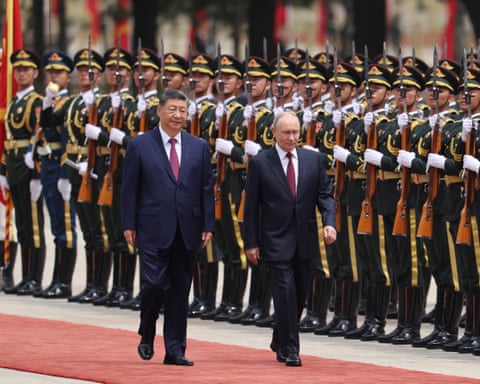 Russia’s president Vladimir Putin and China leader Xi Jinping in Beijing on Wednesday. Photograph: Maxim Shemetov/Reuters
.
.
Click the link below for the complete article:
.
__________________________________________
May 19, 2026
Business, Food For Thought, Human Interest, Political, Science, Technical amazon, business, Business News, current-events, Future, Hotels, human-rights, medicine, mental-health, research, Science, Science News, technology, Technology News, travel, vacation 2 Comments

Click the link below the picture
.
Days after Israeli strikes killed Iran’s supreme leader and other top officials in the opening salvos of the war, President Trump mused publicly that it would be best if “someone from within” Iran took over the country.
It turns out that the United States and Israel went into the conflict with a particular and very surprising someone in mind: Mahmoud Ahmadinejad, the former Iranian president known for his hard-line, anti-Israel, and anti-American views.
But the audacious plan, developed by the Israelis and which Mr. Ahmadinejad had been consulted about, quickly went awry, according to the U.S. officials who were briefed on it.
Mr. Ahmadinejad was injured on the war’s first day by an Israeli strike at his home in Tehran that had been designed to free him from house arrest, the American officials and an associate of Mr. Ahmadinejad said. He survived the strike, they said, but after the near miss, he became disillusioned with the regime change plan.
He has not been seen publicly since then, and his current whereabouts and condition are unknown.
To say that Mr. Ahmadinejad was an unusual choice would be a vast understatement. While he had increasingly clashed with the regime’s leaders and had been placed under close watch by the Iranian authorities, he was known during his term as president, from 2005 to 2013, for his calls to “wipe Israel off the map.” He was a strong supporter of Iran’s nuclear program, a fierce critic of the United States, and known for violently cracking down on internal dissent.
How Mr. Ahmadinejad was recruited to take part remains unknown.
The existence of the effort, which has not been previously reported, was part of a multistage plan developed by Israel to topple Iran’s theocratic government. It underscores how Mr. Trump and Prime Minister Benjamin Netanyahu of Israel went into the war not only misjudging how quickly they could achieve their objectives but also gambling to some degree on a risky plan for leadership change in Iran that even some of Mr. Trump’s aides found implausible. Some American officials were skeptical in particular about the viability of putting Mr. Ahmadinejad back into power.
“From the outset, President Trump was clear about his goals for Operation Epic Fury: destroy Iran’s ballistic missiles, dismantle their production facilities, sink their navy, and weaken their proxy,” Anna Kelly, a White House spokeswoman, said in response to a request for comment about the regime change plan and Ahmadinejad. “The United States military met or exceeded all of its objectives, and now, our negotiators are working to make a deal that would end Iran’s nuclear capabilities for good.”
A spokesperson for Mossad, the Israeli foreign intelligence agency, declined to comment.
U.S. officials spoke during the early days of the war about plans developed with Israel to identify a pragmatist who could take over the country. Officials insisted that there was intelligence that some within the Iranian regime would be willing to work with the United States, even if those people couldn’t be described as “moderates.”
Mr. Trump was enjoying the success of the raid by U.S. forces to capture Venezuela’s leader, Nicolas Maduro, and the willingness of his interim replacement to work with the White House — a model that Mr. Trump appeared to think could be replicated elsewhere.
In recent years, Mr. Ahmadinejad has clashed with regime leaders, accusing them of corruption, and rumors have swirled about his loyalties. He was disqualified from numerous presidential elections, his aides were arrested, and Mr. Ahmadinejad’s movements were increasingly restricted to his home in the Narmak section of eastern Tehran.
That American and Israeli officials saw Mr. Ahmadinejad as a potential leader of a new government in Iran is further evidence that the war in February was launched with the hopes of installing more pliable leadership in Tehran. Mr. Trump and members of his cabinet have said that the goals of the war were narrowly focused on destroying Iran’s nuclear, missile, and military capabilities.
There are many unanswered questions about how Israel and the United States planned to put Mr. Ahmadinejad in power, and the circumstances surrounding the airstrike that injured him. American officials said that the strike — carried out by the Israeli Air Force — was meant to kill the guards watching over Mr. Ahmadinejad as part of a plan to release him from house arrest.
On the first day of the war, Israeli strikes killed Ayatollah Ali Khamenei, Iran’s supreme leader. The strike at Ayatollah Khamenei’s compound in central Tehran also blew up a meeting of Iranian officials, killing some officials whom the White House had identified as more willing to negotiate over a change in government than their bosses.
There were also initial reports at the time in the Iranian media that Mr. Ahmadinejad had been killed in the strike on his home.
The strike did not significantly damage Mr. Ahmadinejad’s house at the end of a dead-end street. But the security outpost at the entrance to the street was struck. Satellite imagery shows that building was destroyed.
In the days that followed, official news agencies clarified that he had survived but that his “bodyguards” — in actuality, Islamic Revolutionary Guard Corps members who were both guarding him and holding him under house arrest — were killed.
An article in The Atlantic in March, citing anonymous associates of Mr. Ahmadinejad, said that the former president had been freed from government confinement after the strike at his house, which the article described as “in effect a jailbreak operation.”
After that article, an associate of Mr. Ahmadinejad confirmed to The New York Times that Mr. Ahmadinejad saw the strike as an attempt to free him. The associate said the Americans viewed Mr. Ahmadinejad as someone who could lead Iran, and had the capability to manage “Iran’s political, social, and military situation.”
Mr. Ahmadinejad would have been able to “play a very important role” in Iran in the near future, the associate said, suggesting that the United States saw him as similar to Delcy Rodriguez, who took power in Venezuela after American forces seized Mr. Maduro and has since worked closely with the Trump administration, the person said.
During his presidency, Mr. Ahmadinejad was known both for his hard-line policies and his often outlandish fundamentalist pronouncements, such as his declaration that there was not a single gay person in Iran and his denial of the Holocaust. He spoke at a conference in Tehran called “A World Without Zionism.”
Western satirists lampooned these views, and Mr. Ahmadinejad became something of an unwitting pop culture curiosity, even the subject of Saturday Night Live parodies.
He also presided over the country at a time when Iran was accelerating the enrichment of uranium it could one day use for making a nuclear bomb should it choose to weaponize its program. An American intelligence assessment in 2007 concluded that Iran had, years earlier, frozen its work on building a nuclear device but was continuing the enrichment of nuclear fuel it could use for a nuclear weapon if it changed its mind.
.
 Former President Mahmoud Ahmadinejad of Iran registering as a candidate in the presidential election in Tehran in 2024. Credit…Arash Khamooshi/Polaris for The New York Times
.
.
Click the link below for the complete article:
.
__________________________________________
May 19, 2026
May 18, 2026
Business, Food For Thought, Human Interest, Political, Science, Technical amazon, business, Business News, current-events, Future, Hotels, human-rights, medicine, mental-health, research, Science, Science News, technology, Technology News, travel, vacation Leave a comment
Click the link below the picture
.
Rachel Feltman: For Scientific American’s Science Quickly, I’m Rachel Feltman.
In 2024, which is the most recent year the Centers for Disease Control and Prevention have released data for, Black women faced a maternal mortality rate of 44.8 deaths per 100,000 live births. That means they were more than three times as likely to die during childbirth than white women were.
But the Black maternal mortality crisis is just one part of a much larger problem. Black women also face disproportionately high rates of fibroids throughout their lives. They’re also more likely to have endometriosis go undiagnosed and more likely to die from endometrial cancer.
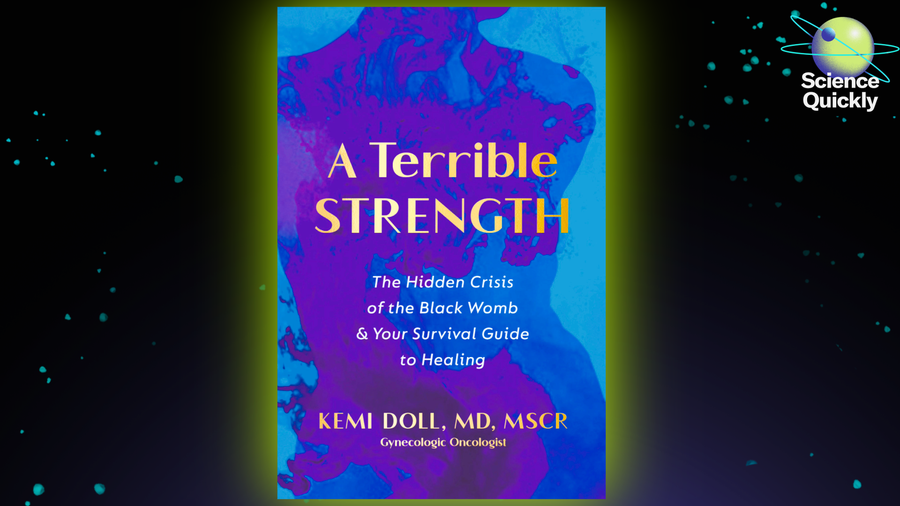
Today’s guest calls this the Black womb crisis. Dr. Kemi Doll is a professor in the University of Washington School of Medicine’s Department of Obstetrics and Gynecology and the director of the university’s Gynecologic Research and Cancer Equity Center. Her new book, A Terrible Strength, combines research data and personal stories to offer insight into this crisis and a way forward.
Thank you so much for coming on to chat with us today.
Kemi Doll: Thank you for having me.
Feltman: I think some of our listeners are, are probably familiar with the
Black maternal mortality crisis, but your book broadens its scope to what you call the Black womb crisis. Can you tell me more about what that phrase encompasses and why that distinction is important?
Doll: Yes, I use that phrase very intentionally to encompass the entire what I think of as, like, the gynecologic life course, so, like, the womb from the time that you start your period and through and past the time that people go through menopause, because, as we know, we spend most of our lives not pregnant. And there are severe gynecologic conditions, up to and including cancer, that disproportionately affect Black women. And what I have found is that when I use the language of the womb, it kind of brings everybody into what we’re talking about and allows us to expand our imagination past just the maternal mortality crisis, to recognizing that the womb itself is actually—we’re having a lot of suffering, you know, from many diseases across the life course.
Feltman: Mm. So tell me a little bit about what brought you to writing this book.
Doll: I am a clinically trained gynecologic oncologist, and I’m also a health-equity scientist, and so my research really focused on the question of why Black women had such a higher mortality rate after endometrial cancer diagnosis in this country. And I like to say that I was agnostic to method; I’m very focused on the problem, and I’ll use any method to get to a solution. And one of the things that we found early on is that endometrial cancer, for a lot of Black women, is just the end of a lifetime of suffering from fibroids and endometriosis and heavy bleeding and that even though, from a medical and biological standpoint, we think of cancer as this other entity and we’re kind of over in a different category, for the actual Black woman going through the disease, she thinks of it as yet another womb condition she’s dealing with.
And so what brought me to write the book was recognizing that we’re not going to bridge the gap of understanding about endometrial cancer, and we’re certainly not going to start to intervene on the issues with delayed diagnosis and incomplete treatment, and the things that plague Black women unless we speak to the experience Black women have over their entire lives with their womb. And so this book is really serving to create a new narrative where we unite those perspectives, and frankly, that we show Black women that from—physicians and scientists can also speak to them in a holistic manner that takes into account all of their life experiences with regard to their womb.
Feltman: Can you tell me more about what we might miss when we just focus on the data in trying to solve problems like this?
Doll: Sure, so a great example is how we diagnose endometrial cancer. So when I was in training and coming up, I learned that the way that we diagnose endometrial cancer is that when a woman has postmenopausal bleeding, she comes to the doctor, we do an ultrasound to evaluate the thickness of what we call the endometrial lining, or the endometrial echo, and if that is over a certain threshold, then her risk is higher and we do a biopsy to rule in or rule out endometrial cancer.
.
 Harmony; Scientific American Illustrations
.
.
Click the link below for the complete article (sound on to listen):
.
__________________________________________
May 18, 2026
Business, Food For Thought, Human Interest, Political, Science, Technical amazon, business, Business News, current-events, Future, Hotels, human-rights, medicine, mental-health, research, Science, Science News, technology, Technology News, travel, vacation Leave a comment

Click the link below the picture
.
Through the muffle of both an interior door and an exterior one, I hear a chair scraping against pavers. Instantly, adrenaline courses through my body. I can hear the whoosh of my blood pumping in my ears, can feel a flat and unyielding pressure against my sternum and throat.
My eyes fly open, and I imagine the hairs on my arms and legs similarly standing at attention, but I have trained myself to stay perfectly still when this bodily response occurs, though every instinct I have is calling me to my feet. In slow motion, as if she will hear my eyeballs moving in their sockets, I shift my gaze downward to my baby. Her breath is light and warm against my chest. I have been holding her for over an hour, trying repeatedly to lull her with milk into a deep enough sleep that I can carefully — so, so carefully — rise from the reclining chair and take the six steps across the room to her crib, where I will attempt for the fourth time in an hour to place her like a piece of unexploded ordnance, not daring to breathe during the operation.
From the patio, I hear the noise again, and I recognize it immediately: the legs of our wooden outdoor furniture are dragging as N gets in and out of a chair. From my place in the noise-controlled, blackout-curtained nursery, where I am one sneeze or hiccup away from having to start the entire process over from scratch, the scraping sounds like a muffler dragging on the highway. My skin is hot with rage, which is just a cover for the deep despair that swells my whole body. My baby won’t sleep unless I am holding her. I am many, many months past the breaking point of going without sleep, and without respite, without my body being under my own control. Under these circumstances, anything that threatens to wake the baby up feels like a direct “f*ck you” to me and my labor, and I know he is out there, my boyfriend, love of my life, inadvertently scraping the f*cking chair on the patio while I die of exhaustion and boredom in here.
The anger and powerlessness snake up my throat from my belly. The baby stirs — whether from the sound of the chair or from my sudden energetic shift, I don’t know — and I know this means I will have to reset my inner countdown at least another 30 minutes. Tears spill down my cheeks, hot and fast, splashing down onto the baby’s face, at the same pace that the rage crests inside my body and rises, like vomit, through my gullet. It wants out. It wants to scream. But I am the parent, not the baby, so I clamp my hand over my lips and try to let it noiselessly into the chamber of my mouth.
I was ready for PPD. But it didn’t come — at least not the way I was expecting it.
“Rage is an unmet need,” a friend often reminds me when we talk about our experiences — shared, but different — of postpartum rage. She’s a provider of mental-health services to perinatal people and the operator of the Mom Rage Art Studio, so I take her words seriously. They feel right. This language came up in all my conversations about postpartum anger. I wish I’d had their clarity.
For me, it was the noise. For other new parents, it might be something completely different, like perceived or real incompetence at taking care of the baby. For others, it is beard hairs in the sink or a chronically overfull trash can or the way he pronounces the word corduroy. Sometimes it’s the way she just gets up and leaves the house when she needs something. Or, most damning of all, simply his face, existing. Postpartum rage triggers are as diverse as they are affecting, but remain remarkably consistent in their targets: the near and the dear.
When I had my baby in 2020, I was well armed for the fight against postpartum depression. PPD is a predator you can see coming — it’s even got its own acronym! — so I assembled my defenses accordingly: therapist, postpartum group, partner, family, Expecting Better, some mindfulness sh*t I bookmarked on YouTube. I took a dutiful series of classes and handouts with the precise vibe of a D.A.R.E. class that taught me the things to watch out for. Sleeping too much, crying too much (how much is too much? No one can say), “persistent sadness,” and thoughts of self-harm. In other words, a version of the treatment-resistant major depression I have managed for most of my life, except now there’s a baby. I was on Prozac by the time Prozac Nation came out. I can clock a generic versus name-brand Zoloft, Paxil, and Lexapro on sight. I was ready for PPD. But it didn’t come — at least not the way I was expecting it.
.
 Mental health
.
.
Click the link below for the complete article:
.
__________________________________________
May 18, 2026
Business, Food For Thought, Human Interest, Political, Science, Technical amazon, business, Business News, current-events, Future, Hotels, human-rights, medicine, mental-health, research, Science, Science News, technology, Technology News, travel, vacation Leave a comment

Click the link below the picture
.
Befitting his home in the Trump administration, Robert F. Kennedy Jr. practices the politics of narcissism: If I embrace it, it must be right. If I embody it, you should emulate it.
I flaunt a sun-sizzled appearance, so you should have the same leathery license.
About two months ago, the health secretary nixed a proposal by the Food and Drug Administration to make tanning beds, like alcohol and cigarettes, off-limits to minors. That development didn’t get extensive news media attention. It couldn’t compete with all the salvos being exchanged — between the United States and Iran, between President Trump and the pope — and it arguably had marginal significance: The proposal had been on the books, unimplemented, for more than a decade. Kennedy wasn’t changing a policy. He was killing a possibility.
But why this one? Why bother? Is there some melanoma lobby we don’t know about? Needn’t he conserve his energy for his shirtless workouts and his mindless conspiracy theories?
He cited the importance of personal choice and the burden that tanning regulations would place on small businesses, but I think his attention to the matter reflected a particular obsession among Trump and his attendants. They’re fixated on looks — to a degree that’s not remotely normal, in a manner that’s positively cartoonish, with no appreciation for how much of themselves and their vacuous governing philosophy they’re revealing.
Never have I witnessed a White House so devoted to surfaces. Surfaces caked with makeup. Surfaces puffed up with hair spray. Surfaces glossed with gold. Surfaces that glitter blue — or someday might, if the over-budget overhaul of the Lincoln Memorial Reflecting Pool ever works out as promised.
Appearances simultaneously obscure reality and substitute for it. Your sheen is your success, and you are what you impersonate. Trump has long been known to judge potential cabinet secretaries and military leaders on whether they look the part, and that thinking factored into his embrace of Kevin Warsh, who was just confirmed by the Senate to be the new chair of the Federal Reserve.
Sure, Warsh has an impressive résumé, and he has signaled obeisance to a president who demands such submission. But he has an additional asset. “On top of everything else, he is ‘central casting,’” Trump wrote in the late January social media post that announced Warsh’s selection. According to an article by Eva Roytburg in Fortune magazine at that time, Trump once told Warsh, during a 2019 meeting in the White House, “You’re a really handsome guy.”
To Trump, that’s an important credential. All the world’s a television show, “central casting” is a recurring compliment and handsomeness or beauty establishes a kind of superiority, which in turn bequeaths confidence, which then begets dominance. By his zoology, an aviary of peacocks equals a menagerie of lions.
And what peacocks these putzes are. In many other milieus, Kristi Noem’s comically voluminous tresses, suspiciously plump visage, and unsubtle makeup would be a waste of aggressive cosmetology. In Trump’s circle, they established her as a fierce warrior goddess — Wonder Woman minus the golden lasso — and got her the title of homeland security secretary for 13 sadistic months.
In many other milieus, Pete Hegseth’s habit of sharing videos of his workouts would be seen as a grossly self-enamored distraction. In Trump’s circle, they’re a testament to his tenacity. The defense secretary posted one such ode to his own musculature shortly before the beginning of the war with Iran, as U.S. warships headed toward that region; it showed him doing a bench press as the soldiers whom he’d gathered around him cheered, his wife applauded, and, I guess, the ayatollahs quivered. Nothing spells imminent doom like a cabinet member’s pecs.
Kennedy has painstakingly sculpted and burnished his own physique — through gym workouts, testosterone therapy, tanning. He has the same retrograde take on masculinity and male primping that Hegseth does, along with the same moth-to-flame fascination with social media, where he can be found pumping iron in jeans, ditching his shirt, soaking in a hot tub. Kid Rock joined him for cardio and calisthenics in a sauna. Hegseth joined him for — and beat him in — a race to finish 100 push-ups and 50 pull-ups.
Is this supposed to pass for inspiration? It’s merely proof of perspiration. But it seems to raise rather than lower these exhibitionists’ standing with the president. Trump treats physical vanity as a secret handshake, a sign that you get his egotistic ethos and you belong. If you’re not strutting, you’re not selling.
Pitch and packaging are everything. Perfect them, and you don’t have to worry about the product itself. That thinking informs the cabinet secretaries’ physical preening just as it explains the president’s oratorical preening — all those ludicrous superlatives — and his emphasis on costumes, scenery, and slogans.
Remember those colorful charts in front of that gigantic American flag in the White House Rose Garden for the announcement of mathematically nonsensical tariffs that would come and go, increase and decrease, and ultimately be deemed illegal? Liberation Day was the semantic lipstick on that pig.
The war with Iran is Operation Epic Fury, and it has demonstrated anew that the Trump administration’s initiatives are lavishly marketed rather than carefully conceived. Assessments of the war’s progress change daily, even hourly, and repeatedly turn out to be unreliable, because they’re often just phrases put through the language equivalent of tanning beds to be given a glow and bronzed just so. That’s what’s important. Not the cancer growing beneath.
.
 Ben Wiseman
.
.
Click the link below for the complete article:
.
__________________________________________
May 18, 2026

Your lifestyle choices speak everything about you. It is that simple. You can talk a massive game, but daily habits broadcast the absolute truth. Whether you are forging a powerful physique, passing on cheap garbage to fuel your body correctly, or relentlessly building a solid empire, your actions are your actual resume. A weak guy […]
True me.. Tap-2499..
Find the Best Forex Broker for Your Trading Success
AS HUMILDES OPINIÕES DE UMA MULHER DE CORAGEM QUE DIZ SIM À VIDA!
Să facem glume, nu război
In the world, human beings are facing various problems. People who are full of greed, anger, and ignorance are seen to be fighting with each other in words and deeds. As the fighting continues, various problems such as civil wars, wars of aggression, and wars of aggression are occurring. As world peace is being destroyed, humans are facing unbearable problems. Innocent children and women are not getting the rights they deserve and deserve. I can't think of one thing every time. What is it? The United Nations. If we look at the responsibilities and duties of the United Nations, I think it is not suitable for solving the problems that are happening in the world today. In fact, the United Nations and the World Security Council, such an organization must rule the world, must be able to give orders, and must have various ways to obey orders. There must be no organization that can influence more than that organization. There should be experts from each country. They can even dominate the superpowers like the US, China, and Britain. Only then will global peace be achieved quickly. Now, if a country with power develops more militarily, economically, or socially than its own country, then powerful countries will jealously seek out enemies and wage war. Or they will attack with fighter jets. In this, innocent people are losing their lives. No one understands the value of a life. You should think about how to achieve global peace by controlling these. If the US continues to be the permanent president of the UN, world peace will never be achieved. If you think carefully, no one sees that they are working for the common good, but for their own benefit, for the benefit of their own country. The permanent president of the UN and the Security Council has rejected this, As a young Rohingya, I have come to realize that only by electing the president and secretary from among the countries in the world through a secret ballot system and governing the world fairly can we achieve global peace. The United Nations and the Security Council are organizations in which any country must govern, give orders, and make them obey their orders. For example, only when a defendant is tried in court can we hold the leaders of the countries in check and control them, can we achieve global peace smoothly. Otherwise, it will not be easy for powerful countries to use various excuses to end this war every year, every year, for the benefit of themselves and their countries. No country's leaders pay any attention to the words of the United Nations and the Security Council. If we look at it in practice, look at the Rohingya issue. Myanmar is a small country. Even that country has been under siege for 8 years. What action can be taken? Why is the UN and the Security Council Powerless? Without such Power, how can the organization bring about global peace? Everyone should think about it. Whether there is a veto or a strong one, all countries in the world can only achieve global peace if they are subject to the UN and the Security Council. Seek peace in the quiet embrace of nature. Peace is an indispensable need of the human race. It is not as if one person can kill another person, and it is as if one country can attack another country, but instead of trying to build peace, we must try to destroy the peace now, and the world is getting hotter and is on the verge of collapse. I especially appeal to all the world experts to urgently try to bring about peace in all parts of the world. Mr, Noor Muhamed Arkhan Rohingya Youth Myanmar
Publicație umoristică dedicată glumeților de pretutindeni
Faith saved us from the savages that we were, losing faith makes us savages again
Where Trends Meet Truth
https://www.tangietwoods
Freelance poetry writing
Zalai Betti
INOVATION BLOG PEOPLE AND NEWS
Németh György
Konsultan Lingkungan Hidup di Lombok - NTB
Lea Krasznai (LeaArt21) – Idezetek (Idézetek) WordPress (Budapest, Hungary)
Appunti, spunti e passioni in liberta'
Gyorgy Nemeth
تعنى بتقديم نصائح للمعلمين المبتدئين، والطلبة الممتحنين، ومشاركة الاخرين تجربة الادخار في المال، بترشيد الاستهلاك المنزلي، وترتيب البيت، والحفاظ على البيئة، وتشجيع السيارات صديقةالبيئة، والسياحة والاسفار، ونماء رؤوس الاموال، والطب البديل وتشجيع التعليم الرقمي والذكاء الاصطناعي، والعناية بالنحل وتربية الاسماك، والاسثمار في رؤوس الاموال، الزراعة العضوية، والعناية باسنان الرضع، و صحة الحوامل، وتفسير القران
apprendre pour évoluer
Thoughts on books, language, meaning, and the culture around it.
Outdoor Recreation & Adventure in the Great Lakes Region
News, Info, Bio, Articles, Reviews, Lyrics, Technology, Science, Inspiration, Motivation, Philosphy and many more...
Christian Lifestyle Blogger
CEO and president of The Mullins Companies
Two Cultures. One Life. Endless Stories
Real Estate Development Specialist
¡Bienvenido de vuelta viajero!
so looking to the sky ¡ sing and from my heart to YOU ¡ bring...
CEO and Founder of Nsight Health
Catholic News, Prayers, HD Images, Rosary, Music, Videos, Holy Mass, Homily, Saints, Lyrics, Novenas, Retreats, Talks, Devotionals and Many More
Decoding Power. Defying Narratives.
A creative collaboration introducing the art of nature and nature's art.
The Home Of Entertainment News, Reviews and Reactions
•Whenever you are confronted with an opponent, conquer him with love.(Gandhi)
Algotrader at TRADING-CLUBS.COM
Film and Writing Festival for Comedy. Showcasing best of comedy short films at the FEEDBACK Film Festival. Plus, showcasing best of comedy novels, short stories, poems, screenplays (TV, short, feature) at the festival performed by professional actors.
Peace. Tranquility. Insanity.
Take a ride on the wild side
Découvre des musiques prometteuses (principalement) dans la sphère musicale française.
No tiene que Ser una Pesadilla.
Life in Kana-text (er... CONtext)
Where feelings meet metaphors and make questionable choices.
Finding hope and peace through writing, art, photography, and faith in Jesus.

