Leave it to Queen Latifah to turn a major career milestone into a full-on family affair. The legendary musician, actress, producer, and entrepreneur hosted the 2026 American Music Awards on Monday, May 25, 2026, and she did not come alone. Latifah brought her partner, Eboni Nichols, and their 6-year-old son, Rebel, to the show, making it one of the sweetest moments on the red carpet for the night.
This year’s AMAs carried extra special significance. The year 2026 marks 30 years since Latifah first took hosting duties at the show, and she returned to welcome audiences to what remains the world’s largest fan-voted awards show. Only a legend gets to celebrate that kind of anniversary on that kind of stage, and she wore every one of those 30 years like a crown.
The family outing took on an even warmer dimension with the addition of a very special guest. Kaayia James Union Wade, the 7-year-old daughter of Gabrielle Union and NBA legend Dwyane Wade, joined the group for the evening. Formerly known to millions of fans online as the “Shady Baby,” Union Wade has already built her own cultural footprint, charming the internet with her unshakeable confidence. Seeing her step into a night this big, surrounded by people who clearly adore her, was a reminder that this next generation is already something special. And she was not the only young star making her presence felt.
Teyana Taylor also brought her two daughters, Iman “Junie” Tayla and Rue Rose, to the show where she was a performer, making it clear that the 2026 AMAs was as much a celebration of family as it was of music.
As for Latifah, it’s not every day that she opens the door to her personal world. She has long been intentional about keeping her relationship with Nichols and their family out of the spotlight, which made the moment feel all the more significant. Choosing to mark this particular milestone with the people she loves most was a statement in itself.
.
LAS VEGAS, NEVADA – MAY 25: EDITORIAL USE ONLY (L-R) Kaavia James Union Wade, Eboni Nichols, Rebel Nichols Owens and Queen Latifah attend the 52nd American Music Awards at MGM Grand Garden Arena on May 25, 2026 in Las Vegas, Nevada. (Photo by Axelle/Bauer-Griffin/FilmMagic)
Ball State University in Indiana has agreed to pay $225,000 to a former administrator who was fired for her Facebook post accusing Charlie Kirk of spreading fear, the latest legal settlement awarded to a worker dismissed for criticizing the conservative activist after he was assassinated.
“As a public university, Ball State cannot fire an employee for protected speech made as a private citizen,” the American Civil Liberties Union of Indiana, which sued on the administrator’s behalf, said in a statement this week announcing the settlement.
Employers in several states have also settled with or reinstated workers.
Scores of people — health care workers, lawyers, journalists, waiters and waitresses — were fired or faced other repercussions for their negative comments about Mr. Kirk, igniting a debate over how far employers can go in restricting employees’ political expression that occurs outside the workplace. The Foundation for Individual Rights and Expression said it was tracking 13 lawsuits in federal court from people who had been disciplined or terminated for their comments about Mr. Kirk.
The Ball State case involved a health care administrator for the university named Suzanne Swierc (pronounced “swirtz”). She became one of many Americans targeted in a campaign by Mr. Kirk’s followers, including Vice President JD Vance, to expose and retaliate against those who had spoken critically of Mr. Kirk after his assassination last fall on a Utah university campus.
“If you think Charlie Kirk was a wonderful person, we can’t be friends,” she wrote on her Facebook page several hours after he was killed. Her post expressed disdain for Mr. Kirk’s loyal fans but also condemned his death as the kind of violence she said was too common in American politics.
Her settings were private, but one of her followers took a screenshot without her knowledge and sent it to others.
Ms. Swierc’s post spread widely after it was publicized by Indiana’s attorney general, Todd Rokita, who had urged people to alert his office to anyone “celebrating or glorifying the tragedy,” according to her lawsuit.
Mr. Rokita’s action — together with a post by Libs of TikTok, a social media account known for mocking left-wing politics — prompted a deluge of phone calls, texts, voice mail messages, and threats to both Ms. Swierc and the university. Even Elon Musk weighed in.
The university, which admitted no wrongdoing as part of the settlement, said that after Ms. Swierc posted her comment, on Sept. 10, 2025, the university’s operations were seriously impeded. Though the First Amendment broadly protects political expression, the right to free speech is not as absolute as many assume — especially when a workplace is involved. The Supreme Court has established that a public institution like Ball State can restrict employee speech on matters of public concern if the comments interfere with the institution’s ability to function.
Ball State’s president, Geoffrey S. Mearns, wrote in an email to university leadership this week that “disruptive and disturbing” phone calls, as well as “more than 130 emails,” including from donors threatening to withhold contributions, “prevented our staff from performing their usual responsibilities.”
Some staff members who fielded the calls said they had been threatened with violence and felt uncomfortable being on campus, he said.
Ms. Swierc’s post, he added, had damaged her credibility to interact with students who did not share her views about Mr. Kirk. “I concluded that I had the legal authority to terminate Ms. Swierc’s employment,” he said in his email.
But the First Amendment makes such cases difficult to defend, as the recent spate of settlements in Kirk-related cases has shown. Florida officials agreed last week to pay $485,000 to Brittney Brown, a biologist, after the state Fish and Wildlife Conservation Commission terminated her over a meme she reposted to her private Instagram account. In Tennessee, a professor at Austin Peay State University received a $500,000 settlement and was reinstated after posting about Mr. Kirk’s support for expansive gun rights. Clemson University in South Carolina rescinded its firing of an assistant professor in another case.
Greg Greubel, a lawyer for the Foundation for Individual Rights and Expression, said that while public pressure campaigns have been around forever, the efforts to shame and punish private citizens, with the endorsement of political leaders, was new and troubling.
.
Suzanne Swierc was fired from her job as a health care administrator at Ball State University in Muncie, Ind. Credit…Kaiti Sullivan for The New York Times
On Monday, May 25, 2026, the global religious landscape shifted profoundly as Pope Leo XIV issued an unprecedented, historic apology for the Roman Catholic Church’s institutional complicity in the trans-Atlantic slave trade. While previous pontiffs had expressed deep regret for the tragic actions of individual Christians during the colonial era, this landmark declaration marks the […]
Star Wars: The Mandalorian and Grogu is a science fiction film directed by Jon Favreau, who co-wrote it with Dave Filoni and Noah Kloor. It is produced by Lucasfilm and Fairview Entertainment, and distributed by Walt Disney Studios Motion Pictures. It’s part of the Star Wars franchise and based on the Disney+ television series, The […]
Hmmmm … Extremely enlightening article! How did Picard and Kirk meet?
Click the link below the bottom picture
.
What shape is the universe? This question is far more intriguing and truly unresolved than any debate over the shape of our planet, despite the claims of flat-Earthers.
We occupy only a tiny space within a gigantic cosmos. Our vantage point is limited. Nevertheless, cosmologists are now fairly certain that our universe is flat.
But that doesn’t explain the exact shape of space. It could extend infinitely along the three spatial dimensions or resemble a three-dimensional generalization of a donut’s surface—or take on even wilder forms. The mathematics of flat space is astonishingly versatile, and new research is upending the traditional thinking about the layout of our cosmos.
Triangles in the Sky
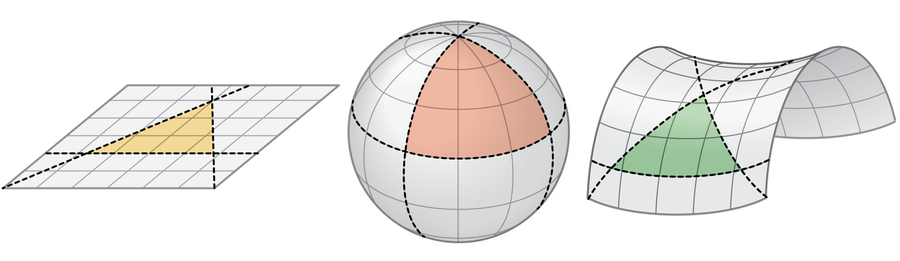
Carl Friedrich Gauss, a German astronomer who lived in the late 1700s and early 1800s, was one of the first mathematicians to study geometry in curved spaces. He knew, for example, that the sum of the angles of a triangle in a plane is 180 degrees and that it is greater on a sphere. On spherical surfaces, such as that of Earth, an equilateral triangle can consist of three right angles, for instance. Other geometries, such as the shape of a Pringles chip, can have angle sums of less than 180 degrees.
The same principle applies not only to triangles on 2D surfaces but also in 3D space. Depending on the curvature of space, the sum of the angles can vary. Gauss may have seen the triangle as a good starting point for investigating the shape of the universe, though this is debated. He is said to have measured the distances between three German mountain peaks (Hohenhagen, Brocken and Inselberg) and determined their angles. His result: the sum was close enough to 180 degrees that it suggested that there was a flat plane between the mountain peaks.
Depending on the curvature of space, the sum of the angles of a triangle can be equal to (yellow), greater than (pink), or less than (green) 180 degrees. Amanda Montañez
.
Unfortunately, although the triangle method is helpful for thinking about the curvature of space, it’s not going to answer the question of whether our universe is curved or flat. The cosmos is gigantic. Even if Gauss or another astronomer used a large telescope, triangulating the distances between stars wouldn’t work. Stars within our own or in neighboring galaxies are too close to us, measured against the vast scale of the universe. Furthermore, we must take into account that the observed objects are moving and that, as a result of gravity, the light traveling to us follows partially curved paths.
But experts can use other tricks to deduce the shape of our universe. For example, they look deep into the past—all the way to the oldest radiation, dating back to around 13.8 billion years ago.
A Brief History of the Universe
Exactly how our universe originated is still unclear. Fortunately, the precise details are not necessary to deduce its shape. Much can already be worked out from the oldest light that reaches us: the cosmic microwave background.
When our universe was very young, it consisted of very hot, dense matter. The building blocks of atomic nuclei, quarks and gluons, floated around loosely in a kind of primordial soup. The medium was so dense that photons could not move freely within it.
As the universe expanded, it cooled; gradually, the first atomic nuclei and eventually atoms formed. As a result, the universe became transparent: photons could move freely. And this light, which originated around 370,000 years after the big bang, is what we can observe.
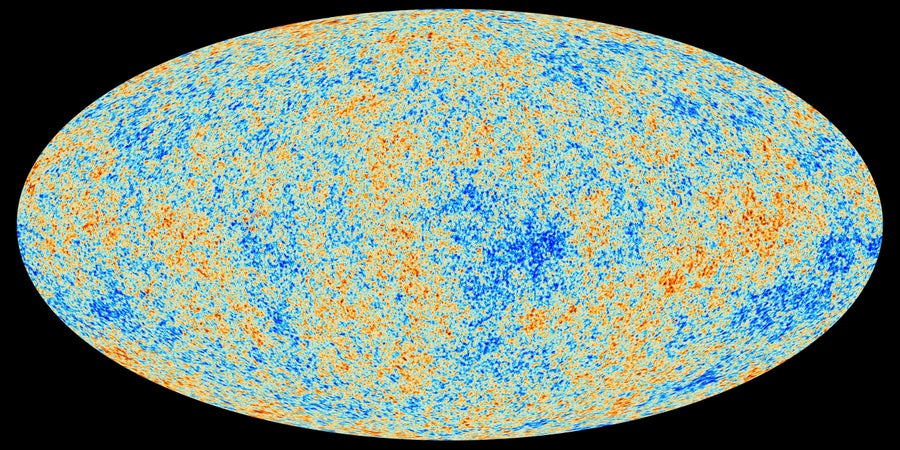
In this image depicting the Planck satellite’s measures of the cosmic microwave background, red areas represent regions that are warmer than the average temperature, and blue areas represent colder regions. ESA and the Planck Collaboration (CC BY 4.0)
.
The signal that reaches us from that time is surprisingly uniformly distributed across the sky, no matter where the detectors are pointed. This means that matter must have been very evenly distributed at this early stage. This observation leads to the cosmological principle: the universe must be homogeneous and isotropic. In other words, matter in the cosmos is uniformly distributed, in the same way in all directions. From Einstein’s equations of general relativity, it then follows that the curvature of space is constant on large scales.
This significantly restricts the possible geometry of the cosmos. If the curvature is constant, then three different cases can be distinguished:
No curvature: in this case, you have a Euclidean geometry, as on a flat surface.
Positive curvature: this corresponds to a spherical geometry, similar to that on a sphere.
Negative curvature: the geometry is hyperbolic, like a Pringles chip.
To determine which of the three cases is realized in the universe, one can again use cosmic microwave radiation. It is almost homogeneous, but not quite: there are tiny fluctuations within it that provide a clue to the geometry of the universe.
The small fluctuations in microwave radiation result from tiny density differences in the hot, bubbling primordial soup. And we can calculate how strong these fluctuations were in the early universe: the largest correspond to the greatest distance the density waves could travel.
These density fluctuations are also visible in our sky, specifically in the cosmic background. How large they appear depends on the geometry of the universe: If the universe is positively curved, the density fluctuations should appear larger than they actually are. With negative curvature, they should appear smaller. And without curvature, they should correspond exactly to the theoretical value (much as the angles of a triangle in flat space will sum to 180 degrees). According to measurements by cosmologists, this last scenario applies to our universe.
So the Universe Is Flat—But How Flat?
Density fluctuation measurements, along with other cosmological data, suggest that our universe is flat. But that still doesn’t mean we know the true shape of our universe.
Because curved 3D spaces are difficult to visualize, we can start with 2D examples. If our universe were 2D and flat, most people would imagine a flat surface. But that’s not the only 2D shape with flat geometry. Another example is the surface of a torus, which resembles a bagel or donut.
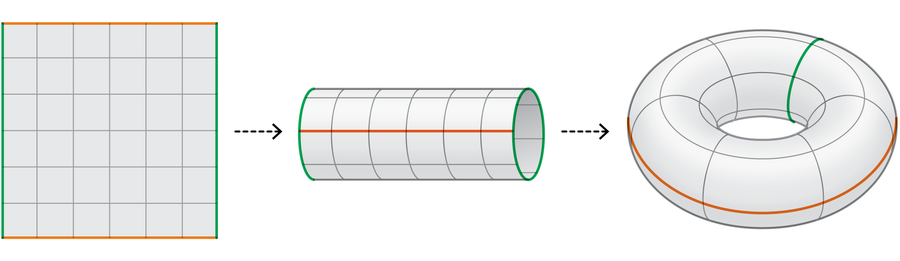
You can imagine creating a torus from a flat material by rolling it so the ends meet and then twisting the resulting tube into a ring. Amanda Montañez
.
A bagel looks curved, but in a crucial sense, it isn’t. You could, in theory, form a torus by taking a flat (and exceptionally stretchy) sheet of paper and gluing the opposite sides together to create a cylinder. You could then twist this sheet so the open cylinder ends meet, creating a hollow ring or torus.
In fact, there are three other variations of a flat space in two dimensions: a cylinder, a Möbius strip and a Klein bottle.
In three dimensions, the possibilities are even more diverse. In 1934, mathematician Werner Nowacki proved that there are 18 different flat 3D shapes. If our universe is truly flat, then it has one of these 18 shapes.
We can rule out some candidates because eight of the 18 are “nonorientable.” If you were to fly a rocket through a nonorientable universe, you would eventually return to your starting point, but in a mirrored form: your right would now be left, and vice versa. According to experts, such universes contradict the laws of physics.
That leaves 10 different forms that the universe can have:
An infinitely extended 3D space with x, y, and z axes.
A 3D generalization of the torus: in this case, one can imagine gluing together the opposite faces of a cube.
A half-twist torus: same as #2, but one pair of surfaces is twisted by 180 degrees, like a Möbius strip.
A quarter-twist torus: same as #2, but a pair of surfaces is joined by twisting them by 90 degrees.
A third-twist prism: instead of looking at the faces of a cube, one can also use a six-sided prism. Here, opposite faces are also glued together, but one face is rotated by 120 degrees.
A sixth-twist prism: same as #5, but one side is rotated by 60 degrees.
A shape called a Hantzsche-Wendt manifold that consists of two cubes stacked on top of each other, with the faces of the cubes joined together in a complex way.
A space consisting of infinitely many flat planes that can be twisted relative to each other.
A space consisting of an infinitely tall “chimney”: four surfaces arranged as the sides of a parallelogram. Opposite surfaces are glued together.
Same as #9, but one of the pairs of surfaces is rotated by 180 degrees.
All of these shapes share the same flat geometry, but each possess their own unique characteristics. Experts can therefore search for clues and evidence of these features to determine the precise shape of the universe using increasingly detailed cosmological data.
Infinitely Many Copies of Ourselves
Many of these candidates for the shape of the universe are compact, meaning they do not extend outward infinitely. Instead a striking characteristic that they share is repetition. In a torus-shaped universe, for example, light from our Earth would eventually reach Earth again, so we would see our reflection.
That said, our universe is gigantic, and light travels at a finite speed. This means that even if the light from our solar system or galaxy were to reach us again someday, we most likely wouldn’t recognize the image. This is because its shape at that time would probably bear little resemblance to our current surroundings. Furthermore, our cosmos might be so vast that light simply hasn’t had enough time to traverse it.
But there could be other clues if we are living in a compact universe. The shape of the cosmos influences, among other things, how matter and light interacted in the early universe. And this should be reflected in the cosmic microwave background radiation. Researchers have searched for repeating structures within it, such as identical circular arrangements that would indicate a compact universe. To do this, they had to make some geometric considerations: because we receive the microwave radiation on the spherical Earth, the signal has the shape of a spherical surface. Our universe could have a more complex shape, however—and traces of this should be reflected in the spherical data we receive.
When experts searched for identical circular structures in cosmic microwave background radiation data during the 2000s and 2010s, they found nothing. Therefore, most cosmologists assumed that the universe had a fairly simple structure: it would be flat and extend infinitely in all three spatial dimensions. Research into the shape of the universe stalled because of a lack of new evidence—until the Collaboration for Observations, Models and Predictions of Anomalies and Cosmic Topology (COMPACT) was launched in 2022.
Researchers in the collaboration are comparing the latest data on the cosmological microwave background radiation with the various possible shapes of the universe. They have discovered that the lack of evidence for identical circular structures in the cosmic microwave background is far less restrictive than previously thought. In fact, it is quite plausible that we would not identify any of these structures in a compact universe. Furthermore, the experts are working on identifying other features in cosmological data that would point to complex shapes for the universe. The COMPACT team is still analyzing the data and developing suitable models. Exciting new results are expected in the coming months and years.
All of this means that the universe could be far more complex than previously thought. And the question of the shape of our cosmos is not merely academic. The topology of spacetime was likely determined by the quantum processes that occurred shortly after the big bang. Therefore, if we knew more precisely about the shape of the universe, we could learn more about the complex processes at its beginning—or so the hope goes.
.
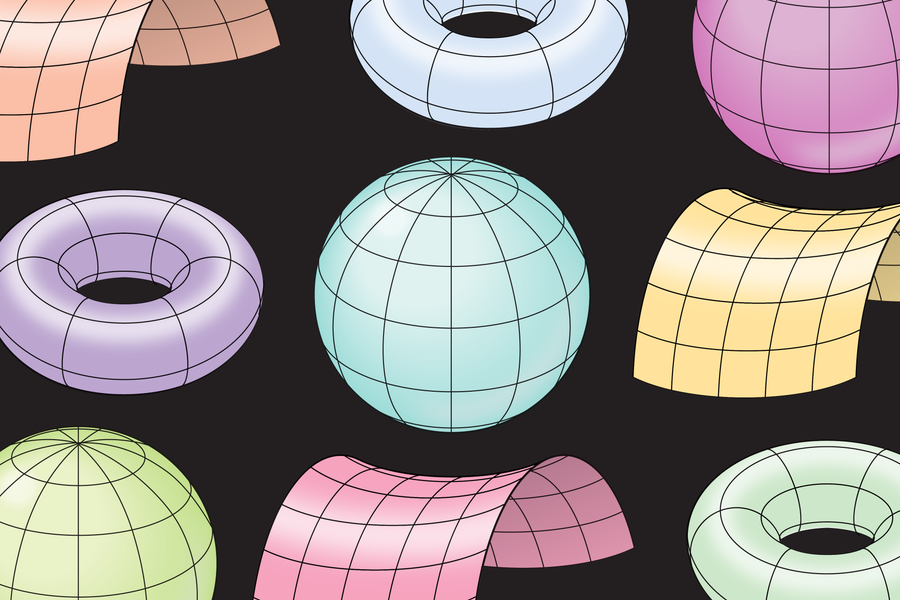
To determine the shape of the universe, astronomers and cosmologists have had to think critically about the geometry of flat and curved space—and then narrow down options based on measurements. Amanda Montañez
As 7.4 million Americans sit unemployed, the path to employment has completely changed. Amid fake listings, AI filtering of candidates, and widening talent pools, job seekers believe that they’re competing against a hiring ecosystem that penalizes honesty and rewards perception.
The result? A hiring environment where the signals employers have traditionally relied on to evaluate candidates have become deeply unreliable. Now, both sides are operating with diminishing trust in each other.
What’s Driving the Deception?
Hiring today is not facing a character problem, but a structural one. When candidates believe that presenting themselves accurately will cost them a job offer, the rational response is to become the person they think the employer is looking for. But when this approach becomes standard, those who still choose to tell the truth take on an “honesty tax,” the systemic disadvantage honest candidates face when exaggeration becomes the market norm.
GCheck’s Trust in Hiring Report revealed that 93% of job seekers have lied or embellished their experience during the hiring process, while 60% do not believe they would have been hired had they presented their qualifications more accurately. This is beyond a confession—it’s a market signal.
Part of what drives this dynamic is opacity on the employer side. When candidates do not know what will be verified, they assume the answer is minimal, and they calibrate their self-presentation accordingly. In fact, GCheck found that although 88% of job seekers believe misrepresentation puts businesses at risk, 53% assumed employers wouldn’t verify their claims, and only about a quarter (26%) report ever being caught lying or exaggerating.
Verification that is invisible to candidates is not a deterrent. It is permission. And thanks to artificial intelligence, candidates can disguise their true skills and identity almost instantaneously.
AI Accelerates Dishonesty in Hiring
LinkedIn’s 2025 Work Change Report estimates that 70% of the skills used in most jobs will change by 2030, driven largely by AI. When job seekers navigate a market where the definition of “qualified” is constantly shifting, the pressure to appear more capable than they are significantly intensifies. AI has not created that pressure, but it has handed candidates sophisticated tools to act on it at every stage of the hiring process.
Employer concerns have moved beyond job seekers’ using AI to compile resumes or assist with writing. Now, the degree to which AI has migrated into live interviews and assessments is worrisome.
GCheck found that 61% of candidates have used AI to rehearse interview answers until they sounded more impressive than authentic, and 25% reported deploying an AI avatar in place of their own face during a virtual interview.
The result is a hiring process where trust is eroding on both sides. On one hand, candidates feel pressure to optimize and automate their performance in a highly mediated, virtual environment; on the other, employers struggle to assess who is genuinely behind the screen. When interviews are increasingly remote, scripted, and technology driven, the lines between preparation and performance become blurred. This highlights how broken and transactional the modern hiring process has become.
There’s also an emerging phenomenon of systematic embellishment, distortion or fabrication of professional qualifications across resumes, interviews, and references as a deliberate competitive strategy driven by market pressure and weak verification expectations. It’s been dubbed “careerfishing,” and it’s no longer the behavior of a fringe group.
What Employers Must Do to Rebuild Trust
Rebuilding trust in hiring is not only a technology problem, but also a standards and transparency issue. Employers who treat verification as a confidential back-end process get exactly what opacity produces: candidates who assume they can game the system, largely because they can. Three leadership-level shifts matter most here:
Make verification standards visible. Communicate what will be checked before a candidate applies. Transparency disrupts embellishment at its source, not after the offer. The FTC’s guidance on employment background checks under the FCRA already mandates disclosure at specific stages. Moving that clarity upstream changes candidate behavior earlier in the process in measurable ways. For example, candidates who know credentials or work samples will be actually verified are less likely to exaggerate or rely on AI-generated materials they cannot defend later.
Make screening decisions reviewable by a person. Candidates who know a human will review findings, not only an algorithm, engage with the process more honestly.
Make verification proportionate to actual risk. Applying the same screening depth to every role signals to candidates that the process is performative. Calibrating scope to genuine role risk makes verification more credible, more defensible, and more likely to deter the embellishment it is meant to catch.
Ken Paxton’s victory in Texas on Tuesday transformed the deep red state into the nation’s newest political battleground, expanding the Senate map, previewing lines of attack from both parties, and offering a test of President Trump’s influence in the general election.
Democrats still face an uphill battle in their quest to turn Texas blue, even with the excitement surrounding their nominee, James Talarico, a state legislator and seminary student who is pitching a brand of inclusive politics.
But the ascension of Mr. Paxton, a scandal-plagued state attorney general who trounced Senator John Cornyn after receiving the “Complete and Total Endorsement” of President Trump last week, promised a general election clash as big as, well, Texas.
Expanding the map.
Many Democrats, and some Republicans, said that they thought the nomination of Mr. Paxton could put Texas into play for Democrats, joining the relatively small number of battleground states that could decide control of the Senate.
With the Republicans holding 53 seats in the Senate, Democrats will have to defend all the seats they currently hold and flip four more seats in order to win control in November. Party leaders initially focused on flipping Alaska, Maine, North Carolina, and Ohio. But with Mr. Trump’s approval rating sagging, some now see Texas as offering another possible path.
And, already, there are signs that the role Mr. Trump played in ousting another incumbent Republican senator — the president backed the challenger who defeated Senator Bill Cassidy of Louisiana this month in a primary — risks hampering his agenda on Capitol Hill.
Opening with attacks.
Both Mr. Paxton and Mr. Talarico framed the Texas race in existential terms on Tuesday night. Mr. Paxton cast Mr. Talarico as a “weird” liberal, while Mr. Talarico described Mr. Paxton as a tool of billionaire donors stealing public resources from regular working people.
“Without a shadow of a doubt, I will be the Democrats’ number one target in November,” Mr. Paxton told supporters at his victory night party.
Moments before Mr. Paxton took the stage in Plano, Texas, Mr. Talarico’s campaign released a video calling his opponent the “most corrupt politician in America.”
“For 50 years, megadonors and their puppet politicians like Ken Paxton have stolen from us with their bribes, bailouts, and billionaire tax breaks,” Mr. Talarico said. “That ends this year. In this state. In this race.”
Can Democrats finally put Texas in play?
No Democrat has won statewide in Texas since 1994. But many Democrats said that they believed the nomination of Mr. Paxton, with all his baggage, could offer them their best chance of victory in years.
While Mr. Trump’s late endorsement helped propel Mr. Paxton’s decisive victory in the low-turnout Republican primary, it is not clear how it will play in the general election, given the president’s low approval ratings, the unpopular Iran war and rising gas prices.
“Paxton doesn’t know how to broaden his appeal,” said Matt Mackowiak, a senior adviser to Mr. Cornyn. “He runs generals like they’re primaries. I don’t know that he’s run in an environment like this.”
Former Representative Beto O’Rourke, a Democrat who came within three points of knocking out Senator Ted Cruz in 2018, predicted Mr. Paxton’s appeal to Republican primary voters will not translate to the much broader electorate in November.
“He’s too extreme, and he’s too tied to Trump, whose popularity continues to decline,” Mr. O’Rourke said.
Bobby Pulido, a moderate Democrat and Latin Grammy Award-winning Tejano singer who is running for Congress in South Texas, said that he thought the race would be competitive. “The Rio Grande Valley has conservative voters that are not necessarily MAGA,” he said. “And Paxton is definitely a MAGA candidate.”
Mr. Talarico was quick to extend an invitation to Mr. Cornyn’s supporters on Tuesday night, thanking the senator for his service to the state and telling his backers in a social media post that they have “a place” in his campaign.
A record-setting race is about to get more expensive.
After waging the most expensive Senate primary campaign in the country’s recent history — with $128 million worth of ads run in the Republican contest — both sides are preparing for a general
election contest that strategists estimate could cost tens of millions of dollars more.
Mr. Talarico has proved himself to be a prodigious fund-raiser, raising about $40.2 million from September through the end of March. Mr. Paxton, who is polarizing even among Texas Republicans, has struggled to meet his own financial goals for the primary race. He fell far short of the $20 million he previously suggested he would need to unseat Mr. Cornyn.
But even as he was heavily outspent, Mr. Paxton was able to cruise to victory in the primary.
Some Republicans supporting Mr. Cornyn had warned that nominating Mr. Paxton would require the party to spend millions more to defend a seat they had previously seen as safe, diverting money from other competitive races around the country.
.
Ken Paxton defeated Senator John Cornyn in a runoff for the Republican nomination on Tuesday, setting up a marquee race against James Talarico, the Democrat. Credit…Desiree Rios for The New York Times
In the world, human beings are facing various problems. People who are full of greed, anger, and ignorance are seen to be fighting with each other in words and deeds. As the fighting continues, various problems such as civil wars, wars of aggression, and wars of aggression are occurring. As world peace is being destroyed, humans are facing unbearable problems. Innocent children and women are not getting the rights they deserve and deserve. I can't think of one thing every time. What is it? The United Nations. If we look at the responsibilities and duties of the United Nations, I think it is not suitable for solving the problems that are happening in the world today. In fact, the United Nations and the World Security Council, such an organization must rule the world, must be able to give orders, and must have various ways to obey orders. There must be no organization that can influence more than that organization. There should be experts from each country. They can even dominate the superpowers like the US, China, and Britain. Only then will global peace be achieved quickly. Now, if a country with power develops more militarily, economically, or socially than its own country, then powerful countries will jealously seek out enemies and wage war. Or they will attack with fighter jets. In this, innocent people are losing their lives. No one understands the value of a life. You should think about how to achieve global peace by controlling these. If the US continues to be the permanent president of the UN, world peace will never be achieved. If you think carefully, no one sees that they are working for the common good, but for their own benefit, for the benefit of their own country. The permanent president of the UN and the Security Council has rejected this, As a young Rohingya, I have come to realize that only by electing the president and secretary from among the countries in the world through a secret ballot system and governing the world fairly can we achieve global peace. The United Nations and the Security Council are organizations in which any country must govern, give orders, and make them obey their orders. For example, only when a defendant is tried in court can we hold the leaders of the countries in check and control them, can we achieve global peace smoothly. Otherwise, it will not be easy for powerful countries to use various excuses to end this war every year, every year, for the benefit of themselves and their countries. No country's leaders pay any attention to the words of the United Nations and the Security Council. If we look at it in practice, look at the Rohingya issue. Myanmar is a small country. Even that country has been under siege for 8 years. What action can be taken? Why is the UN and the Security Council Powerless? Without such Power, how can the organization bring about global peace? Everyone should think about it. Whether there is a veto or a strong one, all countries in the world can only achieve global peace if they are subject to the UN and the Security Council. Seek peace in the quiet embrace of nature. Peace is an indispensable need of the human race. It is not as if one person can kill another person, and it is as if one country can attack another country, but instead of trying to build peace, we must try to destroy the peace now, and the world is getting hotter and is on the verge of collapse. I especially appeal to all the world experts to urgently try to bring about peace in all parts of the world. Mr, Noor Muhamed Arkhan Rohingya Youth Myanmar
Film and Writing Festival for Comedy. Showcasing best of comedy short films at the FEEDBACK Film Festival. Plus, showcasing best of comedy novels, short stories, poems, screenplays (TV, short, feature) at the festival performed by professional actors.

 LAS VEGAS, NEVADA – MAY 25: EDITORIAL USE ONLY (L-R) Kaavia James Union Wade, Eboni Nichols, Rebel Nichols Owens and Queen Latifah attend the 52nd American Music Awards at MGM Grand Garden Arena on May 25, 2026 in Las Vegas, Nevada. (Photo by Axelle/Bauer-Griffin/FilmMagic)




 [Images: Adobe Stock]


