I was told the monkeys would be here, although nothing about this spot seemed particularly suitable for wildlife. On a stifling morning in late July, I stood in a large parking lot near Fort Lauderdale-Hollywood International Airport, about 40 miles north of Miami. Cars drove in and out. Planes passed low overhead. It reeked of gasoline.
The only visible natural habitat was a sliver of forest, just a few hundred feet wide, wedged between the paved lot, a field of oil tanks, and a highway. I couldn’t find monkeys in the lot, so I tried my luck in the forest.
It turned out to be more of a swamp. With each step, thick mud crept past my ankles, making it difficult to move. A thorny underbrush etched puffy red lines into my bare legs.
Half an hour in, when I was about to turn back in pursuit of air conditioning and a fresh pair of socks, I heard a rustling overhead. I froze in place and looked up. There, through the branches, I saw the unmistakable face of a monkey.
To see exotic animals in Florida, one could visit Disney’s Animal Kingdom, Busch Gardens, or Zoo Miami. Or they could just step outside.
The Sunshine State is utterly brimming with nonnative species. More than 500 of them have been reported here, which is more than in any other state, and many of them are considered “invasive,” meaning they harm humans or ecosystems. For most of their evolutionary history, these species have never set foot in Florida — they’ve never been near a Publix, or Magic Kingdom, for that matter.
In the last few decades, Florida has become an unmanaged zoo, an uncontrolled experiment. And each year, the decision of what to do with it gets harder.
.
A veiled chameleon in a patch of trees near a canal east of Fort Myers.Benji Jones
FEBRUARY 6, 2023, BY CONTRIBUTED BY: EUELL A. NIELSEN Emilia Strong Sykes is a Democratic politician now serving as the U.S. Representative for Ohio’s 13th Congressional District. She was sworn into that post on January 3, 2023. Sykes was born on January 4, 1986, in Akron, Ohio, and grew up on the city’s west side. Her father, […]
Singapore’s prime minister has described climate change as “life and death.” He has reason to worry: Stifling temperatures and humidity already last all year, and the city-state has warmed at twice the global average over the past six decades.
Heat like this isn’t just uncomfortable. It can cause chronic illness and death, including heat exhaustion, kidney damage, and even heart attacks. With two-thirds of the global population expected to live in urban areas by 2050, urban heat is an enormous global health challenge.
Rapid urbanization has made Singapore hotter. A big part of the problem is how almost every global city is built.
Preventing climate change is out of Singapore’s control: The city-state emits less than 0.1% of global carbon emissions. But there is a surefire way to limit city temperatures, researchers say: Revive the natural processes that cooled the land before urbanization.
Most cities do not have Singapore’s wealth and centralized political system, which allow it to move quickly to build new infrastructure. But while some of Singapore’s strategies to reduce excess heat are expensive, many of them are straightforward, and cheaper than planning for, say, floods or hurricanes.
As temperature records were shattered around the world this summer, Singapore’s blueprint for slowing the urban impacts of extreme heat is gaining urgency.
.
Singapore is rethinking its sweltering urban areas to dampen the effects of climate change. Can it be a model?
In the film “2001: A Space Odyssey,” an astronaut travels through a seeming tunnel of light. (In the novelization, he radios to mission control: “The thing’s hollow—it goes on forever—and—oh my God!—it’s full of stars!”) Earlier this summer, Artechouse, an organization producing immersive, technology-based art, started offering a science-backed version of a similar trip at its New York venue. The show, titled “Beyond the Light,” is a looping twenty-six-minute journey through space and other realms inspired by images from the James Webb Space Telescope (J.W.S.T.). Artechouse began talks with NASA about a show in 2018, and started pulling this one together earlier this year, after the first images captured by J.W.S.T. were released to the public last July.
There’s a long tradition of art about the stars. More than sixteen thousand years ago, cave explorers in what’s now Lascaux, France, painted animals that are believed to represent the constellations. A few hundred miles away and many centuries later—near Saint-Rémy-de-Provence, in 1889—Vincent van Gogh made “The Starry Night,” a swirling blur of color looming over a village. “I’m sure people have been painting the heavens for as long as they’ve been looking at them,” Maggie Masetti, the NASA social-media lead for the J.W.S.T. mission, told me. “Beyond the Light” is high-tech—video is projected on three walls and the floor of a vast room, while a powerful sound system thrums—but it’s also connected to traditional astro-art in the way it’s largely abstract and impressionistic (sometimes even Cubist). Although the show makes use of images taken by the Webb telescope, it is mostly imaginative. Splashes of color, bubbles, tubes, machinery, and glowing rocks covered with runes flow across the room in response to what the telescope has found.
When the show premièred, in June—its D.C. première is this Friday—a number of researchers involved with the J.W.S.T. were in attendance, among them Stefanie Milam, a NASA astrochemist; Macarena García Marín, an astrophysicist at the European Space Agency; and Mike Menzel, NASA’s mission-systems engineer for the Webb. They stood talking with Sandro Kereselidze, one of Artechouse’s founders. “It’s absolutely fantastic and beautiful,” Milam said. “We already tried to do our own art,” she went on—scientists producing images with the Webb had used “different components of the instruments, different wavelengths, or different filters, to really tell the story about a given image, because we want you to see the baby stars being formed in a giant cloud, or to see the Great Red Spot on Jupiter in multiple colors, or other storms in planetary atmospheres.” But now artists were telling other kinds of stories using the images. “What we do is sort of amateur art,” Milam said.
“We designed the telescope to wow the scientists,” Menzel agreed. Now, he said, “We’re here in an art show, watching some images that we helped produce becoming things that are almost iconic.”
Kereselidze saw similarities between the artists he worked with at Artechouse and the scientists. “We speak the same language,” he said. “We have the passion for expressing what we discovered.” There were some small science exhibits on a mezzanine, but the venue wasn’t trying to be a science museum. Instead, Kereselidze said, “The goal is to open up curious minds. If everything is, like, ‘A, B, C, D,’ it becomes like PowerPoint, right?”
We’ve all heard of the five tastes our tongues can detect—sweet, sour, bitter, savory-umami, and salty. But the real number is actually six, because we have two separate salt-taste systems. One of them detects the attractive, relatively low levels of salt that make potato chips taste delicious. The other one registers high levels of salt—enough to make overly salted food offensive and deter overconsumption.
Exactly how our taste buds sense the two kinds of saltiness is a mystery that’s taken some 40 years of scientific inquiry to unravel, and researchers haven’t solved all the details yet. In fact, the more they look at salt sensation, the weirder it gets.
Many other details of taste have been worked out over the past 25 years. For sweet, bitter, and umami, it’s known that molecular receptors on certain taste bud cells recognize the food molecules and, when activated, kick off a series of events that ultimately sends signals to the brain.
Sour is slightly different: It is detected by taste bud cells that respond to acidity, researchers recently learned.
In the case of salt, scientists understand many details about the low-salt receptor, but a complete description of the high-salt receptor has lagged, as has an understanding of which
taste bud cells host each detector.
“There are a lot of gaps still in our knowledge—especially salt taste. I would call it one of the biggest gaps,” says Maik Behrens, a taste researcher at the Leibniz Institute for Food Systems Biology in Freising, Germany. “There are always missing pieces in the puzzle.”
A fine balance
Our dual perception of saltiness helps us to walk a tightrope between the two faces of sodium, an element that’s crucial for the function of muscles and nerves but dangerous in high quantities. To tightly control salt levels, the body manages the amount of sodium it lets out in urine, and controls how much comes in through the mouth.
.
Too much sodium is bad, but so is too little—no wonder the body has two sensing mechanisms.
Mucus is not widely considered a topic for polite conversation. It’s something to be discreetly blown into a tissue, folded up, and thrown away.
But the simple truth is that without mucus, you wouldn’t be alive.
“Mucus is essential for the protection of your body,” says Jeffrey Spiegel, an ear, nose, and throat surgeon at Boston University. “It’s a protective barrier, and it allows you to breathe comfortably. If you had no mucus, you’d be quite sorry you didn’t.”
Given how important mucus is — and how often colds and allergies cause mucus-related symptoms — it’s worth learning a bit more about it.
1) You produce about 1.5 quarts of mucus a day — and swallow the vast majority
Most of us think of mucus as something that leaks from our nose, but the truth is that it also gets secreted in your trachea and other tubes that carry air through your lungs, where it’s technically called phlegm. Wherever it’s produced, mucus is a mix of water and proteins, and most of it gets pushed to the back of your throat by microscopic hairs called cilia.
FEBRUARY 7, 2023, BY CONTRIBUTED BY: SETH WEISBERG Raphael Bostic is the chief executive officer of the Federal Reserve Bank of Atlanta. In addition, he serves on the Federal Open Market Committee, The Federal Reserve’s chief monetary policy body. Bostic was born June 5, 1966, to Rafael Theodore Bostic of St. Croix and Viola Williams, a native […]
To fully appreciate the modern-day marvel that is the National Weather Service, it’s useful to start with numbers. There’s 6.3 billion. (The number of observations the agency collects and analyzes every day.) There’s 1.5 million. (The number of forecasts it issues each year.) There’s 184 and 100,000. (The number of weather balloons NWS releases every day, including on weekends and holidays, and the number of feet said balloons can rise into the atmosphere.) And there’s 90 percent. (The average accuracy of a five-day forecast.)
There’s also zero. That’s the approximate number of minutes a typical American like you or me spends wondering about the weather information we access every single day via print newspapers or public radio stations or the hour-by-hour forecasts delivered courtesy of the phones we carry. The ubiquitousness of those updates, the fact that we don’t consider them at all, is a testament to just how much modern meteorology has spoiled us and—probably more than anything else—a tribute to the National Weather Service’s success.
This blasé attitude would have astounded the colonists who arrived in the New World from Europe during the seventeenth century and found North American weather to be, in a word, hellish. They sent letters home describing the climate in apocalyptic terms. When it rained, wrote one colonist in New Sweden, on the Delaware River, “the whole sky seems to be on fire, and nothing can be seen but smoke and flames.” “Intemperate” was how a missionary from Rhode Island described it. “Excessive heat and cold, sudden violent changes of weather, terrible and mischievous thunder and lightning, and unwholesome air” created an environment that was “destructive to human bodies.”
The harshness of the weather—with its extreme seasons and severe storms—wasn’t just an unpleasant surprise. It was also confusing. Among the various, sketchy assumptions that the Europeans had brought with them to their new home was the idea that a location’s climate was directly correlated to its latitude. By the colonists’ logic, the seasons in Newfoundland should resemble those in Paris, and crops grown in Spain should thrive in Virginia. Instead, the olive trees imported from the Mediterranean died in the frozen ground during the mid-Atlantic winters, and the beer went sour in the summer heat. American settlers could have consulted with the resident experts—the Native Americans, who had lived in the eastern part of the continent for thousands of years and knew more about the local climate than anyone else. But they generally didn’t. (“Descriptions of local indigenous knowledge in early colonial narratives,” the historian Sam White noted in his book A Cold Welcome, “are mostly conspicuous by their absence.”)
.
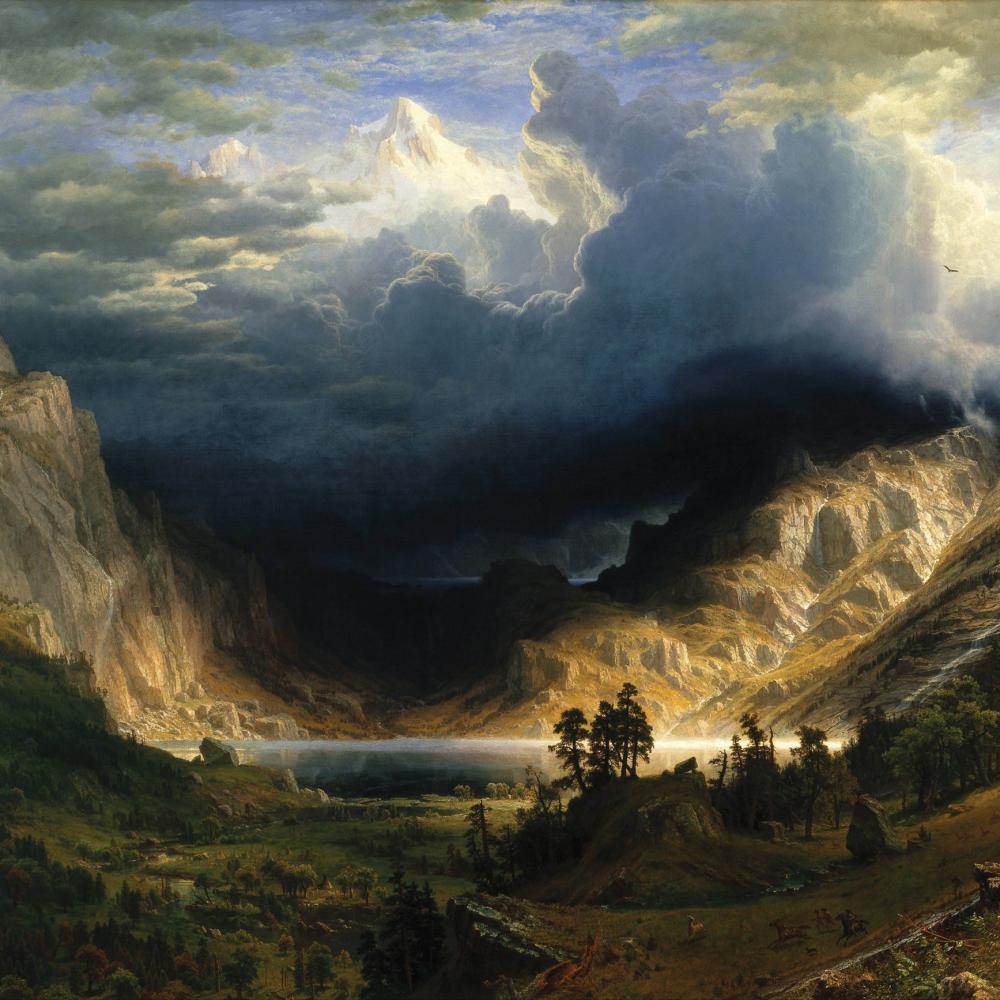
The exact mechanism by which storms formed was once a subject of fierce debate among American scientists. ―Albert Bierstadt, A Storm in the Rocky Mountains, Mt. Rosalie. detail (1866), Wikimedia
On an anonymous desk in a spartan classroom of the pioneering Troy Female Seminary, a teenage girl with blue-grey eyes and an oceanic mind is bent over an astronomy book, preparing to revolutionize our understanding of the planet.
The year is 1836.
No university anywhere in the world would admit her.
No scientific society would grant her membership.
Still, Eunice Newton Foote (July 17, 1819–September 30, 1888) would go on to become the first scientist to link atmospheric carbon dioxide levels to rising planetary temperature.
One August day half a lifetime after graduating from Troy and throwing her energies at the suffrage movement — Susan B. Anthony would celebrate her as one of its founders — Eunice folded her hands into her lap in an auditorium full of distinguished scientists and their dressed up wives as she waited to watch someone else present her own work. A decade earlier, astronomer Maria Mitchell had become the first woman admitted into America’s scientific pantheon, the American Association for the Advancement of Science — but on the default certificate of admission, the word Fellow had been crossed out in pencil and Honorary Member handwritten over it. Women were still in the shadows of science. Like Beatrix Potter’s revelatory research into the reproduction of algae, Eunice Foote’s paper was read on her behalf by a man: the secretary of the Smithsonian Institution.
That paper — Circumstances Affecting the Heat of the Sun’s Rays, published in 1856 — would remain the only physics paper published by an American woman for three decades, until a year after Eunice’s death.
FEBRUARY 7, 2023, BY CONTRIBUTED BY: MANOS KAROUSOS Charles Howard Wright was a Detroit physician and founder of the Charles H. Wright Museum of African American History. He was born on September 18, 1918, in Dothan, Alabama and attended the State Teachers College (later known as Alabama State College, and now Alabama State University), and then Meharry Medical University, […]
In the world, human beings are facing various problems. People who are full of greed, anger, and ignorance are seen to be fighting with each other in words and deeds. As the fighting continues, various problems such as civil wars, wars of aggression, and wars of aggression are occurring. As world peace is being destroyed, humans are facing unbearable problems. Innocent children and women are not getting the rights they deserve and deserve. I can't think of one thing every time. What is it? The United Nations. If we look at the responsibilities and duties of the United Nations, I think it is not suitable for solving the problems that are happening in the world today. In fact, the United Nations and the World Security Council, such an organization must rule the world, must be able to give orders, and must have various ways to obey orders. There must be no organization that can influence more than that organization. There should be experts from each country. They can even dominate the superpowers like the US, China, and Britain. Only then will global peace be achieved quickly. Now, if a country with power develops more militarily, economically, or socially than its own country, then powerful countries will jealously seek out enemies and wage war. Or they will attack with fighter jets. In this, innocent people are losing their lives. No one understands the value of a life. You should think about how to achieve global peace by controlling these. If the US continues to be the permanent president of the UN, world peace will never be achieved. If you think carefully, no one sees that they are working for the common good, but for their own benefit, for the benefit of their own country. The permanent president of the UN and the Security Council has rejected this, As a young Rohingya, I have come to realize that only by electing the president and secretary from among the countries in the world through a secret ballot system and governing the world fairly can we achieve global peace. The United Nations and the Security Council are organizations in which any country must govern, give orders, and make them obey their orders. For example, only when a defendant is tried in court can we hold the leaders of the countries in check and control them, can we achieve global peace smoothly. Otherwise, it will not be easy for powerful countries to use various excuses to end this war every year, every year, for the benefit of themselves and their countries. No country's leaders pay any attention to the words of the United Nations and the Security Council. If we look at it in practice, look at the Rohingya issue. Myanmar is a small country. Even that country has been under siege for 8 years. What action can be taken? Why is the UN and the Security Council Powerless? Without such Power, how can the organization bring about global peace? Everyone should think about it. Whether there is a veto or a strong one, all countries in the world can only achieve global peace if they are subject to the UN and the Security Council. Seek peace in the quiet embrace of nature. Peace is an indispensable need of the human race. It is not as if one person can kill another person, and it is as if one country can attack another country, but instead of trying to build peace, we must try to destroy the peace now, and the world is getting hotter and is on the verge of collapse. I especially appeal to all the world experts to urgently try to bring about peace in all parts of the world. Mr, Noor Muhamed Arkhan Rohingya Youth Myanmar
Film and Writing Festival for Comedy. Showcasing best of comedy short films at the FEEDBACK Film Festival. Plus, showcasing best of comedy novels, short stories, poems, screenplays (TV, short, feature) at the festival performed by professional actors.

:format(webp)/cdn.vox-cdn.com/uploads/chorus_image/image/72659918/lede_Benji.0.jpg)


 Singapore is rethinking its sweltering urban areas to dampen the effects of climate change. Can it be a model?


 Too much sodium is bad, but so is too little—no wonder the body has two sensing mechanisms.


 The Marginalian
