Mocktails and sunscreen, masking and mindfulness — for those of us who strive to be upright, responsible citizens, the constant reminders of various ways we ought to be good are all around us. They’re almost enough to make you forget the pleasures of being a little bit bad. We asked 16 writers — most of them respectable adults — about the irresponsible, immoral, indulgent things they do. Transgression has the power to teach us something about how we ought to live. But it’s also just … fun?
I’m not a drunk. And I’m not a liar. But I am, unequivocally, a drunk liar. After a few tequila shots and an audience of strangers (usually men), I’ve become: a Harvard graduate (summa cum laude), an up-and-coming model, an athlete, a virgin, a Kennedy. It’s adult make-believe. It’s free entertainment. There is something irresistible about telling a big, wet, flapping, booze-induced lie to people (men) that you almost certainly will never see again. Almost. When I was 19, I convinced a man I was British and kept the lie going for three dates. Years later, we bumped into each other in public, in my pitiful American form, resulting in a humiliating exposition that left everyone questioning my sanity. But who, ultimately, is the real idiot here?
In recent years, the word “storytelling” has been thoroughly absorbed by the language of commerce, reshaped into self-aggrandizing doublespeak for “selling.” Which only increases the countervailing need for storytellers in the more artful, ancient, and magical mold of Neil Gaiman, who conjures fictions that stir up our primal fears and darkest desires, our subconscious yearnings and unspoken fantasies. Whether he’s turning death and dream into flesh-and-blood characters, as in his classic comic series, “The Sandman”; populating the modern world with figures from ancient myth in fiction best sellers like “American Gods” and “Anansi Boys”; or conjuring eerie new children’s fairy tales and ghost yarns (“Stardust,” “Coraline”), the British-born author’s genre-jumping writing is a constant reminder that the stories that linger longest, that move us most profoundly, are often the ones that can’t be turned into means but function as ends in themselves. “Myths and stories are how we have made sense of the world for as long as we’ve been wandering the planet,” says Gaiman, 61, who helped oversee Netflix’s long-awaited “The Sandman” series, which premieres on Aug. 5. “And right now, making sense of the world is somewhere between difficult and impossible.”
For the last five or six years, we’ve been living through what feels like almost unfathomable turmoil, and I think a lot of people see this period as an unprecedented chapter in the human story. But when it comes to stories, I basically believe in Ecclesiastes’ “There is nothing new under the sun.” So my question to you is whether you think we are living in a new story — or is it just new to us? This reminds me of something that happened after the Sept. 11 attacks. When we could fly again, I flew to Trieste, Italy, for a conference. I remember going into a display of Robert Capa photographs taken in that area during World War II. Until that moment, I had regarded World War II as being unimaginably distant in time. It was this thing that had happened in history, that had happened to my family — basically all of them were killed; a couple of outliers made it to England — but that was history. That happened then. But there was something very strange about looking at those Robert Capa photos post-9/11 because they made me go, Those people are us. I feel the same way today. History is now. But I’m also getting more obsessive about human beings over huge swaths of time. Part of that came out of being on the Isle of Skye during the serious U.K. lockdown. On Skye, if there’s a rock somewhere, it’s probably because somebody put it there. I realized that the rock that I was using to keep the lid on my dustbin was a stone that had been dragged around. People have been in this place for thousands and thousands of years, and in this bay, I’m living in, they’ve left behind rocks! Realizing that about the rocks makes you take the long view. Which is that the human race is mostly people just trying to live their lives, and that bad [expletive] is going to happen. That then moves you into other territory.
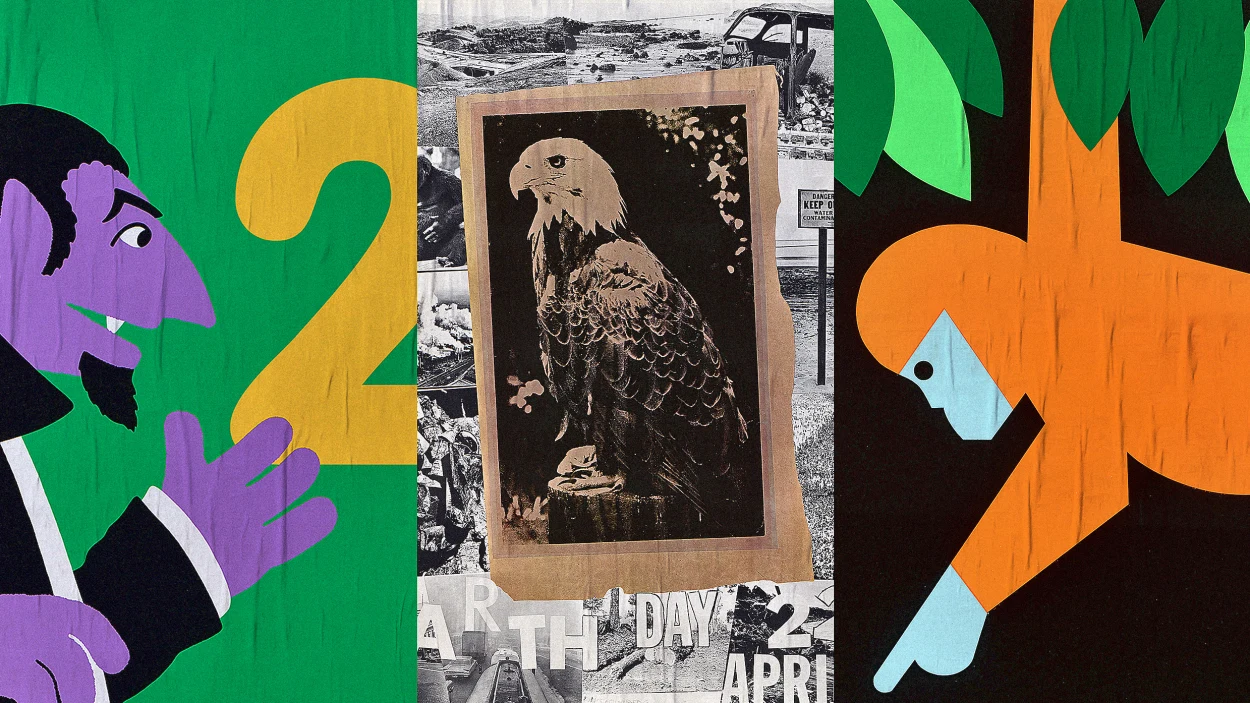
Can a poster save the burning planet? Amid the polemics, politics, and the deluge of climate change data, can a remarkable piece of visual art break through the noise and inspire action?
An illuminating exhibition at New York City’s Poster House offers a nuanced, if inconclusive, exploration about the utility (or futility) of printed propaganda in tackling the worsening environmental crisis. “Every poster in this exhibition is a failure—not in the sense that they failed in their graphic intent of communicating a message, but rather that they failed to successfully modify behavior,” writes curator Tim Medland to introduce We Tried to Warn You! Environmental Crisis Posters, 1970–2020 (on view until Feb. 25, 2024). “Nevertheless, these impactful images have shaped the bounds of public debate on environmental issues, drawing attention to distinct and particular concerns.”
A graphic history of activism
Curiously, the most influential “climate poster” in history isn’t a poster at all, but a photograph. Taken aboard Apollo 8 by NASA astronaut Bill Anders in 1968, the first color image of Earth showed the fragility and a beautiful blue planet in deep space. “Earthrise,” as the photo is known, sparked environmental movements and became a recurring motif in environmental posters, including two in the exhibition: Milton Glaser’s “Give Earth A Chance” (1970) Environmental Action Coalition and Gunter Rambow’s “All the Earth Speaks Up” (1983) created for Germany’s Green Party. (NASA has since released several versions of “Earthrise” over the years.)
Before we glimpsed a snapshot of our profound interconnectedness, conservation efforts were localized; tactical rather than existential. Prior to 1968, posters about the natural world took the form of travel vignettes, such as M. Pallandre’s romanticized 1890s rendering of the thermal baths of the Pyrenees, or charming silk screened preserve-our-forest appeals created during the US Works Progress Administration in the 1930s. And in the 1940s and 1950s, the U.S. Forest Service disseminated many posters featuring Smokey Bear, America’s most enduring wildfire prevention poster child, a bear.
We all know the line: For more than 150 million years, dinosaurs ruled the Earth. We imagine bloodthirsty tyrannosaurs ripping into screaming duckbills, gigantic sauropods shaking the ground with their thunderous footfalls, and spiky stegosaurs swinging their tails in a reign of reptiles so magnificent, it took the unexpected strike of a six-mile-wide asteroid to end it. The ensuing catastrophe handed the world to the mammals, our ancestors, and relatives so that 66 million years later we can claim to have taken over what the terrible lizards left behind. It’s a dramatic retelling of history that is fundamentally wrong on several counts. Let’s talk about some of the worst rumors and what really happened in the so-called “Age of Dinosaurs.”
The oldest dinosaurs we know about are around 235 million years old, from the middle part of the Triassic Period. Those reptiles didn’t rule anything. From recent finds in Africa, South America, and Europe, we know that they were no bigger than a medium-sized dog and were lanky, omnivorous creatures that munched on leaves and beetles. Ancient relatives of crocodiles, by contrast, were much more abundant and diverse. Among the Triassic crocodile cousins were sharp-toothed carnivores that chased after large prey on two legs, “armadillodiles” covered in bony scutes and spikes, and beaked, almost ostrich-like creatures that gobbled up ferns.
Even as early dinosaurs began to evolve into the main lineages that would thrive during the rest of the Mesozoic, most were small and rare compared to the crocodile cousins. The first big herbivorous dinosaurs, which reached about 27 feet in length, didn’t evolve until near the end of the Triassic, around 214 million years ago. But everything changed at the end of the Triassic. Intense volcanic eruptions in the middle of Pangaea altered the global climate; the gases released into the air caused the world to swing between hot and cold phases. By then, dinosaurs had evolved warm-blooded metabolisms and insulating coats of feathers, leaving them relatively unfazed through the crisis, while many other forms of reptiles perished. Had this mass extinction not transpired, we might have had more of an “Age of Crocodiles”—or at least a very different history with a much broader cast of reptilian characters. The only reason the so-called Age of Dinosaurs came to be is because they got lucky in the face of global extinction.
It’s strange to talk about dinosaurs “dominating” an ocean world. While sea levels have risen and fallen over time, the seas make up about 71 percent of Earth’s surface and contain more than 330 million cubic miles of water. The claim that dinosaurs, as diverse as they were, were the dominant form of life on Earth only makes sense if we ignore that three-quarters of our planet is ocean.
.
(Clockwise from top) A T. rex model, T. rex skull, and Triceratops skull on display at the Museum of Natural History in Vienna, Austria. DepositPhotos
It didn’t take long for Mario Zechner to prove the government wrong. In May, the independent software developer was listening to a radio interview with Austria’s labor minister, Martin Kocher, who said the government would build a new database that will help people find the cheapest milk, eggs, and other supermarket products to help fight soaring food prices. However, the planned system would take months to build and cover only a handful of food types. Zechner decided to take action.
Two hours after hearing the interview, Zechner had built the first prototype of a comparison system, pulling the cost of 22,000 items from the websites of Austria’s biggest two supermarket chains. “I decided to just sit down in the afternoon and see how hard it really can be,” Zechner says. The result was Heisse Preise (which translates as “Hot Prices”), with Zechner open-sourcing the project on GitHub. “From then on, it kind of escalated,” he says.
Months later, Heisse Preise has grown enormously, demonstrating the power of citizen-developed tools and what can be achieved when data is opened up to everyone. The comparison site now lists prices from 10 Austrian supermarket chains, plus four in neighboring Germany and Slovenia. Heisse Preise includes more than 177,000 items. Thanks to data provided by an anonymous contributor and local press, item pricing history goes back to 2017. Zechner’s creation of the tool came as Europe’s food retailers and governments have clashed over rising prices and the cost of living.
Perhaps most significantly, Zechner’s tool has shone a light on the opaque world of price changes by supermarkets, allowing price increases and decreases to be tracked. The transparency, Zechner and others say, shows there can be little difference in prices at some major supermarkets, and within days of an item changing price, competitors can mirror the change.
Data gathered by Heisse Preise and other newly-emerged DIY comparison sites has fed into the investigations of Bundeswettbewerbsbehörde, the Austrian Federal Competition Authority, which has been probing the food industry since October 2022. The authority, which is due to present its full findings later this month, has already suggested the government should introduce new laws to make shops publish their price data. The authority also says it “can be assumed” that supermarkets themselves crawl the websites of competitors and use that information to set their own prices.
“This data is enormously useful for anyone interested in serious competition policies,” says Leonhard Dobusch, the academic director at the Momentum Institute, an Austrian progressive think tank. “It really allows a peek into pricing strategies [and] price coordination tactics.”
“A little girl was holding two apples with both hands.Her mum asked her with a smile, “My sweetie, could I have one of your apples?” The girl looked up at her mum for some seconds, then she suddenly took a quick bite of one apple, and then quickly of the other.The mum felt the smile […]
Making a woman cry through your words or actions doesn’t make you a man. Cheating on your woman doesn’t make you a man. Breaking a woman’s heart doesn’t make you a man. Lifting your hand to a woman doesn’t make you a man. Breaking a woman down does not make you a man. This makes […]
In the world, human beings are facing various problems. People who are full of greed, anger, and ignorance are seen to be fighting with each other in words and deeds. As the fighting continues, various problems such as civil wars, wars of aggression, and wars of aggression are occurring. As world peace is being destroyed, humans are facing unbearable problems. Innocent children and women are not getting the rights they deserve and deserve. I can't think of one thing every time. What is it? The United Nations. If we look at the responsibilities and duties of the United Nations, I think it is not suitable for solving the problems that are happening in the world today. In fact, the United Nations and the World Security Council, such an organization must rule the world, must be able to give orders, and must have various ways to obey orders. There must be no organization that can influence more than that organization. There should be experts from each country. They can even dominate the superpowers like the US, China, and Britain. Only then will global peace be achieved quickly. Now, if a country with power develops more militarily, economically, or socially than its own country, then powerful countries will jealously seek out enemies and wage war. Or they will attack with fighter jets. In this, innocent people are losing their lives. No one understands the value of a life. You should think about how to achieve global peace by controlling these. If the US continues to be the permanent president of the UN, world peace will never be achieved. If you think carefully, no one sees that they are working for the common good, but for their own benefit, for the benefit of their own country. The permanent president of the UN and the Security Council has rejected this, As a young Rohingya, I have come to realize that only by electing the president and secretary from among the countries in the world through a secret ballot system and governing the world fairly can we achieve global peace. The United Nations and the Security Council are organizations in which any country must govern, give orders, and make them obey their orders. For example, only when a defendant is tried in court can we hold the leaders of the countries in check and control them, can we achieve global peace smoothly. Otherwise, it will not be easy for powerful countries to use various excuses to end this war every year, every year, for the benefit of themselves and their countries. No country's leaders pay any attention to the words of the United Nations and the Security Council. If we look at it in practice, look at the Rohingya issue. Myanmar is a small country. Even that country has been under siege for 8 years. What action can be taken? Why is the UN and the Security Council Powerless? Without such Power, how can the organization bring about global peace? Everyone should think about it. Whether there is a veto or a strong one, all countries in the world can only achieve global peace if they are subject to the UN and the Security Council. Seek peace in the quiet embrace of nature. Peace is an indispensable need of the human race. It is not as if one person can kill another person, and it is as if one country can attack another country, but instead of trying to build peace, we must try to destroy the peace now, and the world is getting hotter and is on the verge of collapse. I especially appeal to all the world experts to urgently try to bring about peace in all parts of the world. Mr, Noor Muhamed Arkhan Rohingya Youth Myanmar
Film and Writing Festival for Comedy. Showcasing best of comedy short films at the FEEDBACK Film Festival. Plus, showcasing best of comedy novels, short stories, poems, screenplays (TV, short, feature) at the festival performed by professional actors.

 Being Bad




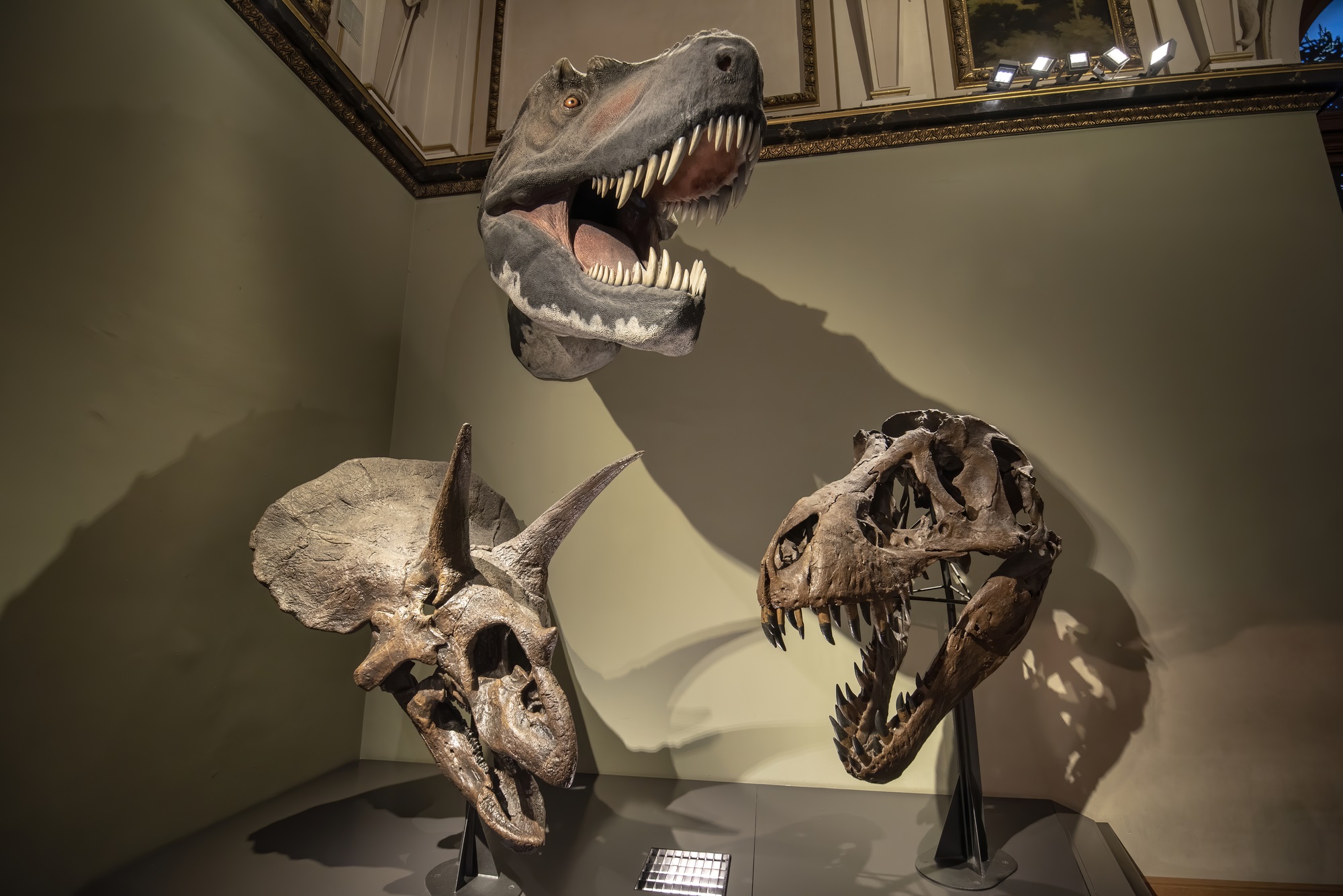 (Clockwise from top) A T. rex model, T. rex skull, and Triceratops skull on display at the Museum of Natural History in Vienna, Austria.
 Photograph: Tanja Ivanua/ Getty Images


