Home

MAGA, the Broligarchs and the Media

Leave a comment

From

Paul Krugman

Click the link below the picture

.

Warner Bros. Discovery, which among other things controls CNN, has agreed to sell itself to Netflix. But it isn’t a done deal, because Paramount has made a rival, hostile bid.

Now, most Americans, even those like me who pay a lot of attention to the economy, don’t usually take much interest in insider baseball about corporate wheeling and dealing. But this is a bigger story than usual, for three reasons.

First, there’s an antitrust issue. In an earlier era, when the U.S. government took monopoly power seriously, both proposed acquisitions would probably have been blocked by regulators.

Second, there’s a financial issue. On its own, there is no way that Paramount, which is deeply in debt and whose credit rating is “a notch below ‘junk’” could afford to buy Warner. It’s able to make a semi-credible bid only because of assurances of support from Larry Ellison, one of the world’s richest men thanks to his stake in the software giant Oracle. But when analysts look closely at the details, they find that Ellison’s promises of support are more than a bit squirrely:

[T]he Warner Bros. Discovery board worried that Mr. Ellison did not personally guarantee the bid under his name and is planning to contribute equity for the deal through a trust with holdings that could be modified at any time.

Adding to the risk of Oracle’s deal is the fact that Oracle is itself shaky according to the estimation of gimlet-eyed financial markets due to its huge, debt-financed bets on AI.

As Bloomberg reports, its investment grade debt now “trades like junk.”

But it’s not just about the money. For the average American, there is something fundamentally important about this corporate cage-match to win Warner Bros. Discovery. And it’s not about entertainment, it’s about democracy. You should understand that Paramount’s hostile bid is, above all, a political move in the pursuit of cementing the dominance of MAGA-supporting tech billionaires and further eroding American democracy.

Back in 2018, during Trump I, the political scientists Steven Levitsky and Daniel Ziblatt published How Democracies Die, which described how nations like Hungary had descended into one-party authoritarianism although the formal, but now toothless, institutions of democracy remain. In the latest edition of Foreign Affairs Levitsky, Ziblatt and Lucan Way say that this process is already well underway here in the U.S.:

In Trump’s second term, the United States has descended into competitive authoritarianism—a system in which parties compete in elections but incumbents routinely abuse their power to punish critics and tilt the playing field against their opposition. Competitive authoritarian regimes emerged in the early twenty-first century in Hugo Chávez’s Venezuela, Recep Tayyip Erdogan’s Turkey, Viktor Orban’s Hungary, and Narendra Modi’s India. Not only did the United States follow a similar path under Trump in 2025, but its authoritarian turn was faster and farther-reaching than those that occurred in the first year of these other regimes.

Now, in some ways America is unusually well-positioned to resist this authoritarian push. As Levitsky et al note, we have a “well-organized and rich civil society” — ranging from law firms to universities to nonprofits — that can push back. And while some of these institutions are led by cowards, not all are. We also have unified political opposition in the form of the Democratic Party, which is very different from the splintered opposition that faced Viktor Orban in Hungary, for example.

Yet, ominously, Trump and Trumpism have powerful allies that had no counterpart in previous competitive authoritarian regimes. Namely, there is a network of deeply anti-democratic tech billionaires, of which Ellison is a very significant player. The Authoritarian Stack project, which tracks that network, calls it the “Authoritarian Tech Right”. I’ve put their chart of some of the keyplayers at the top of this post. Some of us refer to that network, less formally, as the “broligarchy.”

As I have written recently, the broligarchy has deep antipathy to liberal principles in general and to democracy in particular, which they don’t try to hide. Peter Thiel has declared, “I no longer think that freedom and democracy are compatible.” Musk has derided empathy and made common cause with the German neo-Nazi party AfD. Alex Karp, head of the Pentagon contractor Palantir, has said that he hopes killing helpless shipwrecked sailors will be made constitutional so that he can make more money selling equipment to the Pentagon. And Joe Lonsdale says that public executions should come back.

.
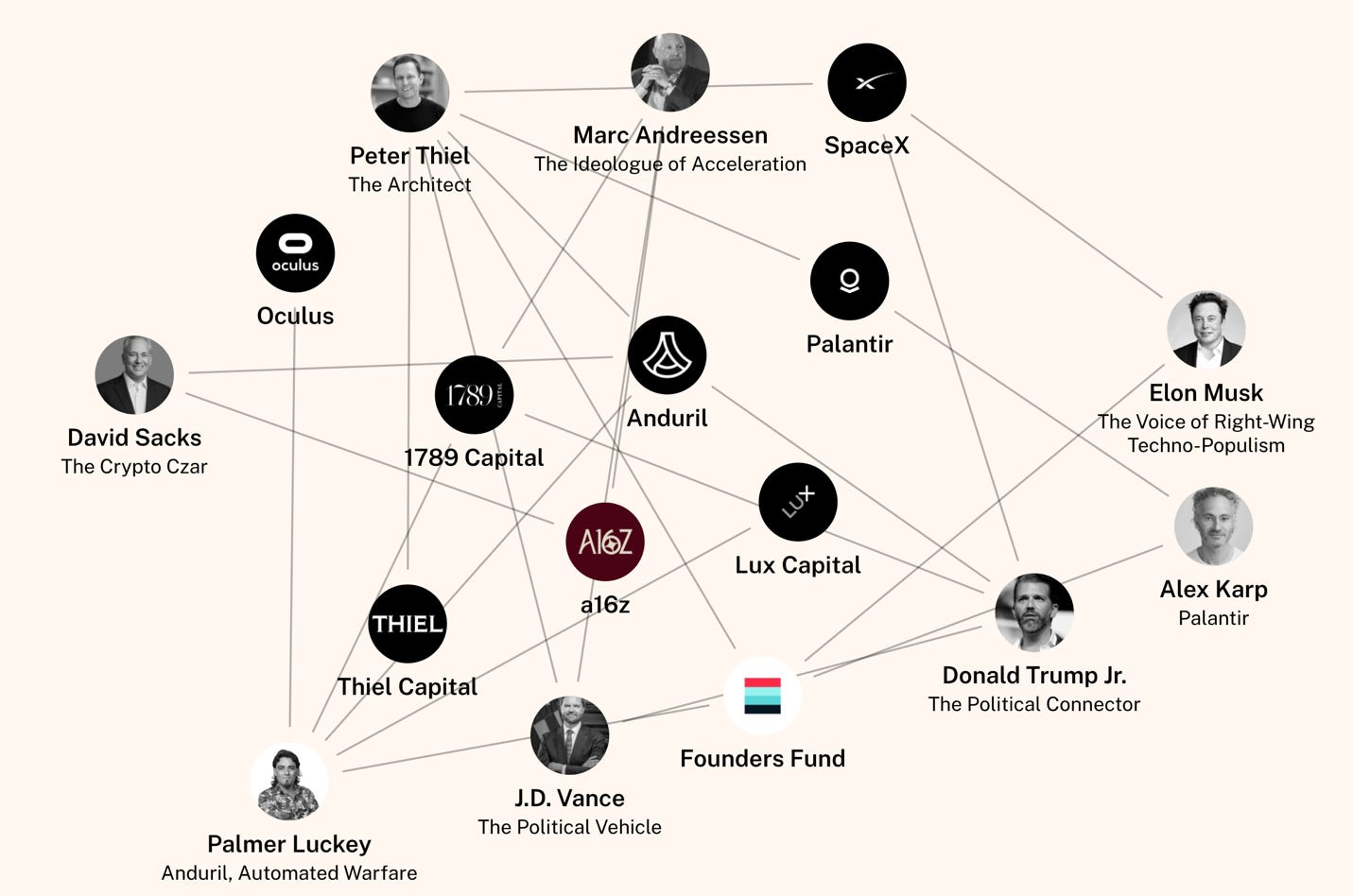
A diagram of a group of people AI-generated content may be incorrect.

Source: The Authoritarian Stack

.

.

Click the link below for the complete article:

https://paulkrugman.substack.com/p/maga-the-broligarchs-and-the-media?utm_source=post-email-title&publication_id=277517&post_id=181630843&utm_campaign=email-post-title&isFreemail=false&r=1ed8i1&triedRedirect=true&utm_medium=email

.

__________________________________________

Trump Isn’t Interested in Fighting a New Cold War. He Wants a New Civilizational War.

Leave a comment

Click the link below the picture

.

Every few years I am reminded of one of my cardinal rules of journalism: Whenever you see elephants flying, don’t laugh, take notes. Because if you see elephants flying, something very different is going on that you don’t understand but you and your readers need to.

I bring that up today in response to the Trump administration’s 33-page National Security Strategy, released last week. It has been widely noted that at a time when our geopolitical rivalry with Russia and China is more heated than at any other time since the Cold War — and Moscow and Beijing are more and more closely aligned against America — the Trump 2025 national security doctrine barely mentions these two geopolitical challengers.

While the report surveys U.S. interests across the globe, what intrigues me most about it is how it talks about our European allies and the European Union. It cites activities by our sister European democracies that “undermine political liberty and sovereignty, migration policies that are transforming the continent and creating strife, censorship of free speech and suppression of political opposition, cratering birthrates, and loss of national identities and self-confidence.”

“Should present trends continue,” it goes on, “the continent will be unrecognizable in 20 years or less.”

Indeed, the strategy paper warns, unless our European allies elect more “patriotic” nationalist parties, committed to stemming immigration, Europe will face “civilizational erasure.” Unstated but implied is that we will judge you not by the quality of your democracy but by the stringency by which you stem the migration flow from Muslim countries to Europe’s south.

That is a flying elephant no one should ignore. It is language unlike any previous U.S. national security survey, and to my mind it reveals a deep truth about this second Trump administration: how much it came to Washington to fight America’s third civil war, not to fight the West’s new cold war.

Yes, in my view, we are in a new civil war over a place called home.

First, I need to make a quick detour to “home.” These days there is a tendency to reduce every crisis to the dry metrics of economics, to the chessboard machinations of political or military campaigns, or to ideological manifestoes. All, of course, have their relevance, but the longer I have worked as a journalist, the more I have found that the better starting place for unlocking a story is with the disciplines of psychology and anthropology. They are often much better at revealing the primal energies, anxieties and aspirations that animate our national politics — and global geopolitics — because they uncover and illuminate not just what people say they want, but also what they fear and what they privately pray for, and why.

I was not here for the Civil War of the 1860s, and I was still a boy during our second great civil struggle, the 1960s civil rights movement and the assassination of Martin Luther King Jr. But I am definitely on duty for America’s third civil war. This one, like the first two, is over the questions “Whose country is this anyway?” and “Who gets to feel at home in our national house?” This civil

war has been less violent than the first two — but it is early.

Humans have an enduring, structural need for home, not only as a physical shelter, but as a psychological anchor and moral compass, too. That is why Dorothy in “The Wizard of Oz” (my favorite movie) got it exactly right: “There’s no place like home.” And when people lose that sense of home — whether by war, rapid economic change, cultural change, demographic change, climate change or technological change — they tend to lose their center of gravity. They may feel as though they are being hurtled around in a tornado, grabbing desperately for anything stable enough to hold onto — and that can include any leader who seems strong enough to reattach them to that place called home, however fraudulent that leader is or unrealistic the prospect.

With that as background, I cannot remember another time in the last 40 years when I have traveled around America, and the world, and found more people asking the same question: “Whose country is this anyway?” Or as Itamar Ben-Gvir, the far-right nationalist Israeli minister, put it, in Hebrew, in his political banner ads during Israel’s 2022 election: “Who is the landlord here?”

And that is not an accident. Today, more people are living outside their country of birth than at any point in recorded history. There are approximately 304 million global migrants — some seeking work, some seeking education, some seeking safety from internal conflicts, some fleeing droughts and floods and deforestation. In our own hemisphere, the U.S. Customs and Border Protection office reports that migrant encounters at our southern border hit historical highs in 2023, while estimates from the Pew Research Center suggest that the total unauthorized population in America grew to 14 million in the same year, breaking a decade-long period of relative stability.

But this is not just about immigrants. America’s third civil war is being fought on multiple fronts. On one front it is white, predominantly Christian Americans resisting the emergence of the minority-dominated America that is now baked into our future sometime in the 2040s, driven by lower birthrates among white Americans and growth in Hispanic, Asian and multiracial American populations.

On another front are Black Americans still struggling against those who would raise new walls to keep them from a place called home. Then there are Americans of every background trying to steady themselves amid cultural currents that seem to shift by the week: new expectations about issues like identity, bathrooms and even a typeface, as well as how we acknowledge one another in the public square.On yet another front, the gale-force winds of technological change, propelled now by artificial intelligence, are sweeping through workplaces faster than people can plant their feet. And on a fifth front, young Americans of every race, creed and color are straining to afford even a modest home — the physical and psychological harbor that has long anchored the American dream.

My sense is that we now have millions of Americans waking up each morning unsure of the social script, the economic ladder or the cultural norms that are OK to practice in their home. They are psychologically homeless.

When Donald Trump made building a wall along the Mexican border the central motif of his first campaign, he instinctively chose a word that did double duty for millions of Americans. “Wall” meant a physical barrier against uncontrolled immigration that was accelerating our transition to a minority-majority-led America. But it also meant a wall against the pace and scope of change: the cultural, digital and generational whirlwinds reshaping daily life.

That, to me, is the deep backdrop to Trump’s National Security Strategy. He is not interested in refighting the Cold War to defend and expand the frontiers of democracy. He is, in my view, interested in fighting the civilizational war over what is the American “home” and what is the European “home,” with an emphasis on race and Christian-Judeo faith — and who is an ally in that war and who is not.

.

https://static01.nyt.com/images/2025/12/11/multimedia/11friedman-cgtm/11friedman-cgtm-superJumbo.jpg?quality=75&auto=webp

Alex Kent for The New York Times

.

.

Click the link below for the complete article:

https://www.nytimes.com/2025/12/11/opinion/trump-europe-security-strategy.html

.

__________________________________________

Annie L. Cooper, Native Played a Crucial Part in Selma Voting Rights Movement

Leave a comment

Annie L. Cooper, Native Played a Crucial Part in Selma Voting Rights Movement

Black Family Killed After Refusing to Leave White Neighborhood in California

Leave a comment

Black Family Killed After Refusing to Leave White Neighborhood in California

ETERNITY (2025) – My rating: 6.5/10

Leave a comment

Eternity is a fantasy romantic comedy directed by David Freyne, who co-wrote the film with Pat Cunnane.  It follows a woman who must choose between two men with whom to spend eternity in the afterlife.  Eternity premiered at the 2025 Toronto International Film Festival and was theatrically released in the United States by A24 in […]

ETERNITY (2025) – My rating: 6.5/10

Trump Officials Keep Comparing the U.S.’s Vaccine Schedule to Denmark’s. They’re Missing the Point

Leave a comment

Click the link below the picture

.

At a controversial meeting of the U.S. Centers for Disease Control and Prevention’s vaccine advisory panel recently, members voted to remove a long-standing recommendation that all babies get a first dose of the hepatitis B vaccine at birth. Public health experts derided the move, which goes against evidence that the shot is safe and effective. Members of the CDC’s Advisory Committee on Immunization Practices (ACIP) and agency officials cited a curious rationale for the change: a need to align the U.S.’s vaccine schedule with Denmark’s.

Shortly after the meeting, President Donald Trump ordered the CDC to fast-track a review of the U.S. vaccination schedule to align with that of other “peer, developed countries,” including Denmark. But there’s something rotten in this comparison.

The U.S. and Denmark have starkly different populations, disease rates, and health care systems. It makes sense that they have different vaccination policies.

“The United States is not Denmark,” says Katelyn Jetelina, an epidemiologist who writes a popular health newsletter and who previously advised the CDC on its COVID policy. “The health care and safety net system of the United States is drastically different than other high-income countries around the world. We should expect country-level policy decisions to vary.”

The U.S. has more than 340 million people; Denmark’s population is a little more than six million. Denmark is also much more demographically and economically homogenous than the U.S. And the countries have different burdens of disease.

Take hepatitis B—there were 99 new cases of chronic hepatitis B in Denmark in 2023, compared with more than 17,000 new cases in the U.S. Denmark also screens practically every single pregnant person for the disease, and most of those who test positive receive treatment. In the U.S., about 85 percent of pregnant people are screened, and many never get treatment. Hepatitis B is a liver infection, and if it is left untreated and becomes chronic, it can lead to cirrhosis, liver cancer and death.

The U.S. and Danish health care systems are incomparable. With the exception of Medicare and Medicaid, the U.S. system operates largely on privately funded insurance. Denmark has a universal health system that is paid for by the government, and all residents have access to free care. The CDC’s advisory panel made no mention of this difference during its recent meeting, and the Trump administration has no appetite for a universal health care system in the U.S.

“Managing and following a small population with universal health care is much different than an enormous population with multiple delivery systems and multiple payers,” says Kathryn Edwards, a professor of pediatrics at Vanderbilt University Medical Center. It’s “like comparing apples and oranges.”

Jetelina concurs. In Denmark, people are less likely to fall through the cracks of their health system, she says, whereas the U.S. has a “very different health care capacity, and we don’t have a safety net.”

A consequence of universal health care systems is that countries like Denmark are also more likely than the U.S. to take cost-effectiveness into consideration when deciding which vaccines to recommend and to whom. Even though providing vaccines is generally far cheaper than treating a disease, it still costs money. For example, in the U.K., which also has state-funded universal health care, flu vaccines aren’t routinely recommended for children because the shots are more cost-effective in older adults. Similar logic may explain why the hepatitis B vaccine isn’t universally given at birth in Denmark.

A lot of the discussion at the December 5 ACIP meeting focused on hypothetical risks from the hepatitis B vaccine in babies born to people who test negative for the disease; there was very little emphasis on the societal benefits of widespread vaccination.

When it comes to targeting vaccination only to individuals born to parents who are known to have hepatitis B, Jetelina says, “we’ve tested this before.” Prior to 1991, the U.S. attempted to vaccinate only people at high risk for hepatitis B. “Even when mothers screened negative for hep B, and the birth dose was withheld, thousands of children did end up infected via another member of the household,” she says. In contrast, after ACIP recommended a universal birth dose in 1991, cases declined dramatically: in children, teens, and young adults up to age 19, cases of acute hepatitis dropped by 99 percent from 1990 to 2019.

The push to alter the U.S. hepatitis B vaccine recommendation fits into a broader effort by the Trump administration and many Republican lawmakers to prioritize individual freedoms over collective action. Yet strong public health systems—and vaccination in particular—rely on collective action to protect those who cannot protect themselves, such as immune-suppressed people, older adults, and young babies.

“I’m concerned about that,” Jetelina says. “If we land too much on individualism, diseases are going to come back.”

.

https://static.scientificamerican.com/dam/m/6d6f8a811c783a27/original/denmark.jpg?m=1765583034.072&w=900

Not the U.S. Dado Daniela via Getty Images

.

.

Click the link below for the complete article:

https://www.scientificamerican.com/article/trump-officials-keep-comparing-the-u-s-s-vaccine-schedule-to-denmarks-theyre/

.

__________________________________________

What Is REM Sleep? Definition and Benefits

Leave a comment

Click the link below the picture

.

Rapid eye movement, or REM sleep, is the final phase of the four stage cycle that occurs during sleep. Unlike non-REM sleep, the fourth phase is characterized by an increase in brain activity and autonomic nervous system functions, which are closer to what is seen during the awakened state. Similar to non-REM sleep stages, this stage of sleep is primarily controlled by the brainstem and hypothalamus, with added contributions from the hippocampus and amygdala. Additionally, REM sleep is associated with an increase in occurrence of vivid dreams. While non-REM sleep has been associated with rest and recovery, the purpose and benefits of REM sleep are still unknown. However, many theories hypothesize that REM sleep is useful for learning and memory formation.

Key Takeaways: What Is REM Sleep?

  • REM sleep is an active stage of sleep characterized by increased brain wave activity, return to awake state autonomic functions, and dreams with associated paralysis.
  • The brainstem, particularly the pons and midbrain, and the hypothalamus are key areas of the brain that control REM sleep with hormone secreting “REM-on” and “REM-off” cells.
  • The most vivid, elaborate, and emotional dreams occur during REM sleep.
  • The benefits of REM sleep are uncertain, but may be related to learning and storage of memory.


REM Definition

REM sleep is often described as a “paradoxical” sleep state due to its increased activity after non-REM sleep. The three prior stages of sleep, known as non-REM or N1, N2, and N3, occur initially during the sleep cycle to progressively slow bodily functions and brain activity. However, after the occurrence of N3 sleep (the deepest stage of sleep), the brain signals for the onset of a more aroused state. As the name implies, the eyes move rapidly sideways during REM sleep. Autonomic functions such as heart rate, respiratory rate, and blood pressure begin to increase closer to their values while awake. However, because this period is often associated with dreams, major limb muscle activities are temporarily paralyzed. Twitching can still be observed in smaller muscle groups.

Brain Activity During REM Sleep
This is a digital illustration of areas of activity during REM sleep in the human brain, highlighted in red and green. Dorling Kinderley / Getty Images 

REM sleep is the longest period of the sleep cycle and lasts for 70 to 120 minutes. As the duration of sleep progresses, the sleep cycle favors increased time spent in REM sleep. The proportion time spent in this phase is determined by a person’s age. All stages of sleep are present in newborns; however, babies have a much higher percentage of non-REM slow wave sleep. The ratio of REM sleep gradually increases with age until it reaches 20-25% of the sleep cycle in adults.


REM and Your Brain

REM Sleep
REM Sleep. Numbering the traces from top to bottom, 1 & 2 are electroencephalograms (EEG) of brain activity; 3 is an electrooculogram (EOG) of movement in the right eye; 4 an EOG of the left eye; 5 is an electrocardiogram (ECG) trace of heart activity. 6 & 7 are electromyograms (EMG) of activity in the laryngeal (6) and neck (7) muscles. James Holmes / Science Photo Library / Getty Images Plus 

During REM sleep, brain wave activity measured on an electroencephalogram (EEG) also increases, as compared to the slower wave activity seen during non-REM sleep. N1 sleep shows slowing of the normal alpha wave pattern noted during the awake state. N2 sleep introduces K waves, or long, high voltage waves lasting up to 1 second, and sleep spindles, or periods of low voltage and high frequency spikes. N3 sleep is characterized by delta waves, or high voltage, slow, and irregular activity. However, EEGs obtained during REM sleep show sleep patterns with low voltage and fast waves, some alpha waves, and muscle twitch spikes associated with transmitted rapid eye movement. These readings are also more variable than those observed during non-REM sleep, with random spiking patterns at times fluctuating more than activity seen while awake.

EEG
An electroencephalogram (EEG) uses electrodes to read small electromagnetic waves from the human brain. Graphic_BKK1979 / iStock / Getty Images Plus 

The major portions of the brain activated during REM sleep are the brainstem and the hypothalamus. The pons and midbrain, in particular, and the hypothalamus contain specialized cells known as “REM-on” and “REM-off” cells. To induce the transition to REM sleep, REM-on cells secrete hormones such as GABA, acetylcholine, and glutamate to instruct the onset of rapid eye movements, muscle activity suppression, and autonomic changes. REM-off cells, as their name implies, induce the offset of REM sleep by secretion of stimulatory hormones such as norepinephrine, epinephrine, and histamine.

.

https://www.thoughtco.com/thmb/jWwgo4oLMeqzxJOhwVJAnq1V08o=/750x0/filters:no_upscale():max_bytes(150000):strip_icc()/woman_dreaming-5081da90c33547c891904ed54ca9849a.jpgREM sleep is an active stage of sleep characterized by increased brain wave activity. Jamie Grill / Getty Images

.

.

Click the link below for the complete article:

https://www.thoughtco.com/what-is-rem-sleep-definition-4781604

.

__________________________________________

Trump administration threatens to take $73 million and all trucker licenses from NY

Leave a comment

From

Axios

Click the link below the picture

.

Transportation Secretary Sean Duffy threatened to freeze $73 million from New York on Friday for allegedly issuing commercial driver’s licenses for immigrants “illegally,” which could result in the “total decertification” of the state’s CDL program.

Why it matters: The warning comes amid the Trump administration’s broader goal of pushing undocumented immigrants out of the American workforce and a broader push to remove non-proficient English speakers off the road.

What they’re saying: “When more than half of the licenses reviewed were issued illegally, it isn’t just a mistake—it is a dereliction of duty by state leadership,” Duffy said in a Friday news release.

  • “Gov. Hochul must immediately revoke these illegally issued licenses. If they refuse to follow the law, we will withhold federal highway funding.”
  • “This administration will never stop fighting to keep you and your family safe on our roads,” he added.

Context: A non-domiciled CDL is a U.S. license for a non-citizen, and is routinely issued to foreign drivers who can meet all of the DOT licensing requirements.

The other side: “Secretary Duffy is lying about New York State once again in a desperate attempt to distract from the failing, chaotic administration he represents,” a NY DMV spokesperson told Axios in an emailed statement.

  • “Here is the truth: Commercial Drivers Licenses are regulated by the Federal Government, and New York State DMV has, and will continue to, comply with federal rules.”
  • “Every CDL we issue is subject to verification of an applicant’s lawful status through federally-issued documents reviewed in accordance with federal regulations.”
  • “This is just another stunt from Secretary Duffy, and it does nothing to keep our roads safer. We will review USDOT’s letter and respond accordingly.”

Catch up quick: The Trump administration has sought to crackdown on the amount of non-citizen drivers on the road and attempted to prohibit states from issuing non-domiciled CDLs earlier this year.

  • A D.C. Court of Appeals judge blocked that move in November, but some states, such as Virginia and Georgia, have paused new applications as the legal challenge unfolds.

State of play: Roughly 18% of all truck drivers are immigrants, and the often-grueling industry is already short of tens of thousands of drivers.

  • Nonetheless, several high-profile fatal crashes involving immigrants over the years have spurred the wave of new restrictions.

By the numbers: Duffy said 53% of New York’s non-domiciled CDLs reviewed by DOT were issued “unlawfully or illegally.”

  • The review only sampled 200 licenses, but 107 of them violated federal law, according to DOT.

Zoom in: Duffy said NY’s DMV system automatically issues an 8-year license to drivers, regardless of if their work authorization or legal status expires before then.

  • He also said that the state frequently skips verifying if applicants have a visa or are in the country legally.

Zoom out: The administration also announced it was revoking roughly 9,500 licenses for failing to meet the president’s reinstated English-language proficiency requirements earlier this week.

  • That move essentially reversed an Obama-era order that softened the ELP requirements back in 2016.

What we’re watching: DOT will trigger the funding freeze if NY doesn’t fix the problems the department identified within 30 days.

.

https://images.axios.com/1UPMzuzbvaX2egJOLm4s1FwCNF0=/0x462:8256x5106/1920x1080/2025/12/12/1765566135784.jpg?w=1920Transportation Secretary Sean Duffy speaks during a news conference on May 20 in Austin, Texas. Photo: Brandon Bell/Getty Images

.

.

Click the link below for the complete article:

https://www.axios.com/2025/12/12/trump-duffy-truck-drivers-license-revoked-new-york

.

__________________________________________
Henry Louis Aaron, American Professional Baseball Right Fielder (MLB)

Leave a comment

Henry Louis Aaron, American Professional Baseball Right Fielder (MLB)

White Mob of Hundreds of Lynches Tom Waller in Mississippi

Leave a comment

White Mob of Hundreds of Lynches Tom Waller in Mississippi

Older Entries Newer Entries

Amor Entre Estrellas

¡Bienvenido de vuelta viajero!

Heart of Loia `'.,°~

so looking to the sky ¡ will sing and from my heart to YOU ¡ bring...

Michael Ciullo

CEO and Founder of Nsight Health

MRS. T’S CORNER

https://www.tangietwoods

Nelson MCBS

Catholic News, Prayers, HD Images, Rosary, Music, Videos, Holy Mass, Homily, Saints, Lyrics, Novenas, Retreats, Talks, Devotionals and Many More

Global geopolitics

Decoding Power. Defying Narratives.

Talk Photo

A creative collaboration introducing the art of nature and nature's art.

Movie Burner Entertainment

The Home Of Entertainment News, Reviews and Reactions

Le Notti di Agarthi

Hollow Earth Society

C r i s t i a n a' s Fine Arts ⛄️

•Whenever you are confronted with an opponent, conquer him with love.(Gandhi)

TradingClubsMan

Algotrader at TRADING-CLUBS.COM

Comedy FESTIVAL

Film and Writing Festival for Comedy. Showcasing best of comedy short films at the FEEDBACK Film Festival. Plus, showcasing best of comedy novels, short stories, poems, screenplays (TV, short, feature) at the festival performed by professional actors.

Bonnywood Manor

Peace. Tranquility. Insanity.

Warum ich Rad fahre

Take a ride on the wild side

Madame-Radio

Découvre des musiques prometteuses (principalement) dans la sphère musicale française.

Ir de Compras Online

No tiene que Ser una Pesadilla.

Kana's Chronicles

Life in Kana-text (er... CONtext)

Cross-Border Currents

Tracking money, power, and meaning across borders.

Jam Writes

Where feelings meet metaphors and make questionable choices.

emotionalpeace

Finding hope and peace through writing, art, photography, and faith in Jesus.

WearingTwoGowns.COM

The Community for Wounded Healers: Former Medical Students, Disabled Nurses, and Faith-Fueled Pivots

...

love each other like you're the lyric to their music

Luca nel laboratorio di Dexter

Comprendere il mondo per cambiarlo.

Tales from a Mid-Lifer

Mid-Life Ponderings

Creative

Travel,Tourism, Life style "Now in hundreds of languages for you."

freedomdailywriting

I speak the honest truth. I share my honest opinions. I share my thoughts. A platform to grow and get surprised.

The Green Stars Project

User-generated ratings for ethical consumerism

Cherryl's Blog

Travel and Lifestyle Blog

Sogni e poesie di una donna qualunque

Questo è un piccolo angolo di poesie, canzoni, immagini, video che raccontano le nostre emozioni

My Awesome Blog

“Log your journey to success.” “Where goals turn into progress.”

pierobarbato.com

scrivo per dare forma ai silenzi e anima alle storie che il mondo dimentica.

Thinkbigwithbukonla

“Dream deeper. Believe bolder. Live transformed.”

Vichar Darshanam

Vichar, Motivation, Kadwi Baat ( विचार दर्शनम्)

Komfort bad heizung

Traum zur Realität

Chic Bites and Flights

Savor. Style. See the world.

ومضات في تطوير الذات

معا نحو النجاح

Broker True Ratings

Best Forex Broker Ratings & Reviews

Blog by ThE NoThInG DrOnEs

art, writing and music by James McFarlane and other musicians

fauxcroft

living life in conscious reality

Srikanth’s poetry

Freelance poetry writing

JupiterPlanet

Peace 🕊️ | Spiritual 🌠 | 📚 Non-fiction | Motivation🔥 | Self-Love💕