TSUKUBA, Japan—Outside the International Institute for Integrative Sleep Medicine, the heavy fragrance of sweet Osmanthus trees fills the air, and big golden spiders string their webs among the bushes. Two men in hard hats next to the main doors mutter quietly as they measure a space and apply adhesive to the slate-colored wall. The building is so new that they are still putting up the signs.
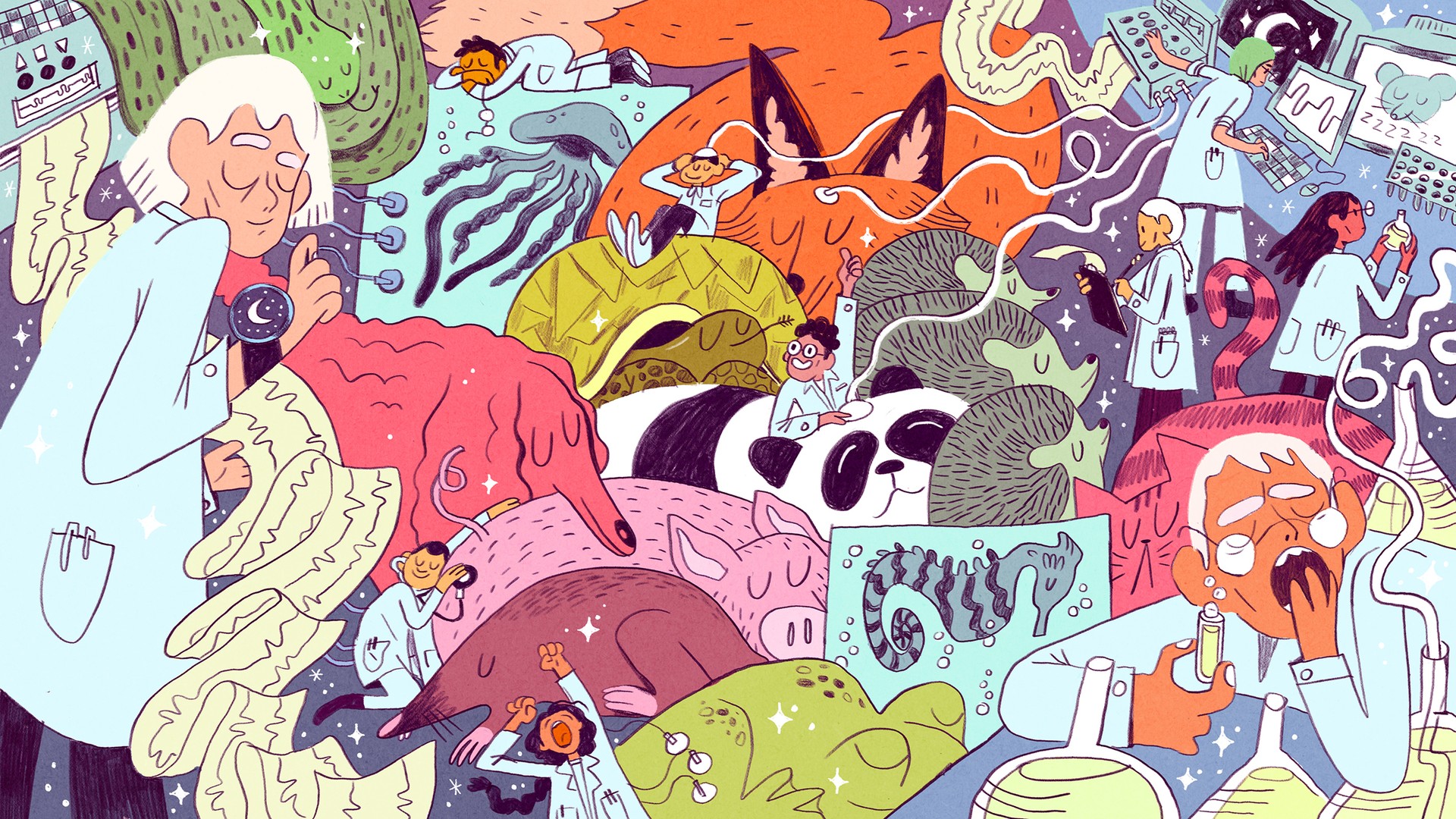
The institute is five years old, its building still younger, but already it has attracted some 120 researchers from fields as diverse as pulmonology and chemistry and countries ranging from Switzerland to China. An hour north of Tokyo at the University of Tsukuba, with funding from the Japanese government and other sources, the institute’s director, Masashi Yanagisawa, has created a place to study the basic biology of sleep, rather than, as is more common, the causes and treatment of sleep problems in people. Full of rooms of gleaming equipment, quiet chambers where mice slumber, and a series of airy work spaces united by a spiraling staircase, it’s a place where tremendous resources are focused on the question of why, exactly, living things sleep.
Ask researchers this question, and listen as, like clockwork, a sense of awe and frustration creeps into their voices. In a way, it’s startling how universal sleep is: In the midst of the hurried scramble for survival, across eons of bloodshed and death and flight, uncountable millions of living things have laid themselves down for a nice, long bout of unconsciousness. This hardly seems conducive to living to fight another day. “It’s crazy, but there you are,” says Tarja Porkka-Heiskanen of the University of Helsinki, a leading sleep biologist. That such a risky habit is so common and so persistent, suggests that whatever is happening is of the utmost importance. Whatever sleep gives to the sleeper is worth tempting death over and over again, for a lifetime.
The precise benefits of sleep are still mysterious, and for many biologists, the unknowns are transfixing. One rainy evening in Tsukuba, a group of institute scientists gathered at an izakaya bar manage to hold off only half an hour before sleep is once again the focus of their conversation. Even simple jellyfish have to rest longer after being forced to stay up, one researcher marvels, referring to a new paper where the little creatures were nudged repeatedly with jets of water to keep them from drifting off. And the work on pigeons—have you read the work on pigeons? another asks. There is something fascinating going on there, the researchers agree. On the table, dishes of vegetable and seafood tempura sit cooling, forgotten in the face of these enigmas.
1) Life’s easy when you live it the hard way… and hard if you try to live it the easy way. 2) Your choices are made in a moment, but their consequences will transcend a lifetime. 3) Self-discipline comes down to choosing between instant and delayed gratification. 4) Quitting when you’re panicked is dangerous and […]
During residency, I worked hospital shifts that could last 36 hours, without sleep, often without breaks of more than a few minutes. Even writing this now, it sounds to me like I’m bragging or laying claim to some fortitude of character. I can’t think of another type of self-injury that might be similarly lauded, except maybe binge drinking. Technically the shifts were 30 hours, the mandatory limit imposed by the Accreditation Council for Graduate Medical Education, but we stayed longer because people kept getting sick. Being a doctor is supposed to be about putting other people’s needs before your own. Our job was to power through.
The shifts usually felt shorter than they were, because they were so hectic. There was always a new patient in the emergency room who needed to be admitted, or a staff member on the eighth floor (which was full of late-stage terminally ill people) who needed me to fill out a death certificate. Sleep deprivation manifested as bouts of anger and despair mixed in with some euphoria, along with other sensations I’ve not had before or since. I remember once sitting with the family of a patient in critical condition, discussing an advance directive—the terms defining what the patient would want done were his heart to stop, which seemed likely to happen at any minute. Would he want to have chest compressions, electrical shocks, a breathing tube? In the middle of this, I had to look straight down at the chart in my lap, because I was laughing. This was the least funny scenario possible. I was experiencing a physical reaction unrelated to anything I knew to be happening in my mind. There is a type of seizure, called a gelastic seizure, during which the seizing person appears to be laughing—but I don’t think that was it. I think it was plain old delirium. It was mortifying, though no one seemed to notice.
No matter what happened to my body, I never felt like it was dangerous for me to keep working. I knew I was irritable and sometimes terse, and I didn’t smell the best, but I didn’t think anything I did was unsafe. Sleep experts often liken sleep-deprived people to drunk drivers: They don’t get behind the wheel thinking they’re probably going to kill someone. But as with drunkenness, one of the first things we lose in sleep deprivation is self-awareness.
It’s this way of thinking—that you can power through, that sleep is the easiest corner to cut—that makes sleep disturbance among the most common sources of health problems in many countries. Insufficient sleep causes many chronic and acute medical conditions that have an enormous impact on quality of life, not to mention the economy. While no one knows why we sleep, it is a universal biological imperative; no animal with a brain can survive without it. Dolphins are said to sleep with only half their brain at a time, keeping partially alert for predators. Many of us spend much of our lives in a similar state.
With each passing year, the climate crisis comes into ever sharper focus. And no matter how small they may seem in the face of the herculean challenges we as a society face, our individual choices do matter. In that spirit, one pillar to consider is your beauty routine. More specifically, what you buy, how often you buy it, and whether it ends up in a landfill at the end of your use. This is because the beauty industry is among the world’s largest polluters. According to Euromonitor International, 152.1 billion units of beauty and personal-care packaging were sold globally in 2018 alone, much of which will never be recycled.
“I am grateful that sustainability has become a major focus for consumer products recently,” says Mia Davis, vice president of sustainability and impact at Credo Beauty. “Sustainability in beauty means that the work we do now–the resources we extract, the stuff we make–will not compromise people’s ability to do the same in the future.”
While change can be daunting, rest assured that being an environmentally conscious consumer and being passionate about your beauty routine aren’t mutually exclusive. “As someone who has always loved beauty, I didn’t want to give that up as I started to transition to a more sustainable lifestyle,” explains sustainability expert and low-waste living content creator Jhánneu. “Many people think they have to give up their lifestyles to be sustainable, but it really comes down to just finding better alternatives.” As a former self-proclaimed Sephora junkie, Ashlee Piper, an eco-lifestyle expert and author of Give a Sh*t: Do Good. Live Better. Save the Planet, knows firsthand it can–and needs–to be done.
“While I love a good haul and discovering new, niche beauty companies [to support], when it comes to creating excess that’s detrimental for the planet and our wallets, beauty, and grooming items are right up there,” explains Piper, citing that as of 2018, the beauty and personal care industry has created almost 8 billion rigid plastic packaging units per year in the U.S. alone. “I began evangelizing about paring down and being more mindful about our beauty-product consumption because it’s the unsung area of personal sustainability.”
.
Photographed by Mikael Jansson, Vogue, November 2019
“Brown — the more ‘off,’ the better. It’s subtle and confrontational: Not a lot of colors have that versatility.” — Thebe Magugu, 30, fashion designer
“After a hugely colorful period, I think we’re going back to a place of minimalism in our clothes: black, a faded brown. Subtlety.” — Nathan Stewart-Jarrett, 37, actor
“Whiskey and cognac — a brown with a lot of caramel.” — Jenna Lyons, 55, designer
“There’s always a resistance to meatball brown, so I believe that is going to be the next color to sweep runways.” — John Waters, 77, film director
“Purple. It’s finally getting its due.” — Freddie Ross Jr., a.k.a. Big Freedia, 45, musician
“Deep violet.” — Sharon Van Etten, 42, singer-songwriter
“Colors that reflect opulence. Like bluish purple. It’ll be the year of treating yourself.” — Kwame Onwuachi, 34, chef
“Neutrals will step up their game and pack some actual punch. I won’t be surprised if a diarrhea tone becomes Pantone’s color of the year. On the flip side, bright colors are still seeking vengeance for the millennial tyranny of pastel; we’ll finally get treated to a color like Tyrian purple.” — Misha Kahn, 34, designer and sculptor
“Pops of red. Navy, too.” — Alex Eagle, 40, creative director
“More blue — the color of the oceans and the skies that arc over every human being on this planet.” — Carole Iida-Nakayama, 46, chef
“Aside from quiet black, I’ll still be promoting gentle grays to show respect and modest deference to others and the conditions they might be going through.” — Rick Owens, 62, fashion designer
“Chroma key green — an ‘invisible’ color that’s ever-changing.” — Alex Da Corte, 43, visual artist
“The color of butter. I’m not sure who it looks good on, but I love gazing on it.” — Eileen Myles, 73, poet
Since 2020, many of us have spent more time feeding ourselves than ever before. Planning, shopping, cooking, and cleaning feel like never-ending tasks as we have become more acutely involved in securing three meals a day, seven days a week for our households. We’re constantly in our kitchens, and this has forced many of us to become that much more aware of the environmental impact of our meals.
Although we are not experts on climate change and the environment, we are authorities on food and kitchens, and we’re often looking for ways to reduce waste in our cooking, cleaning, food storage, and more. If you’re of the same mind-set, we’ve assembled a list of 20 actions — some easy, some a little more involved — that you can take right now to become a more sustainably minded home cook.
If this feels like a long list, start by picking one or two things to try adding to your routine. Each small daily decision can make an impact in the long run.
1. When boiling water, put a lid on it.
Doing so traps the heat inside, meaning that it will require less energy to bring the water to a boil and also does so more quickly.
In the world, human beings are facing various problems. People who are full of greed, anger, and ignorance are seen to be fighting with each other in words and deeds. As the fighting continues, various problems such as civil wars, wars of aggression, and wars of aggression are occurring. As world peace is being destroyed, humans are facing unbearable problems. Innocent children and women are not getting the rights they deserve and deserve. I can't think of one thing every time. What is it? The United Nations. If we look at the responsibilities and duties of the United Nations, I think it is not suitable for solving the problems that are happening in the world today. In fact, the United Nations and the World Security Council, such an organization must rule the world, must be able to give orders, and must have various ways to obey orders. There must be no organization that can influence more than that organization. There should be experts from each country. They can even dominate the superpowers like the US, China, and Britain. Only then will global peace be achieved quickly. Now, if a country with power develops more militarily, economically, or socially than its own country, then powerful countries will jealously seek out enemies and wage war. Or they will attack with fighter jets. In this, innocent people are losing their lives. No one understands the value of a life. You should think about how to achieve global peace by controlling these. If the US continues to be the permanent president of the UN, world peace will never be achieved. If you think carefully, no one sees that they are working for the common good, but for their own benefit, for the benefit of their own country. The permanent president of the UN and the Security Council has rejected this, As a young Rohingya, I have come to realize that only by electing the president and secretary from among the countries in the world through a secret ballot system and governing the world fairly can we achieve global peace. The United Nations and the Security Council are organizations in which any country must govern, give orders, and make them obey their orders. For example, only when a defendant is tried in court can we hold the leaders of the countries in check and control them, can we achieve global peace smoothly. Otherwise, it will not be easy for powerful countries to use various excuses to end this war every year, every year, for the benefit of themselves and their countries. No country's leaders pay any attention to the words of the United Nations and the Security Council. If we look at it in practice, look at the Rohingya issue. Myanmar is a small country. Even that country has been under siege for 8 years. What action can be taken? Why is the UN and the Security Council Powerless? Without such Power, how can the organization bring about global peace? Everyone should think about it. Whether there is a veto or a strong one, all countries in the world can only achieve global peace if they are subject to the UN and the Security Council. Seek peace in the quiet embrace of nature. Peace is an indispensable need of the human race. It is not as if one person can kill another person, and it is as if one country can attack another country, but instead of trying to build peace, we must try to destroy the peace now, and the world is getting hotter and is on the verge of collapse. I especially appeal to all the world experts to urgently try to bring about peace in all parts of the world. Mr, Noor Muhamed Arkhan Rohingya Youth Myanmar
Film and Writing Festival for Comedy. Showcasing best of comedy short films at the FEEDBACK Film Festival. Plus, showcasing best of comedy novels, short stories, poems, screenplays (TV, short, feature) at the festival performed by professional actors.

 Natalie Andrewson


 Mauricio Alejo