Three separate research groups have demonstrated quantum entanglement — in which two or more objects are linked so that they contain the same information even if they are far apart — over several kilometers of existing optical fibers in real urban areas. The feat is a key step towards a future quantum internet, a network that could allow information to be exchanged while encoded in quantum states.
Together, the experiments are “the most advanced demonstrations so far” of the technology needed for a quantum internet, says physicist Tracy Northup at the University of Innsbruck in Austria. Each of the three research teams — based in the United States, China, and the Netherlands — was able to connect parts of a network using photons in the optical-fire-friendly infrared part of the spectrum, which is a “major milestone”, says fellow Innsbruck physicist Simon Baier.
A quantum internet could enable any two users to establish almost unbreakable cryptographic keys to protect sensitive information. But full use of entanglement could do much more, such as connecting separate quantum computers into one larger, more powerful machine. The technology could also enable certain types of scientific experiment, for example by creating networks of optical telescopes that have the resolution of a single dish hundreds of kilometers wide.
Two of the studies were published in Nature on 15 May. The third was described last month in a preprint posted on arXiv, which has not yet been peer-reviewed.
Impractical environment
Many of the technical steps for building a quantum internet have been demonstrated in the laboratory over the past decade or so. And researchers have shown that they can produce entangled photons using lasers in direct line of sight of each other, either in separate ground locations or on the ground and in space.
Forgive, though they stand unapologetic and tall, For your grace is vast; it encompasses all. Let them claim victory; let them have their say, In your silence, you win as you walk away. Send them love, though they know it not, Your kindness is the lesson they forgot. Bid them farewell, let your spirit be […]
At Brooklyn Friends School, progressive Quaker values are part of the curriculum. A required seminar for ninth-grade students encourages them to explore matters of identity and social justice, and there are land acknowledgments on the walls. But a debate over Israel between parents and the school has tested its values. Brooklyn Friends says it is trying not to pick a side, but parents who are critical of Israel say the school has silenced them.
BFS is one of many liberal entities to face a split within its ranks after October 7, including the rift inside the Democratic Party. PEN America, a free-expression group, canceled its prestigious awards and World Voices Festival after writers withdrew, calling on the organization to more strongly condemn Israeli attacks on Palestinian writers and culture. College campuses across the country are convulsed not only by student protesters but by administrators who respond with violent crackdowns.
Nobody has called the police on critical parents at BFS, but there is tension all the same. It stretches as far back as December, when BFS asked Esther Farmer, an activist with Jewish Voice for Peace, to speak at an event honoring Human Rights Day. Farmer says she readily agreed, figuring she had been invited to provide JVP’s anti-Zionist perspective. In her view, that wouldn’t be out of keeping with the school’s pacifist Quaker tradition. “The American Friends Service Committee has been pro-Palestinian and pro-peace for many, many years. And I had a lot of respect for them,” she says.
A few weeks later, BFS withdrew Farmer’s invitation and later canceled the event altogether. “So that was a little surprising because this was the Friends school, and I couldn’t understand what happened there,” Farmer says. Kevin Murungi, the school’s director of global civic engagement and social impact, says they “vetted all the speakers, including Esther, carefully, and told them the spirit of the event that they were attending.”
Farmer wasn’t the only person surprised by her cancellation. Some parents were taken aback when they learned of the decision through a December 8 email from Crissy Cáceres, the head of the school. She wrote that other parents had raised concerns about JVP. “We would never knowingly pursue a course of action that would put any of our students in harm’s way,” Cáceres said.
But what harm could Farmer — who is Jewish — pose to students? “I have to say my experience of that is that’s really what’s antisemitic,” Farmer says. “So we’re only allowed to hear some Jewish voices but not other Jewish voices?”
“The Fall Guy” is an action comedy directed by David Leitch and written by Drew Pearce, loosely based on the 1980s TV series of the same title. The plot follows a stuntman working on his ex-girlfriend’s directorial debut action film, only to find himself involved in a conspiracy surrounding the film’s lead actor. I have […]
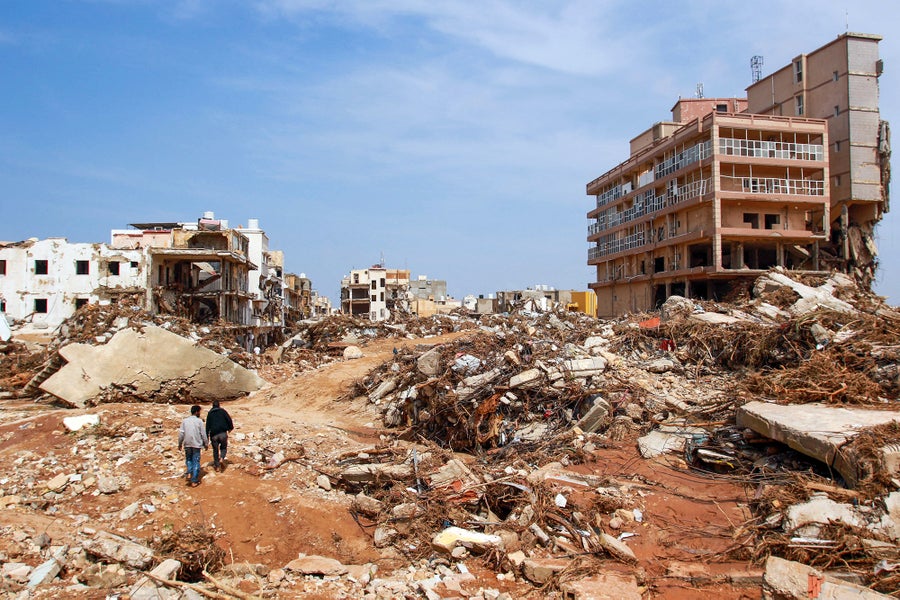
CLIMATEWIRE | Disasters forced more than 26 million people in 148 countries to leave their homes in 2023, underscoring the growing dangers of more frequent floods, storms, wildfires, and droughts.
Last year saw among the highest number of weather-related displacements in the last decade, though fewer than in 2022, according to an annual report by the International Displacement Monitoring Centre. The report, released Tuesday, also found that conflict and violence triggered another 20.5 million displacements in 2023.
Altogether, 75.9 million people were living in “internal displacement” in dozens of countries last year, including tens of millions of people displaced in previous years and still unable to return to their homes.
The report warns that disasters frequently overlap with conflict and violence, dramatically worsening outcomes for affected people. Forty-five countries and territories reported conflict-related displacements in 2023, and all but three of them also reported displacements from disasters as well.
“While the numbers fluctuate year-on-year, disaster-related displacements remain high, in nearly every corner of the world and often intertwined with conflict dynamics in fragile settings,” wrote Robert Piper, special adviser on solutions to internal displacement to the United Nations secretary general, in the report’s forward.
For example, hundreds of thousands of people were displaced by floods last fall in Somalia, a country already wracked by severe drought and long-term civil war.
.
Men walk past debris of buildings caused by flash floods in Derna, eastern Libya, on September 11, 2023. AFP via Getty Images
As the school year ends, many students will be only too happy to see math classes in their rearview mirrors. It may seem to some of us non-mathematicians that geometry and trigonometry were created by the Greeks as a form of torture, so imagine our amazement when we heard two high school seniors had proved a mathematical puzzle that was thought to be impossible for 2,000 years.
We met Calcea Johnson and Ne’Kiya Jackson at their all-girls Catholic high school in New Orleans. We expected to find two mathematical prodigies.
Instead, we found at St. Mary’s Academy, all students are told their possibilities are boundless.
Come Mardi Gras season, New Orleans is alive with colorful parades, replete with floats, and beads, and high school marching bands.
In a city where uniqueness is celebrated, St. Mary’s stands out – with young African American women playing trombones and tubas, twirling batons and dancing – doing it all, which defines St. Mary’s, students told us.
Junior Christina Blazio says the school instills in them they have the ability to accomplish anything.
Christina Blazio: That is kinda a standard here. So we aim very high – like, our aim is excellence for all students.
The private Catholic elementary and high school sits behind the Sisters of the Holy Family Convent in New Orleans East. The academy was started by an African American nun for young Black women just after the Civil War. The church still supports the school with the help of alumni.
In December 2022, seniors Ne’Kiya Jackson and Calcea Johnson were working on a school-wide math contest that came with a cash prize. tangie
It happened the first time over dinner. I was saying something to my husband, who grew up in Paris where we live, and suddenly couldn’t get the word out. The culprit was the “r.” For the previous few months, I had been trying to perfect the French “r.” My failure to do so was the last marker of my Americanness, and I could only do it if I concentrated, moving the sound backward in my mouth and exhaling at the same time. Now I was saying something in English — “reheat” or “rehash” — and the “r” was refusing to come forward. The word felt like a piece of dough stuck in my throat.
Other changes began to push into my speech. I realized that when my husband spoke to me in English, I would answer him in French. My mother called, and I heard myself speaking with a French accent. Drafts of my articles were returned with an unusual number of comments from editors. Then I told a friend about a spill at the grocery store, which — the words “conveyor belt” vanishing mid-sentence — took place on a “supermarket treadmill.” Even back home in New York, I found my mouth puckered into the fish lips that allow for the particularly French sounds of “u,” rather than broadened into the long “ay” sounds that punctuate English.
My mother is American, and my father is French; they split up when I was about 3 months old. I grew up speaking one language exclusively with one half of my family in New York and the other language with the other in France. It’s a standard of academic literature on bilingual people that different languages bring out different aspects of the self. But these were not two different personalities but two separate lives. In one version, I was living with my mom on the Upper West Side and walking up Columbus Avenue to get to school. In the other, I was foraging for mushrooms in Alsatian forests or writing plays with my cousins and later three half-siblings, who at the time didn’t understand a word of English. The experience of either language was entirely distinct, as if I had been given two scripts with mirroring supportive casts. In each a parent, grandparents, aunts, and uncles; in each, a language, a home, a Madeleine.
I moved to Paris in October 2020, on the heels of my 30th birthday. This was both a rational decision and something of a Covid-spurred dare. I had been working as a journalist and editor for several years, specializing in European politics, and had reported across Germany and Spain in those languages. I had never professionally used French, in which I was technically fluent. It seemed like a good idea to try.
A massive group of sunspots has produced the largest flare of the current solar cycle—but the stunning auroral spectacles that Earth enjoyed in recent days are unlikely to resume, experts say.
The sunspot cluster, known as active region 3664 (AR3664), broke a record on Tuesday when it emitted the largest flare to date of our sun’s current activity cycle. This X8.7-class flare peaked at 12:51 P.M. EDT, according to the National Oceanic and Atmospheric Administration’s Space Weather Prediction Center, which monitors the sun’s activity and its potential impacts on Earth.
A sunspot is a magnetic knot on the sun in which cooler temperatures make that part of the star’s surface appear darker than surrounding areas. These structures often produce solar flares—essentially huge flashes of high-energy light that, if pointed at Earth, can reach our planet in about eight minutes, sometimes trailed by slower-moving energetic particles that are also ejected by the blasts. Sunspots can also spark coronal mass ejections (CMEs), which are enormous clouds of charged plasma that can strike our planet within days of erupting from the sun.
At one point, this particular sunspot region stretched some 16 times the width of Earth. The size drew comparisons to the active region that produced the infamous 1859 Carrington Event, a massive solar storm that interrupted telegraph service worldwide and lit up our planet’s skies with auroral displays. A similar solar storm today could damage vital infrastructure such as power grids, communications systems and GPS navigation satellites. The impacts of AR3664 have been generally benign, however, despite the dramatic outbursts.
Beginning on May 7, AR3664 shot out a spree of half a dozen CMEs that started to reach Earth just after 12:30 P.M. EDT on May 10 and produced stunning auroras that night. The auroras occurred in both hemispheres and stretched as far from our planet’s poles as Puerto Rico and Mexico. The spectacle came with minimal downsides, although airplane flights were rerouted to avoid higher radiation levels near the poles, high-frequency radio systems experienced interference, and farmers who used precision GPS to steer tractors reported glitches as well.
.
A massive solar flare that occurred on May 14, as captured by NASA’s Solar Dynamics Observatory spacecraft.
Film and Writing Festival for Comedy. Showcasing best of comedy short films at the FEEDBACK Film Festival. Plus, showcasing best of comedy novels, short stories, poems, screenplays (TV, short, feature) at the festival performed by professional actors.

 Andrey Suslov/Getty Images




 Ne’Kiya Jackson and Calcea Johnson