While I was looking for a gift for a child’s birthday, a math book fell into my hands. I am always fascinated when authors write about abstract scientific topics for children, whether it’s on Albert Einstein’s theories, the life of Marie Curie, technology, or space travel. But this particular book was different. It’s all about prime numbers—specifically twin primes. Danish author Jan Egesborg has endeavored to introduce children to one of the most stubborn open problems in number theory, which even the brightest minds have repeatedly failed to solve over the past 100-plus years: the twin prime conjecture.
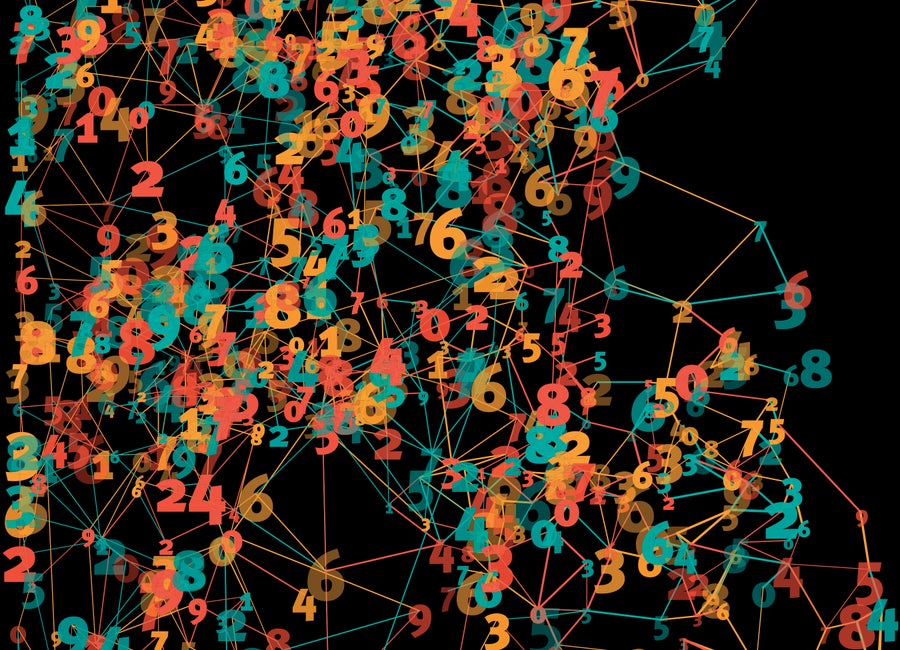
As is so often the case in mathematics, the conjecture falls into the category of those that are easy to understand but devilishly hard to prove. Twin primes are two prime numbers that have a distance of two on the number line; that is, they are directly consecutive if you ignore even numbers. Examples include 3 and 5, 5 and 7, and 17 and 19. You can find a lot of twin primes among small numbers, but the farther up the number line you go, the rarer they become.
That’s no surprise, given that prime numbers are increasingly rare among large numbers. Nevertheless, people have known since ancient times that infinite prime numbers exist, and the prime number twin conjecture states that there are an infinite number of prime number twins, as well. That would mean that no matter how large the values considered, there will always be prime numbers in direct succession among the odd numbers.
Admittedly, translating these concepts for kids is not easy (which is why I have so much respect for Egesborg and his children’s book). Prime numbers (2, 3, 5, 7, 11, 13,…) are like the fundamental particles of the natural numbers. They are only divisible by 1 and themselves. All other natural numbers can be broken down into their prime divisors, which makes prime numbers the basic building blocks of the mathematical world.
A Proof from Antiquity
Mathematics has an unlimited number of prime number building blocks. Euclid proved this more than 2,000 years ago with a simple thought experiment. Suppose there were only a finite number of prime numbers, the largest being p. In this case, all prime numbers up to p could be multiplied together.
The best high-protein snacks can serve a vital role: Meeting your protein goals can be a challenge if you go hard at the gym. Without getting enough protein, you won’t be able to maintain or build muscle. Hopefully, you’re already getting protein at every meal, but it can still be tough to hit your number, and the right snacks are can helps The key is having some of the macronutrient readily accessible, so here are 10 high-protein snack ideas—all recommended by registered dietitians.
What’s Considered a “High Protein” Snack, Anyway?
You already know that protein is important, but maybe things get fuzzy when it comes to how much you should aim to get each day. Registered dietitian and From Burnout to Balance author Patricia Bannan, MS, RDN, says that while individual needs vary based on one’s weight, age, and activity level, a good general rule to follow is consuming .8 grams of protein per kilogram of bodyweight and between 1.2 to 2.0 grams per kilogram of bodyweight if you’re working out regularly or super active.
Take someone who weighs 180 pounds, or 82 kilograms. For the minimum protein requirement (0.8 grams per kg), multiply that by 0.8, which comes out to 65 grams.
While hitting your daily protein goal is important, registered dietitian Andy De Santis, RD, suggests not to get too obsessive. “A protein target is important, but so is having an overall balanced diet,” he says. If you’re eating the same high-protein foods continuously instead of a wider range of nutrient-rich foods just to stay under a certain calorie budget, De Santis says it’s time to take a step back and reevaluate. What’s most important, he says, is eating a wide variety of nutrient-rich foods so you’re getting a broad mix of everything the body needs.
With all of this in mind, what exactly is considered a high-protein snack? Registered dietitian Kristin Kirkpatrick, RD, says this depends on someone’s individual protein goals, but she considers a high-protein snack to be something with between 10 and 25 grams of protein. Any less than that, wouldn’t be considered “high protein” and any more than that is veering into meal territory, not a snack.
When Is a Good Time to Eat a High-Protein Snack?
“What’s most important is hitting your daily protein target. From there, you can consider how you’re meeting that target throughout the day,” De Santis says, emphasizing that this is where high-protein snacks come in handy. “High-protein snacks can help close the gap between the protein people are getting at their meals and their daily goal,” he says.
If you’ve experienced this phenomenon, you’ve had a prospective memory lapse.
Memory usually means remembering things that have already happened. But prospective memory is the ability to remember to do something in the future – such as stopping to get milk on the way home from work, calling your mom on her birthday, or remembering to take your casserole out of the oven. Sometimes, errors lead to heartbreaking results – such as forgetting to take your toddler out of the car on a hot day.
I am a clinical neuropsychologist and a professor of psychology and neuroscience. For the past 30 years, my research has focused on this phenomenon, measuring prospective memory and looking for treatments to help those having problems.
Carrying out future intentions
Prospective memory is the ability to remember to remember, or to remember to carry out a future intention.
A future intention can be retrieved in two different ways. One is in response to something in your environment, such as a sight or a sound, that serves as a cue to do an intended action. Researchers like me call this an “event.” For instance, you see your co-worker and remember you have a message for them; you hear the timer go off and remember to turn off the sprinklers.
The other way is in response to time. Your dental appointment is scheduled for 2 p.m., but you plan to exercise for 30 minutes first.
One possible explanation for how people retrieve a prospective memory is known as the multiprocess theory.
According to this theory, sometimes you have to put forth effort to remember, such as checking the time repeatedly until it gets to be 2 p.m. Other times the memories come to you without effort, such as when you hear an alarm. As the above examples suggest, memories that have time-based cues, like 2 p.m., are usually more difficult to remember than those that have event-based cues, such as an alarm.
Brain regions at play
Older adults tend to lose prospective memory as they age. This may be because of brain changes in the aging prefrontal cortex.
But it’s not all bad news. Older adults actually seem to do better than younger people in some situations when they are asked to remember things in their daily lives. We call this the age-prospective memory paradox.
The part of the brain that seems most responsible for prospective memory is an area of the frontal lobes, referred to as Brodmann’s area 10. This area is involved with holding information in mind while doing a different simultaneous task.
.
People tend to lose prospective memory as they age. jpa1999/Getty Images
Ready to put together an arms-and-shoulders workout? I’ve already given you the lowdown on the best bicep exercises, the best tricep exercises, and best shoulder exercises. Today I’ll give you a formula to combine them, and it’s customizable so you can swap in your favorites if you don’t love mine.
The structure
We’re going to start with a heavy(ish) compound exercise that works your arms and shoulders together. Then we’ll move on to moderately heavy exercises, starting with the ones that didn’t get hit very hard on the compound. We’ll superset exercises where we can, to save time. It will look something like this:
Shoulder press of your choice – 5 sets, heavy, anywhere between 3-8 reps, with 2 minutes of rest between sets.
(optional) Rear delt work – 3 sets of 8-12 reps
Bicep/tricep superset – 3 sets of 8-12 reps each
Shoulder superset – 3 sets of 10+ reps each
(optional) Light bicep/tricep superset – 3 sets of 12-15 reps each
For a 30 minute workout, skip the optional sections and just do a shoulder press, bicep/tricep superset, and a shoulder superset. The first 15 minutes will be spent on the shoulder press and the rests between sets; the other components you can speed through with basically no rest.
To get more work in, take some extra time and do the optional sections. If you try that and find you’re recovering well, it’s fine to add more bi/tri supersets or double up on any of the components of the workout that you’d like to spend more time on.
How this fits into your week: Once a week is okay, but this workout should ideally be done twice per week. It’s also fine to do this workout once, and a different upper-body workout another time.
“Sight” is a biographical drama directed by Andrew Hyatt, and written by Hyatt, John Duigan, and Buzz McLaughlin. The film, based on a true story is about a Chinese immigrant who comes to the United States and becomes a renowned eye surgeon. It is also based on Wang’s 2016 autobiography From Darkness to “Sight”. I […]
Be happy for what you’ve got I know it may not be a lot. – Be happy for where you live Even if you don’t have a lot to give. – Be happy for who you are You may not be a famous star. – Be happy for loving yourself Even if others think you’re […]
A pathological liar lies continuously and often without a clear gain, but they may also lie to manipulate others. Compulsive lying can also be more of a reflex, where a person lies without even realizing it.
Have you ever had the feeling that someone you’re talking to is not telling the truth? Or that what they’re saying doesn’t match up with the facts? Over time, have you caught this person in multiple lies, some small, and others big? If so, you may wonder if the person could be a pathological liar.
With insights from a psychologist, this article will go over what pathological lying is, how it compares to other kinds of lying, and what to do if you’re dealing with a pathological liar.
Press Play for Advice On Lying
Hosted by therapist Amy Morin, LCSW, this episode of The Verywell Mind Podcast, featuring psychologist Paul Ekman aka “the human lie detector” shares why people lie and how to tell if someone is lying. Click below to listen now.
What Is Pathological Lying?
Most people tell the occasional fib, but some people lie more often and even do so unconsciously, says Aimee Daramus, PsyD, a licensed clinical psychologist.
While a pathological liar is not a mental health diagnosis on its own, according to the Diagnostic and Statistical Manual of Mental Disorders, Fifth Edition (DSM-5), it can be a feature of mental health conditions.
While it’s not clear what causes compulsive lying, we know that lying is a complex process in the brain. And we know that pathological lying differs from other types of lying because it’s problematic.
CLIMATEWIRE | The world still isn’t sucking enough carbon dioxide out of the atmosphere to meet the Paris climate targets, scientists said Tuesday. And the gap grows wider every year that humanity delays meaningful cuts to global greenhouse gas emissions.
That’s the punchline of a new report on the state of global carbon dioxide removal, the practice of drawing CO2 out of the air to help tackle climate change. It’s an update to the report’s first edition, which was published in January 2023.
Nations worldwide are scrubbing about 2 billion metric tons of carbon dioxide each year, mainly by planting trees, the report says. But experts estimate they’ll need to remove at least 7 billion tons annually by midcentury.
Meanwhile, global emissions must fall rapidly to stay on the Paris track. Humanity spews nearly 40 billion metric tons of carbon dioxide each year through the burning of fossil fuels.
Scientists agree the primary strategy for tackling climate change is through a reduction of greenhouse gas emissions, mainly by phasing out fossil fuels and halting deforestation. But they also agree at least some carbon removal is necessary to keep global warming below 1.5 or 2 degrees Celsius, the major goals of the Paris Agreement.
That’s because global emissions must reach net zero within a few decades to meet the Paris timeline, meaning any remaining carbon going into the atmosphere must be counterbalanced by an equal amount coming out.
Carbon dioxide removal, or CDR, is the “only way really to provide a balance of net zero if we still have residual emissions in the system,” said Steve Smith, a climate science and policy expert at the University of Oxford and a lead author of the new report, at a press conference Tuesday.
The simplest way to hit net zero is to stop pouring carbon dioxide into the air. But some sectors of the economy likely cannot be fully decarbonized within the next few decades, either because the technology doesn’t exist yet or it can’t be scaled up quickly enough.
That means some residual emissions will be leftover by midcentury, and world leaders will need to offset them with carbon removal.
There are a variety of ways that can be done. Planting forests is the most popular strategy today, accounting for nearly all the carbon removal happening around the world. But researchers are working on a range of novel techniques on the side, from giant carbon-guzzling machines to special minerals that help the land or the ocean absorb more CO2.
.
Mammoth carbon removal plant in Reykjavik, Iceland. John Moore/Getty Images
Film and Writing Festival for Comedy. Showcasing best of comedy short films at the FEEDBACK Film Festival. Plus, showcasing best of comedy novels, short stories, poems, screenplays (TV, short, feature) at the festival performed by professional actors.

 FrankRamspott/Getty Images






:max_bytes(150000):strip_icc():format(webp)/GettyImages-1198174856-9e0b456ad2fa4a2c885bc71385f892b3.jpg)