In a world first, China has approved a brain implant for commercial use in people with spinal cord injuries.
The device is a type of brain-computer interface (BCI) and is made by the Shanghai-based company Neuracle Medical Technology, a potential rival of Elon Musk’s BCI start-up Neuralink. Brain implants have been used as part of clinical trials for decades, but this is the first time such a device has been approved for broad use in patients.
BCIs, sometimes known as brain-machine interfaces, are devices that record brain activity. Invasive BCIs like Neuracle’s are surgically implanted in or on the brain. There, they record electrical signals from neurons. Software then “decodes” these signals, which can then be used to control a computer cursor or a prosthetic limb, for example.
Neuracle’s BCI consists of a coin-sized wireless implant that sits on the surface of the brain’s outer membrane and controls a robotic glove. It is specifically designed for people with spinal cord injuries, but is only approved for people who still have some upper arm function. BCIs, in general, are typically being developed for use by people with paralysis or other disabilities. Neuralink’s Musk has talked about one day making them available to people with no health problems, but that application is farther off.
One of the first (and still one of the leading) BCIs was created in the early 2000s by a research consortium called BrainGate. The device enables study participants with paralysis—including from amyotrophic lateral sclerosis or locked-in syndrome, which involves paralysis of everything but the muscles that control eye movement and an inability to speak caused by a stroke or injury—to control a computer mouse and type on a virtual keyboard. Since then, other research groups have developed devices capable of similar feats.
In the U.S., Musk’s Neuralink has come the closest to commercializing this technology, but questions about the device’s safety remain. In 202,2 the Food and Drug Administration initially rejected a bid for Neuralink to test its technology in a clinical trial. A trial was eventually approved the following year, and then 30-year-old Noland Arbaugh, who was paralyzed below the neck, became the first user to have a Neuralink implant. As of January 2026, the company said it had 21 participants enrolled in its trial.
Other American start-ups, such as Synchron and Paradromics, are developing their own BCIs and are also running ongoing trials.
But while there is compelling evidence from these clinical tests, the devices are still considered experimental. Installing brain implants requires brain surgery, after all, which is highly invasive and carries a risk of infection and complications. And the implants can sometimes move or cause scar tissue buildup over time that degrades their signals. No BCI devices have been approved for commercial use in the U.S.
“It’s super important for partners to be honest with each other and share everything about their finances. A lot of couples have one personality who is more financially aware and one who is happy to let the other person take care of everything. But that can get dangerous when there is a death, disability, or divorce. The person who didn’t do much financially may not even know what they own or where their assets are. I handle most of the investment decisions in my marriage, while my husband handles the bills, but we do an ‘audit’ once a year, where we review everything and make sure we both can log in to all our accounts. So, neither of us is living blindly, and we know how to do something the other does, if we need to.”
Don’t keep your children’s inheritance a secret.
“You shouldn’t be a lottery to your kids. It’s good for your children or heirs to know what money they’re going to get from you. One of the worst things you can do to a young or middle-aged adult is to have them wonder what they’re going to receive, because then they can’t do their own financial planning.”
Give with a warm hand (part one).
“With people living close to 100 years these days, it might not be the best practice to wait until death to leave an inheritance to your kids, who may be in their seventies and retired at that point. Maybe the best thing you could do for your children and grandchildren is to give some of that money to the parents when that baby’s first born. Then the parents have more resources to either get good day care or go to part-time work themselves to be able to invest more in these little ones when they really need it.”
Explain your financial choices.
“Growing up, we didn’t talk about money in our household. If there was enough money, our parents didn’t talk about it. If there wasn’t, they would fuss and argue. With my own children, who are 11 and 15, I do the opposite; we talk about money in age-appropriate ways so they understand how and why we choose to spend our money. We almost never go out to eat, for example, so we can spend our money on travel and education, which are our priorities.”
Give with a warm hand (part two).
“There’s always this kind of fantasy that you’re going to leave equity in your home to your children, but it is often worth a lot less than you think it is because it hasn’t been maintained, it’s filled with your crap. Your kids would likely rather have had the cash earlier or the financial foresight into how to manage that cash than any kind of surprise lump sum.
So consider inter vivos transfers, which means gifting assets while you’re alive. Work with an adviser to find out how much you can give them now during your lifetime, while also making sure that you have enough for yourself. The other reason your children will like that, besides being able to plan more rationally, is that they’ll know you’ll be OK.”
Talk to your kids about money.
“My dad was very open about money. He felt the best thing you can do is teach your kids about money so that they understand it is a tool. He wanted us to learn how to earn, save, and share money, but also to know how to enjoy spending. He explained life insurance to me as a 10-year-old (in an age-appropriate way.) He taught me to not spend money in the dark, so to not waste money on things like fees or fines. But more importantly, he would tell me: ‘Just because you avoid the conversation, doesn’t mean you’re avoiding the problem.’ I’ve tried to carry on that approach with my own children. I did taxes with them, had them fill out their federal student aid applications next to me as teenagers. We talk about Roth contributions, what sneakers they’re buying.”
Let your kids know pertinent details about your finances.
“We know that most financial predation happens within families, so you can imagine a mother or father not wanting to discuss anything about their finances with their children. But if those are the same people you’re planning to leave money to, then you should want to do it in an orderly way. So tell them where important documents are, what your plan is, but don’t hand over the account number. It’s probably best if you don’t ever hand over finances to a family member, but pay a professional to do it. Most children don’t have the financial education to do so and don’t want the added stress.”
Consider a college’s ROI.
“People have started revolting against college for a lot of good reasons. A four-year degree, it turns out, is not what all people need in order to do really well in their careers. And many would be financially better off not going to a four-year college and avoiding taking on life-changing levels of debt.
Families and students really need to be thoughtful about what kind of education is needed and what kind of debt you’ll accumulate getting a degree. For some jobs, like engineers, lawyers or doctors, it is likely still worth the investment. But for many other jobs, it could not be. And it can be really hard to pay back some of those loans when you’re on a social worker’s or teacher’s wages.”
Don’t pick a college based on reputation alone.
“This idea that you have to go to the best college you get into is not great advice anymore. I think students and parents have to look at college as a value proposition. My younger cousin got accepted into Harvard University, but she took a full ride offer from the University of Delaware instead. Then she was able to use the money her mother had saved in a 529 account as a down payment on a fixer-upper home.”
The best advice for young people
Don’t make things too complicated.
“Don’t worry about money so much, and keep things simple: Stay out of debt. Do what’s right instead of what’s easy. Always put people first before money.”
Start small, but start now.
“Saving small amounts, as early as possible, compounds in wonderful ways. It’s not about the amount; it’s that you actually do it. When I graduated from Princeton in 1991, every single person was asked to give $19.91 to the university. They were teaching us to be givers. It’s a brilliant concept, and I wish everyone would do that with their 401(k) plan. Start with even small amounts and, over a lifetime, that can get very big, very fast.”
Understand the true secret to wealth.
“When we are young, we really don’t understand the power of compounding. Warren Buffett, at 95, has seen his entire net worth double over the last seven or eight years. That’s really astonishing when you think about it. And compounding doesn’t just work with money. It works with habits, with health, with networking, with collaboration. It’s not just about your portfolio.”
Take the slow road.
“There is a narrative right now that young people are completely screwed and that in order for them to catch up, they need to take speculative bets, like getting into prediction markets. True, life costs more now than 20 or 30 years ago. But if you consistently save and invest, you will get where you need to be financially—maybe a little bit slower than your predecessors 30 years ago, but you can still live a pretty comfortable life. The prediction market is essentially just gambling. It’s possible to have a nice life without having to take on that kind of risk.”
Save early and often
“Open a savings account early, and make savings a habit, even if the amounts saved are tiny. My father opened a savings account for me when I was little and doubled any money I placed in it. My mother said, ‘Spend money, but don’t waste it.’ I did the same for my two daughters.”
Save early and often
“Open a savings account early, and make savings a habit, even if the amounts saved are tiny. My father opened a savings account for me when I was little and doubled any money I placed in it. My mother said, ‘Spend money, but don’t waste it.’ I did the same for my two daughters.”
Put money in stocks ASAP.
“I should have started investing in stocks much earlier than I did. Even when I became a financial planner, at first I was only paying my bills and investing very little. I’m 64 now, so if I had started investing in the stock market sooner, I could have been the Mexican Warren Buffett.
Don’t wait to save until you make more money.
“Your financial goals don’t have to wait until you’re out of debt or make more money. You can start to act on them as soon as you earn that first paycheck, even if you have student loans or credit card debt. You may not be able to go full speed at the moment, but you can begin to plant seeds and educate yourself. Your financial goals matter because you matter, and the best time to start working toward them is today.”
Live it up a little.
“Have more fun. Yes, focus on your savings and investment rate, but there are certain things you can only do in your twenties. Do them now!”
Ali Bani Odeh’s wife and four young boys hadn’t seen him in a month and a half when he came home to Tammun, in the West Bank, from his construction job in Israel late on Friday to spend the last few days of Ramadan with his family.
On Saturday night, the boys persuaded him to take them out for a drive. Eid al-Fitr, the end of Ramadan, was coming, so there were new clothes to buy. The day’s fast had been broken, so there were sweets to be had, too.
They picked up fried doughnut holes in Tubas, saving them for later, but the clothing shop they went to in Nablus was closed. It was already past midnight, so they headed back to Tammun: Khaled, 11, the oldest, in the back with Mustafa, 8, and Muhammad, 5. Othman, 6, blind and incapable of walking or feeding himself, was in his mother’s lap in front.
As they rounded a corner slowly, a few minutes from home, young Khaled and Mustafa recounted on Sunday, their mother, Waad, 35, asked her husband to pull over and take Othman from her so she could get something from her bag on the floor. Suddenly, the boys said, they saw laser pointers shining on their family from every direction, heard their mother scream, heard their father say “God is great” — and then heard a deafening fusillade of gunfire.
The Israeli police and military, in a joint statement Sunday morning, said that border police officers and soldiers, while on a mission in Tammun to arrest suspected terrorists, had “sensed danger” after a vehicle “accelerated towards” them and “responded by shooting.” They said the circumstances of the episode were being investigated.
The two accounts could not have been more contradictory. But one fact was undisputed: Mr. Bani Odeh, 37, his wife, Othman, and Muhammad were all shot and killed.
The Israeli-occupied West Bank is under siege as it has not been in years, with extremist Israeli settlers terrorizing Palestinian villagers on hillsides and in valleys where they live near one another. The body count is rapidly piling up: Seven Palestinians have been killed so far this year, all but one of those since the war with Iran began on Feb. 28.
The Israeli military, which is the governing authority in the West Bank, has condemned settler violence and insists that it is working to prevent it. The Israeli police, who are responsible for investigating crime committed by Israelis in the West Bank, say they act against any violence, but have largely failed in bringing violent settlers to justice.
But Tammun is deep inside the territory governed and policed by the Palestinian Authority, far from the friction with settlers. And Mr. Bani Odeh believed that, even if he encountered Israeli soldiers, he had little to fear, according to his father, Khaled Sayl Bani Odeh, 65. He knew he posed no threat, and believed that if stopped, he could talk his way out of any trouble — in fluent Hebrew — thanks to his experience working inside Israel.
On Saturday, Ali Bani Odeh was reluctant to take the boys on an outing, his father said. He was tired and wanted to rest. But the boys were restless, and he gave in.
Muhammad, the youngest, usually stayed with his grandparents because he was hyperactive, according to the elder Khaled Bani Odeh. “I was trying to tell him not to go,” he said at the family’s wake on Sunday afternoon. “But his grandmother said, ‘It’s not far, let him go.’”
Little Muhammad asked his grandfather to fix his hair and give him some of his cologne. “I did, and he set off,” Mr. Bani Odeh said.
Later Saturday night, as the grandfather was watching soccer on television, he said, his wife prodded him to call their son and check on them.
“I said, ‘They’re in a car with the children — there’s nothing that can happen to them,’” he recalled ruefully, as dozens of men streamed into the cavernous social hall where he sat, paying their respects.
Palestinian security officials said they had been briefed by their Israeli counterparts only after the fact, and told that the Israeli police and military mission in Tammun was to arrest two youths: one suspected of making explosive devices, the other of using social media to incite violence against Israelis.
Israeli officials mentioned only people suspected of making explosive devices.
Liron Rubin, a spokesman for the border police, said that the officers and soldiers had signaled for the vehicle to stop using flashlights and laser pointers, but that it kept coming toward them.
“They’re a very professional force,” said Dean Elsdunne, another police spokesman. “If they felt their life was at risk when they’re operating there against terrorists in a very dangerous place, it’s for them to say.”
They declined to discuss other details of the case, citing the investigation underway.
Khaled and Mustafa, the surviving boys, spoke later outside the women’s wake for the family at a home uphill from the social hall. Mustafa wore a bandage across his nose, where he said he had been hit by shrapnel from a bullet.
He described trying to pull 5-year-old Muhammad toward him, to help him, but said that his brother was already dead.
Khaled, a sixth-grader, did most of the talking.
“When the shooting stopped, I opened the door and started yelling, ‘Please help me,’” he said. He said the soldiers told him to shut up, and that one pulled him out of the car by his hair. He said he had been thrown to the ground and stepped on, questioned aggressively about whether anyone else had been in the car, and beaten on the head and legs.
An Arabic-speaking soldier spoke to him kindly, calling him “Habibi,” but then kicked him repeatedly, Khaled said.
When Khaled told the soldiers that he and his brother needed a bathroom, he said, the soldiers pointed them in the direction of a Palestinian ambulance that had been waiting about 100 meters away. As they walked that way, he said, a soldier opened the door of his family’s car. Inside, he said, he saw his dead parents.
Khaled’s grandfather said he had seen his slain family members’ bodies at the hospital. His daughter-in-law had been shot multiple times in her head and chest. Young Muhammad was shot several times in the face.
His 11-year-old namesake, visibly numb, said he had found part of his little brother’s body on his shoes.
“It’s indescribable,” Khaled said. “One or two hours before, we were in Nablus. They took us to so many places. They bought us doughnuts. Then we were on our way home.”
They never got the doughnut holes out of the bag.
.
Palestinians mourning the deaths of four members of the Odeh family in Tammun, West Bank, on Sunday. Credit…Majdi Mohammed/Associated Press
Solo Mio is a romantic comedy drama directed by Chuck Kinnane and Dan Kinnane, written by Patrick Kinnane, John Kinnane, and Kevin James. It was released by Angel Studios on February 6, 2026. I have been trying to watch all of Angel Studios’ movies ever since they released The Chosen. I find that this spiritually […]
Hmmmm…give yourself a gold star if you can follow this one!
Click the link below the picture
.
Many people shudder at the thought of Friday the 13th. Myths, legends and horror films have turned it into an omen of bad luck.
History has also had plenty of bad Friday the 13ths. On Friday, September 13, 1940, Nazi forces bombed Buckingham Palace in London. On Friday, January 13, 2012, the Italian cruise ship Costa Concordia struck a rocky outcropping and capsized, resulting in a total evacuation and 32 deaths. And on Friday, September 13, 1996, Tupac Shakur succumbed to his gunshot wounds from six days prior.
But the 13th day of a month that happens to fall on a Friday is just a day. Superstitions about it can be dispelled with mathematics. Using number theory, you can easily demonstrate that there isn’t a single year without this ominous date. In fact, the 13th day of a month falls on a Friday more often than on any other day of the week.
Adventures in Number Theory and Calendars
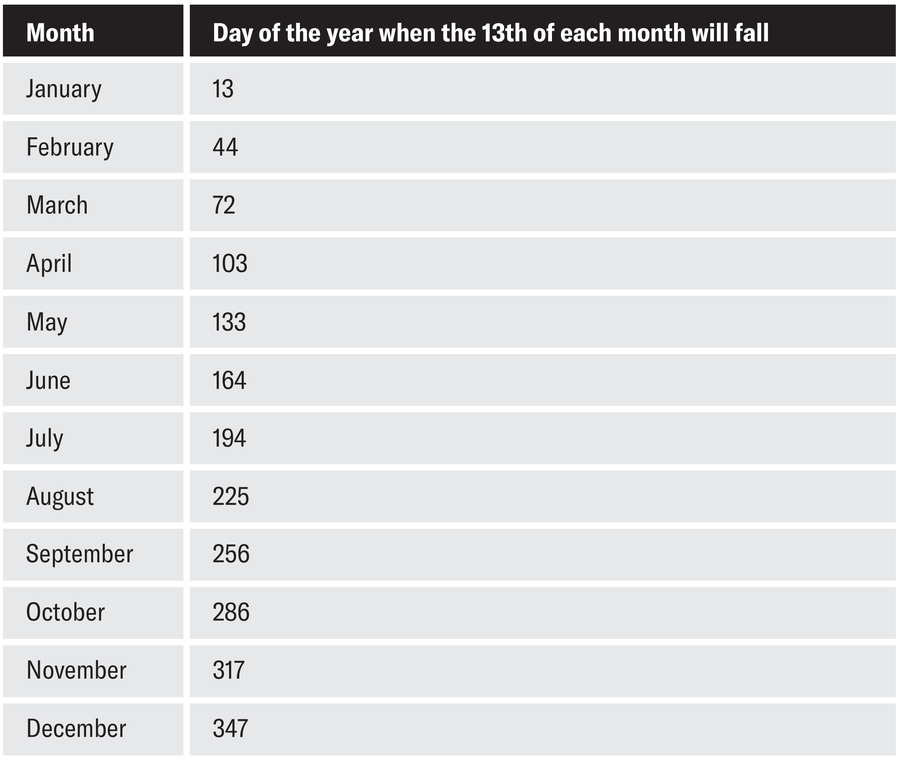
To keep things simple, let’s first focus on years with 365 days. We can begin by calculating which sequentially counted day of the year the 13th of a month will fall on, using the number of days in each month as a guide. So January 13 is the 13th
day of the year, February 13 is the 44th day, March 13 is the 72nd day, and so on. Here’s a table summarizing what this approach reveals.
During a year with 365 days, January 13 falls on the 13th day of the year. February 13 falls on the 44th day of the year; March 13 falls on the 72nd day; April 13 falls on the 103rd day; May 13 falls on the 133rd day; June 13 falls on the 164th day; July 13 falls on the 194th day; August 13 falls on the 225thday; September 13 falls on the 256thday; October 13 falls on the 286th day; November 13 falls on the 317th day; and December 13 falls on the 347th day
A week is a repeating pattern of seven days. That means, for example, that the first, eighth, 15th, 22nd, and so on always fall on the same day of the week. Therefore, it’s possible to determine which 13th days of a month fall on a given day of the week. To do this, simply divide the number of days in the year that have already passed on the date you’re investigating by 7. The remainder will tell you which day of the first week of the year that date matches.
This might sound complicated, but it’s actually quite simple: when you divide the 13th day of the year by 7, for example, you get 1 with a remainder of 6. This means that the 13th day of the year falls on the same day of the week as the sixth day of the year. You can repeat this process for the 13th day of each month, which result in the following.
During a year with 365 days, January 13 and October 13 will fall on the same day of the week as the sixth day of the year. February 13, March 13, and November 13 will fall on the same day of the week as the second day of the year. April 13 and July 13 will fall on the same day of the week as the fifth day of the year. May 13 will fall on the same day of the week as the seventh day of the year, recorded in the chart as the zeroth day of the year. June 13 will fall on the same day as the third day of the year. August 13 will fall on the same day of the week as the first day of the year. September 13 and December 13 will fall on the same day of the week as the fourth day of the year.
Each day of the week, labeled 0 to 6, appears at least once in the list. (And for those skipping the math and skimming the tables, the 0thday of the year is actually the 7th day.) This means that in a year with 365 days, each day of the week will be the 13th of a month at least once (days 0, 1, and 3 each appear only once). Days of the week can also be the 13th of a month twice (days 4, 5, and 6). And there is one day of the week that will be the 13th of a month three times (day 2).
The wealthy bankers, political leaders, and prominent academics who visited Jeffrey Epstein’s Caribbean island traveled by private jet and spent afternoons scuba diving or riding jet skis.
The girls and young women that Epstein shuttled to the island had a drastically different experience: confiscated passports, extensive sexual abuse, and conditions so dire that at least one said she tried to escape by swimming away.
For nearly two decades, Little St. James, Epstein’s roughly 70-acre island, was the perfect tool for him to both cultivate powerful friends and abuse young women and girls. It offered Epstein both a glamorous setting to attract famous figures and the seclusion he needed to prey on his victims.
Now, a trove of millions of pages of documents released by the Department of Justice creates the clearest picture yet of Epstein’s tropical crime scene, a mysterious locale that’s at the center of a sex trafficking scandal still roiling global politics today.
A CNN review of thousands of emails, photos, videos, and documents from the DOJ files adds critical new details to how Epstein transformed the island into his personal fiefdom – and highlights warning signs of the terrible abuse perpetrated there that some staffers and victims say was happening in plain sight.
The testimony outlined in the DOJ documents calls into question claims by some influential visitors to Epstein’s island who have denied knowing about the financier’s sex trafficking – and shows several of those guests boasting of sexual exploits or engaging in crude conversations with the convicted sex offender.
“The activities were so obvious and bold that anyone spending any significant time at one of Epstein’s residences would have clearly been aware of what was going on,” one victim stated in a court document.
Those warning signs include photographs of naked young girls on his walls, airport workers who reported Epstein had traveled with girls who appeared underage, and an interior decorator who said he’d been asked to design one of the island’s bedrooms with pink furnishings and bunk beds.
Some staffers and victims have also called out specific Epstein guests, the documents show, such as Google co-founder Sergey Brin and 23andMe co-founder Anne Wojcicki, who both spent a day on the island in 2007, according to a victim’s statement. “They observed that we did not speak and that we remained mute,” the victim, whose name is not included in the public document, wrote in the statement. “They witnessed the trauma on our faces and in our eyes. Sergey and Anne witnessed our souls and bodies riddled with fear. They said nothing. They did nothing.”
Brin and Wojcicki did not respond to requests for comment.
In the wake of Epstein’s death in a federal jail cell in 2019, his estate sold Little St. James and the neighboring island of Great St. James, which Epstein also owned, for about $60 million, at least some of which has gone to paying settlement costs related to his abuse.
But questions about the island and its place in Epstein’s sprawling financial empire have only grown in the years since his death.
Little St. James became “the hub” of Epstein’s sex trafficking because it was the ideal place to “isolate his victims,” said Thomas Volscho, a City University of New York professor who has studied Epstein’s crimes.
“You’re in paradise,” he said, “but you’re in hell at the same time.”
From tropical paradise to human trafficking hub
When Epstein bought his island for about $8 million in 1998, he was a financier with a spotless criminal record, a growing network of prominent friends, and a home base in one of Manhattan’s largest private residences. In a Wall Street Journal real estate listing at the time, the island’s previous owner, venture capitalist Arch Cummin, described life on Little St. James: “You can hop off a plane and never see anybody again.”
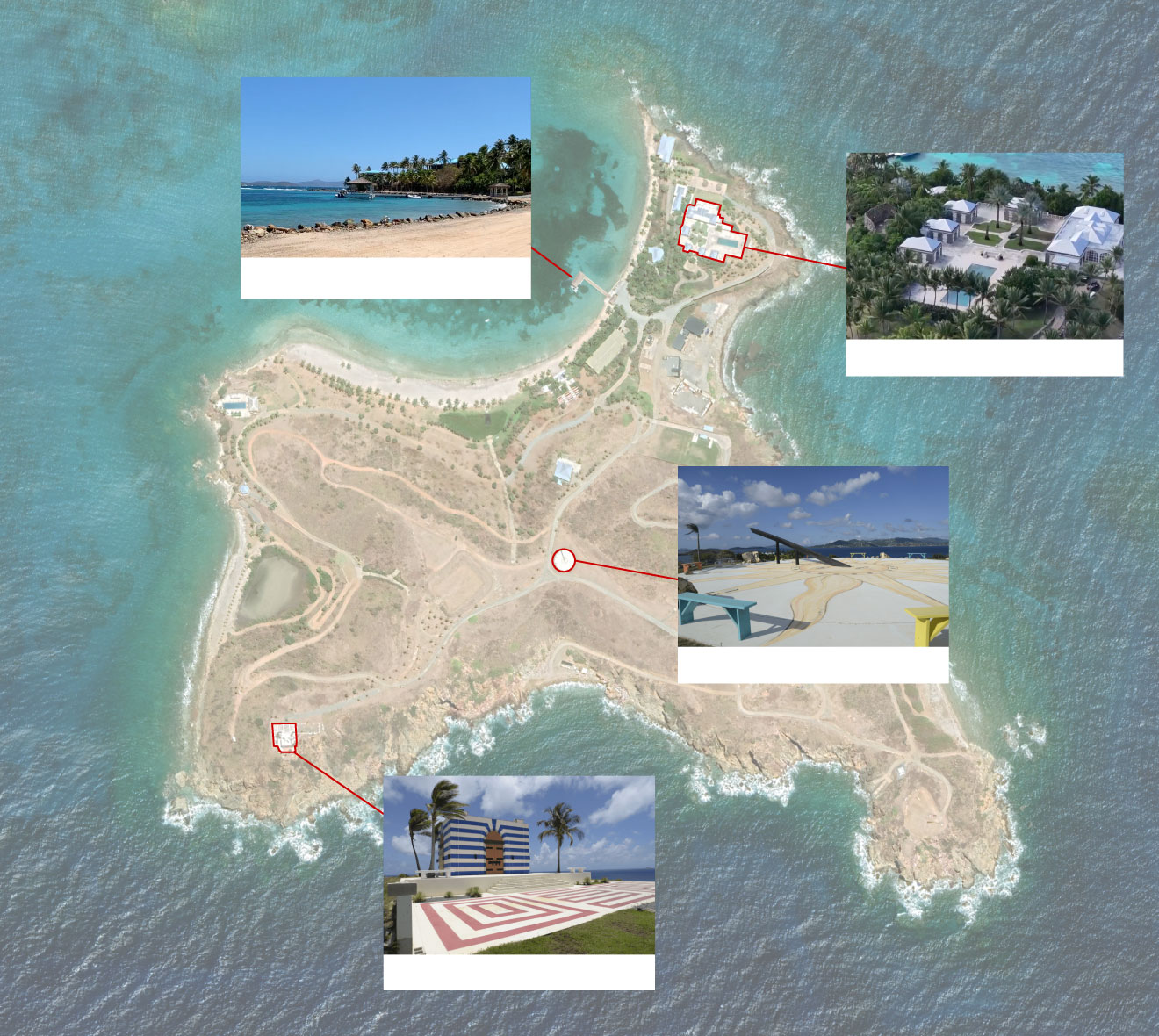
The windswept island is more than a mile away from St. Thomas in the US Virgin Islands, and only accessible by helicopter or boat. Over the course of 20 years, maps and documents illustrate how Epstein transformed the somewhat desolate Little St. James into what appeared on the surface to be a luxurious vacation destination complete with a theater, library, stand-alone gym, tiki hut, and staff residences.
Satellite images from 2002 show just a handful of buildings, with the main house and a few cabanas and outlying structures on the island’s northern tip. In the late 2000s and early 2010s, Epstein significantly expanded the living spaces, adding a larger pool, new cabanas, a massive sundial, and a bizarre temple-like structure overlooking the island’s southwest coast.
.
How Epstein transformed his private island
Jeffrey Epstein embarked on a building spree on Little St. James over the two decades he owned the island, satellite images show. He expanded the pool, extended a dock on his private beach, and added other new structures such as a sundial and temple-like building.
Private beach, main residence, Sundia, and a Temple-like structure
.
.
Click the link belowfor the complete article ( Scroll down slightly for the video to play after it loads):
Last week, James Fishback, a 31-year-old running for governor in Florida, was speaking to a packed house at the Queens Harbour Yacht and Country Club in Jacksonville. Every one of the room’s almost 100 seats was taken, and people were standing several rows deep around the perimeter, with more listening from the lobby outside. The crowd was mostly male and very young; several attendees told me they were in high school. A few wore the “America First” baseball caps popular with followers of Nick Fuentes, the influential white nationalist troll.
Slight and bespectacled, Fishback has a geeky charisma and the verbal dexterity of a former competitive high school debater. His policies are a mishmash of extreme conservatism and economic progressivism; nationalism tinged with socialism, if you will. He believes that Florida’s gun laws are too strict, its abortion laws are too lax and its public teacher pay is too low. He’s called for a 50 percent sin tax on OnlyFans creators and $10,000 grants to high-performing high school graduates to buy homes or start businesses. Though he’s the son of an immigrant — his mother is Colombian — he wants a total immigration moratorium.
Most of all, Fishback has made contempt for Israel and its American lobby a centerpiece of his campaign, constantly reminding audiences how much America spends on Israel while its own needs are ignored. He often calls Byron Donalds, a Black Republican congressman who is the front-runner in the governor’s race, “AIPAC Shakur,” a play on Tupac Shakur. Appearing on Tucker Carlson’s show in January, Fishback described the “sexual, sadistic” pleasure that pro-Israel donors get in forcing America to “bend over” for a foreign country. Carlson endorsed him and wrote, “Pretty soon, all winning Republican politicians will talk like this.”
After Fishback’s hourlong speech, a young guy stood up to ask how he could trust the candidate to keep his promises, especially when it came to refusing money from AIPAC, the American Israel Public Affairs Committee. Fishback claimed that three weeks prior, a donor had offered his PAC $500,000 if he would disavow Fuentes’s supporters. “I hung up the phone because I will never disavow patriotic Americans,” he shouted, to whoops and applause.
Fuentes’s ideology is a sneering, adolescent sort of Nazism. As he said on his podcast last year: “Jews are running society. Women need to shut the [expletive] up. Blacks need to be imprisoned for the most part.” In Fishback, Fuentes’s followers — often known as groypers — have a candidate who is serious about representing them.
It turns out that there are a lot of Gen Z men who have been waiting for a candidate like Fishback to come along. The Jacksonville event was hosted by the Greater Intracoastal Republican Club, which regularly brings Republican candidates to speak. The group’s president, Laura Collins, seemed somewhat amazed by the turnout. “I was surprised to have so many young people,” she told me. “This is the most people that we’ve had for any candidate.”
Fishback is extremely unlikely to ever become governor of Florida. Most polls show him with 5 percent or 6 percent of the vote, and as of January, he’d raised around $19,000, compared with more than $45 million by Donalds, who has Donald Trump’s endorsement. He may not even be legally qualified for the office, since Florida law requires governors to have lived in the state for at least seven years, and Fishback registered to vote in the District of Columbia in 2020.
But anyone concerned with the escalating extremism of the young right should be paying attention to his campaign and the enthusiastic crowds it’s drawing. More than any political candidate yet, Fishback has managed to bring the paranoid, transgressive, meme-drunk spirit of the right-wing internet into the real world. Chris Rufo, a conservative operative who played a major role in Ron DeSantis’s war on wokeness, is no fan of Fishback, but said that “he’s demonstrated a pretty sophisticated method for turning a campaign with no budget, a skeleton staff, into the most talked about campaign in Florida politics.”
Fishback is tapping into an increasingly radicalized generation of Republicans. In December, the conservative Manhattan Institute found that 31 percent of Republicans under 50 identify their own views as racist, and 25 percent say their views are antisemitic. For those over 50, it’s only 4 percent for each. The same survey showed that a majority of Republican men under 50 think that the Holocaust either didn’t happen or was exaggerated.
Last week, College Republicans of America appointed a new political director, Kai Schwemmer, who is a Fuentes crony and Fishback admirer. “James fishback has trustworthy physiognomy, Byron Donalds, on the other hand, is deceitful and suspicious,” he posted on X. Fishback doesn’t represent the mainstream of the Republican Party today, but he’s showing us one vision of a post-Trump Republican future.
After Fishback’s speech, I met Jeremiah Kimmell, a 22-year-old wearing one of the blue “America First” baseball caps common to Fuentes’s movement, and Charles Metcalf, 20. Kimmell runs a land-clearing business but sees little prospect of an independent adult life. “We live with our parents,” he told me. “We don’t see any end in sight, in that we’re not going to own a home. Something has to change.”
Fuentes, he told me, “gave me a political consciousness.” Then he discovered Fishback on social media and signed up to volunteer as a county chair, his first foray into politics. Kimmell insisted he has nothing against Jews — “I love everyone,” he said — but he deeply resents American aid to Israel and laws that tar criticism of the Jewish state as antisemitic. He was indignant at having to certify that he wasn’t boycotting Israel when bidding on a state contract.
At Fishback events, it was easy to see how laws meant to quash anti-Israel activism have backfired, particularly among young men who’ve come of age in a conservative movement that treats demands for greater linguistic sensitivity as woke tyranny. When they’re ordered to watch what they say about Israel, it only imbues attacks on Zionism with subversive excitement. “Just like whenever you’re being raised up, and your parents say, ‘Hey, don’t do that,’ it makes the kid want to do it even more,” said Metcalf.
Given everything Israel has done to earn the world’s opprobrium, it isn’t always easy to determine the line between legitimate criticism and antisemitic demonization. Wherever that line is, though, Fishback seems to delight in crossing it. Like Carlson, he often performs a slick two-step routine when it comes to Jews, baiting them and then acting affronted, even incredulous, when accused of bigotry.
At a campaign stop at the University of Central Florida last month, Fishback referred to the junk in school cafeterias as “goyslop,” a far-right term for unhealthy food that Jews foist on non-Jews. When I spoke to him before his Jacksonville rally, he insisted it was just a harmless joke. “As President Trump rather eloquently said, we do a little bit of trolling,” he told me.
For a decade now, Trump has shown that trolling gets attention, which is one of the most invaluable commodities in modern politics. There have always been extremists at the edge of conservative politics, congeries of Nazi sympathizers, neo-Confederates, theocrats, and militia types. Traditionally, the Republican Party’s relationship to these far-right figures has been an uneasy mix of pandering and embarrassment. One of Trump’s innovations was to dispatch with all shame, reveling in the energy born of smashing taboos.
In Trump’s Republican Party, Hitlerian language about immigrants and minorities has become routine. (Just this week, the MAGA congressman Andy Ogles wrote on X, “Muslims don’t belong in American society.”) It shouldn’t be surprising that young conservatives, raised in a movement that celebrates cruel provocations, don’t see antisemitism as off limits. “I think it’s unfortunate, but the algorithm right now on the right, and the young right in particular, rewards conspiracy, antisemitism, and ideological slop,” said Rufo.
No one can say for sure how much social media shapes its audiences’ prejudices as opposed to simply catering to them. What’s clear, however, is that it’s a boon to Fishback’s style of politics. He engages in stunts, joining Tinder to lobby the women he matches with and beefing with the popular OnlyFans model Sophie Rain. He hurls racist taunts at his enemies, writing that Don Lemon, who was arrested after reporting on a protest in a Minnesota church, is “lucky he’s not getting hanged in the public square.” And he presents himself as one of the few Republicans bold enough to take on Zionist power.
Almost all of the people I met at Fishback events said they learned about him on Instagram or TikTok, except for an older woman who attended the Jacksonville rally at the urging of her grandson in Kansas. Like most political observers, I knew there were lots of frustrated, epistemologically unmoored, and extremely online young people out there; it’s why influencers like Fuentes have such significant audiences. Still, it was slightly uncanny to meet so many of them in the flesh, like comment threads come to life.
The day after the Jacksonville rally, Fishback went to St. Augustine, where he spoke from the bed of a pickup truck to about 100 people in an asphalt lot. As he often does, he drew elliptical links between Israel and the Jeffrey Epstein sex trafficking scandal. Someone recently asked him, he said, if he thinks Israel has a right to exist. “I believe that American citizens have a right to exist in their country without being replaced, without being trafficked, and without being sent to war and distorted and converted by foreign powers,” he said.
When Marco Rubio all but admitted last week that Israel had dragged America to war with Iran — before trying to walk his comments back — it was a gift to Fishback, who presented it as confirmation of his assertions about malign Israeli influence. Unlike most Republicans, he isn’t shy about criticizing Trump for starting the war, demanding that he publicly explain his objectives and plans for getting out. But Fishback puts most of the blame for the conflict on Israel.
“Israel roped us into this war because they are too cowardly to fight for themselves,” he said in St. Augustine. “If they were so convinced that Iran was a threat, they could have done it themselves, but they want to spill our blood, our treasure, spend our money.”
After he spoke, I met Ashton Rozar, a polite 20-year-old sign language interpreter, who told me it was his first-ever political rally. His ideological awakening, he said, came when Kanye West published a list “of names of Jewish people who are in control of banking systems and stuff like that.”
He described a sense of helplessness in the face of the obscene corruption he learns about online, particularly around Epstein, and said he often struggles to discern truth from falsehood, especially given the proliferation of A.I. In Fishback, he saw a seemingly credible source — a real-world politician — whom he could count on to help anchor his suspicions in facts. “Fishback is the guy that everybody’s using for proof,” he said.
Ironically, given how Fishback is benefiting from the young right’s groyper turn, he’s a latecomer to anti-Israel politics. In 2023, he called Bari Weiss’s book “How to Fight Anti-Semitism” the best he’d read that year. The next year, he blasted Joe Biden for not being tough enough on Iran, which he said was funding proxies that “attack the Jewish state, and that is unacceptable.”
When I asked Fishback how his views had shifted so drastically, he paraphrased Ernest Hemingway on bankruptcy, saying, “They changed gradually and then suddenly.” He was disturbed, he said, at “seeing free speech rights erode” over Israel. Then came Israel’s bombing of the Holy Family Catholic Church in Gaza last July, which Fishback, a conservative Catholic, called “the crossing of the Rubicon.”
It almost doesn’t matter whether Fishback’s conversion was sincere; more important was that it was opportune. He had been attempting to make it in conservative politics for years, efforts that have exploded in scandal and litigation. In the ultranationalist right, he found a growth market.
In 2019, Fishback founded the high school debate program Incubate Debate, an alternative to the National Speech and Debate Association, which he claimed had been subverted by woke judges. “That’s why you rarely see students present arguments in favor of capitalism, defending Israel, or challenging affirmative action,” he wrote in a viral 2023 Free Press article.
But by the time that article came out, as NBC News would later report, one of Florida’s largest school districts had cut ties with Fishback, claiming he’d started an inappropriate relationship with an Incubate Debate student when she was 17. They moved in together when she was 18, and she’d later seek a restraining order against him, though a judge denied her request. Fishback denies any wrongdoing.
Fishback also spent the last few years locked in litigation with a former employer, the hedge fund Greenlight Capital, which accused him of stealing confidential information and publicly inflating his job title, among other allegations. In September, he agreed to pay the hedge fund’s legal costs.
Just before leaving Greenlight, Fishback had formed his own company, Azoria Capital. In 2024, he started a new anti-woke fund to great fanfare at Mar-a-Lago. It collapsed months later. In January, a Florida judge ordered Fishback to surrender Azoria Capital stock certificates and luxury purchases to the U.S. Marshals Service as payment on the $229,000 he owes to Greenlight. His Tesla has also been repossessed.
Now he has reinvented himself as a populist opponent of Wall Street, Israel, and Big Tech, making his financial troubles part of his pitch. “I’m not rich,” he said in a December video, adding, “I have student loan debt, credit card debt; my car was repossessed months ago.” Then he laid into his “billionaire ex-boss” and said, “No one should be elected Florida governor by how much money they have in the bank, but how much fuel they have in their heart” to fight for Florida families.
Somehow, his pivot appears to be working.
After Fishback’s event in Jacksonville, he went to a local Waffle House, part of a Waffle House tour he’d promoted on Carlson’s show. When I arrived, a few minutes after he did, young people were swarming the place. (The next day, Waffle House would ban him.) I couldn’t push through the throngs to get into the restaurant, so I hung out with the crowd milling about outside. There I met 23-year-old Leicee Guiou, who told me, “This is the first thing I’ve ever really shown up to since the Black Lives Matter protests.”
Guiou, a case worker for foster children, is a registered Democrat and a “big Zohran Mamdani fan.” But she said she’s considering changing her registration so she can vote for Fishback in the primary. She’s drawn to his promise not to take money from AIPAC and to his insistent emphasis on affordability. Guiou said she and her fiancé have to live with roommates because rent is so expensive and homeownership unachievable.
She told me that she listens to Fuentes sometimes, and some of what he says makes sense to her. “I would say that there are some things that he speaks for that I agree with, especially about things not being affordable, about the elites purposefully keeping the general population under their control by pricing us out of things that should be considered basic needs,” said Guiou. And she listens to Candace Owens, who has lately been accusing Charlie Kirk’s wife of complicity in a Zionist plot to murder him. “My politics are kind of confusing, right?” she told me with a laugh.
Of course, these are confusing times, especially if you’re young and have grown up in a country heaving from crisis to crisis, processing national breakdown through the schizoid pulses of social media, understanding that something has gone horribly wrong but not how or why. In this environment of hysteria and decay, a podcaster or a politician can go far by promising to unmask the dark forces responsible for it all.
“I think that most of the older generation in the Republican Party don’t like him, simply because they think that his policies are too extreme,” Rozar, the sign language interpreter, said of Fishback. “But Gen Z likes him so much because he has those extreme policies.”
Film and Writing Festival for Comedy. Showcasing best of comedy short films at the FEEDBACK Film Festival. Plus, showcasing best of comedy novels, short stories, poems, screenplays (TV, short, feature) at the festival performed by professional actors.
 A. R. Bernard: one of many
 Juan Gaertner/Science Photo Library/Getty Images
 (Image credit: Getty Images)
 Palestinians mourning the deaths of four members of the Odeh family in Tammun, West Bank, on Sunday. Credit…Majdi Mohammed/Associated Press
 Liudmila Chernetska/Getty Images

 Damon Winter/The New York Times

 James' World 2