January 16, 2025
Mohenjo
Business, Food For Thought, Human Interest, Political, Science, Technical
amazon, business, Business News, current-events, Future, Hotels, human-rights, medicine, mental-health, research, Science, Science News, technology, Technology News, travel, vacation

Click the link below the picture
.
In reaction to—or protest over—the impending U.S. TikTok ban, which will take effect on Sunday if the app is not sold or if the Supreme Court doesn’t intervene, thousands of people in the country have joined RedNote. The latter is a China-based e-commerce and lifestyle app that is also known as Xiaohongshu, Mandarin for “Little Red Book”—which is also a nickname for the famous book of quotations from Mao Zedong. About 300 million people, mainly in China, use RedNote for video and image sharing, shopping, and travel recommendations.
This week RedNote climbed to the top of the charts on Apple’s and Google’s U.S. app stores. The potential TikTok ban has so far prompted about 700,000 people to join the Chinese app, according to Reuters. That’s less than 1 percent of the 170 million U.S. users of TikTok, but the influx has been enough to spawn goofy memes and the occasional misunderstanding: a man in Vancouver who welcomed the new arrivals went viral because people mistook him for RedNote’s chief executive.
The rush to this app is an example of the “media substitution hypothesis,” in which people fill a media void with a new platform or network, says Saleem Alhabash, a professor of advertising and public relations at Michigan State University, who studies the psychological effects of social media use. On TikTok, “there is no implicit contract that you have to be an active user,” he points out, unlike arguably more posting-driven platforms such as X (formerly Twitter), Bluesky or Instagram. It’s completely acceptable to passively lurk, scroll, and shop on TikTok, and RedNote may be scratching that same itch. “Mix the social with satisfying the need to shop—to buy cheap clothes or exercise equipment—that is the full package, in terms of user experience,” Alhabash says.
Although TikTok owner ByteDance is based in China, the English version of its app operates in the U.S. through an American subsidiary. RedNote, meanwhile, has a single app with mostly Mandarin content and is headquartered in Shanghai. One result of the recent migration has been a cultural exchange between new users in the U.S. and veteran ones in China: Some Americans on RedNote, for instance, marveled at China’s mass-market electric cars, which aren’t sold in the U.S. because of high tariffs. And Chinese students have sought help with their English homework on the app.
.
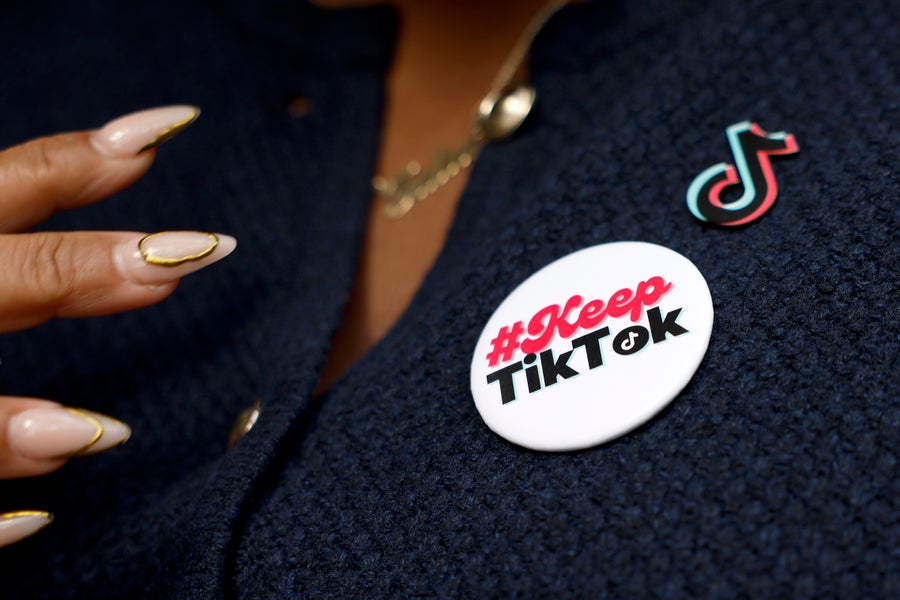
A TikTok creator and advocate wears a button showing support for TikTok. Other users have flocked to alternative apps, such as China-based RedNote. Kevin Dietsch/Getty Images
.
.
Click the link below for the complete article:
.
__________________________________________
January 16, 2025
Mohenjo
Business, Food For Thought, Human Interest, Political, Science, Technical
amazon, business, Business News, current-events, Future, Hotels, human-rights, medicine, mental-health, research, Science, Science News, technology, Technology News, travel, vacation

Click the link below the picture
.
During their prime, the Vikings mastered the seas and went on to make wide-spanning voyages by boat. But how exactly did they know where they were going? A recent study, focused on a set of medieval stone disks found in Ukraine, supports the belief that Viking sailors used solar compasses to navigate and may have passed on this knowledge to other populations in Europe.
The appraisal of the eight stone disks was featured in a December 2024 paper published in Sprawozdania Archeologiczne, a Polish archeological journal. The study’s authors contend that some of the disks display key features that would have used the sun to operate as a compass, sharing similarities with other Viking artifacts originating from Greenland and Poland.
Identifying the Medieval Disks
The disks, found in several medieval-era archaeological sites in Ukraine, were originally crafted from pyrophyllite, a soft and easy-to-process mineral used for many industrial purposes during the period.
The researchers concentrated on three of the disks that already had detailed descriptions: two from the northern Chernihiv region (referred to as Listven and Liubech) and one from nearby Kyiv. The disks were dated from the 12th and 13th centuries, and they were most likely local products made in workshops near the city of Ovruch.
Previous interpretations of these objects have ranged from calendars to needle-sharpening devices, but the new study proposes that they were instead used as navigational tools.
One reason for this is the disks’ design, with the Kyiv and Listven disks featuring a central hole that could hold the gnomon — the pointy component of a sundial that casts a shadow when hit with sunlight. This would help determine latitude in the case of a compass. In addition, concentric rings and radial lines were carved into the three disks, further demonstrating the semblance of a compass.
Similarities Among Viking Solar Compasses
The researchers compared the pyrophyllite disks with other artifacts that have been identified as navigational instruments used by Vikings. Of particular importance are wooden disks, including one from Greenland found in 1948 and one from the Polish island of Wolin found in 2000. These wooden disks contained elements characteristic of sundial-compasses, such as a hole for a gnomon and perimeter notches.
The wooden disks and the pyrophyllite disks share several features, including certain markings. The Wolin disk, dated to the end of the first half of the 11th century, has concentric rings similar to the pyrophyllite disks. However, the Greenland disk, dated to around the start of the 11th century, does not have concentric rings. The researchers suggest that this could mean concentric rings were not present in early Viking solar compasses but developed in later versions.
All of the disks were also similar sizes — the Greenland and Wolin disks were measured at 7 cm and 8.6 cm in diameter respectively; the Kyiv and Listven disks were both 6.5 cm in diameter, while the Liubech disk measured 7.5 cm.
Although additional investigations are needed to confirm the role of the pyrophyllite disks, the researchers say it is possible that Vikings who traveled through what is now Russia and Ukraine during medieval times (known as Varangians) could have imparted technological knowledge that allowed locals to create the solar compasses.
Varangian travelers would have passed by Kyiv, Listven, and Liubech on their journeys along a major trade route connecting Scandinavia with the Eastern Roman Empire, making the spread of Viking-inspired solar compass technology in the region a real possibility.
.
 (Credit: maradon 333/Shutterstock)
.
.
Click the link below for the complete article:
.
__________________________________________
January 15, 2025
Mohenjo
Business, Food For Thought, Human Interest, Political, Science, Technical
amazon, business, Business News, current-events, Future, Hotels, human-rights, medicine, mental-health, research, Science, Science News, technology, Technology News, travel, vacation
Click the link below the picture
.
CLIMATEWIRE | More than 50,000 scientists and their supporters have signed an open letter asking Congress to safeguard federal research and scientific jobs ahead of the incoming Trump administration.
The Union of Concerned Scientists, a nonprofit science advocacy organization, spearheaded and published the letter Monday morning. The document points to concerns that President-elect Donald Trump may eliminate or reorganize federal science agencies, reduce staff, and attack regulations aimed at protecting public health and the environment.
“The Trump administration’s current agenda promises to eviscerate the protections that Americans count on and support: clean air and water; safe food and medicine; products that won’t harm us; and protection from extreme weather and other damaging effects of climate change,” the letter stated. “Without strong federal science, people will suffer, and historically marginalized communities will continue to bear the burden of these harms.”
The letter also asked members of Congress to “oppose anti-science nominees to any federal agency who do not agree on the record to follow and/or implement a scientific integrity policy in their agency.”
Also on Monday, 28 organizations submitted a letter to members of the Senate asking them to vote against political nominees who don’t have appropriate qualifications, exhibit conflicts of interest, fail to recognize the scientific consensus on issues relevant to the agency, or have a record of disregarding scientific integrity.
Signers included public health and medical associations, environmental organizations, and science advocacy groups, the Union of Concerned Scientists among them.
“The decisions you make about nominees will determine whether agencies use the substantial scientific expertise of government employees and advisors to safeguard public health and economic stability, or whether bias and misinformation block effective responses,” the letter said.
Trump was “re-elected by a resounding mandate from the American people to change the status quo in Washington,” said Karoline Leavitt, a spokesperson for the Trump transition, in an email to POLITICO’s E&E News. “That’s why he has chosen brilliant and highly-respected outsiders to serve in his Administration, and he will continue to stand behind them as they fight against all those who seek to derail the MAGA Agenda.”
The letters reflect a growing anxiety among scientists and science advocates about the future of federal research under Trump. Experts have raised concerns that the incoming administration may downsize federal agencies, shift or curtail their research priorities, censor scientists and alter or destroy federal datasets.
Trump has consistently disavowed the seriousness of climate change and pledged to withdraw the U.S. from the Paris Agreement for a second time. He’s also recently tapped a number of political nominees known for denying mainstream science on subjects related to public health and the environment.
.

President-elect Donald Trump is greeted by Robert F. Kennedy Jr. on stage during a campaign event at Desert Diamond Arena in Glendale, Arizona, on August 23, 2024. Tom Brenner for The Washington Post via Getty Images
.
.
Click the link below for the complete article:
.
__________________________________________
January 15, 2025
Mohenjo
Business, Food For Thought, Human Interest, Political, Science, Technical
amazon, business, Business News, current-events, Future, Hotels, human-rights, medicine, mental-health, research, Science, Science News, technology, Technology News, travel, vacation

Click the link below the picture
.
Scribes and surgeons, thieves and theologians, philosophers and pallbearers. Here’s what they all have—patron saints. Knotmakers have no saints. There is, however, Our Lady Undoer of Knots—Mary, serenely unkinking a long ribbon while stomping on a knotted serpent. Here’s St. Irenaeus of Lyons, a second-century Christian theologian: “The knot of disobedience of the first woman, Eve, was undone by the obedience of Mary; the knot the virgin Eve had created was undone by the Virgin Mary through her faith.”
Might the tying and the untying be parts of the same whole? A couple thousand years earlier in ancient Egypt, the goddess Isis seemed to be saying so—the one who weaves it is also the one who unweaves the 𓎬 tyet. The knot itself is endless. Da Vinci knew that, as did Dürer. Not Alexander, though.
I’ve been skimming The Ashley Book of Knots, a charmingly eccentric 1944 volume by sailor and artist Clifford W. Ashley. “I hobnobbed with butchers and steeple jacks, cobblers and truck drivers, electric linesmen, Boy Scouts, and with elderly ladies who knit.” A massive “adventure in unlimited space” with 7,000 illustrations, it is spoken of with near-religious fervor by knotmakers. “In Boston, I halted an operation to see how the surgeon made fast his stitches. I have watched oxen slung for the shoeing, I have helped throw pack lashings, I have followed tree surgeons through their acrobatics, and examined poachers’ traps and snares. But I never saw Houdini,” Ashley goes on to confess.
This public domain copy has no cover, and so I’ve downloaded the original cover image by George Giguere. Against an opalescent sky and an algal sea, an old, weathered sailor sits on a cask with a (mandatory) pipe clenched in his (mandatory) square jaw. He’s showing us the Tom Fool knot, also known as the conjuror’s knot. Now that’s an old knot. Heraklas, the Greek physician, called this knot epankylotos brokhos—the interlooped noose—in his list of surgical nooses and knots in the first century AD. Our sailor looks pleased he knows his history.
Philippe Petit, legendary highwire artist and star of the Oscar-winning Man on Wire says, “If at first you don’t succeed, tie, tie again.” A card-carrying member of the International Guild of Knot Tyers, the man does know a thing or two about knotsmanship. An ill-made knot on the wire could mean he may not go home that day.
My own stakes are much lower. I’m just learning how to make knots. I’ve got heavy-knit cotton cords in ivory and crimson that I keep in a pouch. Using two colors helps me tell the twists and turns apart. I’ve also got an app called Grog Knots made by Alan Grogono—anesthesiologist, sailor, and curious knotter. (“Alan planned a career as an engineer or a comedian but father wisely interceded on the basis that a medical career would allow both. He was right!”)
I should be starting with the basics but I’m constantly distracted by more glamorous knots with names like Turk’s Head or Monkey’s Fist. Or Windy Chien’s Dune Creature, a Heaving Line sandworm that reminds me of the exploding palm leaf snakes I made as a kid. I’ll keep at it. Just like in writing, I enjoy working with shape and form, gesture and constraint. As Nick Cave says in The Red Hand Files, “What it takes for me to pursue these freedoms—to feel genuinely free—has paradoxically something to do with order and constraint. . . . Freedom finds itself in captivity.” And someday I’ll get good at this wonderful thing.
.
 Getty Images
.
.
Click the link below for the complete article:
.
__________________________________________
January 15, 2025
Mohenjo
Business, Food For Thought, Human Interest, Political, Science
amazon, business, Business News, current-events, Future, Hotels, human-rights, medicine, mental-health, research, Science, Science News, technology, Technology News, travel, vacation
From
YogaGo
Click the link below the picture
.
Who knows it might work for you!
.
/monetisation/diversity/26-35%20(1).png) By continuing, you confirm and guarantee that you have read, understood, and agreed to our Terms of Use, Privacy Policy, and Refund Policy.
By continuing, you confirm and guarantee that you have read, understood, and agreed to our Terms of Use, Privacy Policy, and Refund Policy.
.
.
Click the link below for the complete article:
.
__________________________________________
January 14, 2025
Mohenjo
Business, Food For Thought, Human Interest, Political, Science, Technical
amazon, business, Business News, current-events, Future, Hotels, human-rights, medicine, mental-health, research, Science, Science News, technology, Technology News, travel, vacation
Click the link below the picture
.
Firefighters in southern California are battling the Palisades and Eaton Fires, which have killed at least 25 people, burning a cumulative 37,700 acres and at least 12,000 structures. The plumes of smoke are even visible from space.
Residents of many fire-prone areas—as well as those far downwind—have grown familiar with the orange, apocalyptic haze of wildfire smoke as these blazes have become more common because of climate change. Such smoke can contain an unpredictable cocktail of chemicals associated with heart and lung diseases and even cancer, which is the leading cause of death among firefighters. Here’s what makes wildfire smoke so dangerous.
No Ordinary Pollutant
When trees, shrubbery, and other organic matter burn, they release carbon dioxide, water, heat—and, depending on the available fuel, various volatile compounds, gaseous pollutants, and particulate matter. Those tiny particles, which become suspended in the air, can include soot (black carbon), metals, dust, and more. If they’re smaller than 2.5 microns in diameter, they can evade our body’s natural defenses when inhaled, penetrating deep into the lungs and triggering a wide variety of health problems.
Such fine particulate matter is a common pollutant; it’s also created by motor vehicles and industrial plants, for example. But the kind present in wildfire smoke might be even more dangerous. Researchers studying health outcomes in southern California concluded that exposure to particular matter smaller than 2.5 microns, called PM2.5, from wildfires was up to 10 times more harmful to human health compared with exposure to PM2.5 from other sources. The researchers estimated that wildfire-generated particulate matter was three to four times more toxic—but they don’t yet know why.
More Dangerous Fuel
As humans develop ever more land, we grow the number of points of contact between human settlements and increasingly flammable forests. This makes it more likely that an errant, human-caused spark will ignite a blaze—and that the resulting wildfire will consume homes, offices, cars, and other human-made infrastructure, expanding the types and amounts of toxic compounds going up in the smoke. Paints, sealants, insulations, metals, and more can release many kinds of volatile organic compounds, gaseous pollutants and particulate matter.
A 2023 study by researchers at the Environmental Protection Agency found that emission factors for some toxic compounds were more than 1,000 times higher in urban wildfires than in fires that burned in woodland areas.
Unpredictable Chemistry
It’s surprisingly hard to predict what compounds someone is exposed to when they inhale wildfire smoke. What’s in the smoke depends on a few factors: what was burned (a ponderosa pine, for example, or a car), the temperature at which it burned (was it flaming or smoldering?), and how far and for how long the smoke has traveled. As the smoke ages, it is exposed to sunlight. This radiation can hit nitrogen oxides (NOx) and volatile organic compounds (VOCs), setting off a complex set of reactions that usually results in another secondary pollutant: ozone, the main component of smog, which can damage the lungs.
And as smoke containing VOCs travels and settles over other cities, it can mix with even more local pollution in the form of NOx—giving it the opportunity to form a larger amount of ozone. Research also suggests that VOCs and particulate matter—each of which can be toxic—can combine to make their respective health risks even worse.
.
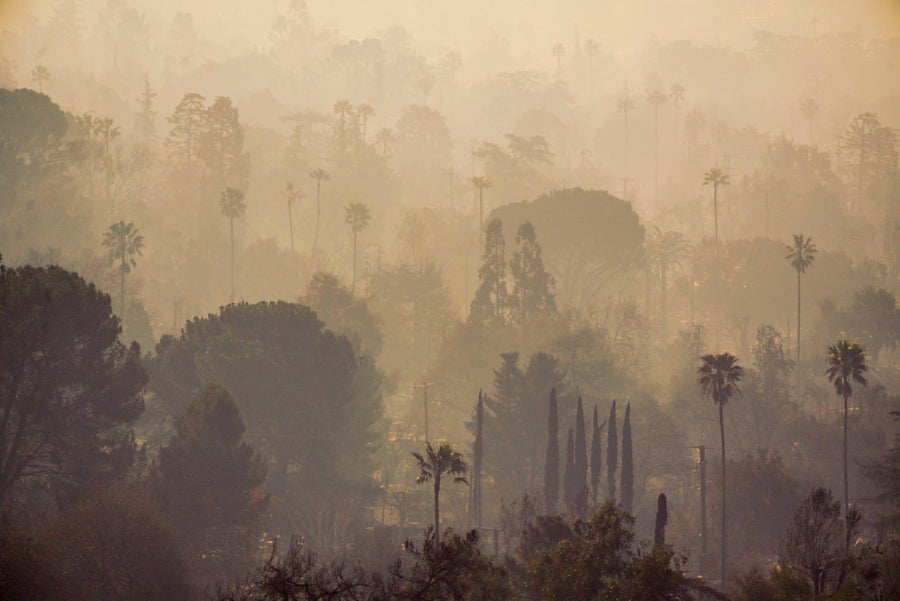
Smoke over destroyed homes in the aftermath of the Eaton Fire in Altadena, California, US, on Saturday, Jan. 11, 2025. Firefighters are making some progress on controlling the deadly blazes that have scorched Los Angeles, as the toll of destruction rises with entire neighborhoods reduced to ash. Kyle Grillot/Bloomberg via Getty Images
.
.
Click the link below for the complete article:
.
__________________________________________
Older Entries
Newer Entries


