“The Brutalist” is a 2024 epic period drama film directed and produced by Brady Corbet from a script he co-wrote with Mona Fastvold. A co-production between the United States, the United Kingdom, and Hungary about a Hungarian-born Jewish Holocaust survivor who emigrates to the United States, where he struggles to achieve the American Dream until […]
THE BRUTALIST (2024) – My rating 8.5/10
THE BRUTALIST (2024) – My rating 8.5/10
February 2, 2025

rise again
February 1, 2025

When you stumble, when you fall,Don’t stay down, stand up tall.Wipe your tears, dust off the pain,Find your strength, rise again. Storms may come, winds may roar,But you are stronger than before.Every fall’s a lesson deep,A step ahead, a climb so steep. So lift your head, don’t be afraid,The sun still shines, the dark will […]
rise again
Giant catapult sends satellites into space without rocket fuel
February 1, 2025

Yes, that’s correct! A company called SpinLaunch is developing a giant catapult system to launch satellites into space without the need for traditional rocket fuel.Here’s how it works: Instead of relying on traditional rocket fuel, SpinLaunch uses a massive rotating arm to propel satellites into low Earth orbit, powered solely by electricity. The company has […]
Giant catapult sends satellites into space without rocket fuel
Limerick’s
February 1, 2025

There once was a man from Peru,Whose limericks would end line two,When asked why this was, he’d simply say, “Because,”And continue with something … Limerick’s
Limerick’s
On This Day: February 01, 1965
February 1, 2025
Trump Funding Freeze Could Set Disaster Recovery Back ‘for Years’
February 1, 2025
Business, Food For Thought, Human Interest, Political, Science, Technical amazon, business, Business News, current-events, Future, Hotels, human-rights, medicine, mental-health, research, Science, Science News, technology, Technology News, travel, vacation Leave a comment

Click the link below the picture
.
CLIMATEWIRE | The federal government Tuesday shut down the online system it uses to distribute billions in disaster aid after President Donald Trump ordered agencies to freeze the flow of public money, alarming officials who are struggling to respond to catastrophes.
The Federal Emergency Management Agency cut off access to the online portal, which funnels roughly $30 billion a year to states for disaster expenses ranging from debris cleanup to infrastructure repairs, following Trump’s expansive order to halt federal funding as the White House scrutinizes spending programs, Todd DeVoe, emergency coordinator for Inglewood, California, told POLITICO’s E&E News.
“We may see recovery delayed for years,” said DeVoe, who is second vice president of the International Association of Emergency Managers in the United States. “The grant portal where we do all grant work is inaccessible.”
FEMA did not respond to requests for comment. The spending pause outlined by a memo released late Monday by the Office of Management and Budget was causing confusion within the disaster agency, according to people within FEMA who were not authorized to speak to the press. A federal judge blocked Trump’s spending freeze on Tuesday evening, minutes before it was scheduled to take effect, until Feb. 3.
“It’s going to slow things down when there’s already frustration with how long it takes for communities to recover,” former FEMA chief of staff Michael Coen told E&E News, referring to the funding disruption. “It’s just one more thing they now have to deal with.”
The spending pause was scheduled to take effect at 5 p.m. Tuesday, four days after Trump assailed FEMA and the Biden administration for the response to Hurricane Helene in North Carolina in late September. The freeze affected programs across the government as the administration undertook a sprawling review to ensure they comply with Trump’s executive orders, including cutting off funds for diversity, equity and inclusion.
A halt to FEMA spending could affect every state that has been hit by a major storm, wildfire or other disaster in the past decade or more as they wait for the federal government to reimburse them for recovery projects. FEMA pays 75-100 percent of rebuilding costs and is still reimbursing states for disasters that occurred two decades ago.
“They’re kind of in limbo right now, trying to figure out if they’re going to be funded or not,” DeVoe said. The pause could “really impact low-income states and communities.”
A lot depends on how long FEMA withholds funding. “If this is just a short pause,” DeVoe said, “there may be no harm, no foul.”
It’s unclear how a halt will affect recovery efforts related to the wildfires in Southern California or from Hurricanes Helene and Milton, which battered Florida, Georgia and South Carolina in addition to North Carolina.
Southeastern states are still cleaning up debris left by the hurricanes, but they have not yet sought reconstruction aid from FEMA. The California wildfires are still active. FEMA has agreed to pay a large share of cleanup costs for the hurricanes and fires and for emergency housing.
.
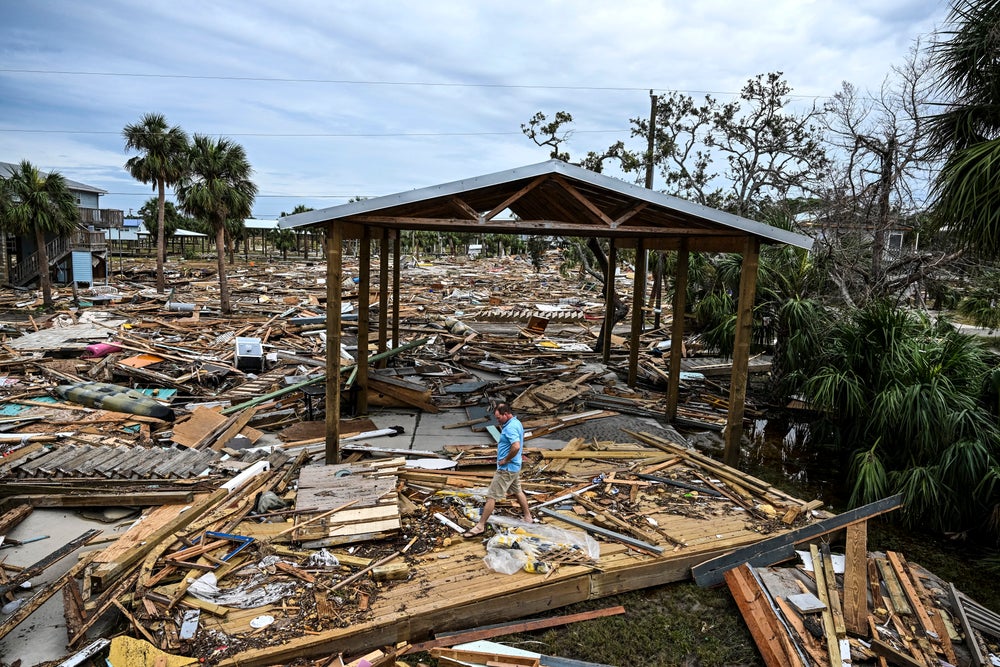
A person assesses damages of his house after Hurricane Helene made landfall in Horseshoe Beach, Florida, on September 28, 2024. Chandan Khanna/AFP via Getty Images
.
.
Click the link below for the complete article:
.
__________________________________________
The trouble with ‘donating our dopamine’ to our phones, not our friends
February 1, 2025
Business, Food For Thought, Human Interest, Political, Science, Technical amazon, business, Business News, current-events, Future, Hotels, human-rights, medicine, mental-health, research, Science, Science News, technology, Technology News, travel, vacation Leave a comment

Click the link below the picture
.
It’s the Friday evening of a long work week. Maybe you sit down on the couch and start to scroll on social media. A friend texts you to cancel the dinner you planned, and a part of you is relieved, happy even. Now you can stay home and order in.
Journalist Derek Thompson says this turn toward isolation can’t entirely be blamed on COVID-19. “We are now in the midst of an anti-social century,” he says.
In his most recent article for The Atlantic, Thompson writes that the trend toward isolation has been driven by technology. Cars, he says, “privatized people’s lives” in the second half of the 20th century, by allowing them to move from dense cities into more sprawling suburbs. Televisions, meanwhile, “privatized our leisure” by keeping us indoors. More recently, Thompson says, smartphones came along, to further silo us.
“Smartphones make our alone time feel more crowded than it used to be, at the same time that our smartphones make crowds feel more lonely than they used to be,” he says. “When you’re at a party, it’s easier than ever, arguably, to take out your phone, look into your palm, and suddenly, from an experiential standpoint, you’re not at a party at all.”
In 2023, Surgeon General Vivek H. Murthy issued a report about America’s “epidemic of loneliness and isolation.” But Thompson makes a distinction between the two.
“If loneliness is an instinct to be around people, I would argue that [the] kind of social isolation that we’re seeing is the opposite of loneliness, choosing to be alone,” he says. “We’re choosing to spend more and more time with ourselves, more and more time, year after year, without feeling that special, important biological cue to be around other people. And that, I think, is something to be quite worried about.”
Interview highlights
On the need for communal spaces
Between the early 1900s and 1950, we built a ton of what the sociologist Eric Klinenberg calls “social infrastructure.” We built library branches and community centers and public pools, and we built places for people to spend time outside of their home and their work. In the last 50, 70 years, we haven’t built nearly as much of this stuff. … “Third space,” or “third place” … it’s not your home and … it’s not your work. And so it’s a place that you choose to be with people you’re not related to and you’re not financially obligated to be around. … These places build community. …
.

SeventyFour via Getty Images
.
.
Click the link below for the complete article:
.
__________________________________________

