.
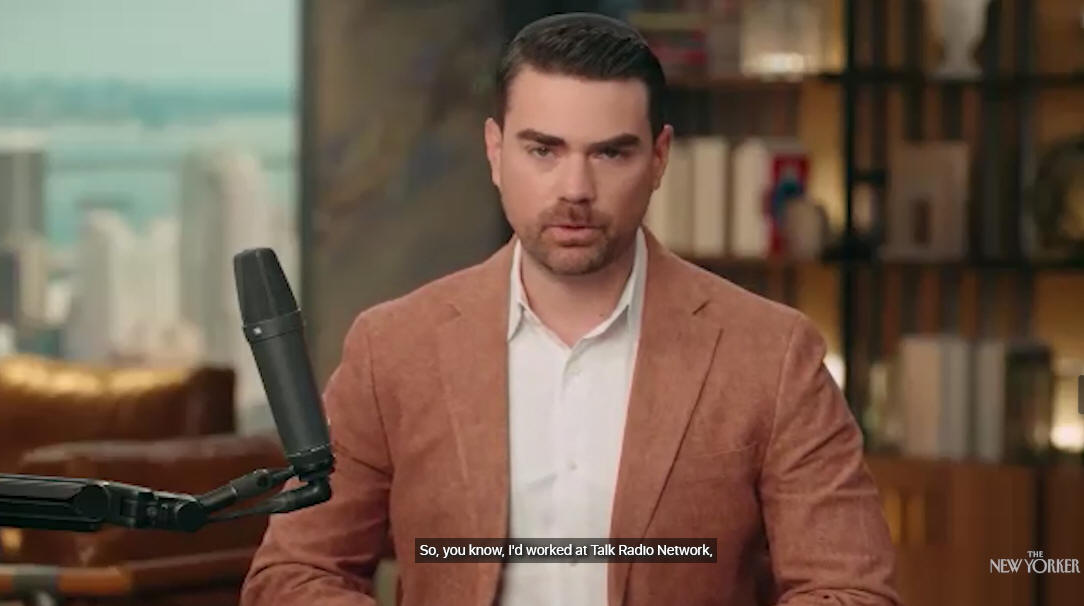
Ben Shapiro is a conservative provocateur. Ever since he was a teen-ager at U.C.L.A. writing op-eds for the Daily Bruin, he has shown a penchant for the rhetorical grenade. Women who have abortions are “baby killers.” Western civilization is “superior” to other civilizations. “Israelis like to build,” he tweeted in 2010. “Arabs like to bomb crap and live in open sewage. This is not a difficult issue. #settlementsrock.” Shapiro is now forty-two, and his rhetoric has mellowed only somewhat. On college campuses and on his podcast, “The Ben Shapiro Show,” he has been an advocate for the Trump Presidency, even though he refused to vote for him in 2016 and allows that the President is—as we discuss here—financially corrupt and morally wanting.
Earlier this week, I spoke with Shapiro for The New Yorker Radio Hour, mainly about the battles within the MAGA movement in which he is currently engaged. Recently, Shapiro has gone into attack mode against some of his fellow MAGA media stars, including Tucker Carlson, for their indulgence, if not outright support, of antisemites like Nick Fuentes. It is a drama that has implications not only for the Trump era but for what might follow. J. D. Vance, for one, has refused to join Shapiro in rebuking Carlson. Our conversation has been edited for clarity and length.
You worked at Breitbart, which was an ur-publication of the MAGA movement. You were acquainted with Steve Bannon and all kinds of people. When you look back on your Breitbart days, what do you think was positive about that time, and what do you look back on with some regret?
I had worked at Talk Radio Network, which was the syndicator for Michael Savage and Laura Ingraham, and then I ended up being hired by Andrew. I’d known Andrew since I was at U.C.L.A.—
Andrew Breitbart, the founder of the publication. Who died in his forties.
Yeah, he was very young. I’d known Andrew for about ten years. He came to me and said, “Will you come on board and join Breitbart?” It was the middle of the 2012 election cycle, and he died three, four weeks after I’d signed on. Suddenly, the leadership structure was completely upended, because Andrew had been sort of a one-man band. He was the person from whom all thoughts sort of sprang, in terms of the direction of the site. The leadership structure changed pretty dramatically. Steve Bannon—who’d been kind of hanging around on the fringes of the Breitbart universe; he’d been making a documentary about Andrew—was brought in by Larry Solov, who was Andrew’s [business] partner, to essentially be president of Breitbart.
Did you have problems with Steve Bannon and the like, and their treatment of rhetoric and truth or non-truth and conspiracy theory, when you first encountered it?
It was never, sort of, a bed of roses with Steve Bannon. There are a lot of people in the Breitbart infrastructure who are not fond of Steve, or the way that he was running things, making editorial decisions and the like. I think that there were some wonderful things—
But how did you assess what Steve Bannon wanted in this world? He wasn’t just a conservative. He was and remains a kind of MAGA warrior who’s willing to say and do what is necessary to push that battle forward. And I’m being gentle about this.
Yeah, I mean, if you look at Breitbart’s coverage circa, say, 2012 or 2013, those were fairly mainstream conservative talking points. It was certainly a mainstream conservative website at that time. I think by the time we hit 2015, 2016, things had started to evolve, especially because of the rise of President Trump. I was not a supporter of President Trump in the 2015-2016 election cycle. I was much more supportive of Ted Cruz in the primaries, and then, in the general election, I actually didn’t vote, because I was unhappy with both candidates.
Obviously, after that, President Trump did many things that, as a conservative, I like. He’s certainly a non-ideological figure, which is why so many people try to sort of claim that MAGA is a part of their movement. You have Reagan conservatives who will say that MAGA is Reagan conservatism. You’ll have national populists who say that it’s national populist. Trump is none of those things. Trump is Trump, and he has instincts—
Which means what to you, Ben? “Trump is Trump” means what?
His instincts are sort of naturally those of a 1975 conservative. That means that he likes a strong America on the world stage, but tempered by a sort of hard-nosed realism about non-interventionism. When it comes to domestic policy, he has a weird mix of not liking the government to be involved in everything, but also wanting to use the government in ways that I don’t particularly approve of. He seems to be more about: What is the solution at hand? Will I try it? And then, if it doesn’t work, then he pulls out of it. People have termed that “TACO”—“Trump Always Chickens Out.” I don’t think that’s right. I think that President Trump is a person who is willing to try different things and then will shift on a dime if he thinks those things aren’t working.
Do you think Trump is honest?
In some ways, yes, and in some ways no.
There was an article in the Wall Street Journal just a couple of days ago describing the fishy investments from Abu Dhabi into the Trump family. Our reporter, David Kirkpatrick, who’s extremely conservative in his calculations, has said that the Trump family has enriched itself to the tune of four billion dollars since taking office again in 2024. Does this concern you at all?
Of course. I’ve been calling this out since, I think, before pretty much anybody else. I mean, early on in the Trump Administration, when World Liberty Financial was pretty clearly making a fair bit of money over in the Middle East, I raised red flags on my show, consistently, about how I thought this was wrong. If the name were Biden instead of Trump, people would be screaming bloody murder. And this was not beneficial to President Trump’s agenda, either. So, sure, that concerns me.
Not beneficial to his agenda, or corrupt?
I mean—both, obviously. I do think that if you are taking what I perceive to be digital assets that are not particularly worthwhile, and then you have people who are politically interested in investing massive amounts of money into those things, that is not a good thing.
You voted for him the second time?
I voted for him in 2020, and then I campaigned for him in 2024.
Why?
Because it was now a binary choice between Trump and Kamala Harris, and I liked a lot of what he did during his first Administration. I felt the guardrails would largely hold, which I believe they have, with regard to President Trump. I know many on the left believe they’ve not, but what I would say is that—
You believe the guardrails have held this time?
Yes. I’m hard-pressed to see—
Help me on that, Ben.
The Trump Administration has not bucked the judiciary by saying that if an appellate court or the Supreme Court rules in a particular way, it will still go ahead and do whatever it is it wants to do. The President does cite legal authority for the things that he’s doing—
So, you’re confident that the Justice Department will pursue corruption charges against the Trump family?
No, I’m confident that the President will likely pardon himself and his children in the same way that Joe Biden did on his way out. [Laughs.]
You’re laughing, but that’s radically corrupt, is it not?
I think that it was radically corrupt when the D.O.J. did not pursue, with alacrity, a lot of the issues surrounding the Biden family, too. So the answer is yes, and it applies to all parties. What I hear from the left is a constant drumbeat of accusations about President Trump, to which I acquiesce, in part, but I find them utterly unconcerned with the same sorts of issues arising on their side of the aisle. They see President Trump as the person who’s constantly violating the standard, the person who’s constantly setting the new standard, the person who is responsible for the death of American politics, or the decay of American politics.
And, as I’ve said publicly before, I think President Trump stumbled on the prone body of American politics and said, “This is a dead body.” I see him much more as a coroner than as the murderer. Now, that doesn’t mean that there’s not some of both, meaning that I think things can get worse under President Trump than they were heretofore, and I’m not going to deny that he’s done things that I think are bad and wrong. I was very critical of his rhetoric, for example, between the election of 2020 and January 6th. But I do think that—
But do you not see any of these things as disqualifying, in a moral-political sense? January 6th, for example.
I don’t know what disqualifying means, in the sense that I did not support him in the primaries—
That he would lose your faith, vote, and support forever.
Well, I mean, the only way to lose my faith and support and vote forever would be for there to be an alternative that I find superior to him. This is the problem when you’re making voting decisions. Would I want Donald Trump marrying into my family? Probably not. The problem is that once you say that the candidate is “disqualified,” then you either have to sit out the election—which I did in 2016. And then whatever damage President Trump had, I thought, done by being elected in 2016, he did a bunch of things I liked between 2016 and 2020, and then I did not like what he did with regard to the election of 2020, and the falsehoods that he told about winning that election. And then I didn’t support him in the primaries, and then he ended up winning the nomination. He was running against Kamala Harris. So I can either sit out the election again, which doesn’t really achieve the—
So what you’re saying is that the potential of Kamala Harris, in your view, politically, outweighs the support for what, in essence, was an insurrection on Capitol Hill? That’s hard for me, to say the least.
I think that that’s a pretty poor way of putting it. That’s not the way that we assess candidates in the real world. The way that we assess candidates in the real world is: Who is more likely to perform the agenda that I see as important, versus who is more likely to inhibit that agenda. And so I can fully disapprove of what happened on January 6th and think it was quite terrible, and still acknowledge that Donald Trump as President, from 2017 to 2021, did a better job than Joe Biden did.
There are many people in the Republican Party who consider themselves Never Trumpers. Not a decisive number, certainly, but there are a number of people who see his moral transgressions as so serious that they make a very different calculation than you do, electorally.
I mean, sure. And they’re entitled to that calculation. The question to me is always one of iteration. Voting is one decision, but just because you vote for someone doesn’t mean that you support everything that they do.
Ben, what initially attracted you to conservatism?
I grew up in a household with two Reagan Republicans—my parents are pretty conservative. The basic idea that lies behind a good conservatism, I think, is personal responsibility, duty, a requirement that you do the right thing, a basic moral stance about how individuals should act in a free country. And I think that’s still largely what drives my conservatism today.
A kind of personal rectitude.
Yes.
Do you find that that’s antithetical to liberalism?
It doesn’t have to be, but I think that liberalism very often is a way of shielding people from the consequences of their own decisions, or an attempt to shift individual responsibility onto systems in a way that is frequently unjustified.
The difference between right and left—in my definition of it—is that the right acknowledges that when people fail, because human nature is fallible, very often that is your own responsibility. And the best way to actually treat that problem is to self-correct. And the left, because they have, I think, a rosier view of what human nature is, tends to attribute to systems that which I think more properly lies in responsibility with the individual.
How much did religion influence your becoming a conservative? You were raised an Orthodox Jew—I think you’re still a practicing Orthodox Jew, am I correct?
Yes, that’s right. We became Orthodox when I was eleven. So I remember eating at Kentucky Fried Chicken. But I was fairly young when we became Orthodox. My mom and dad started going to a synagogue down in Venice Beach, actually, and they were very taken with the rabbi, and I think that they got more and more interested in that. They decided that they wanted to send me to a Jewish day school. And so I’d go to the Jewish day school—it was an Orthodox school—and I’d come home and say, “Mom and Dad, I don’t understand why we’re doing X, Y, and Z, when at school they’re teaching me that this is what we’re supposed to be doing.” And my parents were, I think, smart enough to see the inherent conflict, and, instead of saying, “Your school is doing it wrong,” or “You’re doing it wrong,” or “They’re teaching the wrong thing,” they said “Well, we’re probably doing it wrong,” and so probably we need to actually rectify that breach.
Let’s talk about the debate that you’re having inside MAGA. You’re at the center of a fight—a feud—that’s developing in the conservative movement, and it has to do with antisemitism and conspiracy theories related to antisemitism. Not long after Charlie Kirk died, you spoke at the Turning Point USA Conference, America Fest, and you called out Candace Owens and attendees like Megyn Kelly and Tucker Carlson—these are very influential figures now on the right, and the media, of the MAGA movement. Talk to me a little bit about this divide, how it’s developed, and what it’s done to your relationships inside the MAGA movement.
First of all, as people may suspect, I’m not particularly interested in my personal relationships with others in the political sphere. I have a family that’s very tight-knit. I have four children, going on five. I have a dog. I have plenty of things going on in my social calendar, and I don’t see it as particularly important to hang out with people who are in sort of the same career milieu.
There were two speeches that I gave back to back. One was a speech that I gave at the Heritage Foundation the night before, and one was the T.P.U.S.A. speech that I gave that night. The Heritage Foundation speech was specifically directed at Tucker Carlson, because I believe that Tucker Carlson is not a conservative in any real marked way that I can identify, and I was pointing that out at the Heritage Foundation.
How would you describe his politics?
Conspiratorial populism would probably be a fair descriptor of his politics.
Our colleague Jason Zengerle knew him as a young wise-guy reporter who leaned, maybe, center right. What happened to Tucker Carlson?
I try not to speculate about people’s motivations because I don’t have a window into their head. All I can say is that the stuff that he has been promoting for the past several years is very much in line with the philosophies of people like Alexander Dugin.
The Russian nationalist philosopher, said to be close to the thinking of Vladimir Putin.
Yes. Carlson’s view of America in the world is a view that is actually closer to Howard Zinn than to that of traditional conservatives. This idea that America is a nefarious and terrible force in the world that has committed myriad sins and must withdraw from the world, both for its own good and for the good of the world. His belief that a conspiratorial coterie of people is manipulating American policy. Those people very often happen to have crossover with Jews, according to his guests whom he routinely launders onto the air.
So, when it came to T.P.U.S.A., in the aftermath of Charlie [Kirk]’s death, Candace Owens, in particular, had started speculating, openly, that people at T.P.U.S.A.—up to and including, in my interpretation, Erika Kirk, Charlie’s wife—had been complicit in his murder or at least complicit in a coverup of his murder. Her bizarre conspiratorial rantings had been treated as legitimate and worthwhile by people ranging from Tucker Carlson to Megyn Kelly. And so I felt that it was necessary to make a speech about the gap that has emerged on the right between a conspiratorial view of politics—that sort of conspiratorialism has taken over large parts of the Republican Party and the conservative movement.
Candace Owens is, I believe, somebody that you worked with at the Daily Wire?
Yeah, we hired her in 2021—
What did you see in her then?
—and then we fired her in 2023. In 2021, what we saw was a fairly mainstream conservative who said inflammatory things, and who had been telling us that she—
Inflammatory things that you liked?
Most of them I liked, some of them not as much. And so, as people who hired her, we thought that she was going to develop in intellectual directions. She had said that she was learning with Shelby Steele, for example, and reading the works of Thomas Sowell, and this kind of thing. But, by 2022, it was apparent that she was moving in another direction, and then it took until 2023 for that direction to come to full fruition—
And what was the direction in 2023?
By 2023, she was spouting antisemitic conspiracy theories, among other conspiracy theories, including the idea that Emmanuel Macron’s wife is actually a man, and this sort of stuff.
So that was your limit with her?
Well, to be fair, I am not an officer of my company. The people who made that decision
were Jeremy Boreing and Caleb Robinson, the co-C.E.O.s of the company.
You specifically criticized Tucker Carlson for a really soft interview he did with a guy named Nick Fuentes, who is, I think it’s fair to say, a Nazi apologist. You said, “If you have that person on your show and you proceed to glaze him, you ought to own it.” You point out how outrageous he is. But isn’t that exactly what Carlson wants in his guest? Attention?
I mean, I think that the attention doesn’t hurt, but, at the same time, I think there is probably some ideological overlap between some of the things that he believes about America and some of the stuff that Nick Fuentes believes. Tucker has a habit of bringing on guests who spout the most conspiratorial form of a theory, and then he sort of buys it back about five per cent. And then he allows those views to be predominant in the public discourse while talking about what wonderful people these folks are.
I get that, and I can’t help but agree with that. But then you have Donald Trump, who had dinner with Nick Fuentes. How does that affect your feeling about Donald Trump?
I mean, I condemned that at the time. When it comes to his dinner with Fuentes, and I believe it was Kanye West—
A good combination.
Yeah, pretty awful combination. People say that I grade on a curve, but I think I grade realistically here: I’m not surprised by what President Trump does. He likes being with famous people. He very often does not know who they are. He will say bad things about them five minutes later. He is as inconstant as the changing wind when it comes to his feelings about people. He will like Steve Bannon until he calls him “Sloppy Steven” and fires him, whereupon he will welcome him back into his orbit and like him again. And so these sort of—
But you’re taking this too casually. He’s having dinner with a Nazi apologist.
I didn’t take that casually.
And then doesn’t go off and blast him. He just kind of says, “Oh, I kind of didn’t know who it was, and Kanye brought him along.” First of all, that’s bad staff work, to say the least—
Terrible staff work.
And it’s bad behavior on the part of the President of the United States, no?
I agree that it’s bad behavior on the part of the President of the United States. I’m not sure what else to say about that.
At America Fest, Vice-President Vance said this: “President Trump didn’t build the greatest coalition in politics by running his supporters through endless self-defeating purity tests. I didn’t bring a list of conservatives to denounce or de-platform, and I don’t really care if some people out there, I’m sure, will have the fake-news media denounce me after this speech.” He was attacking you, wasn’t he?
I mean, I assume that he was disagreeing with the thing that I had said, sure. And I will point out that I don’t think the Vice-President is being very accurate about his own approach to various conservatives and other people online. He’s quite fond of attacking people online from time to time.
I remember when a bunch of young Republican leaders had their Signal chat exposed, and they were making all kinds of antisemitic remarks. The Vice-President didn’t denounce that either. In fact, he just thought it was, you know, kids being kids.
And again, I highly disagree with this as both a matter of morality and as a matter of tactics. I think tactically it’s foolish. I think it’s immoral.
Then what’s going on? This is so prevalent and excused at the top end of—at least part of—the conservative media sphere and the White House.
I mean, I think it’s a mirror image of what’s going on on the left. I think to pretend that antisemitism is not rising on both the right and the left is to be whistling past the graveyard. And one of the things—
Fair enough. But stick to the right, and anatomize that.
But the reason that I’m pointing this out—
Because they’re in office—
I understand, but Democrats would like to be in office. And so to go back to the original point with regard to President Trump and voting for him and not voting for him—if the question is binary choice, then you’re going to have to make a decision between one of these parties. These are the two major parties. And so that’s why I think it’s important to bring into perspective what’s happening in both parties.
But Ben, do you see antisemitism in the mouths of leading Democratic contenders for the Presidency?
I see antisemitism in the Democratic Party apparatus’s willingness to not only humor but to promote everybody ranging from New York mayor Zohran Mamdani to Rashida Tlaib, the congresswoman from Michigan, to Ilhan Omar, the congresswoman from Minnesota, to the bizarre attempt to mirror all of the excesses of the anti-Israel movement. And I don’t just mean anti-Netanyahu—I mean anti-Israel.
Listen, I asked Gavin Newsom, the governor of California, about this. I was on Gavin’s podcast, and he acknowledged that this sort of stuff has become quite prevalent in Democratic circles. So the reason that I’m pointing this out is, No. 1, because I think it’s important, just as a matter of description, to be realistic about the rise of antisemitism in the United States, period. And then I’m happy to discuss the problems on my own side of the political aisle—which I have, repeatedly.
Did the degree of antisemitism on the right take you by surprise?
Yes. The rise of it over the course of the last couple of years has certainly taken me by surprise. The willingness to aid and abet and promote antisemitic conspiracy theories has been shocking.
To understand what’s happening, I think we first have to understand what antisemitism actually is, because when people mischaracterize the definition, that allows their particular side to escape. So people tend to define antisemitism in a way that excuses their side, and that throws all of the blame on the other side. What they will say is “Well, I’m just anti-Israel, I’m not antisemitic,” or “I’m not personally antisemitic, I’m just against Jewish control of the media.”
The definition of antisemitism—antisemitism at its root—is a conspiracy theory about the power of Jews as a group in the world. And that can be channelled into an anti-Zionism that says that Israel is controlling American foreign policy, and that Israel has befuddled the world, and it’s all about the Benjamins—which is the kind of thing that Ilhan Omar says—or it can be channelled into: Jews in America are too powerful in the media and they’re cliquish and they are controlling the circumstances of my life.
And yet, Ben, as somebody who’s written from Israel and Palestine for years and years, the reaction to some of the things I write is that I’m an antisemite, which is, I’ve got to say, news to me. And so I worry that that term, which is highly potent, is slung around in a very dangerous way sometimes.
So this is why I’m trying to be more precise about the definition. Being critical of Israeli policy is not the same thing as saying, for example, that Israel’s government designed and implemented a genocide, which is a lie, and that is a lie that can be chalked up to a nefarious view of what Jews are doing in the world, because it is also part and parcel of a broader lie, which is that the Jews have then sold the idea that they’re capable of doing whatever they want under the guise of America’s banner, and they’ve done so because of their inordinate power. It’s part of a broader conspiracy theory.
This is why I’m trying to be particularistic in my definition about what antisemitism is. I think the broad definition of antisemitism as sort of a subset of racism is wrong. I think that that definition is both overbroad and under-inclusive. What you end up with is the emptying out of antisemitism as a worthwhile category that actually bears weight in American life. Much the same way that the right said, for a long time, “You keep calling everybody racist, therefore nobody’s a racist,” which is untrue, right? There are actual racists out there.
There are.
But the idea is that if you over-apply a category, then it starts losing its power and its effectiveness, and that actually opens the door to the thing. I think the same thing has happened with antisemitism. And so what I’ve said before is: instead of talking in categories of antisemitism, or Jew hatred, or the rest of it, why don’t we talk about what’s true and what’s false and what’s moral and what’s not moral, because that’s easier for people to get their head around.
Let me ask you about another extremely potent issue, not just in the Republican Party, and that’s the Epstein files. What do you think they prove or don’t prove, other than the absolute hideous nature of the subject himself?
Let’s put it this way: The virality of the narrative around the Epstein files says something different from what the evidence shows. What the evidence shows in the Epstein files is that you have a number of very high-profile people who were in close contact with Jeffrey Epstein, who was a convicted sex offender with minors. The indictments against Epstein and Ghislaine Maxwell suggest that the trafficking of minors was about Jeffrey Epstein. There’s no one else who’s been indicted in terms of trafficking of minors except for Jeffrey Epstein. And, according to the F.B.I. under President Trump, there is no one who’s going to be, because they do not have sufficient evidence that he was trafficking young girls to other people.
The narrative that has been drawn from the Epstein story—because, presumably, people don’t know where his money comes from, although there was a deep dive, I believe, in the New York Times Magazine, looking into where his money came from—the narrative is a broader one that goes back to the conspiracy theorizing that has taken over large swaths of both parties, but it is very, very potent on the right. And that is that there is a cadre of people who are preying upon children, who manipulate everything in your life, who may be doing so because they have been honey-potted or because they’re being manipulated by a foreign intelligence service. On the far right, this is treated as Mossad, even though there is zero evidence that that is the case. Ehud Barak’s name is brought up in this context. As you might imagine, I’m not a fan of Ehud Barak, but there is no evidence that, on behalf of Mossad, he was running Jeffrey Epstein as a sex-trafficking agent. By the way, it’d be pretty terrible statecraft, considering that Epstein was already a convicted sex offender.
But I think that the broader theory here, which goes well beyond the evidence and the virality of that theory, speaks to people’s belief that they’re not in control of their own lives. I think this gets back to some of my original politics, that individual responsibility is the lodestar of a successful society. And when you have conspiratorialism take over, as Karl Popper suggested, it’s a massive problem.
Are Donald Trump and the MAGA movement healthy for this country? Do you see promise in the people that have been put forward as successors to Donald Trump, J. D. Vance among them?
I have differential opinions on a wide variety of these people. If the Vice-President were in a primary with Marco Rubio, I would be likely to support Marco Rubio in that primary over J. D. Vance. Are there options that I like better than others? Sure. Are there things about the Trump movement that I think have been good and salutatory? Sure. Is he my ideal? If I could construct in my head the ideal Republican candidate or President, would it look exactly like Donald Trump? No, but I’m not sure that he’s claiming to be that, nor do I have that magical power, try as I might, to manifest that in real life.
What do you think Donald Trump cares about?
I try not to get into motivations because I’m not a psychiatrist, but here’s the nice thing about President Trump. When you asked if he was honest, whatever is in his head is going to come out of his mouth in the next two-point-seven seconds. There is no brain-mouth barrier for President Trump.
That’s not so much honesty as impulsivity, no?
Well, I mean, it’s honesty in the sense that you are getting his honest take on what he thinks in that moment. It may be an impulsive approach to honesty, but there is a definition of honesty by which it serves.
It’s revealing, I’ll give you that.
It is revealing. It is authentic—if you want to call it authentic, it’s authentic. But as far as “What is the core of his political belief?” Again, I think he has an instinct that he wants America to be great and powerful in the world. He likes the symbolism of America being great and powerful in the world. America is strong, America is virile. These are things that clearly he does believe. And so the way that manifests, in policy, may be grabbing Nicolás Maduro and taking him back to New York for trial, or it may be an industrial policy that is more reminiscent of a 1937 F.D.R. policy than it is of a traditional sort of Reagan Republican policy.
Or finding more to be sympathetic about with Vladimir Putin than with Volodymyr Zelensky. It’s a pretty slippery slope.
Yeah. So when it comes to Putin and Zelensky, again, that one I cannot explain from a sort of America-great perspective. I think that the President—
Can’t you explain it? I mean, can’t you explain it in terms of: he is impressed by, taken with, the kind of authoritarian impulses and behavior of Putin? Same with Xi Jinping.
I think that he is attracted by powerful people, for sure. But he has sort of varied, fairly widely, actually, over the course of the last year and a half in terms of the things that he’s been saying on Russia-Ukraine. I’ve been very consistent that I think that we ought to be supporting Ukraine sufficiently enough to deter the Russian threat, and to force Putin to the table.
I want to ask you about Minneapolis. From a free-speech point of view, from a First Amendment point of view, should somebody like Don Lemon be prosecuted?
I mean, if what he was doing was performing an act of journalism, then the answer is no. The question is going to be whether they can prove in court that he was actually a conspirator in violation of the FACE Act.
Are you worried about Donald Trump’s regard for journalists? He’s obviously infatuated with them—he loves to talk to them. But he refers to them as enemies of the people. And, you know, as a student of history, that’s a phrase that comes from Robespierre, it comes from Stalin, and it has consequences.
I mean, he’s been doing that for ten years, and you seem to have a robust audience and the ability to speak freely every day. I don’t think that you’re sitting in your studio right now waiting for the F.B.I. to break down your door.
You think he’s just kidding around? The F.B.I. had no problem breaking down the door of a Washington Post reporter and taking all her devices recently.
And, if you go back to the Obama Administration, James Rosen was treated quite similarly when he was working for Fox News. And then the Associated Press, I think, had some situations with the Obama Administration, as well. This is why I go back to: Is Trump breaking new ground here, or is he using tools that were left over from other Administrations in ways that people don’t like? I don’t like it, either. I mean, him suing various outlets, I think, is wrong and bad. Do I think that we are now facing a grave threat that the First Amendment has ended in the United States because Don Lemon was picked up by the D.O.J.? I don’t.
But Ben, sooner or later, he’s not going to like what you say, and your turn is going to come, and you’re going to be deposed, and you’re going to be sued. Will that change your view of this?
Not particularly. Again, I think that it’s wrong for him to do the suing of these outlets. So I’m not sure what would change about my opinion, given that I’ve said already that I think that it’s wrong. It might hurt more, if he did it to me.
Let me get a little insight about—
You’ve noticed that I’m not excusing any of the things that I think he’s doing that are wrong.
I do.
And this is why, one of the things that I think that if people on the opposite side of the aisle actually wanted to be shooting for a better future here, which is, I think, what we would all like, it is not enough to simply rail against Trump and say this is not normal. It is why I think the people on the left should do some of the same with their own side. Much of what we’ve talked about here is me criticizing my own side. I’d say ninety per cent of what we’ve talked about is me criticizing my own side. But I find an extraordinary dearth of that, unfortunately, on the left. And I think people do react by supporting the right. And this is one of the things that I think is a huge mistake on the part of the media, is to sort of play this game where Trump does a thing, therefore it is a bad thing. People on the left do the same thing; they are opposing Trump, therefore, it’s a good thing. And that seems to me completely problematic. I’m perfectly willing to, on each of these specific problems, say: if the evidence shows that Donald Trump is targeting Don Lemon—
Ben, there is no question that every President, and I’ll just say it unequivocally, every President, sooner or later, lies. Every President, sooner or later, misbehaves. We’re talking, though, about a radical difference in degree, are we not?
I mean, I really do not think so.
That’s where we disagree. A lot.
We definitely disagree on this. I think that the left routinely underestimates what’s done by the left, whereas I think I’m being pretty accurate in that I think both sides are routinely violating the rules, and that’s why we are in sort of a political death spiral.
When you look at immigration policy, I think we can agree that there was no immigration policy—certainly no effective immigration policy when it came to the southern border—for far too long. And we can argue about the reasons for that, and what bill didn’t get passed, and so on. How do you feel about the way it’s being done, as dramatized by ICE in Minneapolis and elsewhere, and mass deportations, and people being shipped off to El Salvador, and the rest?
So these are two separate questions. Trump’s border policy is incredibly popular because the border was sealed on Day One, and it turns out that you didn’t need a piece of legislation to do that. Joe Biden could always have done that. In fact, even in the last couple of months while he was President, he sort of started to do that.
As far as internal policing of illegal immigration, I think that the approach taken by Tom Homan, the border czar, has been significantly better than the approach taken by the D.H.S. secretary or Stephen Miller, the President’s top adviser on these issues, which is: home in on the criminal illegal immigrants, many of whom are in the system. I think that Democrats are actually making a major mistake by not having local law enforcement coöperate with ICE in taking people who are in jail and deporting those people, or reporting them to ICE for deportation. I think that’s a huge mistake by Democrats politically, and just in terms of policy—
Well, as we’re constantly reminded, Obama deported many, many people, rightly or wrongly. It’s not as if this is some unique thing.
That’s true. I mean, you’re right, that’s been a consistent policy in the United States for a while, to deport criminal illegal immigrants. Ramping that up, I think, is both smart policy and good policy. I think that the Trump Administration’s reaction, which has been to set up quotas, or radically ramp up going after noncriminal illegal immigrants—by which I mean people who have not committed an additional crime other than crossing the border illegally—is a political mistake, and has been redounding not to the benefit of the Trump Administration. There are better ways to do it. But I think that Democrats are playing with fire in a lot of the stuff that they’ve been doing in places like Minneapolis. I think the idea that ICE agents are state-sponsored terrorism—I confronted the California governor about that, and he backed off of that.
Rhetorically.
Yes. When people suggest that ICE is Gestapo, when people are likening this to the Holocaust, I think it’s a massive . . . not only mistake, but—
Separate out the rhetoric from the behavior. What do you think of the behavior of ICE in Minneapolis? When people in the highest levels of government refer to people like Alex Pretti as a “terrorist,”—you’ve heard this.
Yes. I literally came out that day, and I said that that was a complete misapprehension of the situation, so far as I could tell on the tape. And I said the same thing about the characterization of Renee Good as somebody who was trying to mow down immigration officers by the bushel. I mean, it was stated by Gregory Bovino, I believe, that Alex Pretti wanted to kill as many ICE agents as possible, or border patrol as possible. And I said that that’s not true, and I think that that’s wrong, which is why I’m very happy that Tom Homan, who seems to be more of an adult, has been put in charge of implementation of border policy in Minnesota.
Ben, there are a million things we could talk about and probably disagree about, but I do want to focus on one thing. You said—and I think quite rightly—earlier that the left and the right keep digging their trenches deeper and deeper and deeper. Who do you see in the conservative world who’s a potential leader who would not have these tremendous moral failings that you’ve described, who would do without the kind of rhetorical ugliness that you have denounced? Who would cast out the kind of characters that Tucker Carlson and company are encouraging?
I think there are a number of them. Glenn Youngkin, the former governor of Virginia; Brian Kemp, the former governor of Georgia. I think Governor [Ron] DeSantis in Florida has done an excellent job. I think that Senator Ted Cruz has spoken out very clearly against people like, for example, Tucker Carlson and his predations. I think Secretary of State Rubio would be really good. I’d like to see Vice-President Vance change tack on a lot of this; I hope that he will.
This is a systemic problem on both the left and the right: the primary system is very, very difficult for people who are not deliberately inflammatory to navigate. Because primary voters tend to be the most passionate voters, and that means that the people who tend to elevate are the people who are sometimes the most provocative.
The American system is built for gridlock. It’s meant to force us to generate large-scale approval in order to get major things done. You shouldn’t be able to do things with fifty-one per cent—you should have to have seventy per cent to do it. That’s why the system was built the way it is, with all of the gridlock between the branches, and between the states and the federal government. And I think that the way that both the political parties—as vehicles for political victory—and also the commentariat in search of clicks and giggles have mobilized is in opposition to that. So people are getting more and more frustrated—
My concern is with the sustenance of democracy and democratic institutions. And I wonder if we share, or we don’t share, a concern that the period that we’re in now potentially lays waste to those institutions.
I’m worried about it, for sure, but I think that we may be worried about it from different angles. One of the things that I notice about democracies that sort of fall into crisis is, No. 1, lack of institutional trust. But if you believe that if the other side wins, it’s literally the end of the democracy, that is incredibly dangerous. That really is a problem. Because that suggests that if the other side wins, you’re never going to get to vote again, tyranny is upon you, and perhaps the only solution is a solution that breaks the system.
But Ben, when the President of the United States tries to threaten officials in Georgia to give him some votes, or he starts to talk about “nationalizing” the elections, all these things, whether it’s January 6th—aren’t these legitimate concerns? Is the worrier the problem, or the actual situation the problem?
Well, I mean, no. I think in some situations the worrier is the problem. It depends on the conclusion you’re drawing. I think the worry about January 6th was justified, because I think that the behavior of the President between the election and January 6th was morally wrong and also legally wrong. But I also think that the guardrails held. And the notion that Democrats are sitting around worrying that there will never be another clean election—that’s not true. And when Republicans say the same thing, Democrats are right to pounce on that. President Trump will say: if we don’t win this election, it was stolen. But then I’ll hear Democrats turn around and say very much the same thing about Republicans. And once both sides believe that if the other side wins, the election was stolen, then how are we supposed to ever share a polity together? That is a massive problem.
Now, I think that the founders built an incredible system. I think that the guardrails are incredibly strong. The reality is that our system is very much still functional. And, last I checked, Democrats are slated to win the House and possibly the Senate, so they don’t feel like this is the end of the road. ♦
.
.
.
.




 Ben Shapiro



 Anna Vereshchak/Getty Images