
Click the link below the picture
.
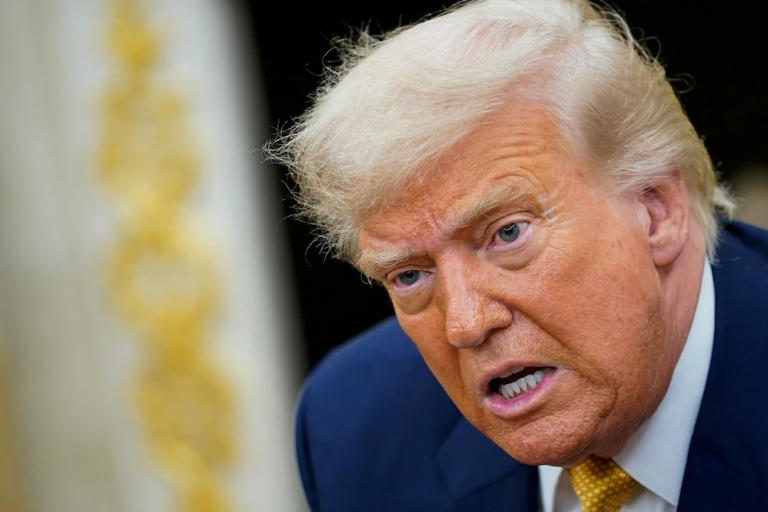
Donald Trump has said he will meet with Vladimir Putin to discuss the war in Ukraine next week and said an end to the three-and-a-half-year war would have to involve “some swapping of territories”.
Trump said he planned to meet the Russian president next Friday in Alaska. He announced the location in a brief post on his Truth Social site.
Russian state media agency Tass confirmed the date and location of the meeting, citing Kremlin aide Yury Ushakov.
Earlier in the day, Trump told reporters in the White House the meeting “would have been sooner, but I guess there’s security arrangements that unfortunately people have to make”.
The US president also said “there’ll be some swapping of territories to the betterment of both” Ukraine and Russia, and that the issue would be discussed soon, but he gave no further details.
Bloomberg reported on Friday that the deal could cement some of Putin’s territorial gains in Ukraine, in effect freezing the battle lines in the Kherson and Zaporizhzhia regions. Putin has claimed four Ukrainian regions in their entirety, although much of their territory remains under Ukrainian control.
US and Russian officials were working on a deal under which Russia would halt its offensive in exchange for the territorial concessions, making it a politically fraught proposal in Ukraine, Bloomberg said.
Trump’s comments came after Poland’s prime minister said a “freeze” in the conflict could be close, after speaking with the Ukrainian leader, Volodymyr Zelenskyy, who has communicated with Trump and European leaders in recent days.
“There are certain signals, and we also have an intuition, that perhaps a freeze in the conflict – I don’t want to say the end, but a freeze in the conflict – is closer than it is further away,” Donald Tusk said during a news conference. “There are hopes for this.”
Tusk said Zelenskyy was “very cautious but optimistic” about the ceasefire, Reuters reported. Ukraine was keen that Poland and other European countries play a role in planning for a ceasefire and an eventual peace settlement, Tusk said.
Trump has previously expressed his readiness to meet Putin one-on-one without preconditions, including direct negotiations between Putin and Zelenskyy, stoking fears that Ukraine may be left out of negotiations for the framework of a potential ceasefire.
If the summit happens, it would be the first US-Russia summit since 2021, when former president Joe Biden met Putin in Geneva.
Zelenskyy has responded by speaking with European leaders, including the German chancellor, Friedrich Merz, and the French president, Emmanuel Macron, who are key conduits to Trump.
The US envoy Steve Witkoff had proposed a three-way meeting with Trump, Putin, and Zelenskyy, but the Kremlin had ignored that suggestion, said the Putin aide Yuri Ushakov, and was “focusing on preparations for a bilateral meeting with Trump in the first place”.
Putin has said he is not ready to meet Zelenskyy, even as the Kremlin claimed preparations were under way for a bilateral summit with Trump next week.
“I have nothing against it in general; it is possible, but certain conditions must be created for this,” Putin said of a meeting with Zelenskyy. “But unfortunately, we are still far from creating such conditions.”
Last month, Trump issued an ultimatum for Putin to agree to a ceasefire or face secondary sanctions, with the deadline set for this Friday. That deadline appeared in place despite plans for the summit, although the White House has not said what secondary measures it could enforce.
Trump did target India with a 25% tariff hike for purchasing Russian oil this week, singling out one of Moscow’s economic enablers in a move that New Delhi complained was unfair and selective.
Trump had grown frustrated with Putin in public in recent months as the war dragged through its third year and Putin continued to launch nightly missile and drone strikes on Ukrainian cities despite Trump’s insistence that he could strike a deal within 24 hours of becoming president.
“Putin … talks nice and then he bombs everybody in the evening,” Trump said last month. “So there’s a little bit of a problem there.”
At this dangerous moment for dissent
I hope you appreciated this article. Before you close this tab, I wanted to ask if you could support the Guardian at this crucial time for journalism in the US.
When the military is deployed to quell overwhelmingly peaceful protest, when elected officials of the opposing party are arrested or handcuffed, when student activists are jailed and deported, and when a wide range of civic institutions – non-profits, law firms, universities, news outlets, the arts, the civil service, scientists – are targeted and penalized by the federal government, it’s hard to avoid the conclusion that our core freedoms are disappearing before our eyes – and democracy itself is slipping away.
In any country on the cusp of authoritarianism, the role of the press as an engine of scrutiny, truth and accountability becomes increasingly critical. At the Guardian, we see it as our job not only to report on the suppression of dissenting voices, but to make sure those voices are heard.
Not every news organization sees its mission this way – indeed, some have been pressured by their corporate and billionaire owners to avoid antagonizing this government. I am thankful the Guardian is different.
Our only financial obligation is to fund independent journalism in perpetuity: we have no ultrarich owner, no shareholders, no corporate bosses with the power to overrule or influence our editorial decisions. Reader support is what guarantees our survival and safeguards our independence – and every cent we receive is reinvested in our work.
The Guardian’s global perspective helps contextualize and illuminate what we are experiencing in this country. That doesn’t mean we have a single viewpoint, but we do have a shared set of values. Humanity, curiosity, and honesty guide us, and our work is rooted in solidarity with ordinary people and hope for our shared future.
.
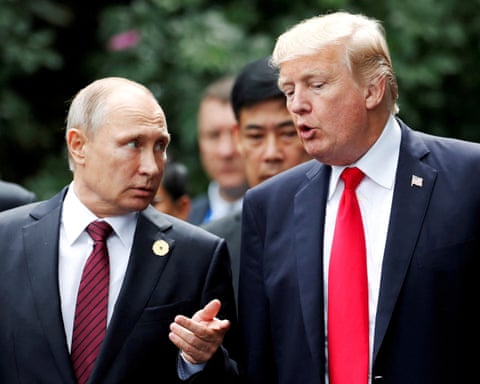 Vladimir Putin and Donald Trump in 2017. According to reports, a US-Russia deal could allow Putin to keep some of the Ukrainian territory his troops have captured. Photograph: Jorge Silva/Reuters
.
.
Click the link below for the complete article:
.
__________________________________________

 .
.

 Romper




 James' World 2