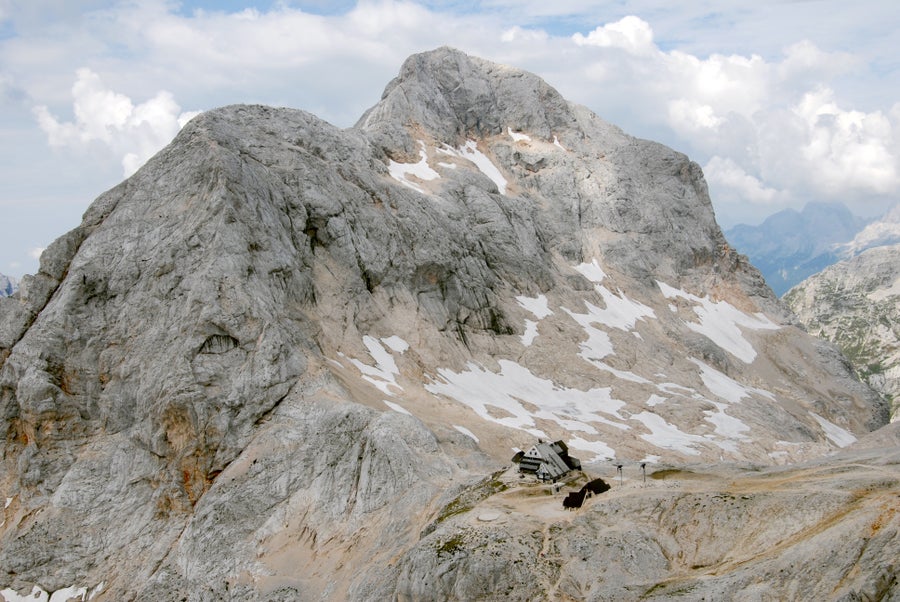
CLIMATEWIRE | Slovenia and Venezuela are the first two countries to lose their last-standing glaciers in a period of climate change induced by people — but they won’t be the last.
Some news outlets reported this month that Venezuela might be the first country in modern times to lose all of its glaciers. However, researchers told E&E News that Slovenia likely claimed the solemn title more than three decades ago.
“The two glacial remnants have not moved, [and] there were no glacial crevasses observed in the last few decades — these characteristics define real glaciers,” Miha Pavšek, who leads ice measurements at Slovenia’s Triglav mountain and Skuta peak with the Anton Melik Geographical Institute, told E&E News.
Melting glaciers are one of the iconic consequences of human-caused climate change, and even Arctic countries like Iceland have lost whole glaciers. But Slovenia and Venezuela appear to be the first countries since the 18th century to lose their last glaciers. It comes as the Intergovernmental Panel on Climate Change expects 18 to 36 percent of global glacial mass to be lost across the 21st century, due in large part to global warming.
A May post on X, formerly Twitter, by climatologist Maximiliano Herrera drew attention to the decline of La Corona — Venezuela’s last glacier — by citing December measurements from the Universidad de Los Andes showing a remaining area of 0.02 square kilometers.
“The disappearance of all the glaciers in Venezuela is a national tragedy,” Julio César Centeno, a professor at Universidad de Los Andes who studied the glaciers, told E&E News in an email. “It is a warning sign about the avalanche of additional effects that are coming to the country in the short term as a consequence of global warming.”
But Slovenia and Venezuela likely lost their last glaciers years earlier.
There’s no universally accepted point of death for a glacier, and no international organization is recognized as the authority on glacial classification. But Centeno said that “the minimum size for a glacier is 0.1 [square kilometers.]” The United States Geological Survey also uses that threshold and says it’s “the commonly accepted guideline.”
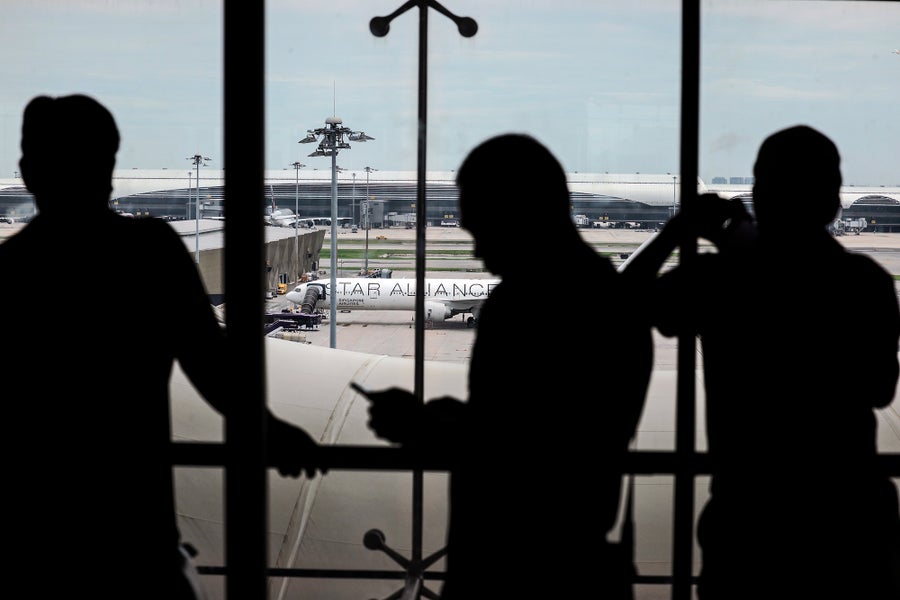
Severe turbulence on a Singapore Airlines flight from London to Singapore has left a 73-year-old man dead and injured more than 70 people. The incident, although rare, is raising questions about what caused such a serious disruption to the flight — and whether climate change will make the strength and frequency of turbulence on planes worse.
The plane, which departed on 20 May, experienced a sudden drop of around more than 1,800 metres that launched people and objects towards the cabin roof. It is the airline’s first fatal incident in 24 years.
“Severe turbulence is the one that turns you into a projectile,” says atmospheric researcher Paul Williams at Reading University, UK. “For anyone not wearing a seatbelt it would have been a bit like being on a rollercoaster without any restraint in place — it would have been terrifying,” he says.
Nature looks at the science of air turbulence and how climate change will influence it.
What causes turbulence in aeroplanes?
Most flights experience some level of turbulence. Near the ground, strong winds around the airport can cause turbulence as planes take off or land. At higher altitudes, up- and downwards flows of air in storm clouds can cause mild to severe turbulence as planes fly through or near them. “Nobody likes flying through a storm,” says Williams.
Air flows that move upwards over mountain ranges can also create turbulence. “As the air blows over the mountain, the plane gets lifted up and can become turbulent,” says Williams. Moreover, turbulence often occurs on the edges of jet streams, which are strong air currents that circle the globe. Any turbulence that occurs outside of clouds is called “clear air” turbulence. It could take weeks to establish what kind of turbulence caused the Singapore Airlines incident, says Williams. “Provisionally, there was a storm nearby, but also the conditions were right for clear air turbulence — we need to do some more digging before we can say,” he says.
Is climate change making turbulence worse and more frequent?
Climate change is making turbulence more frequent and severe, says atmospheric researcher Jung-Hoon Kim at Seoul National University.
Leonard Baier is a graphic designer who lives in a small town in Germany. He’s the perfect person to meet at a party because he can always find a topic of conversation. If he goes into a bar alone, he comes out with a handful of new acquaintances. Yet, he also appreciates living alone in a cozy, two-room apartment. There he enjoys “closing the door every now and then and having some peace and quiet,” he says. After long visits with friends, for example, he is happy to be undisturbed for a while.
Baier meets the criteria for ambiversion, a trait in the middle of the continuum between extroversion and introversion. Whereas an introverted person draws most of their energy from being alone, an extroverted person becomes energized from interacting with other people. Introverts are more easily stressed by other people, whereas extroverts thrive in the company of others. But for Baier these dynamics depend on the circumstances: Sometimes he feels comfortable and relaxed in company. Other times people stress him out.
He’s far from the only one. Most people are not exclusively introverted or extroverted. “Ninety percent of people are somewhere in the middle,” says Jens Asendorpf, a personality researcher at Humboldt University of Berlin. People who tend to be extroverted also like to keep to themselves from time to time. “And since everyone needs social contact, introverts also seek interaction with others—just less so,” Asendorpf adds.
In other words, the vast majority of people are probably ambiverts. But it’s hard to clearly separate these categories, says psychologist Scott Barry Kaufman. “There is no magic line that clearly separates ambiversion from introversion and extroversion,” he says.
If you place people on the continuum according to their characteristics, the vast majority are probably in the middle, with fewer toward the extremes. This dimension of human personality is “normally distributed,” as the statistical term goes. There are also many more gradations than just introverted, ambiverted, and extroverted. “You could create even more subcategories—for example, mild extroversion and mild introversion,” Kaufman says.
Ambiversion: The Best of Everything?
Ambiversion combines the worlds of extroversion and introversion: When Baier’s friends spontaneously drop by on a Friday evening and want to take him to a party, he grabs his jacket and sets off. But if he has no plans, that doesn’t bother him either. On the contrary, he enjoys a quiet evening watching a TV series or drawing. “Ambivert people have a more flexible mindset, which can be very useful in everyday life,” Kaufman says.
.
Ambiverts benefit from a more even balance of social stimulation and time apart when compared with introverts or extroverts. Rivers Dale/Getty Images
Government by the people, exercised either directly or through elected representatives.
A political or social unit that has such a government. The common people, considered as the primary source of political power:
government by the people especially: rule of the majority
a government in which the supreme power is vested in the people and exercised by them directly or indirectly through a system of representation, usually involving periodically held free elections
a political unit that has a democratic government
the principles and policies of the Democratic Party in the U.S. from emancipation Republicanism to New Deal Democracy —C. M. Roberts
the common people, especially when constituting the source of political authority
the absence of hereditary or arbitrary class distinctions or privileges
Fascism
A system of government marked by centralization of authority under a dictator, a capitalist economy subject to stringent governmental controls, the violent suppression of the opposition, and typically a policy of belligerent nationalism and racism A political philosophy or movement based on or advocating such a system of government. Oppressive, dictatorial control
a political philosophy, movement, or regime (such as that of the Fascist) that exalts nation and often race above the individual and that stands for a centralized autocratic government headed by a dictatorial leader, severe economic and social regimentation, and forcible suppression of opposition
a tendency toward or actual exercise of strong autocratic or dictatorial control
Fascism is a system of government led by a dictator who typically rules by forcefully and often violently suppressing opposition and criticism, controlling all industry and commerce, and promoting nationalism and often racism.
More broadly, fascism is used to refer to any ideology or movement seen as authoritarian, nationalistic, and extremely right-wing, especially when fundamentally opposed to democracy and liberalism.
The high-rise apartments — some with panoramic views of Singapore’s tropical cityscape — are airy, light-filled, and spacious enough to comfortably raise a family. They are also public housing units, and for decades, were emphatically affordable, giving Singapore an enviable rate of homeownership.
Now, however, at least a few of the apartments are being sold at a price that would have been unthinkable not long ago: more than $1 million.
“I’m sad to see that — because public housing must equal affordability,” said Liu Thai Ker, the urban planner who gets much of the credit for creating the country’s widely lauded approach to housing its citizens.
Now 86, Mr. Liu is considered the architect of modern Singapore because of his role in overseeing the development of about half of the more than one million apartments that make up public housing in the small and exceptionally prosperous city-state of 5.6 million people.
But in the 1960s, the country’s economic standing was starkly different. It was one of the poorest cities in Southeast Asia, where three out of four residents lived in overcrowded and filthy slums, in ramshackle houses with tin walls known as “squatters.”
At that time, Mr. Liu was working in the New York office of the architect I.M. Pei. He had recently graduated from Yale University with a master’s degree in city planning.
“After four years, I felt that America really did not need me, they had way too many architects,” he said. “So I started thinking about coming back.”
He returned in 1969, accepting a job as head of the design and research unit at Singapore’s Housing and Development Board.
.
Liu Thai Ker, known as the architect of modern Singapore, at his office, in March.
The world of larval plainfin midshipman fish (Porichthys notatus) may look alien, but it could be as close as the cobbles beneath your feet, if you walk a rocky stretch of shore on much of the North American West Coast. Adults of this species swim each spring from ocean depths—up to 366 meters (1,200 feet) beneath the surface—to the intertidal zone to spawn in the shallows, where males excavate nests beneath large rocks. There, they set about trying to attract females and, if successful, rear young.
Perhaps because this species of toadfish is “grotesque in appearance,” as one 1948 description put it, with muddy coloring and vampiric fangs, most males rely on their voices to summon potential mates. They regularly croon at night, rapidly contracting muscles along their swimbladders to produce a monotonous tone resembling the low notes of a trombone. On occasion, they will make this call for more than an hour at a stretch. Multiple males singing at once creates a drone that’s audible through the bottom of a boat, and reportedly loud enough to disrupt conversation or wake someone who is fast asleep. And no wonder, since at least one observer compared the sound to “a huge hive of bees or a group of motorboats.”
Female midshipmen find it irresistible, however. Those drawn to a particular male’s croon will collectively lay hundreds of eggs on the stone ceiling of his watery nest, where he can fertilize them. Unless someone else does, that is. Smaller “sneaker” males often lurk nearby and sometimes inseminate eggs before the guarding male can fend them off. Sneakers don’t sing or build nests, but what they lack in vocal skills and architectural acumen they make up for in cunning—and in testes, which can be as much as seven times larger relative to their body size than those of the crooning “guarder” males.
When this courtship chaos is over, so too are the parts played by the sneaker males and the brood’s moms. Thus abandoned, the singing male braves up to four months of high and low tides to tend those eggs, even though many of them may not hold his offspring. And yet, plainfin midshipman—so named because the pattern of bioluminescent photophores on their bodies resemble the buttons on a naval uniform—are stalwart attendants. They rely on special physiological adaptations to stay put through wild temperature swings and occasional exposure to air. All the while, they ward away predators and use their fins to clean debris from and oxygenate the developing larvae.
This is hungry, even starving, work. With so many hundreds of eggs and babies available in each nest, researchers have shown that some 69 percent of guarding males snack on them, even when other food is available. Recent research suggests that this practice is largely aimed at making way for newer additions to the brood in which paternity may be more certain, since it generally occurs at the start of the egg-guarding season, rather than the end. Fortunately, there are enough babies in each brood to ensure that most survive this dubious aspect of their guardians’ tending. They eventually outgrow the golden yolks anchoring them to their nest rocks, thrashing free, and returning to the deep, where they will begin this bizarre and fascinating cycle all over again.
.
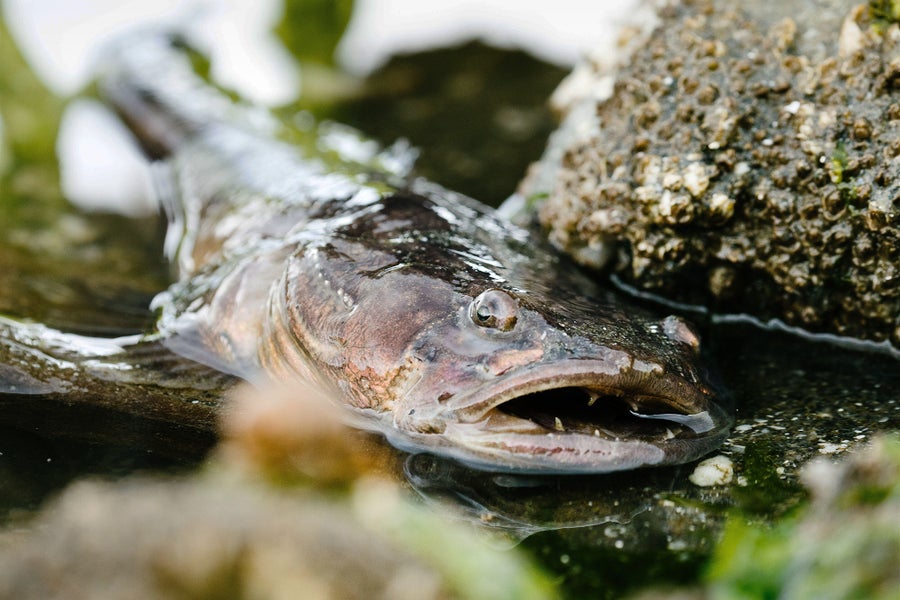
Adult plainfin midshipman (Porichthys notatus) in a Puget Sound tide pool. Cavan Images/Alamy Stock Photo
The 2024 Atlantic hurricane season starts on June 1, and forecasters are predicting an exceptionally active season.
If the National Hurricane Center’s early forecast, released May 23, is right, the North Atlantic could see 17 to 25 named storms, eight to 13 hurricanes, and four to seven major hurricanes by the end of November. That’s the highest number of named storms in any NOAA preseason forecast.
Other forecasts for the season have been just as intense. Colorado State University’s early outlook, released in April, predicted an average of 23 named storms, 11 hurricanes, and five major hurricanes. The European Centre for Medium-Range Weather Forecasts anticipates 21 named storms.
Colorado State also forecasts a whopping 210 accumulated cyclone energy units for 2024, and NOAA forecasts the second-highest ACE on record. Accumulated cyclone energy is a score for how active a given season is by combining intensity and duration of all storms occurring within a given season. Anything over 103 is considered above normal.
These outlooks place the 2024 season in league with 2020, when so many tropical cyclones formed in the Atlantic that they exhausted the usual list of storm names: A record 30 named storms, 13 hurricanes, and six major hurricanes formed that year, combining for 245 accumulated cyclone energy units.
So, what makes for a highly active Atlantic hurricane season?
I am a climate scientist who has worked on seasonal hurricane outlooks and examined how climate change affects our ability to predict hurricanes. Forecasters and climatologists look for two main clues when assessing the risks from upcoming Atlantic hurricane seasons: a warm tropical Atlantic Ocean and a cool tropical eastern Pacific Ocean.
Warm Atlantic water can fuel hurricanes
During the summer, the Atlantic Ocean warms up, resulting in generally favorable conditions for hurricanes to form.
.
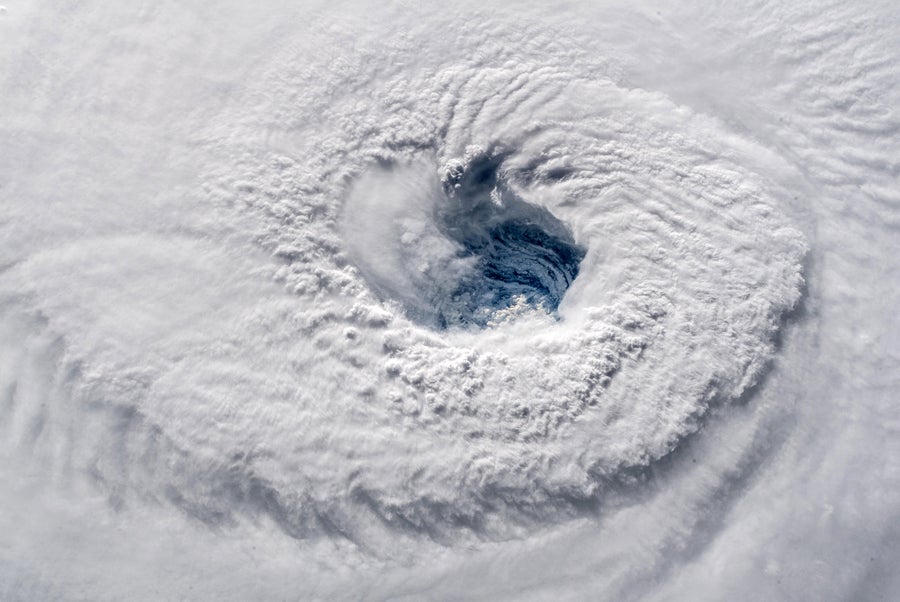
In this satellite image captured by ESA astronaut Alexander Gerst from aboard the International Space Station, Hurricane Florence churns through the Atlantic Ocean toward the U.S. East Coast on September 12, 2018. ESA/NASA via Getty Images
When Courtney Gore ran for a seat on her local school board in 2021, she warned about a movement to indoctrinate children with “leftist” ideology. After 2 1/2 years on the board, Gore said she believes a much different scheme is unfolding: an effort by wealthy conservative donors to undermine public education in Texas and install a voucher system in which public money flows to private and religious schools.
Gore points to West Texas billionaires Tim Dunn and brothers Farris and Dan Wilks, who have contributed to various political action committees that have poured millions into legislative candidates who have promoted vouchers. The men also fund or serve on the boards of a host of public policy and advocacy organizations that have led the fight for vouchers in Texas.
In recent years, the largesse from Dunn and the Wilks brothers has reached local communities across Texas, including Granbury, near Fort Worth, where fights over library books, curriculum, and vouchers have dominated the community conversation.
Gore said that she believes school board candidates are being recruited, at times without their full knowledge, in an effort “to cause as much disruption and chaos as possible” and weaken community faith in local school districts.
In 2021, two local men — former state representative Mike Lang and political consultant Nate Criswell — asked Gore to run for school board. At the time, the three were co-hosts of a web-based talk show that targeted local officials they believed were insufficiently conservative and were straying from GOP platform positions. They took frequent aim at the Granbury school district, which they alleged was allowing explicit sexual content into school libraries and teaching divisive ideas about race.
Gore broke from the group shortly after taking office in January 2022, when she concluded that the materials she had warned about on the campaign trail were not present in Granbury schools. She claims the men and other leaders of the far-right faction in Hood County, home to Granbury, dismissed her findings. They continued to pummel the district over books and curriculum, supported school board candidates who sought to remove a growing number of titles from library shelves, and worked to derail three bond elections that would have funded new and renovated buildings for the overcrowded district.
That’s when Gore said she began to piece together connections that hadn’t been previously apparent to her.
.
Courtney Gore, vice president of the Granbury Independent School District Board of Trustees, listens to public comments during a February meeting.Credit: Shelby Tauber for ProPublica and Texas Tribune
Film and Writing Festival for Comedy. Showcasing best of comedy short films at the FEEDBACK Film Festival. Plus, showcasing best of comedy novels, short stories, poems, screenplays (TV, short, feature) at the festival performed by professional actors.

 Valeria Mongelli/Bloomberg via Getty Images







 James' World 2