I work in a small, close-knit, diverse team in a large health care organization. We have worked well together for years and have occasionally, and happily, socialized together outside of work. Recently there has been a marked cooling between two of my colleagues. They had a scuffle over an office-related issue (parking), which probably would not have been a big deal, but then one of them (P) trash talked the other (Q) in Spanish to another Spanish-speaking colleague. The issue is that this happened right in front of Q, who understands Spanish, which was not known by P. I want to tell P that Q understands Spanish. I worry more will be said in this way, leading to more hard feelings. Is it OK to lean in like this?
— Anonymous
This feels a little like an “A-story” in an NBC sitcom. (I’d call the episode “Mind Your P’s and Q’s.”) In fact, when I ran your question by my editor, his response was: “Love in-office fighting!” I love it as well … when I’m not the subject of it, of course. But I will dispense with the amusement because the reality is this isn’t a situation comedy but a situation — awkward! — and one I’m interested in tackling.
First things first: Parking. You may think it’s not a big deal, but it’s an issue for a fair number of us, and not just in the context of the workplace. (I live in Los Angeles.) Of course, it’s possible, even likely, that the bad vibes that resulted from the parking fracas are evidence of a deeper conflict between your two colleagues. But sometimes a parking space is just a parking space.
A few observations and opinions.
No. 1: That Q understands Spanish heightens the stakes in this scenario, but it’s also secondary. The bigger issue is that P decided it was OK to trash talk a colleague in front of that colleague in the first place.
No. 2: See above. (I can’t stress enough how inappropriate this was.)
Here’s where you come in. You’re wondering whether you should tell P that Q understood what P had to say. I have a few questions for you: Do you worry that more tension will arise if you do tell? Or do you worry that P will continue to trash talk Q because P is unaware that Q understands Spanish? Or is it a little of both? Listen, in a perfect world, P would be horrified and embarrassed to know that Q understood everything. But then again, P felt comfortable enough to trash talk Q in front of Q in the first place. So maybe all bets are off.
Get the best of The Times in your inbox
Thank you for signing up for The Morning. Manage your preferences.
Thank you for signing up for Opinion Today. Manage your preferences.
Thank you for signing up for From The Times. Manage your preferences.
I have another question: How close are you to these two? It sounds like you’re at a bit of a remove because you describe your socialization with P outside of work as being “occasional.” This complicates things, because it may appear (to P) that you’re picking sides in a matter that is actually outside your scope. That said, it couldn’t hurt to give P a quiet heads-up about Q’s literacy in Spanish. You could say something like, “I just wanted you to know that I think Q’s feelings were hurt the other day (week, month, year) when you complained about the parking situation. Q understands Spanish, you know.”
P can take it from there and decide whether to offer Q an apology or keep any complaints private, no matter the lingua franca. As for Q, I don’t think there’s anything you can, or need, to do or say. (In the sitcom version, the stakes are heightened after Q leaves a note that says “Hablo Español” on the windshield of P’s car. Unsigned.)
After all, it happened, and if it happens again, well, Q might be moved to act unprompted, whether in public or in private. I hope this answers your questions. (De nada.)
.
Photo illustration by Margeaux Walter for The New York Times
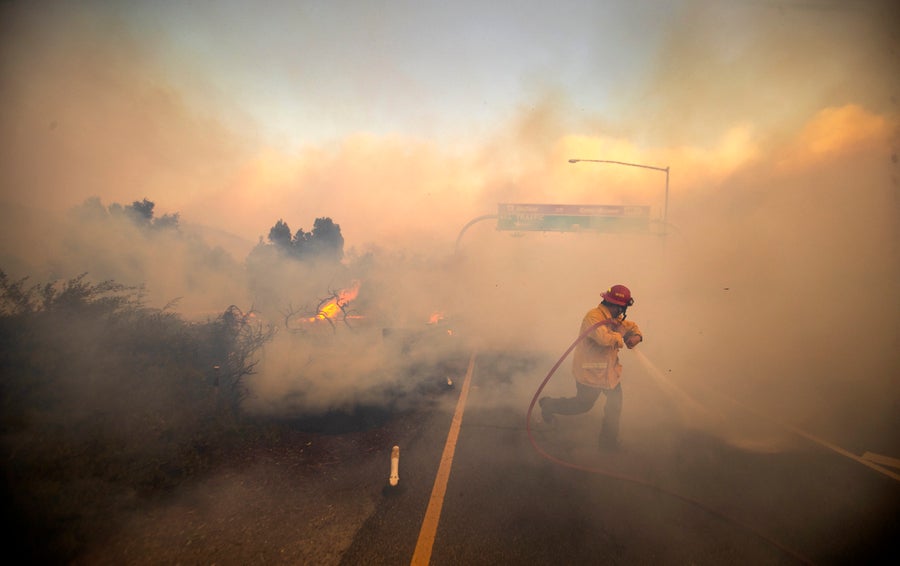
CLIMATEWIRE | Wildfire smoke can aggravate a variety of medical conditions, from asthma to heart disease.
Now, new research adds another worry to the mix. It can elevate the risk of dementia.
A study published Monday in the scientific journal JAMA Neurology, finds that long-term exposure to smoke concentrations is associated with a higher risk of dementia diagnosis over time. For every one microgram increase in wildfire pollution per cubic meter of air over the course of a three-year period, the odds of dementia diagnosis rise by about 18 percent, the study finds.
That’s compared with each person’s baseline risk of dementia diagnosis, which remains relatively low among the general population. Still, the increased risks are large enough to pose a public health concern.
The study focuses on a form of air pollution known as particulate matter — tiny, inhalable particles, with diameters of 2.5 micrometers or smaller. This kind of air pollution can originate from a variety of sources, including automobiles, industrial sources and fires.
Previous studies already have suggested that particulate matter can increase the risk of dementia, among other health problems. The new research zooms in specifically on particles produced by wildfire smoke, which can have different chemical and physical properties than particles produced by other sources.
The study examined medical records from more than 1 million people in Southern California from 2008 to 2019, all part of the Kaiser Permanente Southern California medical care consortium. It also analyzed air quality records from the same time period to estimate long-term pollution concentrations, including particles stemming directly from wildfire smoke.
The study found that wildfire smoke increases the risk of dementia significantly more than particulate matter from other sources. There are several reasons that could be the case, the researchers say.
Wildfire smoke particles tend to have higher concentrations of molecules known for toxic or inflammatory properties. And wildfire smoke tends to spike at certain times of the year, compared with other kinds of air pollution — intermittently exposing communities to extremely high pollution concentrations, which may have greater effects on their health.
The study also found that certain demographics are at higher risk than others, including people with lower incomes and people of color, including Black, Hispanic, and Asian communities.
Low-income communities often are at higher risk of exposure to air pollution, the researchers note. Lower quality housing in these communities may allow particulate matter to infiltrate homes more easily, and residents may have less access to air filtration systems.
Marginalized groups also may contend with more health challenges, in part because of systemic discrimination, compounding their risks of developing dementia later in life.
.
A firefighter is surrounded by heavy smoke as he battles the advancing Silverado Fire fueled by Santa Ana winds at the 241 toll road and Portola Parkway on October 26, 2020, in Irvine, California. Allen J. Schaben/Los Angeles Times via Getty Images
The 2023-24 school year saw more international students in the United States than ever before — setting a new record largely driven by graduate students and recent graduates in internship-type programs.
Over 1.1 million international students were in the U.S. during the last academic year, according to a survey of nearly 3,000 colleges and universities by the Institute of International Education (IIE) and sponsored by the U.S. State Department.
The new figures mark a full rebound from the start of the pandemic, when international enrollment dropped by 15%. But experts say those increases could once again be threatened under the incoming Trump administration, which upended the lives of many international students and workers in its first term.
Already, a few schools have recommended that their international students traveling overseas for winter break consider returning to the U.S. before President-elect Trump takes office on Jan. 20. That includes the University of Massachusetts Amherst, Wesleyan University and the Massachusetts Institute of Technology.
International students have made up around 5% of all college and university students in recent years. In the last school year, they injected about $44 billion into the U.S. economy, while also supporting about 378,000 jobs across the country, according to the group NAFSA: Association of International Educators.
Mirka Martel, who led the IIE survey, said while there is uncertainty, historically there has been bipartisan support to continue to welcome international students.
“We’ve seen numbers go up and down in the past, but overall, we’ve seen that there has been support, because of how much international students bring through economy and through culture to our states,” she said.
For the first time in 15 years, Indian students outnumber Chinese students
The new record in international students is largely fueled by graduate students and those in the Optional Practical Training (OPT) program, which allows foreign students to briefly work in the U.S. after completing their studies.
While the number of undergraduate students stayed about the same compared to the previous year, the graduate cohort and OPT program grew by about 8% and 22% respectively — reaching historic highs.
Meanwhile, India and China together accounted for over half of all international students in the U.S., according to the IIE. But for the first time since 2009, more students came from India than China, with over 331,000 students from India present during the 2023-24 school year.
The number of international Indian students has been rising since 2021, in particular due to an increase in the number of Indian graduate students coming to the U.S. Meanwhile, the number of international Chinese students has been waning since the pandemic. But China remains the top-sending country for undergraduates, with 87,000 students.
.
A group walks on the UC Berkeley campus on March 14, 2022, in Berkeley, Calif. California led the U.S. in international enrollment, with over 140,000 international students attending schools there in the 2023-24 academic year, according to the Institute of International Education. Justin Sullivan/Getty Images
For supporters of reproductive health care, a glaring contradiction stands at the center of the 2024 election. Most pro-abortion ballot initiatives passed, and the American people reelected the president who was responsible for overturning Roe v. Wade through his Supreme Court appointments.
How to reconcile this contradiction? In many ways, the results reflect the complicated dynamics of a post-Roe America.
In the two and a half years since the loss of our federal constitutional right to abortion with the Supreme Court’s Dobbs decision, the legal landscape has been upended, with 13 states currently banning abortion completely and many others banning abortion at different points throughout pregnancy that would have been unconstitutional under Roe. The consequences have been nothing short of disastrous, as the scientific evidence foretold. They include the documented tragic deaths of at least four women, the denial of care for women experiencing pregnancy complications, and the increased criminalization and surveillance of pregnant people. At the same time, the number of abortions has risen. That’s likely a result of monumental efforts by clinics, abortion funds, and practical support organizations to expand access to care and reduce stigma, as well as broader availability of telehealth for medication abortion and new supportive policies in protective states like shield laws that offer protection for abortion providers treating patients in other states via telemedicine and the removal of public insurance coverage restrictions that make abortion care more affordable.
No quick fix offers escape from this complicated legal and policy landscape. No one election can fully restore our rights or—as we needed even while Roe stood—bring us closer to true abortion access for all. There is only the steady, ongoing organizing work necessary, state by state, to deliver deep and lasting change. Ballot measures have become a key tool: between the June 2022 Dobbs decision and November 2023, voters in all seven states where measures on abortion were on the ballot came down decisively in favor of retaining or expanding abortion rights. While in November’s voting, the post-Dobbs winning streak of ballot measures on abortion was ultimately broken, seven new proabortion ballot measures passed while three failed. In sum then, voters in 13 states (Montana had measures in 2022 and 2024) have used direct democracy to declare their desire for legal abortion, in frank opposition to the Dobbs decision.
Amanda Montañez; Source: Guttmacher Institute (abortion ballot measures data)
Those results show voters are clearly comfortable splitting tickets, both in terms of candidates (for example, Wisconsin voters returned Trump to Washington alongside Senator Tammy Baldwin, an abortion rights champion) but also when it comes to abortion rights ballot measures. In Missouri, about 52 percent of voters supported establishing a constitutional right to abortion, making Missouri the first to clear the way for overturning a total ban. With their same votes, over 58 percent of voters supported Donald Trump. Similarly, 57.8 percent of voters approved Montana’s abortion rights ballot measure, while 58.4 percent of them supported Trump.
.
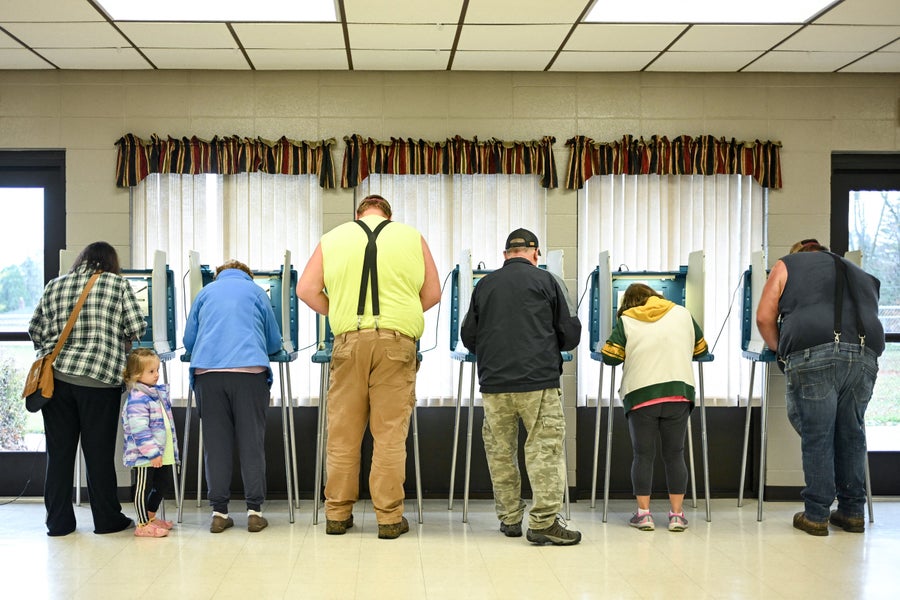
People vote at a polling station at Addison Town Hall in Allenton, Wisconsin, on Election Day, November 5, 2024. Alex Wroblewski/AFP via Getty Images
Modern civilization has encroached on nearly every corner of the globe, but a few uncontacted tribes still do exist today, almost exclusively in dense rainforests or on isolated islands.These tribes manage to live completely self-sufficiently, surviving off the natural resources in their environment. But when outsiders intervene, things can become disastrous.
In 1981, a small, uncontacted tribe in Brazil made contact with outsiders for the first time in history—and it was the worst mistake of their lives.
Before I became a mother, I was certain I’d have two children — possibly three. In our many conversations about our future family, my husband wasn’t sure about a second. “Let’s see how we’re doing with one,” he would say, “then decide.”
“I already know I want two,” I said. “I’m already sure.”
My daughter was born in the spring of 2020. We spent nearly two years on all the day care waitlists in town, desperate for help, as my husband and I both worked from home. My daughter did not nap; she did not sleep; breastfeeding did not come easy. I was totally in love with my baby, totally isolated, and totally overwhelmed. While feverish with my third bout of mastitis, at the onset of the most dangerous depression of my life, I had the thought: I can’t do this again. It would be the death of me.
We had no money to spare; no more hours in the day to work; no sleep to lose. I was so humbled, so in awe that anyone had more than one child. I didn’t understand how they were making it through the day with everyone intact. As I looked closer, I saw they weren’t. They were falling apart.
My vision of having two or more children was not a fantasy, I realized, so much as a received image of what a family should look like. Having two children seemed more inevitable than desirable. I hadn’t considered having one child as a real option — and now I couldn’t imagine it any other way.
I was very fortunate that my husband agreed. We were obsessed with our daughter, we were so happy we’d made parents of ourselves, and we were at capacity. We were a kingdom of three.
My mother says that after I was born, she felt another child waiting for her.
Three years later, a baby began appearing in my dreams. I didn’t know this dream baby; she wasn’t my daughter, and she wasn’t the pregnancies I’d lost — those had a different feeling when I dreamed of them. Soon I was having constant, intrusive thoughts about this baby, both while asleep and awake. I didn’t know this baby, but I knew she was mine.
My mother says that after I was born, she felt another child waiting for her. When I was two years old, she became pregnant with my sister, heeding the call. What was it she felt? I’d imagined it was what I was feeling now — a haunting from the unborn ether. I was afraid to ask her. If these dreams were that call, I wasn’t sure I could heed it. I wasn’t sure what that said about me.
“I don’t know if I want another baby,” I told my husband, when I could no longer keep it from him. “All my reasons for not having another haven’t changed. I just keep seeing her. I don’t know what it means. I want the thoughts to go away, but they won’t go away.”
He confessed he’d been having thoughts of his own. He wasn’t sure he wanted another baby, either, but he’d also been having thoughts.
President-elect Donald Trump’s return to the White House could embolden Republicans who want to weaken or repeal the Affordable Care Act, but implementing such sweeping changes would still require overcoming procedural and political hurdles.
Trump, long an ACA opponent, expressed interest during the campaign in retooling the health law. In addition, some high-ranking Republican lawmakers — who will now have control over both the House and the Senate — have said revamping the landmark 2010 legislation known as Obamacare would be a priority. They say the law is too expensive and represents government overreach.
The governing trifecta sets the stage for potentially seismic changes that could curtail the law’s Medicaid expansion, raise the uninsured rate, weaken patient protections, and increase premium costs for millions of people.
“The Republican plans — they don’t say they are going to repeal the ACA, but their collection of policies could amount to the same thing or worse,” said Sarah Lueck, vice president for health policy at the Center on Budget and Policy Priorities, a research and policy institute. “It could happen through legislation and regulation. We’re on alert for anything and everything. It could take many forms.”
Congressional Republicans have held dozens of votes over the years to try to repeal the law. They were unable to get it done in 2017 after Trump became president, even though they held both chambers and the White House, in large part because some GOP lawmakers wouldn’t support legislation they said would cause such a marked increase in the uninsured rate.
Similar opposition to revamping the law could emerge again, especially because polls show the ACA’s protections are popular.
While neither Trump nor his GOP allies have elaborated on what they would change, House Speaker Mike Johnson said last month that the ACA needs “massive reform” and would be on the party’s agenda should Trump win.
Congress could theoretically change the ACA without a single Democratic vote, using a process known as “reconciliation.” The narrow margins by which Republicans control the House and Senate mean just a handful of “no” votes could sink that effort, though.
Many of the more ambitious goals would require Congress. Some conservatives have called for changing the funding formula for Medicaid, a federal-state government health insurance program for low-income and disabled people. The idea would be to use budget reconciliation to gain lawmakers’ approval to reduce the share paid by the federal government for the expansion population. The group that would be most affected is made up largely of higher-income adults and adults who don’t have children rather than “traditional” Medicaid beneficiaries such as pregnant women, children, and people with disabilities.
A conservative idea that would let individuals use ACA subsidies for plans on the exchange that don’t comply with the health law would likely require Congress. That could cause healthier people to use the subsidies to buy cheaper and skimpier plans, raising premiums for older and sicker consumers who need more comprehensive coverage.
“It’s similar to an ACA repeal plan,” said Cynthia Cox, a vice president and the director of the Affordable Care Act program at KFF, a health information nonprofit that includes KFF Health News. “It’s repeal with a different name.”
.
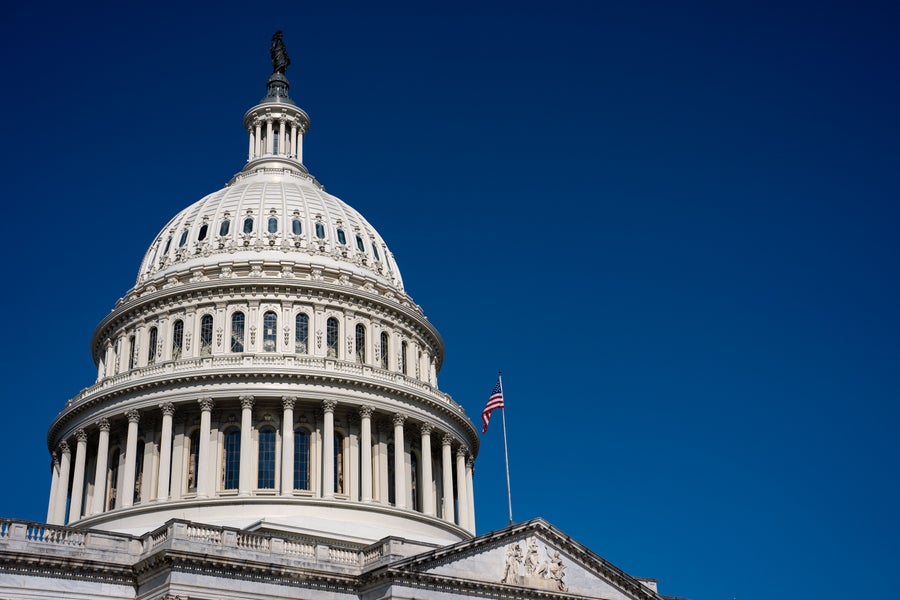
President-elect Donald Trump’s return to the White House could embolden Republicans who want to weaken or repeal the Affordable Care Act, but implementing such sweeping changes would still require overcoming procedural and political hurdles. Kent Nishimura/Getty Images
It seems obvious that there would be a Temple dedicated to the Ancient Greek God of water, Poseidon.But for many years, the temple was lost and was only re-discovered very recently. The ancient ruins were found in Elis, Greece, and identified by archeologists to be the lost Temple of Poseidon of Samikon, described by the ancient Greek geographer Strabo. And now, researchers have revealed that the Temple is even larger than they initially thought (Picture: OeAW-OeAI/Marie Kräker)
It’s impossible to read about modern parenting, especially material intended for the highly educated, middle-class contingent, without coming to one conclusion: Parenting has become needlessly hard, and it would be easier (and better) if we had a “village.”
The “village,” of course, comes from the phrase “It takes a village to raise a child.” In the idealized village, parents might be a child’s primary caregivers, but children are also passed around to relatives and neighbors. This village—primarily composed of women—plays a big role in postpartum families, too, helping clean or cook while the mom rests. You can see the appeal.
I’m going to say something that might sound a bit mean, but bear with me: I don’t think modern parents really want the village, because most parents don’t behave in a village-y way.
Slowly But Surely, the Right Is Taking One of My Heroes for Their Own. It’s Very Hard to Watch.Slowly But Surely, the Right Is Taking One of My Heroes for Their Own. It’s Very Hard to Watch.
Read More
Part of it is simple: Educated people live farther away from their extended families. Twenty-one-year-old college grads starting their careers are probably not thinking about who would watch their older child during the birth of their second. But if you want a village, and your parents don’t live close, you need to socialize with neighbors and friends. And when it comes to this, people repeatedly reveal their preferences: They are “too busy” to meet people. Things are “crazy over here” and they’re “going out of town.” Community is not a priority.
What takes priority over community, for people who claim to want it? A lot of the time, it’s spending time with the nuclear family (parents spend more active parenting time with their kids now than ever before) or the evergreen “going out of town,” which is what I hear every time I try to plan something. Yes, people work, but not more than they used to. At the end of the day, “going out of town” seems to be a far bigger priority than building a community. This is compounded by the fact that (again) the people I’m around are more likely than ever to live far from their parents or other relatives, and if you live far away, you need to travel to visit. Alternatively, maybe nobody likes me!
I’m not saying it’s bad or shameful to enjoy leisure time with your nuclear family. This applies to me, too. Creating community, especially when nobody else is participating, eats up a lot of time. I have some free time, but I spend it at home with my husband and kids, or on hobbies. Yes, I would enjoy having more of a community, but would I rather spend a Saturday playing with my own children, or helping my neighbor move? Building community isn’t my top priority either, despite my occasional attempts to manufacture it by hosting gatherings (the invitations to which are often ignored and never reciprocated).
There’s another element too: Our standards for caregivers are higher than ever. Social media is awash with mothers who decree it’s dangerous to let anyone watch their children, including relatives. People no longer feel comfortable with the 14-year-old neighbor babysitting (our teenage neighbor offered, and we declined). Grandparents can be presented with an email with a list of “boundaries” before the birth of a child, a custom that seems to have become increasingly popular since COVID, when everyone got increasingly worried about vaccines and baby-kissing. As a new mom asked a Parents advice column, “I’m worried about how to set baby boundaries within a family that doesn’t seem to have many. I don’t want my newborn passed around from relative to relative. What do I do?” On the other side of the aisle, a grandmother wrote in to Newsweek expressing dismay that her daughter-in-law won’t let her babysit, or even hold, her 5-month-old grandson.
Rules aren’t necessarily unreasonable—I had a few myself—but the trend is clear. We don’t really want a village, we want a free caretaker or cleaning crew who does things exactly the way we wish.
Even before I could make out the silhouette of Platform Holly on the foggy horizon, I could see and smell oil. Ripples of iridescent liquid floated on the sea’s surface, reflecting the cloudy sky. But the oil wasn’t coming from a leak or some other failure of the rig. Milton Love, a biologist at the Marine Science Institute at the University of California, Santa Barbara, explained that it was “kind of bubbling up out of the seafloor.” Our boat, less than two miles from the central California coast, was sailing above a natural oil seep where the offshore energy boom first began.For thousands of years the Chumash, an Indigenous group native to the region, identified these oceanic seeps and their naturally occurring soft tar, known as malak, which washed up on the shore. Sixteenth-century European explorers noted oil off the coast of modern-day Santa Barbara, and in the 1870s the U.S. oil boom reached California. In the late 1890s the first offshore oil wells in the world were drilled from piers off of Summerland Beach; 60 years later the state’s first offshore oil platform was deployed to drill the Summerland Offshore Field.
Since then, 34 other oil platforms have been installed along the coast, and more than 12,000 have been installed around the world. These hulking pieces of infrastructure, however, have finite lifetimes. Eventually their oil-producing capacities tail off to the point where it is no longer economically viable to operate them—that, or there’s a spill. Today 13 of California’s 27 remaining offshore platforms are what’s known as shut-in, or no longer producing oil.
Platform Holly is among the dead platforms awaiting their afterlives. At the time of its installation in 1966, everyone knew a platform situated directly over a natural oil and gas seep was going to be a success. And for nearly five decades it was. Then, in 2015, a corroded pipeline near Refugio State Beach owned by Plains All American Pipeline cracked, spilling 142,800 gallons of crude oil into the Santa Barbara Channel. The spill killed sea lions, pelicans and perch, among other creatures; closed fisheries and beaches; and permanently severed Platform Holly from its market.
Venoco, the oil company that owned Holly at the time, was not responsible, but it was bankrupted by the event. Because Holly is positioned within three miles of the coast, it was transferred into the hands of the California State Lands Commission (SLC) in 2017. The SLC is now responsible for managing the process of decommissioning the platform and determining its fate.
Because Holly is already owned by the state, not an oil company, its transition could illuminate how to evaluate the fate of rigs worldwide based on science, not politics.
According to platform-decommissioning consultant John Bridges Smith, a former leasing specialist with the Bureau of Ocean Energy Management who counts ExxonMobil, ConocoPhillips and Chevron among his clients, Holly and the eight other platforms whose leases are terminated or expired will be decommissioned by the end of the decade. Based on the original contracts between the oil companies and the state and federal governments, which date to the 1960s, this means the structures will have to be fully removed. In December 2023 the Bureau of Safety and Environmental Enforcement recommended that all 23 California platforms standing in federal waters be fully removed.
Doing so will incur a great expense. That’s true everywhere but especially in California, where some of the platforms are in very deep water. According to one conservative estimate, completely removing all of California’s platforms would cost the responsible oil companies $1.5 billion. Smith says these companies would prefer to delay that process for as long as possible. Some environmental groups in California, meanwhile, are pushing to hold them to the speediest timeline.
Love, who has spent the past three decades studying the aquatic life that now calls southern California’s oil platforms home, would prefer a third alternative.
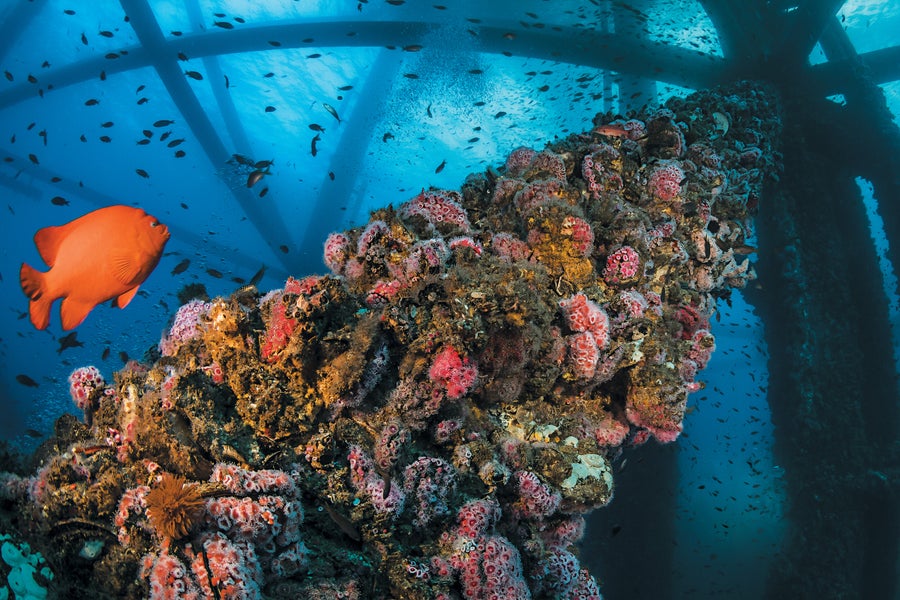
In the decades since they were installed, the steel support structures of California’s oil platforms have become vibrant ecosystems isolated from fishing pressures—de facto marine sanctuaries. Rather than being removed, aging fossil-fuel infrastructure and its serendipitously associated habitats can be salvaged in the ocean as state-managed artificial reefs. The entire topside—
the above-water portion of steel, offices and cranes—and shallow section of a rig are removed, but part of the submerged base may remain. A pathway for doing so already exists in the U.S. and has been successfully followed 573 times in the Gulf of Mexico. Similar examples can be found around the world, from Gabon to Australia. Because Holly is already owned by the state, not an oil company, its transition could illuminate how to evaluate the fate of rigs worldwide based on science, not politics.
When an oil platform is decommissioned, the process goes like this: First, in a phase known as plugging and abandoning, its oil wells are filled with concrete and sealed. Next, scientists conduct an environmental review and consider the various merits and risks of different removal strategies. The results determine a platform’s final resting place, which in most cases has been in a scrap metal yard. A platform’s support structure is called its jacket—hundreds of vertical feet of woven steel that is affixed to the bottom of the ocean. Most of the time engineers will use explosives to sever a platform jacket from the seafloor. The steel is then hauled to shore for disposal and recycling. Decommissioning is considered complete when a platform has been removed down to 15 feet below the mud line and the seafloor has been returned to preplatform conditions.
.
The steel “jackets” that support California’s offshore oil platforms are covered in millions of organisms and provide habitat for thousands of fish. Joe Platko
Film and Writing Festival for Comedy. Showcasing best of comedy short films at the FEEDBACK Film Festival. Plus, showcasing best of comedy novels, short stories, poems, screenplays (TV, short, feature) at the festival performed by professional actors.

 Photo illustration by Margeaux Walter for The New York Times



 Slide 1


 Slide 1
 James' World 2