When Purple’s partner first told her about the FIRE movement — which stands for Financial Independence, Retire Early — in 2013, she wasn’t convinced.
“The first thing I said was, ‘What do I even do with all that time? Why would I want to retire early?’” she says. “I was like, ‘I just need to find my dream job, and then I’ll be happy to work for another 40 years.’”
But in October 2020, Purple retired at just 30 years old with $540,000 in savings, according to documents reviewed by CNBC Make It. She goes by Purple online and in the media to maintain her privacy.
In 2014, she got the dream job she mentioned — but it didn’t bring the satisfaction she thought it would. So the next year, she revisited the FIRE idea and started calculating.
She estimated she could live on roughly $20,000 a year in retirement and would need $500,000 set aside upfront based on the 4% rule, which contends that you can safely withdraw 4% of your portfolio per year to cover your expenses without running out of money. Purple figured if she could boost her income and reduce her spending, she could reasonably retire in 10 years — a goal she hit five years early.
So far, she’s enjoying the freedom to spend her days however she likes and has no problem filling her time. “I’m very good at doing nothing and relaxing and finding new random hobbies,” she says.
Purple wishes she had gotten on board with FIRE when her partner first told her about it. Otherwise, “I don’t have any regrets in retirement,” she says. Her partner hit his FIRE number of $777,000 in November 2023, but he plans to keep working for a few more years to help support some of his loved ones.
Here are the three major moves Purple made to be able to retire early.
1. Job-hopping to maximize her income
Before Purple officially started her FIRE journey, she was making $48,000 a year working in advertising and living in New York City, leaving her virtually ”$0 after rent,” she says. When she decided to increase her income, she knew the best way to do it was through job-hopping.
“In my experience, [job-hopping] has been the only way I can get significant raises and even promotions,” she says.
She also learned early in her career that it doesn’t always pay off to be blindly loyal to a company; it won’t necessarily earn you a raise or promotion. As a result, Purple got very comfortable leaving jobs and companies she felt didn’t meet her financial or psychological needs.
That mindset paid off. Five years and as many jobs later, Purple had more than doubled her salary. As of 2017, at age 28, she earned nearly $107,000 a year. By the time she was getting ready to retire in 2020, her final salary was $114,230.
2. Cutting her spending
A major factor that allowed Purple to stack her savings was moving from New York to Seattle in 2015 to drastically reduce her cost of living. In Seattle, “they pay Manhattan salaries, in my experience, but the cost of living is about half of New York City,” she says.
.
Purple, an anonymous blogger, retired at 30 and now travels the world purple of A Purple Life
Marie Maynard Daly should have received a Nobel Prize. She was the first Black woman in the country to earn a Ph.D. in chemistry, and in the 1950s and 1960s, she discovered the critical relationship between high cholesterol, high blood pressure and clogged arteries, and how this could cause heart attacks, strokes, and other medical issues. This was a huge discovery in medicine, paving the way for the development of statins, which millions of Americans are still prescribed each year to reduce their risk of heart attack.
Such a discovery easily embodies Alfred Nobel’s legacy to award the Nobel Prizes to those who “conferred the greatest benefit to humankind.” And later research on cholesterol metabolism and regulation did earn several other scientists Nobels. So why didn’t Daly, who made the initial connections, win this prestigious award during her lifetime?
We think it’s because the Nobel Committees, whose selection process is notoriously secretive, place emphasis on the way scientists reference one another’s work as grounds for how important that work is. Typically, Nobel Prize–winning research is referenced more than 1,000 times before the scientists who conducted that research win. These references, known as citations, are a proxy for scientific importance but leave room for bias.
Despite their own discoveries leaning heavily on Daly’s initial findings, neither Konrad Bloch and Feodor Lynen, who won the Nobel in Physiology or Medicine in 1964, nor Michael Brown and Joseph Goldstein, who won that award in 1985, mentioned her in their awards speeches. As those researchers and others made discoveries and published findings, they rarely referenced her work at all. Without such references and credit deserved, Daly and other Black scientists have not been awarded Nobels they could have rightfully earned—and instead have been suppressed, even erased, from the historical record of science.
We believe the Nobel Committees need to recognize that, whether overtly or subconsciously, scientists can and do show gender and racial bias when they recognize people as leaders in their fields. While there have been 17 Black Nobel laureates in peace, literature and economics, a Black scientist still has never won a Nobel in physiology/medicine, physics, or chemistry. Asking the question “Why have Black scientists not been awarded?” is a first step toward acknowledging the contributions that Black scientists have made throughout history.
As current and future Black doctors and scientists, we are disheartened by reports that the published research of Black scientists is referenced far less often than that of their white peers. In the hierarchy of publications, the first author of a paper is typically the scientist who has done much of the experimental work it describes, while the last author is usually the scientist who has overseen the research program or the individual project—typically a very senior scientist. In studying who cites whom in neuroscience research papers, neuroscientist Maxwell A. Bertolero and others discovered that papers with white first and last authors were cited 5.4 percent more than expected, while papers with first and last authors of color were cited 9.3 percent less than expected. Inspired by this study, Fengyuan Liu, Talal Rahwan, and Bedoor AlShebli, all at New York University Abu Dhabi, asked a similar question but looked deeper into four racial categories and several scientific fields. They found that Black scientists’ research is significantly undercited compared with similar research published by scientists of other races.
With such studies revealing that Black scientists’ research is often not recognized, we have been intently investigating how this difference in citation numbers could be diminishing the paradigm-shifting discoveries made by Black scientists. It is clear that the number of times a scientist’s research is referencedis important to the Nobel Committees that select each prize. The more cited you are, the more impact your work appears to have on your field. But how can this be an objective measure when citations are affected by such underlying biases? Collating all that we’ve read, it is also clear that the use of citations as a proxy for the importance of a scientific discovery unintentionally ignores the contributions of Black scientists, who are already less likely to be cited regardless of the true impact of their research. And this emphasis on citations over true impact explains scenarios such as that of Marie Maynard Daly, whose research was foundational to work that received two Nobel Prizes but whose name was not deemed worthy of such recognition. It also explains why the major scientific discoveries made by other Black scientists, such as Percy Lavon Julian, Katherine Johnson, and Charles Drew, to name a few, have been overlooked by awarding bodies and the field as a whole. This is a further reflection of systemic inequities in education, mentorship, funding, and recognition, all of which have been described and explored, not just in the U.S. but around the world.
Recognizing the biases in the criteria used by the Nobel Committees, and broader biases woven into academic fields when it comes to underciting Black scientists, is the first step toward creating more equal measures of scientific impact. Further addressing this underlying bias in the Nobel Committees selection process and beyond will not just help the work of Black scientists gain well-deserved recognition; it will also enrich science and society as a whole. This is not about representation; it’s about scientific innovation and progress, especially with research indicating that scientists from minority backgrounds are highly innovative.
.
The Nobel Prize Awards Ceremony 2024 at Stockholm Concert Hall on December 10, 2024, in Stockholm, Sweden. Pascal Le Segretain/Getty Images
In 1943, a Greek war veteran named Stamatis Moraitis came to the United States for treatment of a combat-mangled arm. He’d survived a gunshot wound, escaped to Turkey, and eventually talked his way onto the Queen Elizabeth, then serving as a troopship, to cross the Atlantic. Moraitis settled in Port Jefferson, N.Y., an enclave of countrymen from his native island, Ikaria. He quickly landed a job doing manual labor. Later, he moved to Boynton Beach, Fla. Along the way, Moraitis married a Greek-American woman, had three children, and bought a three-bedroom house and a 1951 Chevrolet.
One day in 1976, Moraitis felt short of breath. Climbing stairs was a chore; he had to quit working midday. After X-rays, his doctor concluded that Moraitis had lung cancer. As he recalls, nine other doctors confirmed the diagnosis. They gave him nine months to live. He was in his mid-60s.
Moraitis considered staying in America and seeking aggressive cancer treatment at a local hospital. That way, he could also be close to his adult children. But he decided instead to return to Ikaria, where he could be buried with his ancestors in a cemetery shaded by oak trees that overlooked the Aegean Sea. He figured a funeral in the United States would cost thousands, a traditional Ikarian one only $200, leaving more of his retirement savings for his wife, Elpiniki. Moraitis and Elpiniki moved in with his elderly parents, into a tiny, whitewashed house on two acres of stepped vineyards near Evdilos, on the north side of Ikaria. At first, he spent his days in bed, as his mother and wife tended to him. He reconnected with his faith. On Sunday mornings, he hobbled up the hill to a tiny Greek Orthodox chapel where his grandfather once served as a priest. When his childhood friends discovered that he had moved back, they started showing up every afternoon. They’d talk for hours, an activity that invariably involved a bottle or two of locally produced wine. I might as well die happy, he thought.
In the ensuing months, something strange happened. He says he started to feel stronger. One day, feeling ambitious, he planted some vegetables in the garden. He didn’t expect to live to harvest them, but he enjoyed being in the sunshine, breathing the ocean air. Elpiniki could enjoy the fresh vegetables after he was gone.
Six months came and went. Moraitis didn’t die. Instead, he reaped his garden and, feeling emboldened, cleaned up the family vineyard as well. Easing himself into the island routine, he woke up when he felt like it, worked in the vineyards until midafternoon, made himself lunch and then took a long nap. In the evenings, he often walked to the local tavern, where he played dominoes past midnight. The years passed. His health continued to improve. He added a couple of rooms to his parents’ home so his children could visit. He built up the vineyard until it produced 400 gallons of wine a year. Today, three and a half decades later, he’s 97 years old — according to an official document he disputes; he says he’s 102 — and cancer-free. He never went through chemotherapy, took drugs or sought therapy of any sort. All he did was move home to Ikaria.
I met Moraitis on Ikaria this past July during one of my visits to explore the extraordinary longevity of the island’s residents. For a
decade, with support from the National Geographic Society, I’ve been organizing a study of the places where people live longest. The project grew out of studies by my partners, Dr. Gianni Pes of the University of Sassari in Italy and Dr. Michel Poulain, a Belgian demographer. In 2000, they identified a region of Sardinia’s Nuoro province as the place with the highest concentration of male centenarians in the world. As they zeroed in on a cluster of villages high in Nuoro’s mountains, they drew a boundary in blue ink on a map and began referring to the area inside as the “blue zone.” Starting in 2002, we identified three other populations around the world where people live measurably longer lives than everyone else. The world’s longest-lived women are found on the island of Okinawa. On Costa Rica’s Nicoya Peninsula, we discovered a population of 100,000 mestizos with a lower-than-normal rate of middle-age mortality. And in Loma Linda, Calif., we identified a population of Seventh-day Adventists in which most of the adherents’ life expectancy exceeded the American average by about a decade.
.
Stamatis Moraitis tending his vineyard and olive grove on Ikaria.Credit…Andrea Frazzetta/LUZphoto for The New York Times
About half of working women reported feeling stressed “a lot of the day,” compared to about 4 in 10 men, according to a Gallup report published this week.
The report suggests that competing demands of work and home comprise part of the problem: working women who are parents or guardians are more likely than men who are parents to say they have declined or delayed a promotion at work because of personal or family obligations, and mothers are more likely than fathers to “strongly agree” that they are the default responders for unexpected child care issues.
And 17% of women overall report having to address personal or family responsibilities at work “daily” or “several times a day,” compared with 11% of men overall.
“There’s been much attention and discussion about promoting women’s well-being and helping women succeed as leaders in the workplace. But at the same time, we’re seeing record levels of stress, of worry, of burnout for women,” said Gallup managing director Ilana Ron Levey at an event on Wednesday presenting the research findings, which were based on four separate surveys of nearly 20,000 adults working full time or part time, conducted between February 2023 and October 2024.
But changing workplace culture and prioritizing well-being can improve the problem, according to Karen Guggenheim, creator of the World Happiness Summit and CEO of WOHASU, the organizing body behind the event and other well-being initiatives.
“Why do we have to choose? Why are we creating environments where people have to make a choice between being the most amazing parent, partner, friend, daughter, sister, whatever, and also thriving at work?” she said, adding: “Investing in women well-being isn’t just good business – it’s a blueprint for societal progress.”
The survey, which also found that working mothers are nearly twice as likely to say they have considered reducing their hours or leaving their job altogether because of child care issues compared to working fathers, also highlights the fallout of the country’s child care crisis weeks ahead of the start of President-elect Donald Trump’s second administration.
Trump has said that child care is “something you have to have in this country” and suggested that his plans to tax imports from foreign nations at higher levels would cover the cost of child care reform, although his campaign website does not mention the issue among the administration’s priorities. Vice President-elect JD Vance has criticized efforts by the Biden administration to control rising costs in child care centers, arguing that doing so encourages parents to go back to work and neglects those who prefer to care for their children at home.
Regarding prohibitively high child care costs —- which can exceed the cost of rent for some families, according to a Department of Labor report published last month — Vance suggested parents should lean more on family members for care.
But juggling work and family responsibilities can be draining for both men and women, who are about as likely to report thinking about work during personal time, the Gallup report found.
Yet researchers also found that employers can significantly improve well-being by supporting work-life balance: Women who say they are able to maintain a healthy balance between work and personal commitments are more likely to be engaged at work, and less likely to be actively looking for a new job, the report says.
Organizations can take action by establishing informed policies, programs, and resources, positioning managers to be the support system employees need, and prioritizing a culture of well-being, explained Kristin Barry, director of hiring analytics at Gallup.
And with women comprising nearly half of the workforce and the narrowest workforce participation gender gap in U.S. history, “turning a blind eye to this challenge women are facing means we are not going to accomplish our goals,” Barry said.
.
FILE – A display of clothes is organized at a retail store on Nov. 25, 2022, in New York. (AP Photo/Julia Nikhinson, File)
Bold hues of red, orange, yellow, blue, and purple help plants and animals communicate with their own species and others in their efforts to survive. Vivid orange dart frogs warn predators of their toxicity. Different birds use a rainbow of plumage to attract mates. Flowers in a rainbow of colors lure birds and bees to disperse pollen and seeds.
The coloration of living things has evolved slowly: colorful fruitlike seeds started dotting an otherwise bland landscape around 300 million years ago, vibrant flowering plants appeared 100 million years later, and animals—namely cockroaches and butterflies—started sporting bolder pigmentation 70 million years after that. But now, in a puzzling twist, new research shows that animals’ ability to perceive many colors came long before the colors themselves existed for them to see.
A recent study in Biological Reviews found that color vision dawned about 500 million years ago—against a drab backdrop of browns and grays and muted shades of some other colors. And it wasn’t until around 400 million years later that bright colors expanded across vertebrates and arthropods (a group of invertebrates with an exoskeleton, such as insects and spiders). “There was this long lag time between the explosion of color and the origins of color vision,” says John J. Wiens, a co-author of the study and a professor of ecology and evolutionary biology at the University of Arizona.
Researchers previously pinpointed the origination of various coloration using a diagram called a phylogenetic tree, which maps organisms’ genetic relationships to one another. This, coupled with fossils that happened to include preserved pigments, allowed evolutionary biologists to trace bright coloration back to the first types of organisms to carry this feature. Wiens and his co-author Zachary Emberts, an integrative biologist at Oklahoma State University, took that work further, analyzing genes that encode protein receptors in animals’ visual system to determine when a species could perceive color. By analyzing the timeline of color vision and that of conspicuous coloration, the study showed that hundreds of millions of years elapsed between the development of the former and the latter.
An evolutionary trait almost always occurs for a reason; this raises the question of why animals would gain the ability to see distinctions in bright color long before they would need to. According to the new study, color vision likely played an important role in early species’ ability to see whether a plant had living green leaves or dead brown ones or to pick a predator out of the background. Color vision also probably proved especially important underwater, where vertebrate species first evolved, for differentiating hues that resulted when light was filtered through the liquid. “In a marine environment, there’s a lot of motion where light is moving, so color vision would have been especially helpful in navigating underwater,” Wiens says.
The study’s scope is impressive but doesn’t tell the whole story of color vision, says Innes C. Cuthill, a professor of behavioral ecology at the University of Bristol in England, who was not involved in the research but provided comments for the manuscript. This research focused on trichromatic color vision—the type of visual color perception that humans possess; it didn’t look at ultraviolet (UV) vision, which most insects have. Bees, for example, use UV light to distinguish different flowers. “The colors that we see aren’t what matters to most animals,” Cuthill says.
Wiens acknowledges that many aspects of color vision are still a mystery. “There’s a very long fuse before this explosion of color occurred,” he says, “and we don’t really know why.”
.
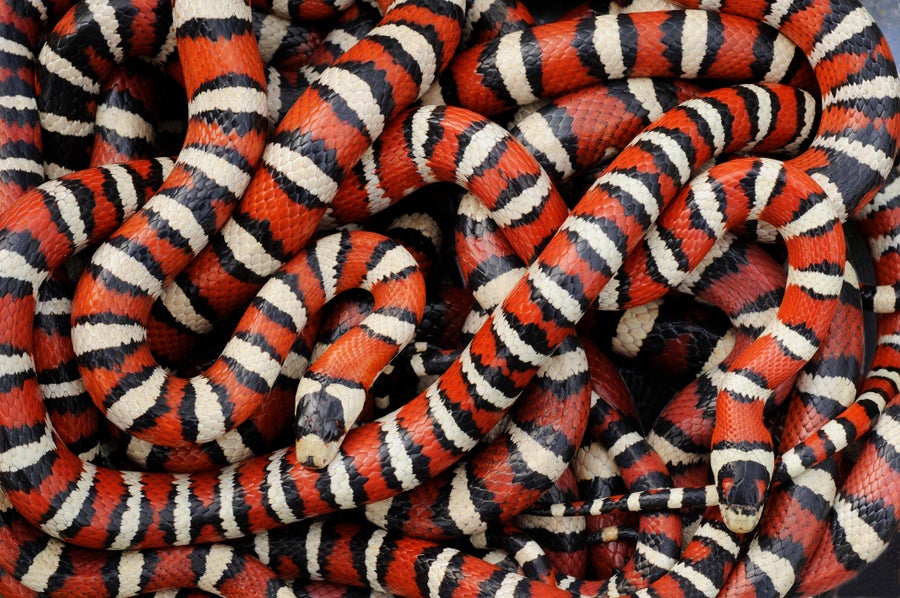
The nonvenomous Arizona mountain kingsnake, which resembles a venomous coral snake, has a survival advantage by warning off would-be predators that avoid colorful coral snakes. Daniel Heuclin/Nature Picture Library/Alamy Stock Photo
In the United States, strokes are a top cause of death and a major cause of disability, according to the American Stroke Association. This is a scary reality, especially since many of the stroke risk factors are pretty silent (like high cholesterol and high blood pressure) ― until they’re not.
But just because some of the risk factors aren’t always obvious doesn’t mean strokes can’t be controlled. In fact, it’s estimated that 80% of strokes are preventable through lifestyle changes like exercise, diet, and more, according to the Centers for Disease Control and Prevention.
No one knows that more than the experts who treat the issue. Stroke doctors say they think a lot about the key ways to lower their risk (and their patients’ risk) of stroke.
“I like to think of it more proactively — what I could do to prevent stroke,” said Dr. Anthony Kim, a vascular neurologist and medical director of the University of California at San Francisco Stroke Center.
Below, stroke doctors share the habits they personally avoid ― and why you should avoid them, too.
Have A Sedentary Lifestyle
According to Dr. Arthur Wang, director of endovascular neurosurgery at Tulane University School of Medicine, one of the modifiable risk factors for stroke is having a sedentary lifestyle.
While there isn’t one across-the-board definition of a sedentary lifestyle, overall, it means spending too much time sitting or lying down and not enough time exercising or moving around.
“It’s been shown that regular physical activity helps keep your blood vessels clog-free. It stops the buildup of plaque in the arteries,” Wang said. “And so we generally recommend that people get probably 30 minutes of moderate exercise maybe five times a week.”
This could mean going for walks, runs, biking, gardening, or joining a group workout class — there is no wrong way to get moving.
Ignore High Blood Pressure
“It turns out that a lot of the same things that we would recommend for a healthy lifestyle also reduce the risk of both heart disease and stroke,” Kim said. “But if there’s one factor that is the most impactful it would be blood pressure, blood pressure, blood pressure.”
Elevated blood pressure, particularly over time, can lead to problems, he said: High blood pressure is the biggest modifiable
stroke risk facto
“If you took a magic wand and waved it and suddenly eliminated high blood pressure from the U.S. population, there would be 60% fewer strokes,” Kim said. “It’s by far the leading risk factor for stroke and we call it the silent killer because oftentimes, patients don’t feel it; you have to have it checked and monitored and treated.”
If you took a magic wand and waved it and suddenly eliminated high blood pressure from the U.S. population, there would be 60% fewer strokes.Dr. Anthony Kim, University of California, San Francisco, Stroke Center
.
It’s important to lead an active lifestyle, eat nutritious foods, and manage things like your blood pressure, doctors say.
Have you experienced that awkward moment when you meet a new colleague, notice a visible disability, and suddenly, all you know about everyday social interaction seems to go out the window? You are not sure what to say, what not to say, or where to look (or not to look). You worry about being inappropriate.
Or maybe it’s not a new colleague. Instead, someone you’ve been around a lot develops a serious health condition. Again, suddenly, you don’t know how to interact, what to ask, what not to ask. You are walking on eggshells.
Discomfort around disability is well-documented. But how do we make sure the discomfort does not turn into discrimination?
The Elephant in the Room: Disability Discomfort
Most of us have some underlying anxiety when it comes to interacting with disabled people. It’s not that we’re cruel or indifferent—it’s that we’re afraid of doing or saying something wrong. We might not fully understand what a person’s experience is like, and this lack of understanding contributes to awkward tension. Worse yet, the elephant grows bigger as we try to avoid it.
Disability discomfort isn’t malicious, but it has serious consequences. When discomfort takes over, it often leads to avoidance. Conversations become shorter—or don’t happen at all. Invitations to coffee, team outings, or professional opportunities dry up. Over time, a disabled colleague may find themselves excluded, not because anyone intended harm, but because discomfort made inclusion feel “too complicated.”
This is how discomfort-driven discrimination happens. It’s not always about overt prejudice. Sometimes, it’s about the small ways people signal, “I don’t know how to interact with you, so I won’t.”
Discomfort is Normal. Discrimination is Not
Let’s clear something up: Feeling awkward around disability doesn’t make you a bad person. Most of us were raised in societies where disability was rarely discussed or openly visible. Where most parents taught their kids to avert their eyes in the face of visible disability and did their darnest to hide their own non-apparent conditions.
So when you encounter disability, your brain fumbles. That fumbling is okay. What’s not okay is letting that discomfort stop you from treating someone with the same respect, dignity, and humanity you extend to everyone else.
How to Turn Awkwardness Into Allyship
So, what can you do when disability awkwardness strikes? Here are some tips to help you navigate these moments with grace—and ensure your discomfort doesn’t unintentionally hurt someone else.
Of all the adjectives that come to mind when you think about scientific research, “cute” probably isn’t at the top of the list. But scientists make plenty of “aw”-inspiring findings every year, from dog facial expressions to the invention of “frog saunas.” Here, Scientific American rounds up a few of our favorite discoveries from this year that are downright adorable.
Singing in Their Sleep
Some people talk in their sleep. Dogs “sleep bark.” Certain birds, it turns out, practice their singing while they snooze. Scientists had previously noticed that some birds seemed to make movements that resembled lip-syncing (beak-syncing?) while they dozed. To see what was a going on, researchers implanted electrodes in the brains of Zebra Finches and Great Kiskadees. The finches, which tend to learn new sounds and songs, seemed to silently rehearse their tunes, whereas the Great Kiskadees, with their more limited repertoire, did not.
s touching heads as a way to communicate with one another.
David Merron Photography/Getty Images
Mighty Morphin’ Melons
Belugas are pretty adorable on their own, but it gets even better: These whales have a mass of fat tissue on their forehead called a “melon” (yes, that’s the technical term), which they move around to communicate with one another. Researchers monitored belugas at Connecticut’s Mystic Aquarium and found that they morph their melon in distinctive ways, such as shaking it or pushing it forward or back. What the whales are communicating isn’t yet clear, but certain morphs could be used to flirt or to signal aggression.
Bear Hugs?
“If not friend, why friend-shaped?” So goes the Internet meme that wants to know why bears looks so cuddly when they are definitely not an animal you’d be advised to hug.
Scientific American editors spoke with experts about why we have an affinity for bears. Some of it likely comes from their role in our cultures (in folklore, for example), as well as humans’ and bears’ similar preferences for where to live and what to eat. The animals’ particular physical features might draw us in, too. Bears have a big nose you kind of want to “boop,” like you would a dog’s, as well as fluffy fur and rounded ears. And their chubby face may trigger our nurturing reflexes by reminding us of our own babies.
.
Close-up of playful European brown bear (Ursus arctos arctos) cubs in the woods of Finland. Dgwildlife/Getty Images
Please give us the elevator pitch of your business. I am Corry Banks, founder and operator of Modbap Modular, a Black-owned boutique manufacturer of electronic musical equipment based in Southern California. We’re dedicated to crafting innovative and performance-focused instruments tailored to the unique approaches of DJs and beatmakers. By combining modular synthesis with beat-making styles like boom bap, Modbap Modular aims to expand the boundaries of beat-making composition and empower musicians to experiment with their craft. We take pride in making our instruments accessible, as they are available in over 40 electronic music stores worldwide, including locations in North America, Europe, and Asia.
When did it launch and what is your role/title? Modbap was launched in the fall of 2020, specifically on 10/10/2020. By the time it hit the market, I had been working on my initial product for about a year. The beginning of the pandemic delayed the launch by a few months, but we pushed through. My official and on-paper role is President of Modbap Modular. I’ve come to realize that I am a product designer, and it is one of the most gratifying things that I’ve ever done.
What inspired you to create this business? Well, I am a beatmaker. I make boombap beats. I spent some years blogging about it and all the related topics like music equipment. I also have a background in IT and a degree in electronics. Somehow, all these things converged to sort of push me in the direction of creating something that I wanted but didn’t seem to exist in the marketplace. I realized that I was uniquely positioned to fill a void for the types of products that I design and that I aspire to design.
My “aha moment” was truly a “Wait, THAT’S it!!” kind of experience. I was preparing for a live beat set featuring my original compositions. As I took stock of all the gear I needed for my performance, I realized it was overwhelming—far too much stuff! I found myself wishing that a particular device could fit into my Eurorack performance case instead. So, I decided to share my thoughts on Instagram, posting a photo of that device with the caption, “Someone needs to make something like this in Eurorack format.” Just like that, I deleted the post, grabbed my sketchbook, and got to work.
Please tell us one “holy @#$!” moment on your business journey. That moment and the most memorable day for me was the launch day of my first product. I was hosting a weekly beatmakers podcast called BeatPPL Podcast. I announced on my social media that I had exciting news about the launch of the first Modbap product. I’d made the product available for preorder, and the plan was to go live, share the announcement, and showcase the production-ready final prototype of the product. The launch exceeded my expectations, and by the end of the weekend, I found myself needing to revise my initial purchase order with the manufacturer three or four times to meet the demand. It was an exhilarating moment, but I also had to pause and ask myself, “Am I really ready for this?” I was confident that the product was solid and ready to succeed, but I suddenly found myself confronted with the responsibility of running a company and making a genuine effort to make it work. Ultimately, I felt prepared for the challenge, and it has been a continuous and rewarding learning experience.
Film and Writing Festival for Comedy. Showcasing best of comedy short films at the FEEDBACK Film Festival. Plus, showcasing best of comedy novels, short stories, poems, screenplays (TV, short, feature) at the festival performed by professional actors.






 Stamatis Moraitis tending his vineyard and olive grove on Ikaria.Credit…Andrea Frazzetta/LUZphoto for The New York Times



 [Source Photo: Ivan Samkov/Pexels]


 James' World 2