A deep field image captured by the James Webb Space Telescope is of galaxy cluster SMACS 0723. Credit: NASA, ESA, CSA, and STScI | mash mix: Space.com Music: Tranquil Dawn by Amber Glow/courtesy of Epidemic Sound
Imagine calling the Social Security Administration and asking, “Where is my April payment?” only to have a chatbot respond, “Canceling all future payments.” Your check has just fallen victim to “hallucination,” a phenomenon in which an automatic speech recognition system outputs text that bears little or no relation to the input.
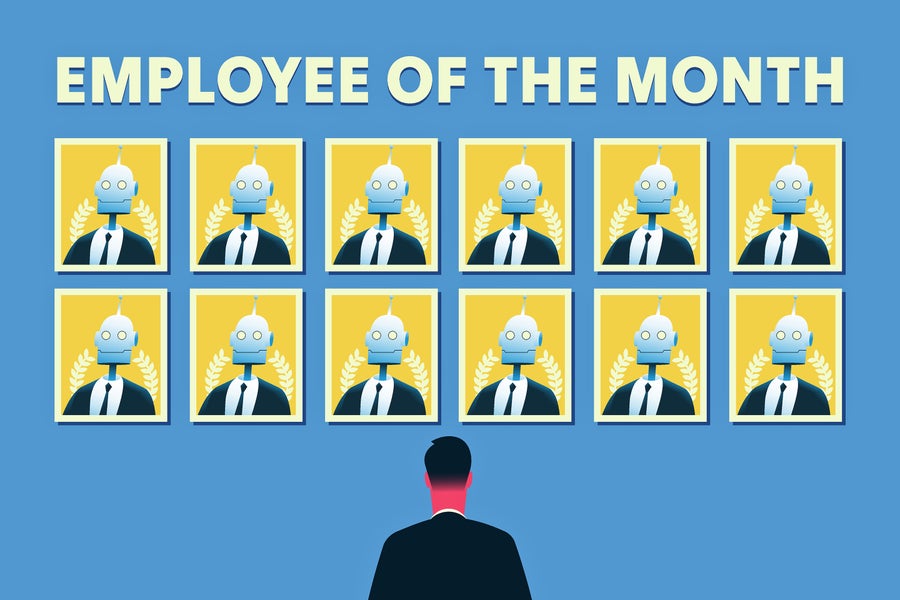
Hallucinations are one of the many issues that plague so-called generative artificial intelligence systems like OpenAI’s ChatGPT, xAI’s Grok, Anthropic’s Claude or Meta’s Llama. These are design flaws, problems in the architecture of these systems, that make them problematic. Yet these are the same types of generative AI tools that the DOGE and the Trump administration want to use to replace, in one official’s words, “the human workforce with machines.”
This is terrifying. There is no “one weird trick” that removes experts and creates miracle machines that can do everything that humans can do, but better. The prospect of replacing federal workers who handle critical tasks, ones that could result in life-and-death scenarios for hundreds of millions of people, with automated systems that can’t even perform basic speech-to-text transcription without making up large swaths of text, is catastrophic. If these automated systems can’t even reliably parrot back the exact information that is given to them, then their outputs will be riddled with errors, leading to inappropriate and even dangerous actions. Automated systems cannot be trusted to make decisions the way that federal workers, actual people, can.
Historically, “hallucination” hasn’t been a major issue in speech recognition. That is, although earlier systems could take specific phrases and respond with transcription errors in specific phrases or misspell words, they didn’t produce large chunks of fluent and grammatically correct texts that weren’t uttered in the corresponding audio inputs. But researchers have shown that recent speech recognition systems like OpenAI’s Whisper can produce entirely fabricated transcriptions. Whisper is a model that has been integrated into some versions of ChatGPT, OpenAI’s famous chatbot.
For example, researchers from four universities analyzed short snippets of audio transcribed by Whisper, and found completely fabricated sentences, with some transcripts inventing the races of the people being spoken about, and others even attributing murder to them. In one case a recording that said, “He, the boy, was going to, I’m not sure exactly, take the umbrella” was transcribed with additions including: “He took a big piece of a cross, a teeny, small piece…. I’m sure he didn’t have a terror knife, so he killed a number of people.” In another example, “two other girls and one lady” was transcribed as “two other girls and one lady, um, which were Black.”
In the age of unbridled AI hype, with the likes of Elon Musk claiming to build a “maximally truth-seeking AI,” how did we come to have less reliable speech recognition systems than we did before? The answer is that while researchers working to improve speech recognition systems used their contextual knowledge to create models uniquely appropriate for performing that specific task, companies like OpenAI and xAI are claiming that they are building something akin to “one model for everything” that can perform many tasks, including, according to OpenAI, “tackling complex problems in science, coding, math, and similar fields.” To do this, these companies use model architectures that they believe can be used for many different tasks and train these models on vast amounts of noisy, uncurated data, instead of using system architectures and training and evaluation datasets that best fit a specific task at hand. A tool that supposedly does everything won’t be able to do it well.
The current dominant method of building tools like ChatGPT or Grok, which are advertised along the lines of “one model for everything,” uses some variation of large language models (LLMs), which are trained to predict the most likely sequences of words. Whisper simultaneously maps the input speech to text and predicts what immediately comes next, a “token” as output. A token is a basic unit of text, such as a word, number, punctuation mark, or word segment, used to analyze textual data. So, giving the system two disparate jobs to do, speech transcription and next-token prediction, in conjunction with the large, messy datasets used to train it, makes it more likely that hallucinations will happen.
The Social Security Trust Fund could be insolvent by 2035
Social Security has been running deficits since 2021, and the losses are projected to persist indefinitely unless lawmakers intervene. The Congressional Budget Office (CBO) estimates the Social Security Trust Funds will be depleted before 2035, at which point the remaining revenue from taxes would cover just 77% of scheduled benefits.
Importantly, that does not mean Social Security is going bankrupt or that benefits will stop. Instead, it means Social Security will lose one of its three funding sources. The trust funds earn interest because assets are invested in Treasury bonds, but the interest income will stop when the trust funds are depleted. That will leave Social Security with two funding sources: (1) taxes collected on payroll and (2) taxes collected on benefits.
One the trust funds are insolvent, the CBO estimates tax revenue will cover only 77% of scheduled payments in 2035. That means Social Security benefits could automatically be cut 23% within a decade unless lawmakers find a fix for the deficit problem. But the timing and severity of the problem would change if President Trump’s tax proposals became law.
President Trump’s proposed tax cuts would further reduce Social Security revenue
As mentioned, Social Security has three funding sources: interest earned on trust fund assets (5%), taxes on benefits (4%), and taxes on payroll (91%). Trust fund insolvency would eliminate 5% of program revenue, which is about $70 billion in 2025. But changes to tax law, such as those Trump has proposed, would reduce other revenue sources.
A budget model from Ivy League business school Penn Wharton suggests ending taxes on benefits would reduce revenue by $1.5 trillion in the next decade, thereby accelerating the time to trust fund depletion by two years. Ending taxes on overtime and tips would further reduce revenue and hasten trust fund depletion by another year, according to the Committee for a Responsible Federal Budget (CRFB).
In total, President Trump’s proposal to end taxes on benefits, overtime, and tips could pull benefit cuts forward to 2032. Additionally, the CRFB estimates those tax law changes would reduce benefits by 33% by 2035, which is 10 percentage points higher than the anticipated reduction under current law.
Importantly, Congress has avoided trust fund insolvency in the past, and there’s no reason to expect a different outcome this time. That means automatic benefit cuts are unlikely. But ending taxes on benefits, overtime, and tips would still reduce Social Security revenue, which makes it more likely that the fix Congress eventually puts in place will involve benefit cuts. That could be bad news for retired workers.
Most companies operate like one-sided cubes—what the world sees is curated and polished, but the rest remains hidden, even to the people inside. Strategy becomes surface-level. Teams chase goals without grounding. Leaders lead without alignment.
In a world growing more complex and emotionally disoriented, that’s not just unsustainable—it’s dangerous. It’s time for a Strategy Renaissance. We need to move beyond sterile planning cycles and rediscover the human heart of strategy.
In this new era of work, meaning isn’t a bonus feature—it’s your sharpest edge.
The Great Divide Between Strategy and Meaning
We have long treated strategy as the realm of numbers and logic, while purpose was relegated to the marketing department or buried in mission statements no one remembers.
This divide has created companies that appear aligned on paper, but feel disjointed in practice. Metrics without meaning drive burnout. Planning without purpose breeds disengagement. And when disruption inevitably hits, strategies built only on spreadsheets crumble.
What endures? Shared purpose, collective clarity, and meaningful momentum.
Illuminate the Whole Strategy Cube
Imagine your organization as a cube. Each face represents a facet of identity: values, operations, leadership, culture, customers, and employees.
Most companies only illuminate one or two sides—the brand and the performance dashboard. The rest remains in the shadows. And when strategy reflects only the visible parts, it becomes hollow.
The companies that are thriving today are the ones brave enough to illuminate the whole cube. That means surfacing the hidden brilliance within teams, reclaiming the narratives that shape culture, and embracing the messy, multidimensional nature of real human work.
I advised a global biotech company whose strategy had become siloed, driven by financial targets but disconnected from employee experience. Through facilitated dialogue sessions, we helped the executive team rediscover their collective purpose.
Within months, they restructured their planning process around a set of guiding principles, resulting in a 22% improvement in employee engagement scores and a renewed sense of cohesion across departments.
When you bring every side of the cube into the light, strategy becomes not just aligned, but alive.
Dialogue Before Direction: The Campfire as a Strategic Tool
Strategy doesn’t start with a spreadsheet. It begins with a story. Before defining your next bold move, gather your people around a campfire—not a literal fire (though that helps), but a space of intentional dialogue where people can share pivotal moments, hopes, fears, and what really matters.
I love simple questions that wind up having complicated—or at least not straightforward—answers. Astronomers twist themselves into knots, for example, trying to define what a planet is, even though it seems like you’d know one when you see it. The same is true for moons; in fact, the International Astronomical Union, the official keeper of names and definitions for celestial objects, doesn’t even try to declare what a moon is. That’s probably for the best because that, too, is not so easy.
What about stars, though? Do they also confound any sort of palatable definition?
In a very broad sense, a star is simply one of those twinkling points of light you can see in the night sky. But that’s not terribly satisfying in either lexicological or physical terms. After all, we also know the sun is a star—but, by definition, we never see it in Earth’s night sky, and it’s certainly not a dot (unless you’re viewing it from well past Pluto, that is).
If such a basic definition leaves us a bit dry, then perhaps we can do better. From centuries of scientific observations and theoretical physics, we can say more. Stars are massive, hot and roughly spherical. They’re held together by their own gravity, and they consist of plasma (gas heated so much that electrons are stripped from its constituent atoms). And, of course, they’re luminous. They shine, which is probably their most basic characteristic.
That’s descriptive, certainly, but still doesn’t really tell us what a star is. What makes one different from, say, a planet? Can there be a smallest star or a biggest one?
To sensibly answer such questions, we need to understand the core mechanism that makes a star luminous in the first place. Then we can use that understanding to better define what is or isn’t a star.
Historically, astronomers were in the dark about this for quite some time. Many mechanisms were proposed, but it wasn’t until the early 20th century that quantum mechanics came to the rescue and introduced humanity (for better or worse) to the concept of nuclear fusion. In this process, subatomic particles such as protons and neutrons—and even entire atomic nuclei—could be smashed together, fusing to form heavier nuclei and releasing an enormous amount of energy.
In a star’s core, fusion takes terrific temperature and pressure that is provided by the crushing gravity of the star’s overlying mass. For a star to be relatively stable, the outward force of the energy generated by fusion in its core must be balanced by the inward pull of the star’s gravity.
There are a couple of different pathways for fusion to occur in stars like the sun, but in the end they both yield essentially the same result: four hydrogen nuclei (each a single proton) plus various other subatomic particles fuse together to form a helium nucleus, and this process blasts out a lot of high-energy radiation as a byproduct. In the sun, this process converts about 620 million metric tons of hydrogen into helium every second. That creates enough energy to, well, power a star.
.
A view of our sun, as seen by NASA’s Solar Dynamics Observatory. NASA/Goddard/SDO
You’re mid-sentence in a meeting, sharing an idea or outlining a strategy you’ve been thinking through for weeks, then it happens. Someone jumps in, cuts you off, and shifts the conversation. You fade out while they take the spotlight.
It’s frustrating, but even more so when it’s subtle. Maybe you weren’t shouted over, but you were redirected, ignored, or sidelined. Over time, it takes a toll on confidence, clarity, and leadership presence.
So, how do you know it’s happening—and how do you stop it? Here are five signs you’re being talked over in meetings, plus practical strategies to reclaim your voice and authority.
1. You’re constantly “circling back” to what you were saying.
If you often hear yourself say, “As I was saying earlier,” or, “Just to finish that thought,” you’re probably being interrupted more than you realize. These polite reentries signal you’ve been cut off—and trained to work around it.
What to do: Don’t just circle back—own the space. Use direct language. “I’d like to finish my point before we move on,” or, “I wasn’t finished with that thought—let me complete it.” It’s not rude. It’s reclaiming your airtime.
2. You’re the idea originator, but someone else gets the credit.
You suggest something early in the meeting. Ten minutes later, someone repeats it—and suddenly it’s a brilliant new direction. This isn’t just annoying—it’s a visibility issue.
What to do: Speak up—gracefully but clearly. Stating, “Thanks for building on my idea from earlier,” signals ownership without confrontation. And when others do this to your colleagues, amplify them, too. It builds a culture of mutual respect.
3. You’re interrupted before you finish a full sentence.
This one is easy to spot—but easy to dismiss. If you rarely get through your full thought before someone else jumps in, you’ve been conditioned to shrink your communication. You may start to self-edit, speak faster, or say less.
What to do: Pause, then continue. “I’d like to finish my point,” is powerful and direct. And don’t speed up or apologize. Take your time. If someone consistently interrupts you, address it privately: “I’ve noticed I’m often cut off mid-thought. Can we be more mindful of giving each other space?”
CLIMATEWIRE | The Trump administration is dismantling a 35-year-old effort to track global climate change that was used to shape regulations and policies across the government.
Federal employees at the U.S. Global Change Research Program were removed from their positions Tuesday, and a government contract with ICF International, which has supported the National Climate Assessment for years, was severed, according to two former officials who were granted anonymity to avoid reprisals.
The move marks a key step by the administration to undermine federal climate research as it rolls back environmental regulations and promotes additional fossil fuel production.
The program was established by Congress in 1990 and signed into law by President George H.W. Bush. In addition to climate science, it focused on land productivity, water resources, fisheries, ecosystems, and the atmosphere. Its most visible product was the National Climate Assessment, a Congress-mandated report that comes out every four years and is used to help shape environmental rules, legislation, and infrastructure projects.
Decades ago, the program identified how a depleted ozone layer was harming Americans, leading to regulations to address the issue.
The next version of the National Climate Assessment is due late next year or in early 2027.
The changes mirror the writings of Russ Vought, director of the White House Office of Management and Budget, who wants to eliminate the program so its work can’t be used to bolster federal climate regulations in court battles.
Vought wrote a chapter in Project 2025, the conservative blueprint that has been closely followed by President Donald Trump, in which he outlined how to “reshape the U.S. Global Change Research Program (USGCRP) and related climate change research programs.”
The chapter spells out how the program could make it harder to enact pro-industry policy and fight court battles that challenge environmental regulations. The USGCRP would “be confined to a more limited advisory role,” he wrote.
“USGCRP actions can frustrate successful litigation defense in ways that the career bureaucracy should not be permitted to control,” the chapter said.
Under Vought’s proposal, OMB would help select researchers to produce a National Climate Assessment that relies on a small pool of scientists who question humanity’s contributions to climate change and give equal weight to industry-produced studies.
.
U.S. President Donald Trump listens to a question as he visits Chez What Furniture Store, which was damaged during Hurricane Helene on September 30, 2024, in Valdosta, Georgia. Michael M. Santiago/Getty Images
Sometimes, being a leader means making tough calls—ones that aren’t popular, and sometimes even get misunderstood. You’ve probably heard the saying, “If everyone likes you, you’re not really leading.” Fair enough. But what do you do when you hear that no one wants to work with you?
Maybe it comes up in passing from a colleague, or maybe it hits harder in a 360 review. Either way, that kind of feedback can sting. It’s that gut-punch moment where you think, Wait . . . what? You’ve been putting in the work, prioritizing the team (at least in your mind), but somehow people aren’t seeing it. They don’t get the pressure you’re under, the decisions you’ve had to make, or why things played out the way they did.
Here’s the hard truth: Perception is reality. You might feel like you’re doing everything right, but if your team feels disconnected or frustrated, their experience is what matters most. It’s time to pause, reflect, and figure out how things veered off course.
No, it’s not fair. And no, you can’t fix it overnight. But you can make a plan to rebuild trust, reconnect with your team, and start turning things around—one step at a time.
Get the data
Yeah, this part’s going to be uncomfortable—but if you’ve heard that no one wants to work with you, it’s time to figure out why. You’ve got a couple of options. If you haven’t already done a 360 review, that’s a good place to start. Or you can reach out to a trusted advisor or mentor and ask for some honest feedback.
One thing you don’t want to do? March straight over to your team and start digging for answers. That’ll likely come off as defensive—or worse, accusatory—and it won’t help your case. Instead, talk to someone outside the situation. Ideally, someone who knows you well but isn’t directly impacted by your leadership style. You want perspective, not more tension.
I worked with one client who’s a strong, passionate leader, but sometimes that passion got the best of him. For instance, when his team would present him with ideas, my client would shout them down if he thought those ideas wouldn’t work. His team felt overwhelmed, and eventually, no one wanted to work with him. My client wasn’t aware of the pattern and had no idea his team felt so discouraged. His 360 revealed to him how much his reactions were demoralizing his team; my client learned to soften his delivery, slow down, and listen more.
It is rare to read about “spectacular progress” or a “once-in-a-century” result in mathematics. That’s for good reason: if a problem has not had a solution for many years, then completely new approaches and ideas are usually needed to tackle it. This is also the case with the innocent-looking “Kakeya conjecture,” which relates to the question of how to rotate a needle in such a way that it takes up as little space as possible.
Experts have been racking their brains over the associated problems since 1917. But in a preprint paper posted in February, mathematician Hong Wang of New York University and her colleague Joshua Zahl of the University of British Columbia finally proved the three-dimensional version of the Kakeya conjecture. “It stands as one of the top mathematical achievements of the 21st century,” said mathematician Eyal Lubetzky of N.Y.U. in a recent press release.
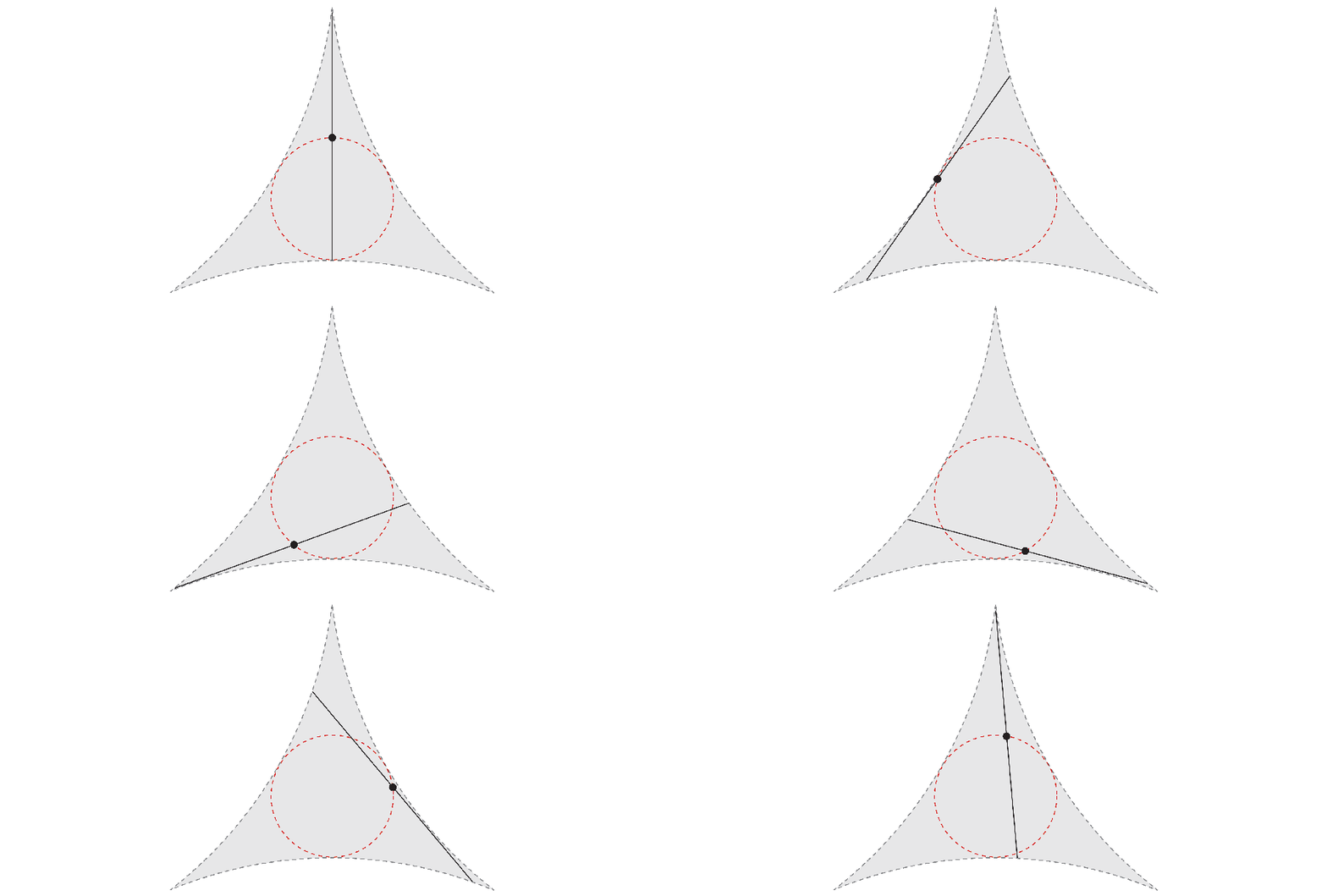
Suppose there is an infinitely narrow needle on a table. Now you want to rotate it 360 degrees so that the tip of the needle points once in each direction of the plane. To do this, you can hold the needle in the middle and rotate it. As it rotates, the needle then covers the surface of a circle.
But if you are clever, the needle can make its 360-degree journey while taking less space. In 1917, mathematician Sōichi Kakeya wanted to investigate the smallest area required to rotate the needle. For example, by rotating not only the outer end of the needle but also its center, you can obtain an area that corresponds to a triangle with curved sides.Years later, mathematician Abram Besicovitch made an unexpected discovery. If you keep moving the needle back and forth like a complex parallel parking maneuver, the surface that the infinitely narrow needle covers can actually have a total area of zero.
The Dimension of an Area of Zero?
From there, experts began to wonder what dimension this “Kakeya surface” has. Usually surfaces in a plane, such as a rectangle or a circle, are two-dimensional. But there are exceptions: fractals, for example, can also have fractional dimensions, meaning they can be 1.5-dimensional, for instance.
Because the Kakeya surfaces can look very jagged, the question of dimensionality is an obvious one. In fact, it has implications for many other areas of mathematics, including harmonic analysis, which breaks down complicated mathematical curves into sums of simpler functions, and geometric measure theory.
In fact, in 1971 mathematician Roy Davies was able to prove that the Kakeya surface is always two-dimensional, even if its area vanishes. But in mathematics, people are interested in general results. The experts wanted to solve the problem in n dimensions—does a needle that is rotated along all n spatial directions always cover an n-dimensional volume? This hypothesis is now known as the Kakeya conjecture.
Film and Writing Festival for Comedy. Showcasing best of comedy short films at the FEEDBACK Film Festival. Plus, showcasing best of comedy novels, short stories, poems, screenplays (TV, short, feature) at the festival performed by professional actors.

 .
.
 Moor Studio/Getty Images

 [Images: Svitlana/Adobe Stock; Tartila/Adobe Stock]

 [Source Illustration: Freepik]



 Sean Gladwell/Getty Images
 James' World 2