April 21, 2025
Mohenjo
Business, Food For Thought, Human Interest, Political, Science, Technical
amazon, business, Business News, current-events, Future, Hotels, human-rights, medicine, mental-health, research, Science, Science News, technology, Technology News, travel, vacation

Click the link below the picture
.
Sammy Ramsey was having a hard time getting information. It was 2019, and he was in Thailand, researching parasites that kill bees. But Ramsey was struggling to get one particular Thai beekeeper to talk to him. In nearby bee yards, Ramsey had seen hives overrun with pale, ticklike creatures, each one smaller than a sharpened pencil point, scuttling at ludicrous speed. For each parasite on the hive surface, there were exponentially more hidden from view inside, feasting on developing bees. But this quiet beekeeper’s colonies were healthy. Ramsey, an entomologist, wanted to know why.
The tiny parasites were a honeybee pest from Asia called tropilaelaps mites—tropi mites for short. In 2024, their presence was confirmed in Europe for the first time, and scientists are certain the mites will soon appear in the Americas. They can cause an epic collapse of honeybee populations that could devastate farms across the continent. Honeybees are essential agricultural workers. Trucked by their keepers from field to field, they help farmers grow more than 130 crops—from nuts to fruits to vegetables to alfalfa hay for cattle—worth more than $15 billion annually. If tropi mites kill those bees, the damage to the farm economy would be staggering.
Other countries have already felt the effects of the mite. The parasites blazed a murderous path through Southeast Asia and India in the 1960s and 1970s. Because crops are smaller and more diverse there than in giant American farms, the economic effects of the mite were felt mainly by beekeepers, who experienced massive colony losses soon after tropilaelaps arrived. The parasite spread through northern Asia, the Middle East, Oceania, and Central Asia. And now Europe. That sighting sounded alarms on this side of the Atlantic because the ocean won’t serve as a barrier for long. Mites can stow away on ships, on smuggled or imported bees. “The acceleration of the tropi mite’s spread has become so clear that no one can deny it’s gunning for us,” said Ramsey, now an assistant professor at the University of Colorado Boulder, on the Beekeeping Today podcast in 2023.
Ramsey, who is small and energetic like the creatures he studies, had traveled to Thailand in 2019 to gather information on techniques that the country’s beekeepers, who had lived with the mite for decades, were using to keep their bees alive. But the silent keeper he was interviewing was reluctant to share. Maybe the man feared this nosy foreigner would give away his beekeeping secrets—Ramsey didn’t know.
But then the keeper’s son tapped his father on the shoulder. “I think that’s Black Thai,” he said, pointing at Ramsey. On his phone, the young man pulled up a video that showed Ramsey’s YouTube alter ego, “Black Thai,” singing a Thai pop song with a gospel lilt. Ramsey, who is Black—and “a scientist, a Christian, queer, a singer,” he says—had taught himself the language by binging Thai movies and music videos. Now that unusual hobby was coming in handy.
Without bees, the almond yield drops drastically. Other foods, such as apples, cherries, blueberries, and some pit fruits and vine fruits, are similarly dependent on bee pollination.
The reticent keeper started to speak. “His face lit up,” Ramsey recalls. “He got really talkative.” The keeper described, in detail, the technique he was using to keep mite populations down. It involved an industrial version of a caustic acid naturally produced by ants. Ramsey thinks the substance might be a worldwide key to fighting the mite, a menace that is both tiny and colossal at the same time.
Ramsey first saw a tropilaelaps mite in 2017, also in Thailand. He had traveled there to study another damaging parasite of honeybees, the aptly named Varroa destructor mites. But when he opened his first hive, he instead saw the stunning effect of tropilaelaps. Stunted bees were crawling across the hive frames, and the next-generation brood of cocooned pupae were staring out of their hexagonal cells in the hive with purple-pigmented eyes, exposed to the elements after their infested cell caps had been chewed away by nurse bees in a frenzy to defend the colony. At the hive entrances, bees were trembling on the ground or wandering in drunken circles. Their wings and legs were deformed, abdomens misshapen, and their bodies had a greasy sheen where hairs had worn off. The colony was doomed. “I was told there was no saving that one,” Ramsey says. He had never seen anything like it.
When he got home, he started reading up on the mites. There was not much to read. Somewhere in Southeast Asia in the middle of the last century, two of four known species of tropilaelaps (Tropilaelaps mercedesae and T. clareae) had jumped to European honeybees from Apis dorsata, the giant honeybee with which it evolved in Asia. Parasites will not, in their natural settings, kill their hosts, “for the same reason you don’t want to burn your house down,” Ramsey said at a beekeeping conference in 2023. “You live there.”
.
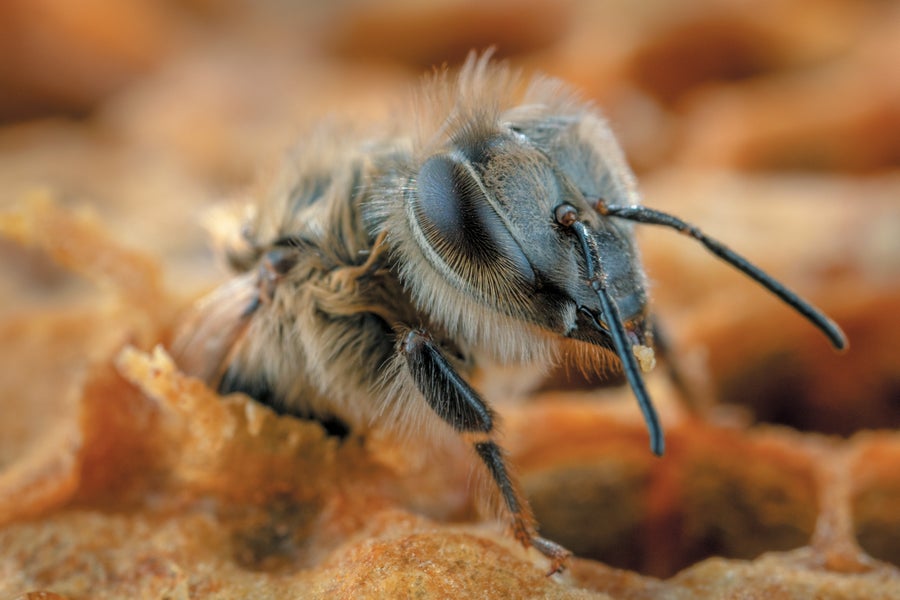
A young honeybee, vulnerable to parasitic mites, comes out of its cell in a hive. Ingo Arndt
.
.
Click the link below for the complete article:
.
__________________________________________
April 21, 2025
Mohenjo
Business, Food For Thought, Human Interest, Political, Science, Technical
amazon, business, Business News, current-events, Future, Hotels, human-rights, medicine, mental-health, research, Science, Science News, technology, Technology News, travel, vacation

Click the link below the picture
.
VATICAN CITY, April 21 (Reuters) – Pope Francis, the first Latin American leader of the Roman Catholic Church, died on Monday after suffering a stroke and cardiac arrest, the Vatican said, ending an often turbulent reign in which he sought to overhaul an ancient and divided institution.
.
He was 88, and had suffered double pneumonia this year, but his death came as a shock after he appeared in St. Peter’s Square in an open-air popemobile to greet cheering crowds on Easter Sunday, suggesting his convalescence was going well.
.
“Dear brothers and sisters, it is with profound sadness I must announce the death of our Holy Father Francis,” Cardinal Kevin Farrell announced on the Vatican’s TV channel.
.
“At 7:35 (0535 GMT) this morning, the Bishop of Rome, Francis, returned to the house of the Father.”
Francis died of a stroke and irreversible cardiovascular arrest, Vatican doctor Andrea Arcangeli said in the death certificate, which was released by the Vatican. It added that the pope had fallen into a coma before he died.
.
Besides his recent lung infection, Arcangeli said Francis had also suffered from high blood pressure and diabetes.
A Vatican spokesman said the pope’s coffin might be moved to St. Peter’s Basilica as early as Wednesday morning to allow the faithful to pay their respects.
.
No date has yet been given for the funeral, but the Vatican said it would normally be expected to take place sometime between Friday and Sunday. A group of cardinals were due to meet on Tuesday to discuss plans.
.
U.S. President Donald Trump said he would attend the ceremony, which was expected to draw dozens of other world leaders to Rome. Meanwhile, Francis’ native Argentina ordered seven days of mourning, as did neighbouring Brazil.
.
“The pope of the poor has left us, the pope of the marginalised,” said Jorge Garcia Cuerva, the archbishop of Buenos Aires, a position Francis once held.
.
Francis had on Sunday made his first prolonged public appearance since being discharged from hospital on March 23 following a 38-day stay for pneumonia, occasionally waving to onlookers and greeting a child who was brought to his side.
n an Easter Sunday message read aloud by an aide as the pope looked on from the main balcony of St. Peter’s Basilica, the pontiff had reiterated his call for an immediate ceasefire in Gaza – a conflict he had long railed against.
.
At the Vatican, locals, tourists, and pilgrims visiting for Easter expressed their shock and grief.
“This is something that really hits you hard,” said Emanuela Tinari from Rome. “He was a pope who brought so many people closer to the church. He was not appreciated by everyone. But he definitely was by ordinary people.”
.
FINAL MEETINGS
Doctors had prescribed two months of rest when the pope left hospital last month, but he appeared on a number of occasions. Francis met Britain’s King Charles in April and had a brief meeting on Sunday with visiting U.S. Vice President JD Vance.
World leaders praised his efforts to reform the worldwide Church and offered condolences to the world’s 1.4 billion Catholics.
.
 .
.
.
Click the link below for the complete article:
.
__________________________________________
April 21, 2025
Mohenjo
Business, Food For Thought, Human Interest, Political, Science, Technical
amazon, business, Business News, current-events, Future, Hotels, human-rights, medicine, mental-health, research, Science, Science News, technology, Technology News, travel, vacation

Click the link below the picture
.
Volcanoes have stirred human awe for thousands of years, with their bursts of fire and rivers of molten rock. Yet, beyond the familiar cone-shaped peaks lies a more silent, hidden danger—supervolcanoes. These colossal forces don’t rumble often, but when they do, the aftermath can reach across continents. Studying these sleeping giants offers not just fascinating science but also sobering warnings for the planet’s future.
Their eruptions sit at the top of the Volcanic Explosivity Index, labeled VEI-8. That’s the highest score possible. To compare, the famous eruption that buried Pompeii was a VEI-5—far less powerful. A single VEI-8 event would not just devastate the surrounding region. It could alter weather patterns, block sunlight, and disrupt global agriculture.
Supervolcanoes act on long, quiet timelines, making them hard to predict. Their sheer potential, however, keeps scientists watchful. These rare eruptions could shift climate, rewrite coastlines, and shake global systems. Understanding their patterns is key to preparing for the unimaginable.
Where Are Supervolcanoes Found?
Supervolcanoes exist on every continent, though some are better known than others. Among the most notable are:
Yellowstone Caldera (United States)
・Size: 70 kilometers by 55 kilometers (caldera size)
・Potential Damage and Power:
・Likelihood to Erupt: Low in the short term. USGS estimates the annual probability of a Yellowstone eruption at approximately 1 in 730,000. Continuous monitoring shows no signs of an imminent eruption.
Toba Caldera (Indonesia)
・Size: 100 kilometers by 30 kilometers
・Potential Damage and Power:
・Likelihood to Erupt: Low, though magma activity beneath the caldera suggests ongoing geological processes. Scientists from the University of Cambridge have identified that its magma chamber has been slowly replenishing.
.

Supervolcanoes act on long, quiet timelines, making them hard to predict. (CREDIT: Joe Burgett) © The Brighter Side of News
.
.
Click the link below for the complete article:
.
__________________________________________
April 21, 2025
Mohenjo
Business, Food For Thought, Human Interest, Political, Science, Technical
amazon, business, Business News, current-events, Future, Hotels, human-rights, medicine, mental-health, research, Science, Science News, technology, Technology News, travel, vacation

Click the link below the picture
.
Exhaustion. Mental fatigue. Difficulty concentrating. Irritability. Dreading your next calendar appointment.
Nobody likes showing up to work with a hangover. But these days, you don’t need a long night of drinking to feel the effects.
Instead, you might be suffering from a meeting hangover—the lingering exhaustion, disengagement, and productivity drain that follow an unproductive meeting.
Studies show that 28% of workplace meetings leave employees feeling drained, with more than 90% of workers experiencing meeting hangovers at least occasionally. Nearly half (47%) report feeling less engaged with their work afterward, while more than half say these hangovers disrupt their workflow and productivity.
Meetings are a double-edged sword. Despite their pitfalls, they remain the most common form of workplace communication. In fact, research suggests face-to-face meetings are more effective for idea generation and task absorption than video calls. In other words, meetings aren’t going anywhere.
But leaders can take charge—ensuring meetings are productive, efficient, and, most importantly, not hangover-inducing. Here are the strategies I use as CEO of Jotform.
Set a concise agenda
If you’ve ever walked into a grocery store for a few essentials and walked out with a cart full of snacks, you understand the power of having a clear list. The same principle applies to meetings.
At Jotform, meeting agendas are indispensable. We also believe in minimizing meetings. By preparing an agenda, you can determine if a meeting is really necessary.
If an asynchronous method—like an email, Slack message, or shared document—can achieve the same outcome faster, we opt for that instead. But when a real-time discussion is necessary, such as brainstorming solutions to an ongoing issue, a meeting is the right call.
An agenda also ensures that only the necessary people are in the room. If someone isn’t essential to the conversation, they can contribute asynchronously—perhaps by answering follow-up questions afterward.
As a result, we have fewer, more efficient meetings and fewer meeting hangovers.
Keep the conversation on track
“The Big Apple Circus in New York once featured a team of Chinese jugglers who could each spin eight plates at a time on the ends of long, slender sticks. Interviewing is a similar balancing act,” writes professor and journalist Helen Benedict.
.
 [Source Photos: Freepik]
.
.
Click the link below for the complete article:
.
__________________________________________
April 20, 2025
Mohenjo
Business, Food For Thought, Human Interest, Political, Science, Technical
amazon, business, Business News, current-events, Future, Hotels, human-rights, medicine, mental-health, research, Science, Science News, technology, Technology News, travel, vacation
Click the link below the picture
.
The US National Institutes of Health (NIH) has terminated nearly 800 research projects at a breakneck pace, wiping out significant chunks of funding to entire scientific fields, finds a Nature analysis of the unprecedented cuts.
The administration of US President Donald Trump began purging NIH-funded studies on topics that it deems problematic less than 50 days ago, continuously expanding its list to include research on topics ranging from COVID-19 to misinformation. Hundreds of the 30,000-plus scientists funded by the NIH yearly have been forced to halt their work after receiving notices that their research “no longer effectuates agency priorities”, and some have had to fire personnel or even shut down their laboratories.
To understand the extent and breadth of these actions, which have so far clawed back more than US$2.3 billion allocated to US researchers, Nature tapped into a scientist-led effort to track these cuts (see ‘How Nature analysed NIH’s grant terminations’ in supplemental info). Our analysis reveals the project topics, NIH institutes and US states affected the most.
The cancellations of projects, despite scientists scoring them highly during review, “tears the long-standing fabric of the government’s contract to pursue medical research that seeks to better the healthspan and lifespan for all Americans”, says Francis Collins, a geneticist who led the NIH, based in Bethesda, Maryland, for 12 years under 3 US presidents, including Trump.
The NIH and its parent organization, the US Department of Health and Human Services (HHS) based in Washington DC, did not respond to Nature’s queries about the terminations or scientists’ concerns about them.
Grant assessment
The NIH is by far the world’s largest public funder of biomedical research, with an annual budget of US$47 billion, paying for more than 60,000 grants. This size means that the agency’s funding is irreplaceable for science, says Shirley Tilghman, a molecular biologist and former president of Princeton University in New Jersey.
Nature’s analysis shows that, looking at just the projects terminated so far, 17% are related to COVID-19, and 29% to HIV/AIDS (see ‘Terminated grant tally’) — although this represents less than 4% of all the grants awarded to each of those topics that the agency funded in 2024. One reason for the focus of these cuts is that the Trump administration has said that the COVID-19 pandemic is over, and people in the United States have moved on from it. Another potential reason is that HIV/AIDS disproportionately affects sexual and gender minorities (LGBT+); Trump signed an executive order on his first day in office on 20 January, directing the US government to stop acknowledging the fact that a person’s gender can differ from their sex at birth.
.
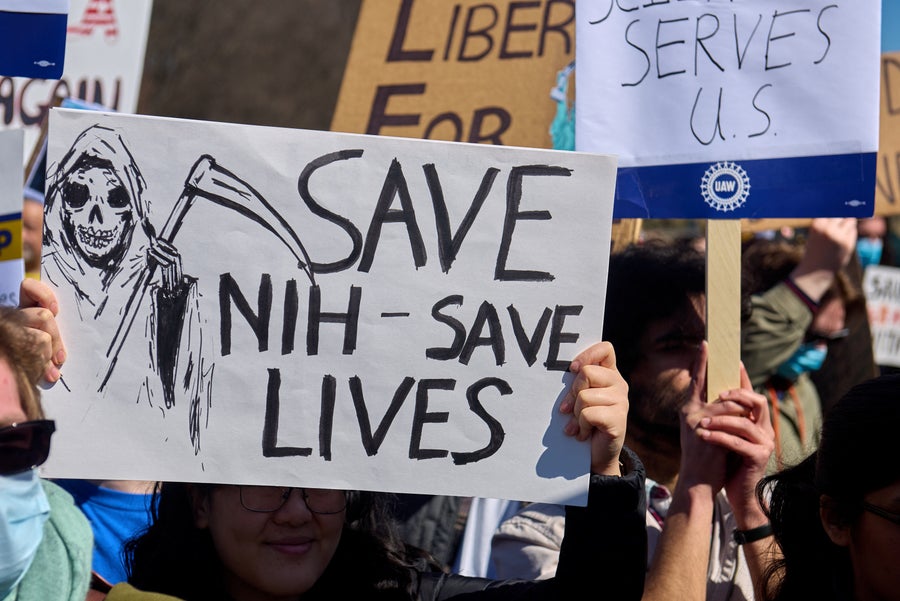
Scientists and others have been protesting the massive cuts to research at the U.S. National Institutes of Health being made by the administration of U.S. President Donald Trump. Dominic GwinnMiddle East Images/AFP via Getty Images
.
.
Click the link below for the complete article:
.
__________________________________________
April 20, 2025
Mohenjo
Business, Food For Thought, Human Interest, Political, Science, Technical
amazon, business, Business News, current-events, Future, Hotels, human-rights, medicine, mental-health, research, Science, Science News, technology, Technology News, travel, vacation
 .
.
__________________________________________
April 20, 2025
Mohenjo
Business, Food For Thought, Human Interest, Political, Science, Technical
amazon, business, Business News, current-events, Future, Hotels, human-rights, medicine, mental-health, research, Science, Science News, technology, Technology News, travel, vacation

Click the link below the picture
.
Scientists have found new but tentative evidence that a faraway world orbiting another star may be home to life.
A Cambridge team studying the atmosphere of a planet called K2-18b has detected signs of molecules which on Earth are only produced by simple organisms.
This is the second, and more promising, time chemicals associated with life have been detected in the planet’s atmosphere by Nasa’s James Webb Space Telescope (JWST).
But the team and independent astronomers stress that more data is needed to confirm these results.
The lead researcher, Prof Nikku Madhusudhan, told me at his lab at Cambridge University’s Institute of Astronomy that he hopes to obtain the clinching evidence soon.
“This is the strongest evidence yet there is possibly life out there. I can realistically say that we can confirm this signal within one to two years.”
K2-18b is two-and-a-half times the size of Earth and is 700 trillion miles, or 124 light years, away from us – a distance far beyond what any human could travel in a lifetime.
JWST is so powerful that it can analyse the chemical composition of the planet’s atmosphere from the light that passes through from the small red Sun it orbits.
The Cambridge group has found that the atmosphere seems to contain the chemical signature of at least one of two molecules that are associated with life: dimethyl sulphide (DMS) and dimethyl disulphide (DMDS). On Earth, these gases are produced by marine phytoplankton and bacteria.
Prof Madhusudhan said he was surprised by how much gas was apparently detected during a single observation window.
“The amount we estimate of this gas in the atmosphere is thousands of times higher than what we have on Earth,” he said.
“So, if the association with life is real, then this planet will be teeming with life,” he added.
Prof Madhusudhan went further: “If we confirm that there is life on K2-18b, it should basically confirm that life is very common in the galaxy.”
He told BBC Radio 5Live on Thursday: “This is a very important moment in science, but also very important to us as a species.
“If there is one example, and the universe being infinite, there is a chance for life on many more planets.”
Dr Subir Sarkar, a lecturer in astrophysics at Cardiff University and part of the research team, said the research suggests K2-18b could have an ocean which could be potentially full of life- though he cautioned scientists “don’t know for sure”.
He added that the research team’s work will continue to focus on looking for life on other planets: “Keep watching this space.”
There are lots of “ifs” and “buts” at this stage, as Prof Madhusudhan’s team freely admits.
Firstly, this latest detection is not at the standard required to claim a discovery.
For that, the researchers need to be about 99.99999% sure that their results are correct and not a fluke reading. In scientific jargon, that is a five sigma result.
These latest results are only three sigma, or 99.7%. Which sounds like a lot, but it is not enough to convince the scientific community. However, it is much more than the one sigma result of 68% the team obtained 18 months ago, which was greeted with much scepticism at the time.
But even if the Cambridge team obtains a five sigma result, that won’t be conclusive proof that life exists on the planet, according to Prof Catherine Heymans of Edinburgh University and Scotland’s Astronomer Royal, who is independent of the research team.
.

Artwork of K2-18b, a faraway world that may be home to life, Cambridge University
.
.
Click the link below for the complete article:
.
__________________________________________
April 20, 2025
Mohenjo
Business, Food For Thought, Human Interest, Political, Science, Technical
amazon, business, Business News, current-events, Future, Hotels, human-rights, medicine, mental-health, research, Science, Science News, technology, Technology News, travel, vacation

Click the link below the picture
.
“Who am I to tell them how to make decisions?”
This anxiety-induced thought played like a broken record in my head as my first leadership training event approached in my new role as a training director. Talking in front of 40 leaders, most of whom were older than my ripe old age of 30 at the time, felt like the perfect opportunity for them to see right through my lack of expertise and expose me as the fraud I was.
Years ago, while working at a regional bank, I was promoted from trainer to leading a training team in another department. My prior roles as a sales trainer and human resources consultant allowed me to build a company-wide reputation as an expert on complicated sales processes and navigating employee benefits and hiring processes.
This new role pushed me out of the payment division into the retail branch banking side. In other words, it was way out of my comfort zone. And at this first training event, I could no longer rely on my expertise to help me feel safe, trusted, or relevant.
The Sky Parted
That first event was tough. Afterward, I admitted to my manager, “Who am I to tell them what to do? I’ve been a manager for about five minutes, and most of these leaders have been managers for 15 years.”
The question she posed to me next transformed my relationship with expertise for a lifetime. She asked, “What if your job is not to be the expert up there, but to facilitate the expertise in the room?”
It was like the sky parted and the sun emerged. Of course, that was the answer. Because I had been promoted throughout my career due to my level of expertise, it was natural for me to assume that in my new role, expertise was the only way I could add value.
Instead of being the expert, I had to rebrand myself as a leader who could facilitate, promote, and grow the expertise around her, whether it be in a training room, on my team, or even now leading my own coaching and speaking practice. Managers looking to break their identity as the expert and the go-to can benefit from undertaking a similar rebranding campaign.
People will likely continue to reach out to you, hoping for you to provide quick answers or jump in to help them fix an issue the way you used to. But it’s critical that you teach others how to see and use you in a new way so that you can advance to more strategic levels of leadership. This is easier said than done. After all, people have grown accustomed to your old ways of working.
Here are some common situations that can keep your stuck in the expert identity trap and some strategies to consider to avoid it.
THE GUILT TRAP
Moving into a new leadership role can sometimes unsettle colleagues accustomed to our old ways of working. They may (intentionally or not) attempt to elicit guilt, saying things like, “You used to do this for me” or “People are going to be upset about this change.”
.
 [Source Photo: Freepik]
.
.
Click the link below for the complete article:
.
__________________________________________
April 19, 2025
Mohenjo
Business, Food For Thought, Human Interest, Political, Science, Technical
amazon, business, Business News, current-events, Future, Hotels, human-rights, medicine, mental-health, research, Science, Science News, technology, Technology News, travel, vacation
Click the link below the picture
.
Today’s corporate job market presents serious challenges for recent college grads. In part, that’s because the job market is difficult for everyone. But it’s also because entry-level job seekers don’t have as much experience and must work harder to show why their skill set and background makes them a good fit for a role.
I recently reached out to Katie Smith, who offers career guidance for young professionals on her site Get a Corporate Job. She encourages students to take the following steps to land their first full-time position—and others to come.
1. UNDERSTAND THE JOBS LISTED
First, begin with a deep dive into the jobs that interest you. You may have a major in English or Psychology, but of course, “these subject areas do not correlate with job descriptions like ‘customer success manager’ or ‘product manager,’” says Smith.
The key, Smith says, “is to understand what the job is before applying for it.” To do this, you’ll need to talk to people who can tell you about the role—ideally, people in your network who may be in that industry or may have held that specific job title. After all, you can’t sell yourself into a role you don’t understand.
Unless you fully understand what that position requires, you won’t be able to customize your résumé or prepare for an interview. Once you know the nature of the job, you can think about how it links with your education and experience.
2. FOCUS ON A FEW APPS
Second, be selective. Though it’s tempting to send out your résumé far and wide, Smith suggests that you apply for no more than three jobs at any one time.
“Recent grads often think they should apply for everything in sight,” she says. “So, they send the same résumé to everyone and then wonder why they are not getting the job.”
Her advice is to take a more focused approach. By limiting the number of jobs you apply for, you can spend more time on each application, and make clear why you have what it takes to succeed in the role.
3. CUSTOMIZE EACH RÉSUMÉ
It’s important to customize every résumé you send out, says Smith.
So, if you have chosen to respond to three postings with three different job titles, craft three separate résumés. “A ‘digital marketing specialist’ and a ‘brand marketing specialist’ might sound similar, but they are not the same job,” says Smith.
.
 [Source Photo: Freepik]
.
.
Click the link below for the complete article:
.
__________________________________________
April 19, 2025
Mohenjo
Business, Food For Thought, Human Interest, Political, Science, Technical
amazon, business, Business News, current-events, Future, Hotels, human-rights, medicine, mental-health, research, Science, Science News, technology, Technology News, travel, vacation

Click the link below the picture
.
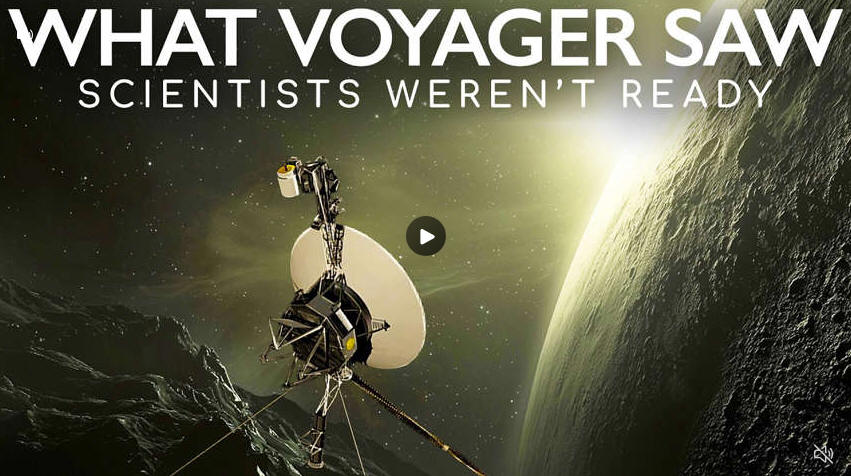
What happens when a spacecraft leaves the solar system? The Voyager probes have finally crossed into interstellar space, sending back unbelievable data about what lies beyond our planetary neighborhood. From detecting mysterious plasma waves to finding unexpected solar winds, their findings have changed everything we thought we knew.
.
 .
.
.
Click the link below for the video (sound on, 51:00 minutes):
.
__________________________________________
Older Entries
Newer Entries
 James' World 2