Home

Live Updates: Senate Republicans Block War Powers Limits as Mideast Crisis Widens

Leave a comment

Click the link below the picture

.

The measure would have restricted President Trump’s power to wage war against Iran without congressional authorization. U.S. officials said airstrikes were accelerating, and several nations sent reinforcements to the Middle East to protect their interests.

Here’s the latest.

Republican lawmakers blocked a measure Wednesday that would have limited President Trump’s power to continue waging war against Iran without congressional authorization, even as the conflict expanded into a wider international crisis.

Earlier in the day, NATO air defenses shot down an Iranian ballistic missile headed toward Turkey, the United States sank an Iranian navy ship in international waters, and several European nations deployed military assets to the region to protect their interests.

The Israeli military said late on Wednesday that the country’s Home Front Command has updated guidelines for the public, easing restrictions on gatherings and activities, starting on Thursday at noon. The transition, from only “essential” activities to a “limited” level of activity, was based on a “situational assessment,” the military said, but it provided no details. Gatherings of up to 50 people will be permitted, and workplaces may operate if protected spaces can be reached promptly, the authorities instructed.

The Senate thwarts a bid to curb Trump’s war powers on Iran.

Republicans on Wednesday blocked a measure that would limit President Trump’s power to continue waging war against Iran without congressional authorization, turning back a bid by Democrats to insist that Congress weigh in on a sweeping and open-ended military campaign.

The 53-to-47 vote against taking up the measure was almost completely along party lines, reflecting a deep partisan divide on the Iran war as the Senate delivered the first clear test of congressional resolve since the joint U.S.-Israeli strikes, Operation Epic Fury, began across Iran four days ago.

The Iranian and Turkish foreign ministers spoke on the phone, after NATO air defenses earlier shot down an Iranian missile headed toward Turkey’s air space, the Iranian ministry said in a statement on Wednesday. Iran’s foreign minister, Abbas Araghchi, stressed that the country’s armed forces “will not rest until the complete repulsion of the enemies’ malevolence,” and defended Iran’s strikes as targeting bases used to “plan and execute aggressive operations against Iran,” the statement said. He also called for Iranian-Turkish cooperation against what he described as Israeli plots in the region. 

Lebanon’s Health Ministry said on Wednesday night that three people were killed and six people were injured in an airstrike near Beirut, the capital. Israel had previously announced new strikes in Lebanon on Wednesday night, including two targeted attacks on individuals near Beirut who were not named.

The Senate is voting on whether to bring a resolution to the floor that would restrict President Trump’s ability to continue military action in Iran, days after he began the campaign without consulting Congress.

A senior U.S. military official and a Western official said the Iranian ballistic missile that NATO air defenses shot down as it was headed toward Turkish air space had been targeting Incirlik Air Base in Turkey, a NATO member that hosts American troops and those from other allied countries. Both officials said the Iranian missile was shot down by an interceptor fired from a U.S. warship in the eastern Mediterranean. The senior U.S. official said it was shot down shortly before midnight Eastern time Tuesday by an SM-3 interceptor for ballistic missiles launched by a U.S. Navy ship.

Spain insists it is not cooperating with the U.S. on Iran war despite a White House claim.

The Spanish government on Wednesday categorically denied an assertion by the White House that the country had reversed its opposition to the war on Iran and was now cooperating with the U.S. military.

It was the latest twist in the back and forth between the United States and Spain’s left-wing government, which has been the Trump’s administration’s most vocal European critic and which has staked out an unequivocal antiwar position. In contrast, Britain, France, and Germany have issued a joint statement promising to help in defensive actions against Iran. 

The Israeli military said in a statement late on Wednesday that it “struck dozens of Hezbollah targets in Lebanon,” completing “an additional wave of strikes” aimed at Hezbollah infrastructure across Lebanon.

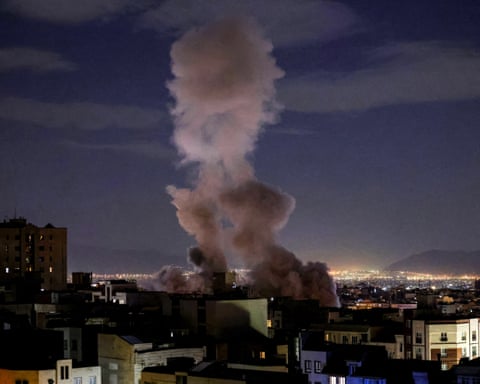
Late in the night in Iran, American–Israeli strikes targeted the western part of the capital, Tehran, as fighter jets attacked the grounds of Mehrabad airport, several locations west of Azadi Square, as well as the Tehransar and Chitgar neighborhoods, according to Tasnim, a semiofficial Iranian news agency.

Secretary of State Marco Rubio spoke with Hakan Fidan, the foreign minister of Turkey, about the U.S.-Israel military action that has enveloped the Middle East. The call came soon after the Turkish defense ministry said a NATO air defense system shot down a ballistic missile fired from Iran that was headed toward Turkish airspace.

“The secretary told the foreign minister that attacks on Turkey’s sovereign territory were unacceptable and pledged full support from the United States,” the State Department said

President Trump called President Emmanuel Macron of France to update him on the military campaign against Iran, according to an official in the French president’s office. Macron raised the issue of the widening conflict in Lebanon, which has been of special concern to the French. It is the first time that Trump and Macron are known to have spoken since the conflict in Iran began.

President Trump made some new comments on the war in Iran during an afternoon appearance at the White House just now. He still doesn’t seem to have an idea for who should run Iran’s government after the death of Ayatollah Ali Khamenei.

“Their leadership is just rapidly going,” he says. “Everybody that seems to want to be a leader, they end up dead. It’s an amazing, an amazing thing that’s taking place before your eyes.”

He said that on a scale of 1 to 10, he would rate the American war effort a 15.

The Israeli military said in a statement late Wednesday that it had launched another “wave of strikes” on Tehran. Earlier, an Israeli military spokesman said the country had struck more than 200 targets in the Iranian capital in nearly five days of fighting.

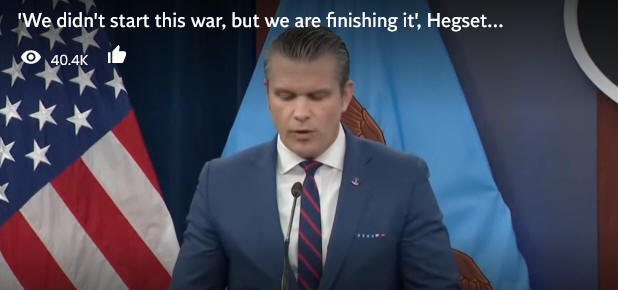
Hegseth plans to join a campaign rally in the home district of a soldier killed in the Iran war.

Secretary of Defense Pete Hegseth is scheduled to headline a “Top Gun”-themed political fundraiser next week for a Republican congressman whose constituent was among the four American soldiers killed in the opening hours of the war with Iran. All four service members had been stationed in the district before deployment.

The event, on behalf of Representative Zach Nunn, who is facing a potentially competitive re-election race, comes as the secretary has signaled he expects more U.S. casualties in the broadening regional conflict.

President Emanuel Macron of France said on Wednesday that he had spoken with Israel’s prime minister, Benjamin Netanyahu, and Lebanon’s president, Joseph Aoun, and its prime minister, Nawaf Salam, to discuss the situation in Lebanon, which he called very concerning. Macron said that he had reaffirmed the need for Hezbollah, the Iran-backed Lebanese militant group, to immediately cease its attacks against Israel, calling its strategy “a major error that endangers the entire region.” Similarly, he said, he called on Netanyahu to preserve Lebanon’s territorial integrity and “to refrain from a ground offensive.”

“It is important for the parties to return to the cease-fire agreement,” Macron said, referring to a fragile truce brokered late in 2024 and ruptured in recent days. France will continue to support the Lebanese Armed Forces, so that they can “put an end to the threat posed by Hezbollah,” he said, and he pledged to support people in southern Lebanon displaced in the renewed conflict.

Naim Qassem, the head of Hezbollah, said: “we will fight to the death and will not surrender.” He said Hezbollah’s fight “is not linked to any other battle,” indicating Hezbollah’s grievances with Israel were not solely tied to its military actions in Iran or the assassination of Iran’s supreme leader, Ayatollah Ali Khamenei, and could continue even after that conflict.

Naim Qassem, the head of Hezbollah, said in a speech on Wednesday evening that the Lebanese militant group has repeatedly reiterated that “patience has limits.” Qassem said that Hezbollah adhered to the cease-fire agreement that Israel and Lebanon reached late in 2024 but charged that “Israel did not abide by any of its provisions.”

Qassem said that Hezbollah had not previously responded to Israeli attacks “so as not to be accused of obstructing diplomacy.” He also said that “the state must be effective,” in reference to the Lebanese government, calling Israeli violations of Lebanon’s sovereignty “significant.”

A U.N. panel condemns the U.S.-Israeli attacks on Iran.

A United Nations human rights panel on Wednesday strongly condemned the attacks by the United States and Israel on Iran as a violation of the U.N. Charter.

The panel, which has been investigating abuses by the Iranian authorities in their crackdown on anti-government protests, said the recent U.S.-Israeli strikes left Iranians caught between large-scale military operations and a government with a long record of gross human rights violations.

American ground troops are not a part of the U.S. military’s current plans for Iran, the White House press secretary, Karoline Leavitt, said. But she added that she would not rule out any option for President Trump that is currently “on the table.”

“They’re not part of the plan for this operation at this time, but I certainly will never take away military options on behalf of the president of the United States or the commander in chief, and he wisely does not do the same for himself,” she said. President Trump and Defense Secretary Pete Hegseth have similarly declined to rule out any military option in recent days.

Leavitt was pressed on why no administration official had been able to articulate what imminent threat the United States faced from Iran that required them to attack it. She took exception to the question and said that President Trump “does not make these decisions in a vacuum,” and that his “decision to launch this operation was based on a cumulative effect of various direct threats that Iran posed to the United States of America.”

On Tuesday, during an Oval Office appearance with Chancellor Friedrich Merz of Germany, Trump suggested that he was guided by instinct. “We were having negotiations with these lunatics, and it was my opinion that they were going to attack first,” Trump said. “If we didn’t do it, they were going to attack first. I felt strongly about that.”

Karoline Leavitt, the White House press secretary, defended the Trump administration against criticism that it did not do enough to evacuate Americans in the Middle East ahead of the strikes on Iran, telling reporters that the State Department had put out “many signs” and was “all hands on deck” in advising Americans in the region to exercise extreme caution and not travel to certain countries. But even after the State Department announced on Tuesday that it would arrange for military and charter flights, Americans who called a department hotline for help were told for hours not to rely on the U.S. government for assistance. The recorded message on the hotline has since been corrected, Leavitt said. Leavitt said at her briefing that the White House had seen “reports” that the son of Ayatollah Ali Khamenei has emerged as the person likely to succeed his father as Iran’s supreme leader, and that it was something “our intelligence agencies are closely monitoring and looking at.” Iranian officials told The New York Times that the clerics responsible for selecting Iran’s next leader wanted to announce him as early as Wednesday, but some had expressed reservations that it could make him a target for the United States and Israel.

.
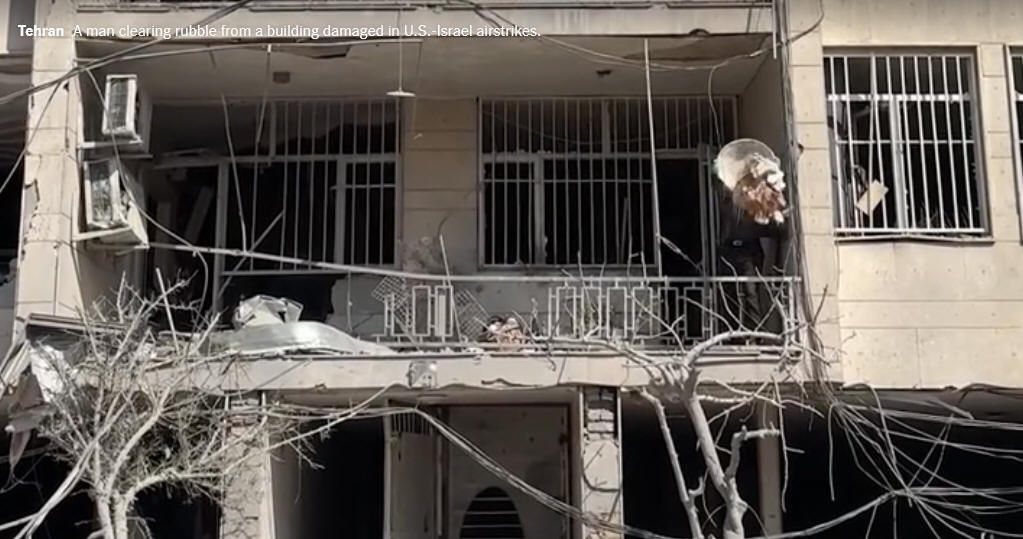
Clearing Rubble in Tehran

.

.

Click the link below for the complete article:

https://www.nytimes.com

.

__________________________________________

17-year-old cracks the code on poacher tracking

Leave a comment

This is really a long read! Sound on to listen (about 22 mins)!

Click the link below the picture

.

Kendra Pierre-Louis: For Scientific American’s Science Quickly, I’m Kendra Pierre-Louis, in for Rachel Feltman.

Wildlife poaching is a serious issue in many parts of the world. One way of monitoring poaching activity is to put recorders in the forest to listen for gunshots.

Pierre-Louis: Computer programs that use AI can help detect the crack of a gun. But accuracy is still a huge challenge when the forest is such a noisy place.

Freelance wildlife writer Melissa Hobson met someone who may have experienced a breakthrough: a 17-year-old high schooler who built an AI model that can accurately pick out gunshots from other jungle sounds.

What impact could this model make on gun-based poaching? Here’s Melissa with more about how it might help save elephants and other animals from the threat of illegal hunting.

Melissa Hobson: That is the sound of an African forest elephant. To the untrained ear, it might be indistinguishable from noises made by the animal’s relative, the African savanna elephant.

Both species are under threat. But while African savanna elephants are endangered, forest elephants are critically endangered. They’re also highly elusive. Living in dense tropical rainforests in central Africa and parts of West Africa, they’re very hard to find and study.

Daniela Hedwig: As such, we don’t know much about the forest elephants, and it’s very difficult to exactly know how many there still are.

Hobson: That’s Daniela Hedwig, director of the Elephant Listening Project at the K. Lisa Yang Center for Conservation Bioacoustics at Cornell University.

Hedwig: Our goal is to use acoustic monitoring to contribute to the conservation of the central African rainforest. We have about almost 100 acoustic units spread out in the area, covering almost 2,000 square kilometers [roughly 772 square miles] combined.

Melissa Hobson: That is the sound of an African forest elephant. To the untrained ear, it might be indistinguishable from noises made by the animal’s relative, the African savanna elephant.

Both species are under threat. But while African savanna elephants are endangered, forest elephants are critically endangered. They’re also highly elusive. Living in dense tropical rainforests in central Africa and parts of West Africa, they’re very hard to find and study.

Daniela Hedwig: As such, we don’t know much about the forest elephants, and it’s very difficult to exactly know how many there still are.

Hobson: That’s Daniela Hedwig, director of the Elephant Listening Project at the K. Lisa Yang Center for Conservation Bioacoustics at Cornell University.

Hedwig: Our goal is to use acoustic monitoring to contribute to the conservation of the central African rainforest. We have about almost 100 acoustic units spread out in the area, covering almost 2,000 square kilometers [roughly 772 square miles] combined.

Hobson: These sound recorders are easily hidden, obscured by the tree branches. These devices enable the Elephant Listening Project to detect elephants through the rumbling vocalizations they use to communicate with one another, even when they’re kilometers apart.

Hobson: This helps the experts learn more about the animals’ lives and population numbers without even seeing them.

But the recording devices don’t just pick up elephant sounds.

Hedwig: Acoustic monitoring is really great at recording these soundscapes and getting this really amazing picture of biodiversity by eavesdropping on nature.

Hobson: They also hear the sounds of human activity and can be an effective way of combating illegal poaching.

Hobson: Illegal hunting poses a huge threat to animals such as elephants and rhinos. In many parts of Africa and Asia, anti-poaching patrols roam national parks, often working with other law enforcement agencies to apprehend armed hunters. It’s time-intensive and incredibly dangerous.

Hedwig: These are very, very brave people that are spending very large amounts of time in the forest under not fun circumstances, really jeopardizing their lives to protect biodiversity in the forest for their children and future generations.

Hobson: But how do the teams who are responsible for conservation efforts find a poacher in the vast expanse of, for example, an African national park?

Hedwig: Looking for poachers is basically like looking for a needle in the haystack.

Conservation managers. typically, they have informants in villages, and they have intelligence that tells them if there are certain activities ongoing. But catching [poachers] is very difficult.

Hobson: Trail cameras can help, but only up to a point.

Richard Hedley is a statistical ecologist at the Alberta Biodiversity Monitoring Institute in Edmonton, Canada. He explains the limitations of camera monitoring.

Richard Hedley: Trail cameras can only detect hunters in a very limited range immediately in front of the camera.

But what sometimes happens when people are monitoring hunting activity with cameras is that often the hunters don’t want to be photographed or don’t like to be photographed, so sometimes the cameras can be destroyed by hunters that don’t want to be photographed, or they can also be stolen because they need to be placed right next to a heavily used trail.

Hobson: Meanwhile, there are several benefits to using acoustic recording devices: they can be hidden high in the canopy and far from the trail, cover a wide area, and are relatively low-maintenance.

Hedwig: Acoustic monitoring is really—if not the only method that can help you to really, systematically and in an unbiased way, collect information on where gunshots were fired.

Hobson: In 2022, Richard was part of a team that published a research paper focused on detecting gunshots from acoustic monitoring recordings.

The study took place in the protected Cooking Lake–Blackfoot Provincial Recreation Area in central Alberta, Canada. At different times of the year, people hunt ducks, geese, deer, elk, and moose in this nearly 24,000-acre park.

Hedley: So we put out about 90 recording units across the protected area and set them to record, and then we went through the recordings to try to detect the gunshots as people were hunting within that park.

And so what we were able to show in the study was that acoustic monitoring can be a very effective tool for mapping out hunting activity.

Hobson: The recordings showed Richard and his colleagues where people tended to hunt: usually in the most accessible areas of the park, closer to the roads. The data also revealed that people generally stick to the park’s rule banning hunting on Sundays.

Hedley: So there [were] moderate levels of hunting from Monday to Friday, and then hunting activity really spiked on Saturdays and went down to practically zero on Sundays.

Hobson: At the time, there were several challenges related to audio monitoring.

Hedley: A gunshot itself might last one or two seconds, but might be embedded within hours or days or even weeks of recording from a location, so that really necessitates the use of computers to help us go through all of these recordings. There’s really no way that a human would be able to do that by themselves.

Hobson: And because the microphones can pick up sounds across long distances, gunshots from farther away can sometimes be faint and hard to hear.

Hobson: Both Richard’s and Daniela’s teams have encountered similar challenges while trying to listen for hunting activity, such as making out a gunshot amid a noisy soundscape.

Hedley: And people often think of nature as being quiet, but in fact, natural soundscapes can be incredibly complex. And the reality is, we’re often not trying to find a loud gunshot in a quiet recording, but sometimes we’re trying to find quiet gunshots in loud recordings, where there’s a lot of other things going on.

Hobson: Especially in a noisy jungle—against the backdrop of rain, wind, storms, rustling leaves and animals—it can be hard to tell the difference between the crack of a distant gun …Hobson: And twigs snapping.

Hobson: This means recorders often give false positives.

Certain noises are more easily confused with the sound of a firing gun.

Hedwig: And those are, most notably, breaking tree branches, sometimes also raindrops falling, even other monkey species—they sound very much like gunshots. [Laughs.]

Hedley: In our study we had quite a lot of beavers in the area, and they would slap their tail in the water, and that sometimes could sound like a gunshot in the distance. So the challenge is really to identify gunshots and distinguish them from all these other natural sources of sounds that are happening all at the same time.

We ended up throwing out a lot of the data and only looked at the loudest gunshots in the recording.

Hedwig: Our problem is that we do have detection algorithms, and we can make them so that they find the gunshots, but that comes at a cost, and that cost is that we’re detecting thousands and thousands of other signals that are not gunshots. That means that we need a person to actually look and listen to all the detections and make the final decision. And this is where acoustic monitoring and its potential really reaches a bottleneck.

Hobson: A high schooler from San Diego, California, thinks he may have found the answer. Naveen Dhar has created a neural network that picks up gunshots with relatively high levels of accuracy without also flagging the many other similar noises.

Here’s Naveen.

Naveen Dhar: I have always been interested in the natural world as far as I can remember, since, like, elementary school and then going through middle school and high school. And this whole project of building this neural network to detect poaching actually kind of started way back in eighth grade.

Hobson: At that time, Naveen was on a backpacking trip with his dad in California’s Channel Islands, where he learned about researchers who were studying the impact of sea urchins on the kelp forests there.

The scientists’ work involved lots of back-and-forth. They collected data in the field, traveled back to the mainland to upload the information and make decisions based on their findings, and then returned to the kelp forests to implement their solutions.

Dhar: I was just thinking, “There’s got to be a better way to get data that is faster than a sea urchin eating a kelp stem, right?” And so following that curiosity, I got into the fields of environmental sensing and, later on, bioacoustics, which is using sound to understand the natural environment.

Hobson: For a school paper in 11th grade, Naveen decided to study poaching and try to understand why it happens.

Dhar: I was really surprised to know that in some areas, for example, rhino-poaching rates from 2020 to 2023, they were actually rising, even though we have this 21st-century technology and we’re not living without the ability to monitor the world around us, right?

And so I was wondering, “Why is this still such a problem? Don’t we have the tools to enable rangers to effectively intercept and stop poachers?” And so I followed that rabbit hole for quite a while, and for the entirety of my junior year that was kind of what I was thinking about outside of school.

Hobson: It’s important to acknowledge that there are many social and economic issues that contribute to poaching.

Hedwig: It’s a very complex problem, you know, where poaching needs to be tackled from multiple angles.

In this context, we often talk about poachers, and we paint them so negatively, but I would like to say that the vast majority of people that are going in a national park to hunt are just, you know, people that are trying to make ends meet. We’re talking about people here that often don’t have much, and they’re trying to feed their children.

Hobson: Naveen, now 17, is well aware of the socioeconomic issues related to poaching. But given his existing interest in bioacoustics, he decided to look at the issue through this lens. His focus was on how acoustic recordings can help rangers prevent gun-based poaching.

He taught himself a programming language called Python and dove into the scientific literature to learn what had already been tried in the area of gunshot detection.

Existing detectors had some key problems, Naveen says.

Dhar: The detectors that were detecting the sounds of the gunshots, they either had too high of a false-positive rate to be deployed in the field—because otherwise it’s just like boy who cried wolf, you know; the rangers aren’t going to use the detector—and then also, the ones that were more accurate, they were specialized to one specific environment or habitat or dataset, and they were too computationally intensive to be run in real time.

Hobson: Instead, Naveen turned to neural networks, a type of machine learning model inspired by the way the human brain makes connections.

Dhar: And specifically, why deep learning, which is a type of neural network that uses many different layers of neural networks stacked on top of each other.

In this context, we often talk about poachers, and we paint them so negatively, but I would like to say that the vast majority of people that are going in a national park to hunt are just, you know, people that are trying to make ends meet. We’re talking about people here that often don’t have much, and they’re trying to feed their children.

Hobson: Naveen, now 17, is well aware of the socioeconomic issues related to poaching. But given his existing interest in bioacoustics, he decided to look at the issue through this lens. His focus was on how acoustic recordings can help rangers prevent gun-based poaching.

He taught himself a programming language called Python and dove into the scientific literature to learn what had already been tried in the area of gunshot detection.

Existing detectors had some key problems, Naveen says.

Dhar: The detectors that were detecting the sounds of the gunshots, they either had too high of a false-positive rate to be deployed in the field—because otherwise it’s just like boy who cried wolf, you know; the rangers aren’t going to use the detector—and then also, the ones that were more accurate, they were specialized to one specific environment or habitat or dataset, and they were too computationally intensive to be run in real time.

Hobson: Instead, Naveen turned to neural networks, a type of machine learning model inspired by the way the human brain makes connections.

Dhar: And specifically, why deep learning, which is a type of neural network that uses many different layers of neural networks stacked on top of each other.

Hedley: In the few short years since we did our study, neural networks have really emerged as being a dominant approach to signal classification, and they’ve shown a much better ability to reach almost humanlike performance in their ability to distinguish one sound from another.

Dhar: So what we actually do is we transform the sound into an image format. We take the sound and turn it into a spectrogram, which has the time on the x-axis, the frequency of the signal on the y-axis, and then you also have a third dimension, or the amplitude of each little coordinate in this xy graph, which tells you how loud that specific time frequency was.

And so by converting our signals into spectrograms, we’re able to use neural network frameworks that are very efficient for image processing, and they have been really well-suited for this task because you can’t be sending your signals up to the cloud all the time. It’s just too power-intensive, right? So you need to have a detector that’s both accurate and also lightweight enough to run in real time.

Hobson: Other projects faced a problem called overfitting. That’s when a machine-learning model becomes too specialized to the dataset it was trained on.

This means it performs well with that specific situation but struggles with other datasets, such as sounds from a different habitat somewhere else in the world—for example, a model trained to detect gunshots in soundscapes from Belizean forests that couldn’t do the same with data from somewhere else in the world.

Dhar: We need these models to be able to pick up gunshots and recognize gunshots from any rainforest or habitat in the world, and each habitat comes with different acoustical properties, and the gunshots are gonna reverb differently.

Instead of taking a really large image-classification model and then fine-tuning it on this small dataset of gunshots from the rainforest, I decided to build something from the ground up.

Hobson: Naveen needed his model to understand exactly how a gunshot looks when it’s converted into a spectrogram. That’s a visual representation of the sound. The noise shows up as a clear spike followed by a fading pattern as the sound decays away.

Dhar: We wanna make sure that we capture that really sharp rise, right, and we don’t confuse it with, like, the fuzzy rise of thunder or something like that.

Hobson: Naveen says the model he developed was able to overcome these problems. It also had the benefit of being relatively small.

Dhar: Every neural network has a parameter count, which is, basically, you can think of it as, like, the amount of knobs that you’re turning to tune this model in order to better classify whatever you’re classifying. And some models, like ChatGPT, [have] many billions of parameters. This model was less than one million parameters.

But that actually helped it because it made sure it didn’t overfit to this dataset that I had. And that allowed it to, when it was only trained on a dataset from Belize, also detect gunshots from Africa and Vietnam because it wasn’t overfitting to this one specific dataset.

Hobson: To make sure the model could pick out gunshots in different habitats, Naveen also overlaid different examples of sounds from various recordings on top of his gunshot spectrograms.

The creation he made with Cornell for the Elephant Listening Project was incredibly accurate. Based on more than 30,000 recordings from Cameroon, the template detector the Cornell team used previously had a recall of around 87 percent—that refers to the proportion of gunshots it was able to pick out from the soundscape—and a precision of 0.084. The precision is how often the detector was right, meaning it didn’t produce false positives.

Hedwig: So there was, like, 90 percent of the detections we got were not gunshots.

Hobson: Naveen says that, using the same Cameroon dataset, the neural network he developed achieved a recall of 82 percent and a precision of 0.87. When trained on data from Belize, his model’s recall was 89 percent, and the precision was 0.93.

Dhar: And if we reduce the recall a little bit—if we’re willing to trade some of the fainter, larger-distance gunshots that were maybe, like, three kilometers [about 1.86 miles] away—then we can get pretty close to 100 percent precision, or 0 percent false positives.

Hobson: Improved accuracy brings the dream of real-time monitoring a step closer. This would make anti-poaching patrols more efficient and help them serve as better deterrents because it’s more likely potential poachers will get caught.

Hedwig: So it’s a win-win, you know? Anti-poaching patrols will be safer, and there will be less encounters that might be potentially dangerous with poachers that are often armed as well.

Hobson: Real-time acoustic monitoring could be a game changer.

Hedley: If you’re monitoring poaching, you need to know that the poaching is happening now, not six weeks ago. If you’re going to mount a response to poaching, you wanna be confident that you’re responding to an actual poaching event, rather than, say, a branch breaking in the forest.

Hobson: There are also a few logistical issues to consider before this approach can become a reality, including the technology’s storage space and battery life.

Hedwig: You need to power these recording units and the algorithms. Of course, solar would be a wonderful solution, but if you work under a closed canopy, you know, you cannot easily install solar systems.

Hobson: Processing all that data takes lots of computing power, which can slow things down. And these devices are often in remote locations where there isn’t good signal to transmit the information wirelessly back to the people who need it.

Satellite transmission is expensive and can be unreliable, and critters can also cause problems.

Hedwig: Termites and monkeys and squirrels, out of all animals out there [Laughs], really like to eat our equipment, too.

Hobson: Yet Daniela thinks we’re only a few years away from this form of monitoring becoming commonplace in tropical forests.

On top of clearly being incredibly talented, Naveen is also modest. He thinks he’s succeeded where others have struggled because the field of gunshot detection hasn’t received much attention in the past.

Dhar: I bet there are a lot of people, maybe, like, 10 years ag,o who could have solved this problem and created a very accurate neural network.

This neural network isn’t, like, this holy grail of something, you know, state of the art. It is better than the other neural networks and detectors that have been made in the past, but I guess it’s just because, you know, I’ve spent a lot of time in it. I really care about this issue.

Pierre-Louis: That’s all for today! Tune in on Monday for our weekly science news roundup.

Science Quickly is produced by me, Kendra Pierre-Louis, along with Fonda Mwangi, Sushmita Pathak, and Jeff DelViscio. This episode was reported and co-hosted by Melissa Hobson and edited by Alex Sugiura. Shayna Posses and Aaron Shattuck fact-check our show. Our theme music was composed by Dominic Smith. Subscribe to Scientific American for more up-to-date and in-depth science news.

For Scientific American, this is Kendra Pierre-Louis. Have a great weekend!

https://static.scientificamerican.com/dam/m/60b869eae12ca58/original/2602_SQ_FRI_ELEPHANTS.png?m=1772120225.646&w=900David Silverman/Getty Images

.

.

Click the link below for the complete article (sound on to listen):

https://www.scientificamerican.com/podcast/episode/how-a-teens-ai-model-could-help-stop-poaching-in-rainforests/

.

__________________________________________

Why You Should Be Using More Sunflower Oil in Cooking, From Heart Health to Flavor

Leave a comment

From


Click the link below the picture

.

Sunflower oil doesn’t get much attention in American kitchens. But chefs and dietitians say it should — especially if you’re looking for a heart-healthy oil that isn’t olive oil.

I realized what I’d been missing on a recent trip to the nation of Georgia, where I was struck by a simple salad of cucumbers, purple basil, and tomatoes, available on every restaurant menu. In many respects, it was just like the cucumber-tomato salads you find across the Mediterranean, but had a rich, nutty flavor that I could not account for. Eventually, I asked how it was made. It turns out that the distinctive flavor I found so memorable was a simple splash of sunflower oil. 

What is sunflower oil — and why isn’t it more popular in the U.S.?

Made from sunflower seeds, sunflower oil is widely popular in Eastern Europe and throughout the former Soviet Union — Ukraine is a leading producer. It’s also produced in Italy, Canada, and the U.S. 

When I returned home, I promptly bought a bottle at my local international grocery store, but was immediately disappointed. The flavor I remembered from my travels was nowhere to be found. It was perfectly good for cooking (I substituted it for canola oil), but I was puzzled and disappointed by its lack of personality.

It turns out, I’d made a common mistake, as I learned from Bonnie Morales, the chef-owner of Kachka in Portland, Oregon. Morales uses sunflower oil in dishes throughout her James Beard Award-nominated, Eastern Europe-inspired menu. 

“I’m very passionate about being true to the food, and so when we opened Kachka, it was really important to me that everything was sunflower oil-based,” says Morales. “But it’s also incredibly delicious. In Eastern European cooking, sunflower oil is the equivalent of olive oil to Spain or Italy. It’s what people cook with and finish with and do everything with,” she says. 

But, she cautioned, not all sunflower oil is the same.  

Refined vs. unrefined sunflower oil: which one should you buy?

Like olive oil, sunflower oil is available in more and less processed versions, Morales explains. 

Unrefined sunflower oil (sometimes labeled virgin sunflower oil) has a rich, nutty flavor. “If I’m making something where I want there to be a pronounced sunflower flavor, I’m going to use the unrefined,” says Morales. Because its delicate aroma can get lost in roasting or frying, and because of its low smoke point (225° to 350°F), Morales says unrefined sunflower oil is ideal for dressings, salads, and finishing dishes. “Like toasted sesame oil, a little goes a long way.” 

She also loves it as a drizzle on desserts. “One of my favorite applications is to drizzle it on top of dark chocolate sorbet or ice cream with a little bit of sea salt,” says Morales. “That’s my happy place.”

More highly processed sunflower oil (often labeled “refined”) is neutral in flavor, has a high smoke point (440° to 475°F), and is what Morales reaches for for frying and roasting. “Refined sunflower oil is like grapeseed oil — it has this really nice, clean quality to it that can go anywhere,” she says. 

Sunflower oil bottles of Cooking Oil on a Production Line

Sunflower oil is produced primarily in Ukraine, but also in the U.S., Italy, and Canada. Credit: Md Zakir Hossain / Getty Images

How to choose the best sunflower oil at the store

When selecting a sunflower oil, read the label carefully to make sure you’re getting the one you want. “A lot of the bottles are labeled in Russian,” says Morales. You can’t tell the difference by color alone, so check the import label, which will confirm whether it’s refined or unrefined.  

As with all oils, look for a recent harvest or press date — not all sunflower oils will include one, but when they do, fresher is better — and check the expiration date, choosing one that’s as far off as possible. 

Is sunflower oil good for your heart?

Besides being delicious and versatile, sunflower oil comes with health benefits. It’s high in vitamin E — one tablespoon delivers over a third of your daily recommended intake — and is a good source of linoleic acid.  

“Plant-based oils, like sunflower oil, are rich in unsaturated fats,” says registered dietitian Chris Mohr, PhD. “Numerous large-scale studies show that replacing saturated fats with unsaturated fats from plant-based oils may lower the risk of heart disease.”

Like olive oil, cold-pressed, unrefined sunflower oil carries more of the plant’s original compounds along with its flavor. But Mohr says both refined and unrefined will confer the health benefits. “The same beneficial unsaturated fatty acids are present in sunflower oil, or any plant-based oil, regardless of the level of processing.”

Why sunflower oil matters

For Morales, sunflower oil is about more than just health or flavor. Many of her relatives no longer cook with sunflower oil. Some have wanted to distance themselves from the painful memories of fleeing their homeland; others assimilated into mainstream American culture, and embraced olive oil when it became popular in the 1990s. Sunflower oil is a way to cultivate her connection to her heritage.

“Part of what I do at Kachka is connecting back to our origins and our roots before assimilation, and that’s really important to me,” she says. “Because I’m a generation removed from that trauma, I can look at the culture a little bit more objectively and really honor and cherish the good parts. So that’s why I stick to my guns and use sunflower oil instead of other things that might be more in fashion.”

.

https://www.foodandwine.com/thmb/bCEVerWlkD4IUgBCAfQQBk1igSI=/750x0/filters:no_upscale():max_bytes(150000):strip_icc()/Inexpensive-Heart-Healthy-Oil-FT-DGTL0226-01-b4a3aa64ea8e4baeb0e3d0549c43a3c7.jpgCredit: Addictive Stock / Getty Images

.

.

Click the link below for the complete article:

https://www.foodandwine.com/sunflower-oil-cooking-health-benefits-11915550

.

__________________________________________

Iran Live Updates: Global Markets Tumble After U.S. Warns War Could Last Weeks

Leave a comment

Much more narrative is included after the link below!

Click the link below the picture

.

President Trump said he “might have forced” the attacks on Iran, and that it’s unclear who will take over. Oil and gas prices surged, and stock markets fell after U.S. officials said strikes would intensify.

Here’s the latest.

lobal stock markets tumbled on Tuesday, and the price of oil surged, as the widening conflict in the Middle East sent a shudder through the world economy and American and Israeli officials signaled that their bombing campaign against Iran could last weeks.

Speaking to reporters at the start of a White House meeting with Chancellor Friedrich Merz of Germany, President Trump said he made the decision to go to war to pre-empt Iranian attacks. “We were having negotiations with these lunatics, and it was my opinion that they were going to attack,” he said. “They were going to attack if we didn’t do it.”At the beginning of this meeting, Merz said that in today’s meeting with Trump, “we will talk about the day after. What will happen then if they are out.” It was a sign of the nervousness around the world about the seeming lack of a clear plan for what will happen in Iran after this war ends.

Trump claims he has “the right” to stop “all business” that the United States does with Spain. He turns Scott Bessent, his Treasury secretary, who affirmed Trump’s declaration that he had the right to tariff.

Trump also just asserted on oil prices, “as soon as this ends, those prices are going to drop, I believe lower than even before.”

It’s an indication that Trump may see higher prices at the pump as a vulnerability in this midterm election year.

Trump was asked how worried he was that his war with Iran would result in rising oil prices that “damage the economy.” After a bit of back and forth, Trump conceded: “If we have a little high oil prices for a little while, but as soon as this ends, those prices are going to drop.”

Trump complained that the Biden administration “gave away a lot of high-end” munitions to Ukraine, while insisting that “we still have a tremendous amount of munitions.”

It is an indication that the war in Iran could make it harder for Ukraine to get access to the sophisticated, U.S.-made weaponry that has been key in allowing Kyiv to ward off Russian strikes and to hit targets behind Russian lines.

When Merz first visited Trump in the Oval Office, last June, he spoke so sparingly that some in the German news media compared him to a movie extra. This time, he might have even fewer lines.

Trump also just asserted on oil prices, “as soon as this ends, those prices are going to drop, I believe lower than even before.”

It’s an indication that Trump may see higher prices at the pump as a vulnerability in this midterm election year.

Trump was asked how worried he was that his war with Iran would result in rising oil prices that “damage the economy.” After a bit of back and forth, Trump conceded: “If we have a little high oil prices for a little while, but as soon as this ends, those prices are going to drop.”

Trump complained that the Biden administration “gave away a lot of high-end” munitions to Ukraine, while insisting that “we still have a tremendous amount of munitions.”

It is an indication that the war in Iran could make it harder for Ukraine to get access to the sophisticated, U.S.-made weaponry that has been key in allowing Kyiv to ward off Russian strikes and to hit targets behind Russian lines.

When Merz first visited Trump in the Oval Office, last June, he spoke so sparingly that some in the German news media compared him to a movie extra. This time, he might have even fewer lines.

Trump compared the war with Iran to his operation seizing President Nicolás Maduro of Venezuela, where “we kept the government totally intact” under the country’s new leader, Delcy Rodriguez. But he quickly made it clear that the situation in Iran was totally different, given that the U.S. and Israeli bombings have killed so many senior Iranian officials that soon, Trump said, “we’re not going to know anybody.”Merz, speaking after a long stretch of watching Trump answer questions, says higher oil prices from the war were hurting the global economy and a reason to try to end the war quickly.

Trump said Germany was letting America land in certain places when helpful. “We’re not asking them to put boots on the ground.”

Trump is now dinging the United States’s European allies who aren’t going along with his war efforts. “We’re going to cut off all trade with Spain; we don’t want anything to do with Spain,” he says. “By the way, I’m not happy with the U.K. either.”

He adds, “This is not Winston Churchill that we’re dealing with.”

Trump just said, “Some of the European nations have been helpful, some haven’t” in the war. He singles out Germany as helpful and Spain as unhelpful. Trump is now complaining about Spain, saying American forces could not use its bases for the attacks on Iran.

Trump is now dinging the United States’s European allies who aren’t going along with his war efforts. “We’re going to cut off all trade with Spain; we don’t want anything to do with Spain,” he says. “By the way, I’m not happy with the U.K. either.”

He adds, “This is not Winston Churchill that we’re dealing with.”

Trump just said, “Some of the European nations have been helpful, some haven’t” in the war. He singles out Germany as helpful and Spain as unhelpful. Trump is now complaining about Spain, saying American forces could not use its bases for the attacks on Iran.

“I guess he is, some people like him,” Trump said when asked if Crown Prince Reza Pahlavi was an “option” to run the country. Trump says he “seems like a very nice person,” but also concedes it’s probably not realistic.

Vice President Vance and Secretary of State Marco Rubio are sitting beside him, on a couch in the Oval.

Trump also offered the number of protesters killed by the government in Iran as another rationale for the war.

Trump is asked what the worst-case scenario in Iran could be. “I guess the worst case would be we do this and then somebody takes over whose as bad as the previous person, right,” he asks. “That could happen.”

When asked who he’d like to take over, he gave a blunt answer: “Most of the people we had in mind are dead.”

He said their backup option after those people are now also dead. It’s a stunning admission from the president. The U.S.-Israeli military operation is killing the same people it wants to run the country it is attacking.

Trump is now dinging the United States’s European allies who aren’t going along with his war efforts. “We’re going to cut off all trade with Spain; we don’t want anything to do with Spain,” he says. “By the way, I’m not happy with the U.K. either.”

He adds, “This is not Winston Churchill that we’re dealing with.”

Trump just said, “Some of the European nations have been helpful, some haven’t” in the war. He singles out Germany as helpful and Spain as unhelpful. Trump is now complaining about Spain, saying American forces could not use its bases for the attacks on Iran.

“I guess he is, some people like him,” Trump said when asked if Crown Prince Reza Pahlavi was an “option” to run the country. Trump says he “seems like a very nice person,” but also concedes it’s probably not realistic.

Vice President Vance and Secretary of State Marco Rubio are sitting beside him, on a couch in the Oval.

Trump also offered the number of protesters killed by the government in Iran as another rationale for the war.

Trump is asked what the worst-case scenario in Iran could be. “I guess the worst case would be we do this, and then somebody takes over whose as bad as the previous person, right,” he asks. “That could happen.”

When asked who he’d like to take over, he gave a blunt answer: “Most of the people we had in mind are dead.”

He said their back-up option after those people are now also dead. It’s a stunning admission from the president. The U.S.-Israeli military operation is killing the same people it wants to run the country it is attacking.

Trump’s assertion that “I might have forced Israel’s hand” in attacking Iran undermines the rationale for the war that Secretary of State Marco Rubio presented just yesterday. Rubio told reporters that the United States faced an imminent threat because Israel was about to attack Iran, and that Iran was poised to retaliate against U.S. forces.

This is the first time Trump has taken questions in public since he launched the war against Iran. Up until now, he’s only taken phone calls from individual reporters and posted on social media.

Trump is now dinging the United States’s European allies who aren’t going along with his war efforts. “We’re going to cut off all trade with Spain; we don’t want anything to do with Spain,” he says. “By the way, I’m not happy with the U.K. either.”

He adds, “This is not Winston Churchill that we’re dealing with.”

Trump just said, “Some of the European nations have been helpful, some haven’t” in the war. He singles out Germany as helpful and Spain as unhelpful. Trump is now complaining about Spain, saying American forces could not use its bases for the attacks on Iran.

“I guess he is, some people like him,” Trump said when asked if Crown Prince Reza Pahlavi was an “option” to run the country. Trump says he “seems like a very nice person,” but also concedes it’s probably not realistic.

Vice President Vance and Secretary of State Marco Rubio are sitting beside him, on a couch in the Oval.

Trump also offered the number of protesters killed by the government in Iran as another rationale for the war.

Trump is asked what the worst-case scenario in Iran could be. “I guess the worst case would be we do this and then somebody takes over whose as bad as the previous person, right,” he asks. “That could happen.”

When asked who he’d like to take over, he gave a blunt answer: “Most of the people we had in mind are dead.”

He said their back-up option after those people are now also dead. It’s a stunning admission from the president. The U.S.-Israeli military operation is killing the same people it wants to run the country it is attacking.

Trump’s assertion that “I might have forced Israel’s hand” in attacking Iran undermines the rationale for the war that Secretary of State Marco Rubio presented just yesterday. Rubio told reporters that the United States faced an imminent threat because Israel was about to attack Iran, and that Iran was poised to retaliate against U.S. forces.

This is the first time Trump has taken questions in public since he launched the war against Iran. Up until now, he’s only taken phone calls from individual reporters and posted on social media.

Trump says “just about everything’s been knocked out,” referring to Iran’s navy, air force, and anti-aircraft systems. Merz briefly chuckles as Trump says that.

It’s clear that the United States has done significant damage to Iran’s military already, but it’s not clear that its military has been devastated in the way Trump described — especially since Trump has said the war could go on for several more weeks.

Trump is taking questions from reporters. He’s asked first if Israel and Netanyahu forced his hand to attack Iran.

“No, I might have forced their hand,” Trump says. “If anything, I might have forced Israel’s hand,” he repeats a moment later.

.

https://static01.nyt.com/images/2026/03/03/multimedia/03iran-live-qwbl/03iran-live-qwbl-jumbo.jpg?quality=75&auto=webp

Really!

.

.

Click the link below for the complete article:

https://www.nytimes.com

.

__________________________________________

See the moon turn blood red in a total lunar eclipse

Leave a comment

Click the link below the picture

.

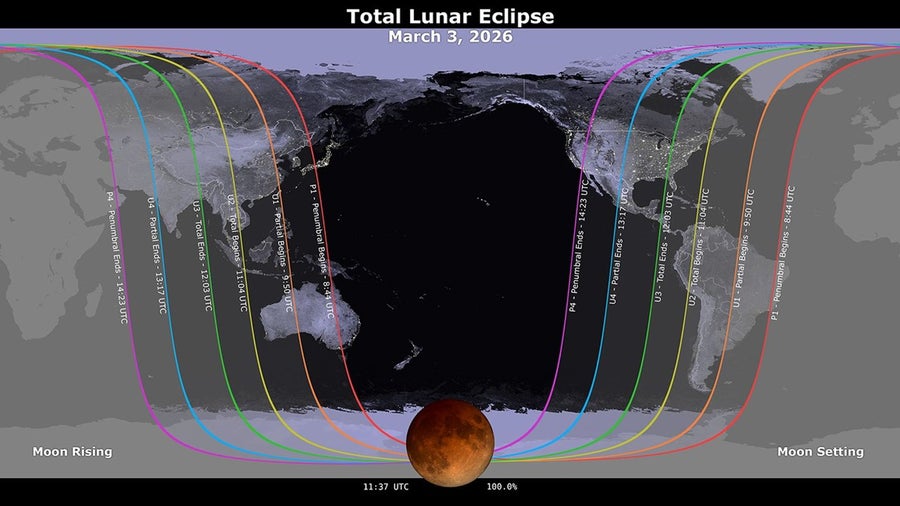
A celestial spectacle is set to grace the sky on Tuesday: a total lunar eclipse will make the moon appear blood red to millions of sky watchers across the globe.

Eclipses happen when the sun, moon, and Earth align in precise ways. In this case, Earth will be positioned directly between the sun and the full moon, casting a shadow over our natural satellite. While Earth blocks some of the sun’s light, stray beams will pass around and through our atmosphere, turning the moon’s usually pearlescent surface red.

The lunar eclipse will be visible across the Americas early in the morning of March 3 , as well as to stargazers in Australia and eastern Asia on Tuesday night. The moment of totality—when Earth fully covers the moon in its shadow—will begin at 6:04 A.M. EST and end at 7:03 A.M. EST. Unfortunately for lunar enthusiasts in Africa and Europe, the spectacle will not be visible there.

A map showing the path of the lunar eclipse

NASA

Tuesday’s eclipse follows hot on the heels of a “ring of fire” solar eclipse that occurred on February 17, although only viewers in Antarctica caught it in all its glory. During that event, the moon passed between Earth and the sun, covering up our star so that only a halo of light was left visible.

This upcoming eclipse is particularly special because it will be the last total lunar eclipse until December 2028. Sky watchers hoping to glimpse Tuesday’s event will require no special equipment to see the eclipse. They just need to hope for a cloudless night, go outside when it is dark, and look up.

For viewers in the U.S., the fun will begin around 3:45 A.M. EST and will last until 9:23 A.M. EST, though on the East Coast, the moon will set well before the eclipse ends. It will be worth stepping out a few times during the eclipse: as the event progresses, Earth’s shadow will creep across the moon, turning it a darker shade of red as it slides into alignment before the color drains away again as the planet moves on.

.


https://static.scientificamerican.com/dam/m/5c767a2c687431f4/original/Total-lunar-eclipse-blood-moon-stock-photo.jpg?m=1772224002.287&w=900fhm via Getty Images

.

.

Click the link below for the complete article:

https://www.scientificamerican.com/article/see-the-moon-turn-blood-red-in-a-total-lunar-eclipse-this-week/

.

__________________________________________

Iran-US war latest: US warns ‘hardest hits yet to come’ as its embassy in Riyadh struck by drones

Leave a comment

Click the link below the picture

.

Donald Trump told reporters Monday night, “you will be finding out very soon” what will happen next in Iran, just hours after a pair of drones struck the U.S. embassy in Riyadh, Saudi Arabia.

“The hardest hits are yet to come from the U.S. military,” Secretary of State Marco Rubioadded before briefing members of Congress about the Iran operation.

Soon after, the Israeli military it was conducting “simultaneous targeted strikes against military targets in Tehran and Beirut.”

Plumes of smoke were seen rising at sites of Israeli airstrike in the southern suburbs of Beirut.

The U.S. President took to Truth Social to claim that wars can be “fought forever” as the munition stockpiles have “never been higher or better”.

He said he expected the fighting to go on for around four weeks. “As was stated to me today, we have a virtually unlimited supply of these weapons. Wars can be fought ‘forever’ and very successfully using just these supplies,” Trump posted.

Earlier, the President also refused to rule out putting boots on the ground as the Pentagon insisted the US was not veering into another “endless war” in the desert.

Trump-Iran latest: Key Points

  • Breaking: Israeli troops to advance in southern Lebanon
  • Trump claims wars can be ‘fought forever’ as munition stockpiles ‘never been better’
  • Israel and U.S. target nuclear facilities and missile infrastructure
  • Iranian drones hit US embassy in Riyadh
  • Netanyahu says war against Iran may take ‘some time,’ but not years
  • Iranian foreign minister says U.S. entered ‘war of choice on behalf of Israel’

Breaking: Israeli troops to advance in southern Lebanon

Israeli troops have been deployed to southern Lebanon in order to “advance and take control of additional positions” in the country, Israel’s defence minister has said.

The military has been stationed at several points along the Lebanon border, in what it described as a tactical measure to boost defences for Israel’s border communities.

A military spokesperson said it was unlikely Israel would deploy ground forces to Iran, because it would not be a practical move.

.

US warns ‘hardest hit yet to come’ as its embassy in Riyadh hit in drone attack

.

.

Click the link below for the complete article:

https://www.independent.co.uk/news/world/middle-east/iran-us-war-latest-updates-israel-trump-riyadh-uk-b2930683.html

.

__________________________________________

In Plunging Into a Mideast Conflict, Trump Gambles His Presidency

Leave a comment

Hmmmm … Has the trump administration seriously over-reached?

Click the link below the picture

.

Six American service members were killed, and U.S. military jets were shot out of the sky. Investors are bracing for market turmoil, fearing prolonged disruption to oil supplies. President Trump says the military campaign against Iran could extend for weeks, and Secretary of State Marco Rubio said Monday that “the hardest hits are yet to come from the U.S. military.”

With his decision Friday to authorize war against Iran, Mr. Trump is taking the biggest gamble of his presidency, risking the lives of American troops, more deaths and instability in the world’s most volatile region, and his own political standing.

Mr. Trump, facing declining approval ratings and staring down the possibility that Republicans will lose control of Congress in the midterms, plunged the United States into what is shaping up to be its most expansive military conflict since the 2003 invasion of Iraq.

In just over a year since taking office, Mr. Trump has authorized military action in seven nations, even after he repeatedly promised American voters that he would end, not start, wars. During his inaugural address, he said his “proudest legacy will be that of a peacemaker.”

Even as he has struggled to provide a clear endgame for the military campaign, Mr. Trump has portrayed the operation as a resounding success. He has acknowledged the U.S. casualties as a cost of war but has spent more effort on boasting about the killing of Ayatollah Ali Khamenei, Iran’s supreme leader, the destruction of military targets across the country, and his commitment to keeping Iran from ever being able to produce a nuclear weapon.

But interventions in the Middle East have bedeviled generations of American presidents. Conflicts there scarred the legacies of Presidents George W. Bush, who led the country into lengthy wars in Iraq and Afghanistan that came to be deeply unpopular, and Jimmy Carter, whose failed operation in 1980 to rescue American hostages in Iran has been top of mind for Mr. Trump.

Now it is Mr. Trump who is orchestrating a rapidly expanding military effort in a region whose history and religious and factional politics make it an especially complex battleground.

“Presidents are reluctant to engage in these situations unless we are provoked, attacked directly,” said Barbara Perry, a presidential historian at the University of Virginia’s Miller Center. “Then there is usually a rally around the flag effect. You’re not going to have that now.”

While a handful of prominent voices in his movement have publicly denounced the decision to go to war, Mr. Trump’s base appears to be standing by him, for now. Still, some of the president’s allies privately worry that there is little political upside to the attacks on Iran and huge downsides, particularly the loss of U.S. troops and rising cost of oil.

Dmocrats have seized on the strikes to paint Mr. Trump as more focused in foreign intervention than addressing Americans’ economic worries at home.

“Trump sold voters on a ‘pro-peace’ vision of himself as an America First candidate, yet in under 13 months, he has ordered strikes on seven foreign nations and plunged our country into more open-ended conflict using taxpayer dollars,” Ken Martin, the chair of the Democratic National Committee, said in a statement. “While he’s distracted by foreign conflicts and shiny ballrooms, Trump has failed to deliver on his promise to bring costs down for working families, who are paying more every day because of Trump’s actions.”

Early polling after the attacks show most voters are not in favor of them. A CNN poll found 59 percent of Americans disapprove of Mr. Trump’s decision to launch strikes against Iran, and Reuters-Ipsos poll found that only 27 percent of Americans approve of the military campaign.

Should the conflict go badly or Iran descend into turmoil, it could leave Republican candidates in the midterm elections faced with difficult choices about whether to distance themselves from Mr. Trump on the issue.

And the war poses challenging questions for those looking to lead the party in the future, complicating the “America First” ideology at the core of the movement.

“This is not what we thought MAGA was supposed to be,” wrote former Representative Marjorie Taylor Greene, the Georgia Republican who broke with Mr. Trump last year and then resigned from Congress, in a social media post. “Shame!”

In a subsequent post, Ms. Greene called the Trump administration a “bunch of sick liars,” punctuating it with an expletive. “We voted for America First and ZERO wars,” she wrote.

Still, Matthew Boyle, the Washington bureau chief of Breitbart News, said he received almost no questions or comments from listeners during his weekly three-hour radio program on Saturday, hours after the strikes. The program, he said, provides a good window into the issues animating Mr. Trump’s base.

Mr. Boyle said he discussed the war extensively and played Mr. Trump’s early morning video announcing the attacks. Listeners, he said, were more interested in other topics. He said that was a stark contrast to the program he hosted after the United States captured Nicolás Maduro, the president of Venezuela, a topic many listeners wanted to discuss.

This time, he said listeners were much more interested in the economy, immigration, and crime. But he warned that could change depending on how the operation unfolds.

“It all comes down to the results,” he said.

Sensing some of the fractures among Mr. Trump’s base, the White House on Monday started to respond directly to criticism on the right. Matt Walsh, a conservative commentator and a prominent voice among Mr. Trump’s supporters, posted on social media that Mr. Trump’s messaging on the U.S. objectives in Iran “is, to put it mildly, confused.”

Karoline Leavitt, the White House press secretary, responded to Mr. Walsh with a lengthy statement. She declared Mr. Trump put out “clear objectives” that would bring the end to Iran’s “brutal attacks and threats.”

Mr. Walsh seemed less than satisfied.

“This operation seemed like a bad idea to me before it happened, and I said so,” he wrote after Ms. Leavitt’s response. “Now that it is happening, I’m not going to suddenly change my tune. It still seems like a bad idea to me. I hope I’m wrong. But that’s how I see it.”

The Iran strikes are far from the first time that the president has tested his base’s capacity to support actions that violate his campaign promise to stay out of foreign conflicts. When he faced questions over whether his supporters would protest after U.S. forces attacked Venezuela, Mr. Trump had a succinct reply.

“MAGA is me,” he told NBC News. “MAGA loves everything I do.”

In recent months, the Make America Great Again movement has started to splinter over key issues, including Mr. Trump’s handling of the Epstein files and his struggles to address rising costs.

Raheem Kassam, the editor in chief of The National Pulse and a conservative activist, said the war with Iran would exacerbate those tensions.

“It’s not something I would have done, but it is definitely something Trump would have done,” he said. “He loves the idea of finishing the job that his predecessors couldn’t even start.”

Mr. Kassam said that Mr. Trump’s supporters trusted him to avoid U.S. casualties more than any of his predecessors, but expressed worries that the conflict does nothing to address a major vulnerability for the president.

He said Americans will only be “just starting to feel better about the economy right as they start voting because they spent too much time on Elon Musk’s failed DOGE project,” arguing Mr. Musk had failed to meaningfully cut government spending. He added: “I agree with the critics that is a big problem.”

More on the Assault on Iran


  • U.S.-Israeli Attack on Iran: Some of the structures destroyed inside the Tehran compound of Iran’s supreme leader had been constructed in recent months, according to an analysis of satellite imagery by The New York Times. The Israeli military said that airstrikes it has conducted since last June had destroyed about 200 Iranian ballistic missile launchers, roughly half of the launchers Iran currently has.

  • Iran Retaliates: The country has fired nearly 400 missiles and more than 800 drones across the Persian Gulf, according to government reports, and has attacked energy installations in Qatar and Saudi Arabia, both key American allies. It has also struck at least six U.S. military facilities around the Middle East, according to our analysis.

  • What’s Next for Iran: A badly weakened Iran will no longer intimidate or threaten its neighbors in the same way. The regional impact could be comparable to the collapse of the Soviet Union. Iran’s top security official struck a defiant tone, berating President Trump for harboring “delusional fantasies” about the toll of a broadening war.

  • Israel Strikes Back at Hezbollah: The U.S.-Israeli war with Iran and its allies brought a new wave of displacement to war-weary Lebanon, after Israel retaliated for rocket attacks by the Iran-backed Hezbollah militia.

  • U.S. Military Death Toll: The number of U.S. service members killed in the first three days of the war grew to six as officials said the remains of two more troops had been recovered.

  • Effects on the Global Economy: The oil-producing countries in the group known as OPEC Plus said that they would increase oil production in April, which could help mitigate the impact on oil prices of disrupted shipments in the Middle East. Rising oil prices, volatile stocks, and potentially higher inflation are all weighing on investors’ minds as the military campaign continues.

  • Strike on Girls’ School in Iran: At least 175 people, most of them likely children, were killed in a strike on a girls’ elementary school in southern Iran, health officials and Iranian state media said. Videos and images verified by The New York Times showed that at least half of the school was destroyed. It was not immediately clear why the school was hit, or which country’s forces had fired at it.

.

https://static01.nyt.com/images/2026/03/01/multimedia/01dc-trump-politics-fhqg/01dc-trump-politics-fhqg-superJumbo.jpg?quality=75&auto=webpPresident Trump leaving the White House on Friday. Interventions in the Middle East have bedeviled generations of American presidents. Credit…Anna Rose Layden for The New York Times

.

.

Click the link below for the complete article:

https://www.nytimes.com

.

__________________________________________

Eerie brainlike nebula captured in stunning new JWST images

Leave a comment

Click the link below the picture

.

The death of a star never looked so beautiful. New images captured by the James Webb Space Telescope reveal what looks eerily like a brain floating in space and housed inside a semitransparent skull.

This is the “Exposed Cranium” Nebula, also known as Nebula PMR 1. Located some 5,000 light-years away in the constellation Vela, it’s a massive, moribund star coming to the end of its fuel-burning life. As the star dies, it is shedding layers of its material, generating billowing clouds of gas and dust.

The new images show the nebula in both near- and mid-infrared light, revealing a dark channel that runs through the middle of the clouds of gas and dust—just like the longitudinal fissure that separates our brain’s right and left hemispheres. In the nebula, this feature may be caused by jets coming from the dying star, pushing the inner gas out. The outer layer of gas is mostly made up of simple hydrogen, but the inner gas clouds are more complex.

It’s unclear what will happen to the dying star. If it is massive enough, it will explode into a supernova. But if not, it will deteriorate until only its core remains, at which point it will become a white dwarf, a dense object that astronomers believe cools over time to become a black dwarf—a cold, dark object that exists only in theory, perhaps because the universe is too young for any to have formed.

.

https://static.scientificamerican.com/dam/m/59675801630c4ad7/original/JWST-cranium-nebula.jpg?m=1772216940.263&w=900NASA/ESA/CSA/STScI (image); Joseph DePasquale/STScI (image processing)

.

.

Click the link below for the complete article:

https://www.scientificamerican.com/article/eerie-brain-like-nebula-captured-in-stunning-new-jwst-images/

.

__________________________________________

US-Israel war on Iran live: Oil price soars in early trading; Israel launches fresh wave of ‘large-scale strikes’ on Tehran

Leave a comment

Click the link below the picture

.

Israel launches ‘large-scale strikes’ on Tehran

The Israeli military said it was carrying out “large-scale strikes” on Tehran on Monday, two days since the start of a US-Israeli campaign against Iran.

“The Israeli Air Force … has begun an additional wave of strikes against the Iranian terror regime at the heart of Tehran,” the military said in a statement, quoted by Agence France-Presse.

Lebanon’s Hezbollah has just claimed responsibility for the projectiles launched from Lebanon to Israel.

The militant group said it launched missiles and drones towards Israel in retaliation for the killing of Iran’s supreme leader.

Israel’s military just said it had begun striking Hezbollah across Lebanon.

More now on the Israeli military saying projectiles fired from Lebanon had triggered air raid sirens in northern Israel – it also said it had had intercepted one of them.

“Following the sirens that sounded in several areas in northern Israel, a projectile that crossed from Lebanon into Israeli territory was intercepted by the Israeli Air Force, and several projectiles fell in open areas,” the Israeli military posted on Telegram on Monday, cited by the AFP news agency.

Lebanese militant group Hezbollah said on Sunday it had a “duty” to support backer Iran after Israeli and US strikes.

But the group has not confirmed action since the US and Israel began attacks on Saturday, killing Iran’s supreme leader and sparking a wave of retaliatory drone and missile strikes.

Hezbollah has been weakened from conflict with Israel, which it entered to support Hamas after the Palestinian militant group’s deadly attack on Israel in October 2023 and the subsequent war in the Gaza strip.

Israel and Hezbollah signed a ceasefire agreement in November 2024, although Israel has continued to strike targets it says are linked to the Lebanese group.

Hezbollah did not intervene during a 12-day war between Israel and Iran last June.

Defence and intelligence experts are describing the strike on a UK airbase in Cyprus as a “possible Iranian one-way drone attack against RAF Akrotiri”.

The base is located over 600 miles (965km) from Iran.

Alerts, thought to have been put out by the UK’s Ministry of Defence, were sent to military personnel and their families by email and text message.

Cyprus authorities confirm drone strike on UK base

Helena Smith

Helena Smith

Authorities in Cyprus have confirmed the drone strike. The sovereign base areas and surrounding areas will remain in a state of high alert amid fears of possible further strikes.

All roads to the military facilities have been cordoned off, the Guardian has learned.

SMS messaging sent to base personnel included this:

We are aware of an ongoing security threat. At this time please remain indoors and allow the emergency services access to react to the incident.

The Main entry point at RAF Akrotiri remains closed at this point …

A small Drone has impacted the airfield at RAF Akrotiri and all agencies are responding. There are no casualties but there is minor damage. However the incident is ongoing.

Further to the report that the UK’s Akrotiri air force base in Cyprus has been hit by a drone, we’ve have word that this SMS message was sent to base personnel before the strike:

There is an ongoing security threat. Please return to your homes and stay inside until further official notice. Move away from windows and take cover behind or beneath substantial, solid furniture. Please await further instruction.

Shares of Australia’s flagship carrier Qantas Airways slumped more than 10% to their lowest level in 10 months on Monday after the US and Israeli strikes on Iran.

The airline’s shares fell as much as 10.4% to A$8.92 each when the Australian market opened on Monday, the lowest level since 2 May 2025, Reuters is reporting.

Drone hits British airbase in Cyprus – report

The UK’s Akrotiri air force base in Cyprus has been struck by a drone, according to a report in the Cyprus Mail.

Personnel on the bases were informed that a “small drone” had impacted the airfield and that the bases’ authorities were responding, the report on Monday said.

There were no casualties as a result, but “minor damage” was caused.

The bases’ authorities instructed personnel to remain in place and await further instruction, warning there may be additional impact, the report said.

The explosion and siren sounds were heard in nearby Limassol.

The British bases had earlier declared a “security threat” shortly before midnight

The report could not be independently verified.

The Israeli military is saying projectiles have been launched from Lebanon, and sirens are sounding in several areas in northern Israel as a result.

We’ll have more on this soon as it comes to hand.

Oil prices soar amid war on Iran

Oil prices have jumped in Asian trade on the back of the turmoil in the Middle East.

In early trade in Asia on Monday, Brent Crude was trading at $80.20 per barrel, up 13% from the closing price of $72.87 on Friday, Bloomberg News reported.

  • This is Adam Fulton picking up our live reporting – stay with us for the latest

Summary of the day so far

  • Iran’s supreme leader, Ali Khamenei, was killed on Saturday after the US and Israel launched a war on the country to trigger regime change. The US president had earlier announced the death of the ayatollah, who ruled Iran since 1989, in a post on Truth Social. Iran’s former president, Mahmoud Ahmadinejad, was also killed in strikes.

  • Donald Trump warned on Sunday that combat operations in Iran were continuing and would carry on “until all of our objectives are achieved.” He continued to justify the operation, saying “an Iranian regime armed with long range missiles and nuclear weapons would be a dire threat to every American… I once again urge the Revolutionary Guard, the Iranian military police, to lay down your arms and receive full immunity or face certain death.”

  • Trump told Fox News that 48 leaders have been killed in US and Israeli strikes on Iran. “It’s moving along. It’s moving along rapidly. This has been this way for 47 years,” he said. “Nobody can believe the success we’re having; 48 leaders are gone in one shot.”

  • Three US service members have been killed in action as part of US military operations against Iran, the US Central Command said in a statement on Sunday. These are the first confirmed deaths since the US began launching strikes against Iran on Saturday. Trump warned in his Truth Social video that there would likely be more casualties.

  • The death toll from a missile strike on a girls’ school in southern Iran has risen to almost 150, according to Iranian state media. Mizan news agency, the official news outlet of Iran’s judiciary, reported that the number killed in Saturday’s strike on a girls’ elementary school in Minab in southern Iran had risen to 148 killed, with 95 others wounded. The school, which was struck on Saturday morning, appears to be the worst mass casualty event of the US-Israeli-led bombing campaign on Iran so far.

  • Trump said earlier that Iran’s new leadership wants to talk to him and that he has agreed, according to an interview with The Atlantic. “They want to talk, and I have agreed to talk, so I will be talking to them. They should have done it sooner,” he said.

  • Just 27% of Americans approve of the US strikes that killed Iran’s leader on Saturday, while about half — including one in four Republicans — believe Trump is too willing to use military force, according to a Reuters/Ipsos poll that concluded on Sunday.

  • UK prime minister Keir Starmer agreed to allow the US to use UK military bases to launch attacks that degrade Iran’s missiles. In a recorded statement, the prime minister said the “only way to stop the threat is to destroy the missiles at source in their storage depots or the launchers which are used to fire the missiles”.

The Philippine Embassy in Israel confirmed the death of a Filipino national in a missile attack in Tel Aviv, according to the Associated Press.

The victim, Mary Ann V. de Vera, 32, a caregiver from Basista, Pangasinan, had been working in Israel since 2019. Her identity was confirmed through biometric records at the Abu Kabir Forensic Institute, where her husband also positively identified her remains.

Ambassador Aileen Mendiola conveyed condolences to the family and assured them of the Philippine government’s full assistance, the embassy said in a statement.

Cuban president Miguel Díaz-Canel wrote Sunday on social media that his administration extended “heartfelt condolences” to Iran’s people and its government for what he called the assassination of Khamenei.

“The execrable act constitutes a scrupleless violation of all the norms of International Law and human dignity,” he wrote. “In Cuba, he will be remembered as a distinguished statesman and leader of his people, who contributed to the development of friendly relations between Cuba and Iran.”

Turkish president Recep Tayyip Erdogan has also issued a message of condolence over the death of Iran’s supreme leader.

In a post on X, Erdogan wrote: “I extend my condolences to the esteemed Khamenei, praying that the Almighty Allah grants him mercy, and offer my sympathies to the brotherly people of Iran; I convey my condolences on behalf of my country and my nation.”

He added: “Together with the people of Iran, we in Turkey will steadfastly continue our efforts to ensure that all our friends and brothers in the region regain the peace and stability they deserve, that the conflict raging in our region comes to an end, and that we return to diplomacy.”

Trump says attack ‘will continue until all of our objectives are achieved.’

Donald Trump warned on Sunday that combat operations in Iran were continuing and would carry on until all of Washington’s objectives are achieved.

“Combat operations continue at this time in full force, and they will continue until all of our objectives are achieved. We have very strong objectives,” Trump said in a recorded video statement posted first on Truth Social. He confirmed that three US service members had been killed and said there would likely be more casualties, vowing to avenge the deaths of Americans.

“As one nation, we grieve for the true American patriots who have made the ultimate sacrifice for our nation, even as we continue the righteous mission for which they gave their lives,” he said. “And sadly, there will likely be more before it ends.”

He continued to justify the operation, saying “an Iranian regime armed with long range missiles and nuclear weapons would be a dire threat to every American… I once again urge the Revolutionary Guard, the Iranian military police, to lay down your arms and receive full immunity or face certain death.”

This is the second video statement he has posted exclusively on Truth Social, his social media platform, which recently declared a big loss. The platform is part of Trump Media and Technology Group, a company whose share price has reached near all-time lows this month.

France and Lebanon are postponing a March 5 conference on the Lebanese army to April, the Elysee palace said in a statement on Sunday, following the launch of US-Israeli strikes on Iran.

France, Lebanon’s former colonial power, plans to mobilize international backing for the Lebanese armed forces and internal security forces at the conference.

The statement stressed that the gravity of the regional situation underscored the need to safeguard Lebanon’s stability, support its legitimate institutions, and ensure the full restoration of its sovereignty.

UK agrees to US request to use British military bases for strikes

Rowena Mason

Rowena Mason

Keir Starmer has agreed to allow the US to use UK military bases to
launch attacks that degrade Iran’s missiles.

In a recorded statement, the prime minister said the “only way to stop the threat is to destroy the missiles at source in their storage depots or the launchers which are used to fire the missiles”.

“The US has requested permission to use British bases for that specific and limited defensive purpose,” he said.

“We have taken the decision to accept this request – to prevent Iran firing missiles across the region … killing innocent civilians … putting British lives at risk … and hitting countries that have not been involved.”

In addition, British jets are in the air as part of coordinated defensive operations, which he said had “already successfully intercepted Iranian strikes”.

He said it remains the case that the UK was not involved in the strikes on Iran. “Our decision that the UK would not be involved with the strikes on Iran was deliberate,” the prime minister said. “Not least because we believe that the best way forward for the region and the world is a negotiated settlement.”

But he said Iran’s approach was becoming more reckless and dangerous to civilians, leading to the decision to allow the US to use UK military bases. He also revealed that there are at least 200,000 British citizens in the region – and urged them to register their presence and follow Foreign Office travel advice.

The leaders of Britain, France, and Germany have said they are ready to take steps to defend their interests in the region after the “indiscriminate and disproportionate” missile attacks by Iran.

In a joint statement on Iran, the E3 leaders said:

“E3 leaders are appalled by the indiscriminate and disproportionate missile attacks launched by Iran against countries in the region, including those who were not involved in initial US and Israeli military operations. Iran’s reckless attacks have targeted our close allies and are threatening our service personnel and our civilians across the region.

“We call on Iran to stop these reckless attacks immediately. We will take steps to defend our interests and those of our allies in the region, potentially through enabling necessary and proportionate defensive action to destroy Iran’s capability to fire missiles and drones at their source.

They continued: “We have agreed to work together with the US and allies in the region on this matter. We will take steps to defend our interests and those of our allies in the region, potentially through enabling necessary and proportionate defensive action to destroy Iran’s capability to fire missiles and drones at their source. We have agreed to work together with the US and allies in the region on this matter.”


.

A smoke plume rises following a missile strike on a building in Tehran amid ongoing strikes by the US and Israel on Iran. Follow live for latest updates.A smoke plume rises following a missile strike on a building in Tehran amid ongoing strikes by the US and Israel on Iran. Follow live for latest updates. Photograph: AFP/Getty Images

.

.

Click the link below for the complete article:

https://www.theguardian.com/us-news/live/2026/mar/01/us-israel-war-on-iran-ayatollah-ali-khamenei-i-dead-latest-reports

.

__________________________________________

Big Change Seems Certain in Iran. What Kind Is the Question.

Leave a comment

Click the link below the picture

.

Experts say that Iran’s clerical rulers may be too deeply entrenched for Iranians to topple them, and that the U.S. and Israeli strikes risk setting off deeper radicalization or violence.

The death of Iran’s supreme leader, Ayatollah Ali Khamenei, is a watershed moment in the 47-year existence of the Islamic Republic. The scenes that followed — throngs of Iranians taking to the streets to celebrate, others turning out to grieve — signal the deep uncertainty about what comes next.

There are now three key questions: How will protesters respond to President Trump’s call to take over the government? Can Iran’s authoritarian system survive? And could the attack unleash a chaotic battle for power?

Mr. Trump and Israel’s prime minister, Benjamin Netanyahu, have made public appeals to Iran’s people, arguing that they have offered them a historic opportunity to topple their brutal authoritarian government. How they envision an unarmed population facing down a heavily armed, ideologically driven security force is less clear.

Though it has been only two days of strikes, some regional experts are skeptical that an aerial campaign alone could weaken Iran’s government enough that Iranians could bring it down with protests.

Nonetheless, Iran is headed toward a transformative moment, said Farzan Sabet, an analyst on Iran and Middle East politics at the Geneva Graduate Institute in Switzerland.

“Some kind of change will happen in the system,” he said. “But in which direction? We don’t know.”

In some ways, Iranians are ever more defiant after facing a brutal crackdown on nationwide anti-government protests in January, in which security forces killed thousands. As the violent repression subsided, the risks were still high even before the bombardment began. Yet students still protested and held sit-ins, and the families of slain protesters used their memorial services to voice dissent.

After the authorities confirmed Ayatollah Khamenei’s death in the attack, many Iranians dared to celebrate publicly — but not to the point of risking bloodshed.

Arian, a resident of a suburb near Tehran, described seeing people “honking in the streets, shouting chants from windows.” Like all people interviewed inside the country, he asked to withhold his full name for fear of retaliation. On Sunday morning, Arian said, he saw people dancing and singing in the streets — until they noticed the arrival of armed members of Iran’s Basij, the volunteer militia force aligned with Iran’s Revolutionary Guards. “When the Basij showed up, everyone got scared and quickly scattered,” he said.

Even under aerial bombardment, Iran’s domestic security apparatus was still making a show of force. Basij forces, estimated to be around one million strong around the country, have already been mobilized around the capital.

“The brutal killing of protesters in January suggests domestic unrest will be met with an iron fist,” said Ellie Geranmayeh, deputy head of the Middle East and North Africa program at the European Council on Foreign Relations. “This time under far harsher wartime conditions.”

Some airstrikes have begun to target Basij and intelligence headquarters, but experts are divided as to whether airstrikes can inflict enough damage to weaken a deeply entrenched and complex network of security forces across such a large country.

“The problem is these are very multilayered targets,” said Abdolrasool Divsallar, an Iran expert at the Catholic University of Milan. “You hit one, but there are so many others. I am not sure how long it can be sustained, munitions-wise.”

Even as strikes wiped out several of Iran’s top political and military leaders, official statements went to great lengths to show the system was prepared for the shock and still functioning.

After Ayatollah Khamenei’s death, Iranian officials announced that the government would follow the constitutional framework for selecting the country’s next leader, and that a temporary leadership council would be formed.

Ali Larijani, the head of Iran’s Supreme National Security Council, who is seen as the de facto leader behind the scenes, stressed that idea in televised comments urging unity after the ayatollah’s death.

“Throughout history, the Iranian nation has faced even greater challenges; even the Mongols plowed through the entire country, yet the people stood firm and defended their land,” he said. “Such martyrdoms make people resistant and steadfast.”

But the system could undergo a transformation from within. Mr. Larijani, seen as a pragmatist, is the type of figure observers say could potentially strike a deal with Washington now that Iran’s more ideologically driven supreme leader is gone.

Some ordinary Iranians said that such a deal, if accompanied by an easing of international sanctions on Iran, may be palatable to many residents who have suffered through so many months of instability and a collapsing economy.

“Most people aren’t chasing deep meaning,” said Payman, 45, a businessman in Tehran. “They just want a normal life: family, work, small goals. If that becomes possible, a lot of people might stop pushing for bigger change.”

But there is also the possibility Iran’s new leaders would turn the state in the opposite direction — making it even more radical. “The risk is that the more hard-line figures emerge,” Mr. Divsallar said.

The fact that the leadership change was brought about by American and Israeli attacks increases that possibility, he said. “That works completely against what people wished for,” he said.

Experts point to several appointments that could tip a transition in this direction.

Two of the members of Iran’s interim leadership council are hard-liners. One of them, Ayatollah Alireza Arafi, is from Iran’s Council of Guardians, a powerful group of jurists. The other is Gholam-Hossein Mohseni-Eje’i, the head of the judiciary. The third member, President Masoud Pezeshkian, is a moderate, but had been largely sidelined before the war.

Another bellwether is the reported appointment of Gen. Ahmad Vahidi to lead the Revolutionary Guards.

“He’s an incredibly brutal person. So I think they’re not going to hesitate to use extreme violence,” said Mr. Sabet, of the Geneva Graduate Institute.

Beyond toppling or transforming Iran’s current system is the possibility that the war unleashes chaos in a country of 90 million people that borders seven countries.

There are many potential opponents who could use violence to challenge a weakened state. Some ethnic minorities, like the Kurds and the Baluchis, already have armed opposition groups.

Mustafa Hijri, the leader of the Kurdistan Democratic Party in Iran, said that his organization was part of an alliance of groups from Iran’s ethnic minorities, and that among them were parties that “when necessary, may engage in armed resistance as part of their struggle.”

Officials from two Kurdish groups in exile, who asked not to be identified, said they were planning on trying to restart operations inside the country, aiming to encourage an uprising in Iran’s Kurdish region.

Even before the war started, many Iranians were bemoaning the increasingly polarized state of the country in the wake of the brutal crackdowns on the protests.

The government retains an ideological and religious support base that, in the current war, would be highly motivated to fight back against perceived threats. That raises the possibility of internal fragmentation and violence that spills beyond Iran’s borders.

On Sunday, Ayatollah Naser Makarem Shirazi, an influential cleric in Iran, called for jihad against Israel and the United States, according to remarks published in the semiofficial Mehr news agency.

All of these factors create a growing risk of a dangerous insurgency should the state collapse, similar to the insurgency that broke out in Iraq after U.S. forces invaded it in 2003, said Ms. Geranmayeh, the analyst.

“This is a holy war for them — and they seem willing to burn down the country and region before surrendering,” she said. “If this air campaign succeeds in toppling Iran’s leadership, years of chaos probably lie ahead for the country and its people.”

More on the Assault on Iran


  • Iran’s Supreme Leader Killed: Ayatollah Ali Khamenei died during the U.S. and Israeli military strikes. In more than three decades of authoritarian rule, Khamenei brutally crushed dissent at home and expanded the Islamic Republic’s influence abroad. Large crowds of people in the country celebrated his killing, while many others gathered to mourn.

  • Trump and the American Public: Hours after the U.S.-Israeli attacks began, President Trump made unsupported and exaggerated claims in a video posted to social media. The American public’s appetite for an attack on Iran was low before Trump and Israel took action.

  • Hope for Regime Change?: Prime Minister Benjamin Netanyahu of Israel has portrayed the Islamic Republic as a singular threat to his country and the world for more than three decades. Israel and the United States declared that their attacks would pave the way for regime change in Iran. Trump urged for Iranians to “take over” their government, but questions remained about how much effort his administration would put into changing the Iranian government.

  • Iran Claims Children Killed in Strikes: HRANA, an Iranian rights group based in Washington, said late Saturday that at least 133 civilians had been killed and 200 others wounded in the attacks. A strike in the town of Minab was one of two that appear to have hit schools on Saturday.

  • Israel’s Shelter Shortage: Iranian missile and drone attacks repeatedly targeted Israel on Sunday, forcing much of the country to take cover and highlighting a shortage of bomb shelters in the country. The Israeli ambulance service said at least nine people were killed after a missile strike in Beit Shemesh, a city about 18 miles west of Jerusalem.

  • U.S. Congress Weighs In: After the attack, Democrats and a few Republicans escalated their calls for swift votes on whether to curb Trump’s power to continue using force against Iran without explicit authorization.

  • Iranian Americans Find Hope: Some Californians of Iranian descent said they welcomed the possible end of an oppressive government in Tehran that their families had fled.

  • World Reacts: Global leaders urged all sides to exercise restraint after the attacks, although some officials backed the campaign. Here’s what other governments are saying.

.

A crowd of people, many wearing head coverings. One person cries out while holding a picture of a bearded man.Iranians mourning their supreme leader at a rally in Tehran. Credit…Arash Khamooshi for The New York Times

.

.

Click the link below for the complete article:

https://www.nytimes.com

.

__________________________________________

Older Entries Newer Entries

Amor Entre Estrellas

¡Bienvenido de vuelta viajero!

Heart of Loia `'.,°~

so looking to the sky ¡ will sing and from my heart to YOU ¡ bring...

Michael Ciullo

CEO and Founder of Nsight Health

MRS. T’S CORNER

https://www.tangietwoods

Nelson MCBS

Catholic News, Prayers, HD Images, Rosary, Music, Videos, Holy Mass, Homily, Saints, Lyrics, Novenas, Retreats, Talks, Devotionals and Many More

Global geopolitics

Decoding Power. Defying Narratives.

Talk Photo

A creative collaboration introducing the art of nature and nature's art.

Movie Burner Entertainment

The Home Of Entertainment News, Reviews and Reactions

Le Notti di Agarthi

Hollow Earth Society

C r i s t i a n a' s Fine Arts ⛄️

•Whenever you are confronted with an opponent, conquer him with love.(Gandhi)

TradingClubsMan

Algotrader at TRADING-CLUBS.COM

Comedy FESTIVAL

Film and Writing Festival for Comedy. Showcasing best of comedy short films at the FEEDBACK Film Festival. Plus, showcasing best of comedy novels, short stories, poems, screenplays (TV, short, feature) at the festival performed by professional actors.

Bonnywood Manor

Peace. Tranquility. Insanity.

Warum ich Rad fahre

Take a ride on the wild side

Madame-Radio

Découvre des musiques prometteuses (principalement) dans la sphère musicale française.

Ir de Compras Online

No tiene que Ser una Pesadilla.

Kana's Chronicles

Life in Kana-text (er... CONtext)

Cross-Border Currents

Tracking money, power, and meaning across borders.

Jam Writes

Where feelings meet metaphors and make questionable choices.

emotionalpeace

Finding hope and peace through writing, art, photography, and faith in Jesus.

WearingTwoGowns.COM

The Community for Wounded Healers: Former Medical Students, Disabled Nurses, and Faith-Fueled Pivots

...

love each other like you're the lyric to their music

Luca nel laboratorio di Dexter

Comprendere il mondo per cambiarlo.

Tales from a Mid-Lifer

Mid-Life Ponderings

Creative

Travel,Tourism, Life style "Now in hundreds of languages for you."

freedomdailywriting

I speak the honest truth. I share my honest opinions. I share my thoughts. A platform to grow and get surprised.

The Green Stars Project

User-generated ratings for ethical consumerism

Cherryl's Blog

Travel and Lifestyle Blog

Sogni e poesie di una donna qualunque

Questo è un piccolo angolo di poesie, canzoni, immagini, video che raccontano le nostre emozioni

My Awesome Blog

“Log your journey to success.” “Where goals turn into progress.”

pierobarbato.com

scrivo per dare forma ai silenzi e anima alle storie che il mondo dimentica.

Thinkbigwithbukonla

“Dream deeper. Believe bolder. Live transformed.”

Vichar Darshanam

Vichar, Motivation, Kadwi Baat ( विचार दर्शनम्)

Komfort bad heizung

Traum zur Realität

Chic Bites and Flights

Savor. Style. See the world.

ومضات في تطوير الذات

معا نحو النجاح

Broker True Ratings

Best Forex Broker Ratings & Reviews

Blog by ThE NoThInG DrOnEs

art, writing and music by James McFarlane and other musicians

fauxcroft

living life in conscious reality

Srikanth’s poetry

Freelance poetry writing

JupiterPlanet

Peace 🕊️ | Spiritual 🌠 | 📚 Non-fiction | Motivation🔥 | Self-Love💕