The New York Times interviewed 18 girls who were captured by militants in Nigeria and sent into crowds to blow themselves up. Here are their stories.
The girls didn’t want to kill anyone. They walked in silence for a while, the weight of the explosives around their waists pulling down on them as they fingered the detonators and tried to think of a way out.
“I don’t know how to get this thing off me,” Hadiza, 16, recalled saying as she headed out on her mission.
“What are you going to do with yours?” she asked the 12-year-old girl next to her, who was also wearing a bomb.
“I’m going to go off by myself and blow myself up,” the girl responded hopelessly.
It was all happening so fast. After being kidnapped by Boko Haram this year, Hadiza was confronted by a fighter in the camp where she was being held hostage. He wanted to “marry” her. She rejected him.
“You’ll regret this,” the fighter told her.
.
“They said to me, ‘Are you going to sleep with us, or do you want to go on a mission?’” Aisha, 15
The end of apartheid was supposed to be a beginning.
Judith Sikade envisioned escaping the townships, where the government had forced black people to live. She aimed to find work in Cape Town, trading her shack for a home with modern conveniences.
More than two decades later, Ms. Sikade, 69, lives on the garbage-strewn dirt of Crossroads township, where thousands of black families have used splintered boards and metal sheets to construct airless hovels for lack of anywhere else to live.
“I’ve gone from a shack to a shack,” Ms. Sikade says. “I’m fighting for everything I have. You still are living in apartheid.”
In the history of civil rights, South Africa lays claim to a momentous achievement — the demolition of apartheid and the construction of a democracy. But for black South Africans, who account for three-fourths of this nation of roughly 55 million people, political liberation has yet to translate into broad material gains.
.
Township residents often endure commutes of an hour or more on private minibuses that extract outsize slices of their paychecks.
There you are in the middle of a conversation, and suddenly you draw a blank on a particular word. It’s right there … if you could just remember …
You move on, and hours later, something jogs your memory and the word comes to you, long after its relevance has passed.
So, what happened?
You experienced what researchers call a tip-of-the-tongue state, that agonizing moment when you know precisely what you want to say but you fail to produce the word or phrase.
Let’s be blunt: With U.S. and U.K. complicity, the Saudi government is committing war crimes in Yemen.
“The country is on the brink of famine, with over 60 percent of the population not knowing where their next meal will come from,” the leaders of the U.N. World Food Program, Unicef and the World Health Organization said in an unusual joint statement.
Yemen, always an impoverished country, has been upended for two years by fighting between the Saudi-backed military coalition and Houthi rebels and their allies (with limited support from Iran). The Saudis regularly bomb civilians and, worse, they have closed the airspace and imposed a blockade to starve the rebel-held areas into submission.
That means that ordinary Yemenis, including children, die in bombings or starve.
.
Buthaina is the only member of her family not killed in a Saudi-led airstrike last week.Khaled Abdullah/Reuters
On my last week in India, I went to say goodbye to Jahiruddin Mewati, the chief of a small village where I had made a dozen or so reporting trips.
Jahiruddin and I were not precisely friends, but we had spent many hours talking over the years, mostly about local politics. I found him entirely without scruples but candid. He suspected my motives but found me entertaining, in the way that a talking dog might be entertaining, without regard for the particulars of what I said.
Jahiruddin, though uneducated, was an adept politician, fresh from winning a hard-fought local election. During our conversations, he would often break into rousing, patriotic speeches about truth and justice, thumping the plastic table in emphasis and making it jump. The effect was somewhat tarnished by his Tourette’s syndrome, which caused him to interject the word “penis” at regular intervals.
.
Jahiruddin Mewati, the chief of Peepli Khera, a small village in Uttar Pradesh, presided over a particularly Indian form of justice.Credit Andrea Bruce for The New York Times
A federal jury convicted Ahmad Khan Rahimi, a loner from New Jersey drawn to online calls to jihad and instruction manuals for carrying it out, of setting the explosives in the Chelsea neighborhood that blew out windows and sent shrapnel flying into buildings, cars and people during a two-day bombing campaign in and around New York City last year.
Mr. Ramini, 29, a stocky and bearded husband and father born in Afghanistan who lived most of his life in New Jersey, remained mostly expressionless in Federal District Court in Manhattan on Monday as he listened to a single word — “guilty” — called out over and over, eight times, by the jury foreman. He blinked rapidly and at times appeared to nod.
Terror attacks that kill and injure scores of people have become all too common around the world. The Chelsea explosion, which took no lives, was widely seen as a near miss. But its proximity to the site of the Sept. 11 attacks in Manhattan, and its callbacks to that day, sent shudders through the city 15 years later. The police have said there have been some two dozen terror plots against the city since then, the vast majority thwarted, but none that shook and smashed a block as strongly.
.
Ahmad Khan Rahimi in custody last year, after he was accused of setting bombs in Manhattan and New Jersey. He was found guilty on all counts Monday.Credit Mel Evans/Associated Press
George Soros, the billionaire hedge fund manager and a major Democratic donor, has given $18 billion to his Open Society Foundations, one of the largest transfers of wealth ever made by a private donor to a single foundation.
The gift, made quietly over the past several years but disclosed only on Tuesday, has transformed Open Society into the second-biggest philanthropic organization in the United States, behind the Bill and Melinda Gates Foundation. It will also place Mr. Soros, a lightning rod for conservative critics, squarely in the middle of the social and political debates convulsing the country.
Founded by Mr. Soros more than 30 years ago, Open Society promotes democracy and human rights in more than 120 countries. In recent years, the organization has increased its attention on the United States, investing in programs to protect gays and lesbians and reduce abuses by the police.
.
George Soros at the offices of the Open Society Foundations in New York in 2014.Credit Joshua Bright for The New York Times
At the start of this decade, the Arab Spring blossomed with the help of social media. That is the sort of story the tech industry loves to tell about itself: It is bringing freedom, enlightenment and a better future for all mankind.
Mark Zuckerberg, the Facebook founder, proclaimed that this was exactly why his social network existed. In a 2012 manifesto for investors, he said Facebook was a tool to create “a more honest and transparent dialogue around government.” The result, he said, would be “better solutions to some of the biggest problems of our time.”
Now tech companies are under fire for creating problems instead of solving them. At the top of the list is Russian interference in last year’s presidential election. Social media might have originally promised liberation, but it proved an even more useful tool for stoking anger. The manipulation was so efficient and so lacking in transparency that the companies themselves barely noticed it was happening.
.
Facebook, Google and others positioned themselves as bettering the world. But their systems and tools have also been used to undermine democracy.Credit Ali Asaei for The New York Times
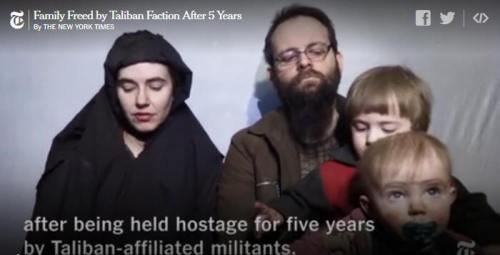
Stuffed by their captors into the back of a car with their children as they were being ferried across the rugged tribal areas of northwest Pakistan, an American woman and her Canadian husband were in the final moments of their five-year ordeal as hostages.
But suddenly, shooting erupted. One of their abductors, a Taliban-linked militant, shouted, “Kill the hostages.”
The militants found themselves cornered by Pakistani troops. The gun battle ended, and soldiers pulled the family from the vehicle, to be taken by helicopter to Islamabad. They were safe. The Pakistanis, acting on information provided by American intelligence and collected from drones that had been tracking the hostages, had pulled off Wednesday’s risky operation.
President Trump will scrap subsidies to health insurance companies that help pay out-of-pocket costs of low-income people, the White House said late Thursday. His plans were disclosed hours after the president ordered potentially sweeping changes in the nation’s insurance system, including sales of cheaper policies with fewer benefits and fewer protections for consumers.
The twin hits to the Affordable Care Act could unravel President Barack Obama’s signature domestic achievement, sending insurance premiums soaring and insurance companies fleeing from the health law’s online marketplaces. After Republicans failed to repeal the health law in Congress, Mr. Trump appears determined to dismantle it on his own.
Without the subsidies, insurance markets could quickly unravel. Insurers have said they will need much higher premiums and may pull out of the insurance exchanges created under the Affordable Care Act if the subsidies were cut off. Known as cost-sharing reduction payments, the subsidies were expected to total $9 billion in the coming year and nearly $100 billion in the coming decade.
.
President Trump signed an executive order on health care in the Roosevelt Room of the White House on Thursday.Credit Doug Mills/The New York Times
Film and Writing Festival for Comedy. Showcasing best of comedy short films at the FEEDBACK Film Festival. Plus, showcasing best of comedy novels, short stories, poems, screenplays (TV, short, feature) at the festival performed by professional actors.

 “They said to me, ‘Are you going to sleep with us, or do you want to go on a mission?’” Aisha, 15


 .
.
 James' World 2