
Click the link below the picture
.
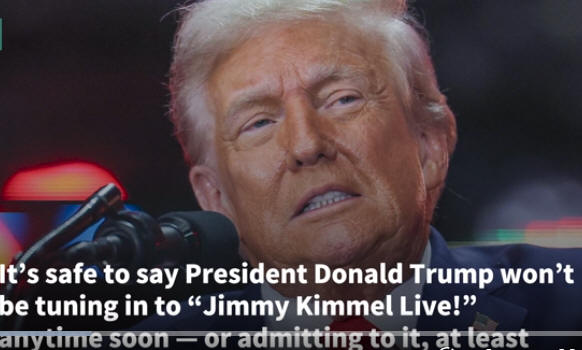
Jimmy Kimmel is back hosting late-night TV, and President Trump has some big feelings about it.
.
 .
.
.
Click the link below for the complete article (sound on for video):
.
__________________________________________
Assorted human interest posts.
September 28, 2025
Business, Food For Thought, Human Interest, Political, Science, Technical amazon, business, Business News, current-events, Future, Hotels, human-rights, medicine, mental-health, research, Science, Science News, technology, Technology News, travel, vacation Leave a comment
Click the link below the picture
.
.
.
.
Click the link below for the complete article (sound on for video):
.
__________________________________________
September 27, 2025
Business, Food For Thought, Human Interest, Political, Science, Technical amazon, business, Business News, current-events, Future, Hotels, human-rights, medicine, mental-health, research, Science, Science News, technology, Technology News, travel, vacation 4 Comments

Click the link below the picture
.
A pair of diamonds that formed hundreds of kilometers deep in Earth’s malleable mantle both contain specks of materials that form in completely opposing chemical environments—a combination so unusual that researchers thought their coexistence was “almost impossible.” The substances’ presence provides a window into the chemical goings-on of the mantle and the reactions that form diamonds.
The two diamond samples were found in a South African mine. As with plenty of other precious gemstones, they contain what are called inclusions—tiny bits of surrounding rocks captured as the diamonds form. These inclusions are loathed by most jewelers but are an exciting source of information for scientists. That’s especially true when diamonds form deep in the unreachable mantle, because they carry these inclusions basically undisturbed to the surface—the only way those minerals can rise hundreds of kilometers without being altered from their original deep-mantle state.
The two new diamond samples each contain inclusions of carbonate minerals that are rich in oxygen atoms (a state known as oxidized) and oxygen-poor nickel alloys (a state known as reduced, in the parlance of chemistry). Much like how an acid and a base immediately react to form water and a salt, oxidized carbonate minerals and reduced metals don’t coexist for long. Typically, diamond inclusions show just one or the other, so the presence of both perplexed Yaakov Weiss, a senior lecturer in Earth sciences at the Hebrew University of Jerusalem, and his colleagues, so much so that they initially put the samples aside for a year in confusion, he says
But when they reanalyzed the diamonds, the researchers realized that the inclusions capture a snapshot of the reaction that made the sparkling stones and confirm for the first time that diamonds can form when carbonate minerals and reduced metals in the mantle react. The new samples are the first time scientists have ever seen the midpoint of that reaction captured in a natural diamond.
“It’s basically two sides of the [oxidation] spectrum,” says Weiss, the senior author of the new study describing the find, which was published on Monday in Nature Geoscience.
The find has implications for what lies in the mantle’s mysterious middle. As you travel deeper into the earth, away from the surface, the rocks and minerals become increasingly reduced, with fewer and fewer oxygen molecules available, but there is little direct evidence of this shift from the mantle.
Theoretical calculations have given researchers a notion of how the planet shifts from oxidized to reduced with depth. “We knew about that reduction with some empirical data, with real samples down to maybe 200 kilometers,” says Maya Kopylova, a professor of Earth, ocean, and atmospheric science at the University of British Columbia, who was not involved in the new study but who wrote an editorial accompanying the paper. “What happened below 200 km [was] just our idea, our models, because it’s so difficult to get the
materials.” There are only a few samples from below this depth, she said.
These new samples, which come from between 280 and 470 km below Earth’s surface, provide the first real-world fact-check on this theoretical mantle chemistry. One finding, Weiss says, is that oxidized melted material exists deeper than expected. Kimberlites, the erupted rocks that bring diamonds to the surface, are oxidized, so researchers had thought they couldn’t originate much below 300 km of depth. But these findings suggest that oxidized rocks occur deeper than that, and thus so might kimberlite rocks.
Diamond-forming reactions likely happen when carbonate fluids are dragged down by subducting tectonic plates, which bring oxygen-heavy minerals in contact with the metal alloys of the mantle, Weiss says. (Another way chemists think diamonds may form is by precipitating out of carbon-rich fluids that cool as they rise upward in the mantle, like sugar crystalizing from syrup. The new paper doesn’t rule out that process happening as well.)
The nickel-rich inclusions might also help explain an odd occurrence in some diamonds: occasional atoms of nickel seem to replace the carbon of these diamonds’ crystal lattice. That’s been a mystery, Kopylova says, because nickel is so much heavier than carbon that it shouldn’t be able to easily swap into the crystal structure. “Now, looking at these data, I see that it might be just a sign of diamond formation at certain depths,” she says. “That would be very interesting to investigate further.”
.

Deep-Earth diamond. Yael Kempe and Yakov Weiss
.
.
Click the link below for the complete article:
.
__________________________________________
September 27, 2025
Business, Food For Thought, Human Interest, Political, Science, Technical amazon, business, Business News, current-events, Future, Hotels, human-rights, medicine, mental-health, research, Science, Science News, technology, Technology News, travel, vacation 1 Comment

Click the link below the picture
.
The Supreme Court upended the constitutional separation of powers on Friday afternoon with a brief order allowing Donald Trump to unilaterally cancel $4 billion in foreign aid appropriated by Congress. In an apparent 6–3 decision, the conservative supermajority greenlit Trump’s so-called “pocket rescission,” ensuring that the money will expire before its intended beneficiaries receive it. It offered a single page of vague, threadbare justification, suggesting that the president’s authority over foreign affairs outweighs Congress’ control over spending.
This view marks a radical rewriting of the Constitution that shifts a massive amount of power from the legislative branch to the executive. It essentially awards Trump a line-item veto over any part of the budget that is remotely connected to foreign policy—and, quite possibly, every dollar appropriated by Congress. And the court did all this without full briefing, oral argument, or a signed ruling, abusing the shadow docket yet again to hand Trump one of the biggest wins of his second term so far.
Friday’s decision in Department of State v. AIDS Vaccine Advocacy Coalition revolves around $4 billion that Congress explicitly appropriated to fund various programs overseas. Lawmakers committed the money to, among other things, democracy-building work, election integrity, climate resilience projects, and gender equality initiatives. But the Trump administration refused to disburse it to its intended recipients, claiming that it was not “aligned with the foreign policy of the president.”
This executive withholding of an appropriation is called an impoundment, and it is flatly illegal. In 1974, after many tussles with Richard Nixon over this issue, Congress enacted the Impoundment Control Act (ICA) to prevent future administrations from canceling money that it had appropriated. Under the law, a president must seek Congress’ permission to rescind “discretionary” spending, and give a reason for his request. If Congress does not grant permission within 45 days, the executive branch must spend the money.
But Trump insists that he has discovered a loophole in the ICA, which his Justice Department calls a “pocket rescission.” The administration sat on the $4 billion in aid until the final 45 days of the fiscal year, which ends on Sept. 30, when the money will lapse. Then, less than 45 days out from that deadline, he sent Congress a letter asking to cancel the funds under the ICA. Congress will not approve this impoundment. But Trump contends that, because he has asked permission, he can simply refuse to spend the money until the fiscal year ends—then let it expire forever.
In response to this gambit, several intended beneficiaries of the aid filed a lawsuit demanding that the government pay out the money. Lower courts ruled in their favor, holding that the Trump administration cannot manipulate the ICA from a restriction on impoundment to a license for impoundment. So the Justice Department asked the Supreme Court for emergency relief. And, predictably, the Republican-appointed justices provided it on Friday in an unsigned shadow docket order.
The majority essentially offered two sentences of explanation. First, it held that the ICA likely “precludes” the parties’ suit “to enforce the appropriations at issue here.” Second, the president had a stronger claim of injury, because “the asserted harms to the executive’s conduct of foreign affairs appears to outweigh the potential harm faced by respondents.” Both of these conclusions are astoundingly backward, which may be why the majority did not try to flesh them out: to describe the majority’s reasoning is to refute it.
Start with the notion that the ICA bars private plaintiffs from suing to receive appropriations to which they are entitled. At the outset, this theory should raise an eyebrow, since it harms the very parties—victims of illegal impoundments—that the law was designed to help. But set that aside. The majority seems to think that private plaintiffs can’t sue because the ICA explicitly empowers only one party, the Comptroller General, to sue over impoundments. That’s what Trump’s Justice Department argued. (As Justice Elena Kagan noted in dissent, though, it only adopted this argument recently, and took the opposite position just last month.)
.
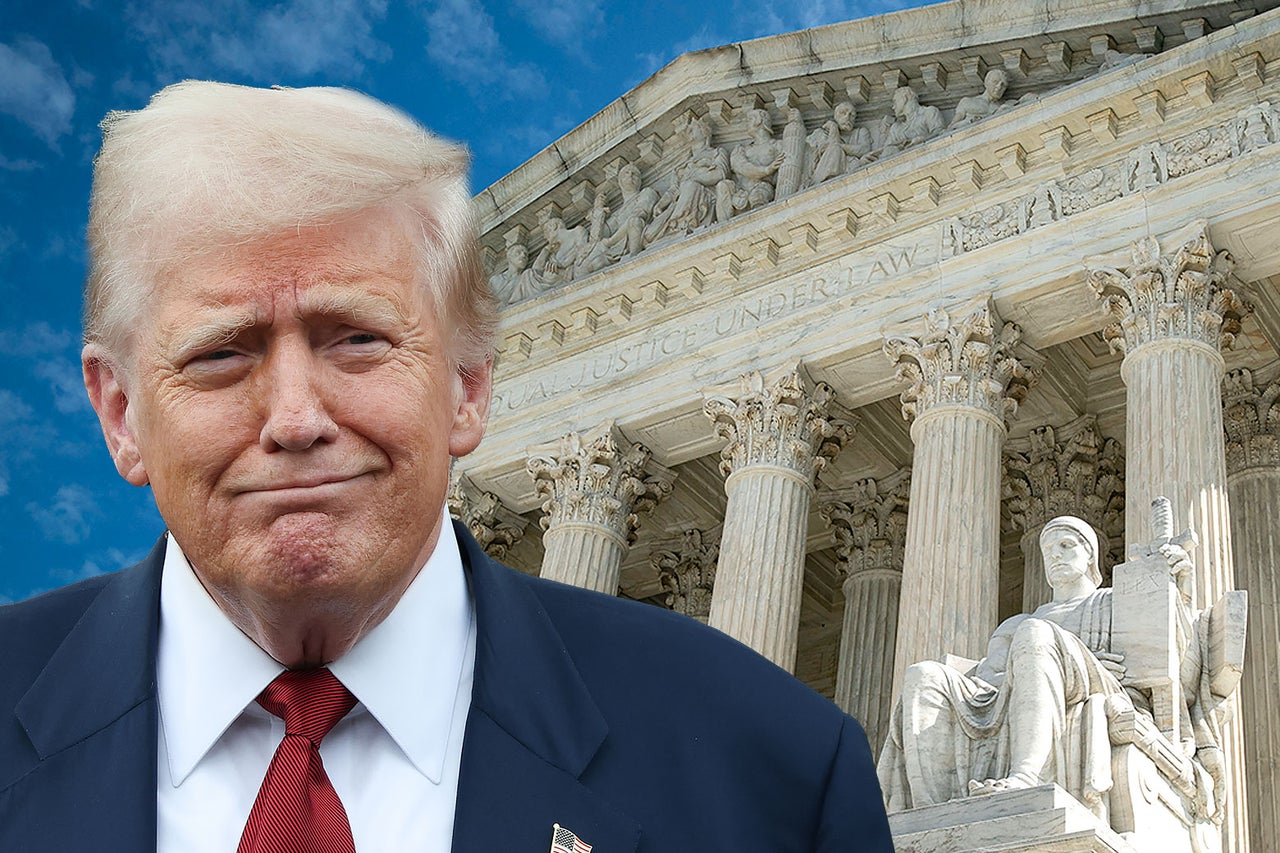
Photo illustration by Slate. Photos by Win McNamee/Getty Images and Al Drago/Getty Images.
.
.
Click the link below for the complete article:
.
__________________________________________
September 27, 2025
Business, Food For Thought, Human Interest, Political, Science, Technical amazon, business, Business News, current-events, Future, Hotels, human-rights, medicine, mental-health, research, Science, Science News, technology, Technology News, travel, vacation Leave a comment

Click the link below the picture
.
The Department of Justice has issued a subpoena for records related to the travel history of Fani T. Willis, the Georgia district attorney who charged President Trump in a sweeping election interference case, according to a federal grand jury subpoena reviewed by The New York Times.
The scope of the investigation is not yet clear. Also unclear is whether Ms. Willis is the target of the inquiry and whether she will ultimately face charges. Grand jury proceedings are secretive by law.
But the document reviewed by The Times is an indication that the Justice Department under President Trump may be investigating another one of his old foes. On Thursday, the department indicted James B. Comey, the former F.B.I. director, over the objection of career prosecutors who found insufficient evidence to support the charges.
Days earlier, Mr. Trump criticized Attorney General Pam Bondi for not moving more aggressively to prosecute Mr. Comey, as well as Letitia James, New York’s attorney general, and Senator Adam B. Schiff, Democrat of California.
In Georgia, federal investigators are seeking records related to travel they believe Ms. Willis took abroad around the time of last year’s election, but it was not immediately clear why. The inquiry is being led by the office of Theodore S. Hertzberg, the U.S. attorney for the Northern District of Georgia.
Jeff DiSantis, a spokesman for Ms. Willis, said Friday that “we have no comment beyond the fact we have no knowledge of any investigation.”
Mr. Hertzberg’s office did not have any immediate comment.
The case that Ms. Willis brought against Mr. Trump and his allies, which accused them of orchestrating a “criminal enterprise” to reverse the results of the 2020 election in Georgia and subvert the will of voters, is in limbo. Last year, a state appeals court disqualified her from overseeing the case after revelations that she had a personal relationship with the lawyer she had hired to run it, Nathan Wade. Defense lawyers accused Ms. Willis of “self-dealing” by going on vacations with Mr. Wade that he had paid for, at least in part.
Those travels took place in 2022 and 2023. But the current subpoena is seeking details of travel in the fall of 2024, around the time of last year’s election.
Last week, the Georgia Supreme Court declined to take up her appeal on the disqualification matter, leaving the case against Mr. Trump and his allies unlikely to proceed anytime soon, if at all.
After the ruling, Mr. Trump said in a social media post that Ms. Willis and others who brought or tried to bring criminal or civil cases against him “are now CRIMINALS who will hopefully pay serious consequences for their illegal actions.” He has put increasing pressure on the Justice Department, shattering the agency’s tradition of keeping the president at arm’s length. On Friday, he predicted more indictments of “corrupt radical left Democrats” were coming.
“There’ll be others,” Mr. Trump told reporters as he left the White House to attend the Ryder Cup golf championship on Long Island.
Mr. Trump’s co-defendants in the Georgia case include Mark Meadows, the former White House chief of staff; Rudy Giuliani, the president’s onetime personal lawyer; and David Shafer, the former head of the Republican Party in Georgia.
The original multicount indictment, which was handed up in August 2023, accused Mr. Trump and a number of his allies of organizing a criminal racketeering enterprise to reverse the election results in Georgia, which Mr. Trump narrowly lost in 2020. Part of the basis for the indictment was a phone call Mr. Trump had made in January 2021 to Brad Raffensperger, Georgia’s Republican secretary of state, asking Mr. Raffensperger to “find” enough votes to overturn the election results.
Mr. Trump had to go to Atlanta to get booked in the city’s jail in 2023.
Ms. Willis is a Democrat who won re-election in November. She has said repeatedly that she did nothing wrong.
In one 2024 court filing, she argued that “personal relationships among lawyers — even on opposing sides of litigation — do not constitute impermissible conflicts of interest.” In a court hearing that year, she said she had paid her share of the cost of the trips she had taken with Mr. Wade.
“I’m not on trial, no matter how hard you try to put me on trial,” she said at one point, while being questioned on the stand by a defense lawyer.
The Trump administration has sought to install political allies in a number of federal prosecutors’ offices, in several cases circumventing established rules for such appointments. But Mr. Hertzberg is a longtime employee in the federal prosecutor’s office in Atlanta whose interim appointment was made permanent earlier this month by local federal judges.
.

The Department of Justice is seeking information on Fani T. Willis, the Georgia district attorney who charged President Trump in an election interference case. Above, Ms. Willis in Atlanta in 2023.Credit…Kenny Holston/The New York Times
.
.
Click the link below for the complete article:
.
__________________________________________
September 26, 2025
Business, Food For Thought, Human Interest, Political, Science, Technical amazon, business, Business News, current-events, Future, Hotels, human-rights, medicine, mental-health, research, Science, Science News, technology, Technology News, travel, vacation Leave a comment
Click the link below the picture
.
Scientists have made monumental strides in their quest to protect vulnerable babies from respiratory syncytial virus (RSV): in just the past few years, monoclonal antibody injections for infants and a maternal vaccine that delivers protection through the placenta have substantially reduced infant hospitalizations and deaths.
But researchers still are grasping at a broader goal: to make a vaccine available for toddlers and preschoolers, who are also vulnerable to severe RSV disease.
That breakthrough, medical researchers say, could be right around the corner.
The most promising candidate is a two-dose vaccine administered as a nasal spray. Should it prove safe and effective in clinical trials, which are currently underway, it could help prevent severe RSV disease in children over the first several years of their lives—not just the first months.
“Where we’re heading next is the possibility of having true vaccines, not monoclonal antibodies, for kids after their first birthday,” says James Campbell, an infectious disease pediatrician at the University of Maryland.
Before the arrival in 2023 of Pfizer’s maternal vaccine and a preventive monoclonal antibody drug called nirsevimab, developed by Sanofi and AstraZeneca, RSV brought an annual scourge upon children’s hospitals. Historically, it has been the number one cause of infant hospitalization; about 2 to 3 percent of infants in their first year of life are hospitalized with RSV each year in the U.S.
During the fall and early winter, RSV “fills up our hospitals with sick children and may potentially have long-term ramifications in terms of a higher likelihood of wheezing,” says Jennifer Nayak, an infectious disease pediatrician at the University of Rochester Medical Center. “The fact that there are prevention strategies out there … has actually moved the landscape quite far in this area.”
A second monoclonal antibody, Merck’s clesrovimab, was approved for use in infants this year.
The monoclonal antibodies and maternal vaccination both protect babies through passive immunization, which means the infants are given antibodies. For RSV, the antibodies are either directly injected as nirsevimab or clesrovimab, or passed through the placenta after the vaccine is given during pregnancy. Those antibodies are ready to fight the disease, but they eventually wear off. Because infants do not receive a vaccine that prompts their immune systems to make their own antibodies—known as active immunity—they aren’t primed to fight RSV after the passively received antibodies have waned.
“Unlike active immunization, where you establish immune memory, passive immunization doesn’t do that,” Nayak says.
And while RSV is the most dangerous to babies, it’s far from harmless in older kids.
A Centers for Disease Control and Prevention analysis of data from two different groups of children in the U.S. revealed this stark reality. In it, scientists found that RSV-related hospitalization rates among infants seven months and younger decreased by about 28 and 43 percent, respectively, during the peak of the 2024–2025 RSV season, when both preventatives were available, compared with pre-COVID-pandemic RSV seasons from 2018 to 2020.
Those same statistics also underscored the ongoing vulnerability of older children: While RSV-related hospitalizations declined in infants, they increased in older kids. For children aged eight months to 19 months, hospitalization rates from RSV were 26 and 34 percent higher in the two groups, respectively, in the 2024–2025 season than they were in 2018–2020. In one of the cohorts, the hospitalization rate rose from five per 1,000 children to nearly seven. Hospitalization rates for 20- to 59-month-olds in the two groups were 1.7 and 2.5 per 1,000 children, 55 and 67 percent higher than they were in those prepandemic seasons.
The existing passive immunization products are reducing the impact on infants, but “what we want to do for them after that is going to be the question,” Campbell says. “We all know that in the second and third season, there is still a burden in two-year-olds and three-year-olds.”
The disease is even more deadly in low- and middle-income countries that don’t have the resources to provide supportive care to children with severe infections. Worldwide, RSV is responsible for more than 3.6 million hospitalizations and about 100,000 deaths in children under age five each year, according to the World Health Organization.
.
 Chiara Vercesi
.
.
Click the link below for the complete article:
.
__________________________________________
September 26, 2025
Business, Food For Thought, Human Interest, Political, Science, Technical amazon, business, Business News, current-events, Future, Hotels, human-rights, medicine, mental-health, research, Science, Science News, technology, Technology News, travel, vacation Leave a comment

Click the link below the picture
.
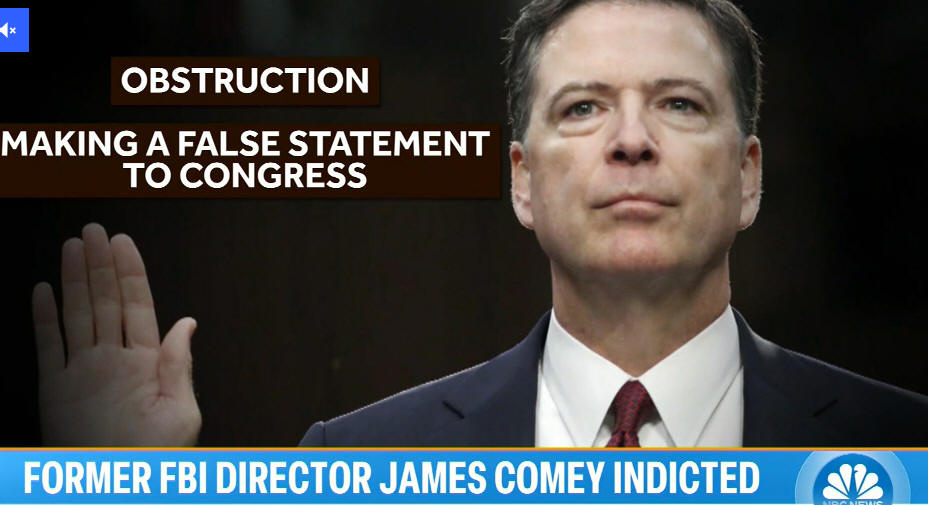
Newly appointed acting U.S. Attorney Lindsey Halligan presented the case to secure the indictment of former FBI Director James Comey on her own, according to a source familiar with the grand jury proceedings in Alexandria, Virginia, on Thursday.
Tapped for the acting role just three days earlier, Halligan’s action came after a senior Justice Department official told NBC News that career prosecutors in Halligan’s office sent her a memo documenting why they believed probable cause did not exist to secure an indictment against Comey.
The appointment of Halligan, who was on President Donald Trump’s defense team in the Mar-a-Lago classified documents case prior to his election to a second term, followed the resignation of acting U.S. Attorney Erik Siebert last Friday after pressure grew from the White House to prosecute Comey.
Time was of the essence in bringing an indictment: A five-year statute of limitations on the charges against the former FBI director was set to expire early next week.
Halligan and the Department of Justice did not immediately respond to NBC News’ requests for comment.
The indictment charged Comey with making a false statement and obstruction of a congressional proceeding. He has denied any wrongdoing.
Halligan was also the only prosecutor to sign the indictment. It is highly unusual for the U.S. attorney to not assign assistant prosecutors to a case for grand jury presentation.
The charges stem from testimony Comey delivered to the Senate Judiciary Committee on Sept. 30, 2020, in response to questioning about who authorized an information leak to The Wall Street Journal about an FBI investigation into the Clinton Foundation in 2016. Comey was asked whether he stood by earlier testimony from 2017 denying that he’d authorized his deputy, Andrew McCabe, to approve the leak, and he responded, “I stand by the testimony.”
A 2018 Justice Department inspector general’s report quoted McCabe as saying he did not recall discussing the disclosure with Comey in advance of authorizing it, although it was possible that he did, but when he told Comey after the article came out, he “did not react negatively.”
The inspector general said Comey denied McCabe ever told him he was responsible for the leak, and the report found that McCabe’s account had changed over time and he “lacked candor.” The report ultimately found the leak had been authorized by McCabe “without consulting Comey.”
Court records show that the grand jury declined to indict Comey on a third count, which was related to his testifying at the hearing that he didn’t remember being told of a “plan” involving two unidentified people and the 2016 election. The filing also shows an apparent typographical error listing that third count again as “count two.”
In a statement Thursday night, Halligan said the “charges as alleged in this represent a breach of the public trust at an extraordinary level.”
Comey declared his innocence in a video post on Instagram Thursday night.
“My heart is broken for the Department of Justice, but I have great confidence in the federal judicial system, and I’m innocent,” he said. “So let’s have a trial and keep the faith.”
The indictment came just days after Trump posted on social media that Attorney General Pam Bondi should take action against Comey and two of the president’s other adversaries, Sen. Adam Schiff, D-Calif., and New York Attorney General Letitia James.
.
 .
.
.
Click the link below for the complete article:
.
__________________________________________
September 26, 2025
Business, Food For Thought, Human Interest, Political, Science, Technical amazon, business, Business News, current-events, Future, Hotels, human-rights, medicine, mental-health, research, Science, Science News, technology, Technology News, travel, vacation Leave a comment

Click the link below the picture
.
The dance between developing storms in the Atlantic could soon evolve into one of meteorology’s most unusual and rare events: The Fujiwhara effect, which occurs when two storms interact with one another.
As of the morning of Sept. 24, two tropical systems continue to meander in the southwest Atlantic Ocean. Neither is a named storm yet, so they’re dubbed “Invest 93L” and “Invest94L” by the National Hurricane Center. Both are highly likely to become tropical cyclones in the next week, the hurricane center said, but their exact paths and potential to impact the United States remain uncertain for now.
When and if the storms reach tropical storm status, one will likely be named Humberto and the other Imelda.
Many weather models show the potential for land impacts mainly from 94L (likely Imelda) but the track is dependent upon 93L (Humberto) with the “Fujiwhara effect determining the outcome,” said Weather Trader meteorologist Ryan Maue in an Substack post Sept. 24.
“The Fujiwhara effect is uncommon in the Atlantic but can occasionally happen,” noted WPLG-TV hurricane specialist Michael Lowry in a Substack post Sept. 24.
What is the Fujiwhara effect?
When two storms or hurricanes spinning in the same direction pass close enough to each other, they begin an intense dance around their common center known as the Fujiwhara effect, the National Weather Service said.
The effect is thought to occur when storms get about 900 miles apart.
Storms involved in the Fujiwhara effect are rotating around one another as if they had locked arms and were square dancing. Rather than each storm spinning about the other, they are actually moving about a central point between them, as if both were tied to the same post and each swung around it separately of the other.
A good way to picture this is to think of two ice skaters who skate quickly toward each other, nearly on a collision course, grab hands as they are about to pass, and spin vigorously around in one big circle with their joined hands at the center.
According to Weather.com, the stronger storm often dominates, tugging the weaker one into its circulation, but in rare cases, two storms of similar strength can combine, creating a single, more powerful storm.
Who was Fujiwhara?
The effect is named after Dr. Sakuhei Fujiwhara, who was the chief of the Central Meteorological Bureau in Tokyo, Japan, shortly after the First World War. In 1921, he wrote a paper describing the motions of “vortices” in water. Water vortices, such as whirlpools, are little water whirls that spin around.
What’s the forecast for the two systems?
“Both Invest 93L and 94L have high chances of developing in the coming days,” noted Houston-based meteorologist Matt Lanza in his Substack “The Eyewall” on Sept. 24. “And the situation has grown no less complicated.”
“The first thing I can say with some confidence about all this is that we are looking at a somewhat lengthy process here,” Lanza said. “We may be watching these systems for the next week. While Invest 93L seems likely to not be a land threat (though it could tease Bermuda), it may ultimately help influence Invest 94L, which could be a land threat on the Southeast or Mid-Atlantic coasts.”
However, “even if 94L stays weak and offshore next week, the upper-level pattern with a cutoff low pinching off over the Tennessee Valley could funnel abundant tropical-laden air into the Carolinas and parts of the southern and central Appalachians and Mid-Atlantic for the start of next week,” Lowry said.
“This suggests an enhanced flood threat for these areas beginning this weekend, which we’ll need to follow over the coming days,” he added.
.
.
.
Click the link below for the complete article (slideshow):
.
__________________________________________
September 25, 2025
Business, Food For Thought, Human Interest, Political, Science, Technical amazon, business, Business News, current-events, Future, Hotels, human-rights, medicine, mental-health, research, Science, Science News, technology, Technology News, travel, vacation Leave a comment
Click the link below the picture
.
While pregnant with her third child last year, Alison Carroll pondered options that hadn’t been available during her first two pregnancies: not one but two ways to help prevent her newborn from ending up in the hospital, fighting for breath because of a severe infection with respiratory syncytial virus (RSV).
A pediatric hospitalist herself, she already had for years witnessed and treated the worst of RSV’s ravages in children, including a scary situation that landed her own daughter, Stella, in the same wing of Vanderbilt Children’s Hospital in Nashville, where Carroll works.
So Carroll didn’t need to think long before saying yes to one of the new preventative options that have revolutionized the medical world’s ability to prevent the most severe symptoms of RSV, especially in infants, who are particularly vulnerable. Since they debuted in 2023, the preventatives—a vaccine for pregnant people and an antibody shot for newborns—have reduced hospitalizations of the youngest babies by up to half.
“That’s amazing,” says Paul Offit, director of the Vaccine Education Center at Children’s Hospital of Philadelphia. “It actually caused a slight decrease in the infant mortality rate in this country,” a figure that wasn’t more dramatic, mainly because RSV is responsible for a small proportion of infant deaths relative to other causes.
Although the infant mortality rate is low, respiratory syncytial virus is the leading cause of hospitalization among infants in the U.S., with newborns up to the age of two months being at the highest risk, according to the U.S. Centers for Disease Control and Prevention. Roughly 60,000 to 80,000 children under age five are hospitalized with RSV every year in the U.S., and an estimated 100 to 300 children in that age group die annually.
In some babies, RSV progresses beyond cold-like symptoms, spreading from the upper respiratory tract (primarily the nose and throat) to the lower, where it affects their lungs and ultimately causes severe breathing difficulties, low oxygen levels and other serious complications.
That’s why pediatricians and infectious disease specialists have reacted with such enthusiasm to the development of the preventative measures, which, in both clinical trials and early real-world results, have produced dramatic reductions in RSV infections that require medical attention or hospitalization among babies. A CDC analysis of data from two different groups of children in the U.S. found that RSV-related hospitalization rates among infants seven months and younger decreased by about 28 and 43 percent, respectively, during the peak of the 2024–2025 RSV season, when both preventatives were available, compared with pre-COVID-pandemic RSV seasons from 2018 to 2020.
Looking at the data more narrowly, the researchers saw an even larger effect: for infants aged zero to two months, the decreases were 45 percent and 52 percent for the two groups, respectively. That 45 percent reduction jumped to 71 percent when the Houston, Tex., region was excluded because of its early-onset RSV season, which began before the new drugs were available.
Offit says the CDC data were not limited to babies who received antibodies through the maternal vaccine or monoclonal antibody injections but rather included all RSV-related infant hospitalizations. “This wasn’t an efficacy study,” he says. “They were looking from 30,000 feet, saying, ‘Has there been a decrease [in hospitalizations]?’”
“And there has,” he adds, “which is remarkable.”
Offit isn’t the only expert offering superlatives.
“I think the results have been stunning, actually,” says Yvonne Maldonado, chief of pediatric infectious diseases at Stanford University School of Medicine and a former member of the federal Advisory Committee on Immunization Practices. “Those two treatments, or preventive measures, have resulted in massive reductions in infections and, among infected kids, massive reductions in hospitalizations.”
The protective measures work in different ways. With an injection of the Pfizer vaccine Abrysvo at 32 to 36 weeks of gestation, a pregnant person develops antibodies against RSV that are conferred to the fetus through the placenta, giving babies crucial protection that lasts for the first six to nine months of life.
.
 Chiara Vercesi
.
.
Click the link below for the complete article:
.
__________________________________________
September 25, 2025
Business, Food For Thought, Human Interest, Political, Science, Technical amazon, business, Business News, current-events, Future, Hotels, human-rights, medicine, mental-health, research, Science, Science News, technology, Technology News, travel, vacation Leave a comment

Click the link below the picture
.
From Panama’s jungles to Vietnam’s buzzing cities, these five countries offer expats the best mix of affordability, friendliness, and quality of life.
More people than ever are living outside of their country of origin: according to the World Migration Report, 3.6% of the global population are considered international migrants. Moving abroad brings both challenges and rewards, but one recent survey suggests a single factor is shaping expat happiness more than ever right now: money.
Internations, a global community for people living and working overseas, surveyed more than 10,000 expats across 172 nationalities. This year, the countries that scored highest for overall happiness also ranked near the top in the survey’s Personal Finance index, alongside strong results for quality of life and ease of settling in.
We spoke to expats in each of the top five destinations to understand the best parts about living there – and their advice for others considering an international move.
1. Panama
Ranking 1st out of 46 countries overall, Panama placed in the top three across all five of the survey’s major indexes – including first in Working Abroad, second in Ease of Settling in and Expat Essentials (like digital life and housing), and third in Quality of Life and Personal Finance. Popular with freelancers, digital nomads, and retirees, Panama attracts people who appreciate its natural beauty and outdoor activities.”I love beyond words being surrounded by this lush jungle landscape where we see toucans, monkeys, iguanas, agoutis, birds, butterflies every day,” says Cari Mackey, an American who owns and operates Morrillo Beach Eco Resort. “Our area is so remote that we rarely see anyone else on our beach other than our own guests of the resort, so, the waves are never crowded and the vibes are always nice.”
Mackey warns, however, that deforestation is an issue and urges expats to respect the environment. “A lot of people move to Panama and before getting to know the land, [they] start cutting down trees or the understory of the forest and then [we] lose that eco system forever,” she said.
The top 10 countries for expats, according to Internations:
1. Panama
2. Colombia
3. Mexico
4. Thailand
5. Vietnam
6. China
7. UAE
8. Indonesia
9. Spain
10. Malaysia
Bureaucracy can also be a challenge, she says, and hiring professional help like lawyers can go a long way when navigating the systems; even renewing vehicle license plates can require complex paperwork. To appreciate Panama’s beauty, Mackey recommends visiting Cerro Hoyas National Park. “The park is home to endemic species of plants and animals that I didn’t know existed,” she said. “It is a dream for birders, a challenge for hikers, and an all-round inspiring place to explore with waterfalls everywhere!”
.
 Getty Images
.
.
Click the link below for the complete article (and all choices):
.
__________________________________________
September 25, 2025
Business, Food For Thought, Human Interest, Political, Science, Technical amazon, business, Business News, current-events, Future, Hotels, human-rights, medicine, mental-health, research, Science, Science News, technology, Technology News, travel, vacation Leave a comment

Click the link below the picture
.
President Donald Trump’s abrupt change in rhetoric on Ukraine, in which he declared it could retake all its territory with help from NATO, was warmly welcomed by Kyiv and quickly dismissed Wednesday by Moscow, particularly his calling the Russian military “a paper tiger” that had been “fighting aimlessly for three and a half years.”
The few early reactions trickling out of Moscow on Wednesday demonstrated how deeply Trump’s unexpectedly friendly appearance in New York alongside Ukrainian President Volodymyr Zelensky on the sidelines of the U.N. General Assembly vexed the Kremlin, which just weeks ago was gloating over Russian President Vladimir Putin’s warm reception in Alaska.
“Russia is in no way a tiger. Still, Russia is more compared with a bear. There are no paper bears,” Kremlin spokesman Dmitry Peskov said to local radio on Wednesday.
Peskov also suggested the motivation behind Trump’s push to halt European purchases of Russian oil and gas — which are helping fund Russia’s war machine — is tied to his desire to boost American sales.
At a later briefing with reporters, Peskov pushed back on Trump’s comments that the war is “aimless,” while still thanking Trump for his willingness to promote peace — and warning that Ukraine was in a dire position.
Kyiv is “trying to demonstrate to their sponsors in Europe and their handlers that they can fight, but they should not forget that with each passing day when the Ukrainian side refuses to negotiate, the negotiating position of the Ukrainian side will only worsen,” he said.
The outspoken former Russian president Dmitry Medvedev mocked Trump’s new position, saying he had been given a dose of “alternative reality,” and noted his often-changing views of the conflict.
“I have no doubt — he will come back. He always comes back,” Medvedev wrote about Trump on X. “The main thing is to radically change your point of view on various issues more often. And everything will be fine. That’s the essence of successful government through social media.”
Margarita Simonyan, who heads the Russian English-language state news channel RT, dismissed the U.S. president’s support for Zelensky as that of a carnival huckster.
“Trump debuts as the tarot card reader telling the thrice-divorced lady that she is going to meet that billionaire prince after all, as long as she buys the magic crystals,” she wrote on X.
European leaders, however, seized on Trump’s about-face, which matches their long-stated support for Ukraine’s struggle against the 2022 full-scale Russian invasion. Trump’s statements Wednesday acknowledged Russia’s inability to make significant ground advances. He praised Ukraine’s military for holding off the much larger Russian army for so long.
“I think Ukraine, with the support of the European Union, is in a position to fight and WIN all of Ukraine back in its original form,” Trump said on Truth Social. “With time, patience, and the financial support of Europe and, in particular, NATO, the original Borders from where this War started, is very much an option,” he said.
Olof Gill, a European Union spokesman, said Wednesday that the bloc welcomed Trump’s engagement, describing it as “now so strong and meaningful as regards coordinated efforts to try to end Russia’s aggression.”
Although Russia has made some small gains in recent months, the results of the summer offensive were limited. Russia has still failed to take the eastern city of Pokrovsk, after its more than year-long quest to seize it.
When asked on Fox News if he thought Trump’s position on the war had changed, Zelensky replied he believed it had — and that Trump appeared to understand that the two countries could not “swap territory.”
“God bless, I really count on this,” he said. In the past, Trump had talked about the need for territorial swaps in any peace agreement.
Zelensky has touted in recent days a small Ukrainian counteroffensive in the eastern Donetsk region. At the same time, Ukraine has lost some territory in other regions, including in Zaporizhzhia and Dnipropetrovsk. Ukrainian commander in chief Oleksandr Syrsky dismissed two commanders responsible for defending those areas.
“We agree. Ukraine is indeed in a position to fight and WIN all of Ukraine back in its original form,” Jonatan Vseviov, secretary general of Estonia’s Foreign Ministry, wrote on X in response to Trump’s assertion that Ukraine could win the war.
Estonian lawmaker Marko Mihkelson, who chairs his Parliament’s foreign affairs committee, shared a post from the White House that quoted Trump describing Zelensky as “a brave man” who is “putting up one hell of a fight.” The post included an image of Zelensky laughing next to Trump on Tuesday — a stunning contrast to Trump and Vice President JD Vance’s dressing down of Zelensky in the Oval Office in February.
“Incredible turnaround. Now actions should follow,” Mihkelson wrote.
Zelensky’s chief of staff, Andriy Yermak, tweeted a bicep emoji in response to the White House post.
.
.
.
Click the link below for the complete article:
.
__________________________________________
¡Bienvenido de vuelta viajero!
so looking to the sky ¡ will sing and from my heart to YOU ¡ bring...
CEO and Founder of Nsight Health
https://www.tangietwoods
Catholic News, Prayers, HD Images, Rosary, Music, Videos, Holy Mass, Homily, Saints, Lyrics, Novenas, Retreats, Talks, Devotionals and Many More
Decoding Power. Defying Narratives.
A creative collaboration introducing the art of nature and nature's art.
The Home Of Entertainment News, Reviews and Reactions
Hollow Earth Society
•Whenever you are confronted with an opponent, conquer him with love.(Gandhi)
Algotrader at TRADING-CLUBS.COM
Film and Writing Festival for Comedy. Showcasing best of comedy short films at the FEEDBACK Film Festival. Plus, showcasing best of comedy novels, short stories, poems, screenplays (TV, short, feature) at the festival performed by professional actors.
Peace. Tranquility. Insanity.
Take a ride on the wild side
Découvre des musiques prometteuses (principalement) dans la sphère musicale française.
No tiene que Ser una Pesadilla.
Life in Kana-text (er... CONtext)
Tracking money, power, and meaning across borders.
Where feelings meet metaphors and make questionable choices.
Finding hope and peace through writing, art, photography, and faith in Jesus.
Eyasu
The Community for Wounded Healers: Former Medical Students, Disabled Nurses, and Faith-Fueled Pivots
love each other like you're the lyric to their music
Comprendere il mondo per cambiarlo.
Mid-Life Ponderings
Travel,Tourism, Life style "Now in hundreds of languages for you."
I speak the honest truth. I share my honest opinions. I share my thoughts. A platform to grow and get surprised.
User-generated ratings for ethical consumerism
Travel and Lifestyle Blog
Questo è un piccolo angolo di poesie, canzoni, immagini, video che raccontano le nostre emozioni
“Log your journey to success.” “Where goals turn into progress.”
scrivo per dare forma ai silenzi e anima alle storie che il mondo dimentica.
“Dream deeper. Believe bolder. Live transformed.”
Vichar, Motivation, Kadwi Baat ( विचार दर्शनम्)
Traum zur Realität
Savor. Style. See the world.
معا نحو النجاح
Best Forex Broker Ratings & Reviews
art, writing and music by James McFarlane and other musicians
living life in conscious reality
Freelance poetry writing
Peace 🕊️ | Spiritual 🌠 | 📚 Non-fiction | Motivation🔥 | Self-Love💕


 James' World 2