January 14, 2025
Mohenjo
Business, Food For Thought, Human Interest, Political, Science, Technical
amazon, business, Business News, current-events, Future, Hotels, human-rights, medicine, mental-health, research, Science, Science News, technology, Technology News, travel, vacation

Click the link below the picture
.
Archaeologists have excavated an intricately carved and painted tomb in northern Egypt, and they think the 4,100-year-old burial chamber belonged to a prominent, multi-talented royal doctor: a physician who served ancient Egyptian kings as an expert in medicinal plants, dentistry and venomous bites.
A team of French and Swiss researchers discovered the tomb in Saqqara, the necropolis of the ancient capital city of Memphis, according to a statement from Egypt’s Ministry of Tourism and Antiquities.
“This incredible find adds to Saqqara’s rich legacy as one of Egypt’s most significant archaeological sites,” writes the ministry. “The tomb is adorned with stunning carvings and vibrant artwork, including a beautifully painted false door and scenes of funerary offerings.”
Inside the tomb, researchers found a stone sarcophagus bearing the name “Tetinebefou” in hieroglyphics. The inscriptions also indicate that he was the chief palace physician, priest, chief dentist, director of medicinal plants and conjurer of the goddess Serket—an Egyptian deity known for curing venomous snake and scorpion bites.
The doctor may have served under Pepi II, a pharaoh of ancient Egypt’s Old Kingdom around the 23rd century B.C.E. He was crowned as a child and retained the throne for 60 to 90 years. When he died, he too was buried in Saqqara, entombed in a pyramid.
The Saqqara necropolis has been extensively looted over the millennia, according to a translated blog post from the researchers. They found only small fragments of funerary materials, but the painted walls alone made the discovery “exceptional.” As Live Science’s Owen Jarus reports, the paintings actually depict objects that the doctor might have used, such as jars and vases.
The doctor’s title of “conjurer of the goddess Serket” means he was “a specialist in poisonous bites,” as research team leader Philippe Collombert, an Egyptologist at the University of Geneva, tells Live Science. The other titles on the sarcophagus are quite rare: “Director of medicinal plants” has only been found on one other ancient Egyptian artifact, and “chief dentist” is also very unusual, Collombert says.
“Evidence for ancient Egyptian ‘dentists’ is exceedingly scarce,” as Roger Forshaw, an Egyptologist at the University of Manchester who wasn’t involved in the research, tells Live Science.
The ancient Egyptians are known for their advances in medical science, and they possessed extensive knowledge of human anatomy. Thousands of years ago, they were treating brain cancer via surgery, diagnosing the condition now known as diabetes, and building prosthetics.
.
:focal(640x481:641x482)/https://tf-cmsv2-smithsonianmag-media.s3.amazonaws.com/filer_public/78/a9/78a955c5-9d8a-4d6d-9a7c-666e4373f659/472552859_993327022828844_6703126601490304254_n.jpeg) The tomb’s walls are painted and carved with images of objects the doctor might have used. Franco-Swiss Archaeological Mission of Saqqara
The tomb’s walls are painted and carved with images of objects the doctor might have used. Franco-Swiss Archaeological Mission of Saqqara
.
.
Click the link below for the complete article:
.
__________________________________________
January 13, 2025
Mohenjo
Business, Food For Thought, Human Interest, Political, Science, Technical
amazon, business, Business News, current-events, Future, Hotels, human-rights, medicine, mental-health, research, Science, Science News, technology, Technology News, travel, vacation

Click the link below the picture
.
Theoretical physicists have proposed the existence of a new type of particle that doesn’t fit into the conventional classifications of fermions and bosons. Their ‘paraparticle’, described in Nature on January 8, is not the first to be suggested, but the detailed mathematical model characterizing it could lead to experiments in which it is created using a quantum computer. The research also suggests that undiscovered elementary paraparticles might exist in nature.
In a separate development published late last year in Science, physicists experimentally demonstrated another kind of particle that is neither a boson nor a fermion — an ‘anyon’ — in a virtual one-dimensional universe for the first time. Anyons had previously been created only in 2D systems.
Because of their unusual behaviour, both paraparticles and anyons could one day play a part in making quantum computers less error-prone.
Particle properties
Around the time when physicists began to understand the structure of atoms, a century ago, Austrian-born theorist Wolfgang Pauli suggested that no two electrons can occupy the same state — and that if two electrons are pushed close to being in the same state, a repulsive force arises between them. This ‘Pauli exclusion principle’ is crucial to the way electrons orbiting an atomic nucleus arrange themselves in shells, instead of all falling to the lowest possible energy state.
Pauli and others soon realized that this empirical rule of exclusion applied not only to electrons but to a broader class of particles, including protons and neutrons, which they called fermions. Conversely, particles that do like to share the same state — which include the photons in a laser beam, for example — became known as bosons. (Pauli and his collaborators also worked out why being a fermion or a boson appeared to relate to a particle’s intrinsic angular momentum, or ‘spin’.)
Mathematically, the fundamental property of fermions is that when two of them switch positions, the ‘wavefunction’ that represents their collective quantum state changes sign, meaning that it gets multiplied by –1. For bosons, the wavefunction remains unaltered. Early quantum theorists knew that, in principle, there could be other kinds of particle whose wavefunctions changed in more complicated ways when they swapped positions. In the 1970s, researchers discovered anyons, which can exist only in universes of one or two dimensions.
Physicists Zhiyuan Wang, now at the Max Planck Institute for Quantum Optics in Garching, Germany, and Kaden Hazzard at Rice University in Houston, Texas, have now constructed a model for paraparticles that can exist in any number of dimensions — and with properties that are different from those of either fermions or bosons. In particular, these paraparticles obey their own type of Pauli exclusion. “It’s not entirely surprising that it’s possible,” says Kasia Rejzner, a mathematical physicist at the University of York, UK. “But it’s still cool.”
Wang says he came up with the exotic swapping rules by chance in 2021 while doing his PhD. “It was the most exciting moment in my life,” he says. Wang adds that it should be possible — although challenging — to realize these paraparticle states on a quantum computer.
1D anyons
Paraparticles share a property with fermions: swapping two particles and then swapping them back restores them to their original state. Anyons generally have a different quantum state even after being restored to their original positions, so they are not classed as paraparticles.
.

Particles known as fermions (shown in this illustration) can’t share the same state. Roman Andrade 3Dcienca/Science Photo Library
.
.
Click the link below for the complete article:
.
__________________________________________
January 13, 2025
Mohenjo
Business, Food For Thought, Human Interest, Political, Science, Technical
amazon, business, Business News, current-events, Future, Hotels, human-rights, medicine, mental-health, research, Science, Science News, technology, Technology News, travel, vacation

Click the link below the picture
.
It was well before dawn when I set off on foot through Granada’s oldest neighborhood, El Albaicín, an intricate brocade of cobbled streets overhung with fragrant jasmine trees. The first glow of sunlight revealed the titanic walls and turrets of the palace-fortress complex called the Alhambra looming above me on a spectacular crag. Poets have rhapsodized about the structure’s fairytale beauty since the finest craftsmen of the Arab world built it nearly 800 years ago. For over two centuries in the Middle Ages, it was the crown jewel of the Emirate of Granada, which stretched across Spain’s Mediterranean coast from modern-day Gibraltar past the snowcapped Sierra Nevada.
After crossing a stone bridge over the River Darro, I took a little-known back route into the palace called Cuesta del Rey Chico, a steep foot trail squeezed into a leafy ravine where the only sound was the water cascading from antique terra-cotta pipes. By now, the morning sunlight was making the Alhambra live up to its original name, al-Qal’ah al-Hamra, “the red fort.” An ornate archway led into the complex itself, an array of palaces and gardens covering 35 acres. The most famous site is the Nasrid Palace, named after the ruling dynasty. On my first visit, I had hardly known where to rest my eyes as I wandered its gorgeous chambers adorned with latticework and geometric patterns, its elegantly proportioned courtyards with burbling fountains, and the surrounding rose and orange gardens. Its interior walls are covered floor to ceiling with carved script in classical Arabic, which scholars have translated as praise for Allah, snippets of poetry and celebrations of the Nasrid rulers.
But on this morning’s visit, I was heading for a more mysterious world: the Alhambra’s secret network of underground tunnels and chambers.
At least, that was my hope. The Alhambra is the most popular attraction in Spain, drawing over two million visitors annually. It’s also one of the most strictly controlled thanks to its status as an Islamic outpost seized by Christians, which still has political overtones more than five centuries later. Gaining permission to visit its off-limits subterranean sections had been challenging. After emailing palace officials for weeks without response, I had already arrived in Granada when they bluntly denied my request. But then, suddenly, they reversed track. I received an urgent phone call: I had been approved to visit at 9 the next morning.
After reporting at a special office to fill out a string of forms, I cooled my heels for a half-hour in the company of an affable security guard named Jaime, who was wearing an earpiece, aviator sunglasses, and a black blazer with a green “A” sewn onto his lapel. Finally, Ignacio Martín-Lagos, a conservation officer, arrived and declared that he would be my Virgil to the palace’s subterráneo, a dimension of the complex that he said holds a special fascination for him. “The artistic beauty of the Alhambra aboveground is undeniable,” Martín-Lagos said in Spanish as we hopped over a metal barrier and walked along the fortress’s defensive walls. “But the most surprising thing is what lies below. It was really two structures. Only if you explore its subterranean levels can you grasp the palace’s true dimensions and understand how its day-to-day life really functioned.”
After passing a 40-foot drop without guardrails, which was not for the vertiginous, we arrived at the Torre de las Gallinas, or Tower of the Hens, where Martín-Lagos fished from his pocket a thin, six-inch-long master key. “You’re going to pass through the entire palace, but underground,” he said. After shouldering open a portal, he used his smartphone flashlight to guide us down worn stone steps into a labyrinth of tunnels and chambers once used by guards and staff. They were chilly, claustrophobic, and, when Martín-Lagos turned off the light, sepulchral. But the underground was once teeming with activity, he said. “The Alhambra was a palace-city. As well as soldiers, it had about a thousand civilian inhabitants to serve the royal family—cooks, bakers, cleaners—who could go back and forth down here, without bothering the sultan. You need to have a double perspective: the ornamental world above versus the practical world below.”
I began to realize that the Alhambra most visitors see, like the Palace of Versailles and the great British manor houses, required an elaborate hidden support system. The upstairs palace offered exquisite luxury, where the sultan lounged on silk pillows and ate slices of oranges and honey cakes. Downstairs was penumbral darkness broken by flickering torches, where the staff toiled unseen to seamlessly maintain the opulence. The security purpose of the tunnels was also crucial, Martín-Lagos added, pointing up at the ceiling. We were under the room where the sultan held his audiences. “Squadrons of soldiers were lined up here, ready to rush upstairs at a moment’s notice.” Nearby was a stairway that had only been discovered after a 1907 landslide, with 200 steps descending to a door hidden in the fortress walls. We then ascended and opened a trapdoor to a bell-shaped chamber with walls of raw stone that had been converted from a grain silo to a dungeon. (Prisoners were lowered 20 feet from the surface by rope, so it was impossible to escape.)
The grand finale was Martín-Lagos’ favorite site. As travelers at an outdoor café in a palace courtyard snapped photographs, he unlocked two panels of a metal trapdoor in the ground and heaved them open, sending up clouds of dust. “Take care!” he said, now pointing a hefty light down a tight spiral staircase. “Take lots of care!” The electric beams cut through the darkness to reveal a vast cistern, including an ancient bucket suspended by a rope and encrusted with skeletal algae. “The major problem of the Alhambra was water,” Martín-Lagos whispered in awe. “Enormous cisterns were needed to supply the palace and its huge staff.” According to Martín-Lagos, the German traveler Hieronymus Münzer saw this cavern in 1494 and declared that it was bigger than the cathedral in his home city. “We all know that the finest engineers in history were the Romans,” he said. “That’s undeniable. But we must acknowledge the technical skill of the Spanish Muslims.”
.
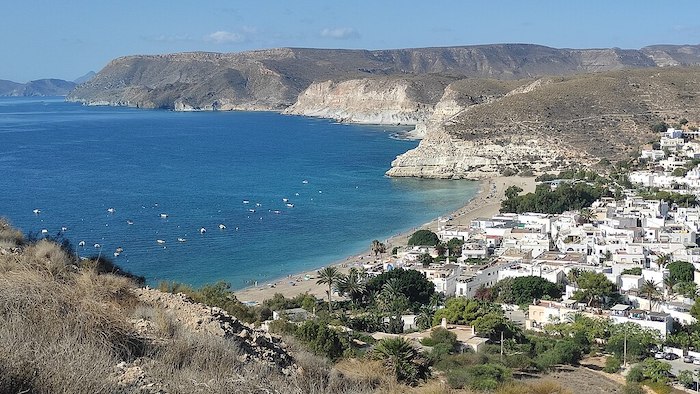 Agua Amarga (Public domain via Wikimedia Commons)
.
.
Click the link below for the complete article:
.
__________________________________________
January 12, 2025
Mohenjo
Business, Food For Thought, Human Interest, Political, Science, Technical
amazon, business, Business News, current-events, Future, Hotels, human-rights, medicine, mental-health, research, Science, Science News, technology, Technology News, travel, vacation

Click the link below the picture
.
Most recently, the FDA has approved:
- Ocrelizumab (Ocrevus): This drug treats relapsing forms of MS and primary progressive MS (PPMS). It’s the first DMTTrusted Source to be approved to treat PPMS and the only one approved for all four types of MS.
- Fingolimod (Gilenya): This drug treats pediatric MS. It was already approved for adults and, in 2018, became the first DMT to be approved for childrenTrusted Source.
- Cladribine (Mavenclad): This drug is approvedTrusted Source to treat relapsing-remitting MS (RRMS) and active secondary progressive MS (SPMS).
- Siponimod (Mayzent): This drug is approvedTrusted Source to treat RRMS, active SPMS, and clinically isolated syndrome (CIS). In a phase 3 clinical trialTrusted Source, siponimod effectively reduced the rate
- of relapse in people with active SPMS. Compared with a placebo, it cut the relapse rate in half.
- Ponesimod (Ponvory): This FDA-approvedTrusted Source drug has been shown to reduce annual relapses for relapsing types of MS by 30.5%Trusted Source when compared with teriflunomide (Aubagio).
- Ublituximab (Briumvi): This drug was approved by the FDATrusted Source to treat RRMS, SPMS, and CIS. It is a monoclonal antibody given as an infusion.
While new treatments are continually being approved, some medications are being removed from pharmacy shelves. In March 2018, daclizumab (Zinbryta) was withdrawn from markets around the world due to reports of the drug potentially causing inflammatory brain disorders. This drug is no longer available to treat MS.
Several other medications are moving through the research pipeline. In recent studies, some of these medications have shown promise for treating MS.
- The results of a phase 2 clinical trial suggest that the drug ibudilast might help reduce the progression of MS. To learn more about this medication, the manufacturer plans to conduct a phase 3 clinical trial.
- The findings of a small 2017 studyTrusted Source suggest that clemastine fumarate might help restore the protective coating around nerves in people with relapsing forms of MS. This oral antihistamine is currently available over the counter but not in the dose used in the clinical trial. More research is needed to study its potential benefits and risks for treating MS.
- Hematopoietic stem cell transplantation therapy is a promising new treatment for MS that’s currently being studied. It’s not currently approved in the United States, but interest is growing in the field, and it’s being evaluated in clinical trials.
Data-driven strategies to target treatments
Thanks to the development of new medications for MS, people have a growing number of treatment options to choose from.
To help guide their decisions, scientists are using large databases and statistical analyses to try to pinpoint the best treatment optionsTrusted Source for different people.
Eventually, this research might help those with MS learn which treatments are most likely to
Progress in gene research
To understand the causes and risk factors for MS, geneticists and other scientists are combing the human genome for clues.
Researchers have identified more than 200 genetic variantsTrusted Source associated with MS. For example, a 2018 studyTrusted Source by the International Multiple Sclerosis Genetics Consortium identified 4 new genes linked to the disease.
Eventually, findings like these might help scientists develop new strategies and tools to predict, prevent, and treat MS.
Studies of the gut microbiome
Scientists have also studied the role that bacteria and other microbes in our gut might play in the development and progression of MS. This community of bacteria is known as our gut microbiome.
.
 Disease-modifying therapies (DMTs) are the main group of medications used to treat MS. To date, the Food and Drug Administration (FDA) has approved more than a dozen DMTs for different types of MS.
.
.
Click the link below for the complete article:
.
__________________________________________
January 12, 2025
Mohenjo
Business, Food For Thought, Human Interest, Political, Science, Technical
amazon, business, Business News, current-events, Future, Hotels, human-rights, medicine, mental-health, research, Science, Science News, technology, Technology News, travel, vacation
Click the link below the picture
.
Most astronomers would love to find a planet, but Mike Brown may be the only one proud of having killed one. Thanks to his research, Pluto, the solar system’s ninth planet, was removed from the pantheon—and the public cried foul. How can you revise our childhoods? How can you mess around with our planetariums?
About 10 years ago Brown’s daughter—then around 10 years old—suggested one way he could seek redemption: go find another planet. “When she said that, I kind of laughed,” Brown says. “In my head, I was like, ‘That’s never happening.’”
Yet Brown may now be on the brink of fulfilling his daughter’s wish. Evidence he and others have gathered over the past decade suggests something strange is happening in the outer solar system: distant subplanetary objects are being found on orbits that look sculpted, arranged by an unseen gravitational force. According to Brown, that force is coming from a ninth planet—one bigger than Earth but smaller than Neptune.
Nobody has found Planet Nine yet. If it’s really out there, it’s too far and too faint for almost any existing telescope to spot it. But that’s about to change. A new telescope, the Vera C. Rubin Observatory in Chile, is about to open its mechanical eyes. When it does, it should catch millions of previously undetected celestial phenomena, from distant supernovae to near-Earth asteroids—and, crucially, tens of thousands of new objects around and beyond Pluto.
If Brown’s hidden world is real, Rubin will almost certainly find it or strong indirect evidence that it exists. “In the first year or two, we’re going to answer that question,” says Megan Schwamb, a planetary astronomer at Queen’s University Belfast in Northern Ireland—and, just maybe, the solar system will once again have a ninth planet.
Pluto was discovered in 1930 and always seemed to be a lonely planet on the fringes of the solar system. But in the early 2000s skywatchers found out that Pluto had company: other rime-coated worlds much like it were popping up in surveys of that benighted frontier. And in 2005, using California’s Palomar Observatory, Brown—an astronomer at the California Institute of Technology—and two of his colleagues spied a far-flung orb that would change the way we perceive the solar system.
That orb was Eris. It was remarkably distant—68 times as far from the sun as Earth. But at roughly 1,500 miles in diameter, it was just a little larger than Pluto. “The day I found Eris and did the calculation about how big it might be, I was like, ‘Okay, that’s it. Game’s up,’” Brown says. Either Eris was going to become a new planet, or Pluto wasn’t what we thought.
Finding a ninth planet would be huge. Such a discovery could change what we know about our solar system’s past.
In 2006 officials at the International Astronomical Union decided that to qualify as a planet, a body must orbit a star, must be sufficiently massive for gravity to squish it into a sphere, and must have a clear orbit. Pluto, which shares its orbital neighborhood with a fleet of other, more modest objects, failed to overcome the third hurdle. Pluto became a “dwarf planet”—but its demotion didn’t make it, or its fellow distant companions, any less beguiling to astronomers.
.
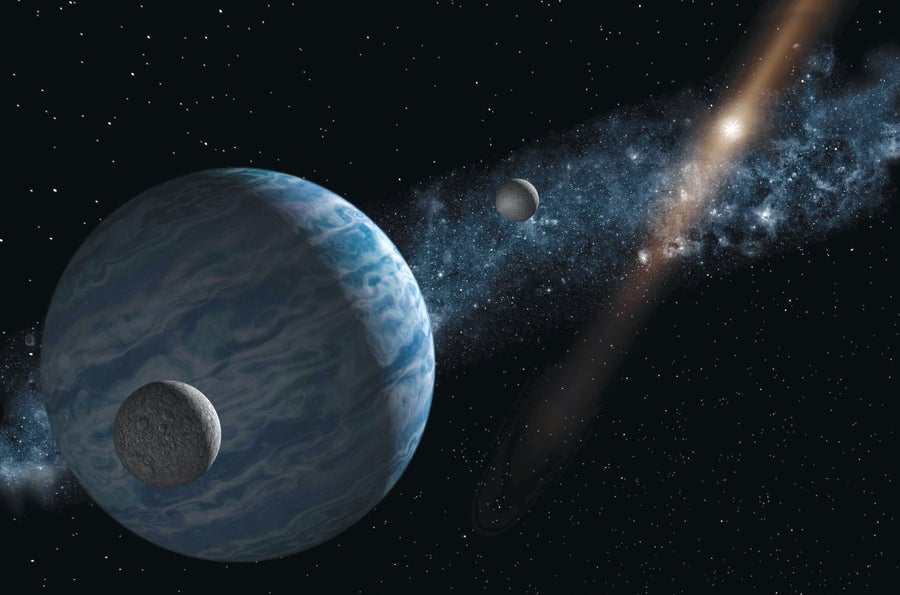 Ron Miller
.
.
Click the link below for the complete article:
.
__________________________________________
January 12, 2025
Mohenjo
Business, Food For Thought, Human Interest, Political, Science, Technical
amazon, business, Business News, current-events, Future, Hotels, human-rights, medicine, mental-health, research, Science, Science News, technology, Technology News, travel, vacation

Click the link below the picture
.
If you’re concerned about ecosystem collapse and climate displacement, you might look to a One Health approach for possible solutions. Techquity could provide a roadmap for countering any of the potential ills that AI may bring, despite all the good that its disciples promise. And if the troubles on our planet have you feeling unmoored, try seeking out belonging and even some enchantment.
These are the buzzwords that global health and development experts say we’ll hear more of in 2025 — a vocab mix of pending global catastrophe and possible remedy.
Belonging
It’s something of a paradox. Our planet is filled with a dizzying number of humans (8 billion and counting), many of whom are connected to one another electronically. And yet more and more people are lonely. Dr. Vivek Murthy, the current U.S. Surgeon General, has spoken of an epidemic of loneliness and isolation..
“Loneliness is far more than just a bad feeling,” he wrote in an advisory in 2023. “It harms both individual and societal health. It is associated with a greater risk of cardiovascular disease, dementia, stroke, depression, anxiety and premature death.” Loneliness is a global concern, as evidenced by the World Health Organization creating an international commission to address it as a public health crisis in late 2023.
Murthy invites us to “build a movement to mend the social fabric” by deeply listening, sharing a meal or volunteering. “The keys to human connection are simple but extraordinarily powerful.”
In Kenya, Sitawa Wafula, an independent mental health advocate, has developed her own approach. She launched and ran a support line that connected more than 11,000 people with mental health resources in its first year. “Many users shared that simply being heard by someone who understood their struggles created an immediate sense of connection,” Wafula says.
That’s why she believes that belonging will be a global buzzword this year. “For those facing stigma and alienation,” says Wafula, “belonging acted as a protective factor, encouraging them to seek further support and adopt healthier coping mechanisms.”
Wafula has also facilitated storytelling workshops among those in the African diaspora, many of whom face challenges surrounding identity and disconnection in their new homes. “Through sharing and affirming each other’s experiences,” she says, “they developed a shared sense of belonging that not only reduced isolation but also fostered resilience.”
.
 Leif Parsons for NPR
.
.
Click the link below for the complete article:
.
__________________________________________
January 11, 2025
Mohenjo
Business, Food For Thought, Human Interest, Political, Science, Technical
amazon, business, Business News, current-events, Future, Hotels, human-rights, medicine, mental-health, research, Science, Science News, technology, Technology News, travel, vacation
Click the link below the picture
.
About 170 million people use TikTok in the U.S., but that number could abruptly plummet toward zero if a law signed by President Joe Biden goes into effect on January 19. The law forces a choice for ByteDance, the China-based company that owns TikTok: it must either sell the app to a non-Chinese company or face a ban. ByteDance has repeatedly said the app is not for sale.
Instead, the company sued to keep the TikTok app available in the U.S.—and that case has now made its way before the Supreme Court. In oral arguments on Friday, Noel Francisco, attorney for ByteDance’s U.S. subsidiary TikTok, Inc., argued that the new law violates the First Amendment rights of that subsidiary, likening TikTok’s curation algorithm to editorial discretion. U.S. solicitor general Elizabeth Prelogar, arguing on behalf of the nation’s government, countered that China does not have a First Amendment right to manipulate content in the U.S. And she claimed that “the Chinese government could weaponize TikTok at any time to harm the United States.”
The Supreme Court is expected to issue a decision within the next nine days.
Why is the clock ticking for TikTok?
Congress, which passed the TikTok law with bipartisan support, says China’s influence over the platform poses a national security threat. The Department of Justice has raised concerns as well, including the potential collection of personal data from the app’s millions of American users and the potential “covert manipulation” of its content. (Although there is evidence that ByteDance shared non-U.S. user data with China, the U.S. government has not provided direct proof that the company or its subsidiary have meddled with American users.)
What might happen?
If TikTok loses its case, “as I understand it, we go dark,” Francisco told the Supreme Court on Friday. Americans would no longer be able to download or update TikTok from Google’s or Apple’s app stores. Internet service providers, too, would face severe penalties if they permitted TikTok access to U.S. users.
Americans may react in similar ways as former TikTok users elsewhere. After India banned the app in 2020, users flocked to other forms of short-form video, such as Instagram reels and YouTube Shorts. It is also possible to access blocked content via virtual private networks, or VPNs, which could disguise traffic to make it appear to originate from a country where TikTok wasn’t banned.
President-elect Donald Trump, meanwhile, has asked the Supreme Court to delay interpreting the law until he takes office. An amicus brief filed on his behalf claims his “consummate dealmaking expertise” could save the platform while addressing the national security concerns. Last September Trump promised to save the app, posting on his social media network Truth Social, “FOR ALL OF THOSE THAT WANT TO SAVE TIK TOK IN AMERICA, VOTE TRUMP!” Legal scholars have criticized Trump’s request for a delay.
.
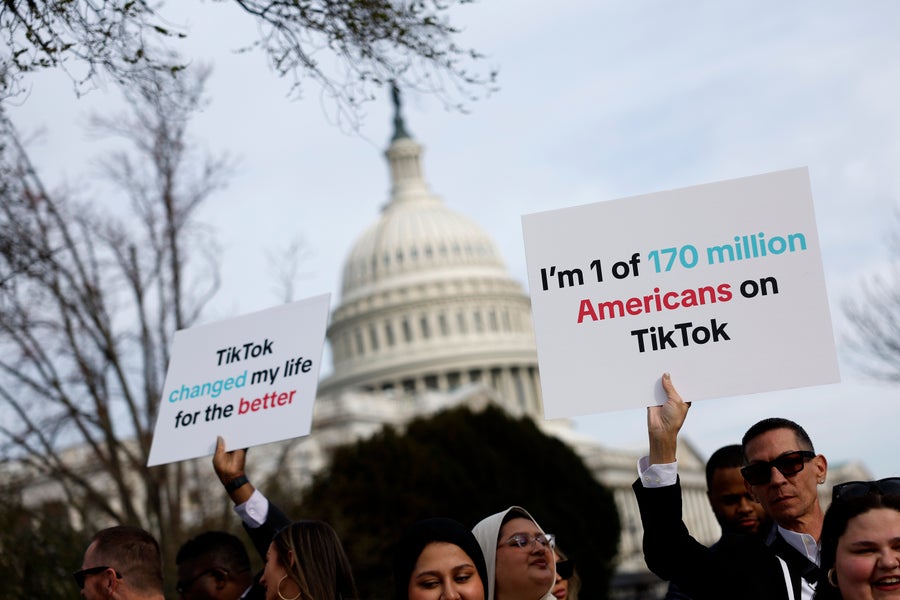
Participants hold signs in support of TikTok outside the U.S. Capitol Building on March 13, 2024, in Washington, D.C. Anna Moneymaker/Getty Images
.
.
Click the link below for the complete article:
.
__________________________________________
January 11, 2025
Mohenjo
Business, Food For Thought, Human Interest, Political, Science, Technical
amazon, business, Business News, current-events, Future, Hotels, human-rights, medicine, mental-health, research, Science, Science News, technology, Technology News, travel, vacation

Click the link below the picture
.
Last month I peeked my head into my son’s bed cave at 9:15 AM and whispered to him that I was off to a meeting, then to a friend’s house. When I squeezed his foot as I zipped him back in, his pre-teen body making the twin bed look tiny, I felt happy. I immediately thought of the word freedom.
And then I thought, as I often do, of a photo from 2021. In the picture, it’s also winter, and I’m hiding under that same son’s bed. We are in our tenth month of no childcare, no school, no daycare. My ear is pressed to my shoulder and my knee is in my armpit. I look like I’m playing 2-dimensional Twister, and losing. I remember the moment my daughter took the picture with her iPad, delighted because she’d found me in our game of hide and seek. In the photo, I look contorted and trapped. I am, of course, smiling.
During those lockdown months, my children were 2, 3, 4, 5. And I don’t know if you have been around any 3-year-olds lately, but there was a physical and emotional intensity to parenting during this time that is beyond any description; if you have ever been furious with a child, imagine being locked in a room with them and unable to leave for a year. Imagine how much you would want to be alone.
And so there is a part of me, emotionally but physically too, that is constantly bracing, as if I’m still alone in the house with my kids. And I can’t stop thinking about that photo because in some ways I’m still in it. I think, I know, it’s the reason that, in the years since, what I always wanted — what I still want, need, more than anything — is space. Time alone so I can breathe; unclench.
My husband, thankfully, works long days out of our house. He takes the kids out to breakfast on weekend mornings so I can have a few hours to myself; they have regular dad and kids dinners at restaurants while I exist alone in our house. A friend described herself as Gollum, the way she guards her time alone, and I felt seen. I guard my girls’ trips, my book club times, my silent baths. I curl around my precious snatches of time like Gollum with his ring, too, hissing at social obligations or even another hour of snuggles (please say I’m not the only one?).
But something has changed, and I’m only just starting to notice it. I don’t feel trapped in the same way. I don’t know if it’s that (for better or worse) social supports are back and running post-pandemic, or if it’s just my kids getting older. I do know any sliver of community care —playdates, shared pickups — still feels extraordinary.
And I know the feeling of freedom can go away at any time — a medical diagnosis, job loss, even relationships. There are many ways mothers can be trapped, and just because I feel some freedom now doesn’t mean I always will.
But still: yesterday I came out of hiding in my bedroom, where I’d holed up to get some writing in, only to find the house was quiet. I had come out into the living room, dreading the immediate dive into the what was for dinner debate, but my kids were off running around the neighborhood. My house was empty, but I was still hiding.
Who, exactly, am I hiding away from?
This possibility, this perspective, that motherhood doesn’t have to mean feeling trapped feels something like a secret. I wonder if I might be alone in this feeling, or if I’m just a selfish mother (another thing to discuss in therapy this week), or if many lockdown parents feel this way.
.
 romper
.
.
Click the link below for the complete article:
.
__________________________________________
January 10, 2025
Mohenjo
Business, Food For Thought, Human Interest, Political, Science, Technical
amazon, business, Business News, current-events, Future, Hotels, human-rights, medicine, mental-health, research, Science, Science News, technology, Technology News, travel, vacation
Click the link below the picture
.
CLIMATEWIRE | As historic fires rip through the Los Angeles area, President-elect Donald Trump is demanding Gov. Gavin Newsom “open up the water main” and allow “beautiful, clean, freshwater to FLOW INTO CALIFORNIA!”
At first glance, it seems to make sense. Why wouldn’t the leader of a state whose northern regions are currently enjoying above-average winter precipitation redirect water south to quench the burning metropolis as its fire hydrants run dry?
To start, there isn’t some central spigot nestled in the Sierra foothills that Newsom can just use a giant wrench to turn on. Then there’s the fact that firefighters were more hamstrung by the raging Santa Ana winds than empty hydrants due to a lack of water from Northern California.
Read on for a detailed explanation from our resident California water expert of the state’s complex water system and a brief history of Trump’s fixation with the issue.
What’s up with the ‘water restoration declaration?’
On Wednesday, Trump posted on Truth Social: “Governor Gavin Newscum refused to sign the water restoration declaration put before him that would have allowed millions of gallons of water, from excess rain and snow melt from the North, to flow daily into many parts of California, including the areas that are currently burning in a virtually apocalyptic way.”
Newsom’s communications director shot back: “There is no such document as the water restoration declaration — that is pure fiction.”
Is it? Not quite. Trump was referring to a real document, even if he used an unknown name for it that left even the most astute California water officials scratching their heads. Karoline Leavitt, the president-elect’s press secretary, explained the reference by pointing to a five-year-old legal showdown between Newsom and Trump over how to manage the state and federal systems of pumps, reservoirs, and canals that move water around California.
In short, the two disagree about how much water should be pumped out of the state’s main rivers, which combine in the Sacramento-San Joaquin River Delta, to the much drier farms of the Central Valley and cities of Southern California and how much water should be kept in the ecosystem to keep declining fish populations alive, including the Delta smelt, a frequent Trump target. Their separate plans for the pumps make only marginal differences in actual water deliveries but have taken on a political life of their own.
The conflict peaked in 2020 when Trump unveiled the “record of decision” cementing his version of the rules at a rally in the Central Valley — only to be sued by Newsom, citing harm to the environment
“That was the last significant water policy decision made during his first term in which both President Trump and Gov. Newsom took a personal interest,” said Tom Birmingham, the former general manager of Westlands Water District, the largest agricultural irrigation district in the country that sided with Trump in that battle.
.

Firefighters battle the Eaton Fire in strong winds as many homes burn on January 7, 2025, in Pasadena, California. A powerful Santa Ana wind event dramatically raised the danger of wind-driven wildfires. David McNew/Getty Images
.
.
Click the link below for the complete article:
.
__________________________________________
January 10, 2025
Mohenjo
Business, Food For Thought, Human Interest, Political, Science, Technical
amazon, business, Business News, current-events, Future, Hotels, human-rights, medicine, mental-health, research, Science, Science News, technology, Technology News, travel, vacation

Click the link below the picture
.
Dressing your child appropriately for winter weather sounds simple, but according to my mom, a former preschool teacher, parents don’t always hit the mark. Between temperature changes throughout the day, your child’s activities, and what your child is actually willing to wear, there are several reasons why it’s easy to miss key details in your kid’s winter attire. As a mom to a preschooler myself, I’m certainly not immune.
I asked for my mom’s input and found 12 preschool-friendly winter clothing items to keep kids warm, dry, and comfortable during cold temperatures and fun snow days in between. From colorful merino wool socks to kids’ snow boots and a classic coat (with a removable hood!), it’s safe to say that my kiddo is ready for winter weather. Is yours? Keep scrolling to find out.
Gloves are essential in the winter, especially during recess. Since gloves can get lost easily, my mom recommends buying inexpensive pairs that come in a pack. This knit set comes in a pack of three with 12 different color combinations and multiple sizes (up to 10 years old).
One grandma bought these gloves for her 3-year-old granddaughter, who “loves the bright colors and was happy to have gloves instead of mittens.” The gloves also “held up very well when building her snowman, and after washing and drying them,” she added.
You’ll want this Miles the Label Snowsuit on hand each year because it’s so warm and cozy. One of our writers received a sample for her 5-year-old, who couldn’t stop raving about the “extra soft” fleece lining and removable faux fur edge on the hood, which “keeps my face warm.” Our writer says she saves the snowsuit pants for snow days and sends her son to school with the jacket nearly every day when it’s cold.
This kids’ coat is wind-resistant and can withstand temperatures down to -22 degrees Fahrenheit. It also features an elastic waistband and cuffs to trap heat and a Velcro cover over the zipper for extra protection. The pants have even more thoughtful features, like reinforced knees, adjustable and removable suspenders, and more.
Bonus: The parka includes a sewn-on label to write your child’s name.
.
:max_bytes(150000):strip_icc()/par-preschool-teacher-recs-for-winter-clothes-tout-34b5a0ed572f41e7a8280b787e2be294.jpg) Parents
Parents
.
.
Click the link below for the complete article:
.
__________________________________________
Older Entries
Newer Entries
 James' World 2