Home

Surprising Creatures Lurk in the Great Pacific Garbage Patch

2 Comments

Click the link below the picture

.

Plastics floating in a massive “garbage patch” in the Pacific Ocean are home to strange new mixes of coastal and marine species that might increase the odds of biological invasions wreaking havoc on nearby ecosystems.

Scientists have long known that critters such as worms, crustaceans and mollusks could make their home on plastic debris. Animals have even crossed the Pacific Ocean on these makeshift rafts after a devastating tsunami struck Japan in 2011. But new research published on April 17 in the journal Nature Ecology & Evolution adds two details that could be concerning for existing ecosystems. First, it finds that plastic is providing a home for coastal species to thrive in the open ocean thousands of miles from shore. Second, some of these species are reproducing despite the alien environment.

“It’s probably one of the least-known environments, the sea surface,” says Martin Thiel, a marine biologist at Catholic University of the North in Chile, who was not involved in the new research. “It’s a very, very particular community that we are disturbing now at a massive scale.”

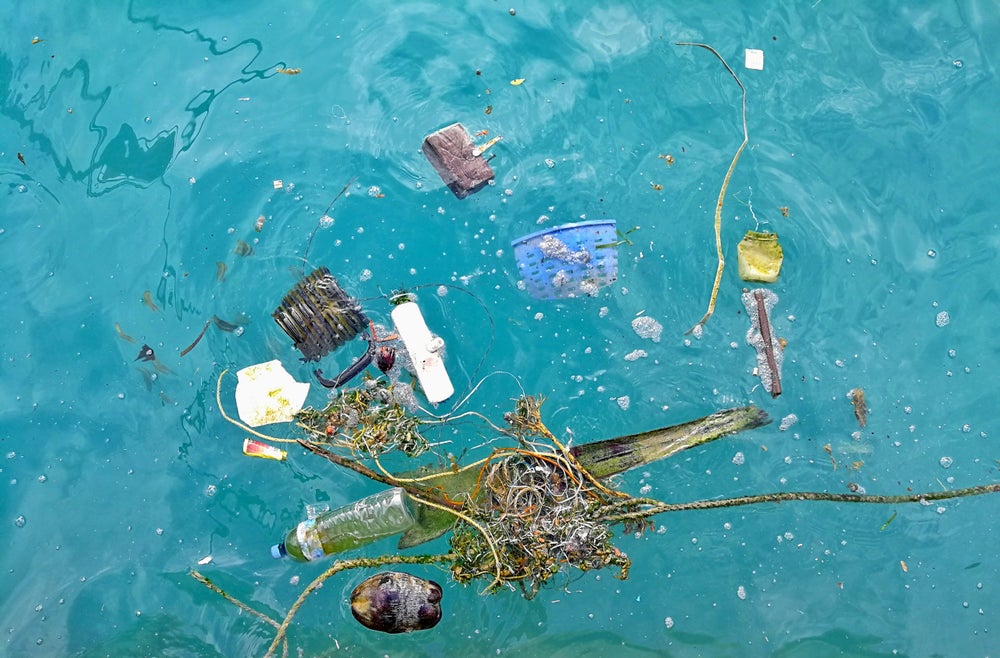
For the new study, researchers identified species living on just more than 100 pieces of plastic that were fished out of the so-called Great Pacific Garbage Patch—a region in the northern Pacific Ocean where currents converge to deposit an estimated 79,000 metric tons of plastic debris. The scientists identified 484 invertebrates from a surprising range of species on the plastic. Many of these animals were species that are more commonly found near coastlines of the western Pacific. These coastal species included “moss animals” or bryozoans, jellyfish, sponges, worms, and other organisms.

“I just remember the first time [study co-author] Jim [Carlton of Williams

College and Mystic Seaport Museum] and I pulled out a piece of plastic and saw the level of coastal species present, we were just blown away,” says Linsey Haram, lead author of the study. Haram, who was a research associate with the Smithsonian Environmental Research Center during the study, specializes in marine ecology.

Nearly all the debris hosted pelagic, or open-ocean, species—which makes sense considering that weathering on much of the plastic suggested it had spent several years at sea. But all told, about 70 percent of the debris the researchers analyzed carried at least one species usually found in coastal waters—a much higher tally than Haram and her colleagues expected going into the work, she says.

And as they looked closer, the scientists found that some two thirds of the debris pieces were home to coastal and open-ocean species living side by side. Plastic isn’t just carrying coastal species out to sea; it’s also creating unnatural neighborhoods that the researchers call “neopelagic communities.”

“What’s new, the ‘neo’ part of that, is that we now—likely because of plastics—are seeing coastal species and these native pelagic species together, interacting quite frequently on debris,” Haram says. “We’re essentially creating new communities in the open ocean.”

And these unnatural communities may come at a cost for traditional open-ocean residents that are used to living on natural debris, she adds, because coastal creatures could be competing for space and food or could even be eating their neighbors.

.
 

https://static.scientificamerican.com/sciam/cache/file/D9D4FD31-D011-4CBB-93D2ACC7843886DA_source.jpg?w=1000

Plastic and other debris seen in water off the Maldives. Jakchai Tilakoon/EyeEm/Getty Images

.

.

Click the link below for the complete article:

https://www.scientificamerican.com/article/surprising-creatures-lurk-in-the-great-pacific-garbage-patch/

.

__________________________________________

At least 9 reported dead in brutal cold as historic snow falls in once-in-a-generation storm in the South

Leave a comment

Click the link below the picture

.

At least nine people are believed to have died as a result of the dangerous cold gripping much of the country, as a once-in-a-generation winter storm wreaks havoc on the Gulf Coast — a region wholly unaccustomed to winter weather.

While the cold has proved deadly, footage from across the Gulf Coast shows snow blanketing implausible places, causing surreal wintry scenes: in New Orleans’ French Quarter, where street performers sang for passersby; on the grass at the Florida border; and on the white sand beaches of Orange Beach, Alabama.

“I’ve never seen anything like this,” Brennan Matherne wrote on X, where he shared footage of snow falling in Cut Off, Louisiana, “and probably never will again.”

Here’s what’s happening now:

• Deadly storm: Two deaths in Austin are being investigated as suspected cold-related deaths, according to the Austin-Travis County Emergency Medical Services, though the medical examiner’s office has not made a final determination of the causes of death. Georgia officials reported one death from hypothermia at a news conference Tuesday, saying the individual was outside the night prior. Another death is also believed to have been caused by hypothermia, involving an 80-year-old man in Milwaukee who fell outdoors early Sunday, according to the Milwaukee

County Medical Examiner’s Office. At least five people died in a vehicle accident caused by icy conditions early Tuesday morning in Zavala County, Texas, according to CNN affiliate WOAI/KABB, citing authorities.

• Record snowfall: Snow is falling from southeast Texas through Louisiana and into parts of Mississippi and Alabama Tuesday, creating treacherous conditions. An area stretching from Houston into Alabama has recorded widespread snowfall of 3 to 6 inches, with at least one locale hitting the double-digit mark. Eight inches of snowfall was recorded at the Louis Armstrong New Orleans International Airport on Tuesday according to the National Weather Service in New Orleans; the previous modern record was 2.7 inches in 1963. Florida has likely broken its all-time statewide snow record, with at least 5.5 inches recorded in Molino – a record that has stood since 1954. Mobile, Alabama, has so far recorded more than five inches of snow, breaking a 143-year-old record for one-day snowfall. A record amount of snow is forecast for New Orleans and other cities along the Gulf Coast.

• Unprecedented blizzard warning issued: Heavy snow and strong wind gusts combined to create whiteout conditions in southern Louisiana, where snow totals of 3 to 6 inches are already widespread. It prompted the first-ever blizzard warning

anywhere along the Gulf Coast from the National Weather Service in Lake Charles, for parts of southern Louisiana and far eastern Texas.

• Widespread closures: Snow has closed or hindered operations at multiple airports in the South, contributing to the more than 2,300 flight cancellations into or out of US airports Tuesday – and more than 900 cancellations so far Wednesday. Large sections of Interstate 10 — the Gulf Coast’s major thoroughfare — in Texas and Louisiana are closed Tuesday as snow and some icy mix make travel difficult to impossible. Major roads were closed across the New Orleans area. Schools and government offices are closed Tuesday throughout the Gulf Coast and states of emergency are active in Louisiana, Georgia, Alabama, Florida and Mississippi.

• Bitter cold: Low temperatures and wind chills from the Canadian border to the Mexican border are hitting dangerous levels for the second consecutive day. Wind chills Tuesday morning dropped into the teens for much of the Gulf Coast with single-digit values in northern Texas.

‘Generational winter storm’ hitting the South

Brutally cold temperatures are allowing an incredibly unusual storm to unfold along the Gulf Coast.

Snow, and an icy mix of snow, sleet and freezing rain, expanded in the early hours of Tuesday and ramped up throughout the morning. Snow even covered sandy beaches along Texas’ coast Tuesday morning.

The sweeping system is “a generational winter storm event,” the National Weather Service said Monday — and urged those along its path to take it seriously.

Roads overnight and Tuesday will be “extremely hazardous if not impossible for much of the area, and travel is highly discouraged,” the service said. Schools are closed in states including Texas, Louisiana, Georgia and North Carolina.

The complex mess of wintry weather spread east to reach more of Mississippi and into Alabama, Georgia, the Carolinas and the western Florida Panhandle throughout the day.

.

https://s.yimg.com/ny/api/res/1.2/yd0AUO0SCd8_4rvWHxD4gw--/YXBwaWQ9aGlnaGxhbmRlcjt3PTEyNDI7aD02OTk-/https://media.zenfs.com/en/aol_cnn_articles_945/184aff4a8d07ce46f859eadc48aac594Galveston, Texas, sees snow on the beach Tuesday morning. – Visit Galveston/San Luis Hotel

.

.

Click the link below for the complete article:

https://www.aol.com/once-generation-winter-storm-sweeping-095119389.html?guccounter=1

.

__________________________________________

What to Know about the Ban on Red Dye in Foods and Drugs

Leave a comment

Click the link below the picture

.

Earlier this week the U.S. Food and Drug Administration revoked the authorization of the dye Red No. 3, which is used in a variety of foods and medications. This artificial dye, which is made from petroleum and had been found to cause cancer in rats, was removed in response to a 2022 petition from the Center for Science in the Public Interest and other advocacy groups.

The cherry-red coloring agent is found in foods such as candies, Maraschino cherries, and strawberry-flavored milk drinks and in medicines such as cough syrups. Manufacturers of foods and ingested drugs have until January 15, 2027, and January 18, 2028, respectively, to remove the dye from their products.

Food safety activists had long called for Red No. 3’s removal, citing concerns about its possible carcinogenicity in humans, as well as some evidence that similar dyes may contribute to behavioral problems in children—including attention deficit hyperactivity disorder (ADHD).

Scientific American spoke with experts about why this red dye is being banned, how much exposure may be harmful and how it compares with other food colorings.

Which red dye is being banned?

Its official name is Red No. 3.

What foods or medicines contain it?

It’s found in candies, fruit juices, snack foods, Maraschino cherries and strawberry-flavored milk. It’s also found in some medications such as cough syrups.

Why was it banned?

Male rats developed thyroid tumors after being exposed to high levels of the dye in lab studies. But according to the FDA, the rats developed cancer through a hormonal mechanism that does not occur in humans—and studies in humans and other animals have not shown similar effects. Nevertheless, the dye was removed under the Delaney Clause of the Federal Food, Drug, and Cosmetic Act, which bans FDA authorization of a food or color additive that has been found to cause cancer in humans or animals.

Concerns have also been raised that some other artificial dyes, including another red dye called Red No. 40, may contribute to hyperactivity in children.

Why did it take so long for the U.S. to ban this compound in food?

The FDA has banned the use of Red No. 3 in cosmetics and topical medications since 1990. The European Union banned the dye in food (except cocktail cherries) in 1994, and in 2023 California banned it as well.

“The FDA has a really large mandate, and they have focused primarily on drugs. Within the food realm, they focused on food safety with a specific eye on infectious diseases like [Escherichia coli infection],” says Sheela Sathyanarayana, a professor of pediatrics and an adjunct professor of environmental and occupational health sciences at the University of Washington and Seattle Children’s Research Institute, but “where there’s been a hole or a gap is in food safety related to additives and environmental exposures and contaminants.”

The FDA, under the Biden administration, recently created a new food chemical safety office. “I am hopeful, with that new office opening, that they will be able to kind of assess in a more holistic way multiple different exposures, from food additives to contaminants,”Sathyanarayana says.

How much of this red dye do you need to consume for it to be harmful?

The relevant studies exposed rats to doses of the dye that were likely much larger than what a human would normally consume. It’s very hard to do studies on the toxic dose in humans because it’s unethical to conduct randomized, controlled trials that give people food with large amounts of certain additives. Most human studies of food ingredients are epidemiological: they involve asking people to remember what foods they’ve eaten and in what amounts, which is notoriously unreliable.

.

https://static.scientificamerican.com/dam/m/68709ae8f99d1d2c/original/Red_and_green_jelly_candies.jpg?m=1737069703.183&w=1000Oleksa/Getty Images

.

.

Click the link below for the complete article:

https://www.scientificamerican.com/article/is-red-no-3-harmful-how-does-it-compare-with-other-dyes/

.

__________________________________________

The 3 Most Dangerous ‘Parenting Styles’—According To A Psychologist

2 Comments

Click the link below the picture

.

Parenting can be one of the most daunting journeys a person undertakes. Despite what our children might think, we’re also first-time humans—figuring things out as we go. Unlike other life endeavors, parenthood doesn’t come with a comprehensive instruction manual. And yet, many parents don’t give themselves enough credit.

The truth is, there is no singular “right way” to parent. Happy, healthy, and well-rounded children can be raised in many different ways. That said, there are parenting styles that should be avoided at all costs, as some of them can have profoundly negative consequences on children.

While these styles may be adopted with good intentions or as a result of one’s own challenging circumstances, their impact can be far-reaching.

Here are three of the most dangerous parenting styles, according to psychological research—including what they look like in practice, and the potential harm they can cause.

1. Authoritarian Parenting

Authoritarian parenting, according to research from the Journal of Cognitive Psychotherapy, is characterized by low warmth and high behavioral control. It represents a style of parenting that is highly rigid; it values strict adherence to rules, without the buffer of affection and nurturing. This approach often places a heavy emphasis on obedience and discipline, with little room for dialogue or compromise.

In simpler terms, authoritarian parenting is all about enforcing rules without explanation or flexibility. It creates households where rules are followed for the sake of being rules—with little to no consideration for the child’s perspective.

Picture a parent who enforces a strict curfew with no exceptions, even if their teenager was staying late at school to work on a group project. The reasoning is irrelevant; the curfew is non-negotiable.

Another example might be a parent who insists that their child finishes every bite of food on their plate, regardless of whether the child is full or dislikes the meal. The child’s voice is not part of the equation, and any dissent is often met with harsh consequences—like grounding or a loss of privileges.

Authoritarian parenting can stifle a child’s emotional, social, and academic development in numerous ways, according to research from the World Journal of Social Sciences. Children in these environments may grow up feeling that their opinions and emotions don’t matter. Consequently, their self-esteem will dwindle, and they may notice difficulties in asserting themselves later in life.

Moreover, the lack of warmth and affection can create emotional distance between the parent and child. This detachment can hinder the development of relationship security, which is essential for building healthy relationships in adulthood.

Children raised in authoritarian households might also internalize a fear of failure, as they’ll likely learn to associate mistakes with punishment, rather than growth. As a result, they may become overly anxious and perfectionistic, or in severe cases, highly rebellious, as they may attempt to reclaim autonomy at all costs.

2. ‘Laissez-Faire’ Parenting

According to research from Group Dynamics, “laissez-faire” parenting—also known as permissive parenting—is characterized by warmth and nurturing, but minimal expectations.

Meaning “allow to do” in French, and implying that children should simply do as they please, these parents impose few rules and take on a friend-like role. In turn, children are allowed significant amounts of independence, and often avoid discipline. While communication is often open, this style lacks the structure and boundaries children need to thrive.

While permissive parenting may seem wholesome and loving on the surface, it often results in a lack of guidance and accountability. Imagine a parent who never enforces bedtime, instead allowing their child to stay up as late as they want—even on school nights.

While this may result in short-term harmony, the child will eventually end up sleep-deprived and unable to focus in class. Over time, they may even start struggling academically. The parent’s reasoning might be that they don’t want to stifle their child’s freedom or create conflict, but the absence of boundaries ultimately leaves the child floundering.

Laissez-faire parents are also prone to overlooking poor behavior. Consider, for instance, a child throwing a tantrum in a store. Instead of addressing the behavior with a firm but understanding approach, the parent might offer a toy or candy to placate the child. Over time, this teaches the child that there aren’t really any consequences for their actions. As these children grow up, they will struggle immensely to develop self-discipline.

Without clear boundaries or guidance, children of permissive parents often struggle to differentiate between right and wrong. This lack of structure forces them to learn many lessons the hard way, and unnecessary risks and mistakes may become the norm.

For instance, a teenager who has never faced restrictions may engage in dangerous behaviors—like reckless driving, risky relationships, or substance use—as they lack the foresight to understand the potential consequences of these choices.

Additionally, these children may develop a sense of entitlement, according to a 2016 study. These children turn into teens and young adults who expect the world to accommodate them just as much as their permissive parents did.

In turn, they might also find it challenging to adapt to environments that demand discipline and responsibility, such as school or the workplace. Over time, the absence of accountability can erode their ability to adapt to the realities of life—let alone to succeed. Overarchingly, permissive parenting results in children who are ill-prepared to navigate life’s challenges independently.

.

https://imageio.forbes.com/specials-images/imageserve/678cecb00fbb23da499e79f9/Shot-of-a-little-girl-being-spoken-to-sternly-at-home-by-her-mother/0x0.jpg?format=jpg&crop=1118,746,x0,y5,safe&width=1440

.

.

Click the link below for the complete article:

https://www.forbes.com/sites/traversmark/2025/01/19/the-3-most-dangerous-parenting-styles-according-to-a-psychologist/?utm_source=pocket_discover_parenting

.

__________________________________________

Could Pain Help Test AI for Sentience?

Leave a comment

Click the link below the picture

.

In the quest for a reliable way to detect any stirrings of a sentient “I” in artificial intelligence systems, researchers are turning to one area of experience—pain—that inarguably unites a vast swath of living beings, from hermit crabs to humans. 

For a new preprint study, posted online but not yet peer-reviewed, scientists at Google DeepMind and the London School of Economics and Political Science (LSE) created a text-based game. They ordered several large language models, or LLMs (the AI systems behind familiar chatbots such as ChatGPT), to play it and to score as many points as possible in two different scenarios. In one, the team informed the models that achieving a high score would incur pain. In the other, the models were given a low-scoring but pleasurable option—so either avoiding pain or seeking pleasure would detract from the main goal. After observing the models’ responses, the researchers say this first-of-its-kind test could help humans learn how to probe complex AI systems for sentience. 

In animals, sentience is the capacity to experience sensations and emotions such as pain, pleasure, and fear. Most AI experts agree that modern generative AI models do not (and maybe never can) have a subjective consciousness despite isolated claims to the contrary. And to be clear, the study’s authors aren’t saying that any of the chatbots they evaluated are sentient. But they believe their study offers a framework to start developing future tests for this characteristic. 

“It’s a new area of research,” says the study’s co-author Jonathan Birch, a professor at the department of philosophy, logic, and scientific method at LSE. “We have to recognize that we don’t actually have a comprehensive test for AI

sentience.” Some prior studies that relied on AI models’ self-reports of their own internal states are thought to be dubious; a model may simply reproduce the human behavior it was trained on. 

The new study is instead based on earlier work with animals. In a well-known experiment, a team zapped hermit crabs with electric shocks of varying voltage, noting what level of pain prompted the crustaceans to abandon their shell. “But one obvious problem with AIs is that there is no behavior, as such, because there is no animal” and thus no physical actions to observe, Birch says. In earlier studies that aimed to evaluate LLMs for sentience, the only behavioral signal scientists had to work with was the models’ text output. 

Pain, Pleasure, and Points 

In the new study, the authors probed the LLMs without asking the chatbots direct questions about their experiential states. Instead, the team used what animal behavioral scientists call a “trade-off” paradigm. “In the case of animals, these trade-offs might be based around incentives to obtain food or avoid pain—providing them with dilemmas and then observing how they make decisions in response,” says Daria Zakharova, Birch’s Ph.D. student, who also co-authored the paper. 

Borrowing from that idea, the authors instructed nine LLMs to play a game. “We told [a given LLM], for example, that if you choose option one, you get one point,” Zakharova says. “Then we told it, ‘If you choose option two, you will experience some degree of pain” but score additional points, she says. Options with a pleasure bonus meant the AI would forfeit some points. 

When Zakharova and her colleagues ran the experiment, varying the intensity of the stipulated pain penalty and pleasure reward, they found that some LLMs traded off points to minimize the former or maximize the latter—especially when told they’d receive higher-intensity pleasure rewards or pain penalties. Google’s Gemini 1.5 Pro, for instance, always prioritized avoiding pain over getting the most possible points. And after a critical threshold of pain or pleasure was reached, the majority of the LLMs’ responses switched from scoring the most points to minimizing pain or maximizing pleasure. 

.

https://static.scientificamerican.com/dam/m/22fa07ed9464cca3/original/Robotic-hand-taking-survey.jpg?m=1737050085.511&w=1000Dragon Claws/Getty Images

.

.

Click the link below for the complete article:

https://www.scientificamerican.com/article/could-inflicting-pain-test-ai-for-sentience/

.

__________________________________________

I’ve worked with over 1,000 kids—the ones with high emotional intelligence use these 6 phrases

Leave a comment

Click the link below the picture

.

A parent’s job isn’t to shield their child from life’s challenges, but to guide them through — offering support and tools to help them thrive in tough times. 

As a child life specialist and therapist, I’ve worked with thousands of children and families facing illness, trauma, grief, and loss. I’ve observed the words and actions that reveal a child is learning to cope effectively with life’s inevitable difficulties.

It isn’t about staying calm or avoiding tears. It’s about using strategies and skills to manage, tolerate, and reduce stress when it arises. That’s why children who cope well tend to have high emotional intelligence. They’re good at identifying their feelings and using positive strategies to manage their emotions.

Listen up for these six things you might hear kids with high emotional intelligence say:

1. ‘It’s okay to be sad’

Children with high emotional intelligence likely have trusted adults who’ve taught them that it’s okay to cry and that all feelings are okay. 

They know it’s natural to feel sad, angry, frustrated, or concerned in response to tough situations. By the same token, they’ve learned that it’s okay to have happy, joyful, or playful moments even during hard times. 

2. ‘I need some space’

Children with healthy coping skills can recognize and manage their emotions. They know the warning signs — rapid thoughts, a fast heartbeat, tense muscles, or a knot in their stomach — and feel comfortable asking for what they need.

They might head to their “coping corner” to give themselves the time and space to use their pre-planned tools. For example, they might pick up a pinwheel or blow bubbles to help them with deep breathing. 

They likely learned these skills by watching their parents model self-regulation and open communication.

3. ‘Are you okay?’

Emotionally intelligent children can recognize emotions in others, too. They understand that both adults and kids can have big feelings during difficult times, and that everyone copes differently. 

They might be the first to recognize that when their friend is upset, they may need space or a hug, and that either is okay.

Empathy toward others comes naturally for them and they demonstrate ease and comfort listening to another’s perspective, respecting their needs, and working together. 

They understand that even when their parent is emotional, they can still be loved, cared for, and safe.

4. ‘I don’t like…’

Children who’ve practiced setting boundaries for how they’d like to be treated tend to have high emotional intelligence. They can effectively communicate their needs, wants, and feelings while being sensitive to the other person. 

They might say, “I don’t like when you use my things without asking,” or, “I don’t like not knowing what to expect.” Or you might hear other statements that start with:

  • “I’m not okay with…”
  • “I don’t want to talk about…”
  • “I don’t think it’s nice/funny when…” 

They’re also thoughtful about respecting their peers’ and siblings’ needs.

.https://image.cnbcfm.com/api/v1/image/108087036-1736958732556-GettyImages-109434264.jpg?v=1736958826&w=1480&h=833&ffmt=webp&vtcrop=y

Image Source | Getty Images

.

.

Click the link below for the complete article:

https://www.cnbc.com/2025/01/19/kids-with-high-emotional-intelligence-use-these-phrases-therapist.html?utm_source=pocket_discover_parenting

.

__________________________________________

Why Does Greenland Interest Trump? Climate Change Is Only Part of the Story

Leave a comment

Click the link below the picture

.

President-elect Donald Trump has been talking covetously about Greenland, the world’s largest island, among other locations. “Greenland is an incredible place, and the people will benefit tremendously if, and when, it becomes part of our Nation,” he wrote on January 6 on the social media network he founded, Truth Social.

The remarks came out of the blue for many Americans—and Greenlanders as well, according to Kuupik Kleist, former prime minister of the island. “We don’t really know what the background is,” he says. But science offers some hints as to Trump’s motivation—particularly whether it rests on potential ice melt and other results of the warming climate, a phenomenon Trump falsely denies is occurring or is linked to human activities.

First, some background: Greenland is home to fewer than 58,000 people, about one tenth the population of Wyoming, the state with the fewest residents, or just a few thousand more people than those in the U.S. territory of the Northern Mariana Islands. Formerly a colony of Denmark, Greenland is now domestically self-governing but still under Danish control regarding issues such as financial policy, foreign affairs, and security.

And those issues are becoming more intricate as climate change accelerates, making the Arctic a center of global attention. Greenland “is in a very strategic place in the Arctic for many different interests,” says Melody Brown Burkins, who works on science policy and diplomacy in the Arctic and globally at Dartmouth College.

Perhaps the most cited aspect of this strategic location comes from an unglamourous source: international shipping routes. As Arctic ice melts, the argument goes, the region will become more passable to ships, offering shorter routes for moving cargo between population centers. And indeed, that trend seems to be in motion: the number of unique ships entering the Arctic increased by 37 percent between 2013 and 2023, according to the intergovernmental Arctic Council.

But the promise of polar routes may be overhyped, Burkins says. “I think this massive idea that we’re going to send all ships to these new routes to save money is a little odd,” she says, particularly given how harsh polar ocean conditions are and will continue to be. “You can say there’s going to be less ice, but there’s going to be a lot more ice drifting around to puncture ships,” she says.

In September 2023, when Arctic sea ice was at its yearly minimum, fewer than 1,800 individual vessels ventured into the region. That’s less than 2 percent of the global fleet and 63 percent of the whole year’s Arctic ship traffic. Moreover, throughout the year, fishing ships outnumbered cargo ships. Combined, those numbers suggest that despite recent growth in Arctic shipping, the opportunities remain limited, as Burkins suggests. “The seasons are not conducive, and it’s very challenging waters,” she says of these northerly seas, also noting that shipping infrastructure, such as the presence of ports, remains scarce in the region.

That limited infrastructure also complicates the second narrative that has often been cited as a reason for interest in Greenland: mineral extraction, says Anne Merrild, a professor of resource management at Aalborg University in Denmark, who grew up in Greenland. The minerals that are so desirable are rich in rare earth metals and other materials that could be particularly useful in renewable energy technology such as power-storing batteries and windmill magnets.

.

https://static.scientificamerican.com/dam/m/493b9b9d3ffce80/original/Container-ship.jpg?m=1736551757.461&w=1000

Container ship navigating among icebergs in the harbor of Narsaq, Southern Greenland. Leamus/Getty Images

.

.

Click the link below for the complete article:

https://www.scientificamerican.com/article/climate-opportunities-in-greenland-may-be-part-of-trumps-interest/

.

__________________________________________

The Best and Worst States To Raise a Family—Where Does Yours Rank?

Leave a comment


Click the link below the picture

.

There are pros and cons to living almost anywhere. But deciding where to raise your family feels like an especially heavy decision, with so many factors at play, from housing affordability to education.

To help parents with this all-important choice, personal finance site WalletHub has come out with a report on the Best & Worst States to Raise a Family in 2025. Experts looked at 50 key indicators of family-friendliness to determine how each state ranks, such as health care quality and crime rates.

Here are the top and bottom ten states to raise a family, according to WalletHub’s research.

The Best States To Raise a Family

  • 1. Massachusetts
  • 2. Minnesota
  • 3. North Dakota
  • 4. Nebraska
  • 5. New Hampshire
  • 6. New York
  • 7. Illinois
  • 8. Wisconsin
  • 9. Maine
  • 10. Connecticut

Virginia pops onto the list with the highest median family income. Iowa has the most affordable housing. Vermont ranks highest for health and safety while California takes the top spot for family fun.

The Worst States To Raise a Family

  • 41. Arizona
  • 42. South Carolina
  • 43. Louisiana
  • 44. Arkansas
  • 45. Alabama
  • 46. Oklahoma
  • 47. Nevada
  • 48. West Virginia 
  • 49. Mississippi
  • 50. New Mexico

Nevada ranks the lowest in terms of affordability. West Virginia is at the bottom when it comes to family fun. Mississippi is the lowest for health and safety.

How the States Were Ranked

So, why did Massachusetts top the list, if parents have to invest time in dressing littles for cold weather for months out of the year, mittens, coats, and all? (Sorry, Floridian here!)

According to the report, The Bay State boasts the highest job security in the country, as well as the lowest poverty rates, with incomes that can support the expense of raising kids. Access to health insurance and a solid education system are other factors that put the home of Mark Wahlberg at the top.

As for states at the bottom, per WalletHub, New Mexico has the highest divorce rate in the U.S., the lowest median family income, and a concerning crime rate.

Other factors that led to certain states being ranked high, while others sank to the bottom, are rankings in family fun, and health and safety, as well as the cost of childcare.

What Parents Should Take Away From the Report

Obviously, we won’t all be packing up our families to move even if our state isn’t high on this list. But as WalletHub writer and analyst Chip Lupo tells Parents, “While relocating to a top-ranked state might not be feasible for everyone, understanding the factors that contribute to family-friendliness can help guide decisions in your current location.”

.

https://www.parents.com/thmb/elI9e25rcnAhd2WPY-e7y-RPxqw=/750x0/filters:no_upscale():max_bytes(150000):strip_icc()/Parents-BestStatestoRaiseFamily-6a29daa120ff4a94a9716dfc8790e886.jpgParents / Ted Levine via Getty Images

.

.

Click the link below for the complete article:

https://www.parents.com/best-and-worst-states-to-raise-a-family-8776440?utm_source=pocket_discover_parenting

.

__________________________________________

This Supermassive Black Hole May Harbor a Bizarre Star That Refuses to Die

Leave a comment

Click the link below the picture

.

Astronomers are grappling with a complex cosmic mystery lurking at the dark heart of a distant galaxy some 270 million light-years from Earth. And its resolution could revolutionize our understanding of how black holes feast on matter throughout the universe.

Known as 1ES 1927+654 and located in the constellation Draco, this far-off island of stars harbors at its core a supermassive black hole weighing more than a million suns—which, surprisingly, isn’t very remarkable. Most large galaxies, including our own, host such hefty monstrosities at their center. But this black hole has proved extraordinarily strange: the object shocked observers with an abrupt outburst of radiation so intense that it apparently obliterated the black hole’s corona, an enveloping cloud of whirling, billion-degree plasma, for three months in 2018. The outburst, it was thought, could’ve come from a tidal disruption event, which occurs when an unlucky star is torn apart and devoured after drifting too close to a black hole. Many research groups began closely monitoring the system, watching across the next few years as the corona reassembled itself and quiescent conditions returned, until the black hole unleashed more surprises—dramatically flaring in radio waves and flickering with rapid pulses of x-rays.

Such a dizzying assortment of dynamic activity is unprecedented around a supermassive black hole and can’t be readily explained by any typical tidal disruption event. Eileen Meyer, an astronomer at the University of Maryland, Baltimore County, who led an international team in the investigation of the system’s radio emissions with the use of multiple telescopes on the ground and in space, recalls her initial impression of 1ES 1927+654 as that of a very “boring, faint radio blob.” But as she and her colleagues saw more and more strange activity unfold, she realized “this [black hole] was weird, very weird.” In particular, her team’s observations revealed that shortly after its radio wave flare-up, the black hole had belched out a pair of giant, oppositely directed plasma jets traveling at one-third the speed of light. This was the first time the creation of such jets had been witnessed in real-time, and it was a clear indicator of extreme activity closer in to the black hole. Meyer presented her team’s findings last week at the 245th meeting of the American Astronomical Society in National Harbor, Md., and was lead author on an accompanying paper published January 13 in the Astrophysical Journal Letters.If a run-of-the-mill act of stellar destruction wasn’t behind the black hole’s bizarre behavior, what was? A crucial clue could lie in the timing of the black hole’s flickering x-ray pulses, which were unveiled via work led by Megan Masterson, a doctoral candidate at the Massachusetts Institute of Technology. Using data from the European Space Agency’s XMM-Newton x-ray space telescope, Masterson and her colleagues found a telltale pattern in the pulses: an oscillation in their flickering that became faster and faster over two years. “The period of this oscillation changed dramatically from 2022 to 2024,” Masterson says. “We started out in 2022 at an 18-minute period, and by 2024, we were at a seven-minute period—so the period has basically been cut in half. That has never been observed around a supermassive black hole before.” A paper reporting the results, co-authored by Masterson, Meyer, and others, was posted to the preprint server arXiv.org in January and has been accepted for publication in the February 13 edition of Nature.

The most obvious explanation for these x-ray oscillations, the researchers say, is that they’re a clear but indirect signal of a substantial something orbiting very close to the black hole. It’s so close, in fact, that it must be plowing through the black hole’s accretion disk—a maelstrom of infalling matter made incandescent from frictional heating as it piles up around the gravitational monster’s maw. If that were the case, the researchers realized, each flickering eruption would correspond to the object completing one orbital cycle, upon which it would swoop through and agitate the accretion disk to kick out a burst of x-rays. And the curious quickening of the oscillations appeared to be a sign that this object’s orbit was decaying, bleeding off energy and spiraling ever closer and faster toward a point of no return—the black hole’s event horizon—via the emission of ripples in spacetime called gravitational waves.

For Masterson, the next step was simple: “I calculated how long it’s going to take that body to inspiral and be eaten,” she says. The math told Masterson that the hypothetical object’s final plunge would occur in January 2024. Then, at last, the mysterious x-ray oscillations would stop.

.

https://static.scientificamerican.com/dam/m/1197755dd1dee67f/original/black_hole_tidal_disruption_event_illustration.jpg?m=1737122596.102&w=1000

An artist’s impression of a tidal disruption event, in which a star passes too close to a supermassive black hole and is ripped apart. Astronomers studying a mysterious system some 270 million light-years from Earth may have found a black hole-circling star that somehow escaped this fate. Mark Garlick/Science Photo Library/Getty Images

.

.

Click the link below for the complete article:

https://www.scientificamerican.com/article/this-supermassive-black-hole-may-harbor-a-bizarre-undead-star/

.

__________________________________________

Scientists Are Using Lasers to Reveal Intricate Tattoos on Peruvian Mummies

Leave a comment

Click the link below the picture

.

These days, more than 30 percent of Americans sport tattoos—but there’s nothing new about our fascination with body art. As tattoos take over contemporary culture, scientists are looking to the past and uncovering the secrets of centuries-old ink.

By examining mummified remains using a technique called laser-stimulated fluorescence (LSF), researchers are unveiling body art from the Chancay culture, a group that lived on the Peruvian coast between roughly 900 and 1500 C.E., according to a study published this week in the journal Proceedings of the National Academy of Sciences.

“LSF technology lets us see tattoos in their full glory,” says study co-author Thomas G. Kaye, a paleontologist at the Foundation for Scientific Advancement, in a statement. “The Chancay culture, known for its mass-produced textiles, also invested significant effort in personal body art. This could point to tattoos as a second major artistic focus, perhaps carrying deep cultural or spiritual significance.”

Tattoos fade over time, making them difficult for scientists to study centuries later. But with the help of LSF, experts are able to uncover the original lines of the body art.

The technique involves shining a laser onto the mummy so that the skin glows, creating a sharp contrast with the ink that can be seen by taking long-exposure photographs. The team studied tattoos with a variety of patterns on more than 100 mummies.

“To some extent, ancient Chancay tattoos show a lot of parallels to the variation in design and significance we can observe among tattoos today,” study co-author Michael Pittman, a paleobiologist at the Chinese University of Hong Kong, tells New Scientist’s James Woodford.

Some tattoos were geometric, featuring shapes like triangles and diamonds. Others included vine-like patterns and depictions of animals.

The researchers were especially intrigued by the thinness of some of the lines that made up the intricate designs, finding the level of precision to be “higher than associated pottery, textiles and rock art,” per the study.

“We were most surprised by just how detailed the Chancay tattoos could be,” Pittman tells Popular Science’s Laura Baisas. “The 0.1 [to] 0.2 millimeter lines we discovered are finer than any line a standard #12 modern tattoo needles can produce, so the level of skill and effort that was required from the Chancay artist really blew our minds.”

.

https://th-thumbnailer.cdn-si-edu.com/WLMM8NkSxag1Phm8enwdQXa5idc=/1000x750/filters:no_upscale():focal(4128x2752:4129x2753)/https://tf-cmsv2-smithsonianmag-media.s3.amazonaws.com/filer_public/92/1a/921a4132-4fed-4b9a-850b-ad7c702ca200/lsf_hand.jpgResearchers studied tattoos on this mummified hand. Michael Pittman

.

.

Click the link below for the complete article:

https://www.smithsonianmag.com/smart-news/scientists-are-using-lasers-to-reveal-intricate-tattoos-on-peruvian-mummies-180985830/?utm_source=pocket_discover_education

.

__________________________________________

Older Entries Newer Entries

Amor Entre Estrellas

¡Bienvenido de vuelta viajero!

Heart of Loia `'.,°~

so looking to the sky ¡ will sing and from my heart to YOU ¡ bring...

Michael Ciullo

CEO and Founder of Nsight Health

Nelson MCBS

Catholic News, Prayers, HD Images, Rosary, Music, Videos, Holy Mass, Homily, Saints, Lyrics, Novenas, Retreats, Talks, Devotionals and Many More

Global geopolitics

Decoding Power. Defying Narratives.

Talk Photo

A creative collaboration introducing the art of nature and nature's art.

Movie Burner Entertainment

The Home Of Entertainment News, Reviews and Reactions

Le Notti di Agarthi

Hollow Earth Society

C r i s t i a n a' s Fine Arts ⛄️

•Whenever you are confronted with an opponent, conquer him with love.(Gandhi)

TradingClubsMan

Algotrader at TRADING-CLUBS.COM

Comedy FESTIVAL

Film and Writing Festival for Comedy. Showcasing best of comedy short films at the FEEDBACK Film Festival. Plus, showcasing best of comedy novels, short stories, poems, screenplays (TV, short, feature) at the festival performed by professional actors.

Bonnywood Manor

Peace. Tranquility. Insanity.

Warum ich Rad fahre

Take a ride on the wild side

Madame-Radio

Découvre des musiques prometteuses (principalement) dans la sphère musicale française.

Ir de Compras Online

No tiene que Ser una Pesadilla.

Kana's Chronicles

Life in Kana-text (er... CONtext)

Cross-Border Currents

Tracking money, power, and meaning across borders.

Jam Writes

Where feelings meet metaphors and make questionable choices.

emotionalpeace

Finding hope and peace through writing, art, photography, and faith in Jesus.

WearingTwoGowns.COM

The Community for Wounded Healers: Former Medical Students, Disabled Nurses, and Faith-Fueled Pivots

...

love each other like you're the lyric to their music

Luca nel laboratorio di Dexter

Comprendere il mondo per cambiarlo.

Tales from a Mid-Lifer

Mid-Life Ponderings

Creative

Travel,Tourism, Life style "Now in hundreds of languages for you."

freedomdailywriting

I speak the honest truth. I share my honest opinions. I share my thoughts. A platform to grow and get surprised.

The Green Stars Project

User-generated ratings for ethical consumerism

Cherryl's Blog

Travel and Lifestyle Blog

Sogni e poesie di una donna qualunque

Questo è un piccolo angolo di poesie, canzoni, immagini, video che raccontano le nostre emozioni

My Awesome Blog

“Log your journey to success.” “Where goals turn into progress.”

pierobarbato.com

scrivo per dare forma ai silenzi e anima alle storie che il mondo dimentica.

Thinkbigwithbukonla

“Dream deeper. Believe bolder. Live transformed.”

Vichar Darshanam

Vichar, Motivation, Kadwi Baat ( विचार दर्शनम्)

Komfort bad heizung

Traum zur Realität

Chic Bites and Flights

Savor. Style. See the world.

ومضات في تطوير الذات

معا نحو النجاح

Broker True Ratings

Best Forex Broker Ratings & Reviews

Blog by ThE NoThInG DrOnEs

art, writing and music by James McFarlane and other musicians

fauxcroft

living life in conscious reality

Srikanth’s poetry

Freelance poetry writing

JupiterPlanet

Peace 🕊️ | Spiritual 🌠 | 📚 Non-fiction | Motivation🔥 | Self-Love💕

Sehnsuchtsbummler

Reiseberichte & Naturfotografie