Home

Go Ahead, Take That Video

Leave a comment

Click the link below the picture

.

It’s one of my favorite 47 seconds of all time.

On the video playing on my phone, a pigtailed toddler gleefully shrieks as she loses a battle with an unruly sprinkler head in a grassy lawn.

It’s a great memory that feels as if it were taken yesterday. But this soaking wet and positively joyful girl—my daughter—is nearly 13 years old and has long since ditched the pigtails. Another video of my younger daughter polishing off a plate of “skabetti” is a close second, and one played just as often.

As parents, it is very much our birthright to capture childhood. The classic go-to for documenting is, of course, the baby book. And look, I tried. My firstborn was the beneficiary of a well-meaning effort to capture and curate milestones in a pastel-colored, polka-dot baby book. It starts off strong but then dramatically tapers off (because life). My second kid has maybe a shoebox with milestones hastily recorded on a Post-it (because second kid).

But I make up for it by saving snippets of their childhood in another way. Like that of many parents, my phone contains lots of videos of my kids. In addition to the delightful sprinkler showdown, there are clips of soccer games, recitals, birthdays. It is a robust repository—hundreds of videos taking up hundreds of gigabytes.

Whenever the time comes for me to upgrade to a new phone, these old videos come with me, thank you very much. I have, at the ready and at any moment, easy access to their early years—from a first encounter with snow to their budding inquiries at dinnertime (“What do badgers eat?” “Were you and Abraham Lincoln friends?”).

Some find the fact that Generation Alpha has such hyperdocumented childhoods to be alarming and potentially harmful. But as long as your knee-jerk reaction isn’t to immediately put all these photos and videos online and you can balance being present in the moment, these gigabytes of still and moving images are an unalloyed blessing.

But I make up for it by saving snippets of their childhood in another way. Like that of many parents, my phone contains lots of videos of my kids. In addition to the delightful sprinkler showdown, there are clips of soccer games, recitals, birthdays. It is a robust repository—hundreds of videos taking up hundreds of gigabytes.

Whenever the time comes for me to upgrade to a new phone, these old videos come with me, thank you very much. I have, at the ready and at any moment, easy access to their early years—from a first encounter with snow to their budding inquiries at dinnertime (“What do badgers eat?” “Were you and Abraham Lincoln friends?”).

Some find the fact that Generation Alpha has such hyperdocumented childhoods to be alarming and potentially harmful. But as long as your knee-jerk reaction isn’t to immediately put all these photos and videos online and you can balance being present in the moment, these gigabytes of still and moving images are an unalloyed blessing.

It’s a privilege to be able to so effortlessly indulge my nostalgia whenever I want. For many adults my age, seeing snaps of our childhood might be limited to whenever we have a chance to visit our parents’ house. It requires some effort to unearth dusty albums from basements and closets. The ritual of sitting together to watch family videos also requires some time. Set up the VCR; dig up the tapes. Rewind, fast-forward, rewind.

There is a redemptive element at play here. My childhood lives in the carefully curated and compartmentalized memory of my mind. There is virtually no record of my own early years, with only a handful of photos and certainly no videos. In the 1980s, the time of camera film and camcorders, my parents didn’t invest in making a record, and the dysfunction of my fractured family life ensured that there were very few moments worth committing to film or ever watching on playback.

But I’m not alone when it comes to my fierce attachment to these old videos. It turns out, the subjects of these videos are kind of obsessed with watching themselves.

My kids eagerly press Play and relive it all: the unmistakable lilt of their little baby voices, unsteady first steps, charmingly off-key renditions of Disney songs, and wary standoffs with anything remotely resembling a vegetable on their plate.

.

https://compote.slate.com/images/b8133ddb-c9af-4d27-9b71-973d406e5ea3.jpeg?crop=1560%2C1040%2Cx0%2Cy0&width=1280Scaliger/iStock/Getty Images Plus

.

.

Click the link below for the complete article:

https://slate.com/life/2025/02/kids-smartphones-videos-photos-storage.html?utm_source=pocket_discover_parenting

.

__________________________________________

Mathematicians Solve Infamous ‘Moving Sofa Problem’

Leave a comment

Click the link below the picture

.

For those who have wrestled a bulky couch around a tight corner and lamented, “Will this even fit?” mathematicians have heard your pleas. Geometry’s “moving sofa problem” asks for the largest shape that can turn a right angle in a narrow corridor without getting stuck. The problem sat unsolved for nearly 60 years until November, when Jineon Baek, a postdoc at Yonsei University in Seoul, posted a paper online claiming to resolve it. Baek’s proof has yet to undergo thorough peer review, but initial passes from mathematicians who know Baek and the moving sofa problem seem optimistic. Only time will tell why it took Baek 119 pages to write what Ross Geller of the sitcom Friends said in one word.

The solution is unlikely to help you on moving day, but as frontier math grows more abstruse, mathematicians hold a special fondness for unsolved problems that anybody can understand. In fact, the popular math forum MathOverflow maintains a list of “Not especially famous, long-open problems which anyone can understand,” and the moving sofa problem currently ranks second on the list. Still, every proof expands our understanding, and the techniques used to resolve the moving sofa problem will likely lend themselves to other geometric puzzles down the road.

The rules of the problem, which Canadian mathematician Leo Moser first formally posed in 1966, involve a rigid shape—so the cushions don’t yield when pressed—turning a right angle in a hallway. The sofa can be any geometric shape; it doesn’t have to resemble a real couch. Both the shape and the hallway are two-dimensional. Imagine the sofa weighs too much to lift, and you can only slide it.

A quick tour through the problem’s history reveals the extensive effort that mathematicians have poured into it—they were no couch potatoes. Faced with an empty hallway, what is the largest shape you could squeeze through it? If each leg of the corridor measures one unit across (the specific unit doesn’t matter), then we can easily scoot a one-by-one square through the passage. Elongating the square to form a rectangle fails instantly, because once it hits the kink in the hallway, it has no room to turn.

Yet mathematicians realized they can go bigger by introducing curved shapes. Consider a semicircle with a diameter (the straight base) of 2. When it hits the turn, much of it still overhangs in the first leg of the hallway, but the rounded edge leaves just enough room to clear the corner.

Remember the goal is to find the largest “couch” that slides around the corner. Dusting off our high school geometry formulas, we can calculate the area of the semicircle as π/2, or approximately 1.571. The semicircle gives a significant improvement over the square, which had an area of only 1. Unfortunately, both would look strange in a living room.

Solving the moving sofa problem requires that you not only optimize the size of a shape but also the path that shape traverses. The setup permits two types of motion: sliding and rotating. The square couch only slid, whereas the semicircle slid, then rotated around the bend, and then slid again on the other side. But objects can slide and rotate at the same time. Mathematician Dan Romik of the University of California, Davis, has noted that a solution to the problem should optimize both types of motion simultaneously.

British mathematician John Hammersley discovered in 1968 that stretching the semicircle can buy you a larger sofa if you carve out a chunk to deal with that pesky corner. Furthermore, Hammersley’s sofa takes advantage of a hybrid sliding plus rotating motion. The resulting sofa looks like a landline telephone:

.

https://static.scientificamerican.com/dam/m/2b5e0c75e43736b8/original/Couple-carrying-couch.jpg?m=1738693306.648&w=1000RgStudio/Getty Images

.

.

Click the link below for the complete article:

https://www.scientificamerican.com/article/mathematicians-solve-infamous-moving-sofa-problem/

.

__________________________________________

The Age of the Unique Baby Name

Leave a comment

Click the link below the picture

.

These days, if you hear about the birth of an Olivia or a Liam, you might feel a pang of sympathy—the poor child has been cursed with the most popular name of their time and might be at risk of sharing it with a kindergarten classmate.

This wasn’t always considered an undesirable outcome. The name Mary, for instance, was the most popular girls’ name for all but six years from 1880 to 1961, and “if you talk to people from earlier generations, [they’ll say] ‘Well, of course, there were five Marys in the class,’” Laura Wattenberg, the founder of the naming-trends site Namerology, told me. “That didn’t matter. There wasn’t that kind of fear.”

In the past 60 or so years, American parents’ approach to naming their kids has undergone a profound shift. Today, many parents seek out less popular names to help their kids stand out. But in the past, parents typically picked common names, consciously or not, so that their kids would fit in.

In 1880, the percentage of babies who got a top-10 most popular name was in the neighborhood of 32 percent, according to Wattenberg’s calculations. In 1950, it was about 28 percent. And in 2020, it had fallen to an all-time low of 7 percent. “We are deep in an era of naming individuality, where parents assume that having a [name] sound distinctive and unique is a virtue,” Wattenberg said.

For much of American history, many people just named their kids after someone on the family tree, which helped keep names in circulation for a long time. This was especially true for baby boys, who have historically had less varied names than baby girls in part because they were more likely to inherit a family name. For instance, in Raleigh Colony, roughly one in two boys had the name John, William, or Thomas. Those three names remained in or near the top 10 from the 1880s, when the Social Security Administration’s records begin, through the 1960s.

Of course, some names from earlier eras did stand out. Puritan names like Patience, Temperance, and Standfast had explicit moral heft. Immigrants injected some variety by using names from their home countries, but also sometimes opted for (or felt pressured to pick) “whiter-sounding” names in hopes of fitting in. And there was some charming regional diversity. Early-20th-century Oklahoma produced names like Ovonual and Odelene. In southern Appalachia, there were kids named Meek, Bent, Wild, Whetstone, Speed, and AnvilThe last decades of relatively uniform naming were the 1940s and ’50s. In 1955, for example, half of all American babies born had one of just 78 names, according to Wattenberg. In 2019, that number was 520. Parents’ inclination toward sameness in the ’40s and ’50s might have had to do with the unifying effect of living through the Great Depression and World War II. Those events “gave them a sense of solidarity with the whole culture, the whole country,” Cleveland Evans, a professor emeritus of psychology at Bellevue University and an expert on names, told me. At a time when the path to success seemed communal, being like other people wasn’t seen as a bad thing.

.

baby wearing blank nametagJamie Grill/Getty Images

.

.

Click the link below for the complete article:

https://getpocket.com/explore/item/the-age-of-the-unique-baby-name

.

__________________________________________

Professional Soccer Players May Demonstrate Exceptional Cognitive Control

Leave a comment

Click the link below the picture

.

Soccer fans sometimes imagine that they themselves could potentially perform at the highest levels of the sport, just like the athletic heroes they watch on the pitch. But if they ever do find the chance to try, they will learn that their body simply won’t cooperate—and they might even get seriously hurt. And many of them are ignoring the fact that the “beautiful game” is also a brain game. Reporting in the Proceedings of the National Academy of Sciences USA, an

international research group says it has now confirmed that success on the soccer field is about mind as well as body. The team, co-led by Leonardo Bonetti of Aarhus University in Denmark and the University of Oxford, examined elite soccer players’ intelligence and personality types and discovered they have exceptional cognitive abilities—as well as a typical psychological profile.

The participants comprised more than 200 professional players from Brazil and Sweden, about 9 percent of whom were women, along with a control group of 124 Brazilian nonathletes with a similar education level and social background. The subjects filled out a personality questionnaire and completed several cognitive tests. The researchers compared the results for the athletes with the same measures in the control group and the general population.

Among other things, the professional players demonstrated a better working memory and showed better performance in planning and problem-solving. But above all, they really shined when it came to executive function—the regulation of information processing in higher-order brain areas that helps someone adapt to fast-changing events. In particular, the elite athletes performed far above the norm on the design fluency test, a measure of cognitive flexibility.

The design fluency test had proved to be a good marker of intelligence on the soccer field in previous studies, with higher scores indicating players who had superior skills in developing strategy and analyzing the play around them. “The ability to plan several steps ahead in order to reach a goal in a quickly changing environment may be one of the most crucial cognitive processes related to successful behavior in complex ball sports such as soccer,” Bonetti and his colleagues write in their new paper.

In the personality test, the professional athletes also demonstrated pronounced self-discipline, energy, extraversion and other factors—all unsurprising results. But at first glance, one thing did not fit the picture of success in a team sport: the players were assessed to be less sociable and cooperative than other people, perhaps because they were so focused on their own performance.

Other studies had previously shown that professional soccer players have a unique cognitive profile—but these investigations had smaller samples that often did not include top players. “Our novel study reproduced previous results but can also be regarded as the first conclusive study,” says Predrag Petrovic, co-senior author of the new paper and a senior lecturer of clinical neuroscience at the Karolinska Institute in Stockholm. (Elite players demonstrate cognitive skills above the norm. But the nature of the game can compromise those superior abilities. The frequent heading of the ball and the collisions with other players can lead to head injuries that put players at higher risk for dementia.)

.

https://static.scientificamerican.com/dam/m/63cd2e34dc7eef7/original/Soccer-player-making-sliding-tackle.jpg?m=1738952525.377&w=1000Andreyuu/Getty Images

.

.

Click the link below for the complete article:

https://www.scientificamerican.com/article/professional-soccer-players-may-demonstrate-exceptional-cognitive-control/

.

__________________________________________

Radio

Leave a comment

Received These links from A Friend

For those of us who grew up listening to the radio –

Have fun!

.


If you have nothing to do for the next 6 to 10 years you can play with this.

Here’s an unbelievable collection of old-time radio shows.

This is a chance to go back in time and listen to the radio.

Find your favorite, click on it, and listen to some of the episodes.

Remember Dragnet and Bergen & McCarthy?


Comedy
Al Jolson Show
Alan Young Show
Aldrich Family
Alka Seltzer Time
Amos & Andy
Avalon Time
Baby Snooks
Bergen & McCarthy
Bickersons, The
Bing Crosby
Bob & Ray
Breakfast In Hollywood
Bright Star
Burns & Allen
Cavalcade Of America
Command Performance
Couple Next Door
Curtain Time
Danny Kaye Show
Dennis Day Show
Duffy’s Tavern
Easy Aces
Father Knows Best
Fibber McGee & Molly
First Nighter Program
Frances Langford Show
Fred Allen Show
Fred Waring Show
Gasoline Alley
GI Journal
Glenn Miller
Goldbergs
Great Gildersleeve
Guest Star
Halls Of Ivy
Harold Peary
Harry James Show
Hollywood Barn Dance
It Pays to Be Ignorant
Jack Benny
Life Of Riley
Lum And Abner
Mail Call
Mayor of the Town
Mel Blanc
Milton Berle
Misadventures Of Si and Elmer
My Favorite Husband
My Friend Irma
Our Miss Brooks
Phil Harris & Alice Faye
Red Skelton
Story Lady, TheWesterns
American Trail
Cisco Kid, The
Fort Laramie
Frontier Fighters
Frontier Gentleman
Frontier Town
Gene Autry
Gunsmoke
Have Gun Will Travel
Hopalong Cassidy
Horizons West
Lone Ranger A
Lone Ranger B
Roy Rogers Show, The
Six Shooter
Tales Of The Texas Rangers
Detective
Barry Craig
Boston Blackie
Broadway Is My Beat
Casey, Crime Photographer
Chase, The
Crime Classics
Crime Club
Crime Does Not Pay
Danger, Dr. Danfield
Dick Tracy
Dragnet
Falcon, The
FBI In War And Peace, The
Federal Agent
Frank Race
Gangbusters
Guilty Party
I Was A Communist For The FBI
Jeff Regan
Let George Do It
Lineup
Mr. District Attorney
Mr. Keene, Tracer of Lost Person
Nero Wolfe
Night Beat
Pat Novak
Philip Marlowe
Saint, The
Secrets Of Scotland Yard
Sherlock Holmes
This Is Your F.B.I
Yours Truly Johnny DollarMystery
Adventures By Morse
Arch Obler’s Plays
Beyond Midnight
Black Museum
Cloak and Dagger
Clock, The
Creaking Door
Dangerous Assignment
Dark Fantasy
Dark Venture
Darkness
David Harding Counter Spy
Diary of Fate
Dimension X
Escape
Five Minute Mysteries
Frankenstein
Ghost Corps
Green Valley Line
Hall Of Fantasy
Haunting Hour, The
Hermits Cave
I Love A Mystery
Incredible, But True
Inner Sanctum, The
Lights Out
Macabre
Man Called X, The
Molle Mystery Theater
Mysterious Traveler
Mystery In The Air
Quiet Please
Sealed Book
Shadow, The
Strange Dr. Weird
Suspense
Weird Circle
Whistler, The
Witch’s Tale
X Minus One
Drama
Academy Award Theater
Adventure Theater
Adventures By Morse
Air Adventures Of Jimmy Allen
Archie Andrews
Audio History
Avenger
Avengers
Big John & Sparky
Big Town
Bill Sterns Sports Reel
Birdseye Open House
Blackstone, The Magic Detective
Blue Beetle
Box 13
British Shows 1
British Shows 2
Campbell Playhouse
Captain Midnight
Chandu The Magician
Chesterfield Chicago Theater Of
Cinnamon Bear
Columbia Workshop
Commercials
Corsican Brothers
Damon Runyon Theater
Dangerously Yours
Family Theater
Fifth Horseman
Fighting AAF
Fire Fighters
Flash Gordon
Ford Show Ford Theater
Frank Merriwell
Future Tense
Goon Show, The
Grand Hotel Grand Marquee
Hallmark Playhouse
Heartbeat Theater
Hollywood Star Playhouse
Hop Harrigan
Horizons West
Humphrey Bogart
I Love Adventure
Information Please
Jungle Jim
Lets Pretend
Little Orphan Annie
Lux Radio Theater 465
Magic Island
Matinee Theater
Mercury Summer Theater
Mercury Theater
Michael Shayne
Miscellaneous Music
Moon Over Africa
Moon River
Mr. President
Railroad Hour
Sears Radio Theater
Smilin Ed’s Buster Brown Gang
Soap Operas
Soldiers of the Press
Speed Gibson
Sports Thrills
Superman
Tarzan
Treasury Star Parade
Treasury Star Salute
Vic & Sade
World Adventures Club
World War II Shows
WSJV Complete Broadcast Day
Your Army Air Force

.

__________________________________________

Can Babies Safely Sleep on Their Sides? We Asked the Experts.

Leave a comment

Click the link below the picture

.

Whether you’re a new parent or a seasoned pro, you probably spend a lot of time thinking about your baby’s sleep. You may have even wondered if babies can safely sleep on their sides—especially if they’re having trouble staying asleep. But according to pediatricians, parents should start all naps and bedtime by putting their baby on their back—even if they’ve mastered the art of rolling over.

“Parents should always offer sleep with babies starting on their backs from birth through 12 months old in order to reduce the risk of SIDS (sudden infant death syndrome),” says Sarah Bossio, certified pediatric sleep expert and owner of Your Zen Baby Sleep.1

But what about babies that roll to their side after they’re asleep? Should you move them to their back, or can those babies sleep on their sides? We turned to experts to learn everything you need to know.

Risks of Babies Sleeping on Their Sides

The American Academy of Pediatrics recommends that all babies are put to sleep on their backs.2 Not only is this the safest position for your baby, but it also reduces the risk of SIDS and other potential complications. In fact, some research shows that putting a baby on their side to sleep, even for a nap, increases their risk of SIDS by up to 45 times.3

“The ‘Back to Sleep’ campaign that began in 1994 (and was renamed to Safe to Sleep in 2012) has been one of the single largest contributors to decreasing the risk of sleep-related infant deaths,” says Jenelle Ferry, MD, board-certified neonatologist at Pediatrix Medical Group in Tampa, Florida.

While Side-Sleeping, Babies Can Roll Further

When babies sleep on their side, it is much easier for them to slip onto their stomach, which also can increase their risk of SIDS. Researchers have found that sleeping on the belly lowers your baby’s blood pressure and reduces their ability to get oxygen to their brain. And, for babies between 2 and 4 months old, the reflex to breathe is even more repressed when they are asleep on their belly.4

Side-Sleeping and Positional Torticollis

Babies who sleep on their sides may develop positional torticollis, or wry neck. This condition is caused by your baby’s head being kept in one primary position. It also can occur if your baby has a preference for having their head in a specific position.5

“Torticllis is a condition caused by a tightening of the sternocleidomastoid muscle in the neck, which results in the turning of the head to one side and tilting it to the other, and sometimes limits full rotation of the neck,” says Ferry.6

This condition can be present at birth or develop later, she says. “If an infant sleeps repeatedly on their side, they may develop a preference to turn their head in one direction that could potentially develop into torticollis with tightening of the muscles on one side, although this is not common.” 

When Is It Safe for Babies to Sleep on Their Sides?

Once a baby is developmentally ready to find their comfortable spot and has the skill of rolling from belly to back and vice versa, they may try to sleep on their side, says Bossio. This milestone typically occurs between 4 and 6 months. However, regardless of their abilities, you should still always place your baby to sleep initially on their back.

It’s also imperative to make sure your baby is in a safe sleep environment, adds Kandra Becerra, a pediatric sleep specialist and owner of Rocky Mountain Sleeping Baby. It can be dangerous if your baby rolls to their side while next to a blanket or in a baby swing. “If the baby is in a crib that is flat, and nothing in the crib, they are fine to sleep on their side, as long as they got there on their own.”

.

https://www.parents.com/thmb/XabENqRYi2q8pv_-bBnGV9AAFiQ=/750x0/filters:no_upscale():max_bytes(150000):strip_icc()/parentscanbabiessleepsides-4572398d49f541a7b9043adaa7a43718.pngParents/Getty Images

.

.

Click the link below for the complete article:

https://www.parents.com/can-babies-safely-sleep-on-their-sides-we-asked-the-experts-8780848?utm_source=pocket_discover_parenting

.

__________________________________________

Mysterious Blobs Found inside Cells Are Rewriting the Story of How Life Works

Leave a comment

Click the link below the picture

.

No one saw the blob takeover coming. In 2009 a team of biophysicists led by Anthony A. Hyman of the Max Planck Institute of Molecular Cell Biology and Genetics in Dresden, Germany, were studying specklelike structures called P granules in the single-celled embryo of a tiny, soil-dwelling worm. These specks were known to accumulate only at one end of the cell, making it lopsided so that, when it divides, the two daughter cells are different. The researchers wanted to know how that uneven distribution of P granules arises.

They discovered that these blobs, made from protein and RNA, were condensing on one side of the cell like raindrops in moist air, and dissolving again on the other side. In other words, the molecular components of the granules were undergoing phase transitions like those that switch a substance between liquid and gas.

That was a weird thing to be happening in cell biology. But at first it seemed to many researchers little more than a quirk and didn’t excite much attention. Then these little blobs—now called biomolecular condensates—began popping up just about anywhere researchers looked in the cell, doing a myriad of vital tasks.

Biologists had long believed that bringing order and organization to the chaos of molecules inside a cell depended on membrane-bound compartments called organelles, such as the mitochondria. But condensates, it turns out, offer “order for free” without the need for membranes. They provide an easy, general-purpose organization that cells can turn on or off. This arrangement permits many of the things on which life depends, explains biophysicist Petra Schwille of the Max Planck Institute of Biochemistry in Martinsried, Germany.

These little blobs inside living cells now appear to feature across all domains of the living world and are “connected to just about every aspect of cellular function,” says biophysical engineer Cliff Bran­gwynne, who was part of the 2009 Dresden team and now runs his own lab at Princeton University. They protect cells from dangerously high or low temperatures; they repair DNA damage; they control the way DNA gets turned into crucial proteins. And when they go bad, they may trigger diseases.

Biomolecular condensates now seem to be a key part of how life gets its countless molecular components to coordinate and cooperate, to form committees that make the group decisions on which our very existence depends. “The ultimate problem in cell biology is not how a few puzzle pieces fit together,” Brang­wynne says, “but how collections of billions of them give rise to emergent, dynamic structures on larger scales.”

These ubiquitous specks have “completely taken over cell biology,” says biophysicist Simon Alberti of the Technical University of Dresden. The challenge now is to understand how they form, what they do—and perhaps how to control them to devise new medical therapies and cures.

Initially researchers studying condensates thought they formed by coalescing as one liquid phase became insoluble in another—like vinegar droplets in the oil of salad dressing. But condensates aren’t always simply phase-separated liquids.

.

https://static.scientificamerican.com/dam/m/2c54c09a4e6a5881/original/sa0225Ball01.jpg?m=1736174431.311&w=1000Mark Ross

.

.

Click the link below for the complete article:

https://www.scientificamerican.com/article/mysterious-blobs-found-in-cells-are-rewriting-how-life-works/

.

__________________________________________

‘Bigorexia’ Is On The Rise. Here’s What Parents Should Know.

Leave a comment

Click the link below the picture

.

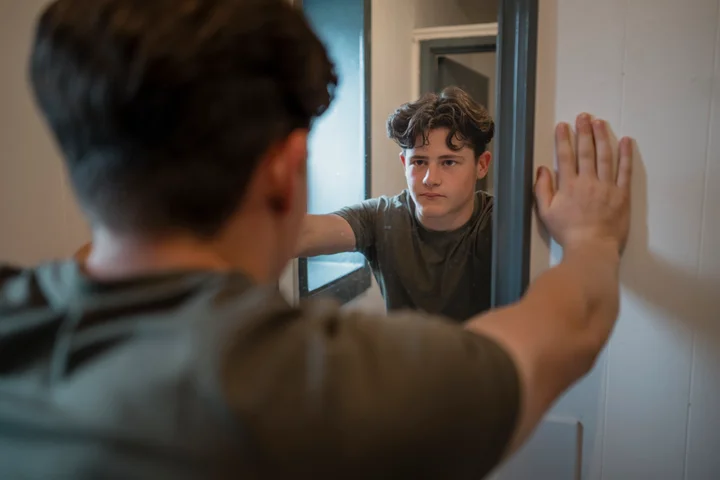
Parents today are generally aware of mental health conditions that relate to body image, including common disorders like anorexia. But experts warn a lesser-known issue is on the rise, particularly among boys: muscle dysmorphia, aka “bigorexia.”

“Bigorexia is a psychological condition and type of body dysmorphic disorder which involves a distorted self-image that focuses specifically on muscle size and physical appearance,” Kara Becker, a certified eating disorder therapist and national director of eating disorder programs at Newport Healthcare, told HuffPost.

With bigorexia, the afflicted person is obsessed with becoming more muscular and preoccupied with the idea that their body isn’t brawny enough ― even if they actually have the physique of a bodybuilder.

“Individuals may have an inaccurate view of their bodies, often believing they are smaller or less muscular,” said Amy Gooding, a clinical psychologist at Eating Recovery Center, Baltimore. “This belief and subsequent preoccupation can lead to unhealthy behaviors, including obsessive exercise, and may lead to changing one’s eating to be as lean as possible.”

Although muscle dysmorphia can affect anyone, it’s more common in males, and research suggests the disorder is on the rise. A 2019 study indicated that 22% of adolescent boys engaged in “muscularity-oriented disordered eating behaviors” in an attempt to bulk up or gain weight and found that supplements, dietary changes and even steroid use were common among young adult males.

“Eating disorders in boys are often under-recognized and under-diagnosed, said Jason Nagata, a pediatrician specializing in eating disorders in boys and men, who co-authored the study.

He noted that a recent Canadian study found that hospitalizations for eating disorders in male patients had risen dramatically since 2002.

“While there’s more awareness around eating disorders, muscle dysmorphia can be overlooked for several reasons ― one reason being that it can lead to behaviors often encouraged in the weight room,” Gooding said. “Lack of awareness of the disorder may lead to the disorder being missed in someone who is struggling, as this is one of the less well-known disorders. Those who struggle may hesitate to reach out for help due to shame, secrecy or the normalization of the behaviors in the community.”

.

https://img.huffingtonpost.com/asset/679d39031600002500636a0d.jpeg?cache=2TDITYOiii&ops=scalefit_720_noupscale&format=webp

SolStock via Getty Images Social media has become a dangerous influence on young people’s body image and self-esteem.

.

.

Click the link below for the complete article:

https://www.huffpost.com/entry/bigorexia-parents-boys_l_6786dc1ee4b0a673540f92d2?utm_source=pocket_discover_parenting

.

__________________________________________

Tuberculosis Outbreak, Highly Pathogenic Bird Flu Strain and Polar Bear Hair

Leave a comment

Click the link below the picture

.

Rachel Feltman: Happy Monday, listeners! For Scientific American’s Science Quickly, I’m Rachel Feltman. Hope your February is off to a great start. Let’s kick off the week by catching up on all the science news you might have missed.

First, a quick note on some presidential moves that might impact health and science. Robert F. Kennedy Jr. faced at least some bipartisan pushback during confirmation hearings for his nomination for secretary of the U.S. Department of Health and Human Services. On Thursday the chair of the Senate Committee on Health, Education, Labor and Pensions, Republican Bill Cassidy, pressed Kennedy to take a definitive pro-vaccine stance. Cassidy, who practiced medicine for decades, claims he has constituents who credit Kennedy—at least in part—for their decision not to vaccinate.

After a lot of back and forth, Cassidy asked Kennedy to agree that if he were to be confirmed, the U.S. Food and Drug Administration would not “deprioritize or delay review and/or approval of new vaccines and that vaccine review standards will not change from historical norms.” Kennedy replied in the affirmative—but it’s important to note that the nominee has a long history of promoting vaccine misinformation.

You can read more about RFK Jr.’s health care track record at ScientificAmerican.com, and we’ll keep you updated on the confirmation hearings as they proceed.

Last week was also pretty chaotic in terms of executive orders, a federal funding freeze, and more. As of last Friday afternoon, there were reports of webpages disappearing from government health agency sites. Stat News reported that data from the Youth Risk Behavior Surveillance System, a large national survey on youth behavioral habits that includes information on gender and sexual identities, had disappeared and was no longer accessible to researchers. The CDC’s Social Vulnerability Index, which highlights groups particularly vulnerable to disasters because of factors like poverty, also appeared to be down on Friday, as did some resources about HIV. That’s not an exhaustive list by any means, and this story was very much still developing as of the time of this recording on the afternoon of January 31. We’re working on a deeper dive on these changes and their implications for this week’s Friday episode, so let us know if you have any specific questions. You can send those over to us at sciencequickly@sciam.com.

Feltman: Now let’s get into some public health news. You may have seen some headlines last week about a record-breaking outbreak of tuberculosis in Kansas. Initial reports dubbing it the nation’s largest TB outbreak since the CDC started keeping track of cases seem to have stemmed from an incorrect statement from the state health department. After the CDC refuted that, a state health official offered clarification, claiming this outbreak has seen the country’s highest case numbers over a one-year period.

The discrepancy has led to some confusion about the nature of this—very real and serious—outbreak. The health department says that as of January 31, more than 60 people in Wyandotte and Johnson counties have been diagnosed with active TB associated with the outbreak, though some have completed treatment since their diagnoses; “active” refers to a type of tuberculosis, not whether someone currently has the illness—more on that shortly. According to a state official, two people have died in the outbreak. Here to unpack the situation for us is Bek Shackelford-Nwanganga, a health equity reporter for the Kansas News Service and KCUR.

Bek Shackelford-Nwanganga: The first cases related to this specific outbreak were, we’ve been told, recorded in January of 2024. There was a pretty large spike over the summer, which is actually when the state came in and started assisting, and that’s when the CDC also came in and started assisting.

Shackelford-Nwanganga: They’re pretty confident that they’ve got the situation under control. They do expect to find more cases. They have to do a lot of contact tracing and a lot of investigations to try and figure out who is in touch with who. But for the most part, they are happy with how numbers are trending downward, and they are monitoring it pretty closely.

Tuberculosis is a bacterial infection. It can settle in other places in your body, but typically it settles in a person’s lungs. You know, when that person coughs or is singing, things like that, it can spread that way. Tuberculosis requires a lot of extended, close contact with a person to catch it.

And then there are two types of tuberculosis. There’s one that’s known as active tuberculosis. This is when a person is displaying symptoms—you know, persistent cough, coughing up blood, pain in the lungs, and then things like night sweats and fevers and weight loss. That means they have an active infection and they can spread it to others. For the other version of tuberculosis, latent tuberculosis—people sometimes call it sleeping tuberculosis—this means that someone has the bacteria in their body, but it’s not causing an active infection. It has to become active for it to spread to others. And if you have a latent case, you won’t be experiencing symptoms.

.

https://static.scientificamerican.com/dam/m/450fc996fe659a91/original/SQ-Monday-EP-Art.png?m=1717792183.71&w=1000Anaissa Ruiz Tejada/Scientific American

.

.

Click the link below for the complete article:

https://www.scientificamerican.com/podcast/episode/h5n9-in-poultry-tuberculosis-outbreak-in-kansas-and-rfk-jr-s-confirmation/

.

__________________________________________

Can a child legally take puberty blockers? What if their parents disagree?

Leave a comment

Click the link below the picture

.

Young people’s access to gender-affirming medical care has been making headlines this week.

Today, federal Health Minister Mark Butler announced a review into health care for trans and gender-diverse children and adolescents. The National Health and Medical Research Council will conduct the review.

Yesterday, The Australian published an open letter to Prime Minister Anthony Albanese calling for a federal inquiry, and a nationwide pause on puberty blockers and hormone therapy for minors.

This followed Queensland Health Minister Tim Nicholls earlier this week announcing an immediate pause on access to puberty blockers and hormone therapies for new patients under 18 in the state’s public health system, pending a review.

In the United States, President Donald Trump signed an executive order this week directing federal agencies to restrict access to gender-affirming care for anyone under 19.

This recent wave of political attention might imply gender-affirming care for young people is risky, controversial, perhaps even new.

But Australian courts have already extensively tested questions about its legitimacy, the conditions under which it can be provided, and the scope and limits of parental powers to authorise it.

What are puberty blockers?

Puberty blockers suppress the release of oestrogen and testosterone, which are primarily responsible for the physical changes associated with puberty. They are generally safe and used in paediatric medicine for various conditions, including precocious (early) puberty, hormone disorders and some hormone-sensitive cancers.

International and domestic standards of care state that puberty blockers are reversible, non-harmful, and can prevent young people from experiencing the distress of undergoing a puberty that does not align with their gender identity. They also give young people time to develop the maturity needed to make informed decisions about more permanent medical interventions further down the line.

Puberty blockers are one type of gender-affirming care. This care includes medical, psychological and social interventions to support transgender, gender-diverse and, in some cases, intersex people.

Young people in Australia need a medical diagnosis of gender dysphoria to receive this care. Gender dysphoria is defined as the psychological distress that can arise when a person’s gender identity does not align with their sex assigned at birth. This diagnosis is only granted after an exhaustive and often onerous medical assessment.

After a diagnosis, treatment may involve hormones such as oestrogen or testosterone and/or puberty-blocking medications.

Hormone therapies involving oestrogen and testosterone are only prescribed in Australia once a young person has been deemed capable of giving informed consent, usually around the age of 16. For puberty blockers, parents can consent at a younger age.

In the United States, President Donald Trump signed an executive order this week directing federal agencies to restrict access to gender-affirming care for anyone under 19.

This recent wave of political attention might imply gender-affirming care for young people is risky, controversial, perhaps even new.

But Australian courts have already extensively tested questions about its legitimacy, the conditions under which it can be provided, and the scope and limits of parental powers to authorise it.

What are puberty blockers?

Puberty blockers suppress the release of oestrogen and testosterone, which are primarily responsible for the physical changes associated with puberty. They are generally safe and used in paediatric medicine for various conditions, including precocious (early) puberty, hormone disorders and some hormone-sensitive cancers.

International and domestic standards of care state that puberty blockers are reversible, non-harmful, and can prevent young people from experiencing the distress of undergoing a puberty that does not align with their gender identity. They also give young people time to develop the maturity needed to make informed decisions about more permanent medical interventions further down the line.

Puberty blockers are one type of gender-affirming care. This care includes medical, psychological and social interventions to support transgender, gender-diverse and, in some cases, intersex people.

Young people in Australia need a medical diagnosis of gender dysphoria to receive this care. Gender dysphoria is defined as the psychological distress that can arise when a person’s gender identity does not align with their sex assigned at birth. This diagnosis is only granted after an exhaustive and often onerous medical assessment.

After a diagnosis, treatment may involve hormones such as oestrogen or testosterone and/or puberty-blocking medications.

Hormone therapies involving oestrogen and testosterone are only prescribed in Australia once a young person has been deemed capable of giving informed consent, usually around the age of 16. For puberty blockers, parents can consent at a younger age.

Can a child legally access puberty blockers?

Gender-affirming care has been the subject of extensive debate in the Family Court of Australia (now the Federal Circuit and Family Court).

Between 2004 and 2017, every minor who wanted to access gender-affirming care had to apply for a judge to approve it. However, medical professionals, human rights organisations and some judges condemned this process.

In research for my forthcoming book, I found the Family Court has heard at least 99 cases about a young person’s gender-affirming care since 2004. Across these cases, the court examined the potential risks of gender-affirming treatment and considered whether parents should have the authority to consent on their child’s behalf.

When determining whether parents can consent to a particular medical procedure for their child, the court must consider whether the treatment is “therapeutic” and whether there is a significant risk of a wrong decision being made.

.

https://images.theconversation.com/files/645943/original/file-20250130-15-og5rwc.jpg?ixlib=rb-4.1.0&rect=1%2C68%2C997%2C498&q=45&auto=format&w=1356&h=668&fit=cropMirasWonderland/Shutterstock

.

.

Click the link below for the complete article:

https://theconversation.com/can-a-child-legally-take-puberty-blockers-what-if-their-parents-disagree-248651?utm_source=pocket_discover_parenting

.

__________________________________________

Older Entries Newer Entries

Amor Entre Estrellas

¡Bienvenido de vuelta viajero!

Heart of Loia `'.,°~

so looking to the sky ¡ will sing and from my heart to YOU ¡ bring...

Michael Ciullo

CEO and Founder of Nsight Health

Nelson MCBS

Catholic News, Prayers, HD Images, Rosary, Music, Videos, Holy Mass, Homily, Saints, Lyrics, Novenas, Retreats, Talks, Devotionals and Many More

Global geopolitics

Decoding Power. Defying Narratives.

Talk Photo

A creative collaboration introducing the art of nature and nature's art.

Movie Burner Entertainment

The Home Of Entertainment News, Reviews and Reactions

Le Notti di Agarthi

Hollow Earth Society

C r i s t i a n a' s Fine Arts ⛄️

•Whenever you are confronted with an opponent, conquer him with love.(Gandhi)

TradingClubsMan

Algotrader at TRADING-CLUBS.COM

Comedy FESTIVAL

Film and Writing Festival for Comedy. Showcasing best of comedy short films at the FEEDBACK Film Festival. Plus, showcasing best of comedy novels, short stories, poems, screenplays (TV, short, feature) at the festival performed by professional actors.

Bonnywood Manor

Peace. Tranquility. Insanity.

Warum ich Rad fahre

Take a ride on the wild side

Madame-Radio

Découvre des musiques prometteuses (principalement) dans la sphère musicale française.

Ir de Compras Online

No tiene que Ser una Pesadilla.

Kana's Chronicles

Life in Kana-text (er... CONtext)

Cross-Border Currents

Tracking money, power, and meaning across borders.

Jam Writes

Where feelings meet metaphors and make questionable choices.

emotionalpeace

Finding hope and peace through writing, art, photography, and faith in Jesus.

WearingTwoGowns.COM

The Community for Wounded Healers: Former Medical Students, Disabled Nurses, and Faith-Fueled Pivots

...

love each other like you're the lyric to their music

Luca nel laboratorio di Dexter

Comprendere il mondo per cambiarlo.

Tales from a Mid-Lifer

Mid-Life Ponderings

Creative

Travel,Tourism, Life style "Now in hundreds of languages for you."

freedomdailywriting

I speak the honest truth. I share my honest opinions. I share my thoughts. A platform to grow and get surprised.

The Green Stars Project

User-generated ratings for ethical consumerism

Cherryl's Blog

Travel and Lifestyle Blog

Sogni e poesie di una donna qualunque

Questo è un piccolo angolo di poesie, canzoni, immagini, video che raccontano le nostre emozioni

My Awesome Blog

“Log your journey to success.” “Where goals turn into progress.”

pierobarbato.com

scrivo per dare forma ai silenzi e anima alle storie che il mondo dimentica.

Thinkbigwithbukonla

“Dream deeper. Believe bolder. Live transformed.”

Vichar Darshanam

Vichar, Motivation, Kadwi Baat ( विचार दर्शनम्)

Komfort bad heizung

Traum zur Realität

Chic Bites and Flights

Savor. Style. See the world.

ومضات في تطوير الذات

معا نحو النجاح

Broker True Ratings

Best Forex Broker Ratings & Reviews

Blog by ThE NoThInG DrOnEs

art, writing and music by James McFarlane and other musicians

fauxcroft

living life in conscious reality

Srikanth’s poetry

Freelance poetry writing

JupiterPlanet

Peace 🕊️ | Spiritual 🌠 | 📚 Non-fiction | Motivation🔥 | Self-Love💕

Sehnsuchtsbummler

Reiseberichte & Naturfotografie