February 19, 2025
Mohenjo
Business, Food For Thought, Human Interest, Political, Science, Technical
amazon, business, Business News, current-events, Future, Hotels, human-rights, medicine, mental-health, research, Science, Science News, technology, Technology News, travel, vacation

Click the link below the picture
.
Inside a laboratory nestled in the foothills of the Rocky Mountains, amid a labyrinth of lenses, mirrors, and other optical machinery bolted to a vibration-resistant table, an apparatus resembling a chimney pipe rises toward the ceiling. On a recent visit, the silvery pipe held a cloud of thousands of supercooled cesium atoms launched upward by lasers and then left to float back down. With each cycle, a maser—like a laser that produces microwaves—hit the atoms to send their outer electrons jumping to a different energy state.
The machine, called a cesium fountain clock, was in the middle of a two-week measurement run at a National Institute of Standards and Technology (NIST) research facility in Boulder, Colo., repeatedly fountaining atoms. Detectors inside measured photons released by the atoms as they settled back down to their original states. Atoms make such transitions by absorbing a specific amount of energy and then emitting it in the form of a specific frequency of light, meaning the light’s waves always reach their peak amplitude at a regular, dependable cadence. This cadence provides a natural temporal reference that scientists can pinpoint with extraordinary precision.
By repeating the fountain process hundreds of thousands of times, the instrument narrows in on the exact transition frequency of the cesium atoms. Although it’s technically a clock, the cesium fountain could not tell you the hour. “This instrument does not keep track of time,” says Vladislav Gerginov, a senior research associate at NIST and the keeper of this clock. “It’s a frequency reference—a tuning fork.” By tuning a beam of light to match this resonance frequency, metrologists can “realize time,” as they phrase it, counting the oscillations of the light wave.
The signal from this tuning fork—about nine gigahertz—is used to calibrate about 18 smaller atomic clocks at NIST that run 24 hours a day. Housed in egg incubators to control the temperature and humidity, these clocks maintain the official time for the U.S., which is compared with similar measurements in other countries to set Coordinated Universal Time, or UTC.Gerginov, dressed casually in a short-sleeve plaid shirt and sneakers, spoke of the instrument with an air of pride. He had recently replaced the clock’s microwave cavity, a copper passageway in the middle of the pipe where the atoms interact with the maser. The instrument would soon be christened NIST-F4, the new principal reference clock for the U.S. “It’s going to be the primary standard of frequency,” Gerginov says, looking up at the metallic fountain, a three-foot-tall vacuum chamber with four layers of nickel-iron-alloy magnetic shielding. “Until the definition of the second changes.”
Since 1967 the second has been defined as the duration of 9,192,631,770 cycles of cesium’s resonance frequency. In other words, when the outer electron of a cesium atom falls to the lower state and releases light, the amount of time it takes to emit 9,192,631,770 cycles of the light wave defines one second. “You can think of an atom as a pendulum,” says NIST research fellow John Kitching. “We cause the atoms to oscillate at their natural resonance frequency. Every atom of cesium is the same, and the frequencies don’t change. They’re determined by fundamental constants. And that’s why atomic clocks are the best way of keeping time right now.”
But cesium clocks are no longer the most accurate clocks available. In the past five years, the world’s most advanced atomic clocks have reached a critical milestone by taking measurements that are more than two orders of magnitude more accurate than those of the best cesium clocks. These newer instruments, called optical clocks, use different atoms, such as strontium or ytterbium, that transition at much higher frequencies. They release optical light, as opposed to the microwave light given out by cesium, effectively dividing the second into about 50,000 times as many “ticks” as a cesium clock can measure.
.

A strontium optical clock produces about 50,000 times more oscillations per second than a cesium clock, the basis for the current definition of a second. Andrew Brookes/National Physical Laboratory/Science Source
.
.
Click the link below for the complete article:
.
__________________________________________
February 19, 2025
Mohenjo
Business, Food For Thought, Human Interest, Political, Science, Technical
amazon, business, Business News, current-events, Future, Hotels, human-rights, medicine, mental-health, research, Science, Science News, technology, Technology News, travel, vacation

Click the link below the picture
.
It’s only natural to want the best for your kid, but sometimes high expectations can lead parents to overcorrect their child’s behaviors. Some parents can strike a balance, but for others, it’s more challenging to notice that their parenting style may be more authoritarian and strict than necessary.
To gain a better understanding of what strict parenting looks like, the psychological impacts it can have, and how to employ strategies for balanced parenting, we spoke with two psychologists.
Common Misconceptions About Strict Parenting
It’s a common belief among parents that being strict or authoritarian with your child is the most effective way to change their behavior. A 2022 poll found that around 36% of parents find their parenting style stricter than most.1
“To be fair, it can be very effective, in the short term,” says Dylan Ochal, MD, FAAP, pediatrician at Ocean Pediatrics, Orange County, California. Often, parents that tend to use more authoritarian strategies gain control in the short term, while sacrificing emotional connection in long run.
It’s common for children to quickly adjust their behavior when they’re scared or worried about consequences, which can lead parents to believe that employing a strict stance with rigid consequences is an effective way to modify a child’s behavior.
Some parents are motivated to employ stricter parenting methods due to parental shaming, a form of criticism that over 61% of mothers report experiencing.2 “You might have heard things like: ‘Are you really going to let him get away with throwing his food?’ or ‘Can you believe she’s letting her son scream like that in the grocery store? He’s out of control!’ That pressure can be overwhelming, but parenting based on external judgement won’t help you or your child,” says Dr. Ochal.
9 Signs You’re Being Too Hard On Your Kid
-
Your tone is consistently harsh.
-
You find yourself yelling regularly or resorting to threats when your child misbehaves.
-
Your child is withdrawing from activities they once enjoyed.
-
You are concerned that without having certain rules in place your child would have an emotional outburst or not respect your authority.
-
You don’t consider your child’s perspective.
-
You have an excessive amount of rules, including rules for virtually everything in your home from meal time to bath time.
-
You consistently point out your child’s mistakes.
-
You only show love or positivity when your child is exhibiting good behavior.
-
Your child shows physical signs of stress like frequent headaches, stomachaches, or changes in appetite.
.
:max_bytes(150000):strip_icc()/Parents-SignsYoureBeingTooHardOnYourKid-7f9ea63f68fc4f96b43937cb23aa62ac.jpg) PARENTS/ GETTY IMAGES
PARENTS/ GETTY IMAGES
.
.
Click the link below for the complete article:
.
__________________________________________
February 18, 2025
Mohenjo
Business, Food For Thought, Human Interest, Political, Science, Technical
amazon, business, Business News, current-events, Future, Hotels, human-rights, medicine, mental-health, research, Science, Science News, technology, Technology News, travel, vacation
Click the link below the picture
.
Our brains are full of plastic.
This was the fun news I read earlier this week while picking up dinner take-out, packed in plastic containers, crammed in a plastic bag, and accompanied by Styrofoam cups. Great, I thought, convenience culture is killing us.
But is it? This is the problem with the slew of research finding microscopic shards of plastic in our arteries, kidneys, and livers, the findings that our oceans, food, soil, and air are teeming with tiny bits of Tupperware. Scientists still don’t know what this plastic is doing to us. And because research takes time, while scientists are trying to answer question, we just keep inhaling, eating, and drinking tiny pieces of plastic.
Why? Regulatory action has never really stopped the U.S. plastics industry from cranking out more plastic, even as clean air and water advocates try to fight the industry’s pollution problems in court and locals wage grassroots wars to slow the permitting of more plants that spew all those toxic chemicals. And now, back in office, is a president beholden to fossil fuel interests (where petroleum and natural gas are plastics precursors), a leader who uses his new powers to demand the use of plastic straws, and an administration that is hell-bent on crippling EPA’s mission to keep us safe rather than empowering it.
Meanwhile, we do not know what all this plastic is doing to us. And no one currently in charge seems to care.
Everything that goes into our bodies gets filtered through our livers and kidneys, so maybe it’s not a big surprise that bits of plastic find their way into those organs. Same with our hearts; microplastics end up in our blood and can get stuck in our clogged arteries. But our brains are designed to keep things out, through something called the blood-brain barrier. The researchers behind the brain plastics study think the tiny shards of plastic hitch a ride on fat molecules to get inside brain cells. And what’s worse is how much microplastics the researchers think might be in a whole human brain: 10 grams. Imagine 2.5 teaspoons of sugar. Now sub in plastic. Gross.
They looked at preserved brains from about a decade ago and compared them to brains from last year. The fresher brains had more plastic in them than the older brains. And yes, they accounted for all the plastic needed to hold and manipulate the brains in their study, just in case those tubes and such were leaching plastic. So, year after year, surrounded by more and more plastic, our bodies are at minimum, storage tanks, and at worst, under an unrelenting attack.
How is this even happening? Chemistry. Capitalism. Convenience culture. To make plastic, petroleum refineries isolate hydrocarbons and then crack those hydrocarbons into even smaller compounds like ethylene or propylene. They then do a little chemistry to stick those smaller compounds into repeating structures called polymers. These polymers then juiced with other chemicals that give them different properties, to mold them into plastics that are bendy, plastics that are hard, plastics that are resistant to heat and other things.
.
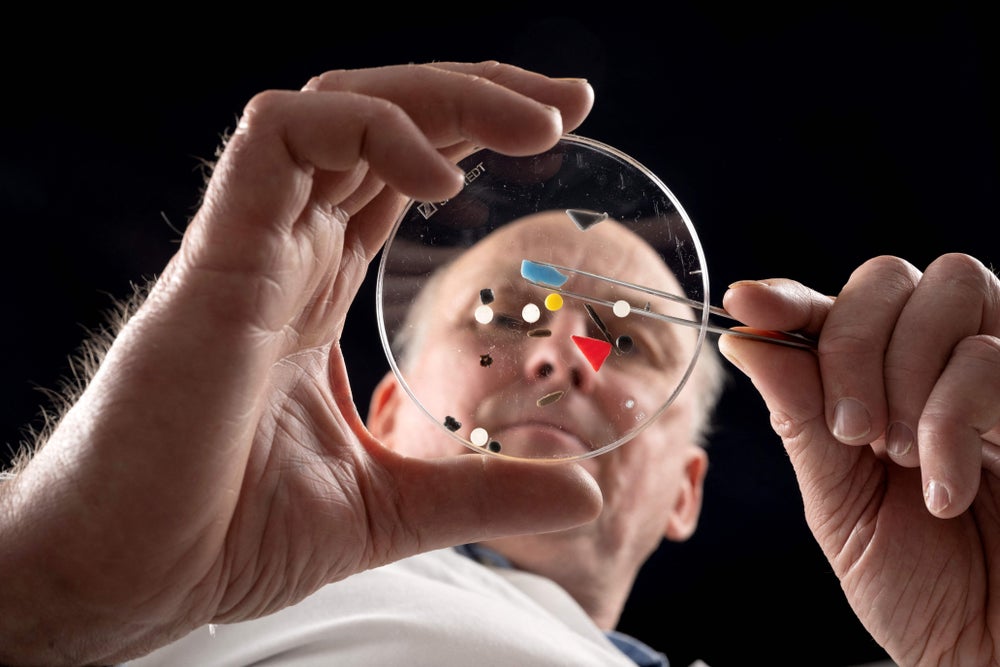
Richard Thompson, director of the Marine Institute of Plymouth analyzes nurdles and other micro-plastics in a laboratory on February 27, 2023. Ben Stansall/AFP via Getty Images
.
.
Click the link below for the complete article:
.
__________________________________________
February 18, 2025
Mohenjo
Business, Food For Thought, Human Interest, Political, Science, Technical
amazon, business, Business News, current-events, Future, Hotels, human-rights, medicine, mental-health, research, Science, Science News, technology, Technology News, travel, vacation

Click the link below the picture
.
No parent wants to see their child become bored and uninterested at school. Most don’t even realize when their kids are losing interest in learning, says author and parenting researcher Jenny Anderson.
Fortunately, parents can actively encourage their kids to be more curious and seek out opportunities to learn — and they can do it without resorting to nagging, according to Anderson, who co-wrote a book with education expert Rebecca Winthrop called “The Disengaged Teen” that published earlier this month.
In a survey of 65,000 third through 12th grade students that Winthrop conducted with the Brookings Institution, 75% of 3rd graders said they “love” school, but only 25% of 10th graders said the same, according to the survey. Meanwhile, 65% of parents of 10th graders said they believed their kids loved school.
“There’s a real mismatch,” Anderson said on an episode of the “Raising Good Humans” podcast earlier this month.
Kids who are engaged at school — meaning they’re curious and self-motivated to learn — perform better academically, and develop skills and traits that’ll help them in the long run. Children who are curious and intrinsically motivated are more likely to grow up to be happy and successful adults, research shows.
But student engagement has declined in the U.S. in recent years. Pandemic disruptions had negative effects on students around the world, and nearly half of U.S. teachers believe their students are less engaged at school now than in 2019, according to a 2024 survey by The Harris Poll for Discovery Education.
No matter how old your children are, you can encourage their curiosity and help them develop a lifelong love of learning, Anderson said. Here are her six recommendations:
Let them make decisions and experience consequences
Sometimes, you need to allow kids to make their own decisions — even if that means they face consequences from their actions, Anderson said. Instead of dictating a strict schedule for how and when they do their homework, for instance, parents could try giving kids the freedom to decide their own schedule.
You should still set firm boundaries — the expectation should always be that kids’ homework will get done — but giving children autonomy within those boundaries can help them develop confidence and motivation to make good decisions on their own, bestselling author and parenting expert Esther Wojcicki wrote for CNBC Make It in 2022.
″[We’re] there to support them as they make a bunch of extremely bad decisions [to learn] to make better ones,” Anderson said. “So hopefully, when they leave [home], they’re capable of making these decisions better.”
Avoid comments like ‘I’m not a math person’
Teach your kids to adopt a “growth mindset,” which involves thinking of your knowledge and abilities as skills you can develop over time, Anderson said.
People who take the opposite approach, a “fixed mindset,” tend to be less motivated to take on new challenges, so you should avoid making comments like, ”‘I’m not a math person. I’m not a science person,’” said Anderson.
.
 Skynesher | E+ | Getty Images
.
.
Click the link below for the complete article:
.
__________________________________________
February 17, 2025
Mohenjo
Business, Food For Thought, Human Interest, Political, Science, Technical
amazon, business, Business News, current-events, Future, Hotels, human-rights, medicine, mental-health, research, Science, Science News, technology, Technology News, travel, vacation
Click the link below the picture
.
When Philip Sontag first visited Antarctica as a Ph.D. student, he brought back an unusual souvenir: a huge bag of penguin feathers. And now, after a decade-long analysis, Sontag and his colleagues have figured out how to use such feathers to create a living map of the mercury contamination that increasingly threatens Southern Hemisphere wildlife.
Mercury is a common by-product of gold mining, a growing industry in several southern countries. The toxic metal accumulates as it moves up the food chain by binding with amino acids in animals and then infiltrating their central nervous systems, where it can inhibit neural growth. Tracking mercury exposure is crucial for monitoring an ecosystem—but merely sampling rocks, ice or soil for its presence tells little about how much is actually entering the food web.
Many predators, including penguins, have evolved ways to dispose of mercury. The chemical builds up in feathers that the birds regularly molt in large quantities. Sontag, now a polar researcher based at Rutgers University, and his colleagues hoped to use molted feathers to determine where penguins picked up the toxic substance. The scientists were surprised to find a very clear correlation between the feathers’ levels of mercury and of a carbon isotope called carbon-13; the latter varies based on geographic location and thus acts as an indicator of “where the penguins are feeding or where their breeding grounds are,” Sontag says. These findings, published in Science of the Total Environment, confirmed this connection in seven penguin species scattered across the Southern Ocean—a pattern suggesting they’re exposed to more mercury farther north, where the comparatively warmer environment leads to higher carbon-13 levels.
These findings suggest that penguins could function as mercury bioindicators: living trackers of environmental pollutants, says the study’s senior author John Reinfelder, a marine biologist at Rutgers. Rather than measuring the chemical itself in a snapshot of time and place, he says, measuring penguin feathers’ mercury levels tracks the substance’s movement through the oceanic food web. For instance, penguin species known to reside near one another had varying
mercury and carbon-13 levels because of their different migration and feeding patterns. These data could be modeled into a maplike database to help guide future projects on conservation and polar science research.
Scientists consider penguins promising candidates for such bioindicators, says marine scientist Míriam Gimeno Castells, a Ph.D. student at the Institute of Marine Science from the Spanish National Research Council, who was not involved in the study. The animals are midway through the food chain. They breed in colonies, so researchers can easily scoop up feathers from many different individuals. Additionally, every breeding season they undergo dramatic molts; the feathers they lose “will contain the mercury that has accumulated during the nonbreeding season,” Gimeno Castells says.
Sontag’s next steps are to collect newer feathers to experiment with, across different species, and to measure mercury in penguins’ blood and prey to compare with levels of the substance in their feathers.
And how are the penguins themselves doing with their current mercury levels? “We don’t believe penguins have been exposed to toxic levels as of yet,” Reinfelder says. “Yes, the penguins will be okay.”
.

Gentoo penguins have a wide geographic range, making them good targets for follow-up research. David Merron Photography/Getty Images
.
.
Click the link below for the complete article:
.
__________________________________________
February 17, 2025
Mohenjo
Business, Food For Thought, Human Interest, Political, Science, Technical
amazon, business, Business News, current-events, Future, Hotels, human-rights, medicine, mental-health, research, Science, Science News, technology, Technology News, travel, vacation

Click the link below the picture
.
Marie and her husband started seeing a couples therapist when the early years of parenthood put a strain on their marriage. Their two kids were 3 years and 4 months old, respectively, when COVID lockdowns began, and the couple were both stressed out and overwhelmed. (Marie—not her real name—said she was the one doing the lion’s share of the child care while her husband worked from home.)
In therapy, when she’d bring up a challenge with her husband or her kids, the therapist frequently brought the conversation back to a topic that surprised Marie: her relationship with her parents. The therapist had determined that because that early relationship was marked by “insecure attachment,” Marie was struggling to form a secure attachment with her husband. “I have issues with my parents,” Marie admitted, but she didn’t see why the therapist was so fixated on her childhood. The therapist assigned Marie and her husband a book on attachment to read together, and Marie started, at the therapist’s encouragement, attending solo sessions with an individual therapist to work through her childhood issues. Marie described that period as “really going down a wormhole.” She was doing her best to “heal her attachment style,” as her therapist insisted, but none of that work seemed to help things at home.
Whether you’re hearing it from a therapist, as Marie did, or picking it up on one of the countless attachment-focused accounts on Instagram and TikTok, chances are if you’re a new parent, you’ve taken in messaging around the need to give your child a “secure attachment,” or the urgency of fixing your own attachment issues lest you pass them on to your kid. “Securely attached” kids, the theory goes, will be socially confident and have a strong sense of self. As adults, they’ll make friends easily and have healthy romantic relationships. In contrast, “anxiously attached” adults are driven by fear of rejection and abandonment and have tendencies toward codependency, while the “avoidantly attached” among us have difficulty sharing feelings and trusting others. Your co-worker who’s clingy at happy hour? Probably anxiously attached. The boyfriend who takes forever to return your texts? Classic avoidant, or so pop psychology would have it. There’s a powerful lure in the idea that it might be possible to parent your kid so effectively that you’ll encase them in psychological Bubble Wrap and safeguard them against whatever relationship challenges have plagued you.
But there’s a flip side to all this: the sense that if our own pasts are a liability, any wrong move might damage our kids for life. Nicole McNelis, a therapist who frequently works with new moms, told me that many of her clients bring these messages from social media into sessions, worrying, for example, that because they bottle-fed their baby, he’ll be insecurely attached. McNelis followed up on this example by clarifying that that’s not how parenting works; there’s no single practice that will determine the quality of your relationship with your kid.
If reading about attachment has helped you feel as if you better understand yourself or your partner, or if it’s guided you toward approaching your parenting or your friendships in a more thoughtful way, I’m so happy for you. But if the idea of attempting to “heal” your insecure attachment before finding true love fills you with despair, or if you’re frantically trying to give your own child the “right” attachment style, I’ve got good news for you: “Attachment styles” have the sheen of science, but underneath, it’s basically all vibes.
Attachment styles were first defined by Mary Ainsworth, a Canadian-American psychologist who developed the Strange Situation, a procedure she used in experiments carried out in Baltimore in the 1970s. In the Strange Situation, a child between 9 months and 3 years comes to the lab with their primary caregiver, and they’re admitted to a room set up as a living room with various toys. After a few moments, a stranger enters, and a few moments after that, the caregiver leaves briefly, then returns. The child’s response to their caregiver’s departure and return, Ainsworth posited, reveals their attachment style. Once a child’s attachment style has been “set,” by about age 3, the theory goes, it’s more or less fixed. The message to moms is clear: If you mess up your kids early, you’ve doomed them for life.
.
 nicoletaionescu/iStock/Getty Images Plus
.
.
Click the link below for the complete article:
.
__________________________________________
February 16, 2025
Mohenjo
Business, Food For Thought, Human Interest, Political, Science, Technical
amazon, business, Business News, current-events, Future, Hotels, human-rights, medicine, mental-health, research, Science, Science News, technology, Technology News, travel, vacation
Click the link below the picture
.
For all the world’s linguistic diversity, human languages still obey some universal patterns. These run even deeper than grammar and syntax; they’re rooted in statistical laws that predict how frequently we use certain words and how long those words tend to be. Think of them as built-in guardrails to keep language easy to learn and use.
And now scientists have found some of the same patterns in whale vocalizations. Two new studies published this week show that, despite the vast evolutionary distance between us, humans and whales have converged on similar solutions to the problem of communicating through sound. “It strengthens the view that we should be thinking about human language not as a completely different phenomenon from other communication systems but instead think about what it shares with them,” says Inbal Arnon, a professor of psychology at the Hebrew University of Jerusalem and a co-author of one of the studies.
Arnon and her colleagues, whose paper was published on Thursday in Science, analyzed eight years of humpback whale song recordings from New Caledonia in the South Pacific—and found that they closely adhered to a principle called Zipf’s law of frequency. This mathematical-power law, a hallmark of human language, is observed in word-use frequencies: the most common word in any language shows up twice as often as the second most common, three times as often as the third most common, and so on.
Listen to the humpback whale songs:

But before they could analyze the recordings, the researchers had to identify the segments that were analogous to words (though, importantly, without semantic meaning) in a stream of otherworldly grunts, shrieks, and moans. They found themselves in the same predicament as a newborn baby—so naturally, that’s where they turned for guidance. Human infants “get this continuous acoustic signal,” Arnon says, “and they have to figure out where the words are.”
A baby’s strategy is simple: listen for unexpected combinations of sounds in adult speech. Whenever you identify one, you’ve probably located a boundary between words because those uncommon transitions are less likely to occur within words.
Incredibly, humpbacks may be using the same approach. When the researchers segmented whale songs based on these “transitional probabilities”—just as a human infant would—they fit Zipf’s law of frequency like a glove. On the other hand, 1,000 arbitrarily shuffled elements of the data came nowhere near a match, strongly suggesting the transitional probability results weren’t a product of random chance.“We were all dumbfounded,” says co-author Ellen Garland, a whale song expert at the University of St. Andrews in Scotland. “There was the possibility of discovering these same structures. Did we think we would? Hell no.”
.
 John Natoli/Getty Images
.
.
Click the link below for the complete article:
.
__________________________________________
February 16, 2025
Mohenjo
Business, Food For Thought, Human Interest, Political, Science, Technical
amazon, business, Business News, current-events, Future, Hotels, human-rights, medicine, mental-health, research, Science, Science News, technology, Technology News, travel, vacation

Click the link below the picture
.
Bernie is the most courageous and honest politician we have ever had. He is well loved and admired. He speaks relentlessly and powerfully for so many. Thank you, Sir.
When younger generations find inspiration in these words, there may be hope for democracy.
.
 Senator Sanders
.
.
Click the link below for the Video:
.
__________________________________________
February 16, 2025
Mohenjo
Business, Food For Thought, Human Interest, Political, Science, Technical
amazon, business, Business News, current-events, Future, Hotels, human-rights, medicine, mental-health, research, Science, Science News, technology, Technology News, travel, vacation
Click the link below the picture
.
Many new parents struggle to put their child to bed, tackling everything from endless cycles of wake-ups to challenging nap times. Rest assured, these nighttime woes won’t last forever. Parents can begin implementing solutions today that can have a lasting impact, beginning with learning how to approach their child’s sleep differently.
To help you understand how to best tackle your child’s sleep issues and help them get through the night, we spoke to pediatric sleep experts for their fool-proof tips for babies, toddlers, and preschoolers. With just a few adjustments to your routines, your little one may just drift off to dreamland in no time flat.
How You’re Sabotaging Your Newborn’s Sleep
It may be tempting to cuddle your newborn to sleep to avoid hearing them cry at night, but experts recommend to stop this practice by the time they reach 3 months. Parents spend too much time rocking and holding their infant in the beginning of the night, preventing their newborn from learning how to self-soothe and slowing the development of healthy sleep-wake patterns.1
“As a result, a baby learns to fall asleep with this help—and then when [they] wake up during the night [they] can’t get back to sleep alone,” says Judith Owens, MD, director of the Center for Pediatric Sleep Disorders at Boston Children’s Hospital.
During the first several weeks of your baby’s life, nearly anything goes as you attempt to get your baby to sleep however you can. However, by the time they reach 3 months old, experts recommend putting them down in their crib “drowsy but awake.” Although they’ll cry for a while, soon, your baby will learn to drift off without help.
Here are additional ways you may be sabotaging your newborn’s sleep and what to do instead, according to experts.
You nap on-the-go
As much as possible, have your baby nap in their crib. “If [they] often fall asleep in a stroller or a car seat, [they’re] going to associate motion with sleep and have a hard time nodding off without it,” says Jodi Mindell, PhD, associate director of the Sleep Center at The Children’s Hospital of Philadelphia.
Aim for at least half, though ideally more, of your baby’s naps to be in their bassinet or crib.
You feed during bedtime
When her son was a baby, Angela Mattke, MD, a pediatrician at the Mayo Clinic Children’s Center in Rochester, Minnesota, would breastfeed right before putting him down. “Because of this, whenever he’d wake during the night, he wouldn’t fall back asleep until I breastfed him,” she says.
At 8 months, when he was still waking three or four times a night, she decided to switch the routine and start sleep training. After a challenging week in which she gradually allowed her son longer times to calm himself before returning to the room—while not offering additional nursing, Dr. Mattke’s son learned to self-soothe.
You may be able to avoid this problem by finishing your baby’s final feeding before you start the bedtime routine. Also, try to feed your baby in a room they don’t typically sleep in so they don’t associate nursing with bedtime.
.
:max_bytes(150000):strip_icc()/Parents-WaysParentsSabotageSleep-a76a0f8da4624be7bed89f7d8545d207.jpg) PARENTS/ GETTY IMAGES
PARENTS/ GETTY IMAGES
.
.
Click the link below for the complete article:
.
__________________________________________
February 15, 2025
Mohenjo
Business, Food For Thought, Human Interest, Political, Science, Technical
amazon, business, Business News, current-events, Future, Hotels, human-rights, medicine, mental-health, research, Science, Science News, technology, Technology News, travel, vacation
Click the link below the picture
.
On a low hill near the coast of Maine, the fresh petals of double daffodils shake frills of gold and peach in a gusting breeze. It is the middle of May, a clear blue sky overhead, and the lacy burgundy foliage of peonies and new stalks of twiggy curly willow are poking through swaths of black landscape fabric. Against the walls of a greenhouse, seedlings of cosmos and celosia, lisianthus, and snapdragons rise in plastic trays. Mud season is barely over, but the turf is vivid green.
Those fragrant, frilly blooms will make up wedding arches and table settings, and bouquets, the mainstays of the profitable farm and floral studio that farmer Bo Dennis, 35, has built since he bought this parcel several years ago. “When people come to us, we say, this is what we’re good at: local flowers that are sustainably grown,” he says, tucking a curl of light hair back under his beanie with muddy hands. “Sometimes I do get clients that say, ‘We want all hydrangeas and all roses, and we want them in May’”—a date when those popular flowers won’t yet have bloomed in Maine. “I will say, ‘Great! Have a good celebration. I don’t think we’re the vendor for you.’”
What Dennis grows won’t be found among the blooms that cram the entrances of supermarkets, big-box stores, downtown florists—most of the places where people buy flowers in the U.S. The bouquets that fill those spaces overwhelmingly come from equatorial countries, such as Ecuador and Ethiopia, where cheap labor and minimal environmental regulation make growing affordable. Those flowers are part of an enormously successful international market that sells blooms thousands of miles from their fields of origin and earns more than $25 billion every year.
But pesticides and other agrochemicals required to sustain that scale of production can injure workers and their families. One ongoing study of children in Ecuador whose parents work at flower farms has documented deficits in attention and eye-hand coordination, particularly after periods when these chemicals are heavily sprayed. Children born to women who work in floriculture regions have higher-than-normal rates of birth defects, another study found. And the risks extend to people around the world. In Belgium, florists with imported flowers had unhealthy levels of pesticide chemicals on their gloves, levels high enough to burn the skin if it wasn’t protected. And in the Netherlands, prolific use of antifungals on the country’s signature tulips has fostered the emergence of deadly drug-resistant fungi.
The remedy for at least some of these problems is rising in small U.S. operations such as Dennis’s Dandy Ram Farm and others in North Carolina and Utah and throughout the country. Dennis came to floriculture out of a desire for economic self-sufficiency and career-long concern for the environment. He and other growers are building a new, surprisingly lucrative agricultural model—a “slow flower movement,” akin to the Slow Food movement, that offers a cleaner, greener alternative to modern floral production. They aim to protect ecosystems and build new economic pathways while bringing a bit of beauty—ungroomed, imperfect, unpredictable—back into the world.
Flowers are so present in our lives that we almost do not see them: sheathed in paper in every market, plunked in a vase on a table in any cafe. But while they are quotidian, they are also monumental; in many cultures, they memorialize the most important days of our lives, from graduations and promotions to weddings and funerals. They are vital to Catholic rituals, Hindu festivals, Buddhist temple offerings, and Mexico’s Day of the Dead—and also, via chrysanthemums, to the quasi-religion of U.S. college football homecoming games. (Mums are funeral flowers in parts of Europe and Asia, which might be a comfort to the losing team.) We invest them with so much meaning that we demand they always be perfect—although like any crop, they are fungible and fragile, subject to weather, diseases, and decay.
And like any product, they are subject to the lure of cheaper production offshore. The movement of American manufacturing to countries with fewer regulations over land and labor is an old story, reenacted in products from furniture to cars to food. But the relocation of flower growing was not an accident of global economics. It was deliberately fostered by the U.S. government, part of the 20th-century war on drugs.
.

Dahlias bloom at the Maine Flower Collective, a group of local growers. Jesse Burke
.
.
Click the link below for the complete article:
.
__________________________________________
Older Entries
Newer Entries
 James' World 2