February 23, 2025
Mohenjo
Business, Food For Thought, Human Interest, Political, Science, Technical
amazon, business, Business News, current-events, Future, Hotels, human-rights, medicine, mental-health, research, Science, Science News, technology, Technology News, travel, vacation

Click the link below the picture
.
President Donald Trump has long promised to cut excess in the federal government, saving money and dismantling bureaucracy.
Behind many of these moves is a new government group — the Department of Government Efficiency, or DOGE.
This new department was created when Trump renamed the previously existing United States Digital Service, appointing Elon Musk as a senior adviser to the president. Though Musk has often been seen as leading DOGE, new court filings claim he doesn’t work for the group.
This redefining of Musk’s role with Trump came after lawsuits challenging his authority. Several Democratic state attorneys general argue that his enormous power violates the Constitution’s “Appointments Clause,” which requires Congress to approve officers in the executive branch.
Here’s everything to know about DOGE, including where it came from, what it has done, and how its work is being tracked.
What is DOGE? What does DOGE mean in politics?
DOGE, which stands for Department of Government Efficiency, is mainly focused on finding ways to cut spending and regulations. The name refers to a cryptocurrency called dogecoin.
Musk was named the head of the organization by Trump shortly after he won the election. Trump made the department official with an executive action on his first day in office.
Recent court filings have called into question Musk’s role with DOGE, stating that Musk is a “senior advisor to the president” rather than leader of DOGE. The court filings also stated that the department is distinct and separate from the White House.
“In his role as Senior Advisor to the President, Mr. Musk has no greater authority than other senior White House advisors,” Joshua Fisher, director of the White House Office of Administration, wrote. “Like other senior White House advisors, Mr. Musk has no actual or formal authority to make government decisions himself. Mr. Musk can only advise the President and communicate the President’s directives.”
How much money has DOGE saved so far?
The DOGE website (doge.gov/savings) claims to track what it has done and how it has saved money.
As of Feb. 19, the site indicates that it has saved $55 billion through a “combination of fraud detection/deletion, contract/lease cancellations, contract/lease renegotiations, asset sales, grant cancellations, workforce reductions, programmatic changes, and regulatory savings.”
What has DOGE done?
The DOGE website claims to post receipts of its budget-slashing efforts, but most items listed are contracts canceled at various federal departments and agencies.
More than 10,000 federal employees have been fired and more cuts are expected. A recent executive order directs heads of federal departments and agencies to make “large-scale reductions in force.”
In many cases, probationary employees and the government’s newest hires are losing their jobs.
DOGE’s actions have fostered confusion and some false steps. For example, the administration rescinded the firings of hundreds of employees at the National Nuclear Security Administration, which oversees the nation’s arsenal of nuclear weapons. The U.S. Department of Agriculture is scrambling to rehire “several” fired employees who play a key role in the agency’s response to bird flu, an agency spokesperson has acknowledged.
The cuts, which include employees with USAID, the Federal Aviation Administration, Internal Revenue Service, the National Park Service, and Department of Education, have prompted legal challenges and other pushback.
There also has been backlash over what data DOGE can access. Several agencies, including the Department of Education and Treasury Department, have attempted to block DOGE’s access to data due to its sensitive nature.
DOGE is also seeking access to IRS data that includes extensive information about taxpayers and allows IRS employees to research accounts, request returns, enter transactions and collection information, and generate “notices, collection documents, and other outputs,” according to the IRS.
.

President Zelensky says he would step down if Ukraine can join NATO
.
.
Click the link below for the complete article:
.
__________________________________________
February 23, 2025
Mohenjo
Business, Food For Thought, Human Interest, Political, Science, Technical
amazon, business, Business News, current-events, Future, Hotels, human-rights, medicine, mental-health, research, Science, Science News, technology, Technology News, travel, vacation

Click the link below the picture
.
For all the extraordinary upheaval Donald Trump promises for America — mass deportations, mass layoffs of federal employees, the revoking of birthright citizenship — we will start to learn, in the coming months, how effective he’ll really be. Executive orders can be rescinded by later administrations, or get snagged in the courts, as has already happened over the past month. Yes, Trump can inflict tangible pain by himself. But becoming a dictator is easier said than done, even with the DOGE boys sowing chaos at the Treasury and IRS.
In Congress, Trump will have his chance to go much bigger. It’s there where his greatest ambitions, if he rounds up the votes, can become laws — which, unlike executive actions, are very difficult to undo. Joe Biden did not unravel Trump’s corporate tax cuts or save affluent households in the Northeast from the tighter SALT (state and local taxes) cap. Trump, in turn, will strain to do significant damage to the industrial policy Biden set into motion under the Inflation Reduction Act. If social conservatives ever felt they wanted to try to outlaw same-sex marriage again, they’d need to jam new legislation through Congress. Other than stacking the courts, leaving a policy legacy at the federal level means passing enormous omnibus legislation when your party is in power and daring rival successors to reverse it all.
When Trump turns his attention to legislation, what comes out of his administration might be, by modern Republican standards, rather conventional. On the agenda will be vicious attacks on the social safety net, the likes of which were waged, with limited success, in Trump’s first term. This is Trump’s version of populism; while he does not, like past Republican standard-bearers, want to privatize Social Security or gut Medicare, he is happy to aim at slashing other programs that the working class and poor rely upon.
It’s the House that will decide the fate of Trump’s legislative ambitions. Republicans have their smallest majority there since 1931, and Speaker Mike Johnson may only be able to spare a single vote. The majority itself is fractious, a mix of hard-right fiscal conservatives who’ve sought to topple Johnson and a small but influential number of moderates who carried swing districts. For many Republicans, aggressively reducing spending is the watchword, and that will carry with it especially destructive goals: bleeding out Medicaid with up to $2 trillion in reductions; slashing student-loan aid; cutting $250 billion from food stamps. The idea, in essence, is to balance out tax cuts for the rich by punishing the poor. MAGA and Reaganomics aren’t so different here.
Several days ago, Johnson got the House Budget Committee to approve a resolution that will allow the House to vote on a bill to address Trump’s aspirations for the border, energy, and taxes. The Senate, unlike the House,
wants to advance two separate bills rather than one, and the government could be shut down in a month if Congress can’t agree. The Senate, with its 53-member Republican majority, has far more leeway to back social safety nets and tax cuts than the House, where relative moderates in swing districts, like Mike Lawler in the Hudson Valley, may balk at any reconciliation bill that does significant damage to Medicaid or SNAP. Lawler wants to run for governor against Kathy Hochul next year, and the House bill that conservatives long for could do significant damage to his political prospects. Lawler would like to join suburban Democrats in getting Trump to lift the SALT cap, which the president imposed in 2017. Trump has signaled he is open to a SALT compromise, if conservatives in rural states still do not want to bail out the higher-tax states in the Northeast. Some progressive Democrats are fine with the SALT cap, too.
Republican leaders are now privately considering a continuing resolution to fund the government at current levels through the end of the fiscal year, along with wildfire aid and other provisions, according to Politico. To do this, the GOP would probably have to get the Democrats to play ball. So far, none of the Democratic leaders are eager to bail out Republicans if they can’t pass reconciliation legislation along a party-line vote or hunt up support for a stopgap bill.
.
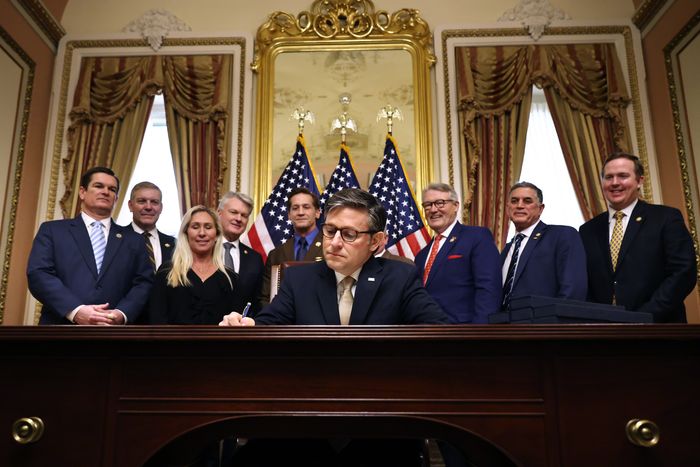 Photo: Chip Somodevilla/Getty Images
.
.
Click the link below for the complete article:
.
__________________________________________
February 23, 2025
Mohenjo
Business, Food For Thought, Human Interest, Political, Science, Technical
amazon, business, Business News, current-events, Future, Hotels, human-rights, medicine, mental-health, research, Science, Science News, technology, Technology News, travel, vacation

Click the link below the picture
.
Our teenagers are in trouble.
Headlines have been ringing loud alarms around adolescent mental health, and the data are sobering. In 2023, 40 percent of high school students surveyed by the Centers for Disease Control and Prevention said they persistently felt hopeless or sad in the past year. Nine percent had attempted suicide.
Some of it is because of COVID. Some of it is related to social media. Then there is bullying, the pressure to succeed academically, the pressure to fit in. Being a teenager in the U.S. is hard.
So it’s perhaps heartening to see President Donald Trump address mental health in a recent executive order (EO) targeting chronic health issues in children, one released as soon as Robert F. Kennedy, Jr., was confirmed as the director of the Department of Health and Human Services.
But nestled in this directive, which creates an RFK, Jr.–chaired commission to “Make America Healthy Again,” are words that speak to the doubt that he and Trump have tried to sow around established science. This includes suggestions that the research funded by the National Institutes of Health and other agencies isn’t “gold standard” and assertions that doctors are overprescribing medicines for conditions such as attention deficit hyperactivity disorder and
depression and that “medical treatments” might be part of the pediatric chronic disease problem. Perhaps most troubling is the language the administration uses to describe prescription medications for mood and behavior disorders—they are a “threat.”
That language stigmatizes families who choose prescription medication to treat their struggling children. It undermines the expertise of medical professionals. And it opens the door for unproven, improperly studied treatments to gain legitimacy.
The next era of snake oil dawns. Won’t anyone think of the children?
According to the CDC, in 2021 and 2022, more than half of U.S. teens talked to a health care provider about their mental health. About 14 percent of teens reported taking medication to manage their emotional state or for concentration and behavior. Yet 20 percent said they have unmet mental health needs.
The Affordable Care Act, and before it, the federal parity law, introduced a lot of Americans, including perhaps these teens’ parents, to parity in mental health coverage—in theory, insurance plans can’t deny mental health coverage, charge ridiculous rates for coverage that included mental health or put limits on the amount of mental health coverage a plan allows.
But even if you have insurance, depending on where you live, finding mental health care for children can be incredibly difficult. Many providers, whether therapists or psychiatrists, don’t take insurance, or don’t take certain plans. This includes Medicaid but also large commercial plans. Many primary care doctors, including pediatricians, have limits on what aspects of mental health care they are comfortable managing, including medication. In rural parts of the U.S., there are hundreds of counties that do not have a single child psychiatrist.
.
 Annadokaz/Getty Images
.
.
Click the link below for the complete article:
.
__________________________________________
February 23, 2025
Mohenjo
Business, Food For Thought, Human Interest, Political, Science, Technical
amazon, business, Business News, current-events, Future, Hotels, human-rights, medicine, mental-health, research, Science, Science News, technology, Technology News, travel, vacation

Click the link below the picture
.
If you are a parent, your greatest fear in life is likely something happening to one of your kids. According to one 2018 poll from OnePoll and the Lice Clinics of America (not my usual data source, but no one else seems to measure this), parents spend an average of 37 hours a week worrying about their children; the No. 1 back-to-school concern is about their safety. And this makes sense, if you believe that safety is a foundation that has to be established before dealing with other concerns.
You can see the effects of all this worrying in modern parenting behavior. According to a 2015 report from the Pew Research Center, on average, parents say children should be at least 10 years old to play unsupervised in their own front yard, 12 years old to stay home alone for an hour, and 14 to be unsupervised at a public park. It also shows up in what parents teach their kids about the world: Writing in The Journal of Positive Psychology in 2021, the psychologists Jeremy D. W. Clifton and Peter Meindl found that 53 percent of respondents preferred “dangerous world” beliefs for their children.
No doubt these beliefs come from the best of intentions. If you want children to be safe (and thus, happy), you should teach them that the world is dangerous—that way, they will be more vigilant and careful. But in fact, teaching them that the world is dangerous is bad for their health, happiness, and success.
The contention that the world is mostly safe or mostly dangerous is what some psychologists call a “primal world belief,” one about life’s basic essence. Specifically, it’s a negative primal in which the fundamental character of the world is assumed to be threatening. Primal beliefs are different from more specific beliefs—say, about sports or politics—insofar as they color our whole worldview. If I believe that the Red Sox are a great baseball team, it generally will not affect my unrelated attitudes and decisions. But according to Clifton and Meindl, if I believe that the world is dangerous, it will affect the way I see many other parts of my life, relationships, and work. I will be more suspicious of other people’s motives, for example, and less likely to do things that might put me or my loved ones in harm’s way, such as going out at night.
As much as we hope the dangerous-world belief will help our kids, the evidence indicates that it does exactly the opposite. In the same paper, Clifton and Meindl show that people holding negative primals are less healthy than their peers, more often sad, more likely to be depressed, and less satisfied with their lives. They also tend to dislike their jobs and perform worse than their more positive counterparts. One explanation for this is that people under bad circumstances (poverty, illness, etc.) have both bad outcomes and a lot to fear. However, as Clifton and Meindl argue, primals can also interact with life outcomes—you likely suffer a lot more when you are always looking for danger and avoiding risk.
Teaching your kids that the world is dangerous can also make them less tolerant of others. In one 2018 study, researchers subjected a sample of adults to a measure called the “Belief in a Dangerous World Scale,” which asked them to agree or disagree with statements such as “Any day now chaos and anarchy could erupt around us” and “There are many dangerous people in our society who will attack someone out of pure meanness, for no reason at all.” They found that people scoring high on this scale also showed heightened prejudice and hostility toward groups such as undocumented immigrants, whom they stereotypically considered a threat to their safety. This study was conducted among adults, but it is easy to see how these attitudes would migrate to their kids.
This is similar to the argument made by the writers Greg Lukianoff and Jonathan Haidt in The Atlantic in 2015, and in their subsequent book, The Coddling of the American Mind. Lukianoff and Haidt contend that when parents (or professors) teach young people that ordinary interactions are dangerous—for example, that speech is a form of violence—it hinders their intellectual and emotional growth. It also leads them to adopt black-and-white views (for example, that the world is made up of people who are either good or evil), and makes them more anxious in the face of minor stressors such as political disagreement.
.
 lemono/Getty Images
.
.
Click the link below for the complete article:
.
__________________________________________
February 22, 2025
Mohenjo
Business, Food For Thought, Human Interest, Political, Science, Technical
amazon, business, Business News, current-events, Future, Hotels, human-rights, medicine, mental-health, research, Science, Science News, technology, Technology News, travel, vacation
Click the link below the picture
.
t’s February 2025. The world feels like complete chaos, and it’s hard to step away from the news. Maybe your body feels tight, and perhaps your mind is racing.
Take a deep breath, then keep reading.
It isn’t just you: lots of people have expressed that they have felt overwhelmed and burned out from the events of recent months. Disasters, including Hurricane Helene and the Los Angeles–area wildfires, served as the backdrop to a frighteningly tense presidential election. And the new administration has acted loud and fast, often in ways that judges are already declaring unconstitutional.
To a degree, the result feels familiar. News overload is nothing new; major crises such as September 11 and the early months of the COVID pandemic delivered a similar onslaught of rapid-fire headlines that were laden with fear and uncertainty. However, experts say the developments during these first weeks of President Donald Trump’s second administration are posing a very real mental health threat that people may need new skills to manage. Scientific American spoke with experts in psychology and beyond about what’s happening and how to stay calm and grounded through it.
What Is the ‘Flood the Zone’ Strategy?
Political strategist Steve Bannon, who advised Trump during his first term, has openly discussed overwhelming the media as a key priority to advance right-wing objectives. “All we have to do is flood the zone,” Bannon told Frontline in 2019. “Every day we hit them with three things. They’ll bite on one, and we’ll get all of our stuff done: bang, bang, bang.”
This approach is reminiscent of the “Gish gallop” tactic that Trump has used during debates to barrage opponents and fact-checkers with so many lies and half-truths that it becomes impossible to adequately address them all. Away from the podium and inside the Oval Office, it’s a strategy that harkens back to a predigital Soviet practice of producing huge amounts of disinformation meant to make people question reality, as many experts have noted. The Trump administration’s version of this tactic uses volume to create paralysis among the opposition, says Dannagal Young, a professor of communication at the University of Delaware. “It’s the sense that you are being overwhelmed by a tidal wave,” she says. “How do you push back against a tidal wave? You can’t.”
In addition to the sheer number of actions coming from the administration, many are also entirely unprecedented. Without historical U.S. parallels to work from, our brain is less able to calculate what these developments might lead to, and that can make processing the news even more difficult. “The chaos that ensues is really hard to make sense of because we don’t know the consequences,” says Kristen Lee, a psychotherapist and a teaching professor of behavioral science at Northeastern University.
But it’s not just the volume of headlines and the intellectual difficulty of understanding what’s happening that make current news overwhelming. The key, psychologists say, is the emotional weight of those headlines’ content—especially for people who find what’s happening in the U.S. today to be genuinely frightening.
Fear in the Brain, Fear in Societies
For someone worried about the administration’s policies creating tangible harm, each new headline can create a spark of fear—and fear is a remarkably powerful emotion. “Threat and fear take the priority in our brains,” says Arash Javanbakht, a psychiatrist and a neuroscientist at Wayne State University. “When you’re afraid, all you’re thinking about is what you’re afraid of.”
.
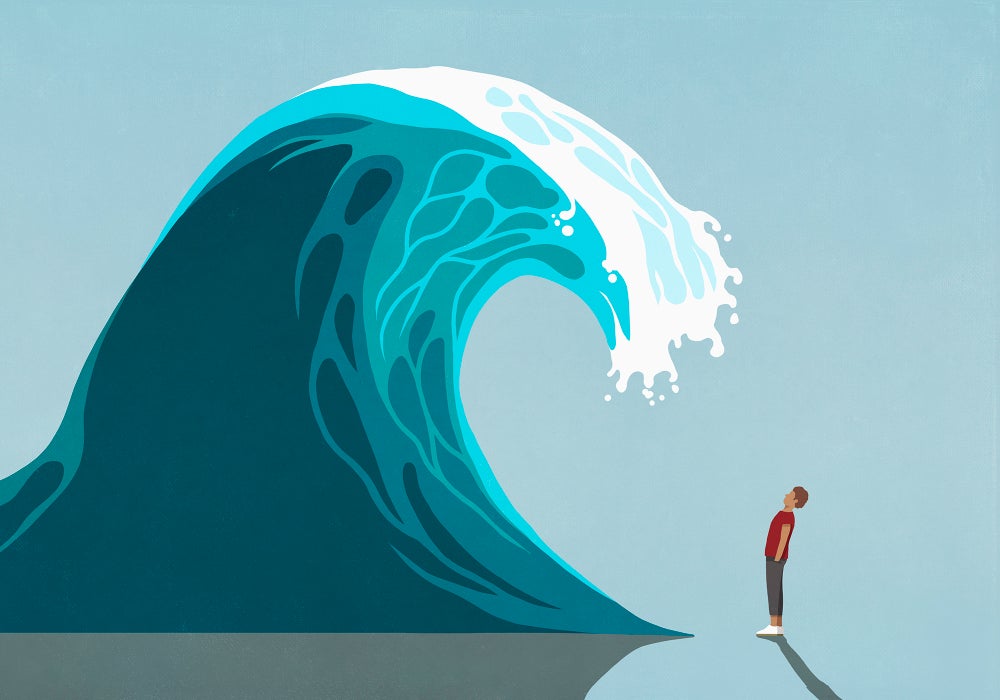 Malte Mueller/Getty Images
.
.
Click the link below for the complete article:
.
__________________________________________
February 22, 2025
Mohenjo
Business, Food For Thought, Human Interest, Political, Science, Technical
amazon, business, Business News, current-events, Future, Hotels, human-rights, medicine, mental-health, research, Science, Science News, technology, Technology News, travel, vacation

Click the link below the picture
.
The day my mom moved in, my 3-year-old spun in circles, singing, thrilled that her Gigi was back for what she assumed was just another visit. My newly walking 1-year-old wobbled after her, babbling, unaware of the shift that was about to redefine our home. In the center of the chaos, my mother smiled, her face and body not yet bearing the visible evidence of the lung cancer that was killing her. She had moved across the country to live with us, preparing to start treatment at our local hospital.
I had imagined this as a time of reconnection — a chance for her to become a steady presence in her grandchildren’s lives, for us to truly know each other as adults after years spent living so far apart. Instead, my days blurred into an exhausting cycle of diaper changes, nap battles, and doctor’s appointments, torn between being the mother my children needed and the daughter my mother deserved. I thought there would be space to simply be with her — to talk, to reminisce, to connect. But caregiving was never still. It was crisis management, the constant triage of needs.
Focusing on both my mom and my kids as much as I wanted to was nearly impossible
When I was focused on my mom, I worried I was neglecting my children; when I was with my children, I felt I was abandoning my mother. Guilt was the main feeling in those days; I never felt like I was fully taking care of or helping anyone who needed me in the capacity they needed. And certainly, I was not taking care of myself.
As the chemo took its toll and my mother grew weaker, my life slowed — necessarily, but unexpectedly. Even as she became less able to care for herself, she found ways to remain present for my children. From her bed, she read to them, her voice softer yet steady. She taught my daughter sign language and helped my son stack blocks into towers, cheering and laughing with him when they toppled over. Though I was busier than ever, life took on a new rhythm, one I had never allowed before. We moved at her pace, sitting longer, staying present.
Then, something would happen that demanded immediate attention. A broken plate. A toddler’s stomach bug. My mom’s fever. Decisions had to be made — should I call her doctor? Should I call 911? In addition to worrying about my children’s sleep, health, and development, I now had to consider what side effects of my mother’s treatment warranted an emergency. What should I do if she stops eating?
I was still trying to make sense of everything when I found myself upstairs, cleaning crayon off the walls, only to realize my mom needed to be rushed to the hospital, where they diagnosed her with sepsis. Why hadn’t I noticed how sick she was earlier? How did I not notice? These questions haunted me for a long time.
.
 The author (not pictured) was a stay-at-home mom with two toddlers while also caregiving for her mom. Ray Kachatorian/Getty Images
.
.
Click the link below for the complete article:
.
__________________________________________
February 21, 2025
Mohenjo
Business, Food For Thought, Human Interest, Political, Science, Technical
amazon, business, Business News, current-events, Future, Hotels, human-rights, medicine, mental-health, research, Science, Science News, technology, Technology News, travel, vacation
Click the link below the picture
.
CLIMATEWIRE | The National Science Foundation went beyond the staff cuts demanded by the Trump administration in a move that set off a frenzied backlash at the science funding agency.
NSF fired about 10 percent of its staff at the end of Tuesday, removing 168 people who included most of the agency’s probationary employees and all of its experts, a class of contract workers who are specialists in niche scientific fields.
The agency didn’t have to fire its experts but decided to in the interest of fairness, a top NSF official told staffers in an emotionally charged hybrid meeting Tuesday morning at its Alexandria, Virginia, headquarters.
“The removal of experts was completely at the agency’s discretion. Because if we’re asked to remove probationers, then we also need to remove at-will employees,” Micah Cheatham, NSF’s chief management officer, said at the tense and tearful hour-long meeting, according to a transcript obtained by POLITICO’s E&E News.
“This is the first of many forthcoming workforce reductions,” he added.
NSF was created by Congress in 1950 to ensure U.S. leadership in science and engineering. The agency now provides roughly a quarter of federal support to America’s colleges and universities for basic research.
E&E News previously reported that NSF expects to cut up to half of its 1,500-person workforce. Scientists and Democratic lawmakers fear that staff losses of that scale could effectively break the nation’s research and innovation pipeline, with disastrous consequences for the U.S. economy and American citizens.
The mass firing at one of the nation’s leading funders of scientific research comes as Elon Musk, the head of the Department of Government Efficiency established by President Donald Trump, races to slash federal spending with the help of the Office of Personnel Management. Musk’s group has initially targeted foreign aid and racial diversity efforts, but nearly all agencies have been impacted by cuts, or expect them to come soon.
A few probationary employees whose work NSF leaders determined was essential were spared from the firings.
“We asked who was mission critical and more than half of people were identified,” Cheatham said. “That was too many.”
Fired NSF staffers were instructed to stop working by 1 p.m. Tuesday, at which point they would be locked out of the agency’s computer network. They had until the end of the day to clean out their desks.
To avoid having the stain of a firing on their resumes, staffers were told they could resign. But then they would not be eligible for unemployment payments.
The announcement prompted outrage, confusion, and concern from people at the meeting, resulting in a string of scathing all-staff emails from impacted workers.
.
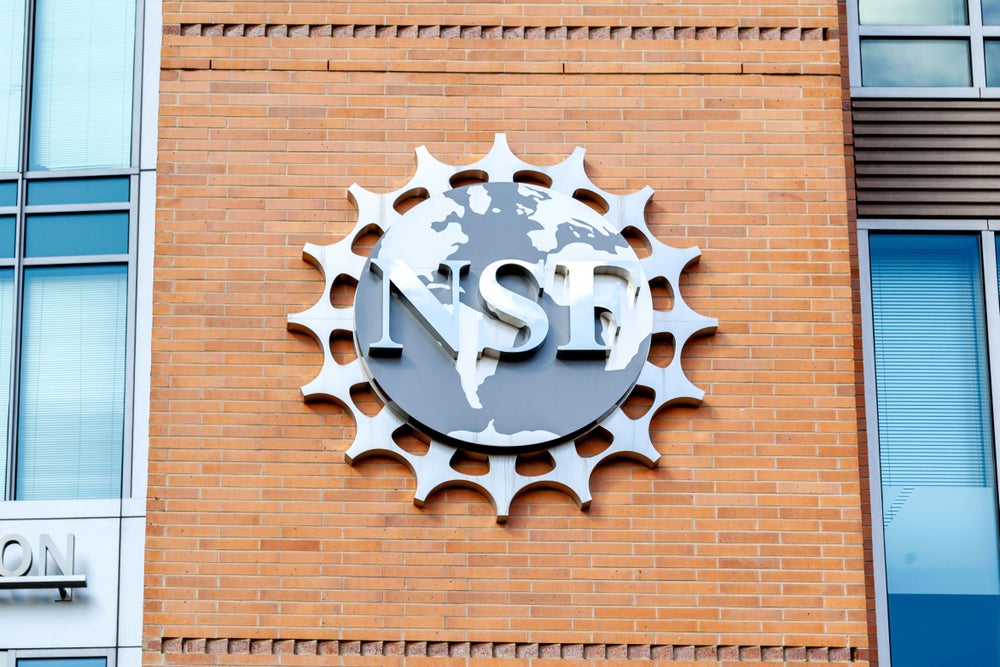
National Science Foundation headquarters shown outside Washington. JHVEPhoto/Alamy Stock Photo
.
.
Click the link below for the complete article:
.
__________________________________________
February 21, 2025
Mohenjo
Business, Food For Thought, Human Interest, Political, Science, Technical
amazon, business, Business News, current-events, Future, Hotels, human-rights, medicine, mental-health, research, Science, Science News, technology, Technology News, travel, vacation

Click the link below the picture
.
On Saturday, August 19, 2023, two weeks after I turn seventy-one, I become a new father, again.
I’m not expecting, nor is Lisa, who’s sixty-seven. And while I’m pleased to say that thirty years on we still savor each other head to toe and in several other positions, our reproductive job was over with when Judah was born in 1999, and we knew it. We had started late (I was married once before: ten years, no kids) and Lisa and I were past forty and craving it all—parenthood, love, redemption. Judah was our last shot.
Imagine that pressure—not on us, on him. Lisa and I were ready. I don’t know if any child is ready, but Judah caught on right away to the basics—cry, suckle, piss, shit—and took it from there. When I was the age he is now, in 1976, I was a geek in search of a carnival, drinking hard, writing poetry, welcoming my worst instincts every day. Judah’s working on a Ph.D. in chemistry at UCLA.
We followed him out to Los Angeles instead of aging out alone in New Jersey because we love him and he loves us. He comes by every Saturday for lunch, usually with Greta, his girlfriend. He arrives alone today, which in itself signifies nothing much, but his smile’s tight. There’s a . . . vibe. A doting, aging father feels these things.
We kiss, we hug, we sit. Lisa’s behind him, standing with her back to us, dishing red-lentil dal, grabbing spoons, asking how Greta’s doing.
“So?” I say once Lisa’s at the table.
“What?”
I see it in his eyes, steel blue, flecked with black.
He knows I see it. He favors the Brennans, Lisa’s people: lean, long-muscled, free of my flat feet and back hair, and quiet—but in one room, we share one brain.
I raise my brows.
He lifts his.
Of course. Like Lisa, he wants me to ask. Information withheld is power. Bad news he’d have dumped by now.
“Bub,” I say.
“Bub?” he says.
Not once has he ever called me Dad. We’re not pals, either. We are men and Bub works fine.
“Buhhhhb,” I croak, low. “What is up?”
He grins, eyes wide and wet. It’s not the jalapeños in his mama’s dal. He’s feeling . . . something. A lot.
“So I heard from this woman yesterday,” he says. “She’s pretty sure I’m her brother.”
Lisa, Judah, and me, the nuclear family stripped to its minimum with little space for secrets—we all know how this has happened. Over the years, I’d talked lightheartedly about my time as a sperm donor in the early 1990s and the possibility that my seed had spread without my knowledge.
It was during my first marriage, to a wonderful woman who didn’t want to be a mother any more than I cared about becoming a father. She earned a medical resident’s paltry stipend, and I raked in forty dollars a pop when a local alternative weekly found my columns to its taste. I was writing short fiction, too, and working on a novel and putting too many basics on credit cards.
A different man might’ve thought about getting a job. Fk that. I’ve known since age twelve that I was alive to write. It was a calling, not a career. I was about to turn forty, my wife had her medical degree and would soon make real money, so no, I wasn’t going back to selling shoes.
.
 COLLAGE BY JENS WORTMANN
.
.
Click the link below for the complete article:
.
__________________________________________
February 20, 2025
Mohenjo
Business, Food For Thought, Human Interest, Political, Science, Technical
amazon, business, Business News, current-events, Future, Hotels, human-rights, medicine, mental-health, research, Science, Science News, technology, Technology News, travel, vacation
Click the link below the picture
.
In the wake of the Second World War, US leaders adopted the view that scientific progress is an “essential key to our security as a nation, to our better health, to more jobs, to a higher standard of living, and to our cultural progress”. And for the next eight decades, government officials on both sides of the political aisle agreed to invest in US science. Just one month into the second administration of Republican President Donald Trump, scientists fear that that long-time consensus is disintegrating.
Acting with unprecedented speed, the administration has laid off thousands of employees at US science agencies and announced reforms to research-grant standards that could drastically reduce federal financial support for science. The cuts form part of a larger effort to radically reduce the government’s spending and downsize its workforce.
Although US courts have intervened in some cases, Republicans in both chambers of the US Congress — which largely blocked Trump’s efforts to cut science funding during his first term as president from 2017 to 2021 — have mostly fallen in line with the agenda for Trump 2.0. For many researchers, this first month signals a realignment of priorities that could affect science and society for decades to come.
These actions are all “unprecedented”, says Harold Varmus, a former director of the US National Institutes of Health (NIH) who is now a cancer researcher at Weill Cornell Medicine in New York City. “No one has ever seen a [presidential] transition in which one of the most valuable parts of our government enterprise is being taken apart.”
The Trump White House did not respond to Nature’s request for comment.
Here, Nature unpacks the Trump team’s blazing-fast actions on science so far (scroll to bottom to see timeline ‘Science impacts: one month of Trump 2.0’) and talks to policy watchers about what’s next.
Fast and furious
The overhaul of US science kicked off within hours of Trump’s inauguration on 20 January, when he signed dozens of executive orders, which are presidential directives on how the government should operate inside existing laws.
Some of those orders had been anticipated, including pulling the United States out of the 2015 Paris agreement to rein in global climate emissions and terminating the nation’s membership in the World Health Organization. Others had surprising and immediate ripple effects through the scientific community.
One order erroneously attempted to define only two biological sexes, male and female, and banned federal actions “that promote or otherwise inculcate gender ideology”. Biomedical-research agencies such as the US Centers for Disease Control and Prevention (CDC) scrambled to respond by, among other things, taking down data sets from their websites and pulling back manuscript submissions from scientific journals to purge terms including ‘gender’ and ‘transgender.’
Another executive order banned what Trump called “illegal and immoral discrimination programs, going by the name ‘diversity, equity, and inclusion’ (DEI)”. Any federal employee who did not report colleagues defying the DEI orders would face “adverse consequences”, according to an e-mail sent to government workers. To many scientists’ dismay, agencies began terminating DEI programs, including environmental-justice efforts, which are programs aimed at protecting low-income communities vulnerable to pollution and climate change. Even some scientific societies and private research organizations scrubbed DEI mentions from their websites. In one of Trump’s orders, he called for the investigation of foundations, non-profit organizations, and other private entities not in compliance.
On 27 January, just one week into the new administration, Trump’s budget office froze all federal grants and loans, saying that it needed to review government spending to ensure that it aligned with the executive orders. Chaos erupted as agencies, including the NIH and the US National Science Foundation (NSF) — both major funders of basic science — halted grant payments, canceled review panels for research-grant funding, and paused communications. A federal judge temporarily blocked the order, but disruptions and confusion continue.
Principal investigators who lead research teams are suffering in this environment, says a university scientist who requested anonymity because their research is funded by multiple US agencies. “Everything is on you to manage your grants and your team,” they say, adding that “there’s a lot of fear of people not wanting to say or do the wrong thing” and therefore lose financial support for their work. “It’s completely chaotic; I’m losing sleep.”
.

U.S. President Donald Trump looks at an executive order on halting federal funds for schools and universities that impose coronavirus vaccine mandates before signing in the Oval Office of the White House on February 14, 2025. Demetrius Freeman/The Washington Post via Getty Images
.
.
Click the link below for the complete article:
.
__________________________________________
February 20, 2025
Mohenjo
Business, Food For Thought, Human Interest, Political, Science, Technical
amazon, business, Business News, current-events, Future, Hotels, human-rights, medicine, mental-health, research, Science, Science News, technology, Technology News, travel, vacation

Click the link below the picture
.
Parents who claim to never lie to their children are liars. It begins with Santa Claus and the Tooth Fairy. Then it’s, “Yes, all kindergartners go to bed at 7 o’clock” and “No, the chickens on the farm and the chicken on your plate are not the same kind of chicken.” Most of these untruths are harmless — white lies, we call them. But there are some lies we tell as parents, however well intentioned, that do more harm than good.
I learned that lesson the hard way.
When I was 11, I underwent a complex procedure to correct a
discrepancy in the length of my legs. Surgeons spent 13 hours drilling through my bones and attaching an external metal frame from my hip to my toe. It took them the next two years to stretch my leg three inches. The pain was so severe that morphine, other opioids, Valium, and muscle relaxants were all standard protocol. Yet, before the surgery, when I asked if it would hurt, the only thing I remember being told was “Don’t worry, we have ways to manage any unpleasantness.” The difference between what I was told and what I experienced shattered my faith in doctors and left me questioning whether I could trust adults at all. Now, as a parent — and through my years working in health care — I’ve made the conscious decision never to lie to people about pain. Even with something as small as a routine vaccination, even before they see the needle coming toward them. Yes, I say, it may hurt.
Many parents opt instead to reassure their children. Since they can’t stop the needle from hurting, they believe the next best thing is to offer comfort. But when the pain does inevitably come, it’s accompanied by a heaping side of betrayal. Lies that mislead children about their experiences are not white lies. Though they may appear innocuous, they erode the fabric of the fundamental
and necessary trust between parent and child. They create an emotional wound not easily healed. The pain of discovering you have been deceived by a trusted adult can cut deeper and last longer than the pain of an unavoidable medical intervention.
In any case, although sugarcoating might make us feel better, it doesn’t help our children — it can actually intensify their discomfort. In an experiment on how parents communicate with children before immunizations, children showed more fear and had to be restrained more after their parents reassured them. Children fared better when their parents were randomly assigned to distract them, or even do nothing. Before the shots, the parents who provided reassurance felt the least upset and the most helpful. But afterward, they felt the most distressed; they realized their attempts to help had actually hurt.
Researchers advise against statements like “This won’t hurt,” “There is nothing to worry about” and “Don’t cry” because they can backfire. Children may interpret them as a warning sign, and they may end up experiencing more distress and pain than they would have otherwise. Lying to children robs them of the opportunity to learn to express difficult emotions in healthy ways and can contribute to future anxiety.
.
 Alma Haser
.
.
Click the link below for the complete article:
.
__________________________________________
Older Entries
Newer Entries
 James' World 2