March 25, 2025
Mohenjo
Business, Food For Thought, Human Interest, Political, Science, Technical
amazon, business, Business News, current-events, Future, Hotels, human-rights, medicine, mental-health, research, Science, Science News, technology, Technology News, travel, vacation

Click the link below the picture
.
Here’s a simple question: What’s a moon?
As with so many questions in science, it may seem straightforward but truly isn’t. “Why, a moon is a celestial body that orbits a planet,” you’re probably thinking. Well, sure—if you squint your eyes and don’t look too closely, that’s a pretty decent description.
But rigidly defining the term “moon” isn’t so easy.
The canonical example is of course our own moon, a decently big chunk of rock that orbits Earth. But centuries ago the first telescopic observations of other planets revealed that many have moons as well; Jupiter has four giant, easily seen satellites, and Saturn has several that are visible by modest means as well. So at that point in time, our definition of “moon” seemed safe enough.
Then, of course, things got complicated—because they always do. As telescopes got bigger and better, more moons were found. Mars has two, and poor Mercury and Venus have none, but in contrast, moons seemingly kept sprouting on Jupiter like mushrooms after a rainstorm. For the first half of the 20th century, Jupiter was known to have an even dozen. A handful more were found telescopically in the 1970s, and the numbers jumped a bit when we started sending spacecraft to the outer planets. Then, in the 2000s, the numbers leaped upward as more exacting techniques were used to scrutinize Jupiter’s environs.
As of this writing Jupiter has 95 confirmed moons. They range in size from mighty Ganymede, the largest in the solar system at more than 5,200 kilometers across—wider than the planet Mercury!—to the tiniest that we’re able to see from Earth, at roughly 1 km in diameter. Saturn is more distant from us than Jupiter, so its moons are harder to see, yet we now know it boasts at least 274 moons, a staggering number! Of these, 128 were just announced this month by scientists who had used an advanced searching technique that allows extremely faint satellites to be spotted in telescopic observations. Most of these new additions are only a few kilometers across.
It’s clear that with ever more powerful equipment, we’ll find that many planets have orbital companions of arbitrarily small dimensions. Is something the size of a football stadium a moon? Sure! But what about something the size of a car, a basketball or a grape? What about a grain of dust?
Saturn’s rings are composed of trillions of small icy particles. Is each of these a moon?
At some lower limit, that term just doesn’t seem to fit.
The problem is further complicated by the fact that many asteroids have moons. More than 430 asteroids are known or suspected to be orbited by smaller asteroids. It’s possible that those satellites were formed from low-speed collisions that either ejected material that subsequently coalesced as moons or slowed two asteroids enough to put them in orbit around each other. In some cases, an asteroid and its moons may have even formed together.
Out past Neptune are countless small icy and rocky bodies called Trans-Neptunian Objects (TNOs), and many of these have moons as well. While some TNOs could be called dwarf planets because of their size, many more are tiny and don’t even come close to falling into that category.
And, although I hate to complicate things even more, I should note that if we broaden our moon definition to “any object that orbits something bigger,” then planets are moons. Even small stars that orbit big stars would be moons!
.
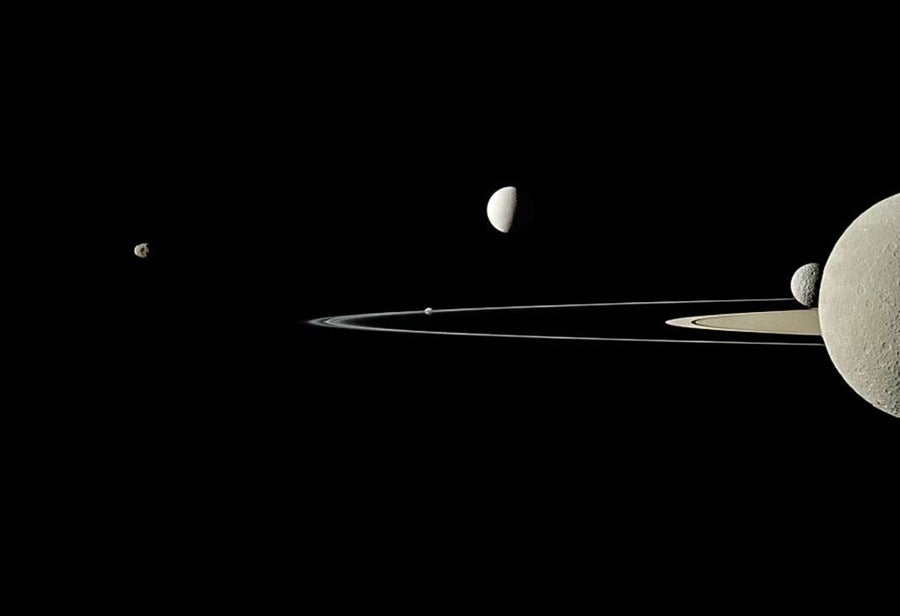
A quintet of Saturn’s moons come together in this image from NASA’s Cassini spacecraft. NASA/JPL-Caltech/Space Science Institute
.
.
Click the link below for the complete article:
.
__________________________________________
March 25, 2025
Mohenjo
Business, Food For Thought, Human Interest, Political, Science, Technical
amazon, business, Business News, current-events, Future, Hotels, human-rights, medicine, mental-health, research, Science, Science News, technology, Technology News, travel, vacation

Click the link below the picture
.
We’ve all done it. You’re in a meeting, on a date or even texting a friend, and two words slip into the conversation: “I think we should go with option A.” “I think we should see this movie.” “I think we should leave at 7.”
While “I think” can be harmless sprinkled in here and there, if you use it too often and in the wrong context, it can weaken your message, diminish your presence, and undermine your confidence.
“I think” is an example of minimizing language: words and phrases that soften your statements and make you seem less sure of yourself. Other common minimizing language includes “just,” “sorry” and “maybe.”
While these words may seem polite, they can dilute your credibility and make your ideas easier to dismiss, especially in a professional context.
Use this ‘subtle but powerful’ swap
Instead of “I think,” swap in “I recommend.” Compare these two statements:
- “I think we should move the deadline.”
- “I recommend moving the deadline.”
The first feels hesitant, while the second feels authoritative and action-oriented. Even if the message you want to convey is exactly the same, your words carry more weight when framed as a recommendation rather than what can be interpreted as a passing thought.
- Instead of: “I think we should go with the second proposal.“
Try: “I recommend we go with the second proposal.”
- Instead of: “I think we should prioritize this project.“
Try: “I recommend prioritizing this project.”
- Instead of: “I think you should try this restaurant.“
Try: “I recommend trying this restaurant.”
- Instead of: “I think you should change your reservation.“
Try: “I recommend changing your reservation.”
The shift is subtle but powerful. Saying “I recommend” instead of “I think” makes you sound more confident and decisive, gives you more influence, and ensures you’re seen as someone whose opinion matters.
What if you’re not sure?
There are times when it feels like you really should use “I think.” Perhaps you’re not confident in your recommendation, or you purposefully want to soften your message.
While it’s certainly a path you can take, you can still use “I recommend” in these situations — with a twist.
Preface your recommendation with an indication of what you’re drawing on to give it. For example:
- “Based on what I’ve seen, I recommend…”
- “Looking at the data, I’d recommend…”
- “From my experience, I’d recommend…”
This keeps your statement strong while acknowledging some uncertainty and leaving room for further discussion.
Break the ‘I think’ habit
Any time you try to disrupt a pattern that’s deeply ingrained in your everyday conversations, it takes practice. Here are a few strategies you can try to break this particular communication habit:
-
Listen for it. Start noticing how often you say “I think,” and in what contexts it tends to pop up. It may surprise you how many times a day you use this phrase.
-
Enlist help. Ask friends or peers to call it out when they hear it to help keep you accountable.
-
Pause before you speak. Speaking more slowly and adding pauses is already helpful when trying to appear more authoritative and confident. Now, you can also catch yourself when you’re about to say “I think” and give yourself enough time to swap it out.
-
Observe your writing. “I think” often creeps into our written communication too, especially quick messages over Slack or Teams. Take a second pass at your writing before hitting send to make sure you’re keeping things concise and using strong phrases like “I recommend.”
.
 Ridofranz | Getty Images
.
.
Click the link below for the complete article:
.
__________________________________________
March 24, 2025
Mohenjo
Business, Food For Thought, Human Interest, Political, Science, Technical
amazon, business, Business News, current-events, Future, Hotels, human-rights, medicine, mental-health, research, Science, Science News, technology, Technology News, travel, vacation
Click the link below the picture
.
The tragic opioid epidemic continues to rage in the U.S. Roughly 76 percent of U.S. drug overdose deaths, more than 70,000 people in 2023, are linked to opioids, including heroin and illicit fentanyl. The bill for that calamity—dire enough to justify a global trade war with Canada, Mexico, and China—is falling increasingly on a federal health coverage program that now faces the chopping block.
That program is Medicaid, which in 2023 paid for about 39 percent of the nonfatal emergency department overdoses. That alone helped people in acute distress some 118,000 times in the 26 states that provide data. The total number of people treated for opioid use disorder (OUD) under Medicaid in 2021 was nearly 1.82 million, or 35 percent of all people treated for the disorder in the U.S. More than half, or 930,910 people, became eligible for Medicaid because of the Affordable Care Act’s (ACA) Medicaid expansion.
In February, Congress passed a resolution that will most likely mean $880 billion in reduced federal spending in Medicaid over 10 years. That would reduce its spending by nearly 12 percent over the next 10 years. To provide some context, in 2023, Medicaid spent $616 billion of federal funds, alongside an additional $245 billion in state spending, according to the Centers for Medicare and Medicaid Services (CMS). Widespread cuts to Medicaid enrollments and spending of the kind Congress contemplates, will surely hurt people who rely on the program for treatment of their addictive conditions.
To realize $880 billion in reduced Medicaid spending, Congress is considering imposing work requirements on beneficiaries who do not qualify for Social Security Disability payments, reduced subsidies for states that expanded Medicaid, and reduced federal “matching” spending provided to states. All of which would result in reduced enrollment of people suffering from opioid use disorder and substance use disorders, involving alcohol, cocaine, methamphetamines or other drugs, generally. If that happens, evidence based on lessons from Medicaid expansion shows that fewer people in the expansion population will have healthcare coverage. In fact, it is estimated that if the expansions were eliminated, roughly 65 percent of people in the expansion population would likely end up uninsured. This is especially salient because Medicaid financed care represents such a large share of all the OUD treatments in the country, in large measure because of the Medicaid expansion.
The lesson from the expansion experience is that when people gain coverage, they are more likely to seek treatment for addiction and get treated with lifesaving drugs. Furthermore, people in treatment are less likely to overdose and die than those not in treatment. So dramatic reductions in spending on treatment for OUD will likely result in more overdoses and more deaths consequent to the disorder.
Medicaid expansion has also contributed to the financial health of hospitals, especially those in rural areas of the nation. It led to significantly reduced uncompensated care costs experienced by hospitals. This was found for hospitals overall. More specifically, states that expanded Medicaid experienced large drops in the percentage of emergency department visits for an OUD (frequently for a nonfatal overdose) that were delivered to people without health insurance. Likewise, expansion states experienced a 50 percent drop in the number of opioid-related hospitalizations that were for people without insurance. That improved hospital bottom lines by millions of dollars. Hospital willingness to address substance use issues through targeted programs generally, and for OUD specifically, has been shown to be greater in states that have expanded Medicaid. This willingness is especially important for rural areas, as about 74 percent of rural hospital closures have been in the non-expansion states. Without these funds, a lot more rural hospitals will close.
.
Rob Dobi/Getty Images
.
.
Click the link below for the complete article:
.
__________________________________________
March 24, 2025
Mohenjo
Business, Food For Thought, Human Interest, Political, Science, Technical
amazon, business, Business News, current-events, Future, Hotels, human-rights, medicine, mental-health, research, Science, Science News, technology, Technology News, travel, vacation

Click the link below the picture
.
Archaeologists discovered a pyramid structure at the Chupacigarro archaeological site, which is part of the Sacred City of Caral-Supe. The pyramid may date back to 3800 years ago!
.
 .
.
.
Click the link below for the video:
.
__________________________________________
March 24, 2025
Mohenjo
Business, Food For Thought, Human Interest, Political, Science, Technical
amazon, business, Business News, current-events, Future, Hotels, human-rights, medicine, mental-health, research, Science, Science News, technology, Technology News, travel, vacation

Click the link below the picture
.
Melanie Ehrenkranz isn’t a stranger to job instability. In the decade she’s worked in media, she’s seen countless smart and creative friends lose their jobs during mass layoffs.
When it happened to her in 2023, it sparked an idea: Ehrenkranz decided to create a resource for people going through layoffs to discuss the thorny parts of getting the news — the indignity of being let go over a video call, who they told first, getting into company gossip with ex-co-workers, and what they named their commiseration group chats.
In other words, all the things you want to spill but can’t post on LinkedIn.
By August 2024, Ehrenkranz launched Laid Off, a Substack newsletter that aims to be “the coolest place on the internet to talk about being laid off.” She runs the newsletter on top of her day job as head of content and community at Business Class, which makes online courses for entrepreneurs.
Readers of Laid Off, now more than 6,000 of them and growing, get weekly spotlights of people’s layoff stories and how they’re handling them.
“This is something I wish I had,” Ehrenkranz, 35, tells CNBC Make It.
‘I don’t want this to be depressing or bleak’
Most of the Laid Off readers work in tech, followed by news and media, health care, advertising and then retail.
A majority discuss being laid off in 2024 — at home via Zoom, while on a group conference call, via an email. Many responded to Ehrenkranz’s recent survey to say joining the Laid Off community has given them a cathartic, almost fun, place to reflect on the experience as a group.
“I don’t want this to be depressing or bleak,” Ehrenkranz says. “Obviously it’s a really deflating experience and traumatic, but I think we can also create a fun, cathartic community.”
Spinning the layoff experience on its head, and detaching the self-blame and guilt that often goes with it, can make it feel less isolating and taboo, Ehrenkranz adds.
She hopes that readers see “all these really smart, cool, successful people” telling their stories in their own words. “We’re all doing our best. We might have been at the top of our game. We’ve been laid off. And I think that also helps to re-wire your brain that might be [wondering]: What did I do wrong to deserve this? And the answer is nothing.”
Laid Off’s paid subscribers (for $5 per month) also get access to a Discord channel, a community of over 700 users who trade layoff horror stories but also tips on navigating today’s challenging job market.
Shame is giving way to ‘righteous anger’
The conversations show a shift in the layoff environment. While early pandemic days helped more people uncouple their job loss from their self-worth, and the post-Great Resignation job cuts ushered in a new era of vulnerability in LinkedIn posts, the chatter around losing your job these days feels a little more confrontational.
As Ehrenkranz puts it, “I think a lot of people are feeling angry.”
It’s “almost impossible” to scroll on LinkedIn without seeing a connection writing that they’ve been laid off, Ehrenkranz says: “Being bombarded with these stories and images and Open to Work banners, it does start to kind of strip away that shame. And underneath that shame, I think, is this righteous anger.”
The rising anger is coinciding with companies like Meta and Microsoft saying they’re laying off people due to poor performance. Meanwhile, tens of thousands of public servants have been fired, some under the guise of unsatisfactory employee assessments, as the Trump administration works to slash the size of the federal workforce.
But those who received pink slips aren’t going quietly, and at times are publicly challenging the evaluations of their work.
Angry posts are less targeted toward the messiness of a mass layoff, and more so toward “executives who made a decision to de-value work [employees] believed was important, or decisions executives made that put the company in a precarious place, and it cost people their jobs, but not necessarily the people at the top.”
.

Melanie Ehrenkranz is an LA-based writer and creator of the “Laid Off” newsletter and Discord communities.
Courtesy of subject
.
.
Click the link below for the complete article:
.
__________________________________________
March 23, 2025
Mohenjo
Business, Food For Thought, Human Interest, Political, Science, Technical
amazon, business, Business News, current-events, Future, Hotels, human-rights, medicine, mental-health, research, Science, Science News, technology, Technology News, travel, vacation
Click the link below the picture
.
The devastating fires in California early this year came after a particularly unfortunate weather pattern—an exceptionally wet period of about 18 months, followed by an exceptionally dry spell. The wet duration encouraged grass and brush growth, and then the lack of rain dried it all out, priming it to catch on fire and spread quickly.
“It was a classic example of wet-to-dry whiplash,” says Daniel Swain, a climate scientist at the University of California, Los Angeles. And such whiplashes may be getting more common. “With climate change, it’s not just that we’re seeing things get drier and drier. There’s also a trend toward more variability, with wider swings between wet and dry,” Swain says.
The warming climate is leading to what scientists call the “expanding atmospheric sponge” effect. Warmer air can hold more water vapor than cooler air, so the atmosphere is like a kitchen sponge that gets larger. If water is available, the atmosphere will absorb more of it, and when you wring out the sponge, you get more precipitation. But if there is no water to absorb, that thirstier air sucks more moisture out of the landscape, from bodies of water, surfaces and plants, drying everything out.
.
 Wesley Grubbs
.
.
Click the link below for the complete article:
.
__________________________________________
March 23, 2025
Mohenjo
Business, Food For Thought, Human Interest, Political, Science, Technical
amazon, business, Business News, current-events, Future, Hotels, human-rights, medicine, mental-health, research, Science, Science News, technology, Technology News, travel, vacation

This episode of Star Trek Shows us where the present administration is taking us!
Click the link below the picture
.
The Enterprise encounters two duo-chromatic and mutually belligerent aliens who put the ship in the middle of their old conflict.
.
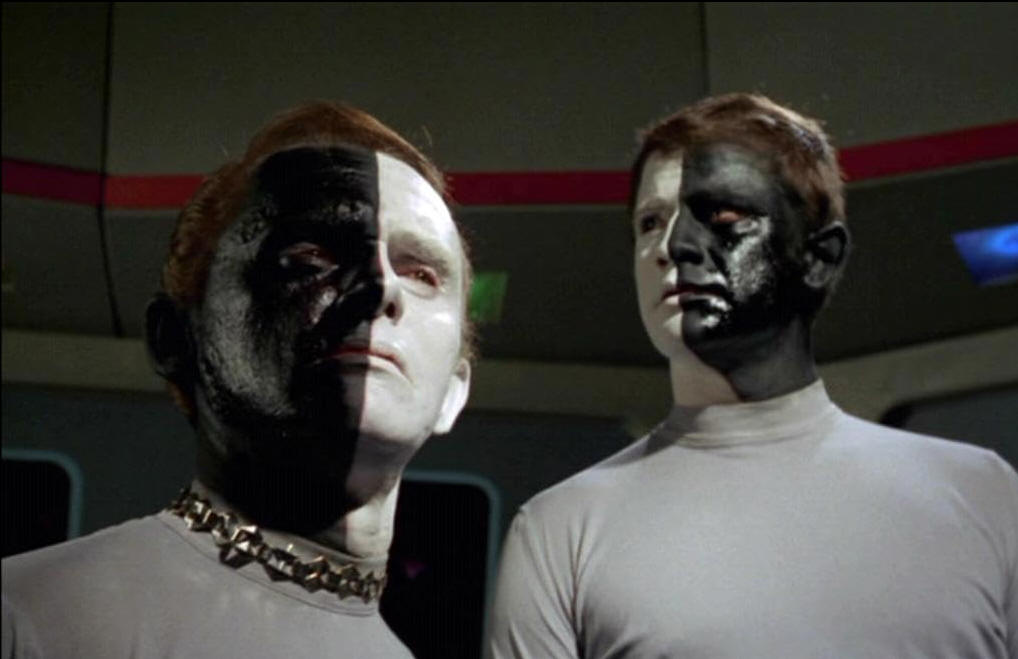 Two duo-chromatic and mutually belligerent aliens
.
.
Click the link below for the complete article:
.
__________________________________________
March 23, 2025
Mohenjo
Business, Food For Thought, Human Interest, Political, Science, Technical
amazon, business, Business News, current-events, Future, Hotels, human-rights, medicine, mental-health, research, Science, Science News, technology, Technology News, travel, vacation

Click the link below the picture
.
When Australia’s parliament passed legislation late last year banning under-16s from social media, anxious parents across the country breathed a collective sigh of relief.
“We want Australian children to have a childhood,” Prime Minister Anthony Albanese said as he introduced the legislation. We need to “get kids off phones and back on the footy field.”
Plenty of parents have echoed those sentiments to me over the past decade as I interviewed more than 250 families about the challenges of parenting in a digital age. When I started my research back in 2015, my own children were just toddlers and I had complete control over their digital devices. But as I wrapped up my book
Parenting in a Digital World last year, I found myself in the thick of all the concerns parents had raised: the hours children spend glued to screens; their failure to complete chores and homework because of devices; family arguments over technology; and a lack of knowledge about what kids are even doing online.
I empathize with the mums and dads that I’d interviewed, who were trying to balance social expectations of what it means to be a good parent with the desires and demands of their children.
From France and Norway to the UK and several US states, authorities are grasping for ways to protect kids after years of headlines about the dangers of social media. Smartphones have destroyed a generation, psychologist Jean Twenge wrote in 2017. Social media and smart phones have caused a “rewiring of childhood,” author Jonathan Haidt stated last year.
But categoric assertions about kids and technology only deepen the anxieties of parents caught between dueling narratives. On the one hand, the media tells parents that too much screen time compromises their children’s development, and by extension, their future wellbeing. On the other, a utopian narrative about the emancipating potential of digital technologies frames them as a necessary ingredient for young people’s education and success.
Media panic has a long history — successive generations raised the alarm first about comics and radio, then cinema, television, and video games. Over the years, we’ve worried that violent videos desensitize young people and increase aggression. We’ve feared that subliminal messages in heavy metal lyrics could incite youth suicide. We also have a tendency to forget these early concerns once a new form of media captures our attention, something Kirsten Drotner, a professor of media studies, refers to as “historical amnesia.”
This media-effects research tradition continues today: Many studies
have linked social media use to conditions such as depression or low self-esteem. But rarely is there evidence of direct causation. For example, does excessive social media use lead to depression, or are some young people using social media significantly more than their peers because they’re already depressed?
Where concerns about earlier media forms focused on exposure to content, today we have an added worry: how young people interact with content. Unlike the passive consumption of TV shows, for instance, digital platforms enable people to make active choices on how to behave. They can participate in online communities and activities and create and share their own content, which has benefits but also tends to increase screen time and poses additional risks. Not only are young people exposed to all manner of explicit content, but they have the tools to create and share their own — widening the challenges for parents, police, and educators.
.
 Illustration: Ibrahim Rayintakath for Bloomberg
.
.
Click the link below for the complete article:
.
__________________________________________
March 22, 2025
Mohenjo
Business, Food For Thought, Human Interest, Political, Science, Technical
amazon, business, Business News, current-events, Future, Hotels, human-rights, medicine, mental-health, research, Science, Science News, technology, Technology News, travel, vacation
Click the link below the picture
.
There’s a new sunflower in town. But it isn’t your stereotypical sunflower with cheery yellow petals.
The so-called “woolly devil” is tiny, pale, and well camouflaged amid limestone-rich rocks and look-alike plants in Texas’s Big Bend National Park, where it was discovered. “When we found it, we didn’t realize it was something new,” says Deb Manley, a park volunteer, who, with a colleague, was the first to spot the little plant. “I just figured it was another small annual that was going to be difficult to look up.”
And indeed, it was quite difficult to look up; it didn’t quite match anything in the guides for tiny, fuzzy wildflower plants. But that turned out to be for a very good reason—the flower was a species not yet known to scientists. “It was so unique that it actually needed to have its own genus, and that’s a very rare thing,” says Isaac Lichter Marck, an evolutionary biologist and a daisy taxonomist at the California Academy of Sciences. Like Manley, he’s a member of the team who published the discovery of the woolly devil in February in PhytoKeys.
Sunflowers are the part of the most diverse family among flowering plants, Asteraceae, which contains more than 30,000 formally described species. This includes, of course, the iconic, bright yellow “common sunflower,” or Helianthus annuus. All sunflower species have a strange trait in common: any one of their blooms, called a capitulum, is actually made up of two varieties of flowers—ray flowers, which make up the sunflower’s characteristic halo of petals, and disc flowers that fill the inner ring of the flower head. The woolly devil follows this plan in miniature: it sports two or three ray flowers that are white with maroon stripes, with a few unremarkable disk flowers between them.
Wild sunflowers tend to thrive in harsh environments, such as the desert conditions that characterize Big Bend National Park: lots of sunshine, extreme heat, and occasional sudden summer storms. “That’s made them really successful in the last 15 to 20 million years, in which the Earth has undergone a lot of cooling and drying,” Lichter Marck says.
The new find is formally known as Ovicula biradiata. Ovicula means “little sheep” in Latin, and the name not only describes the plant but also honors the iconic bighorn sheep that used to roam Big Bend before they were killed by hunters and diseases. (Texas began to reintroduce sheep to the region in 2010). Meanwhile the common name “woolly devil” reflects the plant’s discovery near a canyon called Devil’s Den, Manley says, as well as the hornlike appearance of plants with two ray florets—and, she admits, the frustration of distinguishing it from other tiny, fuzzy plants.
And these plants really are woolly, Lichter Marck says. Thousands of hairs fully cover the stems and leaves. “In order to extract DNA from the plant, we actually had to give the leaves a little shave,” he says. The hairs likely protect the plant from hungry animals, he notes. “Imagine you’re an herbivore—you come to chew on these leaves, but you just get a mouthful of wool,” Lichter Marck says.
This feature is surprisingly common among sunflowers in such harsh environments. It likely also protects the plant from damaging ultraviolet light or the dry desert air that sucks moisture from plants. And right now the region is in a severe drought, so woolly devils need all the protection they can get, Manley says.
The drought also makes keeping tabs on the woolly devil a challenge for Manley and anyone else looking to spot it. The plant is difficult to distinguish when not in flower—and it only flowers after it rains. “It’s frustrating,” Manley says, noting that not even she can track down the plant right now, much less newcomers to the park who have heard about the discovery. “There is not much going on in the park right now, botanically—the main event right now is there’s a lot of plants dying,” she says.
Even if the drought eases up, Lichter Marck worries about the fate of the woolly devil, which Manley and other park representatives identified last year in only a few patches of the park. “We may have documented this plant as it’s on its way out, and we’re lucky to do so,” he says. “It’s almost an urgent type of science. We need to document these things before they go extinct.”
.

A close-up view of the woolly devil sunflower. NPS/D. Manley
.
.
Click the link below for the complete article:
.
__________________________________________
March 22, 2025
Mohenjo
Business, Food For Thought, Human Interest, Political, Science, Technical
amazon, business, Business News, current-events, Future, Hotels, human-rights, medicine, mental-health, research, Science, Science News, technology, Technology News, travel, vacation
Click the link below the picture
.
NASA Perseverance rover captured stunning imagery of an area called “Airey Hill” in Jezero Crater on the Red Planet. Perseverance project scientist Ken Farley gives you a tour. Credit: NASA/JPL-Caltech/ASU/MSSS; ESA/DLR/FU-Berlin
.
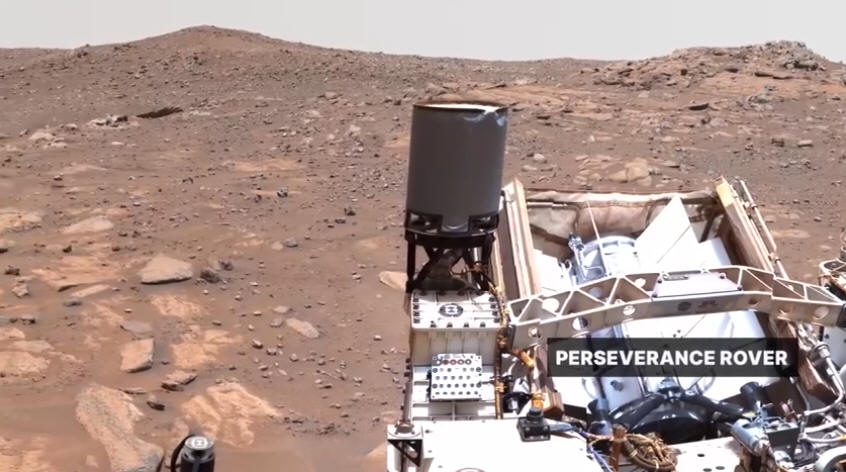 Perseverance
.
.
Click the link below for the complete video (hit play):
.
__________________________________________
Older Entries
Newer Entries
 James' World 2