June 5, 2026
Mohenjo
Business, Food For Thought, Human Interest, Political, Science, Technical
amazon, business, Business News, current-events, Future, Hotels, human-rights, medicine, mental-health, research, Science, Science News, technology, Technology News, travel, vacation

Click the link below the picture
.
Just more than a decade ago, the Laser Interferometer Gravitational-Wave Observatory (LIGO) picked up the signal of something entirely new: a ripple in the fabric of spacetime. About 1.3 billion light-years away, two massive black holes had merged, and the resulting shockwave—a gravitational wave—was strong enough for LIGO to detect the moment it washed over Earth.
Since then, gravitational-wave researchers have focused on fine-tuning their instruments to detect more of these fleeting ripples. Each confirmed, or high-quality candidate event, is added to a running tally in a catalog maintained by the LIGO-Virgo-KAGRA (LVK) Collaboration, a network of four gravitational-wave detectors: the two LIGO stations in the U.S., the Virgo station in Italy, and the Kamioka Gravitational Wave Detector (KAGRA) in Japan. The newest entries on the collaboration’s list—a record-breaking 161 events spotted between April 2024 and January 2025—have researchers excited for a new era of discovery, an “age of gravitational astronomy.”
“The extraordinary sensitivity of our detectors now allows us to capture three or four gravitational wave signals every week,” said Ed Porter, a researcher at the AstroParticle and Cosmology Laboratory, overseen by the French National Center for Scientific Research (CNRS) and Paris City University, in a statement. “This ever-growing wealth of data, which an entire community of scientists and astronomers is working to analyze and study, has taken us from the era of initial discoveries into that of precision gravitational astronomy.”
These recent weekly signals form about 75 percent of the total number of confirmed gravitational-wave events observed by the LVK network; the total is now up to 390. Having more observations of these unusual cosmic events gives researchers the ability to study phenomena and locales of the universe that are too faint or far away to detect through other methods, as well as to better understand the nature and evolution of black holes and a diverse assortment of other fundamental questions in astrophysics.
Among the exciting findings from the latest batch of gravitational-wave detections are GW240615, for which scientists were able to triangulate the exact location of the event’s source; GW250114, which offered the clearest signal ever recorded, with a signal-to-noise ratio of 76.9; and GW241011 and GW241110, which, scientists say, collectively support the existence of “second-generation black holes” that form solely from the mergers of smaller black holes.
“It is another hint that the Universe may still be hiding important pieces of the story of how black holes are born, evolve, and merge,” said Mario Spera, a Virgo Collaboration researcher at the International School for Advanced Studies (SISSA) in Italy, in the same statement. “And this picture will become richer, and more surprising, with every new gravitational-wave catalog by LVK.”
The 161 new entries provide enough data to keep scientists busy for years, but the LVK Collaboration says there is a lot more to come—especially as researchers continue optimizing the detectors to make them even more sensitive to spacetime ripples.
.
 VICTOR de SCHWANBERG/SCIENCE PHOTO LIBRARY
.
.
Click the link below for the complete article:
.
__________________________________________
June 5, 2026
Mohenjo
Business, Food For Thought, Human Interest, Political, Science, Technical
amazon, business, Business News, current-events, Future, Hotels, human-rights, medicine, mental-health, research, Science, Science News, technology, Technology News, travel, vacation

Click the link below the picture
.
The Trump administration unlawfully barred applicants from 39 travel-ban countries from receiving decisions on asylum, work permits, green cards, and citizenship applications, a US federal judge ruled on Friday.
The decision came on the same day that the US Senate voted to pass legislation to fund Donald Trump’s controversial immigration crackdown.
Chief US district judge John McConnell in Providence, Rhode Island, ruled that the US Citizenship and Immigration Services (USCIS) had adopted a series of unlawful policies targeting people from 39 African, Asian, Latin American, and Middle Eastern countries.
His ruling came in a lawsuit filed in March by a coalition of immigrant service organizations and labor unions challenging a suite of policies adopted starting in November by USCIS, which is part of the US Department of Homeland Security (DHS), amid the US president’s anti-immigration agenda.
Those measures placed a hold on processing immigration benefit applications from people in the 39 countries subject to Trump’s full or partial travel bans, which he has justified on vetting and security grounds. Green cards grant foreign nationals permanent resident status in the US.
The DHS did not immediately respond to a request for comment.
McConnell, who was appointed by Barack Obama, said those policies “threw the lives of countless immigrants living in the United States into indeterminate legal limbo.”
The judge wrote: “USCIS’s hold on adjudications cannot be attributed to anything that these individuals did wrong; rather, it arises solely by the happenstance of their birth.“
He said the immigrants at issue had adhered to the legal processes that the US Congress had enacted and USCIS had adopted by regulation, yet had been “stuck waiting, for months on end, for benefit requests that USCIS refuses to adjudicate”.
“But the rule of law has to apply to everyone equally and, as evident here, USCIS has neither ‘followed the law’ nor ‘done things the right way’,” McConnell wrote, adding: “Indeed, the agency has violated the very immigration laws that Congress has charged it with administering, as well as the administrative laws that govern the agency’s actions.”
The New York Immigration Coalition (NYIC) applauded the judge’s decision.
“Every person seeking safety, stability, and opportunity deserves a fair chance to have their case heard under the law. Today, a federal judge reaffirmed what we already knew: that the Trump administration violated the law, and did so with anti-immigrant malice. By shutting down access to asylum and preventing thousands of immigrants from receiving a decision on their immigration applications solely on the basis of which country they come from, the Trump administration acted against statute and against the rule of law,” said Murad Awawdeh, president and CEO of NYIC, in a statement. “Their unlawful actions left thousands of families in limbo, cut people from life-saving protections, and undermined the rule of law by attempting to bypass the immigration system established by Congress.”
.
 Travelers in a waiting area at Kabul international airport in Afghanistan on 2 October 2024. Photograph: Francois LOCHON/Gamma-Rapho/Getty Images
.
.
Click the link below for the complete article:
.
__________________________________________
June 5, 2026
Mohenjo
Business, Food For Thought, Human Interest, Political, Science, Technical
amazon, business, Business News, current-events, Future, Hotels, human-rights, medicine, mental-health, research, Science, Science News, technology, Technology News, travel, vacation

Hmmmm … Epstein, Epstein, Epstein, Epstein, Epstein!
Click the link below the picture
.
President Trump is routinely called powerful and also weak. He holds an iron grip on the G.O.P., helping to dispatch such perceived enemies as Senators Bill Cassidy and John Cornyn, and Representative Thomas Massie.
But on Wednesday, a handful of House Republicans voted to try to rein in the president’s war-making capacity in Iran. Republicans in the Senate have resisted his “weaponization” fund and refused to kill the filibuster, an obstacle to passing the SAVE Act. And a judge ordered his name to be pulled from the Kennedy Center.
So, powerful or weak? Jonathan Bernstein, a political scientist and writer of the Good Politics/Bad Politics newsletter on Substack, makes sense of this apparent contradiction in a written conversation with John Guida, an editor in Times Opinion. It has been edited for length and clarity.
John Guida: President Trump presents a conundrum. He seems both powerful and weak. His record in Republican primaries appears formidable.
Jonathan Bernstein: First of all, his dominance within the Republican Party is a bit overrated. For one thing, a lot of his primary-endorsement successes are pretty hollow. He often, as he did in the Texas Senate race, waits until a leader emerges. He clearly was the main actor in purging Thomas Massie, but it’s not clear in those other cases whether he was the main actor or if other party leaders — especially those in Republican-aligned media, such as local talk-show hosts — were the key players.
It’s hard to compare Trump to other presidents because they generally didn’t try to do such things — for good reason; it risks a lot of blowback. In other words, bullying can get Trump some things that other presidents don’t get, but only at costs that other presidents haven’t had to bear.
Guida: So you think his winning is both overblown and in pursuit of questionable goals. But you have written that he is also losing “a lot” — “far more than any other modern president.” How do you make sense of this?
Bernstein: All presidents lose. Trump loses more often, on more things, than most. I usually begin by following the analysis of Richard Neustadt, the presidency scholar who wrote the 1960 classic “Presidential Power.” Neustadt advised presidents to increase their influence by building a strong presidential reputation and by doing what they can to be popular with voters. Trump has consistently done neither.
The most important tool to achieve those things, for Neustadt, is information. Presidents have more access to useful information than anyone they deal with. Trump, by all accounts, ignores it. Instead, he’s built his second presidency around the goal of keeping himself, as much as possible, from not having to confront information that might contradict his impulses. And that leaves him unable to negotiate deals with friends or enemies abroad, or to adjust his policies at home to account for realities other politicians must live in.
Guida: Could you give examples of where you see Trump losing? You’ve often noted this in his dealings with Congress, right?
Bernstein: Just this week, he had several setbacks. The House embarrassed him with a war powers vote that would end the war in Iran — and then immediately after that, they took a procedural vote to move ahead with support for Ukraine. That’s extraordinary. In the modern House, the majority maintains strict control over the agenda, but a handful of Republicans were willing to defect and basically give Democrats agenda control on both of these foreign policy issues. Normally, a president would have found a way to defuse that revolt, but he’s so alienated some of those Republicans, and his word is so worthless, that he’s not really able to, even if he tried.
Then over on the Senate side, Republicans revolted against his “weaponization” slush fund and against his ballroom. They removed funding for ballroom security from the spending bill they’re working on.
Congress is important, but this is going on everywhere — especially in the courts, where Trump’s Justice Department has squandered the presumption of trust that judges have always had for administration statements. Misleading, if not lying to the courts — or to Congress, bureaucrats, state-level politicians, or foreign nations — might yield some short-term victories. Maybe. But over time, it’s a losing move. Reputation matters.
Guida: The conventional story of Trump 2.0 is that Republicans in Congress have done nothing to oppose the president and have instead enabled his agenda. You are suggesting that this narrative is not true, or at least not complete.
Bernstein: Yeah. He’s won a few real victories: He was able to get some wildly inappropriate nominees confirmed early on, including Secretary of Defense Pete Hegseth and Secretary of Health and Human Services Robert F. Kennedy Jr., and I suppose it’s a victory of sorts that he’s done a lot of impeachable things and no Republicans are looking to impeach him.
But a lot of things that pundits — and Trump! — count as “his” victories are really just traditional Republican policy goals that any Republican Congress would have passed. The One Big Beautiful Bill of 2025 was a real achievement, but it was more a Congress achievement than a presidency one. This isn’t unusual: “Obamacare” could just as accurately be nicknamed “Pelosicare”; George W. Bush’s tax cuts were just what happens when Republicans have unified party government, not a particular Bush achievement.
It is true that Trump has boosted the anti-immigrant wing of the Republican Party, and another Republican president might not have secured massive funding for ICE and the Border Patrol. But again, it’s hard to know whether he deserves the credit for that or if it’s really more of a victory by the nativist wing of the G.O.P., regardless of the president.
.
 Daniel Ribar for The New York Times
.
.
Click the link below for the complete article:
.
__________________________________________
June 4, 2026
Mohenjo
Business, Food For Thought, Human Interest, Political, Science, Technical
amazon, business, Business News, current-events, Future, Hotels, human-rights, medicine, mental-health, research, Science, Science News, technology, Technology News, travel, vacation
Click the link below the picture
.
As more than 50,000 residents of Garden Grove, Calif., returned home on Tuesday and Wednesday after a narrowly averted chemical crisis at an aerospace plant, a rupture at a separate chemical tank in Washington State claimed two lives and left nine people missing and presumed dead.
The back-to-back incidents are among several high-profile disasters at chemical plants in the past year. And a Trump administration proposal to roll back federal regulations that are meant to guard against such accidents means they could become more frequent, threatening surrounding communities and on-site workers.
Last year, the Environmental Protection Agency proposed repealing a 2024 rule that tightened safeguards that were designed to prevent explosions and the release of toxic chemicals at chemical plants and refineries. The rollback, which is opposed by California’s attorney general, would reduce requirements for facilities to implement safer technologies, involve employees in safety planning, and conduct third-party audits after an accident. The plan would also erase a mandate that facilities consider climate-related disasters such as floods when making emergency plans.
Without the rule, many of these details would be left to the discretion of individual companies and their safety culture. And that, experts say, means that accidents will keep happening.
“There is just not enough of that kind of planning that goes on,” says Philip Price, a retired senior research scientist and chemist in Maryland, who has worked on chemical incident investigations.
The rule hasn’t been repealed yet; a call for public comment on the proposal to repeal it just closed. The rule itself hasn’t yet been fully implemented, however, says Emma Cheuse, an attorney for the environmental law nonprofit Earthjustice, which opposes the rollback.
“Some of the key provisions in the rule have compliance deadlines that were going to kick in in May 2027, so EPA is proposing to undo and weaken provisions in advance of those requirements,” Cheuse says.
The Trump administration has argued that the 2024 stipulations that require disclosures about hazardous chemicals have made chemical facilities more vulnerable to attacks and that the rule has been costly and burdensome for businesses.
The twin crises in the past week have sparked questions over safety rules for chemical plants and processing facilities. The one in southern California began at the GKN Aerospace Transparency Systems plant on May 22, when temperatures spiked inside a tank containing around 7,000 gallons of methyl methacrylate, raising the risk that the liquid, which is used in making plexiglass, would volatilize into a gas and cause a massive explosion. In a press conference on May 25, Orange County Fire Authority officials said that a valve in the tank’s cooling system failed, leading to the potential explosion. Methyl methacrylate can cause damage to the skin and respiratory system. Andrew Whelton, an engineering professor at Purdue University, who has developed monitoring and response plans after chemical accidents, explains that because of the chemical’s nature, some people who are exposed to even small amounts will develop serious allergic reactions.
.
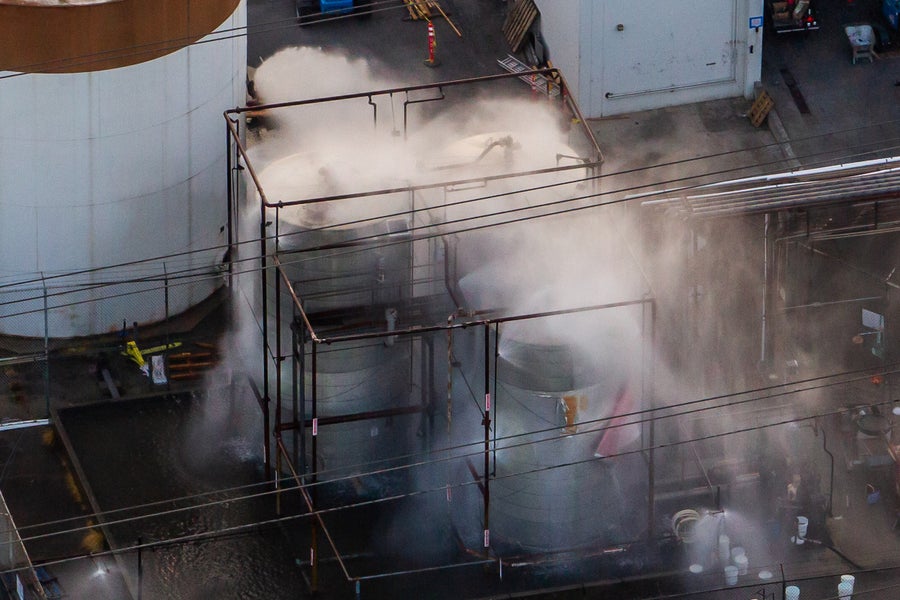
Crews spray water on an overheating tank at GKN Aerospace on May 23, 2026, in Garden Grove, California. The tank holds methyl methacrylate, used in plexiglass. Apu Gomes/Getty Images
.
.
Click the link below for the complete article:
.
__________________________________________
June 4, 2026
Mohenjo
Business, Food For Thought, Human Interest, Political, Science, Technical
amazon, business, Business News, current-events, Future, Hotels, human-rights, medicine, mental-health, research, Science, Science News, technology, Technology News, travel, vacation

Click the link below the picture
.
Every evening at about 6:30 p.m., I pour my toddler a sippy cup of cold milk and we curl up on the couch next to my husband. “Mama sit!” he says, his way of asking to sit on my lap as he enjoys his milk and a movie of his choosing. It’s a joyful moment of family time, a carefree and cozy break at the end of our busy days.
When I learned that the Food and Drug Administration paused its quality testing on milk, my mind immediately went to our sweet family ritual. It rocked me. The testing pause comes after we learned that bird flu is spreading in dairy cows, traces of the killed virus in our commercial milk supply, which was another development that caused a spike in my anxiety and a late-night message to our pediatrician. I wondered what exactly this pause in testing meant, in the literal sense, and how long it would go on. I worried I would now spend that precious family time concerned about what was in my kid’s milk.
This particular threat is just one of many. From increasing grocery prices, shuttering Head Start programs, abortion bans that make pregnancy more dangerous, bringing back measles, not to mention the threat of gun violence in schools — there are many large ways that the Trump administration has made parents’ lives more difficult — and comparatively, concern over a sippy cup of milk might seem small.
But that smallness is part of what makes this new concern feel so particularly insidious.
Milk is a drink that, for many children, becomes an extension of the comforting bond they formed with their parent through breast- or bottle-feeding, a bridge from baby- to toddlerhood. I relish my son’s faint, milky breath before bedtime, and when I read about the FDA pause, my initial panic came in part from the fear that this tether to his early moments would be severed too soon.
These seemingly small issues like the milk testing are the ones that make the everyday lived experience of parenting feel less safe — and less joyful. It’s death by a thousand cuts.
Brittney Pagone, a former nurse and current stay-at-home mom who runs the Instagram page PAMoms4Change, felt a similar panic. The news alarmed her so much, she says, that she no longer plans to wean her nearly 1-year-old daughter, opting to breastfeed for longer rather than switching to whole milk. This is a privilege, she knows; she has both the time and the ability to breastfeed her daughter, two things many moms don’t have.
The confusion Pagone felt with this news, she says, is just another part of parenting under the current Trump administration, which is currently brewing plans to boost the national birth rate. Pagone finds the administration’s push for families to have more children, at the same time eliminating the safety nets that make it feasible, utterly infuriating.
The decision to breastfeed longer than she’d planned isn’t the only one Pagone has felt forced into because of the Trump administration. Her family recently took a vacation that was close enough to Texas that she requested her infant be vaccinated for measles early.
Meanwhile, the president, who has contemplated giving people $5,000 per child to encourage larger families, has taken to billing himself as the “fertilization president.” And as we struggle to navigate what feels like an increasingly dangerous environment for our children, the government goads us to have more.
.
 Experts are reassuring, but for moms like me, the FDA pause on milk testing is just one more way parenting feels less safe — and less joyful — right now.
.
.
Click the link below for the complete article:
.
__________________________________________
June 4, 2026
Mohenjo
Business, Food For Thought, Human Interest, Political, Science, Technical
amazon, business, Business News, current-events, Future, Hotels, human-rights, medicine, mental-health, research, Science, Science News, technology, Technology News, travel, vacation

Click the link below the picture
.
The House on Wednesday voted to direct President Trump to withdraw U.S. forces from the conflict with Iran or win approval from Congress to continue the war, after four Republicans sided with Democrats in a striking sign of growing opposition to a military campaign now in its fourth month.
Adoption of the resolution was a remarkable rebuke to Mr. Trump and his handling of the conflict, after he has repeatedly dismissed any effort by Congress to curb his power and as the G.O.P. has largely ceded its prerogatives to do so, deferring to him time and again. Republicans had abruptly postponed the vote two weeks ago, recognizing that they did not have sufficient votes to defeat the measure and wanting to spare themselves and the president the affront.
But they made no headway over the ensuing days in winning converts, as the conflict has dragged on and Mr. Trump has made little progress toward ending it. G.O.P. leaders were unable to delay the vote any longer because Democrats had invoked the War Powers Resolution, which requires consideration of such measures within a limited period of time.
The move was also the latest reflection of divisions between Republicans in Congress and the president on a range of issues as their interests diverge in the run-up to the midterm congressional elections. It came after Senate Republicans have in recent days, forced Mr. Trump to abandon his request for $1 billion in security funding for his ballroom project and a plan that the Justice Department announced to create a federal fund to pay claimants who accuse the government of having victimized them.
The vote was 215 to 208 to adopt the war powers resolution, sending it to the Senate. Even if it were to pass both chambers, the ability of lawmakers to force a president to withdraw troops remains a contested legal question, and Mr. Trump and his senior aides have dismissed any effort by Congress to limit his war powers as unconstitutional.
But the vote in the House, and a similar one in the Senate last month, when a handful of G.O.P. defectors broke from the president and opposed the war, indicate an increasing willingness by some members of the president’s party to pressure him to end a conflict that a majority of Americans say is not worth the costs.
Republican Representatives Tom Barrett of Michigan, Brian Fitzpatrick of Pennsylvania, Warren Davidson of Ohio and Thomas Massie of Kentucky crossed party lines to vote with Democrats in favor of the resolution. Representative Jared Golden, Democrat of Maine, who had previously opposed similar measures, switched his position to support it.
Representative Gregory W. Meeks of New York, the top Democrat on the Foreign Affairs Committee who led the measure, praised its Republican supporters for standing up to a president who has in recent weeks sought political retribution against members of his party who have bucked him, including Mr. Massie.
Moments after the vote, he said the Republican defectors “had the wherewithal to search within themselves to do the right thing.”
Though the few defections were notable, almost every Republican voted against the resolution. Most of them have accepted the Trump administration’s claim that the initial operation had concluded and that the most recent strikes in Iran were necessary acts of self-defense, arguing that gave him full power as the commander in chief to order American troops to respond.
Republican lawmakers in the House had been able to maintain enough unity to ward off previous attempts to limit Mr. Trump’s authority.
.
 The vote on Wednesday was the latest reflection of divisions between Republicans in Congress and President Trump on a range of issues as their interests diverge in the run-up to the midterm congressional elections. Credit…Kenny Holston/The New York Times
.
.
Click the link below for the complete article:
.
__________________________________________
June 3, 2026
Mohenjo
Business, Food For Thought, Human Interest, Political, Science, Technical
amazon, business, Business News, current-events, Future, Hotels, human-rights, medicine, mental-health, research, Science, Science News, technology, Technology News, travel, vacation
Click the link below the picture
.
The Trump administration’s plan to offer plutonium from dismantled Cold War–era nuclear weapons to private energy companies is drawing criticism from experts who say it makes little economic sense and presents a national security threat.
There are currently no operational nuclear reactors in the country that are built to use plutonium-derived fuel. Instead, nuclear power plants in the U.S. are powered by a mixture of two uranium isotopes. A small portion, usually around 5 percent, of that fuel is uranium 235, which can also be used to make nuclear weapons. The majority is uranium 238, which cannot sustain a nuclear fission reaction on its own. Because of that balance, if some of this fuel were to fall into the wrong hands, it would be enormously difficult to weaponize, says Scott Roecker, vice president of nuclear materials security at the Nuclear Threat Initiative, a nonprofit dedicated to preventing nuclear catastrophe.
“The most difficult step in getting a nuclear weapon is having enough of that material,” he explains. “The U.S. government has spent probably billions of dollars over the last several decades to remove highly-enriched uranium and separated plutonium from countries that don’t need it.”
Plutonium, meanwhile, is considered a human-made element and is a by-product of the reactions that take place inside nuclear reactors. As uranium 238 is bombarded with neutrons inside the reactor, the molecules absorb some of these particles and become the heavier uranium 239, which rapidly decays and eventually becomes extremely radioactive plutonium.
That plutonium can be mixed back with uranium to be used as fuel in specific nuclear reactors called mixed oxide reactors. The U.S. abandoned mixed oxide reactors in the 1970s because they were both difficult and expensive to run. These kinds of reactors do exist elsewhere, though—in Japan, Russia, and France—but those countries have encountered their own problems with the reactors, Roecker says.
“In France, the government’s subsidizing that process,” he says. “Only I think 1 percent of the uranium that’s actually reprocessed is being reused. And in Japan, it’s cost the country billions of dollars and has still not started operation, and who knows if it actually ever will.”
The U.S. Department of Energy has defended the plan, saying the private sector could play a vital role in advancing U.S. nuclear power infrastructure. Ted Garrish, assistant secretary for the Office of Nuclear Energy, said in April that decommissioned nuclear fuel “represents an immense, untapped energy resource for the United States.”
“The Surplus Plutonium Utilization Program is anticipated to help companies unlock the next level of private funding to broaden domestic nuclear fuel supplies, spur innovation on American recycling technologies, and unlock private sector funding to fuel the nation’s nuclear renaissance,” said a DOE spokesperson in a statement, adding that five companies have been selected to take part in the program.
Aside from the concern over cost and feasibility, other experts point out that keeping plutonium secure is much more difficult than doing so with typical uranium-based nuclear fuel. Daniel Speyer, a professor of nuclear power plant systems at New York University, says he isn’t convinced that energy start-ups could properly store plutonium. Even if the material is mixed back with uranium, separating the two to isolate the highly fissile material isn’t so difficult as to be impossible, which introduces a clear security threat, he says.
“It’s not something that a small organization really probably could do, but if you give them plutonium in purer form, I think it’s almost a trivial act to make a bomb,” he says. “A simple atomic bomb is not difficult to make.”
The DOE says that any company selected to receive the Cold War–era plutonium will have to show a deep understanding of the technology involved, as well as robust security plans and regulatory compliance. The plan has also met some pushback on Capitol Hill, however. Last September, Democratic senator Edward Markey of Massachusetts and two Democratic congressional representatives sent a letter to President Donald Trump raising concerns over the risk to national security.
“The transfer of weapons-usable plutonium to private industry would increase the risk of nuclear weapons proliferation, including to rogue states or terrorists,” they wrote.
.
 Heather Khalifa/Bloomberg via Getty Images
.
.
Click the link below for the complete article:
.
__________________________________________
June 3, 2026
Mohenjo
Business, Food For Thought, Human Interest, Political, Science, Technical
amazon, business, Business News, current-events, Future, Hotels, human-rights, medicine, mental-health, research, Science, Science News, technology, Technology News, travel, vacation

Click the link below the picture
.
I’ve been writing about travel for years, and I’ll admit to being a travel addict. The moment I set foot in an airport, I smile. As a nomad by vocation, I’ve always been aware of the formative and educational value of travel: discovering new destinations opens the mind; stimulates curiosity, creativity, and our imaginations; exposes us to different ways of life; teaches tolerance; and trains us to live lightly. When in transit, you can achieve an almost Zen-like attitude when it comes to possessions and mishaps.
But a different aspect of travel has been highlighted by several recent studies: Travel is also good for the body, according to a study published in the Journal of Travel Research, if it’s done the right way. We’re not talking about the weight-training benefits of lifting suitcases, but how travel more broadly can have a positive impact on our overall health, while preventing premature aging. In short, it’s a longevity-boosting practice that can extend our lives while benefiting our mental health. But how? And why? And are there any tips and tricks for planning and executing the perfect anti-aging trip?
A new study claims that traveling extends life
Conducted by Fangli Hu, a PhD candidate at Edith Cowan University in Perth, Australia, the study argues that instead of retinol creams, travel may be the best way to combat premature aging.
“Tourism isn’t just about leisure and recreation,” says Hu. “It could also contribute to people’s physical and mental health.” In short, travel could become a real form of therapy. “Tourism typically exposes people to new surroundings and relaxing activities, and novel settings can stimulate stress responses and elevate metabolic rates, positively influencing metabolic activities and the body’s self-organizing capabilities. These contexts may also trigger an adaptive immune system response,” the ECU Newsroom reported in a story covering the study.
4 major longevity benefits of travel
Travel encourages socializing, which keeps our brains young
Much research regarding the Blue Zones of the world, where the social calendars of centenarians are packed, points to one conclusion: A rich social life is one of the keys to a long, healthy life. Travel provides opportunities to meet people, learn languages, and try new activities. All of this creates new pathways between the brain’s neurons, improving cerebral neuroplasticity and preventing neurodegenerative diseases such as dementia. It’s clear that these rewards are part of why many people choose to travel. According to a survey conducted by Amadeus, 41% of travelers hope to return home with a “calmer nervous system,” while others describe their goal as having a “refreshed brain.”
It offers new opportunities for physical activity
When traveling, we often try our hand at new activities: we go for walks, ski, hike, and climb mountains; at a resort, we might try aqua aerobics or yoga; at the beach, we’ll swim, stand-up paddleboard, surf, or join a windsurfing class. The combination of physical activity and being in the great outdoors gives the body a boost of vitality. Exercise also strengthens muscles that lose mass with age, helping us stay strong and flexible.
Travel strengthens the immune system and improves circulation
“Participating in [physical] activities could enhance the body’s immune function and self-defense capabilities, bolstering its hardiness to external risks. Physical exercise may also improve blood circulation, expedite nutrient transport, and aid waste elimination to collectively maintain an active self-healing system. Moderate exercise is beneficial to the bones, muscles, and joints in addition to supporting the body’s anti–wear-and-tear system,” says Hu.
Travel lowers stress (and cortisol) levels
According to the study, leisure travel can also help alleviate chronic stress, one of the key factors in premature aging. Stepping away from our usual routines in a different setting, far from our commitments and deadlines, can give us a sense of calm, detachment, and tranquility. Ideally, this will take place immersed in nature, the quintessential stress-relieving environment. In those situations, levels of stress hormone cortisol drop while those of serotonin and endorphins rise. The important thing is to be able to completely unplug, leaving worries at home. Stress-relieving travel can also slow the shortening of telomeres, one of the indicators of biological age.
.
 Photographed by Norman Jean Roy, Vogue, September 2012
.
.
Click the link below for the complete article:
.
__________________________________________
June 3, 2026
Mohenjo
Business, Food For Thought, Human Interest, Political, Science, Technical
amazon, business, Business News, current-events, Future, Hotels, human-rights, medicine, mental-health, research, Science, Science News, technology, Technology News, travel, vacation
Click the link below the picture
.
Judges retain a special status even after they hang up their robes. Addressing them in a 2020 article, an American Bar Association official, Marla Greenstein, wrote that “the public will forever view you as a living representative of the judicial system.”
In recent months, coalitions of retired judges have drawn on their distinctive positions to file forceful briefs supporting challenges to what they said was lawless conduct by the Trump administration.
Such briefs are, in one sense, nothing new. It is not unusual to see, for instance, a friend-of-the-court brief from a handful of retired judges concerned about a miscarriage of justice in a criminal case. But ones featuring scores of former judges taking issue with presidential initiatives seem to be on the rise.
Such briefs have attracted critics, who say it is unseemly for retired judges to trade on the prestige of their former positions. But there is reason to think the recent filings have been influential.
On Friday, a federal judge in Florida took a motion from 35 former federal judges very seriously. She ordered President Trump to respond to their request that she reopen a case the administration had used as a vehicle to create a $1.8 billion fund to compensate his allies and to shield him from tax audits and liabilities.
The former judges said the asserted settlement of the case was the product of collusion and fraud. That argument has been made far and wide, but it may have taken on special force coming from people who, as they put it in their motion, “have dedicated their professional lives to the administration of justice.”
It is possible, of course, that the judge overseeing the case, Kathleen Williams of the Federal District Court in Miami, would have taken similar actions without outside prompting or spurred by someone else’s filing. But she seemed to welcome a motion from her former peers.
‘The Federal Judges Are Infuriated’
Even larger groups of former judges have filed supporting briefs in other cases.
In a Supreme Court case on protections for immigrants, more than 175 former judges filed a brief in March arguing that the court’s emergency orders do not count as precedent binding lower courts if the justices did not give reasons. Recent emergency orders have tended to come with explanations.
In May, more than 100 former judges urged the federal appeals court in Boston to address what they called a pattern of abuse by immigration officials, including moving detained immigrants around the country to thwart court challenges and “a broader pattern of disrespect by ICE for judicial process and orders.” The case is pending.
Harold Koh, a professor and former dean of Yale Law School, is among the lawyers for the former judges in the Boston case.
“I thought we’d get about 20 judges, which is still impressive, and instead we got 135,” he said, adding that the surge of interest was driven by a threat to the rule of law.
“This is no longer about ICE versus the detainees,” Professor Koh said. “It’s about ICE versus the courts. The federal judges are infuriated.”
Perhaps the most prominent of the retired judges, Michael Luttig, signed all three of those briefs. Judge Luttig was appointed to a federal appeals court by President George H.W. Bush, served for 15 years, and was considered for a seat on the Supreme Court by President George W. Bush.
He is now a harsh critic of the Trump administration, and he said current and former judges must speak up.
“The courageous voices of the federal and state judges of the United States,” he said, “are the only voices that can and have been heard above the deafening din of partisan political rancor that is literally threatening our nation.”
Asked about the role retired judges should play in general and in the challenge to the $1.8 billion fund, Abigail Jackson, a White House spokeswoman, responded by criticizing sitting judges.
“President Trump has faced a historically unprecedented number of injunctions by liberal lower-court judges, the same judges who would rather push their own policy schemes and undermine the administration’s lawful agenda,” she said in a statement.
Todd Blanche, the acting attorney general, told lawmakers on Tuesday that the administration was withdrawing plans for the fund but would continue to shield Mr. Trump from I.R.S. audits. Mr. Trump’s response to the retired justices’ brief is due June 12.
.
 President Trump at the White House last month. Credit…Doug Mills/The New York Times
.
.
Click the link below for the complete article:
.
__________________________________________
June 2, 2026
Mohenjo
Business, Food For Thought, Human Interest, Political, Science, Technical
amazon, business, Business News, current-events, Future, Hotels, human-rights, medicine, mental-health, research, Science, Science News, technology, Technology News, travel, vacation
Click the link below the picture
.
Even casual basketball fans know that Victor “Wemby” Wembanyama is a phenom. At a towering seven feet, four inches tall, the San Antonio Spurs forward-center is among the National Basketball Association’s (NBA’s) top defenders at the net and a serious threat on offense—often attempting five or more three-point shots per game. His combination of height, agility, and all-around basketball prowess are so out of this world, in fact, that some fans have even taken to calling him “the Alien.”
In the ongoing playoffs, his three-point shooting has been on full display. In the first game of the best-of-seven NBA Western Conference Finals earlier this month, for instance, Wembanyama hit a deep three to tie the game against the Oklahoma City Thunder (OKC) with less than a minute remaining on the clock in overtime. Wembanyama and the Spurs won the game in double overtime.
Whichever team wins this series will take on the New York Knicks in the NBA Finals in June. Ahead of the Spurs and OKC’s Game 6 match on Thursday—which the Spurs won—Scientific American spoke with experts in physics and biomechanics about the science of Wemby’s epic shots to find out: How does the tallest player in the NBA keep hitting all those threes?
The science of Wemby
The NBA’s tallest players typically aren’t known for taking such deep shots as Wemby. “He’s just launching that thing,” says Larry Silverberg, an emeritus professor in mechanical and aerospace engineering at North Carolina State University. “It’s extremely unique,” he says.
A lot goes into making a three-point basketball shot. For one, there’s the player: their height, the size of their hands and arms and the mechanics of their movement affect the shot. There’s also the aim of the ball, as well as its backspin, speed, and angle of release, Silverberg explains. All these factors and more come together in determining the success of a shot.
All things being equal, experts say that height is typically thought of as an advantage on the court because taller players are physically closer to the basket ring, which stands at 10 feet above the ground, and they are harder for smaller players to block. In other words, If the Golden State Warriors’ Stephen Curry, one of the best three-point shooters of all time, was seven feet, four inches instead of six feet, two inches, he’d likely have an even greater shooting advantage. A 2008 study by Silverberg and a co-author suggested that free-throw shooters who release the ball from a higher starting point likely have greater accuracy, “as long as this does not adversely affect the player’s launch consistency.”
Taller players should, in theory, be better shooters, but that doesn’t always translate in a real-life setting, says Dimitrije Cabarkapa. A former collegiate basketball player, Cabarkapa is associate director of the Jayhawk Athletic Performance Laboratory at the University of Kansas, which is part of the Wu Tsai Human Performance Alliance, a research institute dedicated to improving human health.
In part, that may be because the NBA’s so-called big guys usually aren’t encouraged to specialize in shooting threes at an early age, and sometimes it also comes down to an individual player’s coordination and mechanics, Cabarkapa says.
“Many tall players have difficulty with these shots because their long arms can make the shooting motion harder to coordinate consistently,” says Amy Pope, a principal lecturer in physics and astronomy at Clemson University.
For Wemby, that problem doesn’t appear to be an issue: “When Victor Wembanyama shoots a successful three-pointer, what stands out to me is his body mechanics,” Pope says. “His torso stays nearly vertical. Many shorter shooters need a stronger upward jump and more forward momentum to get the necessary range. Wembanyama’s release point is so high that he does not need this large boost from his legs, giving his body a straight appearance.” In fact, all he needs for the right exit velocity is “a small vertical jump,” she says.
Wemby is also notably flexible, which can be its own advantage. For the best shooting proficiency, research by Cabarkapa and his colleagues shows that three-point shooting starts from the “bottom up.” “You’ve got to put your butt closer to the ground, keep your torso in near vertical position, and make sure that your elbow is tucked under the basketball,” he says. It also helps to have greater “flexion,” or bend, in your hips, knees, and ankles.
“If somebody doesn’t have a proper range of motion in the knee or hip joint, they may not be able to achieve enough flexion in those joints, which is necessary to generate force and perform an efficient shooting motion,” he says. And some skills, of course, go beyond biomechanics.
“[Wembanyama] knows he’s seven-foot-four. He knows that people generally are not going to block him, but he goes the extra mile. He says, ‘I’m going to take it from even further out,’” Silverberg says. “Besides being tall, agile, and skilled, he’s even being a little bit creative there by deciding to work on a shot that nobody else would. I think that’s pretty neat.”
.

Victor “Wemby” Wembanyama. Photo by Alex Slitz/Getty Images
.
.
Click the link below for the complete article:
.
__________________________________________
Older Entries
Newer Entries
 James' World 2