Home

This new emoji is all of us in 2026

Leave a comment

Click the link below the picture

.

It’s a new year, and that means a new opportunity for Apple to debut an emoji that perfectly encapsulates the current state of online culture. 

Last year, the company unveiled “Face With Bags Under Eyes,” a beleaguered little guy with the weight of the world on his shoulders who felt like the visual equivalent of the first year of another Trump administration. And in 2026, it appears that Apple has done it again.

The company is currently beta-testing iOS 26.4, a software update that’s expected to debut sometime in late March. The update will include new features in Apple Music, video upgrades in Apple Podcasts, and a few new widgets. It will also come with Apple’s much-anticipated annual drop of new emoji—one of which has already solidified its spot as the defining emoji of 2026 before it’s even officially available. 

We’re all a little bulge-eyed right now

Apple’s eight new emoji are a predictably mixed bag that range from a dust cloud and an orca to a landslide and an artistic interpretation of Bigfoot. But the true standout from this fresh crop of group chat fodder is undoubtedly “Distorted Face.” 

“Distorted Face” has a blushing, bug-eyed expression that looks like he’s been inflated like a helium balloon. Aesthetically, he feels like a relative of the variety of deep-fried emoji memes that Gen Z netizens have turned into popular reaction images. These images take a classic smiley emoji and edit it to convey a more niche emotion, like existential dread or incredulity (one popular example, which doesn’t have an official name, seems likely to be the design inspiration for “Distorted Face”).  

But, on a deeper level, “Distorted Face” is all of us in 2026. The unique blend of exasperation, shock, silliness, and resignation has endless applications: It’s all of us watching the most heinous AI slop videos dupe our relatives on the internet; seeing GLP-1 brands taking over our pharmacy shelves and grocery store aisles; and witnessing the president wear self-promotional branded merch during the dignified transfer of the remains of six U.S. service members.

Already, the internet is predicting that “Distorted Face” is going to have a big year. “About to be most-used emoji in history,” reads one tweet with more than 50,000 likes. A commenter under the post added: “This is literally the ‘I have no words’ emoji.”

If “Face With Bags Under Eyes” captured the “resigned expression of someone who’s well past their limit but is still soldiering on,” as Fast Company put it last year, then “Distorted Face” is the embodiment of someone who cannot really be surprised anymore—yet still manages it somehow.

.

https://images.fastcompany.com/image/upload/f_webp,c_fit,w_750,q_auto/wp-cms-2/2026/03/p-91506158-distorted-face-emoji.jpg[Image: Apple]

.

.

Click the link below for the complete article:

https://www.fastcompany.com/91506158/distorted-face-emoji

.

__________________________________________

How Trump and His Advisers Miscalculated Iran’s Response to War

Leave a comment

Click the link below the picture

.

On Feb. 18, as President Trump weighed whether to launch military attacks on Iran, Chris Wright, the energy secretary, told an interviewer he was not concerned that the looming war might disrupt oil supplies in the Middle East and wreak havoc in energy markets.

Even during the Israeli and U.S. strikes against Iran last June, Mr. Wright said, there had been little disruption in the markets. “Oil prices blipped up and then went back down,” he said. Some of Mr. Trump’s other advisers shared similar views in private, dismissing warnings that — the second time around — Iran might wage economic warfare by closing shipping lanes carrying roughly 20 percent of the world’s oil supply.

The extent of that miscalculation was laid bare in recent days, as Iran threatened to fire at commercial oil tankers transiting the Strait of Hormuz, the strategic choke point through which all ships must pass on their way out of the Persian Gulf. In response to the Iranian threats, commercial shipping has come to a standstill in the Gulf, oil prices have spiked, and the Trump administration has scrambled to find ways to tamp down an economic crisis that has triggered higher gasoline prices for Americans.

The episode is emblematic of how much Mr. Trump and his advisers misjudged how Iran would respond to a conflict that the government in Tehran sees as an existential threat. Iran has responded far more aggressively than it did during last June’s 12-day war, firing barrages of missiles and drones at U.S. military bases, cities in Arab nations across the Middle East, and on Israeli population centers.

U.S. officials have had to adjust plans on the fly, from hastily ordering the evacuation of embassies to developing policy proposals to reduce gas prices.

After Trump administration officials gave a closed-door briefing to lawmakers on Tuesday, Senator Christopher S. Murphy, Democrat of Connecticut, said on social media that the administration had no plan for the Strait of Hormuz and did “not know how to get it safely back open.”

Inside the administration, some officials are growing pessimistic about the lack of a clear strategy to finish the war. But they have been careful not to express that directly to the president, who has repeatedly

declared that the military operation is a complete success.

Mr. Trump has laid out maximalist goals like insisting that Iran name a leader who will submit to him, while Secretary of State Marco Rubio and Defense Secretary Pete Hegseth have described narrower and more tactical objectives that could provide an off-ramp in the near term.

Karoline Leavitt, the White House press secretary, said the administration “had a strong game plan” before the war broke out, and vowed that oil prices would drop after it ended.

“The purposeful disruption in the oil market by the Iranian regime is short term, and necessary for the long-term gain of wiping out these terrorists and the threat they pose to America and the world,” she said in a statement.

This article is based on interviews with a dozen U.S. officials, who asked for anonymity to discuss private conversations.

Mr. Hegseth acknowledged on Tuesday that Iran’s ferocious response against its neighbors caught the Pentagon somewhat off guard. But he insisted that Iran’s actions were backfiring.

“I can’t say that we anticipated necessarily that’s exactly how they would react, but we knew it was a possibility,” Mr. Hegseth said at a Pentagon news conference. “I think it was a demonstration of the desperation of the regime.”

Mr. Trump has displayed growing frustration over how the war is disrupting the oil supply, telling Fox News that oil tanker crews should “show some guts” and sail through the Strait of Hormuz.

Some military advisers did warn before the war that Iran could launch an aggressive campaign in response, and would view the U.S.-Israeli attack as a threat to its existence. But other advisers remained confident that killing Iran’s senior leadership would lead to more pragmatic leaders taking over who might bring an end to the war.

When Mr. Trump was briefed about risks that oil prices could rise in the event of war, he acknowledged the possibility but downplayed it as a short-term concern that should not overshadow the mission to decapitate the Iranian regime. He directed Mr. Wright and Treasury Secretary Scott Bessent to work on developing options for a potential spike in prices.

But the president did not speak publicly about these options — including political risk insurance backed by the U.S. government, and the potential of U.S. Navy escorts — until more than 48 hours after the conflict started. The escorts have not yet taken place.

Mr. Wright, the energy secretary, caused a market commotion Tuesday when he posted on social media that the Navy had successfully escorted an oil tanker through the Strait of Hormuz. His post drove up stocks and reassured oil markets. Then, when he deleted the post after administration officials said no escorts had taken place, markets were once again thrust into turmoil.

Efforts to resume shipments have been complicated by intelligence that Iran was preparing to lay mines in the strait, one U.S. official said. The Iranian operation was only in its earliest stages, but the preparatory efforts spooked the Trump administration. The U.S. military said on Tuesday evening that its forces had attacked 16 Iranian mine-laying vessels near the strait.

As the conflict has roiled global markets, Republicans in Washington have grown concerned about rising oil prices damaging their efforts to sell an economic agenda to voters ahead of the midterm elections.

Mr. Trump, both publicly and privately, has been arguing that Venezuelan oil could help solve any shocks coming from the Iran war. The administration announced on Tuesday a new refinery in Texas that officials said could help increase oil supply, ensuring that Iran does not cause any long-term damage to oil markets.

The confidence that White House officials had that the shipping lanes could stay open is surprising given that Mr. Trump authorized a military campaign last year against the Houthis, a Yemeni group backed by Iran, that had used missile and drone attacks to bring maritime commerce in the Red Sea to a halt.

In a social media post last March announcing he had authorized military strikes against the Houthis, Mr. Trump said that the attacks had cost the global economy billions of dollars, and that “no terrorist force will stop American commercial and naval vessels from freely sailing the Waterways of the World.”

But since the start of the war in Iran, Mr. Trump has not offered a consistent message. In private, his aides have said they feel frustration over his lack of discipline in communicating the objectives of the military campaign to the public.

Mr. Trump has said both that the war could go on for more than a month and that it was “very complete, pretty much.” He also said the United States would “go forward more determined than ever.”

Mr. Rubio and Mr. Hegseth, however, appear to have coordinated their messaging for now on three discrete goals that they began laying out in public remarks on Monday and Tuesday.

“The goals of this mission are clear,” Mr. Rubio said at a State Department event on Monday before Mr. Trump held his own news conference. “It is to destroy the ability of this regime to launch missiles, both by destroying their missiles and their launchers; destroy the factories that make these missiles; and destroy their navy.”

The State Department even laid out the three goals in bullet-point fashion, and highlighted a video clip of Mr. Rubio stating them on an official social media account.

The presentation by Mr. Rubio, who is also the White House national security adviser, appeared to be setting the stage for the president to bring an end to the war sooner rather than later. In his news conference, Mr. Trump boasted of how the U.S. military had already destroyed Iran’s ballistic missile capability and its navy. But he also warned of even more aggressive action if Iranian leaders tried to cut off the world’s energy supply.

Matthew Pottinger, who was a deputy national security adviser in the first Trump administration, said in an interview that Mr. Trump had indicated he could decide to pursue ambitious war goals that would take weeks at least.

“In his press conference, I could hear him circling back to a rationale for fighting a bit longer given that the regime is still signaling it won’t be deterred and is still trying to control the Strait of Hormuz,” said Mr. Pottinger, now the chair of the China program at the Foundation for Defense of Democracies, a group that advocates a close U.S. partnership with Israel and confrontation with Iran.

“He doesn’t want to have to fight a ‘sequel’ war,” Mr. Pottinger added.

The search for pathways out of the war has gained urgency since the weekend, as global oil prices surge and as the United States burns through costly munitions. Pentagon officials said in recent closed-door briefings on Capitol Hill that the military used up $5.6 billion of munitions in the first two days of the war alone, according to three congressional officials. That is a far larger amount and munitions burn rate than had been publicly disclosed. The Washington Post reported on the figure on Monday.

Iranian officials have remained defiant, saying they will use their leverage over the world’s oil supply to force the United States and Israel to blink.

“Strait of Hormuz will either be a Strait of peace and prosperity for all,” Ali Larijani, Iran’s top national security official, said in a social media post on Tuesday. “Or it will be a Strait of defeat and suffering for warmongers.”

.

https://static01.nyt.com/images/2026/03/10/multimedia/10dc-iran-planning-hmpg/10dc-iran-planning-hmpg-jumbo.jpg?quality=75&auto=webpIn response to Iranian threats, commercial shipping has come to a standstill in the Gulf, and oil prices have spiked. Credit…Benoit Tessier/Reuters

.

.

Click the link below for the complete article:

https://www.nytimes.com

.

__________________________________________

Mumps infections reveal that vaccine-preventable illnesses are resurging in the U.S.

Leave a comment

Click the link below the picture

.

Mumps is back. The viral respiratory infection has been detected in at least 34 people across 11 U.S. states, according to the most recent Centers for Disease Control and Prevention data. And at least one state, Maryland, has issued an alert about the disease, which has caused at least 26 reported cases in the state as of February 19, CNN reported.

Mumps, which causes painful mouth swelling, is preventable with two doses of the measles, mumps, and rubella (MMR) vaccine. But vaccination rates in children have fallen as antivaccine sentiment has grown in the wake of the COVID pandemic, leading to a massive spike in measles outbreaks in the past year.

Mumps infects the salivary glands below the ears. The virus spreads via respiratory droplets and saliva through coughing, sneezing, talking, or sharing eating utensils. It can take two to four weeks for people to show symptoms after they are infected. Aside from the jaw swelling, mumps can cause other viral symptoms, such as fever, headache, and muscle ache. While children tend to have either mild disease or even no symptoms at all, in teenagers and adults, mumps tends to be more severe. There is no specific treatment for mumps, but rest, hydration, and pain relievers such as ibuprofen can help people recover.

One of the most painful complications of mumps is orchitis, or swelling of the testicles, which can harm fertility. The disease can also cause oophoritis or mastitis, which respectively mean inflammation in the ovaries or breasts. In rare cases, mumps can also result in meningitis—inflammation of the lining of the brain and spinal cord—or encephalitis, which is inflammation of the brain itself. Additionally, the illness can cause permanent hearing loss. Unvaccinated individuals are both more likely to be infected with mumps and more likely to have complications from the virus.

Since the first mumps vaccine came out in 1967, there has been a 99 percent decrease in cases of the disease in the U.S. But it still causes outbreaks, especially in places where people are in close contact, such as in schools, universities, and prisons.

To protect against mumps, children are recommended to receive two doses of the MMR vaccine, the first at 12 to 15 months of age and the second at four to six years old. Two doses are 86 percent effective at preventing mumps; a single dose is 72 percent effective. Vaccinated people can still get infected, especially as immunity from the shots wanes over time, but if they do, they typically have a milder infection.

.

https://static.scientificamerican.com/dam/m/764070fc74d393f2/original/GettyImages-2216284321_resized.jpeg?m=1772818038.155&w=900

Illustration of the human mumps virus, a member of the Paramyxoviridae family. RUSLANAS BARANAUSKAS/SCIENCE PHOTO LIBRARY/Getty Images

.

.

Click the link below for the complete article:

https://www.scientificamerican.com/article/mumps-infections-reveal-that-vaccine-preventable-illnesses-are-resurging-in/

.

__________________________________________

The Four House Democrats Who Voted Against the War Powers Resolution to Rein in Trump on Iran

Leave a comment

Click the link below the picture

.

Four Democrats split from the rest of their party to vote down the War Powers Resolution, which would have halted President Donald Trump from continuing strikes against Iran without first gaining Congressional approval.

Much like it was in the Senate the day before, the measure was defeated in the Republican-led House of Representatives Thursday evening with a 212-219 vote.

With voting largely representing party lines, all but two GOP lawmakers moved against the measure—Representatives Thomas Massie of Kentucky, a lead sponsor of the resolution, and Warren Davidson of Ohio.

“The Constitution is clear… Our Constitution provides Congress initiatory powers of war,” said Massie during a rousing debate on the House floor. Massie has broken ranks from President Donald Trump and strayed from party lines on other key topics, such as the row over Greenland, often earning him the wrath of the Commander-in-Chief.

However, it’s arguably the Democrat votes that have garnered the most discussion. 

Some Democratic members of the House who had previously stated an intention to vote against the War Powers Resolution, which was first introduced by Massie and Democrat Ro Khanna of California in June last year, reversed course. The impact of Trump joining forces with Israel last weekend to launch surprise strikes on Iran and the widening war that has since emerged prompted some to change their position.

“When it appeared we might preemptively vote on the War Powers Resolution while the U.S. and Iran were in the middle of negotiations, I said I would be a ‘no’ vote because I believed that calling up the resolution at that time could undermine negotiations and telegraph to the Ayatollah that we weren’t applying maximum pressure and that he could delay a deal,” Rep. Jared Moskowit z of Florida said as he explained his change of heart. “A lot has changed in a week.”

While Moskowitz argued that “no one will miss” Iran’s Supreme Leader Ali Khamenei, who was killed in early strikes, and implored that Iran must be prohibited from ever having a nuclear weapon, he pointed to mounting concern over the lack of Congressional oversight.

“Over the last year, we have seen a ludicrous increase in the speed of Congress’ abdication of authority to the Executive Branch,” he argued. “We must begin to claw back that prerogative. We must reestablish our Article I authority, which grants Congress all legislative powers.”

Rep. Josh Gottheimer also changed course by voting to pass the resolution, voicing concern over, what he described as, the lack of a “coherent explanation of what precipitated this war.”

“What I have heard publicly and in classified briefings are shifting justifications and objectives from Administration officials and the President,” he said, adding that he hopes his questions will be answered in the coming weeks, ahead of the next vote during the week of March 23.

But four Democratic lawmakers did vote against the War Powers Resolution on Thursday, defying party leadership. Here’s who they are—and the reasons they offered for their votes:

Rep. Jared Golden of Maine

Rep. Jared Golden, who serves on the House Armed Services Committee, the Seapower and Projection Forces Subcommittee, and the Intelligence and Special Operations Subcommittee, has voted in favor of the Trump Administration’s position in a few recent votes. In February, he voted against a proposal from his party colleague to block Trump’s tariffs on Canada, the only Democrat to do so. He also voted last November against the majority of his party to end the record-long government shutdown.

Golden once again went against party lines on Thursday, instead sponsoring an alternative resolution alongside Rep. Gottheimer that would give Trump a 30-day window (instead of the current 60 days he has to make his case for ongoing operations) to end military action.

“The President has not provided sufficient clarity for why this action was necessary at this exact moment. But servicemembers are actively engaged in hostilities, our allies are under attack, and the Iranian regime is more desperate than ever to reassert its power,” said Golden, in a statement released after the vote.

“While I do not believe that an abrupt about-face is a good course of action given the reality on the ground, that should not be construed as my approval. While conflict requires that we remain flexible to shifting circumstances, at this time I would not support Congressional authorization or funding for sustained combat operations.”

Golden argued that Trump has “so far acted within the authorities given to him by Congress through the War Powers Act of 1973,” but warned that could change. “This is not an illegal war—but it could become one,” he said.

Rep. Greg Landsman of Ohio

Rep. Greg Landsman co-sponsored the alternative measure put forward by his colleagues, but also voted against the War Powers Resolution.

He was critical of the Trump Administration’s attack on Iran, alongside Israel, but argued that the current operation still needs to be concluded. 

“I think it’s important to say, look, this is not good policy. What’s better policy is to allow the military and our allies to finish this particular operation, which is targeted, just the missiles, the launchers, and the ships. That’s it. And then be done,” he told C-SPAN.

Rep. Henry Cuellar of Texas

Rep. Henry Cuellar, in a statement shared with TIME, said he voted no on the resolution because he believes “Congress must exercise oversight responsibly while ensuring our military can protect American lives and interests.”

“I’m supporting a more responsible approach that provides clear oversight and stability. That’s why I helped introduce legislation that directs the President to end military action within 30 days unless Congress provides authorization,” he added, highlighting his support of the alternative resolution.

Cuellar emphasized he does not support an “endless war” and said Congress has a responsibility to “ensure that the use of military force is carefully reviewed, limited in scope, and guided by clear objectives.”

It isn’t the first time Cuellar has moved against the majority of his party, as he previously voted alongside many Republicans to end the government shutdown in November.

Rep. Juan Vargas of California

Rep. Juan Vargas voted against the resolution, in a move that set him aside from other San Diego representatives such as Scott Peters, Sara Jacobs, and Mike Levin, who all moved to rein in Trump’s military action in Iran.

Vargas has not yet released a statement detailing his vote, nor has he expressed support for the alternative war powers resolution.

.


House Of Representatives Votes On War Powers ResolutionAnna Moneymaker—Getty Images

.

.

Click the link below for the complete article:

https://time.com/7382846/democrats-who-voted-against-war-powers-resolution-iran-conflict-trump/

.

__________________________________________

Unlike in Past Conflicts, Most Americans Oppose Iran Attacks

Leave a comment

Click the link below the picture

.

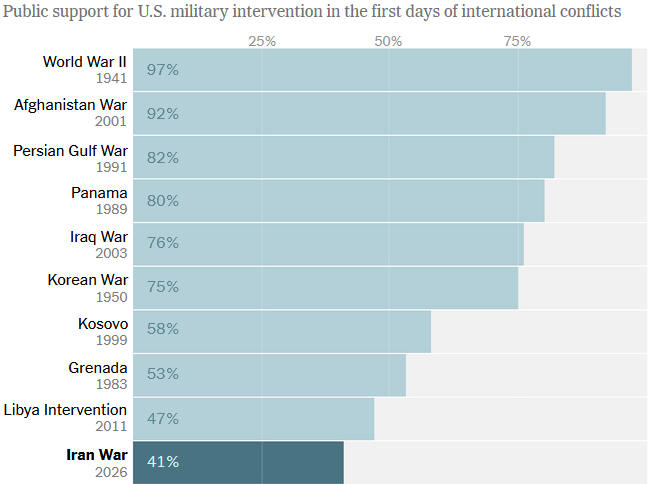
In the days after President Trump launched U.S. forces in an attack against Iran, support for the strikes is far lower than what it has been at the beginnings of previous foreign conflicts.

So far, polls have found that most Americans oppose the Iran attacks. Support ranges from 27 percent in a Reuters/Ipsos poll to 50 percent in a Fox News poll. The wide variation suggests that public opinion is still taking shape as more Americans learn details of the attacks and the aftermath.

But even the highest level of public support for this conflict falls far lower than that at the start of most other conflicts, including World War II, the Korean War, and the Iraq War.

In the days after the United States was attacked at Pearl Harbor and subsequently declared war against Japan, 97 percent of the public supported the move, according to Gallup. And in the days after President George W. Bush put troops on the ground in Afghanistan, 92 percent of Americans were on board in a Gallup poll.

As unpopular as the Iraq War ultimately became, 76 percent of Americans approved of the decision to go to war in a poll taken the day after the conflict began.

A part of this difference in support, said Sarah Maxey, an associate professor of international relations at Loyola University of Chicago, is the way previous presidents have taken the time to sell wars to the public.

“Before the Iraq War in 2003, we had a whole year of why this mattered, why we exhausted other operations, why we needed this,” said Ms. Maxey, who studies public opinion around war and foreign conflicts. “We have not had many foreign conflicts without a clear communication strategy beforehand.”

But there are also larger forces at play.

At the beginning of wars, presidents typically experience what researchers call the “rally around the flag effect,” where support swells, even among those who otherwise disapprove of the president.

As polarization has grown over the last 30 years and Americans have drifted further apart politically, that effect has diminished.

“People from the opposing party of the president have been the source of most of the rally, but Democrats are not going to rally behind Trump,” said Matthew Baum, a professor at Harvard University who studies public opinion on foreign policy.

“For this president, to the extent that he has any rally from his base, he has a base who thinks they hired him to get him out of wars,” he added.

Support for wars typically wanes over time, as casualties increase and Americans start to feel the costs of war.

Near the start of the Vietnam War, a 60 percent majority of Americans did not see the war as a mistake. But as the number of casualties grew, so did the public’s doubts. By 1969, a majority of the public said the war was a mistake. That number continued to grow as the war went on. (There is no polling on public approval of the Vietnam War at the start of the conflict.)

Popular sentiment about the Iraq War plummeted soon after it began, with just 43 percent of Americans supportive of the war by the end. That drop in support, though, occurred across both parties.

But long gone are the days of a unified national front.

“To the extent that politics used to stop at the water’s edge, that’s no longer the case,” Mr. Baum said.

.

.

.

Click the link below for the complete article:

https://www.nytimes.com/2026/03/10/us/politics/polls-wars-us-support.html

.

__________________________________________

It’s time to speak out against the unchecked growth of satellite mega constellations

Leave a comment

Click the link below the picture

.

I remember the first time I saw a satellite. I was a teenager, standing in my mildly light-polluted suburban yard and doing my usual stargazing. The satellite was a faint “star” moving slowly and smoothly across the sky, and as I watched it, I felt a mix of awe and wonder that such a thing could be seen—and that humans could put an object into orbit at all.

That was a lifetime ago, and I now look back on that evening with more discomfiture than nostalgia; my adolescent naivete feels almost embarrassing.

That’s because, these days, seeing one of those celestial travelers fills me with dread. We are firmly in the era of the satellite constellation—groups of dozens of similar satellites—and are currently entering the era of the mega constellation, wherein groups of thousands of satellites swarm the skies. The clusters of satellites started small, but, like a viral outbreak, they grew almost without us noticing—and now we’re dealing with a pandemic.

I wrote about this problem for Scientific American in May 2023. At the time, there were 7,500 active satellites orbiting Earth; more than half of them were SpaceX Starlink satellites that provided Internet service. In a little under three years, the number of just Starlink satellites in orbit has reached nearly 10,000. Today, there are literally more Starlink satellites up there than the sum total of all other operational satellites.

This ratio will almost certainly get more skewed toward Starlink, too; back in 2019, when the first Starlink satellites were launched, SpaceX filed with the Federal Communications Commission (FCC) for up to 30,000 additional satellites.

Does that sound bad? Well, there may come a day, all too soon, when we’re nostalgic for such a small a number of satellites cluttering the sky. On January 30, 2026, SpaceX filed for permission to launch as many as one million more satellites.

Yes, one million.

SpaceX’s plan is for this sprawling mega constellation to become a distributed network operating as an orbital data center, similar to ground-based data centers that provide the information processing backbone of the Internet. In this case, instead of having equipment capable of all that processing power stored in massive warehouses, each satellite in orbit would do a small part of the number crunching and then beam the final results back to the ground.

In principle, such plans could ease the insatiable power demands and environmental effects of ground-based centers. In 2023, data centers in just the U.S. consumed a staggering 176 million megawatt-hours of energy—a little more than 4 percent of the nation’s annual electricity usage and enough to power 16 million homes for a year. Many of these centers are powered by fossil fuels that add greenhouse gases into the atmosphere that worsen global warming. These centers also need to be cooled, and they typically consume vast amounts of water to do so. And as the use of computationally-intensive artificial intelligence soars, so, too, will the appetite for ever more power—and the potential for ever greater environmental harm.

Exporting most of that “compute” to orbit, SpaceX claims, is how to break this vicious cycle. And there is some truth to that: the satellites will be solar powered, easing the electricity demand on Earth. They also won’t need water to cool their hot chips but will instead rely on large radiators to vent heat—a slower, less efficient method, but the best one available in the near-vacuum of space. Currently in-use Starlink satellites already cool themselves this way, and the heat load for a satellite used to process data would be roughly the same as one used to provide Internet, so this isn’t the showstopper problem many people assume it to be.

So, if you don’t look too deep, large-scale orbital data centers might make sense. Scratching the surface of this idea, however, shows just how colossally terrible it is.

First, those satellites need to get to space. As astrophysicist Jonathan McDowell, my friend and colleague, points out, SpaceX claims that its Starship rocket can (once it passes testing) take 150 metric tons to low-Earth orbit, but there are good reasons to think the real operational capacity will prove be more like 100 metric tons. Assuming that low-Earth orbit is in fact where all the satellites will go (and many will undoubtedly need to fly higher), and that they each are two metric tons, that means Starship can launch around 50 satellites at a time—so creating this mega constellation even under very optimistic assumptions would require some 20,000 Starship launches.

It gets worse: these satellites will fail after a few years and will need to be replaced. In the end, upkeep for this notional million-satellite mega constellation could take on the order of 10 Starship launches per day, forever.

The environmental effect of all this wouldn’t be trivial. A single Starship launch emits 76,000 metric tons of carbon dioxide equivalent, for example, leaving aside issues of noise pollution and potential damage to nearby habitats. Twenty thousand launches would have an immense effect, including more damage to our critical ozone layer. The fiery atmospheric reentries of satellites would be a source of pollution, too, dumping significant amounts of vaporized metal and plastic into our planet’s fragile upper atmosphere. At least one Starlink satellite is already burning up like this every day, based on when these satellites started entering orbit, and their planned replacement cycles—and orbital data centers could make this reentry rate skyrocket.

As if this weren’t enough, a proliferation of mega constellations also carries risks for the orbital environment itself. The volume of satellites already over our head is huge, but the numbers of proposed satellites are so vast that space traffic management to avoid collisions would become an even more massive task. Even a single collision in orbit can become catastrophic; these satellites are moving at speeds many times faster than a rifle bullet, and a direct hit from one creates a cloud of shrapnel. That debris spreads, hitting other satellites and creating even more debris, resulting in a violent cascade called the Kessler syndrome. Triggering this syndrome is already a real concern, despite orbital decay naturally “cleaning” low-Earth orbit over time. Increasing the numbers of satellites by several thousandfold could make this threat apocalyptically worse.

And as an astronomer, I can’t help but worry over the effect on my beloved field. A study published last December in Nature showed that if there were roughly half a million satellites in orbit, at least one would contaminate essentially every observation taken by the Hubble Space Telescope. Ground-based telescopes would also be severely affected; they already are now! Vaporized debris from reentries will also add to sky glow, making it more difficult to see faint cosmic objects. Even simple stargazing from your backyard would be affected. In a very real sense, by launching so many satellites, we risk losing the sky.

Keep in mind that SpaceX is not the only one crowding the sky. China has filed to launch 200,000 satellites for its own network. Other countries and companies will no doubt follow suit; Amazon and Blue Origin already plan on launching thousands of satellites each as well. Even more concerning is a new company, called Reflect Orbital, that wants to launch thousands of giant space mirrors into orbit to provide “sunlight on demand” anywhere on Earth. The beams would be far brighter than the full moon and, even if carefully pointed, would scatter in the atmosphere to be very bright off-beam, disrupting wildlife and effectively destroying the sky’s remaining natural beauty by erasing the stars from our sight. These mirrors are a truly terrible idea.

That’s the common theme here, in fact. Even ignoring the deeply disturbing environmental and light pollution from all these launches and reentries, there is another effect. Our night sky—and it is ours—is a natural wonder, a cosmic park we need to preserve, not exploit with a laissez-faire attitude. This careless exploitation of the heavens above is a real danger to us all.

.

https://static.scientificamerican.com/dam/m/2ee5a500a54116fc/original/2XCRY0H_WEB.jpg?m=1719272145.488&w=900

Light trails from satellites in low-Earth orbit fill the sky in this composite long-exposure photograph, which was captured over a 30-minute period. Alan Dyer/VWPics/Alamy Stock Photo

.

.

Click the link below for the complete article:

https://www.scientificamerican.com/article/rampant-growth-of-satellite-mega-constellations-could-ruin-the-night-sky/

.

__________________________________________

7 common household items owned in the ’70s that are now worth a small fortune

Leave a comment

Click the link below the picture

.

Casserole dishes may have gone out of style, but they can still turn a tidy profit

Iconic cookware

Whether you opted for snowflakes or daisies, Pyrex dishes were a staple of the ’70s and ’80s. If you’ve got any of this iconic cookware hiding in your cupboard or stored away with the festive mugs, we recommend a bit of Spring cleaning.

You’re not guaranteed a goldmine, with some dishes on eBay starting from around £10, but there’s a chance you may get lucky: Some vintage CorningWare sets are currently up for sale in the hundreds. And, it doesn’t stop there! A 2-piece CorningWare set is currently up for over £7,300.

Lettera 22 typewriter on a black background.

Click, clack, thunk. It’s the sound of a stressed Seventies secretary at work

Typewriters

When convenience starts removing the more whimsical side of life, like the melodic clunk of a typewriter, we all seem to long for something less streamlined and more mechanical.

A hand-typed letter certainly has something more special to it than a text, and the vintage technology is readily available. Prices start at about £30 on eBay, but special edition machines can head upwards of £700.

VCR recorder

Nothing beats your favourite film on demand, except maybe a hidden treasure in the attic

VCR recorder

If you remember the day you stopped running from the bus to your TV set at home, there’s a chance you’ve encountered a VCR. Long before streaming services, when the thought of Netflix or Amazon Prime would be tantamount to a hoverboard, a video recorder made you the coolest kid on the block.

Watching films or recording the latest episode of your favourite show might not sound revolutionary now, but we’re clearly feeling nostalgic for early tech inventions. You could make a good profit with one VCR recorder listed for over £250 and others circling £100.

Luke Skywalker action figure in original packaging.

Luke Skywalker fronted the beloved sci-fi franchise and made it onto wishlists around the world

Luke Skywalker action figure

In a galaxy far, far away, ’70s kids sat in the cinema not knowing they were watching history unfold on the big screen. Childhood toys naturally hold a special place in our hearts, even when Luke’s telekinetic powers failed to materialise in our own lives. 
If your birthday list included a figurine or two, now would be the time to dig them out. Unboxed figurines start at about £30 on eBay – dependent on rarity and, of course, condition. Sotheby’s 2015 auction is sure to excite you. Just over 10 years ago, a boxed figurine sold for almost £20,000.

Train sets

Choo, chug or chuff, your old train sets are steaming ahead to a new owner

Train sets

Train connoisseurs take their model railways seriously, and if you were lucky enough to discover your passion early on, it might be time to pick up that whistle once more. Hornby is an iconic brand and sets of these beloved toys go for around £100 on eBay, with some active listings reaching over £2000. That’s a first-class ticket to a healthier bank balance (and a tidier downstairs cupboard).

IKEA furniture

Early IKEA is a coveted find for furniture lovers

IKEA furniture

Vintage furniture has a reputation for quality, from raw material to long-lasting construction. While IKEA might bring to mind horror stories of flatpack arguments, even the Swedish furniture company has a more, if you’ll pardon the pun, solid reputation in its past production lines.

Their 1970s Cavelli armchair could potentially go for over £10,000, and even older models can fetch more. In other words, it might be worth looking for gold in the sofa itself, rather than just its cushions.

Original Sony Walkman shown with orange headphones in an exhibition case.

The original ‘Walkman’ made music portable, and buyers are keen to splash out on that heady nostalgia

Original ‘Walkman’

The first Sony ‘Walkman’ snuck in just before the decade’s end, arriving in stores in 1979. Private listening wasn’t just confined to a slammed bedroom door; now you could moodily walk through the local park with headphones blaring AC/DC’s Highway to Hell.

If you’re happy parting with your ‘Walkman’ in favour of a Bluetooth headset, it could be worth a rummage in your cupboards. Complete kits are listed for as much as £1,500 on eBay. Perfect pocket money for a new set of vinyl records – wait, vinyl’s back too?

.

(Getty Images)

.

.

Click the link below for the complete article:

https://ca.style.yahoo.com/7-common-household-items-owned-123039710.html

.

__________________________________________

Israeli Forces Raid New Areas in Southern Lebanon

Leave a comment

Click the link below the picture

.

Israeli forces advanced in southern Lebanon on Monday, raiding new territory as part of a stated effort to expand a military-controlled buffer zone as it steps up its campaign against the Iran-backed armed group Hezbollah.

Israeli fighter jets also bombarded the southern outskirts of Beirut, the Lebanese capital, sending huge explosions echoing throughout the city. Earlier on Monday, Israel had threatened to begin attacking sites affiliated with Al-Qard Al-Hasan, Hezbollah’s de facto bank.

Israeli ground forces began raiding an area close to the border with Lebanon, the military said in a statement, after advancing in the border area over recent days and seizing new sites inside Lebanon.

Nearly 400 people had been killed, including more than 80 children, in the conflict in Lebanon as of Sunday, according to the Lebanese health ministry. Edouard Beigbeder, the regional director for UNICEF, the United Nations’ children’s agency, called the death toll “a stark testament to the toll that conflict is taking on children.”

The Israeli military said on Sunday that it had killed more than 190 militants, without commenting on the rest of the dead.

The conflict ignited last week, when Hezbollah launched a rocket attack against Israel, in retaliation for the killing of Ayatollah Ali Khamenei, whom Israel assassinated in the opening strikes of the U.S.-Israeli war with Iran. Since then, the Israeli military has responded with an escalating military campaign across Lebanon.

Lebanon’s Parliament announced on Monday that it would postpone for two years legislative elections that had been set to take place in May because of the conflict. The Lebanese government has faced considerable pressure to disarm Hezbollah, which is also an entrenched political party and social movement.

Hezbollah is facing rising public frustration at home, where some Lebanese say they have now been dragged unwillingly into a dangerous and deadly confrontation with Israel without any clear benefit.

Analysts say the Israeli actions could signal that a wider ground invasion in Lebanon is in the works. The Israeli military has called up roughly 100,000 reserve soldiers as part of the war with Iran, some of whom have been sent to the northern border.

Lt. Col. Nadav Shoshani, an Israeli military spokesman, dismissed that prospect. “This is part of our forward defense posture. This is a measure to make sure that our troops in those positions are safe,” Lt. Col. Shoshani told reporters on Monday.

More on the Fighting in the Middle East


  • Iran’s De Facto Leader: Ali Larijani, the head of Iran’s Supreme National Security Council and a close confidant of Ayatollah Ali Khamenei, said Iran was determined to avenge the killing of Khamenei.

  • Israel Strikes Oil Facilities: The Israeli military struck several Iranian fuel sites, sending huge balls of fire and smoke into the air and causing explosions in Tehran and the neighboring city of Karaj. The attacks appeared to be the first on the country’s energy infrastructure since the war began.

  • Desalination Plants: Water desalination plants have come under attack in Iran and on the Persian Gulf island of Bahrain, threatening a resource vital to life in the harsh desert climates of the region.

  • Iran’s Uranium: American intelligence agencies have determined that Iran or potentially another group could retrieve Iran’s primary store of highly enriched uranium even though it was entombed under the country’s nuclear site at Isfahan by U.S. strikes last year, according to multiple officials familiar with the classified reports.

  • The Spine of a Militarized State: With their pervasive military, political, and economic clout, the Islamic Revolutionary Guards Corps are often considered the main impediment to regime change, or any change, in Iran.

  • Global Divisions: Brazil, China, and Russia all denounced the U.S.-Israeli attacks, but other nations in the BRICS group haven’t, even though Iran is a fellow member.

  • U.S. Service Members: Another American service member has died in the war with Iran, the Pentagon said on Sunday, bringing the number of U.S. troops killed in the conflict to seven.

  • U.S. Assessment on Regime Change: A report by the National Intelligence Council completed before the United States and Israel launched attacks on Iran assessed that even a large-scale military assault on the country would be unlikely to topple its theocratic government, according to U.S. officials briefed on the work.

.

https://static01.nyt.com/images/2026/03/09/multimedia/09israel-iran-Lebanon-wlpk/09israel-iran-Lebanon-wlpk-superJumbo.jpg?quality=75&auto=webpAn airstrike in the Dahiya neighborhood in the southern outskirts of Beirut, in Lebanon, on Monday. Credit…Diego Ibarra Sanchez for The New York Times

.

.

Click the link below for the complete article:

https://www.nytimes.com

.

__________________________________________

How exactly does the Pentagon evict Claude?

3 Comments

Click the link below the picture

.

The Pentagon has put Anthropic on the clock. On Thursday, the Department of Defense formally notified the company that it has been deemed a “supply chain risk”—a label that has turned its artificial intelligence systems, including its flagship model, Claude—into a liability.

The move escalates a dispute that has been brewing for weeks over Anthropic’s safety-first ethos—its commitment to limit how its technology is deployed—and the DOD’s demand for unfettered control.

The Pentagon is phasing out Claude, one of the world’s most advanced AI models, from its classified networks within six months. On paper, swapping one model for another appears quick. “It’s simple to swap out the models and to install new ones,” according to a source close to Palantir—a defense-tech giant that has partnered with Anthropic to host Claude inside secure military networks.

The hardest part begins after the model is gone, rewiring everything that’s been built around it.

Claude is what’s known as a frontier model, an AI capable of executing complex, multistep tasks on its own. That’s not how the DOD currently uses it. Lauren Kahn, a researcher at Georgetown University’s Center for Security and Emerging Technology and a former Pentagon official, describes its deployment as more like a chatbot than a free-roaming agent. Claude sits “on top” of existing software, she says, and shows up only in certain places—tightly controlled corners of a classified environment. And it isn’t connected to “effectors,” she says, meaning that it can’t “launch an effect”—a weapon command, for example—“in the real world.”

In late 2024, Anthropic became the first AI company to clear the Pentagon’s classified hurdles. Until recently, Claude was the only large language model publicly known to be operating in that environment. Accessed through tools like Claude Gov—which became a preferred option for some defense personnel, according to Bloomberg—the system taps into enormous data pipelines to turn a flood of unstructured information into readable intelligence. In other words, Claude summarizes information for the Department of Defense, but it can’t pull a trigger.

Once people rely on a tool, it can be hard to let it go. Each integration must be offboarded piece by piece. And whatever replaces Claude must clear strict security reviews and approvals before it touches a classified system. Software changes inside the Pentagon can be “excruciating,” Kahn says. Even something as simple as installing Microsoft Office “takes months and months and months.”

At press time, Anthropic did not respond to multiple requests for comment from Scientific American. The Department of Defense declined to discuss the specifics of the transition.

Unlearning Claude

Every AI model fails in its own characteristic ways. Operators who’ve spent months using Claude learn those quirks through trial and error: which prompts land badly, which outputs require a second look.

Kahn studies automation bias, the tendency of human operators to overdelegate to machines. “I worry about a slightly heightened risk of automation bias in the early stages as they’re working out the kinks,” she says. People will check for Claude’s mistakes while the replacement model makes new ones. The personnel most exposed to the transition will be the power users who built the most customized work flows and learned the model’s downsides well enough to exploit its strengths.

While Pentagon personnel brace for the operational transition, the messy details of the political standoff have spilled into public view. Late on Thursday, Anthropic CEO Dario Amodei published a blog post vowing to challenge the government’s “supply chain risk” designation in court, arguing the statute is typically reserved for foreign adversaries. Behind the scenes, the standoff appears to have devolved into a game of chicken. Emil Michael, the Pentagon official who’s led the department’s negotiations with Anthropic, posted on X that talks with the company are dead. And Amodei is reportedly scrambling to resuscitate them.

Meanwhile, the DOD is already moving on. Within hours of Anthropic’s official blacklisting, OpenAI announced it had signed a deal to deploy its models on the military’s classified networks, securing the contract its rival had just lost.

Anthropic was willing to risk eviction from the U.S. government rather than compromise its safety-first ethos. Its replacement initially accepted the Pentagon’s demand for unfettered operational flexibility—only to hastily add the very surveillance guardrails that Anthropic advocated for after OpenAI CEO Sam Altman faced massive internal and public backlash. The swap may not be so simple after all.

.

An aerial shot of the Pentagon

The Department of Defense is phasing Anthropic’s Claude out of its classified networks within six months, triggering a complex transition for military personnel. AFP/Stringer/Getty Images

.

.

Click the link below for the complete article:

https://www.scientificamerican.com/article/why-replacing-anthropic-with-openai-at-the-pentagon-could-take-months/

.

__________________________________________

The Parenting Trend Gen Z Is Leaving Behind

Leave a comment

Click the link below the picture

.

With each generation, parenting styles seem to undergo some sort of transformation. Gen X parents—who are often considered the first latchkey kids—focused on involved parenting (or in extreme cases, helicopter or stealth parenting), while 3 out of 4 Gen Y (or millennial) parents focus on gentle parenting.

Meanwhile, new research indicates that Gen Z parents are moving away from the approaches of their parents and grandparents and creating their own hybrid parenting style. They are focusing on cycle-breaking and cause-and-effect parenting—or a hybrid parenting style, depending on the situation. In fact, only about 38% of Gen Z parents with kids aged 0 to 6 years old use gentle parenting, according to a survey conducted by Kiddie Academy.

“The vast majority—or 4 out of 5—parents polled agree that there’s no one-size-fits-all approach when it comes to parenting,” says Casey Miller, CEO of Kiddie Academy. Most Gen Z parents, he says, aim for a hybrid approach that blends an average of three different parenting styles. 

Digging in to the Survey on Gen Z Parenting

Kiddie Academy surveyed 2,000 parents of children aged 0 to 6 years old and found that 54% of Gen Z parents prioritize preparing their kids for the real world, while their millennial counterparts focus more on supporting their children mentally and emotionally. Meanwhile, Gen Z parents feel gentle parenting only works for some situations.

“In general, younger parents believe parenting styles should be blended and used depending on the circumstances,” says Miller.

According to the survey, these younger parents are using a variety of new styles. For instance:3

  • 37% are using cycle breaking (or healing generational trauma)
  • 33% are using attachment parenting (or forming strong emotional bonds)
  • 31% are prioritizing cause and effect (or real-world consequences)
  • 20% are using child-led parenting

“Our survey also asked parents how they might manage real-life situations, such as if their child threw a tantrum in the car,” says Miller. “Forty-two percent of parents would pull the car over until their child calmed down, while 40% would wait until they returned home to provide consequences, and 34% would take their toys away for the remainder of the ride. These reactions blend the cause-and-effect parenting emphasis with a traditional authoritative parenting style for a hybrid approach.”

Overall, Miller says the shift away from gentle parenting is part of a larger trend of blending parenting styles and focusing on each individual child.

“Seven in 10 parents are choosing parenting styles based on what their child needs, as opposed to the 23% who are trying to make their preferred style work regardless of their child’s personality,” says Miller.

Where Gentle Parenting Might Be Lacking

Gentle parenting emphasizes empathy and respectful communication without harsh punishment, explains Cynthia Vejar, PhD, LPC, program director and associate professor of Clinical Mental Health Counseling at Lebanon Valley College.

The shift of Gen Z parents away from gentle parenting suggests less pressure to adhere to a single brand of parenting or to pursue labels. “Instead of chasing these types of labels, parents might instead focus on what kinds of behavior is most or least ideal in their household,” says Dr. Vejar.

Gentle parenting also may be unappealing because it can require a lot of emotional labor from the parent, says Lexi Berard, MA, AMFT, a psychotherapist with Life After Birth. To be effective, parents must have high emotional intelligence and strong emotional regulation skills, she says. In fact, one study found that more than one-third of “gentle parents” report burnout.4

“Gentle parenting is really hard, and some parents are finding themselves frustrated,” adds Berard. “A big misperception about this parenting style is that by acknowledging the feeling, you can avoid tantrums. This isn’t true. No parenting style completely avoids tantrums; it’s about how you as the parent respond.” 

Gentle parenting also asks you to be present with the tantrum, acknowledge the feeling, and wait for it to pass, she says. “I think many parents are drawn to other styles that tell them it’s OK to not sit in difficult, uncomfortable feelings, and don’t shame them for getting frustrated with their children,” says Berard.

‘Cycle‑Breaking’ vs. Hybrid Parenting

When parents take a hybrid approach to parenting, they often incorporate several different parenting styles in order to create their own unique version of parenting. At its core, hybrid parenting involves considering your family’s goals and values, as well as your temperament and your child’s temperament, and parenting in a way that makes sense for you and your child. 

“Hybrid parenting looks like holding two things at once,” explains Emily Guarnotta, PsyD, PMH-C, a licensed clinical psychologist, certified perinatal mental health specialist, and owner of Phoenix Health. “It’s considering your child’s feelings while also holding your boundaries.”

For example, let’s say your child is screaming because they want more screen time. “A permissive approach would be to give in and allow them to have more screen time,” says Dr. Guarnotta. “A hybrid approach acknowledges the feeling, but also maintains the boundary.”

As for cycle-breaking parenting, it requires parents to examine how they were raised, identify the impact it had on them, and evaluate how they would like to do things differently with their children, says Berard. 

Why Parenting Styles May Be Shifting

Boomer and Gen X parents were raised with more authoritarian and traditional approaches that emphasized obedience, respect for authority, and independence, says Dr. Guarnotta. But millennial parents were the ones to spearhead the gentle parenting movement in reaction to their own childhoods, she says.

“Gen Z parents are new to the conversation,” says Dr. Guarnotta. “They grew up seeing millennial parents document their struggles with burnout, and they want to find a place in the middle.”

What seems to be losing favor among younger parents is the notion that you need to stick to only one parenting philosophy. The idea that you have to be gentle 100% of the time is being replaced by a flexible, hybrid approach.

Dr. Guarnotta also says that this shift is not necessarily a rejection of gentle parenting, but an evolution of it.

“Parents today are asking, ‘What is sustainable and realistic for my family?’ We’re seeing a pushback against picture-perfect parenting and an emphasis on being authentic and considering parental mental health,” says Dr. Guarnotta.

The benefits of this model are significant, says Dr. Vejar, explaining, “Parents who intentionally reflect on family patterns are more likely to have a parenting style that is proactive and devoid of knee-jerk tendencies that are familiar and automatically passed down throughout the generations.” 

Plus, she says the combination of empathy and consistent consequences have a best-of-both-worlds approach. They integrate the strongest aspects of different parenting philosophies to avoid lopsided outcomes.

“However, there are risks when parenting styles become reactionary in nature—such as, ‘I resented my parents for doing X, so I’m going to do the opposite,’” says Dr. Vejar. “A balanced, reflective stance helps parents avoid swinging wildly from one extreme to the other.”


Parents today are asking, ‘What is sustainable and realistic for my family?’ We’re seeing a pushback against picture-perfect parenting and an emphasis on being authentic and considering parental mental health.

— Emily Guarnotta, PsyD, PMH-C


What This Means for Parents Today

There’s a lot of noise out there for parents. “We have Google and ChatGPT at our fingertips as well as influencers on social media telling us what to do, what not to do, and how small things can have massive impacts on your children (whether true or not),” says Berard.

She says it’s a natural response to be overwhelmed by this information overload and to respond by throwing your hands up and going back to what feels right, versus what others are telling you to do.

The beauty of a hybrid approach to parenting means that you have the permission to let go, adds Dr. Guarnotta. Take what works from gentle parenting and other parenting styles and leave the rest. Also consider your own emotional well-being, which is important for the marathon of parenting, she says.

“It’s more sustainable for parents long-term,” says Dr. Guarnotta. “It’s also clearer for children, as they are being given boundaries. And it’s authentic. It allows parents to be human without trying to be perfect all of the time.”

.

mom with daughter at home

Photo: Parents/GettyImages/Maskot

.

.

Click the link below for the complete article:

https://www.parents.com/parenting-trend-genz-is-leaving-behind-11826001

.

__________________________________________

Older Entries Newer Entries

Amor Entre Estrellas

¡Bienvenido de vuelta viajero!

Heart of Loia `'.,°~

so looking to the sky ¡ will sing and from my heart to YOU ¡ bring...

Michael Ciullo

CEO and Founder of Nsight Health

MRS. T’S CORNER

https://www.tangietwoods

Nelson MCBS

Catholic News, Prayers, HD Images, Rosary, Music, Videos, Holy Mass, Homily, Saints, Lyrics, Novenas, Retreats, Talks, Devotionals and Many More

Global geopolitics

Decoding Power. Defying Narratives.

Talk Photo

A creative collaboration introducing the art of nature and nature's art.

Movie Burner Entertainment

The Home Of Entertainment News, Reviews and Reactions

Le Notti di Agarthi

Hollow Earth Society

C r i s t i a n a' s Fine Arts ⛄️

•Whenever you are confronted with an opponent, conquer him with love.(Gandhi)

TradingClubsMan

Algotrader at TRADING-CLUBS.COM

Comedy FESTIVAL

Film and Writing Festival for Comedy. Showcasing best of comedy short films at the FEEDBACK Film Festival. Plus, showcasing best of comedy novels, short stories, poems, screenplays (TV, short, feature) at the festival performed by professional actors.

Bonnywood Manor

Peace. Tranquility. Insanity.

Warum ich Rad fahre

Take a ride on the wild side

Madame-Radio

Découvre des musiques prometteuses (principalement) dans la sphère musicale française.

Ir de Compras Online

No tiene que Ser una Pesadilla.

Kana's Chronicles

Life in Kana-text (er... CONtext)

Cross-Border Currents

Tracking money, power, and meaning across borders.

Jam Writes

Where feelings meet metaphors and make questionable choices.

emotionalpeace

Finding hope and peace through writing, art, photography, and faith in Jesus.

WearingTwoGowns.COM

The Community for Wounded Healers: Former Medical Students, Disabled Nurses, and Faith-Fueled Pivots

...

love each other like you're the lyric to their music

Luca nel laboratorio di Dexter

Comprendere il mondo per cambiarlo.

Tales from a Mid-Lifer

Mid-Life Ponderings

Creative

Travel,Tourism, Life style "Now in hundreds of languages for you."

freedomdailywriting

I speak the honest truth. I share my honest opinions. I share my thoughts. A platform to grow and get surprised.

The Green Stars Project

User-generated ratings for ethical consumerism

Cherryl's Blog

Travel and Lifestyle Blog

Sogni e poesie di una donna qualunque

Questo è un piccolo angolo di poesie, canzoni, immagini, video che raccontano le nostre emozioni

My Awesome Blog

“Log your journey to success.” “Where goals turn into progress.”

pierobarbato.com

scrivo per dare forma ai silenzi e anima alle storie che il mondo dimentica.

Thinkbigwithbukonla

“Dream deeper. Believe bolder. Live transformed.”

Vichar Darshanam

Vichar, Motivation, Kadwi Baat ( विचार दर्शनम्)

Komfort bad heizung

Traum zur Realität

Chic Bites and Flights

Savor. Style. See the world.

ومضات في تطوير الذات

معا نحو النجاح

Broker True Ratings

Best Forex Broker Ratings & Reviews

Blog by ThE NoThInG DrOnEs

art, writing and music by James McFarlane and other musicians

fauxcroft

living life in conscious reality

Srikanth’s poetry

Freelance poetry writing

JupiterPlanet

Peace 🕊️ | Spiritual 🌠 | 📚 Non-fiction | Motivation🔥 | Self-Love💕