Home

The Nontoxic Cleaner That Kills Germs Better Than Bleach—And You Can Use It on Your Skin

Leave a comment

x

Click the link below the picture

.

As norovirus surged across the U.S. last winter, the only thing more horrifying than descriptions of the highly contagious illness—violent projectile vomiting!—was learning that nothing seemed to kill the microbe that causes it. Hand sanitizers made with alcohol are useless. Water needs to be above 150 degrees Fahrenheit to kill the virus, which is too hot for handwashing. Rubbing with soapy water and rinsing can physically remove the virus from your hands and send it down the drain, but won’t effectively kill it. Bleach dismantles norovirus, but you can’t spray bleach on skin or food or many other things, and norovirus can live on surfaces for weeks.

During the early days of the COVID pandemic, however, I had learned about a disinfecting agent called hypochlorous acid, or HOCl. My dad, a now retired otolaryngologist, had been wondering whether there was something he might put up patients’ noses—and his own—to reduce viral load and decrease the chance of COVID infection without, of course, irritating the mucosa or otherwise doing harm. He was imagining a preventive tool, another layer of protection for health-care workers in addition to masks and face shields.

Hypochlorous acid is a weak acid with a pH slightly below neutral. It should not be confused with sodium hypochlorite (NaClO), the main active ingredient in household bleach products, even though they both involve chlorine. Chemically, they are not the same. Sodium hypochlorite is a strong base with a pH of 11 to 13, and when added to water for consumer products, it can be irritating and toxic. Hypochlorous acid, in contrast, is safe on skin.

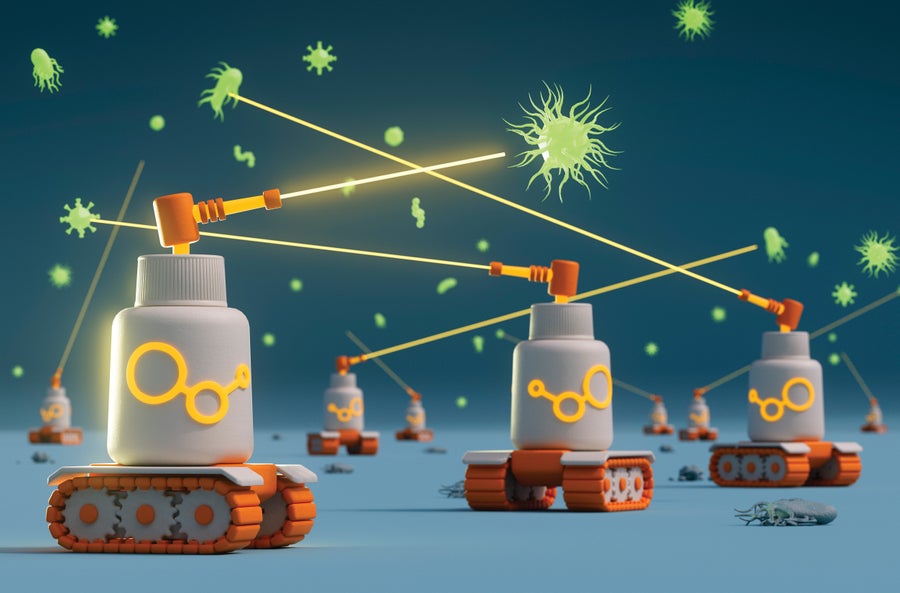
All mammals naturally make hypochlorous acid to fight infection. When you cut yourself, for instance, white blood cells known as neutrophils go to the site of injury, capturing any invading pathogens. Once the pathogen is engulfed, the cell releases biocides, including hypochlorous acid, a powerful oxidant that kills invading microbes within milliseconds by tearing apart their cell membranes and breaking strands of their DNA.

Hypochlorous acid is a well-studied disinfectant that appears to be extremely effective and safe—so why isn’t it a household name?

The synthetic form of hypochlorous acid destroys a broad spectrum of harmful microbes—including highly resistant spores and viruses such as norovirus. Like most disinfectants, it kills pathogens by penetrating their cell walls. But compared with bleach, hypochlorous acid has been shown to be more than 100 times more effective at much lower concentrations, and it works much faster.

Hypochlorous acid isn’t new. It’s listed as one of the World Health Organization’s essential medicines and is approved by the U.S. Food and Drug Administration for use on food products and in certain clinical applications. It’s increasingly used in industrial and commercial settings, such as water-treatment plants, hospitals, and nursing homes. It doesn’t irritate the skin, eyes or lungs. In fact, optometrists use it to clean eyes before procedures, and people have been treating wounds with it for more than a century. It breaks down quickly, doesn’t produce toxic waste, and isn’t harmful to animals or the environment. The U.S. Environmental Protection Agency lists it as a surface disinfectant for the COVID-causing virus SARS-CoV-2.

Hypochlorous acid is a well-studied disinfectant that appears to be extremely effective and safe—so why isn’t it a household name?Scientists have known about the powers of hypochlorous acid for nearly 200 years. In 1834, French chemist Antoine-Jérôme Balard made hypochlorous acid when he added a dilute mix of mercury oxide in water to chlorine gas. Later in the 19th century, English chemist and physicist Michael Faraday developed a technique for synthesizing HOCl from salt and water via a process called electrochemical activation.

Before the advent of antibiotics, hypochlorous acid was a go-to disinfectant. It was used as a wound sanitizer during World War I. The authors of a 1915 article in the British Medical Journal set out to investigate antiseptics that could be used to dress wounds in the field. They compared the efficacy of sodium hypochlorite (bleach) with that of hypochlorous acid and “found that hypochlorous acid is a more potent germicide than its salts.” They “accordingly devised a method in which the free acid is employed as the antiseptic agent.”

For all its benefits, hypochlorous acid solution has one major weakness: it’s highly unstable. It remains stable only in a solution with a pH between about 4 and 6. The solution is still made using salt, water, and electricity through the process of electrolysis. Within minutes of exposure to light or air, hypochlorous acid starts to deteriorate back into salt water, making it useless as a disinfectant. If the solution were to get too acidic, it would start converting into chlorine gas. If it were to get too alkaline, it would gain a higher percentage of hypochlorite. This lack of shelf stability is the biggest reason hypochlorous acid sprays never became a staple of the cleaning-products aisle.

For decades, hypochlorous acid lingered in the background, used as a disinfectant in specific industrial and commercial contexts that could justify a pricey, on-site manufacturing process to create products on demand. But COVID accelerated the need for different methods of disinfection that would be safe, effective, and easy to use in a wide range of environments. According to an article in the magazine Health Facilities Management, during the pandemic, “many countries introduced continuous HOCl misting and fogging tunnels for entry and exit corridors at mass transit facilities.” Since then, use of HOCl in places such as kitchens, gyms, nursing homes, and medical offices has been rising significantly.

Hypochlorous acid consumer products are now proliferating, thanks to the development of new manufacturing processes that reportedly make an extended shelf life possible while keeping costs low. The more reputable of these companies claim their products are effective within two years of the manufacturing date stamped on the bottle if stored correctly (ideally at room temperature, away from sunlight).

Most common are surface sanitizers sold by the bottle and marketed as all-purpose disinfectants for your home, although pure hypochlorous acid isn’t really a cleaner—it’s not meant to get rid of grime and grease. Like all disinfectants, once hypochlorous acid is applied, it must be left to sit for a period of time. But unlike some germicides that require up to 10 minutes to kill harmful stuff, hypochlorous acid requires only one minute. You don’t have to wipe it up, either, but because it doesn’t dry quickly, I found it was easier to do so on hard surfaces such as counters.

A frustrating thing about the finicky nature of hypochlorous acid is that you can’t really decant it from its original bottle into a smaller one without potentially affecting its quality and longevity. When I needed hypochlorous acid that was suitable for air travel, I had to buy a two-ounce bottle of Magic Molecule, an FDA-cleared product launched in 2023. These bottles are conveniently sized but don’t last long, and not being able to refill them results in significant plastic waste.

Other companies have taken a different approach to the shelf-life problem. Force of Nature, for example, sells countertop electrolysis machines for home use. The idea is that you can make as much disinfectant as you need for a week or two, as often as you want, using salt tablets you buy from the company. The process takes about eight minutes. Force of Nature also includes vinegar in its formulation, which gives the product cleansing abilities that the company recommends for use on hard surfaces or carpets. Other businesses sell devices that let you add your own salt. In online forums dedicated to fans of hypochlorous acid, members discuss how they use these devices. Some use pH test strips to make sure each batch of hypochlorous acid is within the correct range. Some people, however, are skeptical that at-home machines can consistently make pure HOCl.

.
https://static.scientificamerican.com/dam/m/75e1f06d911fff11/original/sa0525Schw01.jpg?m=1744124289.697&w=900Richard Borge

.

.

Click the link below for the complete article:

https://www.scientificamerican.com/article/hypochlorous-acid-is-trending-in-skin-care-and-cleaning-but-does-it-work/

.

__________________________________________

Trump says the U.S. government may reimburse oil companies for rebuilding Venezuela’s infrastructure

Leave a comment

Click the link below the picture

.

President Donald Trump said he believes the U.S. oil industry could get expanded operations in Venezuela “up and running” in fewer than 18 months.

“I think we can do it in less time than that, but it’ll be a lot of money,” Trump told NBC News in an interview Monday.

“A tremendous amount of money will have to be spent, and the oil companies will spend it, and then they’ll get reimbursed by us or through revenue,” he said.

Whether the U.S. government ultimately agrees to reimburse the oil industry’s costs in Venezuela, or alternatively, decides that future revenue is sufficient repayment, will likely be a key factor for the oil companies as they consider their options.

Trump declined to say how much money he believes it would cost companies to repair and upgrade Venezuela’s aging oil infrastructure.

“It’ll be a very substantial amount of money will be spent” by the oil companies, Trump said. “But they’ll do very well.”

“And the country will do well,” he added.

Despite Trump’s optimism, oil companies have appeared skeptical of quickly entering, expanding or investing in Venezuela. A history of state asset seizures, the ongoing U.S. sanctions, and the latest political instability all feed into this caution.

Trump said he believed that tapping Venezuela’s oil reserves is “going to reduce oil prices.”

Gas prices are already at multiyear lows. The average retail gas price on Monday was $2.81, according to AAA. That’s the lowest since March 2021.

“Having a Venezuela that’s an oil producer is good for the United States because it keeps the price of oil down,” Trump also added.

While lower oil prices could make gas cheaper at the pump, it would likely also mean lower revenues for the same big oil companies that Trump is counting on to bankroll the rebuilding of Venezuela’s oil industry to the tune of billions of dollars in foreign investment.

Asked if the administration had briefed any oil companies ahead of Saturday’s military operation to capture deposed Venezuelan leader Nicolás Maduro, Trump said, “No. But we’ve been talking to the concept of, ‘what if we did it?'”

Trump told NBC News it was “too soon” to say whether he had personally spoken to top executives at America’s three largest oil producers, Exxon Mobil, Chevron, and ConocoPhillips.

“I speak to everybody,” he said.

ConocoPhillips declined to comment Monday on Trump’s plans for Venezuela’s oil reserves. Chevron told NBC News it does not comment “on commercial matters or speculate on future investments.” Exxon did not immediately respond to questions.

Energy Secretary Chris Wright plans to meet with executives from Exxon and ConocoPhillips this week about Venezuela’s oil industry, Bloomberg News reported Monday, citing people familiar with the matter.

Wright will be a point person for the Trump administration’s broader campaign to rebuild Venezuela’s oil infrastructure, a White House official said Monday.

The Trump administration has repeatedly claimed that the U.S. oil industry is eager to return to Venezuela, nearly two decades after the country last nationalized billions of dollars’ worth of oil company assets.

“They want to go in so badly,” Trump told reporters Sunday evening.

Despite Venezuela’s massive reserves of crude oil, large U.S. oil firms have a good reason to pause before committing to expand operations in Venezuela.

.

.

.

Click the link below for the complete article:

https://www.nbcnews.com/business/energy/trump-venezuela-oil-companies-reimburse-rcna252434

.

__________________________________________
Batshit Crazy

Leave a comment

.

Is it possible that our esteemed 47th “Great Businessman”, “get coal miner’s jobs back” President, is a batshit crazy scam artist?  Are there bats in the belfry at the second white house, Mar-A-Largo?  Can we get a definitive answer, so already great America won’t  be the laughing stock of the world?

 I recently watched the Armageddon  movie and the USA lead the charge to solve the problem.   I want to know where do we go from here? This crazy man won’t shut up, look at what happened in the ‘House of Represenatives’. Do they want to gain power for themselves while destroying America. if we arn’t very careful  America will suffer a ‘Red Dawn’. check out the movie which could be our furture!

Beware America!

.

__________________________________________

For Many Jan. 6 Rioters, a Pardon From Trump Wasn’t Enough

Leave a comment

x

Click the link below the picture

.

In the first hours of his second administration, President Trump sought to wipe away all trace of the attack on the Capitol by granting amnesty to nearly 1,600 people implicated in the riot stoked by his lies about a stolen election.

They answered with a collective cry of gratitude. And why not?

The pardon proclamation saved them, opening prison doors and ending all of the criminal prosecutions related to the Capitol attack. Even more, it gave a presidential stamp of approval to their inverted vision of Jan. 6, 2021: that those who assaulted the police and vandalized the historic building that day were victims, and those who spent the next four years using the criminal justice system to hold them accountable were villains.

But nearly a year after Mr. Trump’s sweeping proclamation asserted that he had cleared the way for “a process of national reconciliation,” many recipients of his clemency remain consumed by conspiracy theories, angry at the Trump administration for not validating their insistence that the Capitol attack was a deep-state setup, and haunted by problems from both before and after the riot.

“Being pardoned doesn’t make these families whole,” Cynthia Hughes, a prominent advocate for the Jan. 6 defendants, wrote on social media recently. “Many are barely holding on mentally, emotionally, and financially. To pretend otherwise is a lie.”

In the five years since the Capitol was stormed, no new facts have emerged to undermine the basic findings of congressional and Justice Department investigators that many of the rioters acted in the misguided belief, pushed relentlessly by Mr. Trump, that he had been robbed of victory in 2020 — and that in attacking the Capitol they not only injured about 140 police officers but also struck at a cornerstone of American democracy: the peaceful transfer of presidential power.

Even so, Mr. Trump has long maintained that the rioters endured horrible, even illegal, mistreatment during their prosecutions.

And yet if that is true, some pardoned rioters are now asking, then why haven’t their persecutors been thrown in jail? And if the rioters are martyrs to a righteous cause, as the president and his allies have often said, then why haven’t they been made whole through financial reparations?

While this disillusionment is not universal, some so-called J6ers have even begun to ask why, after nearly a year in power, Mr. Trump’s law enforcement agencies have yet to provide any proof of the conspiracy theory they promoted to help him reclaim the presidency: that deep-state agents lured Trump supporters into storming the Capitol to derail the MAGA movement and justify political reprisals.

What J6ers rarely seem to acknowledge is the possibility that Mr. Trump’s government has failed to reveal the hidden truth about Jan. 6 because there is no hidden truth, no deep-state conspiracy, and therefore no legal reason to bring further charges related to the riot.

Still, their questions have nurtured new conspiracy theories from the old, focused not on the Biden administration, but on those in power now, Trump loyalists like the F.B.I. director, Kash Patel, and Attorney General Pam Bondi. The theories have intensified as the fifth anniversary of Jan. 6 has arrived — a milestone that many rioters believe marks the final chance to punish the shadowy government agents who supposedly entrapped them in what they have come to call the “fedsurrection.”

“If the true perpetrators of Jan. 6 aren’t held accountable before the statute of limitations expires on Jan. 6, 2026, count me OUT of the midterms,” Shane Jenkins, whose several felony convictions for Jan. 6 included assaulting law enforcement, wrote last month. “I’ll be running AGAINST the GOP.”

By feeding a steady diet of unfounded conspiracy theories not only to the J6ers but also to others in their base, Mr. Trump and his allies have spawned what some experts have likened to a zombie army of followers. And now, by failing to follow these theories to their logical conclusions, they are seeing that army begin to turn on them.

“When you’re told day after day that you’re a victim — when you’re told that for four years straight — it sinks in,” said Jon Lewis, a research fellow with the Program on Extremism at George Washington University. “They’ve become conspiratorial-minded people looking for the next thing to mobilize for.”

“There’s this zombie specter of Jan. 6 defendants who are just looking for that red meat,” Mr. Lewis added.

All of this was on display at the end of the year, when many pardoned rioters reacted in fury as competing solutions were offered to an enduring mystery arising from the Capitol attack: Who planted pipe bombs outside the Republican and Democratic Party headquarters on the night before Jan. 6?

The first answer was put forward in early November, when Steve Baker, one of the rioters, published an article in the right-wing news outlet The Blaze, saying he had found a “forensic match” between the hooded suspect caught on video prowling Capitol Hill that night and a former Capitol Police officer who had fought the mob on Jan. 6 and then went to work for the C.I.A. Mr. Baker’s report fit neatly into the “fedsurrection” narrative, linking the bombs to a former law enforcement official with ties to the country’s premier intelligence agency.

But The Blaze scoop fell flat. Federal officials, including Dan Bongino, the deputy director of the F.B.I. at the time, dismissed it as untrue, and the former officer’s lawyers said that when the suspect was supposedly setting the bombs, their client was home, playing with her dogs.

A couple of weeks later, Mr. Bongino, Mr. Patel, and Ms. Bondi stood side by side at the Justice Department to announce their own break in the case — one that contradicted Mr. Baker’s. Federal agents, they said, had just arrested Brian Cole Jr., a Virginia man who would later tell the F.B.I. he had planted the bombs because he wanted to “speak up” for those who believed the 2020 election had been stolen.

.

https://static01.nyt.com/images/2025/12/31/multimedia/00dc-jan6-zwjg/00dc-jan6-zwjg-superJumbo.jpg?quality=75&auto=webpKenny Holston/The New York Times

.

.

Click the link below for the complete article:

https://www.nytimes.com/2026/01/05/us/politics/trump-jan-6-pardons-rioters.html

.

__________________________________________

Scientists Just Clocked a ‘Rogue’ Planet the Size of Saturn

Leave a comment

Click the link below the picture

.

When we imagine a planet, we think of one like ours, orbiting a star. But some have a far lonelier existence, drifting through interstellar space without a sun to call their own. Known as “rogue” or “free-floating” planets, these worlds are often challenging to study. With no known star and no orbit from which to estimate their size, they’ve generally flown under the radar—until now.

In a new study published in Science on Thursday, scientists show how they measured the mass of one such rogue planet for the first time—a breakthrough that could enable further studies of these strange, lonely worlds.

Instead of looking at the planet’s orbit, the research team, led by Subo Dong of Peking University, instead analyzed how the planet’s gravity bent the light from a distant star, in a so-called microlensing event, from two separate vantage points: Earth and the now-retired Gaia space observatory.

The technique resembles how our eyes’ depth perception works, Dong says: the microlensing event was seen by Gaia about two hours later than by scientists on Earth. That difference in time allowed the researchers to measure the planet’s distance and estimate its mass.

“What’s really great about this work, and really noteworthy, is that it’s the first time we’ve got a mass for these objects,” says Gavin Coleman, a postdoctoral researcher at Queen Mary University of London, who authored a related commentary also published in Science but was not involved in the study. “This was purely because the authors had both ground-based observations and Gaia, looking at observations from two different places.”

What they found is that the planet has about the same mass as Saturn. But the findings also offer a hint about its past: “Knowing [its mass] is the starting point,” Dong says. “We can start to understand, okay, what could be the origin, the history of this planet?”

Dong hopes the study offers a jumping-off point for more research to better understand these mysterious cosmic bodies. That pursuit gets a boost later this year from NASA’s Nancy Grace Roman Space Telescope, set to launch in September, says David Bennet, a senior research scientist at the University of Maryland, College Park, and NASA. Able to image the entire sky 1,000 times faster than the Hubble Space Telescope can, Roman could help identify hundreds of rogue planets. And with this work, researchers will have a way to estimate their masses, too.

“The door is open to study this new emerging population of planets,” Dong says.

.

https://static.scientificamerican.com/dam/m/115fb3d9e452288/original/rogue-planet.webp?m=1767126684.609&w=900NASA’s Goddard Space Flight Center

.

.

Click the link below for the complete article:

https://www.scientificamerican.com/article/scientists-just-clocked-a-rogue-planet-the-size-of-saturn/

.

__________________________________________

Venezuela’s Maduro tells US court ‘I am still president’ as he pleads not guilty to drugs charges

Leave a comment

x

Click the link below the picture

.

Summary

  • Venezuela’s Nicolás Maduro says, “I am still president,” as he pleads not guilty to drug trafficking and other charges in his first appearance at a New York court

  • He and his wife Cilia Flores were seized from their Caracas compound on Saturday and flown to the US as part of a special forces operation – here’s what happened

  • Today’s hearing ended with a tense exchange between a member of the public and Maduro, who said he was a “prisoner of war”, our reporter in court says

  • Outside, protesters have been gathering, with some brandishing placards – one reads “USA Hands-off Venezuela”, while another says “Thank You President Trump.”

  • Earlier, dramatic images showed the pair being transferred to the courthouse in handcuffs, surrounded by armed officers

  • Meanwhile, Delcy Rodríguez, while being sworn in as Venezuela’s interim president, has praised Maduro and his wife as “heroes”. You can read BBC Mundo’s live Spanish coverage here.

At the rainy border between Colombia and Venezuela, I’ve been speaking to more Venezuelans about their feelings about what’s happening.

Glendys Quiroz, 28, tells me she crosses the border regularly to pick up groceries, noting that it feels quieter than usual today.

“We know Maduro has been captured, but we don’t know what’s going on or what’s going to happen,” she says.

She says she supports the US action and wants Maduro and his government to “pay for [what] they’ve done”, adding that there is a “long list of people” who should also face action.

She adds that she wants opposition leader María Corina Machado to run the country.

With no cameras allowed inside the New York courthouse, we rely on artists to give us a glimpse inside.

Jane Rosenberg’s drawing shows Nicolás Maduro standing, while his wife Cilia Flores sits nearby.

They both wear headphones to listen to a translation of proceedings, and both wear the same blue prison outfits.

We’ve been hearing from people in the Venezuelan capital, Caracas, about what life is like there since the US action and what they want for the country.

A 33-year-old masseuse who asks not to be named says she is still waiting at home today to see how things develop. “There’s so much fear in the streets and in our homes,” she says.

She does not support Venezuela’s new leader, Delcy Rodríguez, but says “if this is the price we have to pay for a government transition, then I accept it”.

“If it wasn’t this way, then we could have a rebellion, and we can’t forget the armed groups,” she adds.

She says she hopes there will be lasting change for Venezuela. “They gave the people the scraps while keeping the feast for themselves,” she says of Maduro’s regime.

.

https://ichef.bbci.co.uk/ace/standard/800/cpsprodpb/vivo/live/images/2026/1/5/e568caeb-c596-4c3a-a6bc-5dfa8a95f299.jpg.webp

Venezuela’s seized President Nicolás Maduro and his wife Cilia Flores attend their arraignment with defense lawyers Barry Pollack and Mark Donnelly

.

.

Click the link below for the complete article:

https://www.bbc.com/news/live/cwy1x9vwn3dt

.

__________________________________________

Trump Is Unleashing Forces Beyond His Control

Leave a comment

Click the link below the picture

.

“War,” the Prussian military thinker Carl von Clausewitz wrote, “is a mere continuation of policy by other means.” If there is one line that virtually every Army officer learns from Clausewitz’s posthumously published 1832 book, “On War,” it’s that description of the purpose of armed conflict.

Those words were among the first that popped into my head when I woke up Saturday morning to the news that the American military had attacked Venezuela, seized its dictator, Nicolás Maduro, and brought him to the United States to face criminal charges.

The reason those words occurred to me was simple: The attack on Venezuela harks back to a different time, before the 19th-century world order unraveled, before two catastrophic world wars, and before the creation of international legal and diplomatic structures designed to stop nations from doing exactly what the United States just did.

One of the most important questions any nation must decide is when — and how — to wage war. It’s a mistake, incidentally, to view Clausewitz as an amoral warmonger. He wasn’t inventing the notion he describes; he was describing the world as it was. His statement is a pithy explanation of how sovereign states have viewed warfare for much of human history.

When a strong state operates under the principle that war is just another extension of policy, it is tempted to operate a bit like a mob boss. Every interaction with a weaker nation is tinged in some way with the threat of force: Nice little country you have there — shame if something happened to it.

This is not fanciful. In a telephone conversation with The Atlantic’s Michael Scherer, President Trump threatened Venezuela’s new leader, Delcy Rodríguez, who served as Maduro’s vice president. “If she doesn’t do what’s right,” Trump said, “she is going to pay a very big price, probably bigger than Maduro.”

Diplomacy and economic pressure are almost always still a first resort for powerful nations, but if they fail to achieve the intended results, well, you can watch footage from the American strike in Venezuela to know what can happen next.

But the Clausewitzian view isn’t the only option for nations and their leaders. There is a better model for international affairs, one that acknowledges the existence of evil and the reality of national interests but also draws lines designed to preserve peace and human life.

Carl von Clausewitz, meet Thomas Aquinas.

In the Summa Theologica, written in the 13th century, Aquinas outlined three cardinal requirements of what came to be known as just war theory.

First, war must be waged through the lawful operation of a sovereign and not through the private adventurism of ambitious individuals.

Second, the war must be based on a just cause. National self-defense or collective self-defense are obviously just, for example.

Third, there must be a just purpose, namely the advancement of good and the avoidance of evil.

One way to think about the shifting patterns of warfare is that humanity seesaws between Clausewitz and Aquinas. Strong nations impose their will on the weak and then — eventually — try to impose their will on one another. When catastrophe results, as it invariably does, they turn back to Aquinas.

You can actually see the results of this shifting approach across the sweep of history. An analysis of global deaths in conflict shows that war is always with us, but its intensity waxes and wanes. Periods of extreme suffering and death are followed by periods of relative quiet, followed again by an age of horror.

Consider history since World War I. After the ongoing slaughter of trench warfare, the world attempted to ban aggressive warfare and to establish an international institution — the League of Nations — to keep the peace.

The League failed, in part because the United States refused to join, and after an even more horrible world war, the world tried again, this time under American leadership.

Echoes of Aquinas are all over the U.N. Charter. Article 2 of the United Nations Charter bans aggressive warfare (taking away a key tool in the Clausewitz toolbox), Article 51 permits individual and collective self-defense to keep great powers in check, and Chapter V established a body (the Security Council) that’s designed to keep the peace.

.

https://static01.nyt.com/images/2026/01/06/multimedia/05French-bmpt/05French-bmpt-superJumbo.jpg?quality=75&auto=webpAlex Brandon/Associated Press

.

.

Click the link below for the complete article:

https://www.nytimes.com/2026/01/05/opinion/trump-venezuela-maduro-clausewitz-aquinas.html

.

__________________________________________

How Woodpeckers Turn Their Entire Bodies into Pecking Machines

Leave a comment

Click the link below the picture

.

Woodpeckers operate at an extreme level, boring through solid wood with forces more than 30 times their own weight and drilling up to 13 times a second. How do they never miss a beat while head banging so hard?

It turns out that the birds tense up their entire body to smash through wood, letting out short, explosive grunts with each strike, report Brown University biologist Nicholas Antonson and his colleagues in the Journal of Experimental Biology. “Woodpeckers really are nature’s hammer in a sense,” Antonson says.

To study how the birds tap, the researchers first humanely captured eight wild Downy Woodpeckers and carefully inserted electrodes into their muscles in the laboratory. The electrodes fed into a tiny, fitted backpack that recorded electrical signals from contracting muscles as the birds pecked. They also checked whether the woodpeckers held their breath during exertion (like weight lifters tend to do) or exhaled (like tennis players) while striking the wood by examining airflow through the birds’ air sacs—small, balloonlike structures that help them breathe in and out. By matching these measurements with high-speed videos, the scientists tracked the woodpeckers’ taps down to every four milliseconds.

Instead of using a single muscle to control the action, woodpeckers activated “every muscle from the head to the tail,” Antonson says. The birds used their powerful hip flexors to push forward, clenched their tail and abs to prepare for the strike, and stiffened the back of their head and neck on contact—similar to the way you might stiffen the back of your wrist when you hammer a nail. They then engaged a different set of hip and neck muscles to draw back.

The birds also perfectly paired their pecks with sharp exhalations “as another means of stabilizing their core muscles and powering through those strikes,” Antonson explains. “To be able to breathe out 13 times per second and inhale on the order of 40 milliseconds is really impressive.” Songbirds, which aren’t closely related to woodpeckers, are the only other birds known to so precisely time their breaths, which they do as they sing.

“Pecking is a full-body exercise,” says University of Alabama biologist Nicole Ackermans, who studies brain damage in woodpeckers and head-butting sheep. Coordinating “micro breaths” with muscle clenching and creating “this hammerlike structure in their whole body is such a unique approach,” she adds.

.

https://static.scientificamerican.com/dam/m/1b122e81fb921645/original/sa0226Adva06.jpg?m=1766505830.135&w=900

Tapping woodpeckers harness their muscles more like tennis players than like weight lifters. Diana Robinson Photography/Getty Images

.

.

Click the link below for the complete article:

https://www.scientificamerican.com/article/how-woodpeckers-turn-their-entire-bodies-into-pecking-machines/

.

__________________________________________

The Hidden Health Benefits of Going Alcohol-Free for Dry January

Leave a comment

Click the link below the picture

.

If your New Year’s resolution is to cut back on or quit alcohol, Dry January is a great place to start, especially since you won’t be alone in giving up alcohol for the month. However, you may be wondering: Are there any health benefits that come with swapping alcoholic drinks for nonalcoholic beverages for only one month? We have good news: The answer is yes, and these are the following advantages you may experience from a wellbeing standpoint.

Please note: While Dry January can help you temporarily reduce your alcohol intake and improve your health, if you need help cutting back on drinking or think you might have an alcohol dependency, visit the National Institute for Alcohol Abuse and Alcoholism for additional resources.

Benefits of Dry January

It’s absolutely no secret that alcohol can take a toll on your body. Alcohol can affect virtually all of your organs, from your brain to your heart to, of course, your liver. Alcohol consumption is linked to certain cancers, suppressed immunity, digestive problems, and more. 

Reducing or eliminating alcohol consumption can improve your health in many ways — but it might sound silly to give up alcohol for a month, because what can 31 days do? However, research suggests that taking short breaks from alcohol can do wonders for your health. 

If your New Year’s resolution is to cut back on or quit alcohol, Dry January is a great place to start, especially since you won’t be alone in giving up alcohol for the month. However, you may be wondering: Are there any health benefits that come with swapping alcoholic drinks for nonalcoholic beverages for only one month? We have good news: The answer is yes, and these are the following advantages you may experience from a wellbeing standpoint.

Please note: While Dry January can help you temporarily reduce your alcohol intake and improve your health, if you need help cutting back on drinking or think you might have an alcohol dependency, visit the National Institute for Alcohol Abuse and Alcoholism for additional resources.

Benefits of Dry January

It’s absolutely no secret that alcohol can take a toll on your body. Alcohol can affect virtually all of your organs, from your brain to your heart to, of course, your liver. Alcohol consumption is linked to certain cancers, suppressed immunity, digestive problems, and more. 

This story is part of 12 Days of Tips, helping you make the most of your tech, home, and health during the holiday season.

Reducing or eliminating alcohol consumption can improve your health in many ways — but it might sound silly to give up alcohol for a month, because what can 31 days do? However, research suggests that taking short breaks from alcohol can do wonders for your health. 

If you try Dry January, you might experience: 

  • Improved sleep
  • More alertness and reduced daytime fatigue
  • Fewer headaches 
  • Better focus and productivity 
  • Improved exercise performance 
  • More good moods and fewer mood swings
  • Weight loss
  • Stronger immune system
  • Increased hydration

Why do people do Dry January? 

People choose to do Dry January for a variety of reasons. You might consider trying Dry January if: 

  • You’re trying to reach a health-related goal. For instance, avoiding alcohol may help you lose weight and improve physical fitness performance. 
  • You want to reevaluate your relationship with alcohol. 
  • You’ve been drinking more than usual lately and want to reset. 
  • You’re supporting a friend or family member who wants to quit drinking alcohol.
  • You just want to see how it feels to be sober for a month.

How to do Dry January

In theory, Dry January sounds simple: Just stop drinking alcohol, right? However, even people who reserve booze for special occasions might struggle to make it a full month with no alcohol.

Try these tips to make Dry January go smoothly: 

  • Commit to the month with a friend (or a few). You can all help hold each other accountable. 

  • Inform your friends and family that you’re participating in Dry January ahead of time, and keep reinforcing it so they know not to offer you drinks — because sometimes, saying “no” is the hardest part. 

  • Stock up on non-alcoholic beverages (listed below) to enjoy in place of your favorite alcoholic beverages. 

  • Choose different activities to fill the time you’d normally spend drinking. For example, instead of watching TV and drinking wine, try playing a board game, reading a book, completing a puzzle, calling a loved one, or drawing a picture. Learning a new skill can help you stay occupied. 

  • Invite your friends to non-alcoholic outings, such as hikes, craft sessions, movies, or dinner dates.

.

gettyimages-967723676

Even a month of giving up alcoholic drinks can give your health a boost. Getty Images

.

.

Click the link below for the complete article:

https://www.cnet.com/health/nutrition/dry-january-ways-quitting-alcohol-month-improve-health/

.

__________________________________________

I Study Friendship. Here’s How You Make Lasting Friends.

Leave a comment

Click the link below the picture

.

When people find that they are having a hard time making new friends, they often blame their own awkwardness — some failure on their part. As a sociologist who studies how people connect, I’ve interviewed more than 150 people about friendship. One woman told me a typical story: She had moved to a new town after college and said that the conversations she struck up at coffee shops, work, and yoga didn’t seem to go anywhere. Forging new relationships felt hopeless. “I’m not good at it,” she said.

Yet she, like most of us, could pinpoint times in her life when making friends seemed easier. Across two decades of studying friendship, I’ve found that people’s ability to make new friends doesn’t come and go at random. Instead, it reflects, in large part, the strength of what I call the “friendship market” they are in.

In a thriving friendship market, a majority of people in a particular setting are interested in “buying” or “selling” friendship. For example, middle schoolers merging into a new high school, or first-year students arriving at college. New connections abound.

But we spend much of our lives in weaker friendship markets, where people are open to conversation, but not connection. A parent shows up at a P.T.A. meeting, and even if others are friendly, they keep their distance. Or people moves to a new city for work, and acquaintances don’t turn toward their bids for connection. Even intentionally putting yourself out there doesn’t inspire reciprocation if a friendship market has closed: Others already have fully formed friend groups.

In adulthood, open friendship markets become harder to find. But there’s a key to finding new ones: a shifting sense of self. We define ourselves through our relationships with friends. These connections help us to construct our desired selves, who we are, and who we are becoming.

The key, then, is not just to start an activity or join a club so you can meet new people. It’s to join one related to a new sense of self or an identity you’re looking to deepen. Pregnant women, for example, will look for friendships in prenatal classes — not only to find people who understand their experience but also to reaffirm their emerging identity as a mom.

Milestones make friendship markets easier to find, but markets exist for all sorts of identities, big and small. One woman I spoke to heard about a coffee club as she was starting to consider herself a coffee aficionado. Another found friendship in a pride club; although she had come out as gay years before, she felt that her queer identity was becoming a more important part of who she was. Friends connected to emerging identities bring out new sides of us. One interviewee told me that she was not religious growing up. As she started to explore Christianity, she joined a Bible study group and said she was her most “upbeat” and “cheery” self with the friends she made there.

We’ve all seen how much closer you can feel to someone when your identities change together. I worked in an office for five years with someone whom I did not know well until we were both pregnant together, both first-time moms with the same due date. We ended up taking walks, having lunches, and getting to know each other as we talked through our excitement and worries about the ways our lives would change. As our identities shifted, our friendships did as well.

Even embracing less favorable identities opens up new markets. Several people I interviewed told me about a group for single parents. Remembering the challenging period after their breakups, club members went out of their way to welcome new entrants. One member noted how her new friends offered her support as she raised a child on her own. Eventually, she got married, which booted her from the club, but two people she met there remained among her closest friends years later.

To be clear, being aware of “friendship markets” does not mean that those friendships are transactional. Friendships are not commodities or disposable. But they are also not always readily available. Everyone needs to make sure to seek them out, optimizing the possibility of connection in our busy, sometimes isolated-feeling lives.

I recommend a New Year’s resolution: Do the work to find new friendship markets in 2026, rather than waiting passively for new connections to find you. Even those with active social lives and healthy friendships benefit from new relationships that reaffirm who they are. These connections have been proven to bring us joy, fulfill our basic need to connect, and help us to live healthier, longer lives.

So the next time making new friends feels challenging, remember the structural role of friendship markets rather than blaming yourself. If you take a class not just to learn a new skill but also to deepen a part of yourself, you may find your people.

.

https://static01.nyt.com/images/2026/01/05/opinion/02mccabe/02mccabe-jumbo.jpg?quality=75&auto=webpAude Bertrand

.

.

Click the link below for the complete article:

https://www.nytimes.com/2026/01/03/opinion/friendship-markets-new-friends.html

.

__________________________________________

Older Entries Newer Entries

Heart of Loia `'.,°~

so looking to the sky ¡ will sing and from my heart to YOU ¡ bring...

Michael Ciullo

CEO and Founder of Nsight Health

MRS. T’S CORNER

https://www.tangietwoods

Nelson MCBS

Catholic News, Prayers, HD Images, Rosary, Music, Videos, Holy Mass, Homily, Saints, Lyrics, Novenas, Retreats, Talks, Devotionals and Many More

Global geopolitics

Decoding Power. Defying Narratives.

Talk Photo

A creative collaboration introducing the art of nature and nature's art.

Movie Burner Entertainment

The Home Of Entertainment News, Reviews and Reactions

Le Notti di Agarthi

Hollow Earth Society

C r i s t i a n a' s Fine Arts ⛄️

•Whenever you are confronted with an opponent, conquer him with love.(Gandhi)

TradingClubsMan

Algotrader at TRADING-CLUBS.COM

Comedy FESTIVAL

Film and Writing Festival for Comedy. Showcasing best of comedy short films at the FEEDBACK Film Festival. Plus, showcasing best of comedy novels, short stories, poems, screenplays (TV, short, feature) at the festival performed by professional actors.

Bonnywood Manor

Peace. Tranquility. Insanity.

Warum ich Rad fahre

Take a ride on the wild side

Madame-Radio

Découvre des musiques prometteuses dans la sphère musicale française (principalement, mais pas que...).

Ir de Compras Online

No tiene que Ser una Pesadilla.

Kana's Chronicles

Life in Kana-text (er... CONtext)

Cross-Border Currents

Tracking money, power, and meaning across borders.

Jam Writes

Where feelings meet metaphors and make questionable choices.

emotionalpeace

Finding hope and peace through writing, art, photography, and faith in Jesus.

WearingTwoGowns.COM

MOVING FORWARD...That's how WINNING is done!”-Rocky Balboa

...

love each other like you're the lyric to their music

Luca nel laboratorio di Dexter

Comprendere il mondo per cambiarlo.

Tales from a Mid-Lifer

Mid-Life Ponderings

Creative

Travel,Tourism, Life style "Now in hundreds of languages for you."

freedomdailywriting

I speak the honest truth. I share my honest opinions. I share my thoughts. A platform to grow and get surprised.

The Green Stars Project

User-generated ratings for ethical consumerism

Cherryl's Blog

Travel and Lifestyle Blog

Sogni e poesie di una donna qualunque

Questo è un piccolo angolo di poesie, canzoni, immagini, video che raccontano le nostre emozioni

My Awesome Blog

“Log your journey to success.” “Where goals turn into progress.”

pierobarbato.com

scrivo per dare forma ai silenzi e anima alle storie che il mondo dimentica.

Thinkbigwithbukonla

“Dream deeper. Believe bolder. Live transformed.”

Vichar Darshanam

Vichar, Motivation, Kadwi Baat ( विचार दर्शनम्)

Komfort bad heizung

Traum zur Realität

Chic Bites and Flights

Savor. Style. See the world.

ومضات في تطوير الذات

معا نحو النجاح

Broker True Ratings

Best Forex Broker Ratings & Reviews

Blog by ThE NoThInG DrOnEs

art, writing and music by James McFarlane and other musicians

fauxcroft

living life in conscious reality

Srikanth’s poetry

Freelance poetry writing

JupiterPlanet

Peace 🕊️ | Spiritual 🌠 | 📚 Non-fiction | Motivation🔥 | Self-Love💕

Sehnsuchtsbummler

Reiseberichte & Naturfotografie