Home

The Surprising New History of Horse Domestication

Leave a comment

Click the link below the picture

.

The world we live in was built on horseback. Many people today rarely encounter horses, but this is a recent development. Only a few decades ago domestic horses formed the fabric of societies around the globe. Almost every aspect of daily life was linked to horses in an important way. Mail was delivered by postal riders, people traveled by horse-drawn carriage, merchants used horses to transport goods across continents, farmers cultivated their land with horsepower, and soldiers rode horses into battle.

Scholars have long sought to understand how the unique partnership between humans and horses got its start. Until recently, the conventional wisdom was that horses were gradually domesticated by the Yamnaya people beginning more than 5,000 years ago in the grassy plains of western Asia and that this development allowed these people to populate Eurasia, carrying their early Indo-European language and cultural traditions with them.

Now new kinds of archaeological evidence, in conjunction with interdisciplinary collaborations, are overturning some basic assumptions about when—and why—horses were first domesticated and how rapidly they spread across the globe. These insights dramatically change our understanding of not only horses but also people, who used this important relationship to their

advantage in everything from herding to warfare. This revised view of the past also has lessons for us today as we consider the fate of endangered wild horses in the steppes. And it highlights the essential value of Indigenous knowledge in piecing together later chapters of the horse-human story, when domesticated horses moved from Eurasia into the rest of the world.

The genus Equus, which includes horses, asses, and zebras, originated around four million years ago in North America. Over the next few million years its members began dispersing across the Beringia land bridge between what is now Russia and Alaska and into Asia, Europe and Africa. Horses are among humanity’s oldest and most prized prey animals. Perhaps the first indisputable evidence for hunting with weapons by early members of the human family comes from horse-rich archaeological sites such as Schöningen in Germany, dating to some 300,000 years ago. The unique lakeshore environment there preserved not only the remains of a band of horses but also the immaculately crafted wood spears that humans used to dispatch them. For millennia wild horses remained a dietary staple for early Homo sapiens living in northern Eurasia. People were keen observers of these animals they depended on for food: horses featured prominently in Ice Age art, including in spectacular images rendered in charcoal on the limestone walls of France’s Chauvet Cave more than 30,000 years ago.

Tracking the transition from this ancient predator-prey connection to early domestication—which includes such activities as raising, herding, milking, and riding horses—can be challenging. Researchers studying the deep past rarely have the luxury of written documents or detailed imagery to chronicle changing relationships between people and animals. This is especially true in the Eurasian steppes—the cold, dry, remote grasslands where scientists suspect that the first horse herders emerged, which stretch from eastern Europe nearly to the Pacific. In the steppes, cultures have long been highly mobile, moving herds to fresh pastures with the changing seasons. Their way of life left behind archaeological assemblages that can be shallow, poorly preserved and difficult to study. Indeed, much of what we know about the origins of horse domestication comes from a single, powerful scientific source: the bones of ancient horses themselves.

As an archaeozoologist, I seek to understand the origins of domestication through the study of horse bones from archaeological sites. In the early days of this kind of scientific inquiry into domestication, some researchers looked for patterns in the size, shape, or frequency of these bones over time. The basic logic behind this approach is that if horses were living in close contact with people, their bones might have become more widespread or more variable in shape and size than in earlier periods, whether because people were breeding them for particular traits or because they were putting the horses to work in ways that altered the animals’ bodies over the course of their life, among other factors.

.

https://static.scientificamerican.com/dam/m/5d7169d829dd7ba7/original/sa1224Tayl01.jpg?m=1730732499.052&w=900Mark Harvey

.

.

Click the link below for the article:

https://www.scientificamerican.com/article/horse-domestication-story-gets-a-surprising-rewrite/

.

__________________________________________

Why Arguing With Your Kids Is Completely Missing the Point

Leave a comment

Click the link below the picture

.

PARENTING IS SO fucking hard!! Actually, life and work are hard because I decided to become a chef, and now I am parenting as a newly single dad, in short bursts, every week. And you guys, I have never struggled so hard to be an adult. Even with a therapist, I have to constantly work to maintain the abundant mindset we talk about each week.

My daughter Barbara is seven, and getting easier to manage in a lot of ways. I can explain why her needs are often unreasonable, at least in the moment, but she now has the language to argue with me over every single thing: What we are doing, where we are going, what we will do when we get there, and what we will eat. Actually, that one isn’t really an argument. She wants pizza from Rocco’s, around the corner from where we’re currently staying, and I usually cave because I too want pizza from Rocco’s and also I like to smoke weed and eat her crust after she falls asleep.

Also, I am dealing with a lot of anxiety and depression, and having Barbara with me can be a stark reminder of how drastically my life has changed this year. And the changes keep coming, abrupt and challenging every single time. I work 13 to 14 hours a day, four days a week, running a restaurant kitchen. The three days I have “off” I do ordering, receiving, and I boil out the deep fryer every Tuesday. Any time my staff is in the building I am “on,” keeping everybody’s energy up so that we can get through a long and sometimes grueling, sometimes boring service. I shout a lot about

socialism and abundance and I try to keep my team laughing and on track.

It’s hard, but you know that from everything you’ve ever heard about a restaurant kitchen, and so the last thing I am equipped to deal with in my little down time is an argument with my child. It hurts my soul, but so does caving to her demands. So I try to find my sense of abundance while being realistic about my own capabilities when I am stressed, sad, and hurting, and sometimes I say passive-aggressive things to her. Things like, “Babe, if we can’t figure out how to live together we may not be able to do nights at my apartment anymore.” Or, “If you can’t eat breakfast a little faster my whole body will explode and it will be your fault.” Once I told her that it’s illegal to buy kids candy before school because I couldn’t just tell her no, because I’ve never had boundaries for myself, and I am struggling to create them for my child, and I hate that for both of us, even when I’m being kind to myself.

I get frustrated when Barbara is being argumentative over the walk to school, and I get mad when she brushes off my rules about bedtime, but

I get inwardly furious, with both her and myself, when she won’t eat the food I’ve made for her. Sometimes I work up the energy to cook for her and she understands that it’s not going to be anything elaborate. I’ll make rice and beans or roasted chicken thighs, simple things that make me feel cared for. But every time, unless it’s pasta with butter or instant ramen noodles, she’s not interested and I still end up going to get her pizza from Rocco’s because I don’t want to be a bad parent who puts his child to bed hungry on the few nights I get with her. But I also don’t want her memories from this time to just be of eating pizza while daddy stares deeper and deeper into the void of scarcity, barely holding his shit together.

And that’s not to say she’s a picky eater. She is, but at her mom’s house she eats all kinds of different stuff! Pork chops! Bacon! Sausage! Really any kind of pig parts and I’m realizing now that my next dinner with her will be pork jowls or pig’s ears or whatever and then I’ll dip her pizza crust in the broth. I am the chef of my own popular restaurant! I cook for famous people sometimes and I cook for Barbara’s friends’ parents a lot so I’m like a local celebrity. AND YET, nothing has really changed since she was little. She still gets whatever she wants but instead of pushing what she deems as sketchy food to the floor, now she hides from it under the table.

.

https://hips.hearstapps.com/hmg-prod/images/mh-parentingontheline-arguments-672e3b5535061.jpg?crop=0.5xw:1xh;center,top&resize=1120:*

Getty Images; Matt Ryan, MH Illustration

.

.

Click the link below for the article:

https://www.menshealth.com/trending-news/a62579985/tyler-kord-fatherhood-column-arguing/?utm_source=pocket_discover_parenting

.

__________________________________________

Concussions Are Remarkably Common and Can Cause Long-Term Problems

Leave a comment

Click the link below the picture

.

Fifteen years ago I slipped on a wet patio deck and fell backward, slamming the back of my skull into a pillar. I saw stars and briefly felt nauseated. But I picked myself up, checked that I wasn’t bleeding, and went about my day. The back of my head was sore for a few days, but there weren’t any lingering effects, and I didn’t see a doctor.

Still, those symptoms I did have might have been signs of a concussion, the common term for a mild traumatic brain injury (TBI). Such injuries are a lot more common than you might think and may cause long-term problems. When more than 600 average middle-aged people in the U.K. and Ireland were asked careful questions about past incidents in which they might have hit their heads, a full third turned out to have suffered a TBI of some kind. And nearly three million people in the U.S. are officially diagnosed with a TBI every year in emergency departments and hospitals. About 75 to 80 percent of their injuries are described as mild.

But “mild,” it turns out, can have consequences years later for many people. For example, in 2023 the multicenter TRACK-TBI study revealed that out of more than 1,200 people, 33 percent of those with mild TBI and 30 percent of those with moderate or severe TBI showed deterioration one to seven years after injury. Complaints can include problems sleeping, headaches, and memory and psychiatric issues. Long term, a TBI can lead to dementia, and it may also trigger several types of cardiovascular disease.

“What we need to do is pay more attention to what happens in the months and years after injury.” —David Sharp Imperial College London

Doctors have misunderstood or mis­diagnosed these problems because of an old way of looking at and thinking about concussions. For 50 years physicians have relied on symptoms they observe, such as loss of consciousness and motor or verbal changes, and on patient reports to classify traumatic brain injury as mild, moderate or severe. But this system isn’t very accurate at predicting either short- or long-term outcomes.

Experts have been pushing for change for several years. A 2022 National Academies report listed reclassification of these three grades, based on stronger evidence, as its first recommendation. “We know these terms are not accurate; they’re not precise. In fact, they can actually be problematic for patients,” says Nsini Umoh, who is the TBI program director at the National Institute of Neurological Disorders and Stroke (NINDS).

Now the field is doing something about the problem. After a January 2024 meeting hosted by NINDS, experts are proposing a new system of diagnosis and classification that provides neuro­bio­log­i­c­al detail instead of a vague term such as “mild.” Called the CBI-M model, it includes clinical symptoms (C), blood-based biomarkers (B), imaging (I), and modifiers (M). The last item includes social determinants of health, such as access to care.

If doctors use this model, they will have to approach concussions and their treatment differently. Breast cancer patients, for instance, are not told that

their cancer is mild or severe but are informed of the exact size of the tumor, whether it is estrogen-receptor-positive, and so on. People with a potential TBI could get that level of detail. Under the proposed guidelines, they will get a TBI score on a scale based on their responsiveness to a clinician’s questions (as they do today), as well as blood biomarker results and possibly imaging results. The biomarkers are proteins released in the brain in response to injury; new technology can measure concentrations of these proteins in the bloodstream. The U.S. Food and Drug Administration has approved two tests, for the proteins GFAP and UCHL1, that can predict whether intracranial lesions are present in the brain and whether a CT scan is warranted to confirm them.

Someone with no visible changes in imaging and low blood biomarkers would be told that their recovery prognosis was good. Someone with more worrisome indicators might be told to follow up with specialists over months or even years. Physicians would adjust these risk assessments based on modifiers—for example, a person with a history of mental health issues is at higher risk than someone without.

.

https://static.scientificamerican.com/dam/m/108c95db3f298aa9/original/sa1224Mind_SoH02.jpg?m=1730819636.491&w=900ay Bendt

.

.

Click the link below for the article:

https://www.scientificamerican.com/article/concussions-are-remarkably-common-and-can-cause-long-term-problems/

.

__________________________________________
Roblox will restrict kids under 13 from chatting outside of games

Leave a comment

Click the link below the picture

.

Roblox is starting to roll out some recently-announced child safety features, and the updates include some new limitations for how users under 13 can communicate on the platform. Beginning Monday, users younger than 13 won’t be able to DM players outside of games or experiences on Roblox. And they’ll need parental permission to be able to send in-game DMs — though this change won’t be fully implemented across the platform until the first quarter of 2025.

The changes follow recent reports highlighting instances of Roblox failing to protect children. A big article from Bloomberg described how predators on the platform use chat to communicate with kids. And a report from Hindenburg Research described Roblox as “an X-rated pedophile hellscape.” These new restrictions on chat will build on Roblox’s automatic chat filters intended to block users from sharing personal information.

In addition to the changes to chat, Roblox is rolling out its previously-announced accounts for parents and caregivers that will let them remotely manage things like a child’s screen time limits. Previously, parents had to have physical access to their child’s account to set parental controls.

Roblox is also starting to use content labels to describe experiences instead of rating experiences for specific age groups. That means, for example, a “moderate” experience may contain things like moderate fear or crude humor. Users under the age of 9 will only be able to access experiences with “minimal” or “mild” content labels unless a parent gives permission. And Roblox will stop users under 13 from accessing social hangout experiences and experiences with free-form writing or drawing.


.

https://duet-cdn.vox-cdn.com/thumbor/0x0:2040x1360/540x360/filters:focal(1020x680:1021x681):format(webp)/cdn.vox-cdn.com/uploads/chorus_asset/file/24785213/STK146_Roblox_New.jpgIllustration: The Verge

.

.

Click the link below for the article:

https://www.theverge.com/2024/11/18/24298330/roblox-child-safety-chat-parent-accounts?utm_source=pocket_discover_technology

.

__________________________________________

Mathematicians Discover a New Kind of Shape That’s All over Nature

Leave a comment

Click the link below the picture

.

How few corners can a shape have and still tile the plane?” mathematician Gábor Domokos asked me over pizza. His deceptively simple question was about the geometry of tilings, also called tessellations—arrangements of shapes, called tiles or cells, that fill a surface with no gaps or overlaps. Humans have a preoccupation with tessellation that dates back at least to ancient Sumer, where tilings featured prominently in architecture and art. But in all the centuries that thinkers have tinkered with tiles, no one seems to have seriously pondered whether there’s some limit to how few vertices—sharp corners where lines meet—the tiles of a tessellation can have. Until Domokos. Chasing tiles with ever fewer corners eventually led him and his small team to discover an entirely new type of shape.

It was the summer of 2023 when Domokos and I sat at a wood picnic table at the Black Dog, a cozy spot for pizza and wine just a few blocks from the Budapest University of Technology and Economics, where Domokos is a professor. He reached across the table to grab a paper pizza menu and flip it over, revealing a blank underside, and gestured to me to grab a pen. The midsummer sky was taking on shades of orange and indigo as I filled the menu with triangles. Domokos watched expectantly. “You’re allowed to use curves,” he finally said. I started filling the page with circles, which of course can’t fill space on their own. But Domokos lit up. “Oh, that’s interesting!” he said. “Keep going, you can mix shapes. Just try to keep the average number of corners as low as possible.”

I kept going. My page of circles filled with increasingly desperate, squiggly forms. Domokos’s pizza Margherita had long since disappeared, but he wasn’t quite ready to leave. A quick glance at my crude drawing wasn’t enough to determine its average number of corners, let alone the minimum possible. But the right answer must have been something less than the triangle’s three—otherwise, the question would be boring.

That observation seemed to satisfy the mathematician, who revealed that the real answer is two. “That’s an easy question,” he said. “But what about 3D?”

“This is a tool that can reasonably describe, at least to me, a wide range of more physically relevant things than just polyhedrons stuck together.” —Chaim Goodman-Strauss, mathematician

Now, more than a year after that evening at the pizza shop, Domokos has the answer. Finding it was an exciting, frustrating challenge that ultimately led him and three colleagues to discover “soft cells,” shapes that can fit together to completely fill a flat surface or a three-dimensional space with as few corners as possible. In two dimensions, soft cells have two corners bridged by curves. But in 3D, these curvy, almost organic forms have no corners at all. Once the researchers identified the new shapes, they began to see them all over the place—in nature, art and architecture. The results have now been published in the journal PNAS Nexus.

Although soft cells hadn’t been categorized by mathematicians before—no one had noticed or named them in an academic paper—they abound in art and nature, from the architecture of Zaha Hadid, “Queen of the Curve,” to the forms of zebra stripes. Krisztina Regős, Domokos’s graduate student, found the first natural 3D soft cell tucked away in the chambers of the nautilus shell, an object that’s become iconic for showcasing the convergence of math and biology. “They were in front of our eyes the whole time,” Regős says. This connection to such a famous shape led Domokos to fear that his group would be scooped. He swore his collaborators to secrecy until their discovery was ready to be published. (It came out in September.) At the end of his lesson over pizza, he even took the paper menu, folded it up and pocketed it. Just to be safe.

In retrospect, it should have been obvious that soft cells exist, says mathematician Joseph O’Rourke of Smith College, who wasn’t involved in the study. But to think to ask such a question, “to even imagine that you can tile space with no vertices,” he says, is original. “I found that quite surprising and very clever.”

.

https://static.scientificamerican.com/dam/m/693ed35ebd8de283/original/sa1224-CuttComboOpener.jpg?m=1730734601.531&w=900

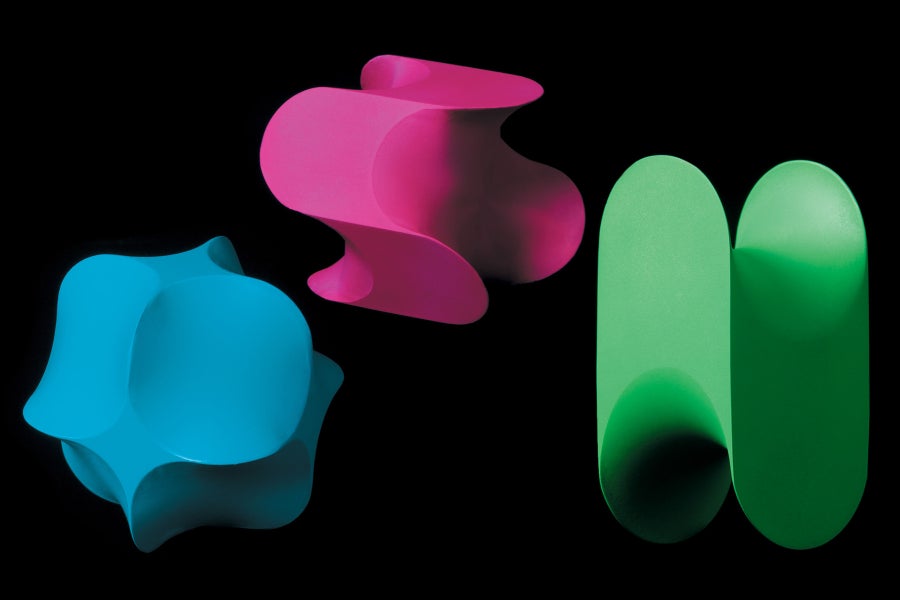
Photographs of 3D-printed shapes show soft cells derived from space filling polyhedra. Blue is derived from a truncated octahedron, pink is from a hexagonal prism and green is from a cube. Jelle Wagenaar

.

.

Click the link below for the article:

https://www.scientificamerican.com/article/mathematicians-discover-a-new-kind-of-shape-thats-all-over-nature/

.

__________________________________________

Why so many families are “drowning in toys”

Leave a comment

Click the link below the picture

.

Lynne Randall doesn’t buy all the toys that show up at her house. They just kind of happen.

There’s the play kitchen her 3-year-old son inherited from his cousins. There’s the “random stuff” her mother-in-law buys online, all of it plastic and made up of countless tiny pieces. There’s the kid-sized workbench — Randall got that from her local Buy Nothing group, where neighbors can offload used items (and pick up more).

The sheer volume of stuff her son has to play with is overwhelming, Randall told Vox. The day we talked, she and her family were having guests at their Pacific Northwest home, so she was attempting to declutter, “finding all the parts and putting food in the toy kitchen and putting the tools in the workbench.” But it was always a losing battle.

It’s a familiar refrain among parents: One reader told Vox recently that her family was “absolutely drowning in toys.” And while adults have been complaining about kids’ junk for generations (please see my father’s fruitless search for my brother’s one-inch-long toy wrench in Los Angeles International Airport circa 1992), many millennial and Gen X parents have the sense that something is different now — that kids have more toys than in past decades, and that they seem to arrive in ways Randall describes as “unintentional.”

Historical data on the average number of toys per kid is surprisingly hard to come by, but there is evidence that Americans’ toy glut is increasing — and it’s not just a problem for affluent households.

US toy sales jumped from $22.3 billion in 2019 to $26 billion in 2020, and then to $30.1 billion in 2021, as parents struggled to entertain their kids at home during the pandemic. Sales dipped slightly in 2023, perhaps because of inflation, but remain solidly above 2019 levels.

“I don’t think we’ll ever go back,” Juli Lennett, a vice president and industry adviser for toys at the market research firm Circana, told me.

Shelves overflowing with cars and blocks and action figures can be just as stressful for kids as they are for parents. Sometimes “kids don’t play with anything, because there’s just too many options,” said Sarah Davis, a parenting coach and co-author of the book Modern Manners for Moms and Dads. Meanwhile, an overemphasis on acquiring new toys can foster materialism, which is linked with anxiety and depression.

Stemming the tide of clutter is easier said than done since toys often come from grandparents or other loved ones, or even from parties at school. But experts say there are certain characteristics that kids’ favorite toys share. And by focusing on those, grown-ups may be able not only to save money and space, but also to help kids have more fun.

Still, I get the struggle. Recently, I was taking a shower when I noticed a pink plastic rat in the drain.

Why kids have so many toys

In the early 2000s, a team led by archaeologist Jeanne E. Arnold counted up the possessions of 32 self-identified middle-class families. The average family in their sample had 139 toys visibly on display, with “untold numbers” out of sight in closets or under beds, the authors wrote in a 2012 book about the research. One girl’s room contained 165 Beanie Babies, 22 Barbie dolls, 36 “human/animal figurines,” and one miniature castle. “Spilling out of children’s bedrooms and into living rooms, dining rooms, kitchens, and parents’ bedrooms, the playthings of America’s kids are ubiquitous in middle-class homes,” the authors wrote.

That problem has only worsened, with several factors contributing to the overflow. Unlike most other categories of products, childrens’ playthings have actually gotten cheaper over the last 30 years, Business Insider’s Katie Notopoulos reported. A toy that cost $20 in 1993 would retail for just $4.68 today, in part because of lower production costs as manufacturing moved overseas. Those rock-bottom prices make it easier for grown-ups to buy kids that extra doll or car or guinea pig in a shark suit.

.

https://platform.vox.com/wp-content/uploads/sites/2/2024/11/JoeySendaydiego_Vox_Toys.png?quality=90&strip=all&crop=0%2C0%2C100%2C100&w=1440Joey Sendaydiego/Vox

.

.

Click the link below for the article:

https://www.vox.com/money/382217/too-many-toys-kids-amazon-consumerism?utm_source=pocket_discover_parenting

.

__________________________________________

She Was a Child Instagram Influencer. Her Fans Were Grown Men.

Leave a comment

Click the link below the picture

.

For her 18th birthday in March, “Jacky Dejo,” a snowboarder, bikini model, and child influencer turned social media entrepreneur, celebrated on the secluded island of Dominica.

On Instagram, she appeared in strappy swimsuits, basking luxuriously on a black-sand beach and floating in a jungle stream.

Her fans — thousands of men had been following her through her teens as she posted and sold photos — wished her well and eagerly anticipated her next move online as an adult.

“Happy birthday,” one wrote in French. “I can’t wait to see you without any clothes on.”

Born two years after the launch of Facebook, she belongs to the first generation to grow up with social media and the multibillion-dollar creator economy that is redefining adolescence for girls.

A Dutch citizen — her real name is Jacquelina de Jong — she has lived in more than a half-dozen countries and picks up languages with ease. But she is equally at home on the internet, where she has built a global fan base that is dominated by American men. At 16, with the consent of her parents, she was pulling in upward of $50,000 some months, she says, charging for access to her online posts and images.

When The New York Times began investigating the culture of underage girl influencers more than a year ago, Jacky Dejo — or simply Jacky, as she is widely known by her followers on the internet — quickly emerged as a prominent and enigmatic figure.

Still underage, she was posting salacious images of herself on Instagram and had her own photo-selling platform. Everyone in the ever-growing world of child influencers seemed to know about her — mothers who managed their underage daughters’ Instagram accounts, men who followed the girls on various platforms, and anti-child-exploitation crusaders who condemned all of it.

To better understand the alluring and sometimes perilous lifestyle so many of these girls aspire to achieve, The Times asked Jacky to share her story. Her experience is hardly that of a typical American girl for many reasons, including Jacky’s independence and international escapades. But it illustrates in rare detail the dangers faced by child influencers everywhere, and how adolescence for many girls is being molded by platforms that value — and monetize — attention from men who are sexually interested in minors.

Jacky agreed to talk, and her father said he and her mother had no objections. (Since 16, she has been legally emancipated under Dutch law, but her father in particular remains a regular presence in her life.) What followed were months of conversations in English on Telegram and Zoom, and a visit by a reporter and photographer to St. Maarten in the Caribbean, where she lives.

More than a decade online has made Jacky suspicious and cynical. She can be thoughtful and nuanced, but can also exhibit the

bravado and self-certainty of a teenager. She decries online child exploitation, blaming parents as much as the leering men, but proudly proclaims that she has turned the web’s ever-present male gaze to her advantage.

As she recounts her experience, it becomes apparent how much of it has been spent fending off pedophiles, outsmarting scammers and shedding the innocence of childhood.

“If a psycho blackmails a girl in a bikini,” she asserted in one somewhat contentious exchange about the risks of posting sexualized photos, “I don’t think the bikini is the problem here.”

It began harmlessly in 2012, when she was 6 years old and her mother and father launched a parent-run Facebook account to share her snowboarding prowess. By the time she was 8, they had added an Instagram account, where they highlighted free gear she received from brands like Adidas and Nitro Snowboards. They also posted photos of her surfing and skateboarding, two other favorite activities.

.

https://static01.nyt.com/images/2024/10/11/multimedia/00child-influencer-02-pwlz/00child-influencer-02-pwlz-superJumbo.jpg?quality=75&auto=webp“Jacky Dejo,” a child influencer turned social media entrepreneur, in St. Maarten. Credit…Martina Tuaty for The New York Times

.

.

Click the link below for the article:

https://www.nytimes.com

.

__________________________________________

102 years ago, one of the all-time greatest archaeological discoveries was made

Leave a comment

Click the link below the picture

.

Monday marked the 102nd anniversary of the discovery of Tutankhamun’s tomb in the Valley of the Kings on November 4, 1922, one of the most spectacular discoveries in archaeology. On that fateful day, British archaeologist Howard Carter wrote in his diary, “I discovered the first traces of the entrance to the tomb (Tut-ank-Amon),” marking the discovery of the tomb of the Golden King.

Howard Carter had been excavating in the Valley of the Kings for a decade and was no stranger to the challenges of treasure hunting in such an ancient and looted place. Since 1907, he had been working with British nobleman Lord Carnarvon, who financed the excavations in the lands washed by the Nile. However, Lord Carnarvon began to doubt that his investment would yield results. In 1922, when Carter had been excavating in the valley for five years without significant results, Lord Carnarvon pressured him to terminate the work. Lord Carnarvon granted Carter a last season of work in the autumn of that year—his final opportunity.

By a stroke of luck, Carter and his team made an incredible discovery, having begun excavations just three days earlier. A member of their team, a water boy, accidentally stumbled upon a stone that turned out to be the first step of an ancient staircase. Intrigued, Carter ordered to excavate quickly, and gradually, the team unearthed a series of descending steps leading to a sealed door with hieroglyphic inscriptions. These seals indicated that it was a royal tomb, and Carter realized he was facing the find of his life—a historic event.

Despite the anxiety, Carter decided to stop before opening the tomb. He knew he had to wait for the arrival of Lord Carnarvon, who was in England and would want to witness the opening. So Carter ordered to cover the steps again and sent an urgent telegram to Lord Carnarvon, notifying him of the find. The wait lasted almost three weeks, certainly eternal for the archaeologist. Lord Carnarvon finally arrived in Egypt on November 23, accompanied by his daughter, Evelyn Herbert. The next day, Carter and Lord Carnarvon uncovered the staircase again and examined together the threshold of the tomb.

On November 26, Carter made a small opening in the door of the tomb and, with a candle, peered inside to see the interior. When Lord Carnarvon asked him if he saw anything, Carter replied with the phrase that would go down in history: “Yes, I see wonderful things,” he replied. Inside, the archaeologist glimpsed an amazing collection of objects that shone with the reflection of the light: chests, statues, gilded furniture, and other objects destined for the young pharaoh in his journey to the afterlife.

The tomb of King Tutankhamun is globally famous as the only royal tomb in the Valley of the Kings whose contents were discovered intact and relatively complete. On February 16, 1923, Howard Carter became the first person in over 3,000 years to set foot in the chamber containing Tutankhamun’s sarcophagus. The burial chamber was officially opened in mid-February 1923, after Carter and his sponsor, Lord Carnarvon, first contemplated the interior of a burial chamber that had remained closed for over 3,300 years.

Inside the tomb, sealed for over 3,300 years, they found more than 5,400 artifacts, including the ruler’s gold mask, chariots, a bed, jewelry, board games, food remains, and numerous figurines, many in perfect condition. Among the most dazzling items of the 18-year-old pharaoh is the mortuary mask, which exceeds six kilos of gold. They also found a leopard skin mantle, four game boards, six chariots, 30 jars of wine, and 46 bows.

The artifacts in Tutankhamun’s tomb reflect the lifestyle in the royal palace and include items he would have used in daily life, such as clothing, jewelry, cosmetics, incense, furniture, chairs, toys, vessels, weapons, and others. Among the treasures discovered were personal articles and weapons, revealing unknown aspects of his daily life and rituals, including an amazing collection of objects destined for his journey to the afterlife. A total of around 5,000 artifacts were discovered tightly packed inside the tomb, which, despite its immense wealth, was very modest in size and architectural design compared to other tombs in the Valley of the Kings. According to data from the Ministry of Tourism and Antiquities, Tutankhamun’s tomb is number 62 in the Valley of the Kings.

In December 1922, the first artifact was removed from the tomb, and cleaning of the antechamber began, which took seven weeks. The classification work extended for years, as it involved more than 5,000 unique pieces. Some of the most fascinating and meticulous moments in the exploration of Tutankhamun’s tomb was the revelation of treasures hidden among the layers of linen that wrapped his mummy. After years of excavation and cataloging the objects found in the burial chambers, Carter and his team faced the last challenge: unrolling the bandages that covered the pharaoh, a process that began in 1925.

With utmost care, the archaeologists and doctors proceeded to remove the layers of linen that had been placed in embalming ceremonies to protect the body in its journey to the afterlife. As they removed each layer, they discovered an impressive variety of jewelry and amulets carefully arranged among the bandages. A total of 143 pieces were hidden alongside the body of the pharaoh. Among them, gold diadems, intricate necklaces, bracelets of various metals and precious stones, and a series of amulets and talismans stood out, all with deep symbolic and religious meaning in ancient Egypt. These objects, besides beautifying the deceased, were believed to possess protective and magical powers that would help the pharaoh in his eternal life.

Some of the most notable findings included the royal diadem, which adorned the head of Tutankhamun and was made of gold, lapis lazuli, and other precious stones. This symbol of royalty identified him as pharaoh even in death. The archaeologists also discovered two daggers, one of iron and the other of gold, placed at the pharaoh’s waist. The iron dagger, forged with a rare material for the time and decorated with intricate motifs, is particularly famous for its composition, as recent studies suggested that this iron may have come from a meteorite.

.

https://img-s-msn-com.akamaized.net/tenant/amp/entityid/AA1tyou6.img?w=768&h=502&m=6Tutankhamun © (photo credit: Jaroslav Moravcik. Via Shutterstock)

.

.

Click the link below for the article:

https://www.msn.com/en-us/news/world/102-years-ago-one-of-the-all-time-greatest-archaeological-discoveries-was-made/ar-AA1tymgc?ocid=winp2fptaskbarhover&cvid=a2fecf633d0e44a789e9736c5052c23b&ei=17

.

__________________________________________

How Geometry Revealed Quantum Memory

Leave a comment

Click the link below the picture

.

I didn’t find math particularly exciting when I was in high school. To be honest, I only studied it when I went to university because it initially seemed quite easy to me. But in my very first math lecture as an undergraduate, I realized that everything I thought I knew about math was wrong. It was anything but easy. Mathematics, I soon discovered, can be really exciting—especially if you go beyond the realm of pure arithmetic.

In physics, the truly surprising content—concepts that go against your intuition about the universe—emerges around high school, when students can glimpse the strange quantum world and encounter Einstein’s general and special theories of relativity. School mathematics cannot keep up with these wonders. You learn elementary arithmetic operations, integration, and derivation, the basic handling of probabilities and vectors. If you’re lucky, ambitious teachers might show you a simple proof. And that’s it. So it’s no wonder that many pupils fail to develop a real passion for the subject.

Yet mathematics offers all sorts of surprises, such as the Banach-Tarski paradox, which states that you can double a sphere almost magically, or the fact that there are infinitely many different infinities. What really blew me away was discovering how deeply mathematics is interwoven with the strangest physical phenomena. It’s not necessarily quantum physics itself that gives rise to the incredible effects; no, the systems always follow the strict rules of mathematics. As chemist Peter Atkins put it in his 2003 book Galileo’s Finger, “Determining where mathematics ends and science begins is as difficult, and as pointless, as mapping the edge of a morning mist.”

Few examples illustrate the mixing of math and physics better than a discovery made by physicist Michael Berry. In 1984 Berry revealed a profound and largely unexpected geometric side to quantum mechanics. This geometry, Berry realized, gives quantum particles a kind of memory.

Nothing Should Actually Happen

At the time, Berry was investigating a very simple system: the quantum state of a particle, such as a neutron, in a changing environment. Neutrons have a quantum property called spin, which acts like a tiny magnet that the particles carry with them. This spin can either be oriented with the north pole facing upward or downward—so physicists speak of neutrons having “spin up” or “spin down.” The spin of a neutron is influenced by external magnetic fields.

Berry used mathematical means to investigate what would happen to the neutron if the direction of the magnetic field changed slowly. According to the so-called adiabatic theorem, which was introduced in the early 20th century, the quantum properties of the particle should not change as a result: its energy, momentum, mass, and spin remain the same.

If you slowly turn the direction of the magnetic field and then move it back in the original direction, this action should, in principle, not actually change anything. “That, at any rate, was the prevalent opinion among physicists for many years,” wrote Berry in an article in Scientific American in December 1988. But a “change on the phase of a wave function was overlooked.”

One of the strangest phenomena of quantum mechanics is wave-particle duality: quantum objects can be imagined as pointlike shapes, but they also exhibit wave behavior like water. A phase describes a displacement of the wave by a certain angle—for example, the cosine function is nothing other than a phase-shifted sine function.

As Berry recognized in his calculations, a slow change in the magnetic field causes the wave function of the neutron to rotate by a certain phase. This means that the wave function of the particle shows what happened in the past (in this case, the change in the magnetic field). Further, Berry recognized that this phase does not only occur in the special case of a particle in a magnetic field. Various situations in which a quantum system is slowly changed and then returned to its original conditions leave traces in the wave function.

.

https://static.scientificamerican.com/dam/m/7ad60bd08d7040ba/original/GettyImages-2175376842.jpg?m=1731338863.573&w=900

diyun Zhu/Getty Images

.

.

Click the link below for the article:

https://www.scientificamerican.com/article/how-geometry-revealed-quantum-memory/

.

__________________________________________

Methane Leaks Are Everywhere. The Trump Administration May Repeal Penalty Meant to Reduce Them

Leave a comment

Click the link below the picture

.

CLIMATEWIRE | EPA finalized regulations Tuesday for a fee that oil and gas companies could begin paying on excess methane emissions next year — if Republicans don’t repeal it first.

The rule guides implementation of a levy created by the 2022 climate law and is the last important climate standard of the Biden administration. It was unveiled at an event on the sidelines of this year’s U.N. climate conference in Baku, Azerbaijan, shortly before a U.S.-China methane summit.

EPA Administrator Michael Regan, who did not attend the global meeting, said in a statement that the rule is “the latest in a series of actions under President Biden’s methane strategy to improve efficiency in the oil and gas sector, support American jobs, protect clean air, and reinforce U.S. leadership on the global stage.”

EPA estimated that the levy would keep 1.2 million metric tons of methane out of the atmosphere through 2035 and deliver “up to $2 billion” in climate benefits.

Companies will begin paying the levy next year for excess emissions released in 2024. Oil and gas operators will pay $900 for each metric ton of methane that’s above a threshold enshrined in the Inflation Reduction Act. The fee, called the waste emissions charge, will climb to $1,500 a ton for 2026 and beyond. The levy reinforces EPA’s Clean Air Act rules for methane by ensuring that if operators aren’t covered by those standards — or don’t comply with them — they would pay the fee.

But President-elect Donald Trump’s victory last week throws doubt on the future of President Joe Biden’s methane policies — particularly the methane fee. Trump could direct former Rep. Lee Zeldin, a New York Republican whom Trump announced as his future EPA administrator Monday, to pare back elements of those policies or scrap them. Zeldin faces Senate confirmation.

The Biden EPA has rolled out important methane rules at each of the last three U.N. climate summits. The administration has also built its climate diplomacy around the need to curb methane — a superpollutant that’s 80 times more powerful than carbon dioxide at raising temperatures over a 20-year time horizon.

The U.S. joined the European Union in 2021 to launch the Global Methane Pledge, which has resulted in more than 150 countries promising to work together to reduce global methane at least 30 percent by 2030. The U.S. summit with China on Tuesday marks the second time the biggest two polluters are meeting to curb the potent gas.

But under Trump, EPA could quickly begin the process of pulling back and replacing Biden-era methane rules with laxer standards — including those that drive implementation of the methane fee. Because the rule is being finalized so late in Biden’s term, Republican lawmakers could invalidate it through a Congressional Review Act resolution.

But experts say those moves wouldn’t absolve Trump’s EPA from having to implement the fee.

“The law is still the law,” said one industry advocate who was granted anonymity to talk about future policies.

A CRA resolution would allow the Trump administration to craft a more industry-friendly methane fee. It could, for instance, make it easier for oil and gas operators to claim fee exemptions offered under the Inflation Reduction Act. Trump could also let operators delay paying the fee until their annual greenhouse gas reports are finalized late in the year. The Trump EPA could also allow corporations to net emissions across all assets, removing restrictions on how cleaner facilities may compensate for dirtier ones to mitigate fees.

If Trump and congressional Republicans wish to kill the methane fee, they would have to enact legislation to repeal it. Democrats and Biden moved the IRA through the annual budget process, and the GOP could potentially use the same maneuver to undo parts of it. Trade groups like the American Petroleum Institute and Independent Petroleum Association of America oppose the fee.

Rosalie Winn, an attorney with the Environmental Defense Fund, said legislation to scrap the fee “would be directly contrary to the interests of the American people.”

.

https://static.scientificamerican.com/dam/m/3d93b015590797f8/original/A_natural_gas_flare_burns_near_an-oil_pump_jack.jpg?m=1731430117.624&w=900

A natural gas flare burns near an oil pump jack at the New Harmony Oil Field in Grayville, Illinois, US, on Sunday, June 19, 2022. Luke Sharrett/Bloomberg via Getty Images

.

.

Click the link below for the article:

https://www.scientificamerican.com/article/trump-administration-likely-to-repeal-methane-leak-penalty/

.

__________________________________________

Older Entries Newer Entries

MRS. T’S CORNER

https://www.tangietwoods

Amor Entre Estrellas

¡Bienvenido de vuelta viajero!

Heart of Loia `'.,°~

so looking to the sky ¡ will sing and from my heart to YOU ¡ bring...

Michael Ciullo

CEO and Founder of Nsight Health

Nelson MCBS

Catholic News, Prayers, HD Images, Rosary, Music, Videos, Holy Mass, Homily, Saints, Lyrics, Novenas, Retreats, Talks, Devotionals and Many More

Global geopolitics

Decoding Power. Defying Narratives.

Talk Photo

A creative collaboration introducing the art of nature and nature's art.

Movie Burner Entertainment

The Home Of Entertainment News, Reviews and Reactions

Le Notti di Agarthi

Hollow Earth Society

C r i s t i a n a' s Fine Arts ⛄️

•Whenever you are confronted with an opponent, conquer him with love.(Gandhi)

TradingClubsMan

Algotrader at TRADING-CLUBS.COM

Comedy FESTIVAL

Film and Writing Festival for Comedy. Showcasing best of comedy short films at the FEEDBACK Film Festival. Plus, showcasing best of comedy novels, short stories, poems, screenplays (TV, short, feature) at the festival performed by professional actors.

Bonnywood Manor

Peace. Tranquility. Insanity.

Warum ich Rad fahre

Take a ride on the wild side

Madame-Radio

Découvre des musiques prometteuses (principalement) dans la sphère musicale française.

Ir de Compras Online

No tiene que Ser una Pesadilla.

Kana's Chronicles

Life in Kana-text (er... CONtext)

Cross-Border Currents

Tracking money, power, and meaning across borders.

Jam Writes

Where feelings meet metaphors and make questionable choices.

emotionalpeace

Finding hope and peace through writing, art, photography, and faith in Jesus.

WearingTwoGowns.COM

The Community for Wounded Healers: Former Medical Students, Disabled Nurses, and Faith-Fueled Pivots

...

love each other like you're the lyric to their music

Luca nel laboratorio di Dexter

Comprendere il mondo per cambiarlo.

Tales from a Mid-Lifer

Mid-Life Ponderings

Creative

Travel,Tourism, Life style "Now in hundreds of languages for you."

freedomdailywriting

I speak the honest truth. I share my honest opinions. I share my thoughts. A platform to grow and get surprised.

The Green Stars Project

User-generated ratings for ethical consumerism

Cherryl's Blog

Travel and Lifestyle Blog

Sogni e poesie di una donna qualunque

Questo è un piccolo angolo di poesie, canzoni, immagini, video che raccontano le nostre emozioni

My Awesome Blog

“Log your journey to success.” “Where goals turn into progress.”

pierobarbato.com

scrivo per dare forma ai silenzi e anima alle storie che il mondo dimentica.

Thinkbigwithbukonla

“Dream deeper. Believe bolder. Live transformed.”

Vichar Darshanam

Vichar, Motivation, Kadwi Baat ( विचार दर्शनम्)

Komfort bad heizung

Traum zur Realität

Chic Bites and Flights

Savor. Style. See the world.

ومضات في تطوير الذات

معا نحو النجاح

Broker True Ratings

Best Forex Broker Ratings & Reviews

Blog by ThE NoThInG DrOnEs

art, writing and music by James McFarlane and other musicians

fauxcroft

living life in conscious reality

Srikanth’s poetry

Freelance poetry writing

JupiterPlanet

Peace 🕊️ | Spiritual 🌠 | 📚 Non-fiction | Motivation🔥 | Self-Love💕