November 17, 2025
Mohenjo
Business, Food For Thought, Human Interest, Political, Science, Technical
amazon, business, Business News, current-events, Future, Hotels, human-rights, medicine, mental-health, research, Science, Science News, technology, Technology News, travel, vacation

Click the link below the picture
.
Customs and Border Patrol agents made an arrest on the grounds of a church in front of children in Charlotte as federal officers surged into the Democratic-led city for the Trump administration’s latest anti-immigration operation.
Immigration agents descended on North Carolina’s largest city over the weekend against fierce objections from local leaders, leading to the arrests of at least 81 people within one day, according to Gregory Bovino, a top border patrol official for Donald Trump’s mass deportation agenda.
In one reported sting, agents turned up at a church in the east of the city Saturday as 15 to 20 churchgoers were doing yard work on the property and children were playing games, according to the Charlotte Observer.
The masked agents’ presence caused some of the churchgoers to run into the nearby woods, but officers detained one member of the group, according to the church’s pastor, who did not wish to be identified.
“They took one of the members of the church, they don’t ask nothing, they just took him,” the pastor told the newspaper. “One of these guys with immigration, he [said] he was going to arrest one of the other guys in the church. He pushed him.”
The pastor claimed the agents did not show any identification before they detained the suspect, whose wife and child were reportedly inside the church at the time.
Members of the church were aware the anti-immigration operation was starting this weekend, but believed they would be safe on church grounds, said 15-year-old Miguel Vazquez.
“We thought church was safe and nothing gonna happen,” Vazquez told the Observer. “But it did happen.”
The arrest appears to be one of the first instances where the Trump administration has deliberately entered church grounds to carry out anti-immigration enforcement.
The Independent has requested comment from the Department of Homeland Security.
Homeland Security Secretary Kristi Noem has been accused of violating First Amendment protections and infringing on religious freedoms after the Trump administration rescinded previous Immigration and Customs Enforcement policy that prohibited enforcement actions in sensitive locations such as places of worship, as well as schools and hospitals.
Faith leaders have hit back with lawsuits in recent months to stop immigration enforcement arrests in their places of worship.
Hundreds of demonstrators protested against Homeland Security’s so-called “Operation Charlotte’s Web” in marches across the city over the weekend.
Charlotte’s New Covenant AME Church, which was not believed to be targeted by CBP, is condemning the administration’s tactics.
“This is not a partisan issue —this is a humanitarian issue,” the church posted in a statement on social media.
“To witness individuals, including U.S. citizens, being snatched off the street and violently forced into vans is more than a travesty of justice; it is a violation of human dignity and a crime against humanity,” the statement added.
Elsewhere in the city, footage began circulating of Border Patrol agents questioning two workers hanging Christmas lights in a homeowner’s front yard.
The homeowner, Rheba Hamilton, filmed the agents speaking to the workers in Spanish, asking them which country they were from.
One agent told the workers, “If you are a citizen, there should be no problems,” and asked, “Do you know which country you are from, sir? Are you an American citizen?”
They did not respond, and the agents did not make any arrests.
The Trump administration’s mass deportation operations have seen a boost in ICE and border patrol agents in major Democratic-led cities with large immigrant populations in recent months, including Chicago, Los Angeles, and Portland.
.
 Resident captures Border Patrol agents questioning garden workers in her garden
.
.
Click the link below for the complete article:
.
__________________________________________
November 17, 2025
Mohenjo
Business, Food For Thought, Human Interest, Political, Science, Technical
amazon, business, Business News, current-events, Future, Hotels, human-rights, medicine, mental-health, research, Science, Science News, technology, Technology News, travel, vacation

Click the link below the picture
.
President Trump on Sunday urged House Republicans to back a measure that would compel the Justice Department to release the Epstein files, a sudden reversal after his campaign to tamp down G.O.P. dissent and halt the vote.
Mr. Trump said on social media that House Republicans should vote to release files related to the sex offender “because we have nothing to hide,” a dramatic shift in his stance as he faced the possibility that dozens of G.O.P. lawmakers could support the measure in a floor vote expected this week.
“It’s time to move on from this Democrat Hoax perpetrated by Radical Left Lunatics in order to deflect from the Great Success of the Republican Party, including our recent Victory on the Democrat ‘Shutdown,’” he wrote.
The president’s turnabout followed his intensive pressure campaign over the Epstein files that often appeared to overshadow efforts on other matters, including the recent government shutdown. In a last-ditch effort in recent days, Mr. Trump reached out personally to try to sway Republican lawmakers backing the measure, summoning one to a meeting in the White House Situation Room with his attorney general and F.B.I. director to discuss the demand to release the files.
It was unclear how quickly Mr. Trump’s tightly controlled Justice Department might release files on Mr. Epstein, or whether the president’s seeming backing of the idea might speed such a release, regardless of the vote. When he ordered the department to look into Democrats associated with Mr. Epstein last week, his own ties to the disgraced financier were receiving renewed scrutiny because of a release of a trove of emails in which Mr. Epstein claimed Mr. Trump knew of his activities.
The Republican base remains split over the files, and the tension has led to a falling-out between Mr. Trump and one of his closest political allies, Representative Marjorie Taylor Greene of Georgia.
On Sunday, minutes after Mr. Trump publicly reversed course on the Epstein files, he said on social media that Ms. Greene “is working overtime to try and portray herself as a victim when, in actuality, she is the cause of all of her own problems.” Mr. Trump has escalated his attacks on Ms. Greene in the past week, calling her a “traitor,” something that she says has led to death threats.
Ms. Greene is far from the only Republican lawmaker pushing to release the files.
Hours before Mr. Trump’s announcement on Sunday evening, Representative Thomas Massie of Kentucky, who has helped lead congressional efforts, suggested in an ABC News interview that “100 or more” House Republicans could vote in favor of releasing the Epstein files this week despite opposition from the president. Speaker Mike Johnson also predicted significant G.O.P. support, acknowledging on Sunday that there would be “lots of votes” for the bill.
Mr. Johnson said last week he would move up the timeline for a vote on the bill to this week, and told “Fox News Sunday” that the House just needed to “get this done and move it on.”
“There’s nothing to hide,” he added.
Mr. Massie has long called on other Republicans to support the measure. “The record of this vote will last longer than Donald Trump’s presidency,” he said Sunday on ABC’s “This Week.”
On Wednesday, lawmakers released more than 20,000 emails belonging to Mr. Epstein in which the sex offender claimed that the president once “spent hours at my house” with a young woman who later accused Mr. Epstein of sexually abusing and trafficking her when she was a teenager.
.

President Trump speaking to reporters before boarding Air Force One at Palm Beach International Airport on Sunday.Credit…Pete Marovich for The New York Times
.
.
Click the link below for the complete article:
.
__________________________________________
November 16, 2025
Mohenjo
Business, Food For Thought, Human Interest, Political, Technical
amazon, business, Business News, current-events, Future, Hotels, human-rights, medicine, mental-health, research, Science, Science News, technology, Technology News, travel, vacation

Click the link below the picture
.
Rachel Feltman: For Scientific American’s Science Quickly, I’m Rachel Feltman.
Headaches are incredibly common, but they’ve gotten surprisingly little attention from scientists.
Here to walk us through what we know—and don’t know—about headache science is Tom Zeller, Jr. He’s a former New York Times reporter and editor and the current editor in chief of Undark. He’s also the author of a new book called The Headache.
Thanks so much for coming on to chat with us today.
Tom Zeller, Jr.: Oh, it’s great to be here. Thanks for having me.
Feltman: So I would love to start with a little bit about what inspired you to write a book about headaches.
Zeller: Sure, well, you probably could guess that I have headaches myself. And not just the ordinary sort of headaches that we all get, but I have something called cluster headache, which is one of the three primary headache disorders—I mean, there are other primary headache disorders, but these are the three main ones: tension-type headache being the most common, migraine being probably the most familiar and most debilitating—and predominantly among women. Cluster headache is far more rare and more common among men, and that’s what I have.
So, you know, it’s an issue that I’ve sort of grappled with for most of my adult life. It’s not something that I ever wrote about as a journalist, or thought that I ever would. But when I started thinking about a book, I realized that I’d kind of been researching this topic for most of my life for other reasons, and so it seemed like a natural fit.
Feltman: And what is the research landscape like when it comes to these, you know, three major headache types?
Zeller: Yeah, it’s surprisingly bleak. I mean, in the book, I focus mostly on migraine because if there is any research being done, it tends to be on that. And to some extent, I think it’s fair to assume that what we learn about migraine will shed light on other headache disorders, too, because there’s sure to be some underlying biology that they all share.
But in general, the surprising thing to me that I discovered was how little we actually know about what’s actually going on inside, like what bits of anatomy are being pulled into the choreography of a migraine attack, what bits of anatomy are more important than others.
And we know some. I mean, the research suggests—there are a lot of good imaging studies that show certain parts of the brain lighting up. There are more recent studies that indicate that certain neurochemicals are in abundant supply in the blood when someone is undergoing an attack. And we also know that the blood vessels may or may not play a role in all of this. But that’s the extent of our knowledge of what’s happening in migraine headache.
Feltman: Yeah, and how is it that we know so little when headaches are so ubiquitous?
Zeller: I think there’s a lot going on. I think one of the most obvious things is that migraine mostly affects women, and I don’t think I’m saying anything that you don’t already know: that women’s health in general has gotten short shrift over the decades. And so to the extent that women were more often presenting in clinicians’ [offices] with migraine over the course of the 20th century, it was not taken very seriously …
Feltman: Mm.
Zeller: And I think that that, in a lot of ways, it bled into decision-making at institutions like the [National Institutes of Health], which is the biggest funder of basic science in the U.S. So I think that’s part of it.
I also think that there’s something sort of cultural about the word “headache.” I mean, we use this word as a metaphor for a mere annoyance: You know, “Doing your taxes is a headache.” “Sitting in traffic is a headache.” And it’s unfortunate that we often have the same word to describe real neurobiological disorders. So that’s at play, too.
And I think a third leg of it is the fact that we all get this thing called headache. If you don’t have enough water, or you’ve skipped lunch, you have a little too much to drink the night before, you get a bit of a headache. So we all sort of think that we know what a headache is, and yet there is this sort of subset of people who have headaches, in a disorder sense …
Feltman: Yeah.
.
 Uncle3105/Getty Images
.
.
Click the link below for the complete article (sound on to listen):
.
__________________________________________
November 16, 2025
Mohenjo
Business, Food For Thought, Human Interest, Political, Science, Technical
amazon, business, Business News, current-events, Future, Hotels, human-rights, medicine, mental-health, research, Science, Science News, technology, Technology News, travel, vacation

Click the link below the picture
.
Beere also stated that the alleged shooter came to campus for a “specific reason”, though he declined to elaborate. He emphasized Beam’s community presence, saying Beam was “open to helping everybody in our community”.
According to a reporter for the Citizen news outlet who attended a Wednesday meeting at Laney’s downtown campus, Beam used that gathering to express his unease about current security measures. Beam urged officials to reinstate armed security guards, citing past thefts at the field house, where he worked daily.
Beam had described how stolen items were never recovered, and no suspects were identified by the college’s security contractor. He also questioned a recent idea to arm six guards, asking whether it would sufficiently address the problem.
The district had reportedly previously ended its partnership with the Alameda county sheriff’s office five years earlier and shifted to an unarmed security force, according to the Mercury News.
The 66-year-old coach was shot Thursday at Laney College and died the following day. The shooting was the latest incident in an epidemic of gun violence afflicting school and college campuses across the US.
Tributes and expressions of grief have since poured in from both professional and high school sports communities following Beam’s death.
Beam’s coaching career began with a dominant run at Skyline High, where he led the team to 15 Oakland Athletic League titles from the 1980s through the early 2000s. He later achieved similar success at Laney College before stepping away from coaching last year to focus on his duties as athletic director. His influence reached a national audience after Netflix highlighted Laney’s football career in its 2020 season of Last Chance U.
At this unsettling time
We hope you appreciated this article. Before you close this tab, we want to ask if you could spare 37 seconds to support our most important fundraising appeal of the year.
In his first presidency, Donald Trump called journalists the enemy; a year on from his second victory, it’s clear that this time around, he’s treating us like one.
.
 John Beam during football practice at Skyline high school in Oakland, California, on 5 October 2000. Photograph: Kendra Luck/AP
.
.
Click the link below for the complete article:
.
__________________________________________
November 16, 2025
Mohenjo
Business, Food For Thought, Human Interest, Political, Science, Technical
amazon, business, Business News, current-events, Future, Hotels, human-rights, medicine, mental-health, research, Science, Science News, technology, Technology News, travel, vacation

Click the link below the picture
.
An unusually strong storm system that was linked to at least two deaths lashed Southern California with heavy rain on Saturday, bringing a risk for flash flooding and landslides and forcing evacuations in areas of Los Angeles County recently burned by wildfires.
The region has been wet since Thursday night, but the heaviest rain fell on Saturday as the storm stalled over the region, drawing moisture off the Pacific Ocean.
As of early Saturday afternoon, there were no reports of major landslides, and the rain over Los Angeles County was easing. Flood warnings in the area expired at 2 p.m., and county officials planned to lift all evacuation warnings and orders by 6 p.m. Debris flow was no longer anticipated in burn areas.
The main front of the storm had passed through the county, but forecasters warned that there was still a chance of thunderstorms through the night.
The system was continuing to dump rain in coastal areas between Orange and San Diego Counties and was spreading inland into southeastern California and southern Nevada.
The storm pulled in a band of moisture known as an atmospheric river, bringing rain to Santa Barbara and Ventura Counties overnight and spreading into Los Angeles County by Saturday morning.
By early Saturday afternoon, some locations in the mountains of Santa Barbara County had recorded more than eight inches since Thursday. Downtown Santa Barbara had received more than four inches.
As of noon, downtown Los Angeles had recorded nearly two inches of rain since Friday — more than double the average monthly total of 0.78 inch for the entire month of November.
The storm system moving through the region and a second system arriving on its heels in Northern California on Sunday have churned up seas and brought big waves to beaches.
At Garrapata State Beach along the Big Sur coastline, a father and his 5-year-old daughter were swept out on Friday by waves estimated to be between 15 to 20 feet high.
The Monterey County Sheriff’s Office confirmed that the father was later found dead and said that the child was missing.
And a 71-year-old man in Sutter County, near Sacramento, died after his vehicle was swept away by floodwaters, according to Sierra Pedley, a spokeswoman with the Sutter County Sheriff’s Office.
Todd Hall, a forecaster with the National Weather Service, said that the rate at which the rain was falling on Saturday was impressive. The burn scar from the Palisades fire received 0.5 inch of rain in 15 minutes on Saturday morning, a rate at which a debris flow could occur.
.
 A car crushed by a fallen tree in Altadena, Calif., on Saturday, after a powerful storm moved through the region. Credit…Philip Cheung for The New York Times
.
.
Click the link below for the complete article:
.
__________________________________________
November 15, 2025
Mohenjo
Business, Food For Thought, Human Interest, Political, Science, Technical
amazon, business, Business News, current-events, Future, Hotels, human-rights, medicine, mental-health, research, Science, Science News, technology, Technology News, travel, vacation
Click the link below the picture
.
This week, the China Manned Space Agency (CMSA) announced that the homecoming for three of its astronauts was delayed after a piece of space junk struck the Shenzhou 20 spacecraft that was intended to ferry them back to Earth from China’s Tiangong space station. While the agency continues to investigate the extent of the damage, independent experts say the incident is a clear sign that the danger of proliferating orbital debris is only going to grow.
Although this is the first known time a return to Earth has been affected by debris, scientists have long warned that the rising amount of space junk makes such disruptions inevitable.
“It was only a matter of time before this happened,” says research analyst Lauren Kahn of Georgetown University.
Space junk is essentially all the human-made objects floating in space that are no longer useful. As orbital launches and other space activities have increased, so have the fragments produced by collisions, accidental breakups, spent rocket stages, and more. In Earth orbit, debris can drift through space for decades, gradually descending because of atmospheric drag before finally experiencing a fiery reentry. The result, Kahn says, is that parts of Earth’s orbital environment are rife with hazardous objects that can collide with vital space infrastructure.
A recent analysis, co-authored by Kahn, tracked 34,000 pieces of space debris larger than 10 centimeters that were cataloged from 1958 to mid-April 2025. The researchers found that 73 percent of all tracked debris in orbit today can be traced back to just 20 major sources—from launches by China, the U.S., and Russia.
According to NASA, as of today, there are more than 45,000 human-made objects orbiting Earth. Some of them could cause severe damage to space stations and satellites, endangering the global space economy floating above us, which is currently valued at more than $600 billion.
While objects larger than 10 cm can be found and tracked, the real danger comes from harder-to-see debris that can be as small as a bullet and travel at more than 27,000 kilometers per hour. “Those are the scary ones,” says Jonathan McDowell, an astronomer at the Center for Astrophysics | Harvard & Smithsonian. “They are time bombs in orbit.”
Although the CMSA has not revealed more details about the object that may have hit the Shenzhou 20 spacecraft, McDowell says that even a small piece could be dangerous if it struck a key system.
Still, the astronauts are expected to be safe, McDowell says, because China has another spacecraft docked to the space station and ready to retrieve them if they cannot return on the Shenzhou 20 craft.
A Cascade of Collisions
The greatest fear among space scientists is that debris could trigger a chain reaction of satellite collisions, creating even more junk, a nightmare scenario known as the Kessler syndrome.
In recent years, astronomers tracking space junk have focused on low-Earth orbit (LEO), where human space missions operate alongside communication and observation satellites. According to the analysis co-authored by Kahn, most space
debris—more than 83 percent of tracked objects, as of April 2025—is in LEO.
Right now, there are about 13,000 active satellites orbiting Earth, about 10 times more than there were a decade ago. Because of that, McDowell says, satellites often must move out of the way to avoid crashing into other satellites or debris. These movements, called avoidance maneuvers, already happen tens of thousands of times every year. The number of maneuvers grows much faster than the number of satellites because more satellites mean more chances to cross paths. If satellites increase 10-fold, maneuvers could rise a 100-fold, making orbital traffic far more difficult to manage safely.
Even as this risk rises rapidly, there are still plans for launching mega constellations of tiny satellites akin to those that are already orbiting as part of SpaceX’s Starlink system, along with a newly emerging push for orbital data centers such as Nvidia’s Starcloud. “There’s no limit right now on how many satellites you can launch,” McDowell says.
Two problems are especially worrying, says Victoria Samson, chief director of space security and stability at the Colorado-based nonprofit Secure World Foundation: there is currently no way to clean up space debris, and there is very little international coordination to prevent further debris-creating collisions, especially between the U.S and China.
.

Wang Jie, Chen Dong, and Chen Zhongrui before their April 2025 launch on the Shenzhou-20 spacecraft. CG/VCG via Getty Images
.
.
Click the link below for the complete article:
.
__________________________________________
November 15, 2025
Mohenjo
Business, Food For Thought, Human Interest, Political, Science, Technical
amazon, business, Business News, current-events, Future, Hotels, human-rights, medicine, mental-health, research, Science, Science News, technology, Technology News, travel, vacation
x
Click the link below the picture
.
Threats of retribution and revenge seem to be everywhere in our public discourse. They may play well in some arenas, but when it comes to protecting kids from sexual abuse, they can backfire — badly.
As an emergency physician who works in a children’s hospital, I provide medical care to pediatric patients who are brought to the emergency room because they experienced sexual abuse. Statistically, 1 in 4 girls and 1 in 20 boys are sexually abused during childhood. Researchers have documented many reasons why children may not readily disclose abuse, such as guilt, shame, feeling that they are at fault, fear for their safety, or concern that no one will believe them.
There’s another barrier to disclosure that has been largely overlooked by parents and professionals alike, one that I’ve repeatedly encountered in my conversations with children and adolescents: Young people are less likely to disclose sexual abuse if they are taught that their loved one will retaliate with violence.
Here is the scenario that I see far too often: A teenager, statistically female, presents to the emergency department after being sexually assaulted. When I ask her if her parents know about what happened, she begs me not to tell a particular person, typically her father, because “he told me that if this ever happened, he would kill the person who did that to me.”
That teenager might decide not to disclose the abuse to protect her father from the perceived consequences he might face if he retaliated against the perpetrator of her abuse. She may consider whether she would rather suffer in silence and risk being raped again or risk losing her father if he were to get hurt, killed, or arrested while pursuing the person who abused her.
Instead of vowing retribution, we should assure our children that we will always love them, no matter what happens, and that they should feel safe talking with us about anything and everything.
To be clear, this is not just about fathers and daughters; I have seen people of all ages and genders struggle with these impossible calculations. Further complicating the matter, more than 80% of perpetrators of childhood sexual abuse are known to the victim and may even be part of their family. Countless kids have told me they were afraid to say anything because they did not want one member of their family, whom they love and trust, to be harmed while going after the family member who had abused them.
Sometimes, children are so scared about how an adult might react that they fail to report the abuse — and are repeatedly raped — for years before finally being brought in for emergency care. In these cases, the abuse is often discovered by someone like a teacher or counselor, and the child’s parents still do not know about the abuse.
Parents and loved ones might think they are helping their kids feel safer by threatening retribution. Some might even think that promising to take matters into their own hands is helpful. Perhaps they know that fewer than 3% of rapists ever receive a felony conviction.
While our justice system clearly needs reform, how we talk with our kids about sexual violence also needs attention. When parents and other loved ones tell their children and teenagers that they would take matters into their own hands, they are adding to their child’s burden, not easing it. Even if these threats are not intended to be taken literally, kids often take them at face value anyway.
After seeing the harm that this messaging can cause to kids who face abuse, I have come to believe that these types of statements are misguided. Threatening to retaliate against someone who hurts their child allows an adult to have the illusion of control without doing the difficult work of considering what kind of help might truly be needed from them if the child were to experience sexual abuse.
.
 As an emergency physician in a children’s hospital, I’ve treated kids who have suffered in silence, without telling their parents, far too often.
.
.
Click the link below for the complete article:
.
__________________________________________
November 15, 2025
Mohenjo
Business, Food For Thought, Human Interest, Political, Science, Technical
amazon, business, Business News, current-events, Future, Hotels, human-rights, medicine, mental-health, research, Science, Science News, technology, Technology News, travel, vacation
Click the link below the picture
.
The Trump Organization is in talks that could bring a Trump-branded property to one of Saudi Arabia’s largest government-owned real estate developments, according to the chief executive of the Saudi company leading the development.
The negotiations are the latest example of Mr. Trump blending governance and family business, particularly in Persian Gulf countries. Since returning to office, the president’s family and businesses have announced new ventures abroad involving billions of dollars, made hundreds of millions from cryptocurrency, and sold tickets to a private dinner hosted by Mr. Trump.
Mr. Trump is set to host Crown Prince Mohammed bin Salman, Saudi Arabia’s de facto ruler, in Washington next week.
The prince is overseeing a $63 billion project that is set to transform the historic Saudi town of Diriyah into a luxury destination with hotels, retail shops, and office space. The Trump business has a history of lending its name to mixed-use projects touting “iconic luxury.”
“Nothing announced yet, but soon to be,” Jerry Inzerillo, chief executive of the Diriyah development and a longtime friend of President Trump, said in an interview. He said it was “just a matter of time” before the Trump Organization sealed a deal.
Saudi officials toured the Diriyah development with Mr. Trump during the president’s official state visit in May, with the goal of piquing his interest in the project, Mr. Inzerillo said.
“It turned out to be a good stroke of luck and maybe a little bit clever of us to say, ‘OK, let’s appeal to him as a developer’ — and he loved it,” Mr. Inzerillo said.
Next week, Prince Mohammed is expected to make his first visit to the United States in seven years. He hopes to sign a mutual defense agreement with Washington and potentially advance a deal to transfer American nuclear technology to Saudi Arabia.
That sets up a scenario in which Mr. Trump discusses matters of national security with a foreign leader who is also a key figure in a potential business deal with the president’s family.
Deal-making and diplomacy are increasingly intertwined for Mr. Trump and his family members. Some have engaged in business talks around the world in tandem with his statecraft, mingling profit-making ventures with political relationships.
Diriyah is one of several ongoing Saudi developments that are so big that officials call them “giga-projects.”
The Trump Organization did not respond to questions about the potential deal, nor did Eric Trump, one of Mr. Trump’s two sons overseeing the family business. It can be hard to separate hype from reality in international real estate discussions. Speculation doesn’t always lead to negotiations, and negotiations don’t always end in signed contracts.
.

President Trump, Crown Prince Mohammed bin Salman and Jerry Inzerillo at a model of the proposed Diriyah development during a state dinner in Saudi Arabia in May.Credit…Doug Mills/The New York Times
.
.
Click the link below for the complete article:
.
__________________________________________
November 14, 2025
Mohenjo
Business, Food For Thought, Human Interest, Political, Science, Technical
amazon, business, Business News, current-events, Future, Hotels, human-rights, medicine, mental-health, research, Science, Science News, technology, Technology News, travel, vacation
Click the link below the picture
.
A blast of frigid air will plunge into the central U.S. and move eastward over the next few days, potentially breaking records in a notably early cold snap. The most extreme cold will occur around November 10.
The event will be particularly notable in the southeastern U.S., where daytime and nighttime low temperatures may break records that have been held for decades, including some that have been in place for more than a century. All told, half the residents of the contiguous U.S. could experience temperatures below freezing, according to calculations by the New York Times.
The freezing temperatures may surprise many, given that swaths of the nation are currently relatively warm, with daily highs above average—parts of central Texas are even expected to crack 90 degrees Fahrenheit (32 degrees Celsius) on Friday, says Ashton Robinson Cook, a meteorologist at the National Weather Service’s Weather Prediction Center.
But cold air is currently brewing over Canada. Simultaneously, a mass of low-pressure air is developing over the Great Lakes. Because air swirls counterclockwise around low-pressure systems, Cook says, the alignment will sweep frigid air deep into the central U.S. next Sunday and, from there, into the southeastern states next Monday and Tuesday.
Predominantly, the system will only affect temperatures, but parts of the Great Lakes region may see a few inches of snow. Cook notes that the precipitation forecast is still subject to change, however.
Because severe low temperatures will be concentrated in the Southeast, Floridians will need to beware of a notable regional hazard: cold-shocked iguanas that fall out of trees after losing blood flow, which can begin at temperatures as high as 50 degrees F (10 degrees C). Any such animals should be left alone, experts note, as they might not take kindly to rescue attempts once they warm up again.
Fortunately, the blast of frigid air will dissipate quickly, with temperatures rising throughout the southern and southeastern U.S. by next Wednesday. “The silver lining with this impending cold snap is that it should be relatively brief,” Cook says. “But it could be pretty intense.”
.
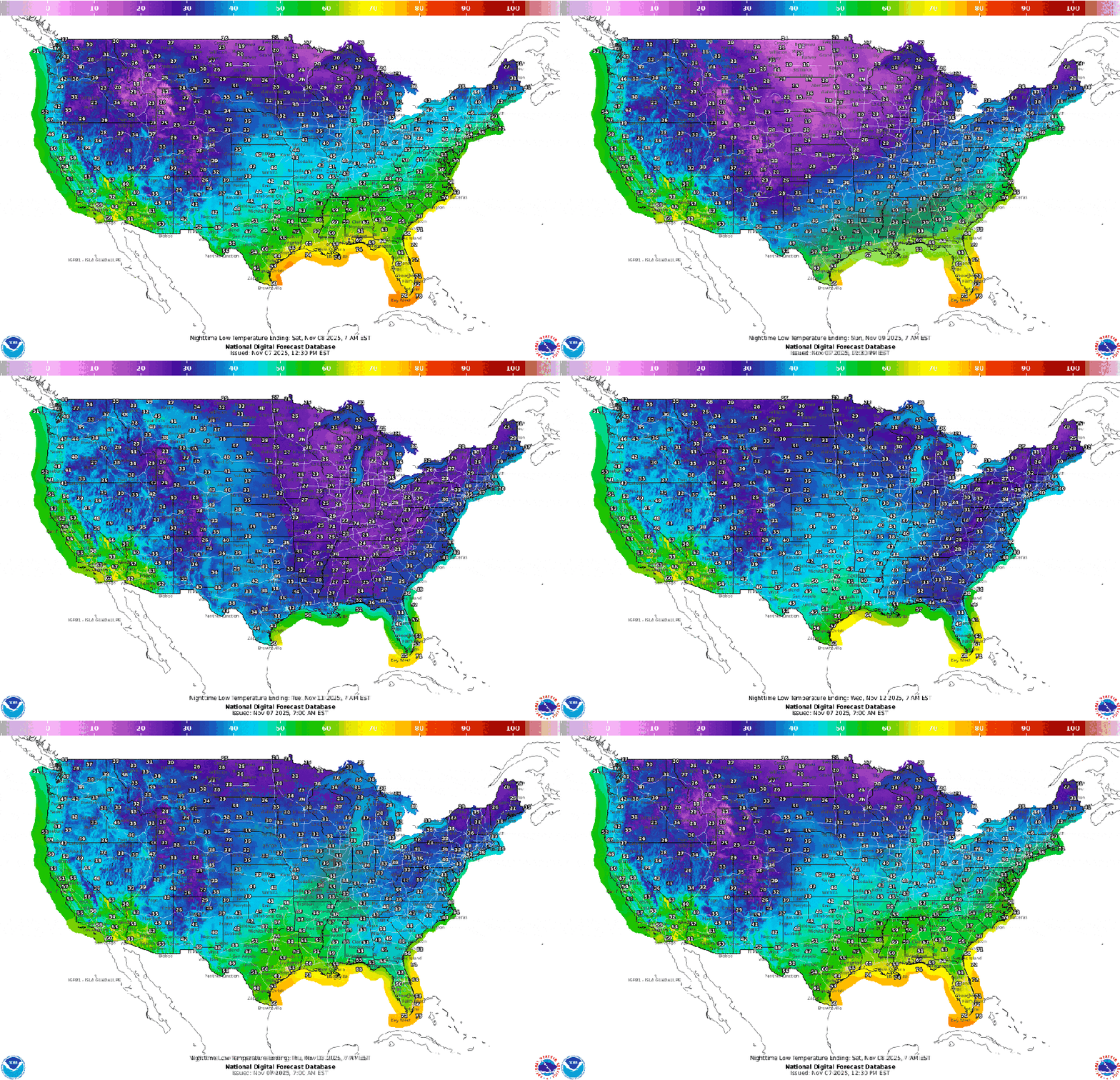
Temperatures will drop across country as a cold snap moves first into the central U.S. and then eastward.
.
.
Click the link below for the complete article:
.
__________________________________________
November 14, 2025
Mohenjo
Business, Food For Thought, Human Interest, Political, Science, Technical
amazon, business, Business News, current-events, Future, Hotels, human-rights, medicine, mental-health, research, Science, Science News, technology, Technology News, travel, vacation

Click the link below the picture
.
If someone so much as says “my boyf–” on social media, they’re muted. There’s nothing I hate more than following someone for fun, only for their content to become “my boyfriend”-ified suddenly. This is probably because, for so long, it felt like we were living in what one of my favorite Substackers calls Boyfriend Land: a world where women’s online identities centered around the lives of their partners, a situation rarely seen reversed. Women were rewarded for their ability to find and keep a man, with elevated social status and praise. It became even more suffocating when this could be leveraged on social media for engagement and, if you were serious enough, financial gain.
However, more recently, there’s been a pronounced shift in the way people showcase their relationships online: far from fully hard-launching romantic partners, straight women are opting for subtler signs—a hand on a steering wheel, clinking glasses at dinner, or the back of someone’s head. On the more confusing end, you have faces blurred out of wedding pictures, or entire professionally edited videos with the fiancé conveniently cropped out of all shots. Women are obscuring their partner’s face when they post, as if they want to erase the fact they exist without actually not posting them.
So, what gives? Are people embarrassed by their boyfriends now? Or is something more complicated going on? To me, it feels like the result of women wanting to straddle two worlds: one where they can receive the social benefits of having a partner, but also not appear so boyfriend-obsessed that they come across as quite culturally loser-ish. “They want the prize and celebration of partnership, but understand the norminess of it,” says Zoé Samudzi, writer and activist. In other words, in an era of widespread heterofatalism, women don’t want to be seen as being all about their man, but they also want the clout that comes with being partnered.
But it’s not all about image. When I did a callout on Instagram, plenty of women told me that they were, in fact, superstitious. Some feared the “evil eye,” a belief that their happy relationships would spark a jealousy so strong in other people that it could end the relationship. Others were concerned about their relationship ending, and then being stuck with the posts. “I was in a relationship for 12 years and never once posted him or talked about him online. We broke up recently, and I don’t think I will ever post a man,” says Nikki, 38. “Even though I am a romantic, I still feel like men will embarrass you even 12 years in, so claiming them feels so lame.”
But there was an overwhelming sense, from single and partnered women alike, that regardless of the relationship, being with a man was an almost guilty thing to do. On the Delusional Diaries podcast, fronted by two New York-based influencers, Halley and Jaz, they discuss whether having a boyfriend is “lame” now. “Why does having a boyfriend feel Republican?” read a top comment. “Boyfriends are out of style. They won’t come back in until they start acting right,” read another with thousands of likes. In essence, “having a boyfriend typically takes hits on a woman’s aura,” as one commenter claimed. Funnily enough, both of these hosts have partners, which is something I often see online. Even partnered women will lament men and heterosexuality—partly in solidarity with other women, but also because it is now fundamentally uncool to be a boyfriend-girl.
It’s not just in these women’s imaginations—audiences are icked out by seeing too much boyfriend content, myself included, it seems (as indicated by my liberal use of the mute button). When author and British Vogue contributor Stephanie Yeboah hard-launched her boyfriend on social media, she lost hundreds of followers. “Even if we were still together, I wouldn’t post them here. There is something cringey and embarrassing about constantly posting your partner these days,” she tells me, adding that, “there is part of me that would also feel guilty for sharing my partner constantly—especially when we know the dating landscape is really bad at the moment. I wouldn’t want to be boastful.”
Sophie Milner, a content creator, also experienced people unfollowing her when she shared a romantic relationship. “This summer, a boy took me to Sicily. I posted about it on my subscribers section, and people replied saying things like, ‘please don’t get a boyfriend!’” She admits that her content perhaps becomes less exciting when she is in a relationship. “Being single gives you this ultimate freedom to say and do what you want. It is absolutely not every woman, but I do notice that we can become more beige and watered-down online when in a relationship—myself included.”
.
 Photo: GraphicaArtis/Getty Images
.
.
Click the link below for the complete article (sound on to listen):
.
__________________________________________
Older Entries
Newer Entries
 James' World 2