Click the link at the bottom of the page for 118 photos!
Every year, the Met Gala is where celebrities ascend to style icon status.
On the first Monday in May, celebrities don’t just walk the red carpet: They climb the steps of the Metropolitan Museum in custom gowns and statement couture, presenting their interpretation of the exhibition’s theme to the entire world. Unlike an awards show or a premiere, the goal isn’t to shine for a moment—it’s to create a look that resonates for decades. Despite the wealth of designer gowns and bespoke suits, few accomplish that feat, but those who do earn themselves a place in fashion history.
The greatest hits—Rihanna’s papal chic, Kate Moss’s golden turban, Sarah Jessica Parker’s tartan Alexander McQueen, Erykah Badu’s glittering top hat, Madonna in a hippie caftan—rank among the best outfits ever to be worn. And their charms wouldn’t have been as compelling on another night. After all, the gala encourages the kind of innovation rarely seen elsewhere.
The Costume Institute’s trove of landmark runway creations serves as an inspiration for guests, allowing them to take on fashion at its most avant-garde. Where else will you see Cardi B. and a small army of assistants move a mountainous red Thom Browne train across a pink carpet? Or watch awestruck as Lady Gaga and Brandon Maxwell take their magenta nesting doll ballgown to the streets, much to the delight of New Yorkers. A standout Met look can be performative (Amber Valletta going full baroque in 2004), subversive (Daphne Guinness in a plume of McQueen feathers in 2011), witty (Karolina Kurkova’s playful Viktor and Rolf in 2015, or referential (the Olsen twins and their yearly vintage surprise)—it just can’t be boring.
With this year’s exhibition theme, Costume Art, and a “Fashion is art” red-carpet dress code, what looks can we expect to see? Those fashions will be kept under wraps until the first Monday in May, but considering the co-chairs are Beyoncé, Nicole Kidman, and Venus Williams, you can rest assured they’ll be worth the wait.
In honor of the 2026 Met Gala, see 118 of the most memorable, daring, and over-the-top Met outfits of all time below.
Even as the status of the Strait of Hormuz remained unclear and U.S. and Iranian officials issued dueling threats to resume attacks if the cease-fire fell apart, both countries had reason to hope it held together.
Here’s the latest.
The day-old cease-fire between the United States and Iran was being tested on Wednesday by uncertainty over the status of the economically vital Strait of Hormuz and disagreement over whether the truce applied to Lebanon, where Israel continued to carry out punishing attacks.
Iran, which said Lebanon was included in the cease-fire, accused the United States of not upholding its end of the deal. And Iran’s foreign minister, Abbas Araghchi, said Washington had to choose between a cease-fire or continued war via Israel, and “cannot have both.” Pakistan, which mediated the truce, said the deal covered Lebanon, a claim disputed by the White House press secretary, Karoline Leavitt.
Disagreement over Lebanon’s inclusion in the cease-fire threatens to unravel it.
Less than twenty-four hours after Iran and the United States agreed to a cease-fire, a disagreement surfaced over whether or not the terms applied to Lebanon, where Israel is bombarding Hezbollah.
Iran said the deal included Lebanon. The U.S. said it did not.
Attacks reported after cease-fire took effect
Attacks continued in the Middle East on Wednesday after a U.S.-Israeli cease-fire with Iran. Israel said that Lebanon was excluded from the truce.
.
As the cease-fire deal among the U.S., Israel and Iran took hold, residents of Tehran expressed mixed reactions. CreditCredit…Arash Khamooshi for The New York Times
Right now, all eyes are on Artemis II, NASA’s historic mission that just sent astronauts around the moon for the first time in more than a half-century. But, as detailed by NASA administrator Jared Isaacman at the space agency’s recent “Ignition” event in Washington, D.C., Artemis II is only the beginning of a larger U.S. effort to populate the moon with astronauts and resource-prospecting robots. If this quest advances at the breakneck pace Isaacman desires, then Earth’s celestial sidekick will also become a place of profound scientific revelations.
Despite the moon being so nearby, we know surprisingly little about it with much certainty. The Apollo astronauts hauled back a bevy of moon rocks and left behind a few short-lived geological experiments, but most of our lunar knowledge today comes from moon-orbiting satellites, telescopic observations from Earth, and the handful of sample-return missions undertaken recently by China.
Starved of more in situ data, researchers can’t yet scratch a bigger scientific itch; they wish to study the moon as a Rosetta Stone for the origin and evolution of our world and the solar system at large. Now, thanks to the proposed high cadence of lunar missions—crewed and robotic, by space agencies and private industry alike—it looks like their wish will be granted. Earth’s tectonics, volcanism, oceans, atmosphere, and life have all erased the geological records of the planet’s earliest eras. But the moon, lacking such tumult, has preserved them. That makes Earth’s silvery orb “a perfect geological laboratory,” says Sara Russell, a planetary scientist at London’s Natural History Museum.
With that in mind, here are the biggest mysteries moon-focused scientists are now hoping to solve.
How is the moon still alive, geologically speaking?
The churning heat deep within planets and moons is what gives them geological “life,” from volcanic eruptions and earthquakes to uplifting mountains and excavating ocean basins. But when the heat wanes, a world dies, geologically speaking.
Scientists know of three main ways to keep the metaphorical fires burning: the “primordial” heat left over from impactors slamming together during the world’s collisional formation, the heat from decaying radioactive elements and the frictional heat from tidal forces that can knead a world’s innards like dough.
The moon is much smaller than Earth, so its primordial heat should have leaked into space long ago. Lunar samples and theoretical models suggest it lacks a hidden abundance of radioactive elements. And careful calculations show that Earth’s gravitational pull shouldn’t be causing significant lunar tidal heating. Yet shallow “moonquakes” still shake the moon, while age estimates based on crater counts of its pockmarked surface hint that some volcanism may be 100 million years old—which, on geological timescales, is yesterday.
Scientists, naturally, have questions. “Is the moon still volcanically active?” asks Thomas Watters, a senior scientist in the Center for Earth and Planetary Studies of the Smithsonian Institution’s National Air and Space Museum in Washington, D.C. To find out just how much geological “life” still lingers there—and why—“we need to get a better look at the moon’s internal structure,” Watters says.
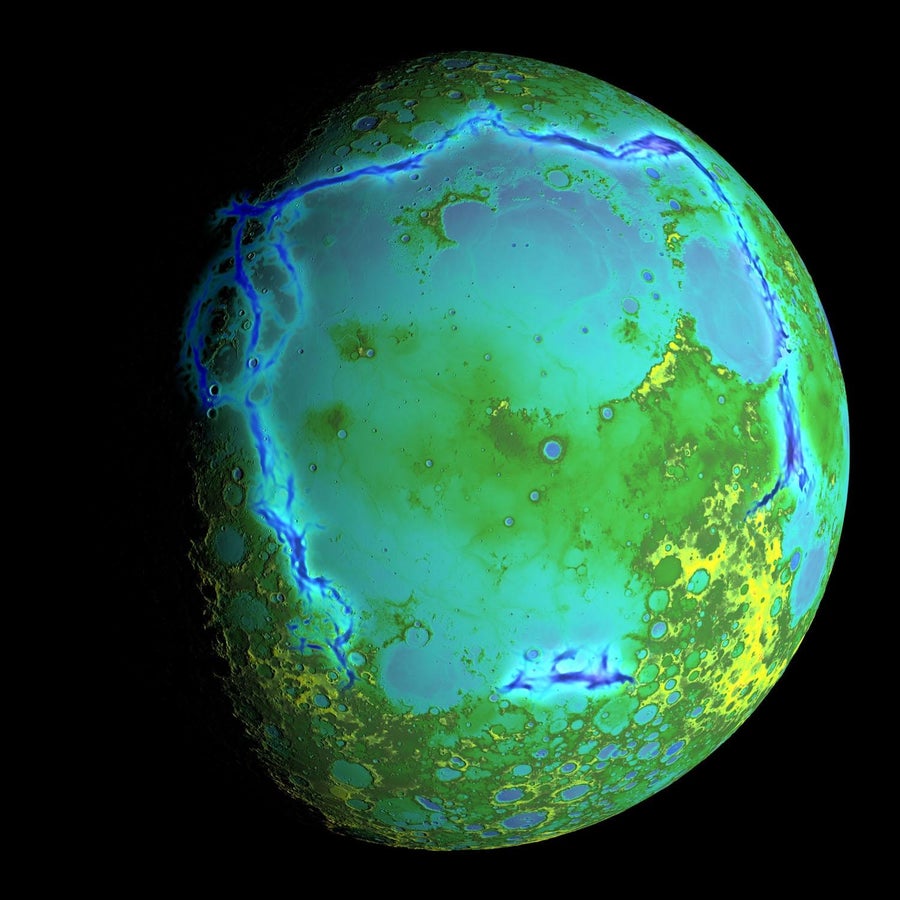
This eerie false-color topographic lunar view is centered on Oceanus Procellarum, the largest expanse of frozen lava on the moon. Based on data from NASA’s Lunar Reconnaissance Orbiter as well as the space agency’s Gravity Recovery and Interior Laboratory (GRAIL) mission, the blue border structures are thought to be ancient, lava-flooded rift zones buried beneath Oceanus Procellarum’s volcanic plains. NASA/Colorado School of Mines/MIT/GSFC/Scientific Visualization Studio
To delve to the (geological) heart of the matter, scientists want to know the moon’s deepest secret—what’s happening at its most abyssal depths. “Does the moon have a solid core or a liquid core?” says Yuqi Qian, a lunar geologist at the University of Hong Kong. “We still don’t know.”
Seismometers offer silver bullets, allowing scientists to use moonquakes (whether homegrown or imported via lunar impacts of errant meteoroids) to effectively perform a CT scan of the deep subsurface. But coverage is currently nonexistent; what we know about the lunar underworld was provided by Apollo-era seismometers that operated until 1977. And these were all placed in just one patch of the moon’s nearside. “We don’t have any seismometers deployed on the farside,” Qian says.
That’s about to change. If current projections are to be believed, the next time anyone lands astronauts on the moon will be the Artemis IV mission, set for 2028. When those crew members reach their landing site near the moon’s south pole, they’ll tote along a cutting-edge seismometer package called the Lunar Environment Monitoring Station, or LEMS. Eventually, as part of NASA’s Commercial Lunar Payload Services, or CLPS, initiative, a network of sensors known as the Farside Seismic Suite will be robotically deployed in the eponymous region. Recent news suggests China may make its first crewed landing somewhere on the moon’s nearside, and those astronauts will likely bring seismometers as well.
In other words, the “Artemis astronauts will be laying down some of the first nodes of a global seismic network,” says Nicholas Schmerr, a seismologist and planetary scientist at the University of Maryland.
Samples, too, will be vital. Rocks nabbed by China’s robotic lunar sample return missions, Chang’e 5 and 6, indicate active volcanism there up until at least two billion years ago. Widening our view to the moon’s more recent epochs requires nabbing more youthful material from the surface. For now, Qian says, “we don’t have samples younger than that.”
Scientists also hope future landings will locate and sample expunged sections of the moon’s mantle—the primeval, less altered underbelly of the lunar crust. If mantle rocks prove to be riddled with byproducts of radioactive decay, this would probably mean the moon’s interior is richer in heat-generating radioisotopes than scientists had thought—thus explaining why it’s still convulsing long past its presumed geological expiry date.
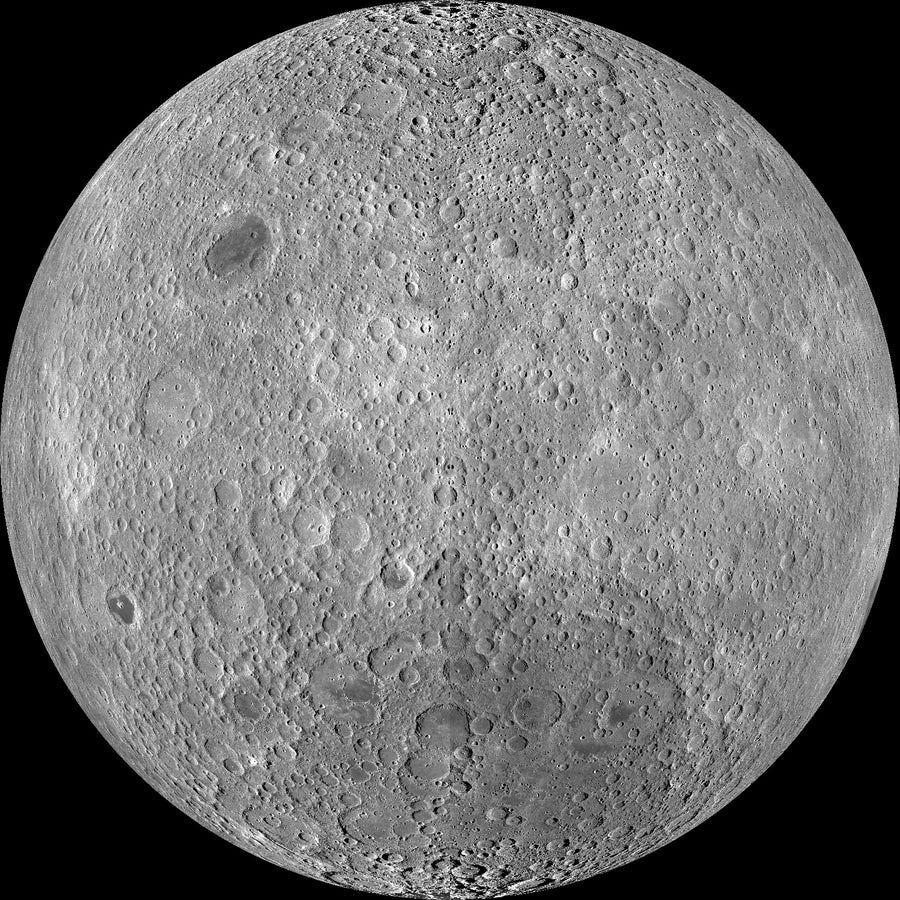
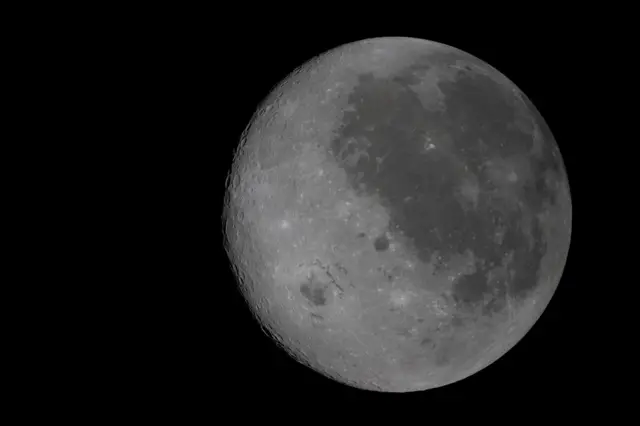
A view of the moon’s crater-pocked far side, based on observations from NASA’s Lunar Reconnaissance Orbiter. NASA/Goddard/Arizona State University
How did the moon form?
The most popular origin story involves Theia—a Mars-sized protoplanet—smashing into the primordial proto-Earth, with the debris from both bodies quickly coalescing into the moon. This isn’t just a fable: it’s backed up by robust computer simulations grounded with plenty of geochemical evidence. Samples of the moon’s mantle, though, could further test this theory—while geophysical observations could address the moon’s weirdest feature.
The nearside is covered in vast, dark splotches of cooled volcanic rock named mare (Latin for “sea”). The farside has a dearth of these and instead looks more like Mercury: a crater-filled land of jagged mountain ridges. Why is the moon so two-faced?
One possible explanation comes from an idea dubbed “Earthshine.” Eons ago, when the moon formed, it orbited Earth 15 times closer. At some stage, the moon became tidally locked, meaning one hemisphere (the nearside) always faced Earth. And because our planet back then was a seething ball of magma, the lunar nearside should have been baked like crème brûlée, with the nearside turning molten and bubbly. Streams of vaporized rock whooshed around the moon, cooling and raining out on the farside to create its thick, lumpy crust.
Here, too, seismology offers another silver bullet. A network of seismometers, especially on the farside, could reveal crucial otherwise-hidden clues. “What is the structure of the moon?” Russell asks. “This is important to find out, as it will help us understand how the moon first formed from the debris of a giant impact and how it then evolved.”
Where did the moon’s water come from?
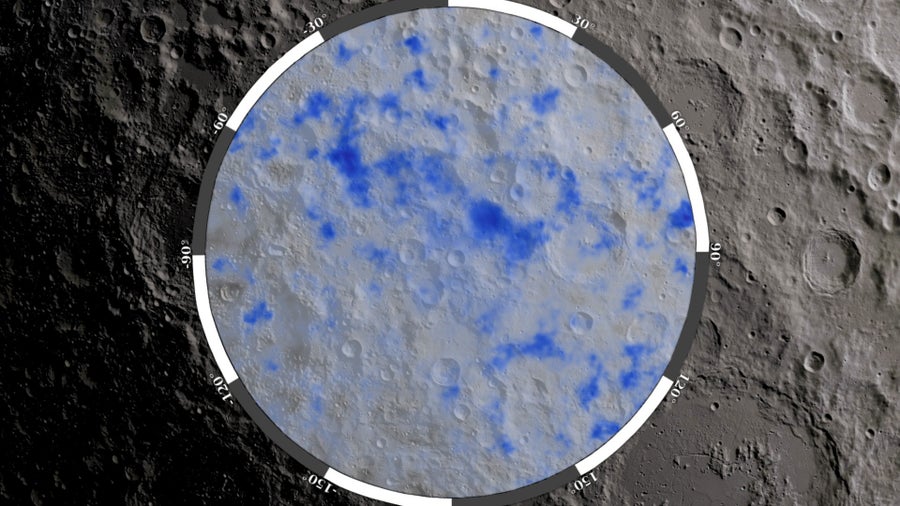
NASA really wants to plonk its astronauts down near the lunar south pole (and even build a moon base there) because that’s where permanently shadowed craters harbor some vague amount of water ice—a potential resource for hydrating humans, growing crops and making rocket fuel.
Data from NASA’s Lunar Reconnaissance Orbiter reveals the possible presence of water-ice deposits (blue) at the dark floors of craters around the moon’s south pole. NASA/GSFC
It’s no coincidence, then, that lunar prospecting was a hot topic at NASA’s Ignition event. Astronauts could, in principle, descend into the treacherously dark and cold craters to look for themselves, but most of this water divining will be conducting by robots.
NASA’s Volatiles Investigating Polar Exploration Rover, or VIPER, will use its instruments to sniff out subsurface water, then use a drill to confirm its suspicions. And NASA’s next-generation moon buggy—or Lunar Terrain Vehicle—will do something similar, whether it’s being piloted by astronauts or (as will likely be the case for most of its lunar tenure) autonomously navigating the surface. And brought along for the ride on an upcoming crewed surface mission will be the Lunar Dielectric Analyzer, an instrument that can detect electrical currents in the ground below, which can reveal the presence of ice. “This will really help us understand where water is on the moon and in what form,” Russell says.
This endeavor isn’t just about being pragmatic. Scientists still don’t really know where Earth’s water came from. Ice-rich comets or drier asteroids are the two prime suspects. Geochemical studies of various meteorites and Earth’s oceans hint at asteroids as the more likely culprit, but the case is far from closed. Consulting the moon’s relatively pristine terrain —much of which has been frozen in time for billions of years—could help finally solve this mystery. “If there’s any water ice on the moon, its signal might be more primitive,” Qian says. And because Earth and the moon have a very similar ancient history, then “the origin of water on the moon is likely the same as the origin of water on the Earth,” Russell says. All scientists need to do now, then, is find it.
.
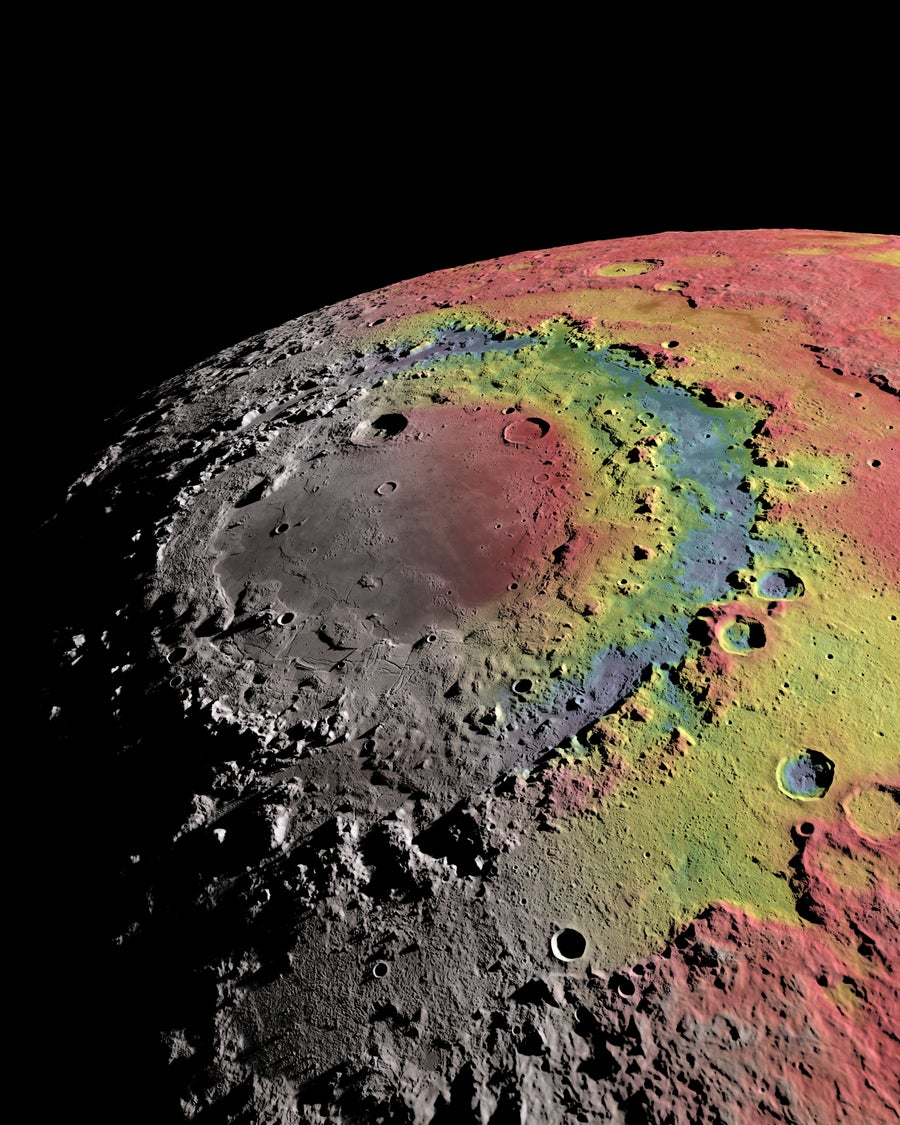
A visualization of the moon’s Orientale basin, a region closely studied by the Artemis II crew during their lunar flyby. Gravitational data from NASA’s Gravity Recovery and Interior Laboratory (GRAIL) mission are depicted in false colors on this image’s right side, and chart the basin’s subsurface structure. NASA’s Scientific Visualization Studio
The Stanislaus County Sheriff’s Office in California is assisting with a shooting involving agents from U.S. Immigration and Customs Enforcement. The incident occurred near Sperry Avenue and Interstate 5, between San Jose and Modesto.
Authorities said no local law enforcement officers were involved in the incident. The “suspect” was taken to a local hospital for further medical attention, the sheriff’s office said.
There will be road closures and a large law enforcement presence for an undetermined period, causing significant traffic delays, the sheriff’s office said.
Person shot by ICE in critical condition, county officials say, adding FBI will lead investigation
A sheriff’s sergeant said the person shot by ICE officers has been taken to a local hospital and is in critical condition.
Sgt. Veronica Esquivez, speaking with reporters in Spanish, said the shooting victim was the only one who was hurt in the incident.
Asked for a message to the broader community, Esquivez said that it was a unique event and that the community should not be scared.
ICE spokesperson Todd Lyons had identified the man as Carlos Ivan Mendoza Hernandez, an alleged gang member from El Salvador, and has said the shooting took place after a “targeted vehicle stop.”
Esquivez said that the Stanislaus Sheriff’s Department does not work with ICE but that it responded to the shooting after it initially got a call about shots fired and helped secure the scene.
The FBI has assumed primary responsibility for the investigation and asked the public to share information or videos of what happened online.
ICE has been under the microscope after months of tensions
For the last year, the Immigration and Customs Enforcement agency has been under intense public scrutiny as the Trump administration has ramped up immigration enforcement.
There were at least 14 shootings involving ICE between September and March, which included shootings of suspected criminals, immigrants who lack permanent legal status, and U.S. citizens. It is not clear how many of the shootings federal authorities have fully investigate,d as there have been no public reports of any findings.
In addition to the use of force, some have criticized the administration for going after undocumented immigrants without criminal histories and those in the process of obtaining citizenship through the legal system. Critics have also taken issue with the detention of young children.
President Donald Trump has repeatedly defended his immigration policies, which was a cornerstone of his re-election campaign.
Tensions came to a head in January, when federal officers flooded into Minneapolis and its surrounding area as part of an immigration crackdown. They were met with widespread protest.
Two U.S. citizens were fatally shot — Renee Good and Alex Pretti.
Their deaths ignited a national outrage. The Trump administration withdrew most of its immigration enforcement from Minnesota. Former Homeland Secretary Kristi Noem was fired weeks later and replaced by Sen. Markwayne Mullin, R-Okla.
Democrats are insisting on reforms on how ICE and Customs and Border Patrol operate in return for funding the Department of Homeland Security, which has been in a shutdown since Feb. 14. Republicans have yet to come to an agreement with their counterparts on the matter.
Video from bystander shows ICE shooting at vehicle
+2
Caroline Radnofsky, Marin Scott, and Video from a bystander shows the moment ICE officers opened fire on a vehicle in Patterson, California.
The video shows a hatchback vehicle on the side of the road with at least three law enforcement officers surrounding it. The hatchback is between two larger vehicles in an area that matches where the Stanislaus County Sheriff’s Office said the shooting occurred.
NBC News has reached out to the Department of Homeland Security for comment on the video.
At least one of the officers is in front of the driver-side window and seems to lean forward before the hatchback reverses into a truck behind it. The passenger-side door is open and seems to be heavily damaged in the crash.
Seconds later, the video shows the hatchback moving forward and turning toward the road as officers appear to pull weapons and point them at the vehicle. There is no audio in the clip seen by NBC News.
The hatchback accelerates across the road’s median, hitting the road hard enough that two hubcaps come off the wheel, before the clip ends.
FBI confirms it is investigating ICE shooting
Insiya Gandhi
The FBI’s field office in Sacramento is responding to the shooting in Patterson, California, it confirmed in a statement that noted the investigation is “in its early stages.”
“We are conducting a thorough investigation in partnership with the Stanislaus County Sheriff’s Office and are grateful for the Patterson community’s continued patience and support,” the FBI said.
ICE officers were seeking a gang member before shooting, DHS says
Doha Madani
ICE officers were attempting to arrest a man who is allegedly a gang member wanted in El Salvador prior to the shooting this morning in Patterson, according to a statement from Todd Lyons, acting director of the agency.
ICE identified the man as Carlos Ivan Mendoza Hernandez, saying he is a member of the 18th Street Gang. Hernandez is wanted in El Salvador for questioning in connection with a murder, and ICE officers attempted to arrest him in a “targeted vehicle stop,” Lyons said.
“As officers approached the car, the wanted gang member weaponized his vehicle in an attempt to run an officer over,” Lyons said in the statement. “Following their training, our officers fired defensive shots to protect themselves, their fellow agents, and the public.”
The FBI is at the scene of the shooting, the statement added.
No details yet on suspect’s condition, sheriff’s office says
Doha Madani and Insiya Gandhi
There is no information yet on the status of the individual who was shot, according to a spokesperson for the Stanislaus County Sheriff’s Office.
The person, identified only as a “suspect” by the sheriff’s office, was transported to a local hospital. The spokesperson added that the sheriff’s office does not provide information on which hospital individuals are taken to for medical care.
NBC News has reached out to multiple medical centers in the area, but some said they do not take trauma patients. A hospital in the nearby city of Turlock referred NBC News to the Stanislaus County Sheriff’s Office when asked if it had received a patient in the incident.
Homeland Security still without funding as Congress debates ICE reforms
Doha Madani
The Department of Homeland Security is still in a shutdown as Congress remains at odds over Democrats’ push to implement reforms to Immigration and Customs Enforcement.
It’s been nearly two months since the department’s funding lapsed on Feb. 13, and lawmakers have not been able to come to an agreement on the future of the embattled agency. Democrats have insisted on implementing changes to ICE after two U.S. citizens were shot and killed during the surge of federal agents in Minneapolis earlier this year.
Congress is currently in recess and will not return to Capitol Hill until Friday, with the House of Representatives returning to session.
ICE reportedly made 18 arrests in the county over last 6 months
Doha Madani
There have been at least 18 arrests by ICE in the county over the last six months, according to a report by The Modesto Bee last week.
Stanislaus County, home to the city of Modesto, is located in the San Joaquin Valley of Northern California.
The area is known for its agricultural economy, with almonds serving as its top crop over the last several years. An agricultural report from 2023, the most recent available on the county’s website, says its total gross value of almonds brought in exceeded $813 million, with milk shortly behind at more than $761 million.
ICE involved in shooting in Northern California, sheriff’s office says
Doha Madani and Jay Varela
There has been a shooting involving Immigration and Customs Enforcement in California, according to a statement from the Stanislaus County Sheriff’s Office.
No details were provided, but the sheriff’s office said the “suspect” involved was transported to a local hospital. NBC News has reached out to the Department of Homeland Security for comment.
Residents should expect traffic delays due to road closures for the rest of the day, the sheriff’s office advised.
Is it possible that our esteemed 47th “Great Businessman”, “get coal miner’s jobs back” President, is a batshit crazy scam artist? Are there bats in the belfry at the second white house, Mar-A-Largo? Can we get a definitive answer, so already great America won’t be the laughing stock of the world?
I recently watched the Armageddon movie and the USA lead the charge to solve the problem. I want to know where do we go from here? This crazy man won’t shut up, look at what happened in the ‘House of Represenatives’. Do they want to gain power for themselves while destroying America. if we arn’t very careful America will suffer a ‘Red Dawn’. check out the movie which could be our furture!
It was a stunning threat that promised to eliminate Iranian civilization, delivered with all the casual callousness that has become President Trump’s preferred style of communication.
“A whole civilization will die tonight, never to be brought back again.”
And that is what passed as a normal Tuesday-morning update from the Trump White House: a warning of mass destruction and what international law would define as war crimes, blithely delivered on Truth Social, posted alongside ads for bullet-shaped pens, patriotic hats, and a gala dinner at Mar-a-Lago.
“However, now that we have Complete and Total Regime Change, where different, smarter, and less radicalized minds prevail, maybe something revolutionarily wonderful can happen, WHO KNOWS?” Mr. Trump wrote in his message. “We will find out tonight, one of the most important moments in the long and complex history of the World.”
The message arrived two days after Mr. Trump marked Easter Sunday by calling on the Iranians to end its blockade of the Strait of Hormuz: “Open the Fuckin’ Strait, you crazy bastards, or you’ll be living in Hell — JUST WATCH! Praise be to Allah,” he wrote.
In the minds of the president and his supporters, the post is all part of Mr. Trump’s chaotic negotiation style, intended to prompt an end to his self-inflicted conflict and persuade Tehran to open the strait. Some of the president’s advisers saw Mr. Trump’s escalating rhetoric as a negotiating tactic that suggested he was more interested in finding a way out of the war than following through with a devastating attack.
On Tuesday evening, Mr. Trump had toggled back to diplomat mode, announcing that he had agreed to a proposal by Pakistan that calls for a two-week cease-fire and the immediate opening of the Strait of Hormuz.
The president said that the United States would work on finalizing an agreement with Iran. “It is an Honor to have this Longterm problem close to resolution,” he wrote.
Even for Mr. Trump, who has a long history of comments that fly far beyond the pale, his latest comments bear the mark of an impulsive leader who is used to getting his way through coercion and unpredictability, but who is not getting his way now.
Alex Wellerstein, a historian who studies nuclear conflicts, said that even if Mr. Trump does not carry out the extent of his threat, the president’s violent rhetoric damages his credibility as a negotiator and his country’s standing in the world.
“You’re talking about a world that largely increasingly sees the United States as unhinged and dangerous, and not a reliable partner,” he said, “where all of the countries that typically align with democracy and freedom are on the other side of the United States.”
Some of Mr. Trump’s most fervent supporters have joined the usual chorus of critics in recent days. Tucker Carlson, the right-wing podcaster, said that the president’s Easter message had “shattered” the holiest day on the Christian calendar.
“It is vile on every level,” Mr. Carlson said on his podcast. “It begins with a promise to use the U.S. military, our military, to destroy civilian infrastructure in another country, which is to say to commit a war crime, a moral crime against the people of the country, whose welfare, by the way, was one of the reasons we supposedly went into this war in the first place.”
The president responded by calling Mr. Carlson a “low I.Q. person,” and continuing on with his war. Ever a reality television producer, Mr. Trump is trying to program this war like he does everything else — through cliffhangers and wait-and-see diplomacy. As such, Mr. Trump created an 8 p.m. Eastern deadline Tuesday for Tehran to comply. Mr. Trump announced “a double sided CEASEFIRE” about 90 minutes before his self-imposed deadline.
Americans have seen versions of this playbook before: Mr. Trump makes increasingly escalatory threats, secures some semblance of a deal, and walks away declaring victory. In January, Mr. Trump threatened to send in U.S. forces to capture the Danish territory of Greenland. He settled for an agreement to increase the number of American troops there.
With Iran, though, there is still little evidence that Mr. Trump is going to ultimately get what he wants. Ebrahim Zolfaghari, a spokesman for the Iranian military, has said that Iran would retaliate “crushingly and extensively” if its civilian infrastructure were attacked.
Even with a cease-fire, Mr. Trump is far from achieving his larger strategic objectives.
The president’s increasingly violent messaging betrays a degree of frustration that he has not gotten what he wanted after pushing back an earlier deadline to barrage the country’s infrastructure. His threats to level power plants, oil installations, and bridges have seemed to have the opposite effect on some Iranians, who have formed human chains around points of infrastructure that support civilian life.
Even some people who have supported Mr. Trump in the past see his strategy on Iran, to the extent that there is one, as damaging and dangerous.
“Trump believes he is threatening Iran with destruction, but it is America that now stands in danger,” Joe Kent, the former director of the National Counterterrorism Center who resigned in March, wrote on X. “If he attempts to eradicate Iranian civilization, the United States will no longer be viewed as a stabilizing force in the world, but as an agent of chaos — effectively ending our status as the world’s greatest superpower.”
Several Republicans in Congress, who are absent from Washington during a two-week recess, criticized the president’s rhetoric, although many of them have stayed mum.
Senator Ron Johnson of Wisconsin, a close ally of Mr. Trump’s, left room for the possibility that Mr. Trump was posturing: “I hope and pray that President Trump is just using this as bluster.”
Mr. Trump’s message also alarmed top Democrats, who quickly promised to force another vote on a resolution to rein in the use of the military in Iran.
“This is an extremely sick person,” Senator Chuck Schumer of New York, the minority leader, wrote on X after Mr. Trump sent his threat. “Each Republican who refuses to join us in voting against this wanton war of choice owns every consequence of whatever the hell this is.”
Other Democrats have called to remove Mr. Trump from office over his threats, with some calling for impeachment and others pointing to the 25th Amendment, which provides a process for a president to be stripped of power if he is “unable to discharge the powers and duties of his office.”
They were joined by Marjorie Taylor Greene, the former Republican representative who has shifted from being one of Trump’s staunchest allies to being one of his most vocal detractors.
“25TH AMENDMENT!!!” she wrote on X. “Not a single bomb has dropped on America. We cannot kill an entire civilization. This is evil and madness.”
The U.S. Food and Drug Administration’s approval of Eli Lilly’s once-daily pill orforglipron as a weight loss and obesity treatment this week was the fastest approval of a new medication in decades. Clinical trial results showed that the highest doses of the oral medication, which will be marketed as Foundayo, caused people to lose an average of 27 pounds after 72 weeks of treatment.
The new oral medication is the latest glucagonlike peptide 1 (GLP-1) drug in the rapidly expanding market. Foundayo is the second GLP-1 weight-loss pill to gain FDA approval; Novo Nordisk’s once-a-day Wegovy pill was approved in December 2025. Experts hope that having more options for these popular weight-loss and type 2 diabetes treatments will drive down costs and offer people more flexibility.
“Generally, it’s much easier to make pills and distribute them,” compared with injectable drugs, says Daniel Drucker, an endocrinologist at the University of Toronto, who has previously consulted for Eli Lilly. “That should be an advantage in really getting the drug to a much wider population.”
In the latest phase 3 trial of orforglipron, three doses of the drug were compared with a placebo in 1,613 people with type 2 diabetes who were overweight or had obesity. After 72 weeks, people on the six-milligram dose lost 5 percent of their body weight, those on 12 milligrams lost 7 percent, and those on 36 milligrams lost nearly 10 percent.
A clinical trial found a 25-mg dose of the Wegovy pill caused nearly 17 percent weight loss in 64 weeks. And in another clinical trial, injections of 15-mg doses of tirzepatide (the active ingredient in Eli Lilly’s weight-loss injectable Zepbound) resulted in an average of about 21 percent body-weight reductions after 72 weeks.
“It’s not as high of weight loss as tirzepatide and not as high as some of the things that we’ll see coming down the pipeline in the next six months to a year, but I think there’s room for all of those [medications],” says Deborah Horn, director of obesity medicine at UTHealth Houston, who led the most recent trial on Foundayo. (Horn consults for Eli Lilly.)
The various forms and levels of effectiveness of these drugs could provide more individualized treatments, she says. For instance, another recently completed trial by Eli Lilly investigated if people who were initially treated with an injectable GLP-1 drug could eventually transition to an oral version like Foundayo and still maintain the weight loss and health benefits. The results have been submitted for peer-reviewed publication.
“A lot of people are asking the question: ‘If I do these injectables for a year and get to a healthy place, could I transition to this oral medication and keep the weight off?’” Horn says. “That data will be available very soon.”
Foundayo works similarly to other GLP-1 drugs, such as semaglutide—the active ingredient in the injectable and pill forms of Wegovy. The new oral drug latches on to the receptors for the gut hormone GLP-1 to make people feel satiated and slow down stomach emptying, causing them to eat less and ultimately lose weight. The Wegovy pill and all currently available injectable versions of the drug are peptides, or short chains of amino acids, that are similar to the body’s GLP-1, whereas Foundayo is a nonpeptide small molecule. That comes with several advantages, Horn says.
Because Semaglutide is a peptide, it quickly degrades in the acidic environment of our stomach, Horn explains. The Wegovy pill has a special ingredient that shields it from some erosion, but people must still take it on an empty stomach to ensure it’s properly absorbed. As a nonpeptide, Foundayo can be absorbed through the gut without breaking down, and that means it can be taken anytime, regardless of when you eat, drink or take other medications.
Such small-molecule-based drugs are also generally easier and cheaper to manufacturer than peptides. “In terms of distribution, it gets rid of things like cold storage and plastics for [injection] pens,” Horn says.
In a press release about Foundayo’s approval, Eli Lilly listed the starting price for the drug at $25 per month for people who have commercial insurance and enroll in the company’s Foundayo savings card program. Out-of-pocket costs start at $149 per month and go up to $349 for higher doses, according to material an Eli Lilly spokesperson shared with Scientific American. Starting in July, the drug is expected to be available for $50 to eligible individuals on Medicare Part D—a federal prescription drug benefit program for adults who are aged 65 and older or have certain disabilities.
Eli Lilly’s announcement lists several tablet doses, starting at 0.8 mg and up to 17.2 mg—the pill with the maximum dosage of 17.2 mg is reported have an efficacy equivalent to the 36-mg dose tested in trials, according to the company spokesperson. Further information isn’t yet publicly available on the pricing of the various doses. The FDA’s news release about the approval describes a schedule that gradually increases doses over time—a titration scheme similar to that of other GLP-1 drugs that helps the body adjust to the medication, Drucker explains. “We’ve seen with every single one, if you start too high and increase the dose too quickly, you get sick,” he says.
Similar to other GLP-1 medications, Foundayo causes nausea, vomiting, diarrhea and other gastrointestinal side effects. In the recent trial, participants on the highest 36-milligram dose had about a 2 percent greater risk of a serious adverse event, compared with those given a placebo. Rates of treatment discontinuation—most commonly from gastrointestinal symptoms—were higher, at 6 to 10 percent, depending on the dose, for those who received the pill, compared with a rate of 4 percent for those who received the placebo. The trials find Foundayo to be very safe, but Drucker notes that people should continue to keep a watchful eye on any new drug.
For peptide-based GLP-1 drugs, “we have 21 years of safety data,” he says. “Whenever we have a new medicine, we always restart the clock in terms of safety.”
In a response to Scientific American’s request for comment, the Eli Lilly spokesperson said that the FDA reviewed the company’s “robust clinical data package” and that the approval establishes “Foundayo’s strong safety and efficacy profile.”
Foundayo and other weight-loss drug candidates in the works could increase supply and help with affordability of GLP-1 drugs overall—though that might take some time, Horn says. “I don’t think we’re at very, very inexpensive yet, but I think we will get there as more and more GLP-1s and other medicines become available.”
“Believe women” was the defining message of the #MeToo movement. Today, there’s a new one: Erase women.
The Trump administration’s attack on diversity, equity, and inclusion has rolled back decades of progress for women, who now face a widening gender pay gap and narrowing employment protections. In the process, discussions about women have become a third rail, a toxic topic that is too politically charged to touch. Companies, universities, law firms, and cultural institutions are all expunging references to “women” and “gender,” even under the most benign circumstances.
The Trump administration has defined “illegal D.E.I.” as “programs, initiatives, or policies that discriminate, exclude or divide individuals based on race or sex.” But in practice, President Trump’s allies have questioned whether women deserve a place in the workforce at all. They have blamed women for last year’s California wildfires and slammed the conservative Supreme Court justice Amy Coney Barrett as a “D.E.I. hire” for a ruling they didn’t like. Defense Secretary Pete Hegseth is purging the military of senior female officers after complaining that the armed forces had become “effeminate.” Women’s names have disappeared from museums, parks, monuments, and even the Arlington National Cemetery.
Terrified of being the administration’s next target, organizations are descending into the realm of the absurd. A researcher focused on maternal health removed references to gender-based discrimination in order to receive federal funding. A medical trade publication warned scientists to avoid words such as “female” and “women” in grant applications. After Senator Ted Cruz of Texas released a list of supposedly “woke” National Science Foundation grants last year, ProPublica found that some were included merely because their project descriptions included words like “female,” as in a female research scientist, or “diversify,” as in the biodiversity of plants.
It’s a fun-house mirror moment. For more than a decade, while reporting on women in the workplace, I’ve seen my inbox clogged with companies boasting about their work championing female employees. But most firms I contacted for this piece begged me to keep them out of it. At a recent event about working women, I asked a room of human resources executives whether their firms’ diversity efforts were continuing, and every hand shot up. When I asked who would talk about it publicly, almost every hand quickly went down. Executives say they fear not just the administration, but also right-wing activists and misogynistic trolls who might target them.
Even companies with excellent track records in promoting women don’t want to mention it. In a recent Harvard Business Review article, the sociologists Frank Dobbin and Alexandra Kalev identified several initiatives available to all employees that can actually be more effective than D.E.I. programs in boosting outcomes for marginalized groups. They highlighted the successes of IBM’s formal mentorship programs, Walmart’s training academy, and Gap’s family-friendly scheduling options. All three companies recorded increases in the percentage of women and people of color in senior roles.
Just don’t ask IBM, Walmart, or Gap to elaborate on those impressive findings. I did. All declined.
It may seem perfectly reasonable, even admirable, for companies to keep their mouths shut as they continue to advance diversity goals. After all, nobody wants to be a target. In previous years, too many companies went overboard, with lots of cheap talk about diversity and not enough action. The problem is that silencing the conversation risks undoing years of progress at a time when women are still underrepresented in business and public life. As women are erased from the narrative, injustices against them go unnoticed.
Already, incidents that in years past would have prompted public outrage are being met with silence. Just last month, in a stunning reversal, the United States for the first time in 70 years refused to sign off on the U.N. Commission on the Status of Women’s annual principles, an anodyne set of statements including a reaffirmation of its “commitments to gender equality” and a call to repeal “gender discriminatory provisions.” A U.S. representative to the U
My guess is that you haven’t heard about this historic repudiation. It’s not your fault: It got almost no public attention.
Firms are even cutting funding for employee resource groups — affinity groups centered on women, ethnic and racial minorities or L.G.B.T.Q. communities — despite the fact that many aren’t in the administration’s cross hairs. In previous years, companies “would brag about what they’re doing,” Shelley Correll, a sociologist at Stanford University, told me. Now, companies are “canceling E.R.G.s that aren’t illegal,” she says. It’s “an overreaction to what even Trump is asking them to do.”
As a result, last year, an annual report on women in the workplace found that women have “less career support and fewer opportunities to advance.” One previous champion of women’s advancement, Meta’s chief executive, Mark Zuckerberg, now says companies need more “masculine energy.”
Other marginalized groups have also been targeted. In the wake of George Floyd’s murder in 2020, corporations jumped to make grand statements and pledge billions of dollars to combat discrimination. Most of those efforts, including initiatives to boost female employees, turned out to be empty platitudes or just plain failures.
The erasure of women from the national narrative has long been a key strategy authoritarian leaders use to destroy democracies. In Turkey, President Recep Tayyip Erdogan has declared that women aren’t equal to men. In Russia, some forms of domestic violence have been decriminalized. And in Hungary, Prime Minister Viktor Orban’s government has urged women to focus on childbearing, not its large pay gap. A primary feature of the “autocrat’s playbook” is “reversing progress on gender equality and women’s rights,” the Harvard scholars Erica Chenoweth and Zoe Marks have written.
Now, women’s rights are eroding in the United States. The Trump administration has called for resurrecting “traditional” nuclear families where the mother is a homemaker. JD Vance argued that having more women in the workforce results in “unhappier, unhealthier children.” The administration recently sued a Coca-Cola distributor for hosting a women’s retreat, alleging it discriminated against men. Trump allies have even suggested stripping women of the right to vote.
When women mobilize, countries are more likely to be egalitarian democracies. That’s why authoritarians fear women. The rest of us shouldn’t.
The Artemis II astronauts are bound for Earth after conducting a historic lunar fly-by and witnessing a total solar eclipse from their spacecraft
Commander Reid Wiseman says the Orion spacecraft crew “saw sights that no human has ever seen”, while pilot Victor Glover says there are “no adjectives” to describe what they observed
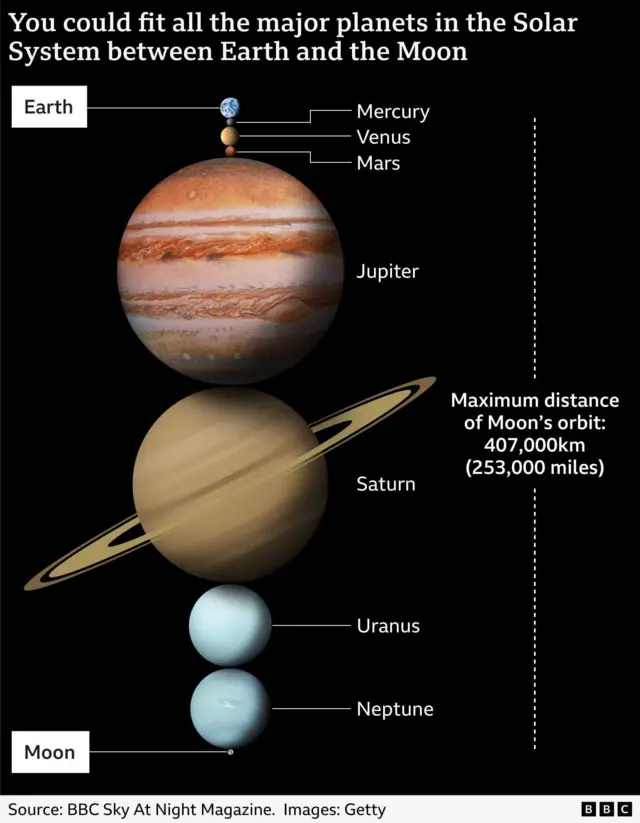
The spacecraft reached its maximum distance from Earth – 252,756 miles (406,771km) – during the lunar fly-by. The crew had already broken the previous record for the furthest distance humans have travelled into space
The astronauts lost connection with NASA while behind the Moon – the outage was expected and lasted around 40 minutes
“It is so great to hear from Earth again,” said mission specialist Christina Koch as she broke the silence from the spacecraft
US President Donald Trump tells the astronauts that they have “made history and made all America really proud” – and invites them to the White House
The astronauts are due to splash down in the Pacific Ocean off the west coast of the US at 20:07 eastern US time on Friday (01:07 BST Saturday)
Live Reporting
Edited by James Chater and Toby Mann, with science editor Rebecca Morelle at Mission Control in Houston, Texas, and science correspondent Pallab Ghosh
Crew were well-prepared for testing mission, says astronaut
I
Image source, European Space Agency
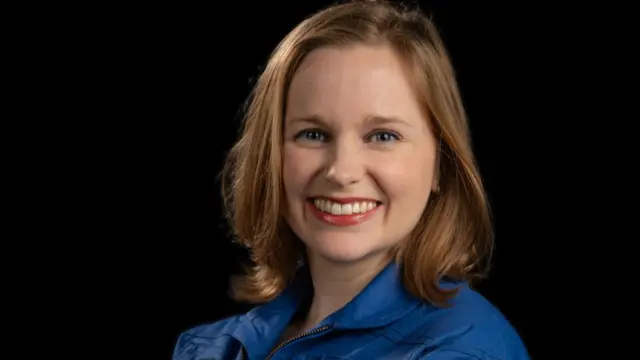
It is hoped the Artemis II mission will help to usher in a new era of space travel – and one of those hoping to be part of it is Dr Meganne Christian, a reserve astronaut with the European Space Agency.
The dual British national began training in January 2025 after being selected from thousands of applicants, getting a taste of the rigorous preparations the Artemis crew will have gone through for moments like losing contact with Earth.
She tells BBC Radio 4’s Today programme the astronauts will have performed “simulation after simulation, knowing what’s going to happen in any given moment – they were ready for it”.
Asked about the importance of this mission, she says: “This is a test flight, preparing us for the future of exploration, preparing us for future landing sites… We are not just going to the moon, we are going there to stay.”
Moon crater to be named after astronaut’s late wifepublished at 02:56
02:56
There was a poignant moment onboard the capsule yesterday when conversation turned to proposing names for craters on the Moon to memorialise this record-breaking voyage.
One of the craters should be named Integrity after their Orion spacecraft, the crew agreed – while another should be named after astronaut Reid Wiseman’s late wife Carroll who died in 2020.
The name proposals will need to be formally submitted to the International Astronomical Union,which governs the naming of features in space – but we suspect they’ll be open to the suggestion.
Astronauts clock off for the night after record-breaking daypublished at 02:30
02:30
Esme Stallard Science reporter
We’ve just heard from the crew onboard the Orion spacecraft, who have bid goodnight to the teams on Earth after a day which saw them surpass a space-travel record.
Mission control tells the astronauts: “We got a sneak peek at your imagery. It is absolutely stunning, we are all completely in awe of the work you did today.
“Thank you so much for bringing us on this journey with you. We hope you have sweet dreams of Moon joy.”
The crew replies: “We’re glad they’re appreciated. We certainly appreciate it up here.”
Artemis II is ‘kick-off for the next generation of space exploration’published at 02:10
02:10
Nasa’s head of science Dr Nicola Fox says the Artemis II Moon mission is all about “doing the work to set up that sustained presence on the Moon”.
Artemis IV, which is expected to launch in early 2028, will land humans on the Moon for the first time since 1972, Fox tells BBC Breakfast.
She says Nasa’s ultimate goal is to have astronauts living and working there continuously, which will pave the way for the “next giant leap in exploration, to send crews to Mars”.
Gravity in control and instant death awaits outside spacecraft, says ex-astronautpublished at 01:50
01:50
Image source, Getty Images
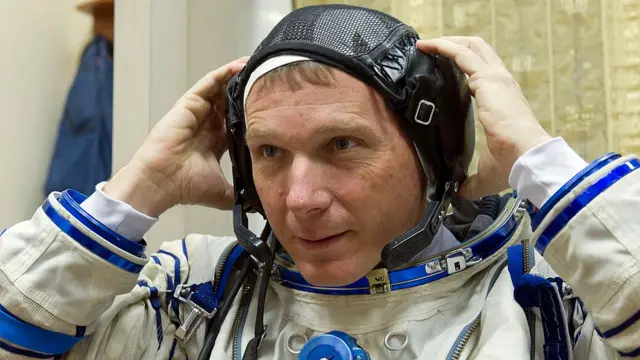
Retired Nasa astronaut Terry Virts, who was formerly commander of the International Space Station, says the crew of the shuttle had to allow gravity to take over in order to slingshot the moon.
He says: “They are in deep space with no way to be rescued, getting the harshest radiation that doesn’t even exist on Earth, surrounded by instant death just a few millimetres outside of that thin aluminium shell.
“The entire 10-day mission is not exactly super safe but basically nothing happened today. The only thing that happened today was the moon flew by the capsule.
“They didn’t do a manoeuvre – they allowed the moon’s gravity to kind of bend the shape of their trajectory 180 degrees and bring them back to Earth.
“So it wasn’t like they had to do a big complicated manoeuvre or docking or landing or anything like that.
“Sir Isaac Newton is in charge – gravity is what’s manoeuvring the capsule now.”
Satellites have been here before – but human eyes have notpublished at 01:31
01:31
Esme Stallard Science reporter
Image source, NASA
Now contact has successfully been remade with the Artemis II crew I am frantically refreshing the Nasa’s photos stream, which will bring us all the images they took while observing the far side of the Moon.
Both the record distance, illumination levels and particular orbit means that the crew have seen sights that no human has ever laid their eyes on.
They have digital cameras with them which they are using to capture the sights – but it is what they saw from the spacecraft that has many scientists back on Earth most excited.
Both China and India have sent probes over this side in the last few years to capture images – so is having humans see it for themselves exciting from a scientific point of view, or purely in terms of human exploration?
Chris Lintott, professor of astrophysics at the University of Oxford and co-host of BBC’s series The Sky at Night, told my colleague Georgina Rannard: “The value of the images coming back from Artemis and its crew is artistic, not scientific.”
And yet, ask any former geology student like me and you are still trained to make observations and sketches with the human eye. Science puts great store by our own inbuilt cameras.
Abbie MacKinnon, curator of the Science Museum’s space gallery, says: “I know we have… satellite imagery and everything like that. It’s just not the same as humans there deciding what images to take and what looks good.”
Now contact has successfully been remade with the Artemis II crew I am frantically refreshing the Nasa’s photos stream, which will bring us all the images they took while observing the far side of the Moon.
Both the record distance, illumination levels and particular orbit means that the crew have seen sights that no human has ever laid their eyes on.
They have digital cameras with them which they are using to capture the sights – but it is what they saw from the spacecraft that has many scientists back on Earth most excited.
Both China and India have sent probes over this side in the last few years to capture images – so is having humans see it for themselves exciting from a scientific point of view, or purely in terms of human exploration?
Chris Lintott, professor of astrophysics at the University of Oxford and co-host of BBC’s series The Sky at Night, told my colleague Georgina Rannard: “The value of the images coming back from Artemis and its crew is artistic, not scientific.”
And yet, ask any former geology student like me and you are still trained to make observations and sketches with the human eye. Science puts great store by our own inbuilt cameras.
Abbie MacKinnon, curator of the Science Museum’s space gallery, says: “I know we have… satellite imagery and everything like that. It’s just not the same as humans there deciding what images to take and what looks good.”
Key moments from the Artemis II lunar fly-bypublished at 00:56
00:56
Media caption,
Watch: Artemis II mission loses contact with Earth for 40 minutes
It has been a historic day for the Artemis II crew, who are now bound for Earth after completing a fly-by of the Moon. Here’s what has happened over the past few hours:
While flying behind the Moon, the Orion spacecraft also reached its maximum distance from Earth – a new record for the furthest distance travelled by humans from our home planet
The new record has been set at 252,756 miles (406,771km)
As the four astronauts began the process of sending all their data from the past seven hours of observation to Earth, they also received a call from US President Donald Trump – you can read a recap of their conversation here
Amazing and busy day for Nasa’s scientistspublished at 00:37
00:37
Rebecca Morelle Science editor
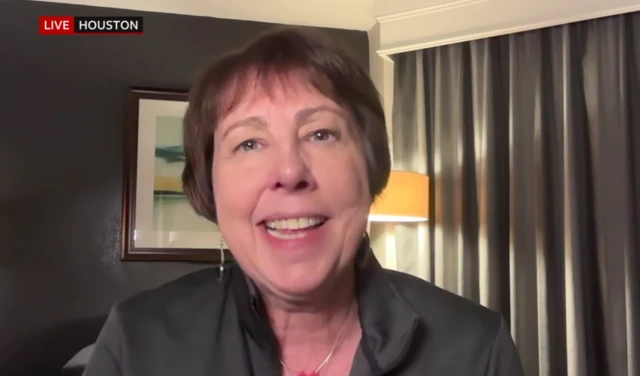
We spoke to Nasa’s head of science Dr Nicola Fox after the fly-by.
She said it had been an amazing – and very busy – day for the science team here at mission control.
The astronauts have spent years preparing for this part of the mission, studying lunar science with the team here – and Fox said the crew had aced their test, providing fantastic lunar observations.
As a solar scientist, she was particularly excited about the eclipse.
She’s gazed at many of these celestial events, but said this one, with such an unusual vantage point, looked very different from any she’d seen on Earth.
What the Artemis astronauts said after regaining communication with Earthpublished at 00:23
00:23
There was much anticipation during the 40 minutes when Orion was not able to contact Earth.
After the Artemis crew returned from the far side of the moon, mission specialist Christina Koch broke the silence.
Here is what Koch said:
“Houston, Integrity, comm check.
It is so great to hear from Earth again…
To Asia, Africa and Oceana, we are looking back at you, we hear you can look up and see the moon right now. We see you too.
When we burned this bird towards the moon, I said that we do not leave Earth, but we choose it and that is true.
We will explore, we will build, we will build ships, we will visit again.
We will construct science outposts. We will drive rovers, we will do radio astronomy, we will found companies, we will bolster industry.
We will inspire but ultimately we will always choose Earth.
We will always choose each other.”
The long journey homepublished at 23:55
23:55
After travelling a record-breaking 252,756 miles (406,771km) from Earth and circling past the moon, the Artemis II astronauts are on their way home.
It will take them about four days to journey back, with a splashdown in the Pacific Ocean off the west coast of the US expected at 20:07 eastern US time 10 April (01:07 BST 11 April).
Teams will collect the astronauts from the water in helicopters and take them to the a nearby US Navy ship.
They will have medical checks aboard the ship as they head back towards land, Nasa says.
Trump tells astronauts ‘you’ve made history’ – a recap of his call to spacepublished at 23:16
23:16
Image source, NASA
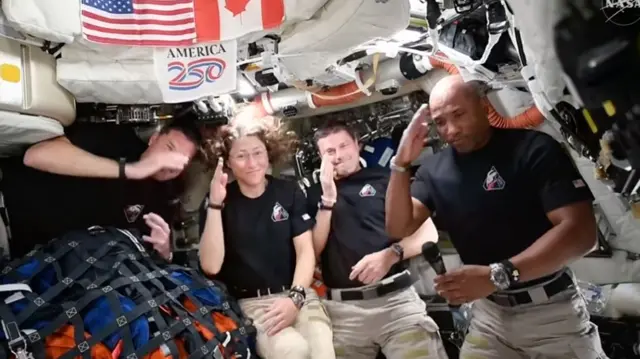
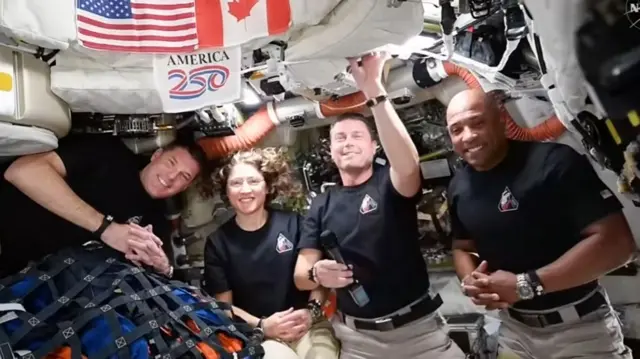
US President Donald Trump had a short conversation with the four astronauts aboard the Orion spacecraft. As a microphone floated in front of the astronauts on their journey back to Earth, Trump praised the crew for their achievements.
He told the Artemis II crew that they had “made history” by breaking the record for the furthest distance travelled from planet Earth
Astronaut Victor Glover told the US president that he said “a little prayer” when the spacecraft briefly lost contact with Nasa, while Commander Reid Wiseman said they had seen sights “that no human has ever seen”
Canadian Space Agency astronaut Jeremy Hansen also gave a special thanks to Trump on behalf of Canada; Trump responded by saying he had spoken to Canadian Prime Minister Mark Carney and former Canadian ice hockey player Wayne Gretzky, who had both expressed how proud they were of Hansen and the Artemis II crew
The president invited the four astronauts to the White House once they return to Earth – he said he rarely asks for autographs, but he wanted to get theirs
Trump invites crew to White Housepublished at 22:44
22:44
Before the call ended, Trump said he will be seeing the Artemis crew at the White House once the mission is complete.
“I’ve been pretty busy also, as you know, but I will absolutely find the time,” Trump said, before adding he would like to give “a big salute on behalf of the American people and beyond that”.
“Thank you for that, Mr President,” pilot Victor Glover replied.
‘Saw sights that no human has ever seen’published at 22:39
22:39
Trump continues with questions, asking the crew: “What is the most unforgettable part of this really historic day?”
Commander Reid Wiseman was the first to respond, and starts by saying that the call from the president was “certainly very special to all of us”.
“We saw sights that no human has ever seen, not even Apollo, and that was amazing for us,” said Wiseman.
He went on to explain the crew’s observations of the solar eclipse, and said all four of the crew had commented on how “excited we are to watch this nation and this planet become a two-planet species” in reference to goals of future ventures to Mars.
Trump asks crew what it was like to lose contact with Earthpublished at 22:36
22:36
Trump asks the Artemis crew: “What was your feeling when you had no communication all of a sudden?”
Astronaut Victor Glover answers by saying he said “a little prayer” but then had to keep working to record scientific observations of the far side of the moon.
“We were busy up here and working really hard, and I must say it was actually quite nice,” Glover adds.
Trump congratulates Artemis crew and Nasapublished at 22:31
22:31
Trump continues and says: “Humans have really never seen anything quite like what you’re doing.”
“It’s really special.”
He then congratulates each crew member of the Artemis crew and the entire team at Nasa.
Trump speaking to Artemis II crew nowpublished at 22:29
22:29
US President Donald Trump is speaking directly to the crew aboard Artemis II in a surprise appearance.
“Today, you’ve made history and made all America really proud, incredibly proud,” he tells the four astronauts.
“We have a lot of things to be proud of lately, but this is… there’s nothing like what you’re doing, circling around the moon for the first time in more than a half century, and breaking the all time record for the farthest distance from planet Earth.”
Image source, NASA
Watch the moment Artemis II regains contact with Earthpublished at 22:12
22:12
Eclipse observation period endspublished at 21:46
21:46
The Nasa science crew has just signed off, thanking the Artemis II crew for their observations.
Mission control says the solar eclipse observation period has closed, and the team aboard the Orion spacecraft will now begin “down-linking” all of the images and data they have captured over the past seven hours of observation.
Not enough adjectives to describe observations, astronaut sayspublished at 21:32
21:32
Artemis II pilot Victor Glover has just told the crew on the ground that what the four astronauts are currently seeing is “truly hard to describe”.
“I know this observation won’t be of any scientific value but I’m really glad we launched on April 1st, because humans have probably not evolved to see what we are seeing,” he tells them.
Commander Reid Wiseman jumped in with his observations:
“It’s just indescribable. No matter how long we look at this, our brains are not processing this image in front of us. It is absolutely spectacular, surreal… there’s no adjectives, I’m going to need to invent some new ones, there’s absolutely no words to describe what we are looking at out this window.”
As Glover described something he said was orange, the crew on the ground said the reddish object was likely Mars.
“Good opportunity to look to the future of where we’re going,” mission control tells the four aboard the Orion spacecraft.
The crew joked they wanted 20 new superlatives added to the mission summary tomorrow, to assist with their descriptions.
‘The Earth is so bright out there’published at 21:24
21:24
Earlier we heard Nasa astronaut Victor Glover describe what he was seeing during the solar eclipse period as “sci-fi” and “unreal”. He also described the view of the corona of the sun.
Here is what he said:
“This continues to be unreal.
The Sun has gone behind the Moon and the corona is still visible, and it’s bright and creates a halo almost around the entire moon.
But when you get to the Earth side, it’s the Earth shine that’s already shown.
I mean almost seconds after the Sun set behind the Moon, you could see Earth shine.
The Earth is so bright out there and the Moon is just hanging in front of us.
This black orb out in front of us now, not the blackness but the grey that blends and drifts into the blackness. We can see stars and planets behind it.
Christina is in window one, Reid is in window two with the long lens and Jeremy is describing it in window three.
It is quite an impressive sight.
You can still see the horizon with a brighter… where the sun set on that side of the Moon. And the Earth shine is very distinct and it creates quite an impressive visual illusion.
Wow it’s amazing.”
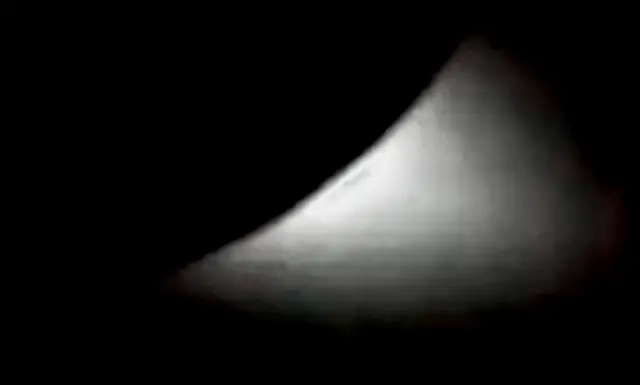
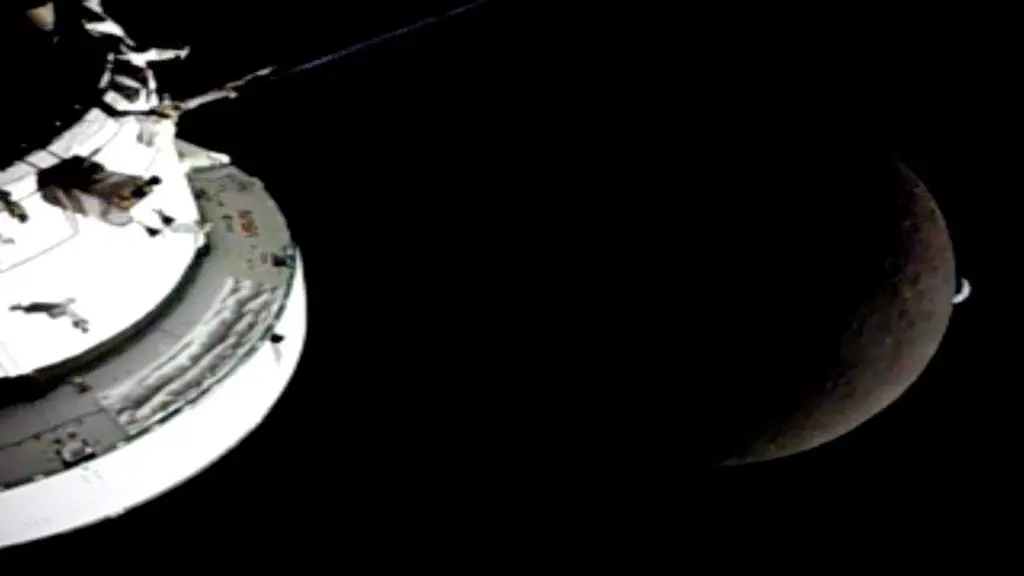
Image caption,An image of the solar eclipse
.
From space
.
.
Click the link belowfor the complete article (differs slightly:
As they traveled back toward Earth following a solar eclipse and a communications blackout, President Trump called the space capsule to praise the four astronauts on their success.
On the sixth day, 248,655 miles from Earth, four people ventured farther from home than any human being who has ever lived.
Embraced by the moon’s gravitational pull, four astronauts accelerated Monday afternoon on a path to swing around the lunar far side, five days after launching on the Artemis II mission from the Kennedy Space Center in Florida.
President Trump calls the Artemis II astronauts after their historic journey.
President Trump spoke with the astronauts of the Artemis II mission hours after their spaceship swung around the far side of the moon and took them farther from Earth than any humans on Monday.
“You’ve made history and made all America really proud,” Mr. Trump said, and later acknowledged the contribution of the Canadian member of the mission, Jeremy Hansen.
Jared Isaacman wrapped up the Q&A by thanking the astronauts for taking us to the moon with them. “We are just honored to be a part of that,” Reid Wiseman said.
When asked how this mission change’s humanity’s future among the stars, Victor Glover, the mission’s pilot, said he had huge expectations for what’s coming next.
Isaacman next asked what thoughts filled the astronauts’ minds when they were out of contact. The mission specialist, Jeremy Hansen, said they were so busy that they just tried to do a good job collecting science observations. But Reid Wiseman added they had a a brief moment eating maple cookies to celebrate Canada’s participation in Artemis II.
Isaacman then asked what were some words that come to mind when the astronauts try to wrap their minds around this very unique experience.
Christina Koch said, “Humility,” talking about all the people who came before.
Next question: what advice would you pass on to the Artemis III mission, which is to orbit the Earth and test docking with lunar landers in 2027. The pilot, Victor Glover, says they’ve been taking notes to pass on. How the astronauts pack is apparently very important. He also brought up the troubles with the toilet. Isaacman, in response, acknowledged, “We definitely have to fix some of the plumbing.”“What inspires you?” is the next question to the crew. Wiseman, noting he is now over 50, says it all comes back to family.
Reid Wiseman, the mission commander, said, “We’ve got to explore. We’ve got to go farther.”“I’m not ready to go home,” Christina Koch said, who noted how much fun she’s having in spite of the cramped quarters.
.
NASA’s Lunar Science Team at Johnson Space Center in Houston watching the Artemis II flyby of the Moon.Credit…Cassandra Klos for The New York Times
Film and Writing Festival for Comedy. Showcasing best of comedy short films at the FEEDBACK Film Festival. Plus, showcasing best of comedy novels, short stories, poems, screenplays (TV, short, feature) at the festival performed by professional actors.

.jpg) Photos: Getty Images
Photos: Getty Images


 A visualization of the moon’s Orientale basin, a region closely studied by the Artemis II crew during their lunar flyby. Gravitational data from NASA’s Gravity Recovery and Interior Laboratory (GRAIL) mission are depicted in false colors on this image’s right side, and chart the basin’s subsurface structure. NASA’s Scientific Visualization Studio


 .
.

 Smith Collection/Gado/Getty Images





 From space

 James' World 2