Home

A doctor reveals the hidden wonders of the human body

Leave a comment

This is a long read!

Click the link below the picture

.

In his new book, The Unseen Body, Dr. Jonathan Reisman offers a guided tour inside the human body, from the remarkable design of our organs to the messages contained in our body fluids.

TERRY GROSS, HOST:

This is FRESH AIR. I’m Terry Gross. We’re going to talk about the hidden world inside our bodies, the remarkable design of our organs, the messages contained in our body fluids, and how things can turn foul when something goes wrong. My guest, Dr. Jonathan Reisman, is an internist, pediatrician, and ER physician, and the author of the new book, “The Unseen Body.” Each chapter is about a specific body part or body fluid from his perspective as a doctor. So there’s chapters on the throat, heart, feces, genitals, liver, brain, skin, urine, blood, and so on. It’s fascinating material, but I want to acknowledge at the start that our conversation will include discussion of body fluids and genitals. And I know that makes some people uncomfortable or squeamish. I suspect Dr. Reisman will try to convince you that you needn’t be squeamish about the complexity of the human body.

Before studying medicine, his passion was studying the natural world and ecology. As a medical student, he found that exploring the body felt similar to exploring the outside world. Each organ was a different creature with its own unique appearance and behaviors. He’s practiced medicine in remote and culturally unique regions of the world, including the Arctic, Antarctica, high altitudes in Nepal, people living on the street in Calcutta, in India, and among the Oglala Sioux in South Dakota. He currently works in several ERs in the Philadelphia area.

Dr. Jonathan Reisman, welcome to FRESH AIR. It’s a fascinating book. I know you’re fascinated by our insides, our organs, our body fluids. It’s part of what drew you to medicine. But many people are squeamish about looking even at a video of a chest cut open during surgery. Why do you think that the body can seem so revolting or upsetting?

JONATHAN REISMAN: Well, thanks so much for having me here today, Terry. I think that a lot of people are simply, you know, grossed out or repulsed by what they’re not used to. You know, when we go about our daily lives, we don’t see the body’s innards. We don’t see our internal organs. And we try to do our best to try not to see the, you know, the excreted bodily fluids that come out of us too. Just our normal daily life does not involve seeing those deeper parts of the body. And part of the reason I named my book “The Unseen Body” is because I’m trying to open up, you know, that unseen portion of the body that we all don’t see in our daily lives, pull back the curtain, if you will, on how all the organs work, how fascinating they are, but also how they impact every aspect of our lives from daily life and, you know, all the milestones of our lives from birth to death and beyond.

GROSS: The first time you could open a cadaver as a medical student, did you find it revolting or fascinating?

REISMAN: I actually found it absolutely fascinating on that first day. In fact, before the end of the very first day of medical school, during which they had us start in the anatomy lab, which is the class in which we would dissect the cadaver over the coming months, before the end of the very first day of medical school, I decided that, when I died, I would want to donate my body for the same medical school dissection, you know, the same thing that was happening between me and the three other medical students that shared this cadaver, you know, kind of exploring its innards and sort of seeing what’s inside this strange man that we never knew in life. And, you know, as an extension, when you look inside the body of another person, you’re necessarily looking inside your own, seeing how you are built, how organs are, you know, organized inside of you. And so it kind of takes on this very self-reflective and philosophical nature. And I was really taken with that from Day 1 and resolved – and I’m still sticking to it – when I die, I want to donate my body for medical student dissection.

GROSS: Well, let’s start talking about a part of the body that does not make people squeamish. I’m thinking of the throat. When you were in med school, you were amazed at how stupidly designed the throat seemed. What seemed stupid about it?

REISMAN: You know, what is its basic function? The throat helps us deal with whatever enters our body, you know, usually through the mouth. We drink. We eat. We inhale. Air comes in through the mouth and the nose. All of it ends up in the throat. And it’s the throat’s very, very important job to deal with all of it. Specifically, the throat has to take food, drink saliva, other things that we mean to swallow and make sure they go into the one tube, the esophagus, the food tube, which goes down to the stomach. The tube right next to the esophagus, literally millimeters away, is the windpipe, which goes down to the lungs. And every single time something passes through the throat, its most important job is to make sure that that – whatever it is besides air does not go down the windpipe.

This – the design seemed fairly stupid to me because if you mess up just once, if you try to talk while swallowing just once or laugh with your mouth full, as we all know, sadly, you know, you can aspirate, choke and die just from one little slip up. So it seemed sort of silly to have these two tubes right next to each other. And every time we swallow food and drink or every time we thoughtlessly swallow our own saliva, which happens basically all day, every day of our lives, that material comes within a few millimeters of slipping into the windpipe, therefore a few millimeters within killing us.

And so it seemed like such a really poor design. Like, maybe food and drink and air could enter the body through different orifices. Of course, it can’t because of how we form in the womb. But it seems like a big problem that can cause a lot of trouble, and especially in contrast to other parts of the body, which seemed so exquisitely designed, so brilliantly constructed to keep us alive, to ensure our survival. The throat almost seemed like a really easy way to die.

.

The human body

.

.

Click the link below for the article:

https://www.npr.org/2022/03/16/1086662380/a-doctor-reveals-the-hidden-wonders-of-the-human-body

.

__________________________________________

Something Is Wrong with Dark Energy, Physicists Say

Leave a comment

Click the link below the picture

.

Imagine sitting in the center of a firework that has just exploded. After the first flash of light and heat, sparks fly off in all directions, with some streaming together into fiery filaments and others fading quickly into cold, ashy oblivion. After a moment more, the smoke is all that remains—the echo, if you will, of the firework’s big bang.

Now imagine the firework is the universe, which scientists think began with a similar explosion. Where the firework’s expansion is propelled by a chemical reaction, the expansion of the cosmos comes from the energy of empty space itself. From where we sit, it seems that the universe is expanding in all directions, faster and faster at every moment.

This spring scientists announced that something is wrong with the fireworks. For the first time since the discovery of dark energy—the mysterious force that is accelerating our cosmic fireworks show—cosmologists think we may be on the cusp of something new. Two prominent dark energy surveys seeking to measure the nature of this force found evidence that dark energy seems to have weakened over time.

“If it is true, it is a big deal,” says Licia Verde, a theoretical cosmologist at the Institute of Cosmos Sciences of the University of Barcelona in Spain and a member of the collaboration reporting the oddity. “But as usual, extraordinary claims require extraordinary proofs.”

Dark energy was assumed to be a constant force in the universe, as unchanging and reliable as the forward march of time. If the new results are right, it is changeable after all. “It’s mega important,” says Paul J. Steinhardt, a cosmologist at Princeton University, who did not work on the data, adding that this is only true if the results hold up to scrutiny. “But it’s still early days.”

The news is based on a combination of two dark energy studies, called the Dark Energy Survey (DES) and the Dark Energy Spectroscopic Instrument (DESI), with a third set of preexisting data. DES measures distant supernovae, and the DESI experiment measures galaxies and sound waves from the early universe. The third component measures the cosmic microwave background (CMB)—the smoke ring of the cosmic firework.

DES yielded new findings back in February, and DESI came out with novel results in April. The DESI data produced a detailed three-dimensional map of the universe. It showed that galaxies appear to be spread apart less than they should be if dark energy’s role was unchanging through cosmic time.

The DESI telescope is perched on Kitt Peak in Arizona and measures the positions of millions of galaxies as they existed between 12 billion and two billion years ago. Astronomers compared these observed galactic locales against where galaxies are expected to be based on dark energy predictions and saw the lack of expected spreading.

A bigger surprise came when cosmologists combined the DESI galaxies, DES’s supernovae, and the cosmic microwave background. The map of reality began to drift apart from theory.

Theorists have been buzzing since if the results are true, a bedrock assumption of cosmology is incorrect. Scientists might have to throw out the widely held idea that dark energy is a “cosmological constant”—a static element of the universe.

.

https://static.scientificamerican.com/dam/m/1882dd01e44d79b2/original/GettyImages-1429569563_web.jpg?w=900Vitalii Pasichnyk/Getty Images

.

.

Click the link below for the article:

https://www.scientificamerican.com/article/dark-energy-measurements-suggest-the-universe-might-be-way-weirder-than-we/

.

__________________________________________

Tim Walz’s son, Gus, has nonverbal learning disorder. What is that?

Leave a comment

Click the link below the picture

.

After his heartfelt reaction to his father’s acceptance speech at the Democratic National Convention thrust him into the spotlight, 17-year-old Gus Walz has become one of the most high-profile people with nonverbal learning disorder.

The condition doesn’t mean Gus can’t speak — he does. After hearing his dad, Minnesota Gov. Tim Walz, describe his family as “my entire world” Wednesday night, the tearful teenager rose to his feet, pointed toward the stage, and said, “That’s my dad!”

Gus is one of millions of Americans with nonverbal learning disorder. A 2020 study in JAMA Network Open estimated that 3% to 4% of children and adolescents in the U.S. may have the condition, and another study this year in Scientific Reports concluded that the prevalence in children may be as high as 8%.

The condition, known as NVLD, was first recognized in 1967 and doesn’t yet have a formal clinical definition. It is characterized by a significant gap between verbal abilities — which are just fine — and nonverbal kinds of learning that involve visual-spatial processing, such as telling time on an analog clock, reading a map, and balancing a budget.

Those challenges with spatial awareness can give children trouble with motor skills. That can make them clumsy or cause problems with tasks like tying shoes, using silverware, and writing by hand, according to the NVLD Project, a nonprofit that aims to have the condition added to the American Psychiatric Assn.’s Diagnostic and Statistical Manual of Mental Disorders.

In a way, having NVLD is like the opposite of having dyslexia, according to Scott Bezsylko, who works with neurodivergent students as executive director of Winston Preparatory School.

Reading is not a problem for kids with NVLD, who often have a large vocabulary. They’re also able to recall facts and memorize things like multiplication tables.

School becomes more challenging toward the end of elementary school when learning becomes more about noticing patterns and applying concepts. That can cause problems with reading comprehension and more advanced kinds of math problems.

NVLD also affects higher-order thinking, which is used to organize our thoughts and plan a project that requires multiple steps.

.

https://ca-times.brightspotcdn.com/dims4/default/7effedc/2147483647/strip/true/crop/3314x2216+0+0/resize/1200x802!/format/webp/quality/75/?url=https%3A%2F%2Fcalifornia-times-brightspot.s3.amazonaws.com%2Fa9%2F2d%2F48d2e1b84c61954c41a1ec6a17a4%2Felection-2024-dnc-35167.jpg

A tearful Gus Walz pointed to his father, Minnesota Gov. Tim Walz, as he accepted the Democratic Party’s vice presidential nomination Wednesday night in Chicago.  (Charles Rex Arbogast / Associated Press)

.

.

Click the link below for the article:

https://www.latimes.com/science/story/2024-08-23/what-is-non-verbal-learning-disorder-gus-walz?utm_source=pocket_discover_parenting

.

__________________________________________

How Food Banks Prevented 1.8 Million Metric Tons of Carbon Emissions Last Year

Leave a comment

Click the link below the picture

.

The latest annual impact report from the Global Foodbanking Network — a nonprofit that works with regional food banks in more than 50 countries to fight hunger — found that its member organizations provided 1.7 billion meals to more than 40 million people in 2023. According to the nonprofit, this redistribution of food, much of which was recovered from farms or wholesale produce markets, mitigated an estimated 1.8 million metric tons of carbon dioxide equivalent.

These numbers reflect an ongoing, high demand for food banks. Last year, the Global Foodbanking Network, or GFN, served almost as many people as it did in 2020, when the COVID-19 pandemic sent food insecurity soaring. In order to respond to this pressing need in their communities, many of GFN’s member organizations have invested in agricultural recovery, working to rescue food from farmers before it gets thrown out.

Their efforts show how food banks can serve the dual purpose of addressing hunger and protecting the environment. By intercepting perfectly good, edible food before it winds up in the landfill, food banks help mitigate harmful greenhouse gas emissions created by food loss and waste.

“There is always food that is unnecessarily wasted,” said Emily Broad Leib, the founding director of the Food Law and Policy Clinic at Harvard Law School, who has worked with GFN before but was not involved in the recent study. All that unnecessary waste means “there is ongoing need for scaling up food banks and food-recovery operations,” Broad Leib added.

The Food and Agriculture Organization of the United Nations found that 13 percent of food was lost while it was making its way from producers to retailers in 2022. Subsequently, 19 percent was wasted by retailers, restaurants, and households, according to a recent analysis from the United Nations Environment Program. The world’s households alone let 1 billion meals go to waste each day. The scope of food wasted around the world has been shockingly high for years: In 2011, the Food and Agricultural Organization of the United Nations released a study that suggested roughly one-third of food produced globally is never eaten.

Food waste at this scale comes with massive planetary impacts. When food goes uneaten, all of the emissions associated with growing, transporting, and processing it are rendered unnecessary. Furthermore, when food rots in landfills, it emits methane, a greenhouse gas that is roughly 80 times more potent than CO2 over a 20-year period. Last year, the Environmental Protection Agency reported that 58 percent of methane emissions from U.S. landfills come from food waste. Globally, food loss and waste have been estimated to be responsible for 8 percent to 10 percent of greenhouse gas emissions, and reducing them is essential for achieving climate targets.

Food banks can play a special role in that reduction by rescuing more food before it’s lost and redirecting it to people in need. “Our members have been building out their redistribution capacity,” said Lisa Moon, the president and CEO of GFN. “I think that was our first challenge in the face of this rising need: How do we as an organization capture more supply?”

In order to do this, food banks within GFN member organizations have been coordinating more closely with farmers to redirect surplus food from landfills. GFN defines surplus food as food from commercial streams that was grown for human consumption but that, for some reason or another, cannot be sold. So-called “ugly” produce — misshapen food that never makes it to the grocery store because of its looks — falls into this category.

.

https://static.scientificamerican.com/dam/m/310a2abef2fb3e3a/original/People_at_foodbank_at_table_with_potatoes.jpg?w=900

Volunteers stack bags of potatoes at the San Francisco-Marin Food Bank in San Francisco, Calif., on May 28, 2020. David Paul Morris/Bloomberg via Getty Images

.

.

Click the link below for the article:

https://www.scientificamerican.com/article/how-food-banks-prevent-climate-change-by-averting-carbon-emissions/

.

__________________________________________

Nearly All Google Pixel Phones Exposed by Unpatched Flaw in Hidden Android App

Leave a comment

Click the link below the picture

.

Google’s flagship Pixel smartphone line touts security as a centerpiece feature, offering guaranteed software updates for seven years and running stock Android that’s meant to be free of third-party add-ons and bloatware. On Thursday, though, researchers from the mobile device security firm iVerify are publishing findings on an Android vulnerability that seems to have been present in every Android release for Pixel since September 2017 and could expose the devices to manipulation and takeover.

The issue relates to a software package called “Showcase.apk” that runs at the system level and lurks invisible to users. The application was developed by the enterprise software company Smith Micro for Verizon as a mechanism for putting phones into a retail store demo mode—it is not Google software. Yet for years, it has been in each Android release for Pixel and has deep system privileges, including remote code execution and remote software installation. Even riskier, the application is designed to download a configuration file over an unencrypted HTTP web connection that iVerify researchers say could be hijacked by an attacker to take control of the application and then the entire victim device.

Verify disclosed its findings to Google at the beginning of May, and the tech giant has not yet released a fix for the issue. Google spokesperson Ed Fernandez tells WIRED in a statement that Showcase “is no longer being used” by Verizon, and Android will remove Showcase from all supported Pixel devices with a software update “in the coming weeks.” He added that Google has not seen evidence of active exploitation and that the app is not present in the new Pixel 9 series devices that Google announced this week.

In response to WIRED’s inquiry about Showcase’s vulnerability, Verizon spokesperson George Koroneos says, “The APK in question was used for retail demos and is no longer in use.” Smith Micro said in a statement that, “The APK in question was previously licensed to Verizon for in-store retail demos, and is no longer in use.”

“I’ve seen a lot of Android vulnerabilities, and this one is unique in a few ways and quite troubling,” says Rocky Cole, chief operating officer of iVerify and a former US National Security Agency analyst. “When Showcase.apk runs, it has the ability to take over the phone. But the code is, frankly, shoddy. It raises questions about why third-party software that runs with such high privileges so deep in the operating system was not tested more deeply. It seems to me that Google has been pushing bloatware to Pixel devices around the world.”

iVerify researchers discovered the application after the company’s threat-detection scanner flagged an unusual Google Play Store app validation on a user’s device. The customer, big data analytics company Palantir, worked with iVerify to investigate

Showcase.apk and disclose the findings to Google. Palantir chief information security officer Dane Stuckey says that the discovery and what he describes as Google’s slow, opaque response has prompted Palantir to phase out not just Pixel phones, but all Android devices across the company.

.

https://media.wired.com/photos/6640f1f0f59145e49d5e32e1/master/w_1920,c_limit/Google-Pixel-8A-Back-View-Hand-Reviewer-Photo-SOURCE-Julian-Chokkattu.pngPhotograph: Julian Chokkattu

.

.

Click the link below for the article:

https://www.wired.com/story/google-android-pixel-showcase-vulnerability/?utm_source=pocket_discover_technology

.

__________________________________________

People Are Overdosing on Semaglutide Drugs like Ozempic and Wegovy

Leave a comment

Click the link below the picture

.

As more people take the injectable weight-loss medication Wegovy, they should be aware of concerning reports of overdoses. That drug, more generally called semaglutide, can have unpleasant gastrointestinal side effects at prescribed doses. But if people take too much semaglutide, the adverse effects can be severe and even require hospitalization. The Food and Drug Administration recently alerted health care providers, pharmacies, and the public about the dangers of overdoses from semaglutide, which is also prescribed under the name Ozempic to treat diabetes. Scientific American spoke to experts about how people using semaglutide and similar weight-loss medications can stay safe.

How can people overdose on semaglutide?

These incidents often happen when people are required to portion their own doses of the medication. Novo Nordisk, the company that produces semaglutide, provides injectable forms of the medication in disposable injector pens with preportioned doses. But many people are reportedly receiving such medication through a different (and usually cheaper) source: compounding pharmacies. These facilities are allowed to replicate and dispense patented medications that are in shortage.* Such drugs include semaglutide, which has been listed as “in shortage” by the FDA since 2022.

Compounding pharmacies typically dispense these drugs in vials with accompanying syringes, leaving the patient to draw up their own dose as prescribed by their doctor. “You have to know conversions, and you have to know how much to draw up,” says Janice Jin Hwang, an endocrinologist at University of North Carolina at Chapel Hill.

These conversions can be complicated. Doses are sometimes prescribed in milligrams but dispensed in syringes that are marked in milliliters—and these may be ambiguously referred to as “units.” Additionally, the syringes people receive can be far larger than the intended dose, potentially leading to a much higher one. According to the FDA, some individuals injected anywhere from five to 20 times the prescribed dose.

These wonky conversions have even confused doctors. The FDA overdose alert cited two cases in which doctors prescribed patients an incorrect dose. (Doses can vary among people and throughout the course of treatment. Regimens should be determined at the discretion of a health care provider.)

“You really have to know exactly what you’re doing. Otherwise, it’s really, really easy to make mistakes,” Hwang says.

What happens when people take too much of these medications?

Taking too much semaglutide can cause severe gastrointestinal symptoms, such as nausea, vomiting, and abdominal pain. People who have experienced dosing errors have also reported fainting, headaches, migraines, dehydration, gallstones and acute pancreatitis, or inflammation of the pancreas, which can be life-threatening. (These drugs are known to carry a risk of pancreatitis and gallbladder disease.) Many of these people sought out medical care or were hospitalized.

.

https://static.scientificamerican.com/dam/m/57f94b239ff3df55/original/GettyImages-2148794359_WEB.jpg?w=900Iuliia Burmistrova/Getty Images

.

.

Click the link below for the article:

https://www.scientificamerican.com/article/people-are-overdosing-on-semaglutide-drugs-like-ozempic-and-wegovy/

.

__________________________________________

Republican Donors, Do You Know Where Your Money Goes?

Leave a comment

Click the link below the picture

.

We long ago blew past any meaningful controls on political giving in American elections. Now we should focus on the rules governing political spending, which are in equally terrible shape. For that we can blame the Trump campaign and the federal government’s feeble enforcement efforts.

Anyone who has spent time reviewing Donald Trump’s campaign spending reports would quickly conclude they’re a governance nightmare. There is so little disclosure about what happened to the billions raised in 2020 and 2024 that donors (and maybe even the former president himself) can’t possibly know how it was spent.

Federal Election Commission campaign disclosure reports from 2020 show that much of the money donated to the Trump campaign went into a legal and financial black hole reportedly controlled by Trump family members and close associates. This year’s campaign disclosures are shaping up to be the same. Donors big and small give their hard-earned dollars to candidates with the expectation they will be spent on direct efforts to win votes. They deserve better.

During the 2020 election, almost $516 million of the over $780 million spent by the Trump campaign was directed to American Made Media Consultants, a Delaware-based private company created in 2018 that masked the identities of who ultimately received donor dollars, according to a complaint filed with the F.E.C. by the nonpartisan Campaign Legal Center. How A.M.M.C. spent the money was a mystery even to Mr. Trump’s campaign team, according to news reports shortly after the election.

All but 18 of the 150 largest expenditures on a Trump campaign’s 2020 F.E.C. report went to A.M.M.C. None of the expenses were itemized or otherwise explained aside from anodyne descriptions including “placed media,” “SMS advertising” and “online advertising.” F.E.C. rules require candidates to fully and accurately disclose the final recipients of their campaign disbursements, which is usually understood to include when payments are made through a vendor such as A.M.M.C. This disclosure is intended to assure donors their contributions are used for campaign expenses. Currently, neither voters nor law enforcement can know whether any laws were broken.

A.M.M.C.’s first president was reported to be Lara Trump, the wife of Mr. Trump’s son Eric. The New York Times reported that A.M.M.C. had a treasurer who was also the chief financial officer of Mr. Trump’s 2020 presidential campaign. Mr. Trump’s son-in-law Jared Kushner signed off on the plan to set up A.M.M.C., and one of Eric Trump’s deputies from the Trump Organization was involved in running it.

Ms. Trump is now a co-chair of the Republican National Committee, which, soon after her arrival, announced it would link up with the Trump campaign for joint fund-raising. The joint entity prioritizes a PAC that pays Mr. Trump’s legal fees over the R.N.C., The Associated Press has reported, making assurances from Mr. Trump’s campaign co-manager that R.N.C. funds wouldn’t be used to pay Mr. Trump’s legal bills seem more hollow.

This election, the Trump campaign and four of its PACs have paid Red Curve Solutions, another private company, at least $18 million. The Campaign Legal Center says Red Curve appears to pay Mr. Trump’s legal bills and then gets reimbursed by the PACs. (The law is murky on what types of legal bills can be paid by campaigns, but some are allowed.) The head of Red Curve also serves as the treasurer for the Trump campaign as well as the affiliated PACs.

What percentage of donor contributions go to lawyers defending Mr. Trump? It’s impossible to know.

In June, NBC revealed the existence of a new mystery company, called Launchpad Strategies. Launchpad took in almost $15 million in Trump political cash via the Trump Save America Joint Fundraising Committee and the Trump National Committee. Little is known about this new group. It was created in 2023 and the Trump campaign says it is related to fund-raising. We don’t know who owns it, who runs it, or where the $15 million went.

.

https://static01.nyt.com/images/2024/08/27/opinion/26glover/26glover-superJumbo-v2.jpg?quality=75&auto=webpBaptiste Virot

.

.

Click the link below for the article:

https://www.nytimes.com

.

__________________________________________

What Was It Like to Be a Dinosaur?

Leave a comment

Click the link below the picture

.

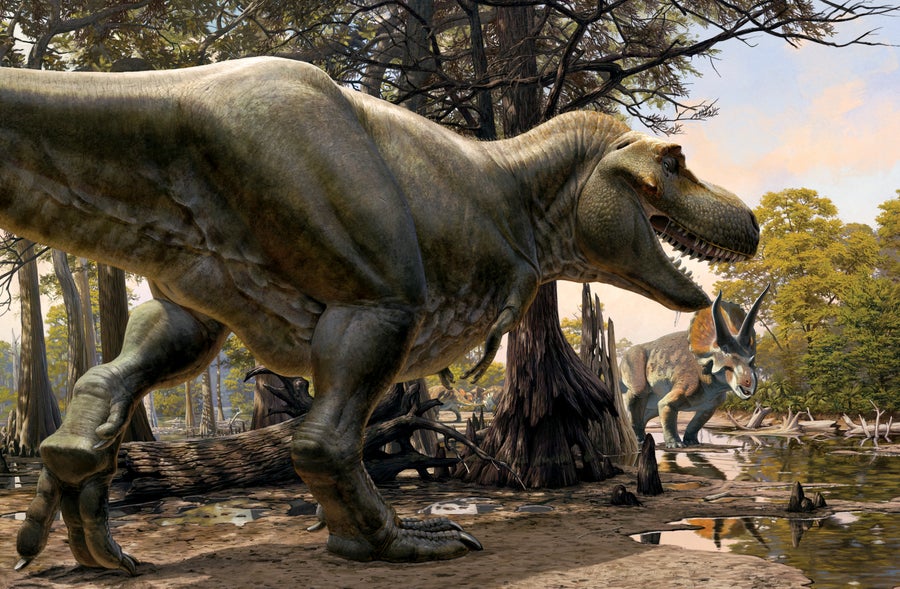
Alone, Tyrannosaurus rex sniffs the humid Cretaceous air, scenting a herd of Triceratops grazing beyond the tree line. As the predator scans the floodplain, its vision suddenly snaps into focus. A single Triceratops has broken off from the herd and wandered within striking distance. Standing motionless, the T. rex formulates a plan of attack, anticipating the precise angle at which it must intersect its target before the Triceratops can regain the safety of the herd. The afternoon silence is shattered as the predator crashes though the low branches at the edge of the forest in hot pursuit.

T. rex has hunted Triceratops in so many books, games, and movies that the encounter has become a cliché. But did a scene like this one ever unfold in real life? Would T. rex identify its prey by vision or by smell? Would the Triceratops be warned by a loudly cracking branch, or remain oblivious because it was unable to locate the source of the sound? Could T. rex plan its attack like a cat, or would it lash out indiscriminately like a shark?

Ever since dinosaurs were first described in the early 1800s, paleontologists have debated their intelligence, sensory capabilities, and behavioral complexity. Early investigations relied on natural endocasts, which are casts formed when sediment fills the empty space in a skull. These casts replicate the shape of the braincase’s contents in life. The conventional wisdom long held that all dinosaurs had tiny brains and therefore unsophisticated behaviors. Perhaps the most amusing example of this view of dinosaur intelligence came from 19th-century paleontologist Othniel Charles Marsh, who hypothesized that the armored dinosaur Stegosaurus had a second brain near its rump to supplement the walnut-size brain in its skull. This idea was based on a vaguely braincase-shaped expansion of the spinal canal near the dinosaur’s pelvis. The mysterious expansion is now thought to represent a glycogen body—a structure that stores energy-rich glucose and occurs in a similar position in some modern birds.

Present-day paleontologists remain unconvinced that Stegosaurus was capable of much higher reasoning. But in recent years, scientists’ appraisal of the cognitive capacity of some other dinosaurs has improved, particularly that of members of the theropod lineage that gave rise to birds. With the advent of new technologies, such as micro computed tomography (CT) scanning, we can now reconstruct the volume and surface topography of brains without having to depend entirely on rare natural endocasts, greatly expanding the number of species available to study. Advanced imaging is also teaching us how dinosaurs might have used their brains. We now have the tools needed to answer the question of how long-­vanished animals perceived the world around them and what really happened when predator met prey in the age of dinosaurs.

Where did T. rex fall on the intelligence spectrum between dim-witted Stegosaurus and tool-using ravens? In a high-profile paper published last fall, neuroscientist Suzana Herculano-Houzel of Vanderbilt University suggested that a T. rex was about as smart as a baboon—a startling conclusion because primates, with their large brains, are some of the cleverest animals around. Having spent long hours pondering the way brain volume scales with body size and what this relation means for brain function in extinct dinosaurs and birds, we were intrigued to see the headlines about this study. Superficially, the brain of the tyrant lizard king looks fairly puny compared with its body size. Weighing in at less than a pound, the brain of this six-ton dinosaur is diminutive next to the 11-pound brain of the African elephant, which, despite being the largest living terrestrial mammal has a smaller body than T. rex.

Herculano-Houzel argued that the relation be­­tween brain size and body size is unimportant when it comes to intelligence. What matters, she said, is the raw number of neurons in the telencephalon, a region in the front of the brain that includes not only the olfactory bulbs that process smell but also the cerebrum, where higher cognitive functions such as decision-making occur. Scientists previously had only an imprecise understanding of how many neurons were present in vertebrate brains because in different species they can be more or less densely packed in different parts of the brain.

A T. rex with the intelligence of a primate would be terrifying. We think some caveats are in order, however.

Herculano-Houzel and Roberto Lent of Federal University of Rio de Janeiro invented a technique for counting neurons called the isotropic fractionator method. It uses special chemicals to dissolve a brain, essentially making brain soup. A fluorescent dye stains the nuclei of neurons so that they glow and are easily visible. Researchers can precisely count the glowing nuclei in a small, homogeneous sample of the soup and then extrapolate the total number of neurons in the living brain. Using this method, Herculano-­Houzel and her colleagues calculated that human brains have approximately 100 billion neurons, confirming earlier estimates.

.

https://static.scientificamerican.com/dam/m/1f562bfed9aecd81/original/sa0924Bala01b.jpg?w=900Beth Zaiken

.

.

Click the link below for the article:

https://www.scientificamerican.com/article/how-did-dinosaurs-see-smell-hear-and-move/

.

__________________________________________

A Third Of The World Lacks Internet Access. Airborne Communications Stations Could Fix That

Leave a comment

Click the link below the picture

.

About one-third of the global population, around 3 billion people, don’t have access to the Internet or have poor connections because of infrastructure limitations, economic disparities, and geographic isolation.

Today’s satellites and ground-based networks leave communications gaps where, because of geography, setting up traditional ground-based communications equipment would be too expensive.

High-altitude platform stations – telecommunications equipment positioned high in the air, on uncrewed balloons, airships, gliders, and airplanes – could increase social and economic equality by filling internet connectivity gaps in ground and satellite coverage. This could allow more people to participate fully in the digital age.

One of us, Mohamed-Slim Alouini, is an electrical engineer who contributed to an experiment that showed it is possible to provide high data rates and ubiquitous 5G coverage from the stratosphere. The stratosphere is the second lowest layer of the atmosphere, ranging from 4 to 30 miles above the Earth. Commercial planes usually fly in the lower part of the stratosphere. The experiment measured signals between platform stations and users on the ground in three scenarios: a person staying in one place, a person driving a car, and a person operating a boat.

My colleagues measured how strong the signal was in relation to interference and background noise levels. This is one of the measures of network reliability. The results showed that the platform stations can support high-data-rate applications such as streaming 4K resolution videos and can cover 15 to 20 times the area of standard terrestrial towers.

Early attempts by Facebook and Google to commercially deploy platform stations were unsuccessful. But recent investments, technological improvements, and interest from traditional aviation companies and specialized aerospace startups may change the equation.

The goal is global connectivity, a cause that brought the platform stations idea recognition in the World Economic Forum’s 2024 Top 10 Emerging Technologies report. The international industry initiative HAPS Alliance, which includes academic partners, is also pushing toward that goal.

Fast, Cost-Effective, Flexible

Platform stations would be faster, more cost-effective, and more flexible than satellite-based systems.

Because they keep communications equipment closer to Earth than satellites, the stations could offer stronger, higher-capacity signals. This would enable real-time communications speedy enough to communicate with standard smartphones, high-resolution capabilities for imaging tasks, and greater sensitivity for sensing applications. They transmit data via free-space optics, or light beams, and large-scale antenna array systems, which can send large amounts of data quickly.

Satellites can be vulnerable to eavesdropping or jamming when their orbits bring them over adversarial countries. However, platform stations remain within the airspace of a single country, which reduces that risk.

High-altitude platform stations are also easier to put in place than satellites, which have high launch and maintenance costs. The regulatory requirements and compliance procedures required to secure spots in the stratosphere are likely to be simpler than the complex international laws governing satellite orbits. Platform stations are also easier to upgrade, so improvements could be deployed more quickly.

.

https://images.ctfassets.net/cnu0m8re1exe/2ZaM3VTcP3aiSHuQ7Gabfr/c332459fa1394b8439d69adf61947961/Stratobus_artiste.jpg?fm=jpg&fl=progressive&w=660&h=433&fit=fill(Credit: Thales Alenia Space via Wikimedia Commons, CC BY-SA)
.

.

Click the link below for the article:

https://www.discovermagazine.com/technology/a-third-of-the-world-lacks-internet-access-airborne-communications-stations?utm_source=pocket_discover_technology

.

__________________________________________

How Our Brains See Faces

Leave a comment

Click the link below the picture

.

Doris Tsao is the 2024 recipient of The Kavli Prize in Neuroscience for her research on facial recognition. Her work has provided insights into the complex workings of the brain and has the potential to advance our understanding of perception and cognition.

Megan Hall: When we see a friend’s face, how do we instantly know who they are? Doris Tsao looks closely at the brain patterns of monkeys to help unravel this mystery. This year, she received The Kavli Prize in Neuroscience with Nancy Kanwisher and Winrich Freiwald, for identifying a specialized region of the brain where facial recognition happens.

Scientific American Custom Media, in partnership with The Kavli Prize, spoke with Doris to learn more about her discoveries and how she’s using them to unlock a bigger question – how do our brains represent the world?

As a kid, Doris Tsao was surrounded by science. Her mother was a computer programmer and her father is a mathematician.

Doris Tsao: I always had grew up with the sense that being a scientist was the most noble life calling. That really came from my parents talking to them. It was part of our family.

Megan Hall: But Doris didn’t think she’d be a scientist.

Doris Tsao: I didn’t think of myself as particularly interested in science. I like math. My parents gave me geometry problems, and I loved that. I certainly didn’t think about the brain when I was a kid. I liked to play. I played with Barbie dolls. I loved to read biographies.

Megan Hall: That all changed when she was in sixth grade.

Doris Tsao: I remember just waking up one morning and, suddenly, for no real reason, wondering if space is infinite or not. Because it seemed like if space is infinite, that seems incredible. I’d never thought about infinity before. And if it wasn’t, how could that be? Right? So, I just kept going in these loops, and I remember obsessing about this for days.

Megan Hall: She revisited this question in high school as she started reading about artificial intelligence and neuroscience. Books by philosophers like Immanuel Kant made her think about how our minds perceive space. Why do you think that question gripped you so much?

Doris Tsao: It’s kind of funny, I always thought I was special, but my kids, they’re like six years old and they ask me that nowadays. So, I think it’s such a natural question. Maybe every kid wonders about this at some point.

Megan Hall: But Doris kept wondering about it. Still, she couldn’t pinpoint exactly what she was looking for. She says she went to the California Institute of Technology for college because she liked the idea of being a scientist.

Doris Tsao: And I had read all these books about the brain, and so on. So, I had romantic notions about that, but it was like sort of a fantasy about what my life could be like rather than motivated in a question about the world.

Megan Hall: Then something pretty common happened. She was on a camping trip with her dad and he asked her to proofread one of his academic papers. His first language is Chinese, so…

Doris Tsao: He would give me his papers to correct English mistakes. And I did this starting in middle school, high school, and I had no idea what his papers were – they were like gobbledygook – but I could figure out that the verb was not agreeing with the subject.

Megan Hall: But this time was different. With her training from Caltech, Doris actually understood what he was writing about.

Doris Tsao: It was kind of astonishing to me, like, the idea.

.

https://static.scientificamerican.com/dam/m/2d6e155b62ad8729/original/GettyImages-815059760.jpg?w=900Getty Images

.

.

Click the link below for the article:

https://www.scientificamerican.com/custom-media/kavli-foundation/how-our-brains-see-faces/

.

__________________________________________

Older Entries Newer Entries

MRS. T’S CORNER

https://www.tangietwoods

Amor Entre Estrellas

¡Bienvenido de vuelta viajero!

Heart of Loia `'.,°~

so looking to the sky ¡ will sing and from my heart to YOU ¡ bring...

Michael Ciullo

CEO and Founder of Nsight Health

Nelson MCBS

Catholic News, Prayers, HD Images, Rosary, Music, Videos, Holy Mass, Homily, Saints, Lyrics, Novenas, Retreats, Talks, Devotionals and Many More

Global geopolitics

Decoding Power. Defying Narratives.

Talk Photo

A creative collaboration introducing the art of nature and nature's art.

Movie Burner Entertainment

The Home Of Entertainment News, Reviews and Reactions

Le Notti di Agarthi

Hollow Earth Society

C r i s t i a n a' s Fine Arts ⛄️

•Whenever you are confronted with an opponent, conquer him with love.(Gandhi)

TradingClubsMan

Algotrader at TRADING-CLUBS.COM

Comedy FESTIVAL

Film and Writing Festival for Comedy. Showcasing best of comedy short films at the FEEDBACK Film Festival. Plus, showcasing best of comedy novels, short stories, poems, screenplays (TV, short, feature) at the festival performed by professional actors.

Bonnywood Manor

Peace. Tranquility. Insanity.

Warum ich Rad fahre

Take a ride on the wild side

Madame-Radio

Découvre des musiques prometteuses (principalement) dans la sphère musicale française.

Ir de Compras Online

No tiene que Ser una Pesadilla.

Kana's Chronicles

Life in Kana-text (er... CONtext)

Jam Writes

Where feelings meet metaphors and make questionable choices.

emotionalpeace

Finding hope and peace through writing, art, photography, and faith in Jesus.

WearingTwoGowns.COM

The Community for Wounded Healers: Former Medical Students, Disabled Nurses, and Faith-Fueled Pivots

...

love each other like you're the lyric to their music

Luca nel laboratorio di Dexter

Comprendere il mondo per cambiarlo.

Tales from a Mid-Lifer

Mid-Life Ponderings

Creative

Travel,Tourism, Life style "Now in hundreds of languages for you."

freedomdailywriting

I speak the honest truth. I share my honest opinions. I share my thoughts. A platform to grow and get surprised.

The Green Stars Project

User-generated ratings for ethical consumerism

Cherryl's Blog

Travel and Lifestyle Blog

Sogni e poesie di una donna qualunque

Questo è un piccolo angolo di poesie, canzoni, immagini, video che raccontano le nostre emozioni

My Awesome Blog

“Log your journey to success.” “Where goals turn into progress.”

pierobarbato.com

scrivo per dare forma ai silenzi e anima alle storie che il mondo dimentica.

Thinkbigwithbukonla

“Dream deeper. Believe bolder. Live transformed.”

Vichar Darshanam

Vichar, Motivation, Kadwi Baat ( विचार दर्शनम्)

Komfort bad heizung

Traum zur Realität

Chic Bites and Flights

Savor. Style. See the world.

ومضات في تطوير الذات

معا نحو النجاح

Broker True Ratings

Best Forex Broker Ratings & Reviews

Blog by ThE NoThInG DrOnEs

art, writing and music by James McFarlane and other musicians

fauxcroft

living life in conscious reality

Srikanth’s poetry

Freelance poetry writing

JupiterPlanet

Peace 🕊️ | Spiritual 🌠 | 📚 Non-fiction | Motivation🔥 | Self-Love💕

Sehnsuchtsbummler

Reiseberichte & Naturfotografie