May 15, 2024
Mohenjo
Business, Food For Thought, Human Interest, Political, Science, Technical
amazon, business, Business News, current-events, Future, Hotels, human-rights, medicine, mental-health, research, Science, Science News, technology, Technology News, travel, vacation

Click the link below the picture
.
Colossal Biosciences has generated a flurry of headlines in recent years, as the ‘de-extinction’ company announced plans to resurrect the woolly mammoth, the Tasmanian tiger, and, most recently, the dodo bird, developing a bioengineering toolkit along the way that has prompted investment from outfits like In-Q-Tel, a CIA-funded venture capital firm. Colossal has also acquired a stellar lineup of geneticists, including leading paleogeneticist Beth Shapiro, to help it in its quest to see these proxies of extinct species walk the Earth.
Last month, Shapiro—author of How to Clone a Mammoth: The Science of De-Extinction (2015) and Life As We Made It (2021)—leveled up her involvement with the company from an advisory capacity to its chief science officer.
While an exact version of an extinct animal cannot be created, scientists hope they can (to paraphrase the line from Moneyball) recreate the creatures in the aggregate. That means endowing Asian elephants with the long hair and cold resistance of a mammoth, and making facsimile dodos spring forth from chicken eggs. Just last month, Colossal said it had engineered elephant stem cells that can be converted into an embryonic state, a big step toward its beyond-elephantine goal. In April, the company said it would give $7.5 million in 2024 to academic institutions undertaking ancient DNA research.
Shapiro recently spoke with Gizmodo about Colossal’s goals and her new role at the company. Below is our conversation, lightly edited for clarity.
Isaac Schultz, Gizmodo: Things are moving so fast. When we last spoke, the dodo project had not even been announced. There was this open question of, well, how do you even go about de-extinction with birds? Colossal CEO Ben Lamm recently said that he thinks it’s more likely that we’ll have a dodo before a mammoth, just due to the artificial womb issue.
Beth Shapiro, Colossal: Artificial womb technology seems pretty hard. But that is so cool. Like, the ability to try to figure out the placental interface and really understand some really foundational biology is exciting to me. I mean, that’s a field that I’ve never imagined that I would be in. And then, when I look at that team that’s working on the artificial womb, it’s engineers and developmental biologists and people who really care about trying to figure this out. It’s impressive. But yes, that’s probably a long time frame. The timing of a different species really varies. For every species that’s a candidate for de-extinction, there are different technical and ethical, and ecological challenges associated with them. If we’re just focusing on the technology to get us to a gene-edited embryo, there are different hurdles with birds, as you say.
.
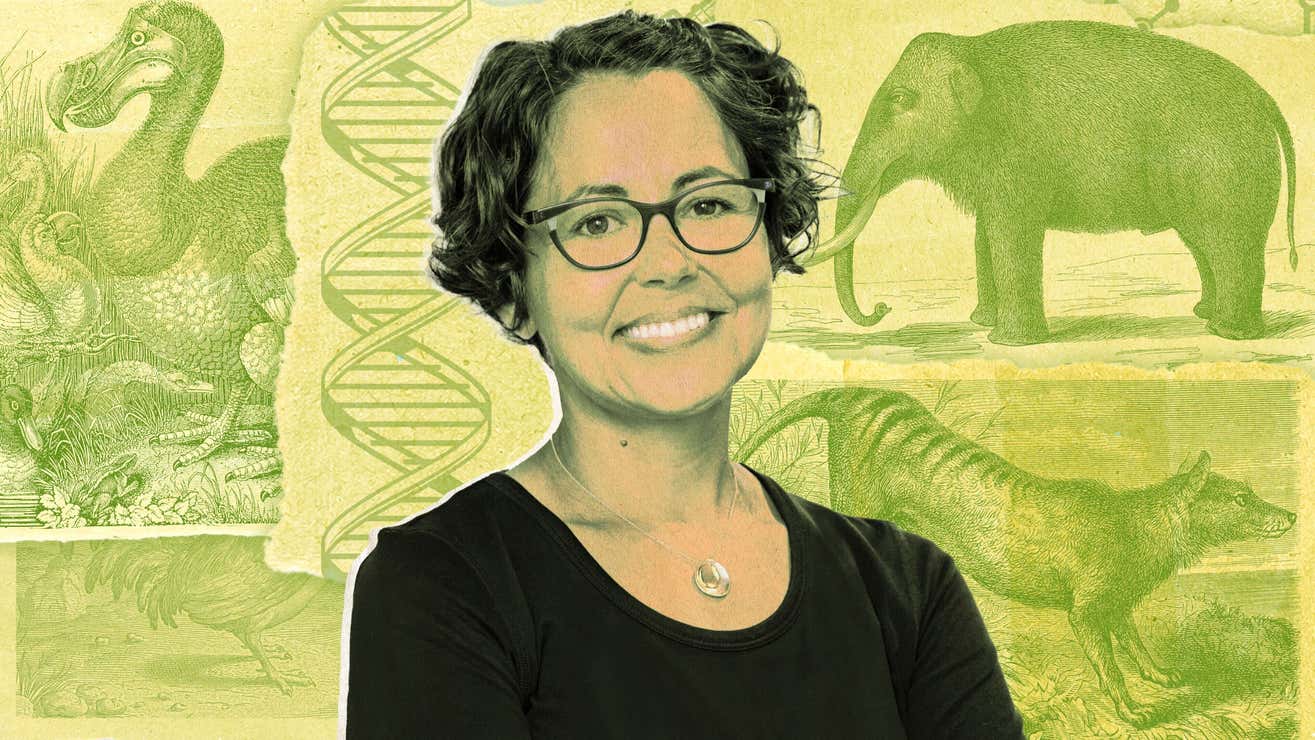 Beth Shapiro
.
.
Click the link below for the article:
.
__________________________________________
May 15, 2024
Mohenjo
Business, Food For Thought, Human Interest, Political, Science, Technical
amazon, business, Business News, current-events, Future, Hotels, human-rights, medicine, mental-health, research, Science, Science News, technology, Technology News, travel, vacation

Click the link below the picture
.
Hi, Liz! 🙂 How are you feeling?” an incoming text pings.
I click on a pre-generated answer. “Okay, I guess. . .” I’m in the home stretch of a long work trip, and I’ve been stressing about spending time away from my kids.
“If you were to describe your current mood, what kind of an ‘okay’ are you feeling right now?”
“Anxious,” I type.
“I’m here to help you feel more in control,” the bot replies. Nanoseconds later, a meme-ified cartoon gif blinks into the text window: “Don’t let the little worries bring you down.”
This automated exchange launches my dialogue with Wysa, an AI therapy chatbot that now lives in my computer. In leaning on a bot to shore up my mental health, I’m joining the 22 percent of American adults who’ve already done the same—a movement rooted in a dire shortage of trained providers and the recent availability of fast, low-cost online AI tools. Most therapists are perpetually slammed, in part due to the pandemic-era surge in demand for mental healthcare. “Everybody’s full. Everybody‘s busy. Everybody’s referring out,” says Santa Clara University psychologist and ethicist Thomas Plante. “There’s a need out there, no question about it.”
With the demand for care outpacing supply, mental health support bots have begun to fill the gap. Wysa, launched in 2016, was among the first. Since then, hundreds of viable competitors, including Woebot and Youper, have been broadly deployed in a marketplace that imposes few restrictions on them.
Standard AI therapy bots don’t require approval from the U.S. Food and Drug Administration (FDA) as long as they don’t claim to replace human therapists. In 2020 the agency also relaxed enforcement procedures for “digital therapeutics” in hopes of stemming the pandemic-related psychiatric crisis, clearing the way for developers to launch popular products claiming mental health benefits. Woebot alone has exchanged messages with more than 1.5 million users to date, according to CEO Michael Evers. Wysa is being used in the United Kingdom to triage those seeking appointments and to offer support to people while they wait to be matched with a therapist. Aetna International is now offering the app for free to members in the United States and elsewhere.
My experiences with Wysa and Woebot mirror the analysis of experts like Plante, who view the rise of AI chatbots with a mixture of optimism and concern. Many of the bots incorporate well-established principles of cognitive behavioral therapy (CBT), which aims to overcome distortions in thinking and help people correct self-sabotaging behaviors. It’s easy, I found, to think of the bots as rational or sentient, making even simple advice feel authoritative. Interacting with a chatbot can also give users the sense they’re being heard without judgment, says Chaitali Sinha, Wysa’s senior vice president of healthcare and clinical development. “It’s such a powerful experience for people who have never had the opportunity to experience that,” she says.
.
 da-kuk/Gettyimages
.
.
Click the link below for the article:
https://www.scientificamerican.com/article/ai-therapy-bots-have-risks-and-benefits-and-more-risks/
.
__________________________________________
May 14, 2024
Mohenjo
Business, Food For Thought, Human Interest, Political, Science, Technical
amazon, business, Business News, current-events, Future, Hotels, human-rights, medicine, mental-health, research, Science, Science News, technology, Technology News, travel, vacation

.
This is interesting…
.
New Living Translation
3 If the Good News we preach is hidden behind a veil, it is hidden only from people who are perishing. 4 Satan, who is the god of this world, has blinded the minds of those who don’t believe. They are unable to see the glorious light of the Good News. They don’t understand this message about the glory of Christ, who is the exact likeness of God.
.
__________________________________________
May 14, 2024
Mohenjo
Business, Food For Thought, Human Interest, Political, Science, Technical
amazon, business, Business News, current-events, Future, Hotels, human-rights, medicine, mental-health, research, Science, Science News, technology, Technology News, travel, vacation

Click the link below the picture
.
If you’re like many digitally savvy Americans, it has likely been a while since you’ve spent much time writing by hand.
The laborious process of tracing out our thoughts, letter by letter, on the page is becoming a relic of the past in our screen-dominated world, where text messages and thumb-typed grocery lists have replaced handwritten letters and sticky notes. Electronic keyboards offer obvious efficiency benefits that have undoubtedly boosted our productivity — imagine having to write all your emails longhand.
To keep up, many schools are introducing computers as early as preschool, meaning some kids may learn the basics of typing before writing by hand.
But giving up this slower, more tactile way of expressing ourselves may come at a significant cost, according to a growing body of research that’s uncovering the surprising cognitive benefits of taking pen to paper, or even stylus to iPad — for both children and adults.
In kids, studies show that tracing out ABCs, as opposed to typing them, leads to better and longer-lasting recognition and understanding of letters. Writing by hand also improves memory and recall of words, laying down the foundations of literacy and learning. In adults, taking notes by hand during a lecture, instead of typing, can lead to better conceptual understanding of material.
“There’s actually some very important things going on during the embodied experience of writing by hand,” says Ramesh Balasubramaniam, a neuroscientist at the University of California, Merced. “It has important cognitive benefits.”
While those benefits have long been recognized by some (for instance, many authors, including Jennifer Egan and Neil Gaiman, draft their stories by hand to stoke creativity), scientists have only recently started investigating why writing by hand has these effects.
A slew of recent brain imaging research suggests handwriting’s power stems from the relative complexity of the process and how it forces different brain systems to work together to reproduce the shapes of letters in our heads onto the page.
.
 van-balvan/Getty Images/iStockphoto
.
.
Click the link below for the article:
.
__________________________________________
May 14, 2024
Mohenjo
Business, Food For Thought, Human Interest, Political, Science, Technical
amazon, business, Business News, current-events, Future, Hotels, human-rights, medicine, mental-health, research, Science, Science News, technology, Technology News, travel, vacation
Click the link below the picture
.
Earlier this week, news broke that independent presidential candidate Robert F. Kennedy, Jr., claimed to have once had a dead worm in his brain. Kennedy had been experiencing memory loss and mental fog, and he originally suspected these symptoms might be caused by a brain tumor. Brain scans in 2010 showed a cyst that his doctors said contained remains of a parasite. The findings and other health issues were revealed in a New York Times article based on a review of a deposition for his 2012 divorce, as well as an interview the outlet conducted with him.
The revelation drew attention in the worlds of politics and parasitology. “I woke up to all kinds of messages from friends in parasitology,” says Shira Shafir, an epidemiologist and an associate adjunct professor at the University of California, Los Angeles, in response to the news.
The species of the purported parasite in Kennedy’s brain was never identified, and he did not know where he got infected. A spokesperson told media outlets on Wednesday that Kennedy had traveled extensively to Africa, South America, and Asia and likely contracted the parasite on one of the trips. Several parasites can affect the central nervous system and potentially create cysts in brain tissue. While relatively uncommon in the U.S., such infections can be devastating in many parts of the world. For example, the World Health Organization estimates there are between 2.56 million and 8.3 million people around the globe living with neurocysticercosis, a brain infection caused by the pork tapeworm Taenia solium. “It’s a really big deal in Latin America, sub-Saharan Africa, India, and other parts of Asia. It’s a leading cause of acquired seizures,” says Clinton White, a parasitologist and infectious diseases professor at the University of Texas Medical Branch at Galveston. “Neurocysticercosis is a major disease, and it’s kind of funny [these are] the circumstances in which people are paying attention to it.”
Scientific American spoke with Shafir and White to discuss how parasitic worms may infect the brain, what symptoms they cause, and how infections are diagnosed and treated.
What are parasitic worms, and which ones can infect the brain?
SHAFIR: We generally don’t have adult worms that end up in the brain. What does end up in the brain are parasites in their earlier developmental stages, such as eggs or larvae—or, for lack of a better word, baby worms. So generally the parasitic infections that can impact the brain are those of pathogens in early developmental stages, which, for the most part, accidentally make it into the brain.
.
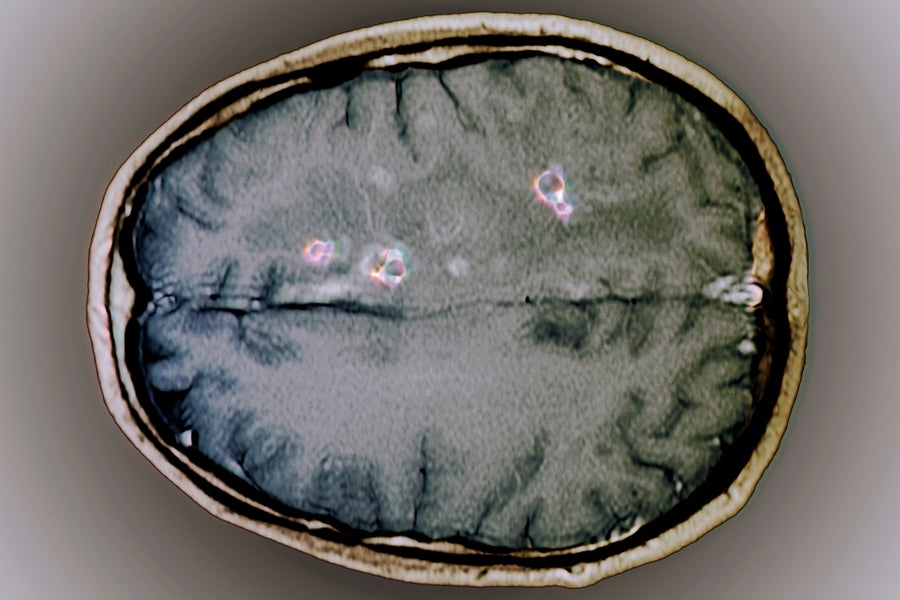
Magnetic resonance imaging (MRI) scan of an axial section through the brain of a 25-year-old patient, showing cysts (purple) from a tapeworm infection. Zephyr/Getty Images
.
.
Click the link below for the article:
.
__________________________________________
May 13, 2024
Mohenjo
Business, Food For Thought, Human Interest, Political, Science, Technical
amazon, business, Business News, current-events, Future, Hotels, human-rights, medicine, mental-health, research, Science, Science News, technology, Technology News, travel, vacation
.
Is history repeating…
.
2 Timothy 3:2-6
New Living Translation
2 For people will love only themselves and their money. They will be boastful and proud, scoffing at God, disobedient to their parents, and ungrateful. They will consider nothing sacred. 3 They will be unloving and unforgiving; they will slander others and have no self-control. They will be cruel and hate what is good. 4 They will betray their friends, be reckless, be puffed up with pride, and love pleasure rather than God. 5 They will act religious, but they will reject the power that could make them godly. Stay away from people like that!
6 They are the kind who work their way into people’s homes and win the confidence of vulnerable women who are burdened with the guilt of sin and controlled by various desires.
.
__________________________________________
May 13, 2024
Mohenjo
Business, Food For Thought, Human Interest, Political, Science, Technical
amazon, business, Business News, current-events, Future, Hotels, human-rights, medicine, mental-health, research, Science, Science News, technology, Technology News, travel, vacation

Click the link below the picture
.
Now that Donald Trump is just a few delegates away from the Republican nomination, conversation among commentators has turned to his electability and his “pivot” to the general election. The same pundits who ignored the polls to say Trump would lose the nomination now urge us to take his odds seriously. He’ll take on a more “presidential tone.” He’ll attack Hillary Clinton on all sides. He’ll be formidable. He might even win.
Or at least, that’s the argument.
But before we get there, we have to answer a simple question. How will Donald Trump improve on Mitt Romney’s campaign for president? What will he win that Romney lost?
Romney wasn’t a bad candidate. He ran a competent and largely professional campaign against an incumbent who presided over high unemployment and slow growth. No, Romney wasn’t favored, but he also had a better shot than most candidates who run against a sitting president. If you believe that Trump can win—absent an exogenous shock like a terrorist attack or recession—you need to show how he beats Romney. You need to move this from the realm of speculation and into the world as it exists.
The idea of Trump as a plausible winner is rooted in the same error that drove pundits to discount and dismiss him as late as the Iowa and New Hampshire primaries. Then, observers saw the polls—which accurately showed his appeal to a cross-section of Republican voters—but refused to believe them. It was unthinkable that a field of ostensibly talented candidates would fail to stop Trump before he gained traction.
That’s what happened. If Trump had entered the race as an Icarus-type—a candidate who shoots to the top but withers under the heat—then by the fall, he was something different. He was a genuine presence in a crowded field with real support among Republican voters. No one bothered to stop him. Afraid of alienating Trump’s supporters, GOP leaders disarmed themselves; fearful of Trump’s attacks, Republican donors refused to fund a confrontation; complacent about his threat, Republican candidates focused on clearing their respective “lanes” rather than stopping the leader in the field. By the time Republican voters went to the ballot box, Trump had cultivated a following.
.
 Donald Trump speaks to supporters and the media at Trump Tower in Manhattan following his victory in the Indiana primary on Tuesday. View Press/Getty Images
.
.
Click the link below for the article:
.
__________________________________________
May 13, 2024
Mohenjo
Business, Food For Thought, Human Interest, Political, Science, Technical
amazon, business, Business News, current-events, Future, Hotels, human-rights, medicine, mental-health, research, Science, Science News, technology, Technology News, travel, vacation

Click the link below the picture
.
The last pandemic was bad, but COVID-19 is only one of many infectious diseases that emerged since the turn of this century.
Since 2000, the world has experienced 15 novel Ebola epidemics, the global spread of a 1918-like influenza strain and major outbreaks of three new and unusually deadly coronavirus infections: SARS, MERS and, of course, COVID-19. Every year, researchers discover two or three entirely new pathogens: the viruses, bacteria and microparasites that sicken and kill people.
While some of these discoveries reflect better detection methods, genetic studies confirm that most of these pathogens are indeed new to the human species. Even more troubling, these diseases are appearing at an increasing rate.
Despite the novelty of these particular infectiprimarily ons, the primary factors that led to their emergence are quite ancient. Working in the field of anthropology, I have found that these are human factors: the ways we feed ourselves, the ways we live together, and the ways we treat one another. In a forthcoming book, “Emerging Infections: Three Epidemiological Transitions from Prehistory to the Present,” my colleagues and I examine how these same elements have influenced disease dynamics for thousands of years. Twenty-first century technologies have served only to magnify ancient challenges.
Neolithic Infections
The first major wave of newly emerging infections occurred with the start of the Neolithic revolution about 12,000 years ago, when people began shifting from foraging to farming as their primary means of subsistence.
Before then, human infections tended to be mild and chronic in nature, manageable burdens of long-term parasites that people carried around from place to place. But full-time agrarian living brought the kinds of acute and virulent infections that we are familiar with today. This global shift was humanity’s first epidemiological transition.
.
 Nastasic/DigitalVision Vectors via Getty Images
.
.
Click the link below for the article:
.
__________________________________________
May 12, 2024
Mohenjo
Business, Food For Thought, Human Interest, Political, Science, Technical
amazon, business, Business News, current-events, Future, Hotels, human-rights, medicine, mental-health, research, Science, Science News, technology, Technology News, travel, vacation
Click the link below the picture
.
In the weeks since the U.S. Department of Agriculture announced a bird flu outbreak in dairy cows that had gone undiagnosed for months, bystanders have wondered why it took so long to identify. Experts say there are key scientific and political reasons why the dairy industry was caught off guard by the H5N1 avian influenza virus—and that understanding those factors will be vital to controlling the disease on dairy farms and preventing an outbreak in humans.
“The dairy industry has never had to deal with something like this before,” says Keith Poulsen, director of the Wisconsin Veterinary Diagnostic Laboratory and a former dairy veterinarian. “This is probably going to be the most important outbreak in my professional career.”
After weeks of uncertainty—fueled by the unnerving revelation that the outbreak likely began last December and took months to recognize—the federal government is taking some action. The USDA has mandated testing for lactating cows that are being transported across state lines in the hopes of squashing the spread of the virus, which has so far been confirmed in 36 herds across nine states. One human case has been reported this year, but the infection was mild, and more than a month has passed with no new cases confirmed. Epidemiologists have called for more human testing to better monitor the situation, however. Meanwhile, Food and Drug Administration testing has shown that viral particles that were found in pasteurized milk were not infectious, suggesting little threat to consumers.
Authorities’ scramble to understand and control the situation is particularly concerning because scientists have long worried about the potential for an H5N1 strain to jump into humans and cause a pandemic. And bird flu has been devastating poultry farms around the world for years now. Veterinarians and epidemiologists have been on high alert since 2022, when a new strain began tearing through wild birds and even mammals, killing or forcing U.S. farmers to cull some 90 million domestic birds. How could it take months to notice the same virus was spreading in dairy cows?
One reason the outbreak went undetected for so long is that people thought it was unlikely that the virus would jump into cows. Avian influenza is, after all, most common in birds, whereas flus in general have been rare in cows. “The chances of it going from migratory birds to cows were so low,” Poulsen says. “And then it happened.”
.
 Vladimir Zapletin/Getty Images
.
.
Click the link below for the article:
.
__________________________________________
May 12, 2024
Mohenjo
Business, Food For Thought, Human Interest, Political, Science, Technical
amazon, business, Business News, current-events, Future, Hotels, human-rights, medicine, mental-health, research, Science, Science News, technology, Technology News, travel, vacation

Click the link below the picture
.
Men are punching random women on the streets of New York City. As usual with these kinds of diffuse and chaotic stories, there’s much that is unknown, including how often this is happening, how many people are involved, or whether it’s at all coordinated. But what we do know is already alarming. CNN reports that dozens of women have discussed being victims on social media, and formally interviewed six of them. NBC News reports there have been at least 3 arrests. CBS News reports that NYPD released images last week of a fourth man wanted for allegedly punching a woman in Union Square. Even reality TV star Bethany Frankel says she’s been victimized.
Women report being assaulted by men of different races and ages. Still, across the different stories, a couple of similarities pop out: The alleged victims are mostly young and pretty, and most of them say they were minding their own business when they were attacked. Some were on their phones or reading on tablets. Others were speaking to friends or daydreaming. Whatever they were doing, they were just living their lives, and that, it seems, is what enraged their assailants.
The alleged victims are mostly young and pretty, and most of them say they were minding their own business when they were attacked.
Whatever the scale of this problem eventually turns out to be, it’s not surprising that these stories have gone viral and captured the public’s imagination. While it rarely turns to violence, most women who spend much time walking around in public have experience with men who berate them for paying attention to something other than the man who is now, often out of nowhere, spewing invectives. In our modern era, that often manifests with men who are infuriated at women for looking at their phones. But I’m old enough to remember when I would get yelled at for reading books in public.
Whatever the excuse the angry man concocts, the impetus is always the same: The eyes of a woman are directed at someone or something that is not him, and he is indignant over it. So he will make sure she has no choice but to look at him, either by getting in her face or — in these alarming New York cases — punching her. If he cannot capture her adoring gaze, well, he will make her stare at him in fear.
These stories resonate, as well, because the nation is having a moment of increasingly unhinged male fury at women for daring to have lives that are centered around something other than catering to a man’s every whim. Unleashed by Donald Trump and the MAGA movement, there’s an upswell of loud male entitlement shouting at us from every corner.
.
 People eat in a restaurant sidewalk shed on Mott Street in Little Italy in New York City. (Gary Hershorn/Getty Images)
.
.
Click the link below for the article:
.
__________________________________________
Older Entries
Newer Entries
 James' World 2