May 25, 2024
Mohenjo
Business, Food For Thought, Human Interest, Political, Science, Technical
amazon, business, Business News, current-events, Future, Hotels, human-rights, medicine, mental-health, research, Science, Science News, technology, Technology News, travel, vacation

Click the link below the picture
.
People have long been fascinated with how the Egyptian pyramids were built, floating theories from the construction of expansive causeways to extraterrestrial assistance.
 Now scientists have evidence to support another theory, centered around the discovery of a long-lost branch of the Nile that would have run alongside 31 ancient pyramids built between the 27th and 18th centuries BC.
Though the pyramids today sit on a sandy, desert plateau near the ancient Egyptian capital of Memphis, a newly published study maintains the region was once home to a bustling river branch that was likely a vital means of transportation.
Researchers named the 64-kilometre river branch Ahramat (the Arabic word for “pyramids”) and said it was likely used to float large stone blocks for the construction of the pyramids. Many of the stones originated from hundreds of kilometers south of where the pyramids stand today, with some weighing more than a ton.
The river likely also transported other equipment and people.
Geomorphologist Eman Ghoneim, the study’s lead researcher, told National Geographic she and her team from the University of North Carolina Wilmington believe the lost river “was a superhighway for ancient Egypt.”
.
 Scientists have discovered a lost river branch of the Nile, now named Ahramat, that they believe may have been used to transport building materials and massive stone blocks to pyramid construction sites in ancient Egypt. EWEL SAMAD/AFP via Getty Images
.
.
Click the link below for the article:
.
__________________________________________
May 25, 2024
Mohenjo
Business, Food For Thought, Human Interest, Political, Science, Technical
amazon, business, Business News, current-events, Future, Hotels, human-rights, medicine, mental-health, research, Science, Science News, technology, Technology News, travel, vacation

Click the link below the picture
.
The rock group Counting Crows were onto something when they chose their band name. Crows can indeed count, according to research published this week in Science.
The results show that crows have counting capacities near those of human toddlers who are beginning to develop a knack for numbers, says lead study author Diana Liao, a postdoctoral researcher in neurobiology at the University of Tübingen in Germany. “We think this is the first time this has been shown for any animal species,” she adds.
Crows do not appear to be capable of symbolic counting, in which numbers are associated with a particular symbol that serves as an exact representation. This skill is still thought to be unique to humans. Instead, the birds are able to count by controlling the number of vocalizations they produce to correspond to associated cues—just like young children who have yet to master symbolic counting often do, Liao says. For example, a toddler who is asked how many apples are on a tree may answer, “One, one, one” or “One, two, three”—producing the number of speech sounds that correspond to the number of objects they see rather than just saying, “Three.”
Scientists have long suspected that some nonhuman species might also have the ability to count by controlling the number of their vocalizations, but they have lacked the smoking gun evidence to prove it. In a study of Black-capped Chickadees, for example, researchers reported that the number of “dee” notes at the ends of the birds’ alarm calls was inversely correlated with the size of the predator they were issuing warnings about. (The small predators in that study posed a higher risk to the chickadees than large ones did.) “They seemed to be conveying the magnitude of the threat,” Liao says.
Yet, this finding on its own did not prove that chickadees were intentionally conveying information about the predator through numbered calls. The behavior could also be driven by the level of fear the birds were experiencing, Liao says, with more dangerous predators triggering higher states of arousal and thus more calls.
.

Carrion Crow (Corvus corone). Ernie Janes/Alamy Stock Photo
.
.
Click the link below for the article:
.
__________________________________________
May 24, 2024
Mohenjo
Business, Food For Thought, Human Interest, Political, Science, Technical
amazon, business, Business News, current-events, Future, Hotels, human-rights, medicine, mental-health, research, Science, Science News, technology, Technology News, travel, vacation

Click the link below the picture
.
Europe’s upcoming Mars mission will use a pioneering nuclear-powered device that harnesses the radioactive decay of americium to keep its components warm — a first for spacecraft.
The European Space Agency (ESA) announced the plans on 16 May, alongside details of an agreement with NASA that crystallized the US agency’s contribution to the long-delayed ExoMars mission, which will deliver Europe’s first Mars rover, called Rosalind Franklin. ESA was originally working with the Russian space agency Roscosmos on the mission, but canceled the partnership in 2022, after Russia invaded Ukraine.
Radioisotope heater units (RHUs) harness the heat produced by the decay of radioactive elements to keep spacecraft warm enough to operate when it is not possible to use electricity generated by solar panels. ESA has historically relied on US or Russian partners to provide RHUs that use plutonium-238 for missions, but since 2009 has been working on its own program to create RHUs, as well as batteries that provide electricity.
The European RHUs will heat components of the mission’s landing platform, which deploys the rover onto the Martian surface. The lander powers the rover before it exits the platform and opens its solar panels. Heating the lander will extend its life, so it can provide backup in case there are issues when the rover is deployed, says Orson Sutherland, ESA’s group leader for Mars Exploration, who is based at the European Space Research and Technology Center (ESTEC) in Noordwijk, the Netherlands.
Americium decay
ESA’s heater units will not only be a first for Europe, but the first anywhere to use americium-241, a by-product of plutonium decay that packs less power per gram than does its precursor. But americium-241 is more abundant and cheaper — meaning that, even if the RHUs require more of the isotope, they might be less expensive overall. “Developing and launching a European RHU will be a first for ESA and a major achievement,” says Sutherland.
The Rosalind Franklin rover is uniquely equipped to search for traces of ancient life on Mars: it has a 2-meter drill that will allow it to burrow deep beneath the Martian surface. But the mission was originally slated for launch in 2018 and had already been delayed by technical issues and the COVID-19 pandemic, even before tensions escalated with Russia.
ESA had to radically rethink the mission to proceed without the involvement of Roscosmos, which was meant to build the lander. That led ESA to create a new European-designed lander and rely on NASA to fill the remaining holes in the mission plan. According to the agreement, NASA will provide capacity to launch ExoMars in 2028, as well as braking engines for the lander. NASA will also supply RHUs, for the rover.
.
 An artist’s impression of ESA’s ExoMars rover, Rosalind Franklin. Credit: ESA/ATG medialab
.
.
Click the link below for the article:
.
__________________________________________
May 24, 2024
Mohenjo
Business, Food For Thought, Human Interest, Political, Science, Technical
amazon, business, Business News, current-events, Future, Hotels, human-rights, medicine, mental-health, research, Science, Science News, technology, Technology News, travel, vacation

Click the link below the picture
.
I last interviewed Ebrahim Raisi, the ultra-hard-line President of Iran, during his début appearance at the United Nations, in 2022. He spoke belligerently and with such speed that the interpreter struggled to keep up. He was the same on the U.N. dais, where he furiously waved a photo of General Qassem Soleimani and demanded that Donald Trump be tried for ordering his assassination—a “savage, illegal, immoral crime”—in a U.S. drone strike, in 2020. Back home, Iran was in turmoil after nationwide protests erupted in response to the death, in police custody, of a twenty-two-year-old named Mahsa Amini. She had been arrested for improper hijab; too much hair was showing. Raisi’s government ordered a brutal crackdown; security forces eventually killed more than five hundred protesters and arrested nearly twenty thousand. During an interview with a handful of journalists, conducted in the chandeliered ballroom of a New York hotel, Raisi was asked about the protests. “We’re all professionals,” he said, and insisted that we focus on the dispute over Iran’s nuclear program “rather than diverting to other issues.”
Raisi, who had a manicured white beard and wore a black turban signifying his descent from the Prophet Muhammad, offered no hint of diplomatic compromises over the growing tensions with the West, as three of his predecessors had done during their U.N. visits. He instead boasted of a shifting world order that mobilized America’s rivals. After his election, in 2021, Raisi oversaw Tehran’s expanding military cooperation with Russia, which included the transfer of hundreds of drones for its war in Ukraine. He tightened ties with China, which is now the main importer of Iranian oil, thus bailing Iran out of the sanctions noose created by Washington. At home, however, Raisi was “derided for incompetence” and often the butt of relentless Persian humor, Vali Nasr, the former dean of the Johns Hopkins School for Advanced International Studies, told me. Raisi invoked tougher enforcement of the hijab and restricted personal freedoms, which in turn sparked the widest protests against the regime since the 1979 Revolution. He was arguably Iran’s most unpopular President. “Whoever succeeds him could be construed by the public as an improvement,” Nasr added. Raisi was also the first President to be personally sanctioned by the U.S.
Raisi died in a helicopter crash on Sunday. He was flying back from the country’s border with Azerbaijan, in the northwest, where he had celebrated the opening of a new dam with his Azerbaijani counterpart—a symbol of Iran’s strengthening relations with nations in the Caucasus. He flew in a convoy of three helicopters. Two landed safely after navigating thick fog over remote and rugged mountains. Raisi flew in a vintage U.S.-manufactured Bell helicopter, a model purchased during the monarchy in the nineteen-seventies. (Bell stopped producing it more than twenty-five years ago.) Iran has struggled to maintain its aging aircraft, and U.S. sanctions have complicated access to spare parts. Despite early conspiracy theories about deliberate sabotage of Raisi’s helicopter, which spread feverishly across social media, Iran attributed the crash to a “technical failure” after the charred wreckage was finally found early on Monday in a dense mountain forest. Eight others, including Iran’s foreign minister, Hossein Amir-Abdollahian, were also killed.
Raisi died at a precarious time for a revolutionary regime that is ever more xenophobic, paranoid, and rigid. His legacy is “a sharp deterioration of Iran’s relations with the West, owing to the failed efforts to negotiate a return to the 2015 nuclear agreement, increasingly close military ties with Russia, and the perilous tit for tat with Israel,” Ali Vaez, an Iran expert at the International Crisis Group, told me. His successor will have to deal with “deep social and economic discontent, regional instability and tension, and, over the longer horizon, the fate of the Islamic Republic.”
.

.
.
Click the link below for the article:
.
__________________________________________
May 23, 2024
Mohenjo
Business, Food For Thought, Human Interest, Political, Science, Technical
amazon, business, Business News, current-events, Future, Hotels, human-rights, medicine, mental-health, research, Science, Science News, technology, Technology News, travel, vacation
Click the link below the picture
.
Black holes stretch the fabric of spacetime to its extreme—and the closer you get to one, the more warped things get. “You can be really very close to a black hole and, happily, circularly orbit,” says Andrew Mummery, a physicist at the University of Oxford. But as you draw nearer, a black hole’s gravitational grip becomes overpowering. You hit a precipice, and instead of peacefully circling, you simply fall.
At this point, classical orbital mechanics breaks down, and “[Isaac] Newton has nothing to say,” Mummery notes. Describing the dynamics of an object falling headlong down a black hole’s maw is a task for Albert Einstein’s general theory of relativity.
Einstein used this theory more than a century ago to predict what happens in what would later become known as black holes. Just outside a black hole’s event horizon—the boundary past which not even light can escape—an orbiting object will abruptly encounter a so-called plunging region and plummet to its doom at nearly the speed of light.
Theorists consider a black hole’s plunging region to be where the fate of all things falling in becomes sealed. Yet beyond that basic insight, this area has remained a near-total mystery. “Basically, the preexisting theoretical models ignored this region,” Mummery says—after all, it’s small and hard to see with current telescopes. But thanks to a chance outburst by a black hole feasting on matter in our galaxy, Mummery, and his colleagues have now observed the plunging region for the first time. They reported their results in a paper published last week in the Monthly Notices of the Royal Astronomical Society.
“The first time you see it, it’s just nice to know it’s there at all,” Mummery says. “Now that we know we can see this, there’s a lot of things we can, in principle, learn using it.”
.

An artist’s concept of a stellar-mass black hole (right) siphoning material from a companion star (left). Much of the material forms an accretion disk around the black hole before falling inside. ESO/L. Calçada/M.Kornmesser
.
.
Click the link below for the article:
.
__________________________________________
May 23, 2024
Mohenjo
Business, Food For Thought, Human Interest, Political, Science, Technical
amazon, business, Business News, current-events, Future, Hotels, human-rights, medicine, mental-health, research, Science, Science News, technology, Technology News, travel, vacation

Click the link below the picture
.
If not for the ongoing carnage in Gaza, there’s a good chance the spiral of violence between Israel and the Lebanon-based military group Hezbollah would be the Middle Eastern conflict dominating the world’s attention right now. In the weeks leading up to the current Israeli offensive in Rafah, there was often more actual fighting happening on Israel’s northern border with Lebanon than in the south in Gaza.
The fighting has been happening since the day after Hamas’s October 7 attacks, when Hezbollah launched guided rocket strikes against Israel in what it called “solidarity with the victorious Palestinian resistance.” Hezbollah has continually fired rockets and drones into Israel and in return, the Israeli military has launched air and military strikes against the group’s bases in Lebanon in response. Hamas and Hezbollah are both Iran-backed, anti-Israel militant groups, though they differ significantly in ideology and operational approach.
In the first six months of the fighting, there were at least 4,400 combined strikes from both sides, according to the US-based Center for Strategic and International Studies (CSIS). An estimated 250 Hezbollah members and 75 Lebanese civilians have been killed in the fighting, along with 20 Israelis — both civilians and soldiers. More than 60,000 residents of northern Israel have been displaced by the attacks, along with some 90,000 people in southern Lebanon.
Those numbers may pale against the far larger death toll and refugee crisis caused by the fighting in Gaza, but the situation in the north could have been — and may yet be — far worse than it has been, given the military strength on both sides. The Israeli military is, for its size, one of the most powerful in the world, while Hezbollah is the best-armed non-state group in the world, with an arsenal of between 120,000 and 200,000 rockets and missiles and up to 30,000 active personnel and 20,000 reserves, according to CSIS estimates. If it wanted to, Hezbollah could cause far more damage on Israel than Hamas — which, for comparison, had around 30,000 rockets before October 7 — ever could.
While both sides have seemed to be trying to avoid escalating the fighting into a full-scale war as devastating as the one they fought in 2006, that doesn’t mean such a war won’t happen anyway. After the latest series of Israeli Defense Forces (IDF) airstrikes in Lebanon, in response to Hezbollah drone attacks on May 6 that killed two IDF soldiers, Defense Minister Yoav Gallant predicted a “hot summer” on the border.
.

An Israeli reserve combat soldier takes part in a training drill on May 8, 2024, in the Golan Heights. Amir Levy/Getty Images
.
.
Click the link below for the article:
.
__________________________________________
May 22, 2024
Mohenjo
Business, Food For Thought, Human Interest, Political, Science, Technical
amazon, business, Business News, current-events, Future, Hotels, human-rights, medicine, mental-health, research, Science, Science News, technology, Technology News, travel, vacation
Click the link below the picture
.
Three separate research groups have demonstrated quantum entanglement — in which two or more objects are linked so that they contain the same information even if they are far apart — over several kilometers of existing optical fibers in real urban areas. The feat is a key step towards a future quantum internet, a network that could allow information to be exchanged while encoded in quantum states.
Together, the experiments are “the most advanced demonstrations so far” of the technology needed for a quantum internet, says physicist Tracy Northup at the University of Innsbruck in Austria. Each of the three research teams — based in the United States, China, and the Netherlands — was able to connect parts of a network using photons in the optical-fire-friendly infrared part of the spectrum, which is a “major milestone”, says fellow Innsbruck physicist Simon Baier.
A quantum internet could enable any two users to establish almost unbreakable cryptographic keys to protect sensitive information. But full use of entanglement could do much more, such as connecting separate quantum computers into one larger, more powerful machine. The technology could also enable certain types of scientific experiment, for example by creating networks of optical telescopes that have the resolution of a single dish hundreds of kilometers wide.
Two of the studies were published in Nature on 15 May. The third was described last month in a preprint posted on arXiv, which has not yet been peer-reviewed.
Impractical environment
Many of the technical steps for building a quantum internet have been demonstrated in the laboratory over the past decade or so. And researchers have shown that they can produce entangled photons using lasers in direct line of sight of each other, either in separate ground locations or on the ground and in space.
.
 Andrey Suslov/Getty Images
.
.
Click the link below for the article:
.
__________________________________________
May 22, 2024
Mohenjo
Business, Food For Thought, Human Interest, Political, Science, Technical
amazon, business, Business News, current-events, Future, Hotels, human-rights, medicine, mental-health, research, Science, Science News, technology, Technology News, travel, vacation

Click the link below the picture
.
At Brooklyn Friends School, progressive Quaker values are part of the curriculum. A required seminar for ninth-grade students encourages them to explore matters of identity and social justice, and there are land acknowledgments on the walls. But a debate over Israel between parents and the school has tested its values. Brooklyn Friends says it is trying not to pick a side, but parents who are critical of Israel say the school has silenced them.
BFS is one of many liberal entities to face a split within its ranks after October 7, including the rift inside the Democratic Party. PEN America, a free-expression group, canceled its prestigious awards and World Voices Festival after writers withdrew, calling on the organization to more strongly condemn Israeli attacks on Palestinian writers and culture. College campuses across the country are convulsed not only by student protesters but by administrators who respond with violent crackdowns.
Nobody has called the police on critical parents at BFS, but there is tension all the same. It stretches as far back as December, when BFS asked Esther Farmer, an activist with Jewish Voice for Peace, to speak at an event honoring Human Rights Day. Farmer says she readily agreed, figuring she had been invited to provide JVP’s anti-Zionist perspective. In her view, that wouldn’t be out of keeping with the school’s pacifist Quaker tradition. “The American Friends Service Committee has been pro-Palestinian and pro-peace for many, many years. And I had a lot of respect for them,” she says.
A few weeks later, BFS withdrew Farmer’s invitation and later canceled the event altogether. “So that was a little surprising because this was the Friends school, and I couldn’t understand what happened there,” Farmer says. Kevin Murungi, the school’s director of global civic engagement and social impact, says they “vetted all the speakers, including Esther, carefully, and told them the spirit of the event that they were attending.”
Farmer wasn’t the only person surprised by her cancellation. Some parents were taken aback when they learned of the decision through a December 8 email from Crissy Cáceres, the head of the school. She wrote that other parents had raised concerns about JVP. “We would never knowingly pursue a course of action that would put any of our students in harm’s way,” Cáceres said.
But what harm could Farmer — who is Jewish — pose to students? “I have to say my experience of that is that’s really what’s antisemitic,” Farmer says. “So we’re only allowed to hear some Jewish voices but not other Jewish voices?”
.
 Photo-Illustration: Intelligencer; Photos: Ajay Suresh
.
.
Click the link below for the article:
.
__________________________________________
May 21, 2024
Mohenjo
Business, Food For Thought, Human Interest, Political, Science, Technical
amazon, business, Business News, current-events, Future, Hotels, human-rights, medicine, mental-health, research, Science, Science News, technology, Technology News, travel, vacation
Click the link below the picture
.
CLIMATEWIRE | Disasters forced more than 26 million people in 148 countries to leave their homes in 2023, underscoring the growing dangers of more frequent floods, storms, wildfires, and droughts.
Last year saw among the highest number of weather-related displacements in the last decade, though fewer than in 2022, according to an annual report by the International Displacement Monitoring Centre. The report, released Tuesday, also found that conflict and violence triggered another 20.5 million displacements in 2023.
Altogether, 75.9 million people were living in “internal displacement” in dozens of countries last year, including tens of millions of people displaced in previous years and still unable to return to their homes.
The report warns that disasters frequently overlap with conflict and violence, dramatically worsening outcomes for affected people. Forty-five countries and territories reported conflict-related displacements in 2023, and all but three of them also reported displacements from disasters as well.
“While the numbers fluctuate year-on-year, disaster-related displacements remain high, in nearly every corner of the world and often intertwined with conflict dynamics in fragile settings,” wrote Robert Piper, special adviser on solutions to internal displacement to the United Nations secretary general, in the report’s forward.
For example, hundreds of thousands of people were displaced by floods last fall in Somalia, a country already wracked by severe drought and long-term civil war.
.
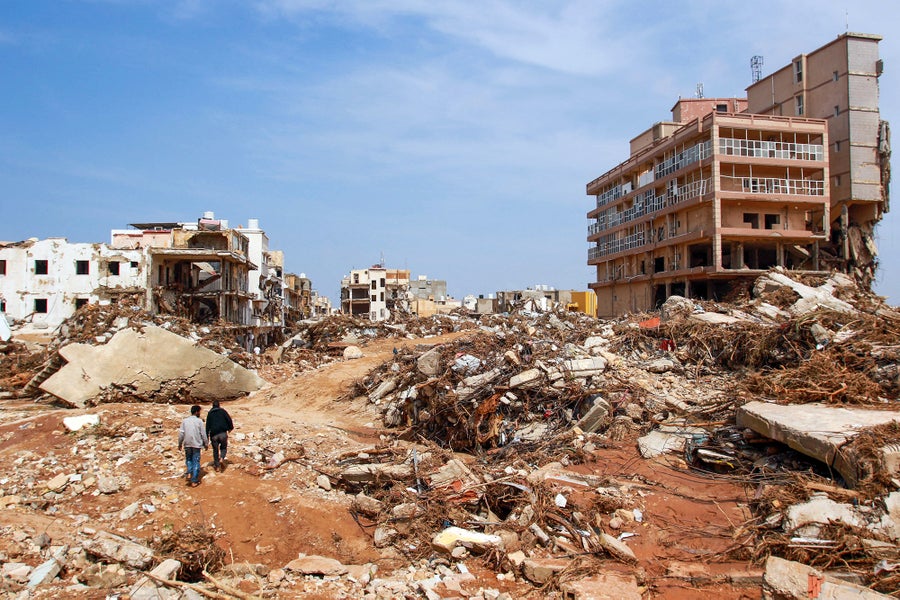
Men walk past debris of buildings caused by flash floods in Derna, eastern Libya, on September 11, 2023. AFP via Getty Images
.
.
Click the link below for the article:
.
__________________________________________
May 21, 2024
Mohenjo
Business, Food For Thought, Human Interest, Political, Science, Technical
amazon, business, Business News, current-events, Future, Hotels, human-rights, medicine, mental-health, research, Science, Science News, technology, Technology News, travel, vacation

Click the link below the picture
.
As the school year ends, many students will be only too happy to see math classes in their rearview mirrors. It may seem to some of us non-mathematicians that geometry and trigonometry were created by the Greeks as a form of torture, so imagine our amazement when we heard two high school seniors had proved a mathematical puzzle that was thought to be impossible for 2,000 years.
We met Calcea Johnson and Ne’Kiya Jackson at their all-girls Catholic high school in New Orleans. We expected to find two mathematical prodigies.
Instead, we found at St. Mary’s Academy, all students are told their possibilities are boundless.
Come Mardi Gras season, New Orleans is alive with colorful parades, replete with floats, and beads, and high school marching bands.
In a city where uniqueness is celebrated, St. Mary’s stands out – with young African American women playing trombones and tubas, twirling batons and dancing – doing it all, which defines St. Mary’s, students told us.
Junior Christina Blazio says the school instills in them they have the ability to accomplish anything.
Christina Blazio: That is kinda a standard here. So we aim very high – like, our aim is excellence for all students.
The private Catholic elementary and high school sits behind the Sisters of the Holy Family Convent in New Orleans East. The academy was started by an African American nun for young Black women just after the Civil War. The church still supports the school with the help of alumni.
In December 2022, seniors Ne’Kiya Jackson and Calcea Johnson were working on a school-wide math contest that came with a cash prize. tangie
.
 Ne’Kiya Jackson and Calcea Johnson
.
.
Click the link below for the article:
.
__________________________________________
Older Entries
Newer Entries
 James' World 2