Home

Trump Promised the ‘World’s Lowest’ Drug Prices. We Checked the Numbers.

Leave a comment

Click the link below the picture

.

President Trump and top federal health officials have repeatedly claimed that their new website, TrumpRx, offers Americans the world’s lowest prices on prescription drugs.

“I took prescription drugs, a very big part of health care, from the highest price in the entire world to the lowest,” Mr. Trump said during his State of the Union address last month.

That is not true, according to a review by The New York Times and the German news organizations Süddeutsche Zeitung, NDR, and WDR.

The drugs listed on TrumpRx can cost American patients up to hundreds or thousands of dollars, while a patient walking into a German pharmacy pays next to nothing. The German health system foots the bill, and records show that, more often than not, it pays less than what the Trump administration negotiated for Americans.

The TrumpRx website shows the prices that the administration negotiated for a few dozen of the several thousand prescription medications in the United States. The list includes almost none of the most widely used drugs, like statins, or ultra-expensive drugs like cancer therapies.

Some well-known drugs on the list are Xeljanz, for autoimmune conditions, and Farxiga, for diabetes and heart and kidney problems. Both are cheaper in Germany, a rare example of a country that makes its negotiated drug prices public.

The biggest names on TrumpRx are two blockbuster weight-loss drugs — Wegovy and Zepbound. Both are available for lower out-of-pocket prices at pharmacies in wealthy countries around the world. In some cases, Americans pay about twice as much as patients overseas.

Higher price for Wegovy on TrumpRx

How much patients pay out of pocket at a pharmacy, without using insurance, for a four-week supply of a medium dose (one milligram) of Wegovy, Novo Nordisk’s injection for weight loss.

Some countries, like Germany, mandate the same prices at every pharmacy. In the other countries, some pharmacies may charge more or less than the price in the chart.

Source: Prices at local pharmacies.

Rebecca Robbins/The New York Times

The review by The Times and its German partners is an assessment of one of Mr. Trump’s signature domestic issues. With gas prices rising because of the unpopular war in Iran, the president is counting on his drug policy to resonate with voters who are concerned about affordability. Mr. Trump has repeatedly claimed that this policy alone should be enough to carry Republicans to victory in November’s midterm elections.

Our analysis shows that with some drugs, Mr. Trump appears to have modestly narrowed the gap between European and U.S. prices. But the gap persists, and the reality does not match his hyperbole. That is particularly true for patent-protected drugs, which consistently were cheaper in Germany.

White House officials and pharmaceutical companies contested our findings. They argued that the gap disappears after adjusting for the economic conditions in every country. That means that TrumpRx prices can count as cheaper, even when the price is higher.

The administration did not provide enough detail about how it ran those numbers for that claim to be checked. We examined raw numbers, comparing prices in U.S. dollars.

“By any objective measure, no president has accomplished what President Trump has in the past year alone to lower prescription drug prices for American patients,” Kush Desai, a White House spokesman, said.

Mr. Trump has long complained that Americans pay too much for medicines while Europeans pay too little. The president diagnosed a real disparity: Brand-name drugs in the United States have been shown to be three times as expensive, on average, as those in other wealthy nations.

.

https://static01.nyt.com/images/2026/03/18/multimedia/18int-drug-prices-01-tkfl/18int-drug-prices-01-tkfl-jumbo.jpg?quality=75&auto=webpPresident Trump unveiled the TrumpRx website last month. Visitors to the site are greeted by a promise: “Find the world’s lowest prices on prescription drugs.” Credit…Kenny Holston/The New York Times

.

.

Click the link below for the complete article:

https://www.nytimes.com

.

__________________________________________

Brain implant allows people who are paralyzed to type using their thoughts at speed of texting

Leave a comment

Click the link below the picture

.

For people with near-total paralysis, the ability to communicate easily in real time is a challenge. For years, scientists have been working to remedy that by developing devices that can decode brain signals and translate them into computer cursor movements or text.

These devices are a type of brain-computer interface, or BCI, and they consist of electrode chips that are implanted inside the brain to listen to and decode the electrical whispers of neurons. In the past, BCIs allowed people to type using a virtual keyboard, but the speed was frustratingly slow. Now, however, a team of scientists report that their BCI keyboard helped two people with paralysis type at speeds of up to 22 words per minute—nearly as fast as the average person can text using a smartphone. The findings were published today in Nature Neuroscience.

“This is an important technical advance that brings brain-computer typing much closer to practical communication speeds for people with paralysis,” says Edward Chang, a professor of neurological surgery at the University of California, San Francisco, who was not involved in the study.

“At about 22 words per minute, this is among the fastest motor-cortex typing BCIs yet and dramatically faster than most earlier neural spellers,” says Chang, who has worked on another speech-decoding BCI.

BCI technology has advanced significantly since its genesis in the 1960s, when researchers began using single electrodes implanted in the brains of monkeys to record their neural activity. In 2006, a consortium of researchers called BrainGate reported that a BCI allowed people with paralysis to control a computer cursor and operate a prosthetic hand. In recent years, the BrainGate BCI was used to control a virtual keyboard with a cursor and to decode letters from handwriting areas of the brain. Other groups’ BCIs have decoded words or short phrases directly from speech-related brain regions, too.

Previous versions of these brain-typing systems required participants to control a cursor on a screen and individually select letters, “which is far slower than being able to access any key at any time using your fingers,” says lead study author Justin Jude, a postdoctoral researcher at BrainGate, based at Brown University, and an appointed research fellow at Massachusetts General Hospital and Harvard Medical School.

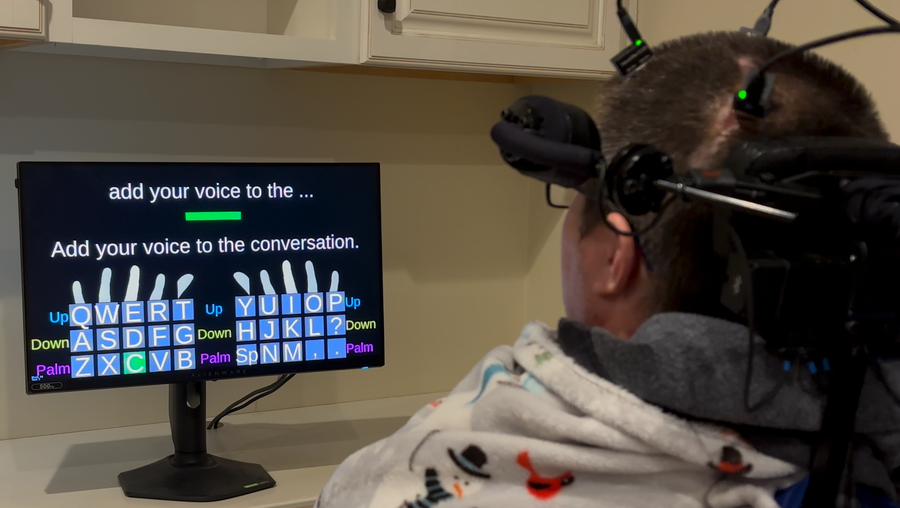
In the new paper, Jude and his colleagues trained their BCI using artificial intelligence to recognize intended hand or finger movements from a part of the brain’s movement area, called the precentral gyrus, as participants tried to move their paralyzed hands or fingers. The AI model predicted the letters on a QWERTY keyboard that the movements most likely corresponded to. They tested their system in two participants: one person with amyotrophic lateral sclerosis, a progressive neurological disease that causes paralysis, and one with a spinal cord injury that left them paralyzed but still able to speak.

Using the device, the latter participant was able to type at 110 characters or 22 words per minute, with a word error rate of 1.6 percent. The other participant’s typing was slower but still impressive for someone who lacked the ability to speak. By comparison, several years ago, the BrainGate handwriting BCI achieved speeds of 90 characters per minute (about 18 words per minute). Another previous BCI that was implanted in a speech-related brain region by Chang and his colleagues was used to achieve a typing speed of 78 words per minute, but the median word error rate was far higher—25 percent.

“One of the things that we talk about a lot is the speed of communication. The reason we do that is not just to have a faster system than someone else,” says Daniel Rubin, a critical care neurologist at Massachusetts General Hospital and an assistant professor of neurology at Harvard Medical School, who was a co-author of the new study.

People who have lost the ability to speak and to use their hands might be able to employ an eye-tracking system to type, but this method is slow. “Communication speed matters, because being part of a conversation matters,” Rubin says.

The researchers say the QWERTY keyboard system is more successful than the version that decoded mental handwriting. It remains to be seen, however, whether decoding from brain regions that control finger movement or from speech-related regions is a better strategy overall, Chang says. Signals in the brain’s motor cortex are easier to decode, but those in speech-related areas might be faster and more direct.

The technology is not ready for widespread use yet; the study was small, and the device requires brain surgery, which carries risks. “The biggest limitations are the small number of participants and the need for invasive intracortical implants,” Chang says.

Another limitation is the need to calibrate the BCI each time before it can used. “It’s almost like a musical instrument, and you have to tune it each day,” Rubin says. Having an instrument that can tune itself is a big goal for the field, he says.

Several companies are developing commercial BCIs, primarily for use in people who are paralyzed. Perhaps the most hyped has been Elon Musk’s Neuralink, but there are others, such as Paradromics and Synchron. (Some of the study authors consult for these companies and receive research funding from them.)

China recently approved the first invasive BCI for use in people with a form of partial paralysis. No such devices have been approved by the Food and Drug Administration for use by people with paralysis in the U.S.

.

https://static.scientificamerican.com/dam/m/2527f52d78b90cdb/original/braingate.png?m=1773681632.425&w=900

A BrainGate participant types using a brain implant. BrainGate Consortium

.

.

Click the link below for the complete article:

https://www.scientificamerican.com/article/brain-implant-allows-people-who-are-paralyzed-to-type-using-their-thoughts/

.

__________________________________________

Top US counterterrorism official resigns over Iran war, urging Trump to ‘reverse course’

Leave a comment

Click the link below the picture

.

Donald Trump’s top counterterrorism official has resigned over the war in Iran, urging the president to “reverse course”.

In a letter posted to X, National Counterterrorism Center Director Joe Kent said that Iran posed “no imminent threat” to the US and claimed the administration “started this war due to pressure from Israel and its powerful American lobby”.

The White House dismissed the letter, saying the president had “compelling evidence” that Iran was going to attack the US first. A US hate monitor accused Kent of “antisemitic tropes”.

With his departure, Kent is the most high-profile figure within the Trump administration to publicly criticise the US-Israeli attack on Iran.

In the Oval Office on Tuesday, Trump said Kent was a “nice guy”, but “weak on security”.

He also said Kent’s resignation letter had made him realise “it was a good thing that he’s out”.

Latest updates: Trump lashes out at Nato allies

In the letter addressed to Trump, Kent alleged that “high-ranking Israeli officials” and influential US journalists had sowed “misinformation” that led the president to undermine his “America First” platform.

“This echo chamber was used to deceive you into believing that Iran posed an imminent threat to the United States,” the letter continued. “This was a lie.”

Kent, a long-time supporter of Trump who unsuccessfully ran for Congress twice, was nominated by the president early in his administration and narrowly confirmed to his post. Democrats had criticised Kent’s hiring of a member of the far-right Proud Boys as a consultant to his 2022 election bid.

In his confirmation hearings, Kent also refused to back away from claims that federal agents had fomented the January 2021 riot at the US Capitol, or that Trump had not been defeated in the 2020 election.

The Anti-Defamation League (ADL), a US antisemitism monitor, said in a statement that Kent’s accusations “traffic in old-age antisemitic tropes”.

“So it’s no surprise that he would blame Israel and the media for pushing the President into war against the Iranian regime,” the ADL said.

The pro-Israel lobbying group, the American Israel Public Affairs Committee (Aipac), reposted the ADL statement on X. Aipac did not immediately respond to a BBC request for comment.

Ilan Goldenberg, a senior official at the liberal pro-Israel advocacy group J Street, described Kent’s letter as “ugly stuff that plays on the worst antisemitic tropes”.

Kent, 45, is a US special forces and CIA veteran whose wife, navy cryptologic technician Shannon Kent, was killed in a suicide bombing in Syria in 2019.

The father-of-two deployed 11 times overseas with the US military, including with the US Army’s special forces in Iraq.

He later became a paramilitary officer at the CIA, before leaving government service following his wife’s death.

Kent cited his military service and his wife’s death in his letter, saying that he “cannot support sending the next generation off to fight and die in a war that serves no benefit to the American people nor justifies the cost of American lives”.

At the National Counterterrorism Center, Kent reported to Director of National Intelligence Tulsi Gabbard and oversaw the analysis and detection of potential terrorist threats from around the globe.

Following Kent’s resignation on Tuesday, Gabbard backed Trump’s decision to go to war with Iran.

In a statement posted on X, she said that as commander-in-chief, the president was responsible for determining what is and is not an imminent threat.

She noted that the Office of the Director of National Intelligence was responsible for helping to provide the president “with the best information available to inform his decisions”.

“After carefully reviewing all the information before him, President Trump concluded that the terrorist Islamist regime in Iran posed an imminent threat and he took action based on that conclusion,” Gabbard wrote on X.

White House Press Secretary Karoline Leavitt said Kent’s suggestion that “Trump made the decision based on the influence of others, even foreign countries, is both insulting and laughable”.

“As President Trump has clearly and explicitly stated, he had strong and compelling evidence that Iran was going to attack the United States first,” she added.

In a brief interview with the New York Times, conservative media commentator Tucker Carlson praised Kent, with whom he has close personal ties.

“Joe is the bravest man I know, and he can’t be dismissed as a nut,” Carlson said. “He’s leaving a job that gave him access to the highest-level relevant intelligence. The neocons will try to destroy him for that.”

“He understands that and did it anyway,” he added.

There have been a number of resignations among senior officials in the Trump administration, including Securities and Exchange Commission enforcement director Margaret Ryan and Kennedy Center head Ric Grenell.

President Trump’s second term, however, has seen far less turnover than his previous tenure at the White House between 2017-21.

.

https://ichef.bbci.co.uk/news/800/cpsprodpb/0b41/live/90b14820-220e-11f1-934f-036468834728.jpg.webpJoe Kent is a long-time Trump supporter and decorated veteran of the US military.

.

.

Click the link below for the complete article:

https://www.bbc.com/news/articles/cg4g66r3z40o

.

__________________________________________

Trump Administration Live Updates: Senate Opens Bitter Debate on Stiffening Voting Rules

Leave a comment

Hmmmm … an attempt to keep a highly questionable administration in office!

Click the link below the picture

.

  • Voter ID Bill: Under pressure from President Trump, the House and the far right, Senate Republicans opened debate on Tuesday on legislation they call the SAVE America Act, which would require voters to show approved photo identification to vote in federal elections and proof of citizenship to register. It is expected to be a prolonged and bitter election-year debate, with the potential to disenfranchise millions of voters.

  • D.H.S. Funding: The White House indicated in a letter to two Senate Republicans that it was open to rolling back some of its aggressive immigration enforcement efforts. Trump officials have been negotiating on the enforcement campaign with Democrats to end a partial government shutdown, which has disrupted most funding for the Department of Homeland Security and, according to a top T.S.A. official, could force smaller U.S. airports to close.

  • Epstein Files: The House Oversight Committee sent a subpoena to Attorney General Pam Bondi, requiring her to testify in a deposition about the Justice Department’s investigation of Jeffrey Epstein and its release of material connected to Epstein. The deposition has been scheduled for April 14. Five Republicans had joined Democrats in voting to approve the subpoena two weeks ago. Separately, Ms. Bondi and Todd Blanche, her deputy, will brief committee members on Wednesday.

The Senate voted 51-48 to open debate on its contentious voter ID bill, with Senator Lisa Murkowski of Alaska joining Democrats in opposition. The debate is expected to last for days, and the close vote illustrates the tensions surrounding the legislation.

Senator Thom Tillis, another Republican opponent of the legislation, was absent.

The Senate is teeing up its first test vote on the Republican proposal to put tougher voter identification and registration rules in place for the November elections. At least one Republican, Senator Thom Tillis of North Carolina, has said he would join Democrats in opposing the effort to bring the bill to the floor, narrowing the Republican margin for error. If the first procedural hurdle is cleared, days of debate are expected.

What’s in the voter ID bill that Trump and Republicans are pushing?

The Senate has taken up a strict voter identification bill that President Trump has demanded Congress deliver him, and that he and his Republican allies groundlessly claim is needed to combat mass voter fraud by noncitizens.

Passed narrowly by the House last month, the legislation, which Republicans call the SAVE America Act, would normally seem to have little chance of enactment given near-solid Democratic opposition. That means it lacks the 60 votes required to move to a final vote.

President Trump threatened on Tuesday to campaign against any lawmaker who votes against the voter ID bill, escalating what had been a steady barrage of warnings against any effort to stymie the politically divisive legislation. “Only sick, demented, or deranged people in the House or Senate could vote against THE SAVE AMERICA ACT,” he wrote in a social media post, in which he pledged he would never endorse anyone who voted against it.

The Senate’s debate over the bill is expected to be long and bitter.

Senate Republicans on Tuesday narrowly agreed to open what is expected to be a prolonged and bitter election-year debate on a bill to stiffen voter identification and registration rules, defying Democratic vows to block the measure even though they lack the votes in their own ranks to push it through.

Under pressure from President Trump, the House and the far right, Senate Republicans voted to move ahead with the legislation they call the SAVE America Act, which would require voters to show approved photo identification to vote in federal elections and proof of citizenship to register. It would also require states to turn over voter rolls to the Department of Homeland Security to remove those flagged as noncitizens. 

David Steiner, the postmaster general, said at a congressional oversight hearing that at the current rate, “we’ll be out of cash in less than 12 months, so in about a year from now the postal service will be unable to deliver the mail if we continue the status quo.”

“The postal service is at a critical juncture,” he said.

Trump administration offers narrow immigration changes to end D.H.S. shutdown.

White House officials on Tuesday outlined narrow adjustments the administration would make to federal immigration enforcement operations to answer Democratic demands for major changes in exchange for funding the Department of Homeland Security.

In a letter to Senate Republicans, the administration ignored several of Democrats’ top priorities, including blocking immigration officers from wearing masks to shield their identities and requiring them to obtain warrants from judges to enter private homes or businesses. And the proposal did not address Democrats’ call for a use-of-force policy, a central demand they made after federal immigration officers killed two American citizens in Minneapolis.

A T.S.A. official warns that small U.S. airports could close if the partial government shutdown continues.

With more than 30 percent of Transportation Security Administration officers absent from work at several airports across the United States this week, a senior T.S.A. official warned on Tuesday that the ongoing partial government shutdown may force the closure of small U.S. airports.

The latest court ruling voiding the Trump administration’s efforts to shutter Voice of America dealt another blow to Kari Lake, a Trump ally and the de-facto head of V.O.A.’s oversight agency, and President Trump, who has called the news group the “voice of radical America.” It was not immediately clear whether the administration will appeal.

This ruling comes more than a week after Judge Lamberth ruled Lake’s appointment illegal, effectively voiding all layoffs. But that ruling fell short of ordering the administration to bring back journalists and resume all news programming. Nearly all V.O.A. journalists had been on paid leave since March, 2025.

A federal judge has voided nearly all actions that the Trump administration took to shutter Voice of America, a federally funded news group that broadcast to countries with limited press freedoms, such as Iran, China and Russia.

In a victory for V.O.A. reporters and staff who sued the administration, Judge Royce Lamberth of U.S. District Court for the District of Columbia ordered more than 1,000 full-time journalists and support staff at the news group to return to work by March 23 and to resume broadcasting operations.

Judge Richard J. Leon of the Federal District Court in Washington, who is presiding over the lawsuit challenging President Trump’s White House ballroom project, said he would rule on a motion to halt construction by the end of March.

A bipartisan bill would waive Trump’s $100,000 visa fees for medical professionals.

A bipartisan bill introduced in the House on Tuesday would waive the $100,000 application fee for H-1B visas for foreign health care professionals seeking to work in the United States, among them doctors and nurses.

The fee, imposed by the Trump administration last September, threatened to drive up costs for hospitals that rely on foreign health providers for staffing, and typically bring on a new class of medical residents, among them many foreign medical school graduates, on July 1.

As Congress remains locked in a standoff over funding the Department of Homeland Security, Senator Chuck Schumer, Democrat of New York and the minority leader, said that progress had not yet been made around some of Democrats’ major demands. Those demands include requiring officers to not use masks, to display visible identification, and to require warrants when entering private homes. “They haven’t budged on those,” Schumer said of the White House. “They’ve got to get serious.” The department’s funding lapsed on Feb. 14, but negotiations have remained stalled.

Chief Justice John Roberts says personal attacks on judges are ‘dangerous’ and must stop.

Chief Justice John G. Roberts Jr. on Tuesday denounced personal attacks aimed at judges and justices, calling them “dangerous.”

“It’s got to stop,” he said.

Democrats hammer Trump on ‘energy affordability.’

Democrats are dialing up their rhetorical attacks against President Trump over energy affordability as the war against Iran drags into its third week, and oil prices remain elevated.

In a new report on Tuesday, top Senate Democrats accused the Trump administration of waging a “war on energy affordability” by canceling hundreds of clean energy projects even before the United States and Israel launched strikes on Iran — strikes which have sent energy costs higher. The report is a precursor to a series of live-streamed round-table discussions that party leaders hope will keep a spotlight on their campaign mantra for the fall’s midterm elections, focusing on lowering the cost of living.

The House Oversight Committee sent a subpoena to Attorney General Pam Bondi on Tuesday, requiring her to testify in a deposition about the Justice Department’s investigation of Jeffrey Epstein and its release of material connected to Epstein. Representative James R. Comer, the Kentucky Republican who chairs the committee, was forced to issue the subpoena after a bipartisan group of lawmakers voted to do so in a hearing.

In the subpoena, Comer scheduled Bondi’s deposition for April 14. Separately, Bondi and Todd Blanche, her deputy, will brief committee members on Wednesday.

Speaking in the Oval Office, President Trump said Cuba’s government was in “very bad shape” and that “they are talking to Marco,’’ referring to Secretary of State Marco Rubio. Rubio stepped in to say that “their economy does not work, it is a non-functioning economy” and that the country’s subsidies from Venezuela had halted. The Trump administration is seeking to push the Cuban president, Miguel Díaz-Canel, from power, according to four people familiar with talks between U.S. and Cuban officials.

President Trump just addressed his trip to China, which he delayed over the U.S.-Israeli war with Iran. “We are resetting the meeting, and it looks like it will happen in five or six weeks,’’ Trump said, speaking in the Oval Office.

Trump says Newsom shouldn’t be president because he is dyslexic.

President Trump said on Monday that Gov. Gavin Newsom of California, a Democrat widely seen as a likely presidential contender, should not be president because he has dyslexia. A leading advocacy group for people with learning disabilities criticized the comments.

In an appearance at the White House, Mr. Trump said that he was “all for people with learning disabilities, but not for my president — a president should not have learning disabilities.” He added, referring to Mr. Newsom, “Everything about him is dumb.”

Judge ejects federal prosecutor from court and orders bosses to testify.

A federal judge threw a top prosecutor from the New Jersey U.S. attorney’s office out of his courtroom during a sentencing hearing this week and demanded that the office’s leadership testify about who had authority over their actions, according to court documents.

The rapid sequence of events on Monday in the courtroom of Judge Zahid N. Quraishi was the latest indication of growing tensions between the Justice Department and the federal judiciary in New Jersey. It came during the scheduled sentencing of a man who last year agreed to plead guilty to possession of child pornography.

Trump officials weigh a new $1 billion deal to block offshore wind farms off New York and North Carolina.

The Trump administration is considering a new strategy for throttling the country’s offshore wind industry, after federal judges blocked its five previous attempts to stop wind farms under construction off the East Coast.

Senior administration officials are drafting settlement agreements that would pay nearly $1 billion to TotalEnergies, the French energy company behind two wind farms off New York State and North Carolina, according to documents reviewed by The New York Times, including copies of the agreements.

The Supreme Court has deferred a decision on Trump’s bid to end protections for migrants.

The Supreme Court on Monday declined to immediately allow the Trump administration to end deportation protections for hundreds of thousands of Haitian and Syrian migrants living in the United States, and instead agreed to hear oral arguments in the matter in late April.

As part of President Trump’s crackdown on immigration, the administration has moved to terminate a program, known as Temporary Protected Status, that has allowed migrants from certain troubled nations to live and work legally in the United States. At issue in the cases before the Supreme Court are protections for some 350,000 Haitians and more than 6,000 Syrians.

The Latest on the Trump Administration


  • Legal Retribution Campaign: In the wake of a lacerating ruling by a federal judge derailing an inquiry into the Federal Reserve chair, Jerome Powell, prosecutors are floundering in the most basic steps of criminal investigations into those President Trump wants scrutinized.

  • Susie Wiles Diagnosed With Breast Cancer: Trump’s White House chief of staff, the first woman to ever hold that position, said that the disease was caught in its early stages, and she is not planning to take a leave.

  • War in the Middle East: The president is no stranger to staking out contradictory stands, part of what his aides say is his negotiating style. But on Iran, Trump’s shifting positions are colliding with the consequences of war. And a surge in oil price is threatening to raise costs across the economy and cut into the already modest stimulus the tax cuts passed by Republicans last year were poised to deliver.

  • Kennedy Center: The board of the John F. Kennedy Center for the Performing Arts has voted to shutter the institution for a two-year renovation project after Trump warned them that the building was in “very bad shape” and had been on “the verge of collapse” before he took over.

.

https://static01.nyt.com/images/2026/03/17/multimedia/17trump-news-header-245pm-bzlw/17trump-news-header-245pm-bzlw-jumbo.jpg?quality=75&auto=webp

The Senate majority leader, John Thune, and his Republican colleagues plan to move ahead on Tuesday with the legislation they call the SAVE America Act. Credit…Nathan Howard for The New York Times

.

.

Click the link below for the complete article:

https://www.nytimes.com

.

__________________________________________


What’s with all the wild weather this week?

Leave a comment

Click the link below the picture

.

Torrential rains have brought flash floods to Hawaii. Parts of the upper Midwest are blanketed in more than two feet of snow, with flakes still falling. Hail, strong winds, and tornadoes threaten the eastern U.S., and the West is in for record-shattering heat. Why is all the weather seemingly happening right now?

The short answer: it’s March. Early spring is a transitional time of year, weather-wise. Cold air from the north lingers even as warm, moist air pushes up from the south, leading to collisions over the contiguous U.S. that set up prime conditions for unsettled weather and blockbuster snowstorms. “March and April are the time of year we get these clashes in air masses,” says Brian Hurley, a meteorologist with the National Weather Service’s (NWS’s) Weather Prediction Center.

Let’s dig into the details a little more, starting with the snow in the Midwest. A storm, or low-pressure system, developed over the area, with cold air coming down from Canada meeting moist air streaming up from the Gulf of Mexico. That means the storm “has a lot of moisture to work with,” Hurley says, so snowfall totals are high. The snow is also very wet compared with what typically falls in the region in January or February. This is fairly normal for March and April snows there, Hurley says. But because this storm is fairly strong, it is bringing blizzard conditions and snowfall rates of up to three to four inches per hour in some places. Certain spots could see record-setting snowfalls for this time of year.

Next up, the low-pressure system has a feature associated with it that, in meteorology speak, is called a QLCS, or quasi-linear convective system. Basically, this means a long, wavy line of thunderstorms, which can be seen trailing down from the low-pressure area in a classic comma shape on weather maps. The waves happen when “winds are gusting out faster” ahead of the main line, Hurley says, an arrangement that looks like a bow pulled taut. The wind happens because of large pressure differences, and in this case, it could gust up to 60 to 70 miles per hour in parts of the mid-Atlantic on Monday. Abundant moisture makes for an unstable atmosphere that will cause thunderstorms to develop, and that, along with the strong winds, could create tornadoes.

Now let’s move westward. Upstream of a low-pressure area, you’ll find a high-pressure one, which is exactly what is set to settle and strengthen over the Southwest this week. That will usher in a major heat wave that is expected to send temperatures soaring well above 100 degrees Fahrenheit (38 degrees Celsius) in some places. This also happens in the summer and is often called a heat dome—temperatures won’t get as high as they would if this was, say, July, but are very warm compared to what [they] should be,” Hurley says. The heat wave could set all-time March records unusually early in the month.

Moving westward and further upstream again, on the other side of the high-pressure system is another low-pressure area. This one, called a “Kona low,” brings southerly winds “that draw a lot of deep moisture up over the islands,” says Thomas Vaughan, a meteorologist at the NWS’s office in Honolulu. The Hawaiian Islands typically see a few of these systems a year, he says, but this one was intense. Several places saw rainfall totals of 15 or more inches over five days, which led to flash flooding and mudslides. Those rains “far surpassed normal rainfall values for the entire month of March,” Vaughan says. Further rain is expected this week, although not on the same scale, he adds.

.

https://static.scientificamerican.com/dam/m/757c1b671751ad/original/20260751651_GOES19-ABI-CONUS-GEOCOLOR-2500x1500.jpg?m=1773685978.243&w=900

A low-pressure system was bringing snow to the Midwest and stormy conditions to the eastern U.S. on Monday. NOAA

.

.

Click the link below for the complete article:

https://www.scientificamerican.com/article/why-blizzards-heat-waves-tornados-and-floods-are-all-hitting-the-u-s-this/

.

__________________________________________

OpenAI to Launch ChatGPT ‘Adult Mode’ Despite Warnings From Its Own Advisers

Leave a comment

Click the link below the picture

.

OpenAI said it will eventually launch a text-only adult mode for ChatGPT, the Wall Street Journal reports, despite what are strong misgivings from the company’s own advisers.

In adult mode, ChatGPT users will be able to have text chats with adult themes, the Journal said, citing an OpenAI spokesperson. But the chatbot will not be able to generate erotic audio, images, or videos. The OpenAI spokesperson told the Journal the company considers these chats “smut rather than pornography.”

ChatGPT is an AI-powered chatbot launched in November 2022 by OpenAI, an artificial intelligence research and deployment company led by CEO Sam Altman. Since its release, ChatGPT has banned erotica, though in recent years, OpenAI has begun to consider ways to permit certain erotic and NSFW (not suitable for work) content. 

A representative for OpenAI did not immediately respond to a request for comment.

(Disclosure: Ziff Davis, CNET’s parent company, in April filed a lawsuit against ChatGPT maker OpenAI, alleging it infringed Ziff Davis copyrights in training and operating its AI systems.)  

Adult mode was delayed

OpenAI said earlier this month that it was delaying the feature to focus on higher-priority items, including “gains in intelligence, personality improvements, personalization, and making the experience more proactive.” The company said it wanted to take the necessary time to get adult mode “right.”

Initially, the company was going to release adult mode by late March.

Ryan Beiermeister, an executive in charge of product policy who voiced opposition to the rollout of the adult mode feature, was fired in January, the Wall Street Journal reported in February. 

Following a leave of absence, Beiermeister was ousted, with the company claiming it was due to sexual discrimination against a male colleague. In early 2025, Beiermeister had started a peer-mentorship program for women at the company. OpenAI denied that the executive’s dismissal was related to her outspoken concerns over the erotica feature, and Beiermeister said the discrimination allegation was “absolutely false,” the report said.

Unnamed employees told the Journal that Beiermeister was worried that OpenAI lacked strong guardrails against child-exploitation content and that teens could too easily access adult-mode chats.

Last October, Altman posted on X that the company would be “allowing more user freedom for adults,” saying the company would be protecting minors from harmful material but also “treating adult users like adults” and allowing “erotica” on ChatGPT. 

Altman said the company had made strides toward prioritizing children’s safety in the wake of a lawsuit over a teen’s suicide. Last September, OpenAI added parental controls that let parents set times when their children can’t use ChatGPT. Parents can also disable image generation and voice mode.

Company representatives faced strong pushback from a panel of advisers at a January meeting, according to the Wall Street Journal report. The company had created the advisory council to “help define what healthy interactions with AI should look like for all ages.” The advisers included experts in psychology and cognitive neuroscience.

At the January meeting, advisers warned that children would find ways to get around age restrictions and access the chats. The advisers also said it was likely that some users would become emotionally dependent on adult mode.

One adviser said that OpenAI risked adult mode creating a “sexy suicide coach,” referencing some ChatGPT users who have taken their own lives.

Citing unnamed sources, the Wall Street Journal report said OpenAI is trying to tighten up its age-prediction technology, which tries to guess a user’s age by the “general topics you talk about or the times of day you use ChatGPT.” The Journal report cited sources as saying that the system was misclassifying minors as adults about 12% of the time — resulting in millions of minors being able to create adult-themed chats.

OpenAI also wants to make sure that adult mode doesn’t enable users to delve into topics such as child sexual abuse or nonconsensual sexual behavior, the report said.

By launching the new feature, OpenAI will be entering a realm that has become a major topic in the fast-expanding world of AI — sexual material generated by chatbots. Elon Musk’s Grok allegedly has generated millions of nonconsensual sexual images, and Meta’s AI is being investigated for having sensual chats with children.

.

https://www.cnet.com/a/img/resize/db16088ad4eb9d40bc71e7a0d640ab909cf4c1f7/hub/2026/03/16/eebddd0c-3f20-4352-b456-5ec34a07e90d/openai-logo-gettyimages-2266383509.jpg?auto=webp&fit=crop&height=675&width=1200

Advisers warned OpenAI it risked creating a “sexy suicide coach” by allowing a text-only adult mode on ChatGPT. SOPA Images/Getty Images

.

.

Click the link below for the complete article:

https://www.cnet.com/tech/services-and-software/openai-chatgpt-to-launch-talk-dirty-mode-despite-warnings/

.

__________________________________________

I Predicted the 2008 Financial Crisis. What Is Coming May Be Worse.

Leave a comment

Click the link below the picture

.

At the start of the 2008 financial crisis, I was at a hedge fund. By its end, I was at the U.S. Treasury. At both, I worked with people only a few years out of college. The drama of 2008 was all they knew about financial markets. “Remember what’s happening,” I told them. “You’ll never see anything like this again.”

Now I’m not so sure. Maybe they’ll see worse.

We have returned to a period of risk, one rife with the sort of pressures that have led to major financial crises. This time, the risks are spread across industries, markets, and nations: artificial intelligence, the roughly $2 trillion private credit industry, stock markets, Taiwan, and now Iran. These risks are analyzed one by one, news article by news article. We understand them in isolation. Yet they are different entry points into the same underlying structure — a complex and tightly coupled system where the specific source of stress matters less than how quickly that stress can spread.

Signs of systemic strain are emerging.

Let’s start with private credit, which is already showing worrisome signs. Over the past two decades, the retreat of traditional banks after the financial crisis has left many companies increasingly reliant on borrowing from institutional investors. But these loans rarely exchange hands, leaving investors uncertain about what these instruments are really worth or how easily they could be sold if conditions deteriorate.

Now clouding the picture is the fact that many of the borrowers underpinning the lending industry are software and technology companies — the kinds of businesses whose services could be replaced by A.I.

That vulnerability is starting to worry investors. Already uneasy about the way higher interest rates are raising borrowing costs, some have begun withdrawing their money from the private credit funds of well-known companies like Blue Owl, BlackRock, and Blackstone. Shares in Blue Owl have fallen sharply. And because the market has no organized exchange and information is inaccessible, investor withdrawals can trigger the kind of wholesale run that, in the past, turned financial stresses into full-blown crises.

Simultaneously, the A.I. boom is driving extraordinary investment into a small group of dominant technology companies, inflating their valuations to the point that 10 stocks now account for more than a third of the S&P 500’s value. That level of concentration is unprecedented — and dangerous, because it means a shock to any one of these companies can ripple across the entire market rather than be absorbed by it.

What appear to be separate developments — a new kind of lending market and technological dislocation on one hand, stock market exuberance on the other — are in fact the same network of money and expectations, approached from different directions.

Of course, private credit isn’t only financing those companies vulnerable to A.I. It is also a critical source of financing for the infrastructure that drives A.I. — the data centers and semiconductor chips. This infrastructure is largely being built by the handful of companies like Google and Microsoft that dominate our stock market. In this tightly connected system, the weakening of private credit strains the A.I. investments of the tech Goliaths, which in turn threatens the stock portfolios, the retirements, and the pensions of tens of millions of people.

In addition, the A.I. boom is placing new strains on the physical infrastructure it depends on. It drives enormous electricity consumption and has a ravenous appetite for advanced semiconductors. These carry geopolitical weight.

Take Iran. An energy shock from the conflict that raises the cost of power or constrains its supply directly affects data centers and A.I. production, raising costs for the A.I. Goliaths, which then transfer those pressures to our private credit and stock markets.

Then there’s Taiwan. If China were to invade or blockade it, America’s access to semiconductors would be severely limited. That would immediately slow deployment of A.I., weakening the companies driving the A.I. boom, with the inevitable knock-on effects.

Our current financial system fails not because any one thing goes wrong. It fails because different shocks propagate through the same structure and in ways that are hard to anticipate. When something eventually goes wrong, it spreads faster than it can be contained.

It is critical that our policymakers realize that private credit is not just a parallel risk sitting alongside the A.I. boom. A.I.’s data centers, chips, and infrastructure have been built largely on private loans. Investors in those loans cannot easily sell their positions. So if there is any quake in the system and they find they need to raise cash, they will do what investors do when they can’t sell what they want to sell: They sell what they can. And what they can sell easily are the large, publicly traded technology stocks that dominate the major indexes.

This is not the first time we have built a system like this. The crisis of 2008 is often remembered as a story of homeowners gorging on excessive debt, a housing bubble fueled by speculation, and millions of mortgages going bad. But the housing bubble itself was not the reason the crunch became so destructive. The accelerant that pushed the crisis to such depths was the financial system that had been constructed around the housing market. Novel and complex financial instruments obscured the risk, intertwined balance sheets across the financial system, and eliminated the buffers that once absorbed shocks. When the housing market tanked, these instruments nearly took our entire financial system down with it.

This time, the danger isn’t financial engineering. It’s that our financial system has attached itself to the vulnerabilities of our physical world — power grids, water, land, supply chains — and created hazards that markets have no framework to analyze. Our models for detecting risk look at prices, volatility, and correlations. They have no instruments for reading a grid failure, a drought, or a severed supply chain. By the time warning signs show up in market data, the damage will already have been done.

The physical risks of Iran, Taiwan, and the A.I. boom are supplanting the types of financial risks that preceded 2008. I’d take financial risk any day. Financial risk moves just prices. Physical risk moves the world.

.

https://static01.nyt.com/images/2026/03/16/opinion/16bookstaber/16bookstaber-superJumbo.jpg?quality=75&auto=webpLiana Finck

.

.

Click the link below for the complete article (sound on to listen):

https://www.nytimes.com

.

__________________________________________

China just approved its first brain implant for commercial use, a world first

Leave a comment

Click the link below the picture

.

In a world first, China has approved a brain implant for commercial use in people with spinal cord injuries.

The device is a type of brain-computer interface (BCI) and is made by the Shanghai-based company Neuracle Medical Technology, a potential rival of Elon Musk’s BCI start-up Neuralink. Brain implants have been used as part of clinical trials for decades, but this is the first time such a device has been approved for broad use in patients.

BCIs, sometimes known as brain-machine interfaces, are devices that record brain activity. Invasive BCIs like Neuracle’s are surgically implanted in or on the brain. There, they record electrical signals from neurons. Software then “decodes” these signals, which can then be used to control a computer cursor or a prosthetic limb, for example.

Neuracle’s BCI consists of a coin-sized wireless implant that sits on the surface of the brain’s outer membrane and controls a robotic glove. It is specifically designed for people with spinal cord injuries, but is only approved for people who still have some upper arm function. BCIs, in general, are typically being developed for use by people with paralysis or other disabilities. Neuralink’s Musk has talked about one day making them available to people with no health problems, but that application is farther off.

One of the first (and still one of the leading) BCIs was created in the early 2000s by a research consortium called BrainGate. The device enables study participants with paralysis—including from amyotrophic lateral sclerosis or locked-in syndrome, which involves paralysis of everything but the muscles that control eye movement and an inability to speak caused by a stroke or injury—to control a computer mouse and type on a virtual keyboard. Since then, other research groups have developed devices capable of similar feats.

In the U.S., Musk’s Neuralink has come the closest to commercializing this technology, but questions about the device’s safety remain. In 202,2 the Food and Drug Administration initially rejected a bid for Neuralink to test its technology in a clinical trial. A trial was eventually approved the following year, and then 30-year-old Noland Arbaugh, who was paralyzed below the neck, became the first user to have a Neuralink implant. As of January 2026, the company said it had 21 participants enrolled in its trial.

Other American start-ups, such as Synchron and Paradromics, are developing their own BCIs and are also running ongoing trials.

But while there is compelling evidence from these clinical tests, the devices are still considered experimental. Installing brain implants requires brain surgery, after all, which is highly invasive and carries a risk of infection and complications. And the implants can sometimes move or cause scar tissue buildup over time that degrades their signals. No BCI devices have been approved for commercial use in the U.S.

.

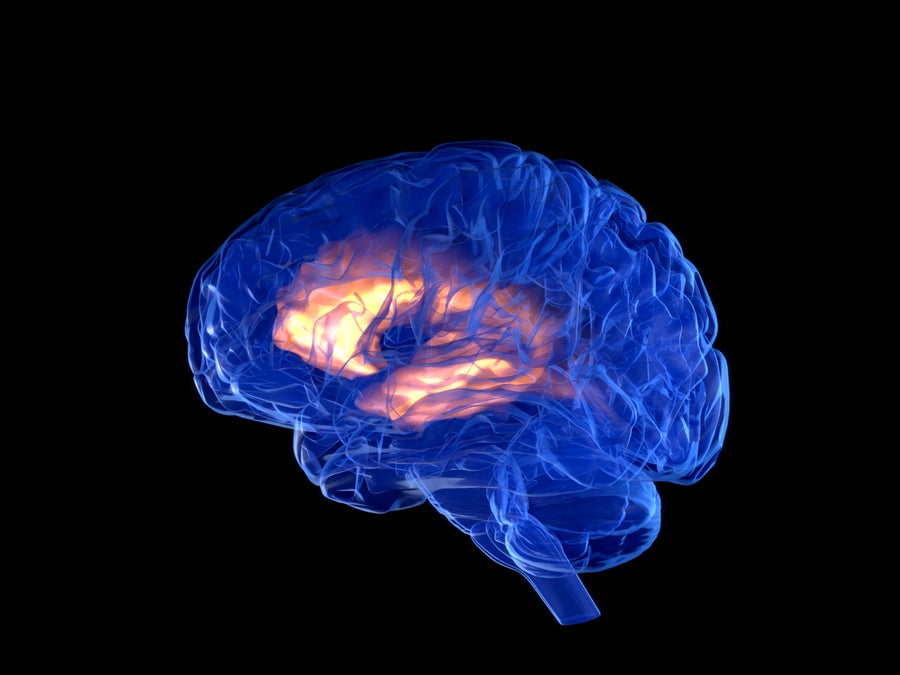
https://static.scientificamerican.com/dam/m/7f040a2d62846a0a/original/Human-brain-illustration.jpg?m=1773415439.828&w=900Juan Gaertner/Science Photo Library/Getty Images

.

.

Click the link below for the complete article:

https://www.scientificamerican.com/article/china-just-approved-its-first-brain-implant-for-commercial-use-a-world-first/

.

__________________________________________

The Best Family Finance Advice of All Time

Leave a comment

Click the link below the picture

.

The best family finance advice

Be open about money.

“It’s super important for partners to be honest with each other and share everything about their finances. A lot of couples have one personality who is more financially aware and one who is happy to let the other person take care of everything. But that can get dangerous when there is a death, disability, or divorce. The person who didn’t do much financially may not even know what they own or where their assets are. I handle most of the investment decisions in my marriage, while my husband handles the bills, but we do an ‘audit’ once a year, where we review everything and make sure we both can log in to all our accounts. So, neither of us is living blindly, and we know how to do something the other does, if we need to.”

Don’t keep your children’s inheritance a secret.

“You shouldn’t be a lottery to your kids. It’s good for your children or heirs to know what money they’re going to get from you. One of the worst things you can do to a young or middle-aged adult is to have them wonder what they’re going to receive, because then they can’t do their own financial planning.”

Give with a warm hand (part one).

“With people living close to 100 years these days, it might not be the best practice to wait until death to leave an inheritance to your kids, who may be in their seventies and retired at that point. Maybe the best thing you could do for your children and grandchildren is to give some of that money to the parents when that baby’s first born. Then the parents have more resources to either get good day care or go to part-time work themselves to be able to invest more in these little ones when they really need it.”

Explain your financial choices.

“Growing up, we didn’t talk about money in our household. If there was enough money, our parents didn’t talk about it. If there wasn’t, they would fuss and argue. With my own children, who are 11 and 15, I do the opposite; we talk about money in age-appropriate ways so they understand how and why we choose to spend our money. We almost never go out to eat, for example, so we can spend our money on travel and education, which are our priorities.”

Give with a warm hand (part two).

“There’s always this kind of fantasy that you’re going to leave equity in your home to your children, but it is often worth a lot less than you think it is because it hasn’t been maintained, it’s filled with your crap. Your kids would likely rather have had the cash earlier or the financial foresight into how to manage that cash than any kind of surprise lump sum.

So consider inter vivos transfers, which means gifting assets while you’re alive. Work with an adviser to find out how much you can give them now during your lifetime, while also making sure that you have enough for yourself. The other reason your children will like that, besides being able to plan more rationally, is that they’ll know you’ll be OK.”

Talk to your kids about money.

“My dad was very open about money. He felt the best thing you can do is teach your kids about money so that they understand it is a tool. He wanted us to learn how to earn, save, and share money, but also to know how to enjoy spending. He explained life insurance to me as a 10-year-old (in an age-appropriate way.) He taught me to not spend money in the dark, so to not waste money on things like fees or fines. But more importantly, he would tell me: ‘Just because you avoid the conversation, doesn’t mean you’re avoiding the problem.’ I’ve tried to carry on that approach with my own children. I did taxes with them, had them fill out their federal student aid applications next to me as teenagers. We talk about Roth contributions, what sneakers they’re buying.”

Let your kids know pertinent details about your finances.

“We know that most financial predation happens within families, so you can imagine a mother or father not wanting to discuss anything about their finances with their children. But if those are the same people you’re planning to leave money to, then you should want to do it in an orderly way. So tell them where important documents are, what your plan is, but don’t hand over the account number. It’s probably best if you don’t ever hand over finances to a family member, but pay a professional to do it. Most children don’t have the financial education to do so and don’t want the added stress.”

Consider a college’s ROI.

“People have started revolting against college for a lot of good reasons. A four-year degree, it turns out, is not what all people need in order to do really well in their careers. And many would be financially better off not going to a four-year college and avoiding taking on life-changing levels of debt.

Families and students really need to be thoughtful about what kind of education is needed and what kind of debt you’ll accumulate getting a degree. For some jobs, like engineers, lawyers or doctors, it is likely still worth the investment. But for many other jobs, it could not be. And it can be really hard to pay back some of those loans when you’re on a social worker’s or teacher’s wages.”

Don’t pick a college based on reputation alone.

“This idea that you have to go to the best college you get into is not great advice anymore. I think students and parents have to look at college as a value proposition. My younger cousin got accepted into Harvard University, but she took a full ride offer from the University of Delaware instead. Then she was able to use the money her mother had saved in a 529 account as a down payment on a fixer-upper home.”

The best advice for young people

Don’t make things too complicated.

“Don’t worry about money so much, and keep things simple: Stay out of debt. Do what’s right instead of what’s easy. Always put people first before money.”

Start small, but start now.

“Saving small amounts, as early as possible, compounds in wonderful ways. It’s not about the amount; it’s that you actually do it. When I graduated from Princeton in 1991, every single person was asked to give $19.91 to the university. They were teaching us to be givers. It’s a brilliant concept, and I wish everyone would do that with their 401(k) plan. Start with even small amounts and, over a lifetime, that can get very big, very fast.”

Understand the true secret to wealth.

“When we are young, we really don’t understand the power of compounding. Warren Buffett, at 95, has seen his entire net worth double over the last seven or eight years. That’s really astonishing when you think about it. And compounding doesn’t just work with money. It works with habits, with health, with networking, with collaboration. It’s not just about your portfolio.”

Take the slow road.

“There is a narrative right now that young people are completely screwed and that in order for them to catch up, they need to take speculative bets, like getting into prediction markets. True, life costs more now than 20 or 30 years ago. But if you consistently save and invest, you will get where you need to be financially—maybe a little bit slower than your predecessors 30 years ago, but you can still live a pretty comfortable life. The prediction market is essentially just gambling. It’s possible to have a nice life without having to take on that kind of risk.”

Save early and often

“Open a savings account early, and make savings a habit, even if the amounts saved are tiny. My father opened a savings account for me when I was little and doubled any money I placed in it. My mother said, ‘Spend money, but don’t waste it.’ I did the same for my two daughters.”

Save early and often

“Open a savings account early, and make savings a habit, even if the amounts saved are tiny. My father opened a savings account for me when I was little and doubled any money I placed in it. My mother said, ‘Spend money, but don’t waste it.’ I did the same for my two daughters.”

Put money in stocks ASAP.

“I should have started investing in stocks much earlier than I did. Even when I became a financial planner, at first I was only paying my bills and investing very little. I’m 64 now, so if I had started investing in the stock market sooner, I could have been the Mexican Warren Buffett.

Don’t wait to save until you make more money.

“Your financial goals don’t have to wait until you’re out of debt or make more money. You can start to act on them as soon as you earn that first paycheck, even if you have student loans or credit card debt. You may not be able to go full speed at the moment, but you can begin to plant seeds and educate yourself. Your financial goals matter because you matter, and the best time to start working toward them is today.”

Live it up a little.

“Have more fun. Yes, focus on your savings and investment rate, but there are certain things you can only do in your twenties. Do them now!”

.

Multi Generation Family Sitting On Sofa With Newborn Baby Smiling.(Image credit: Getty Images)

.

.

Click the link below for the complete article:

https://www.kiplinger.com/personal-finance/family-savings/the-best-family-finance-advice-of-all-time

.

__________________________________________

Family Outing in West Bank Ends in Hail of Israeli Gunfire

2 Comments

Hmmmm … War is evil!

Click the link below the picture

.

Ali Bani Odeh’s wife and four young boys hadn’t seen him in a month and a half when he came home to Tammun, in the West Bank, from his construction job in Israel late on Friday to spend the last few days of Ramadan with his family.

On Saturday night, the boys persuaded him to take them out for a drive. Eid al-Fitr, the end of Ramadan, was coming, so there were new clothes to buy. The day’s fast had been broken, so there were sweets to be had, too.

They picked up fried doughnut holes in Tubas, saving them for later, but the clothing shop they went to in Nablus was closed. It was already past midnight, so they headed back to Tammun: Khaled, 11, the oldest, in the back with Mustafa, 8, and Muhammad, 5. Othman, 6, blind and incapable of walking or feeding himself, was in his mother’s lap in front.

As they rounded a corner slowly, a few minutes from home, young Khaled and Mustafa recounted on Sunday, their mother, Waad, 35, asked her husband to pull over and take Othman from her so she could get something from her bag on the floor. Suddenly, the boys said, they saw laser pointers shining on their family from every direction, heard their mother scream, heard their father say “God is great” — and then heard a deafening fusillade of gunfire.

The Israeli police and military, in a joint statement Sunday morning, said that border police officers and soldiers, while on a mission in Tammun to arrest suspected terrorists, had “sensed danger” after a vehicle “accelerated towards” them and “responded by shooting.” They said the circumstances of the episode were being investigated.

The two accounts could not have been more contradictory. But one fact was undisputed: Mr. Bani Odeh, 37, his wife, Othman, and Muhammad were all shot and killed.

The Israeli-occupied West Bank is under siege as it has not been in years, with extremist Israeli settlers terrorizing Palestinian villagers on hillsides and in valleys where they live near one another. The body count is rapidly piling up: Seven Palestinians have been killed so far this year, all but one of those since the war with Iran began on Feb. 28.

The Israeli military, which is the governing authority in the West Bank, has condemned settler violence and insists that it is working to prevent it. The Israeli police, who are responsible for investigating crime committed by Israelis in the West Bank, say they act against any violence, but have largely failed in bringing violent settlers to justice.

But Tammun is deep inside the territory governed and policed by the Palestinian Authority, far from the friction with settlers. And Mr. Bani Odeh believed that, even if he encountered Israeli soldiers, he had little to fear, according to his father, Khaled Sayl Bani Odeh, 65. He knew he posed no threat, and believed that if stopped, he could talk his way out of any trouble — in fluent Hebrew — thanks to his experience working inside Israel.

On Saturday, Ali Bani Odeh was reluctant to take the boys on an outing, his father said. He was tired and wanted to rest. But the boys were restless, and he gave in.

Muhammad, the youngest, usually stayed with his grandparents because he was hyperactive, according to the elder Khaled Bani Odeh. “I was trying to tell him not to go,” he said at the family’s wake on Sunday afternoon. “But his grandmother said, ‘It’s not far, let him go.’”

Little Muhammad asked his grandfather to fix his hair and give him some of his cologne. “I did, and he set off,” Mr. Bani Odeh said.

Later Saturday night, as the grandfather was watching soccer on television, he said, his wife prodded him to call their son and check on them.

“I said, ‘They’re in a car with the children — there’s nothing that can happen to them,’” he recalled ruefully, as dozens of men streamed into the cavernous social hall where he sat, paying their respects.

Palestinian security officials said they had been briefed by their Israeli counterparts only after the fact, and told that the Israeli police and military mission in Tammun was to arrest two youths: one suspected of making explosive devices, the other of using social media to incite violence against Israelis.

Israeli officials mentioned only people suspected of making explosive devices.

Liron Rubin, a spokesman for the border police, said that the officers and soldiers had signaled for the vehicle to stop using flashlights and laser pointers, but that it kept coming toward them.

“They’re a very professional force,” said Dean Elsdunne, another police spokesman. “If they felt their life was at risk when they’re operating there against terrorists in a very dangerous place, it’s for them to say.”

They declined to discuss other details of the case, citing the investigation underway.

Khaled and Mustafa, the surviving boys, spoke later outside the women’s wake for the family at a home uphill from the social hall. Mustafa wore a bandage across his nose, where he said he had been hit by shrapnel from a bullet.

He described trying to pull 5-year-old Muhammad toward him, to help him, but said that his brother was already dead.

Khaled, a sixth-grader, did most of the talking.

“When the shooting stopped, I opened the door and started yelling, ‘Please help me,’” he said. He said the soldiers told him to shut up, and that one pulled him out of the car by his hair. He said he had been thrown to the ground and stepped on, questioned aggressively about whether anyone else had been in the car, and beaten on the head and legs.

An Arabic-speaking soldier spoke to him kindly, calling him “Habibi,” but then kicked him repeatedly, Khaled said.

When Khaled told the soldiers that he and his brother needed a bathroom, he said, the soldiers pointed them in the direction of a Palestinian ambulance that had been waiting about 100 meters away. As they walked that way, he said, a soldier opened the door of his family’s car. Inside, he said, he saw his dead parents.

Khaled’s grandfather said he had seen his slain family members’ bodies at the hospital. His daughter-in-law had been shot multiple times in her head and chest. Young Muhammad was shot several times in the face.

His 11-year-old namesake, visibly numb, said he had found part of his little brother’s body on his shoes.

“It’s indescribable,” Khaled said. “One or two hours before, we were in Nablus. They took us to so many places. They bought us doughnuts. Then we were on our way home.”

They never got the doughnut holes out of the bag.

.

A crowd of people near a body wrapped in cloth. Several appear to be weeping, some with hands on their faces.Palestinians mourning the deaths of four members of the Odeh family in Tammun, West Bank, on Sunday. Credit…Majdi Mohammed/Associated Press

.

.

Click the link below for the complete article:

https://www.nytimes.com

.

__________________________________________

Older Entries Newer Entries

Amor Entre Estrellas

¡Bienvenido de vuelta viajero!

Heart of Loia `'.,°~

so looking to the sky ¡ will sing and from my heart to YOU ¡ bring...

Michael Ciullo

CEO and Founder of Nsight Health

MRS. T’S CORNER

https://www.tangietwoods

Nelson MCBS

Catholic News, Prayers, HD Images, Rosary, Music, Videos, Holy Mass, Homily, Saints, Lyrics, Novenas, Retreats, Talks, Devotionals and Many More

Global geopolitics

Decoding Power. Defying Narratives.

Talk Photo

A creative collaboration introducing the art of nature and nature's art.

Movie Burner Entertainment

The Home Of Entertainment News, Reviews and Reactions

Le Notti di Agarthi

Hollow Earth Society

C r i s t i a n a' s Fine Arts ⛄️

•Whenever you are confronted with an opponent, conquer him with love.(Gandhi)

TradingClubsMan

Algotrader at TRADING-CLUBS.COM

Comedy FESTIVAL

Film and Writing Festival for Comedy. Showcasing best of comedy short films at the FEEDBACK Film Festival. Plus, showcasing best of comedy novels, short stories, poems, screenplays (TV, short, feature) at the festival performed by professional actors.

Bonnywood Manor

Peace. Tranquility. Insanity.

Warum ich Rad fahre

Take a ride on the wild side

Madame-Radio

Découvre des musiques prometteuses (principalement) dans la sphère musicale française.

Ir de Compras Online

No tiene que Ser una Pesadilla.

Kana's Chronicles

Life in Kana-text (er... CONtext)

Cross-Border Currents

Tracking money, power, and meaning across borders.

Jam Writes

Where feelings meet metaphors and make questionable choices.

emotionalpeace

Finding hope and peace through writing, art, photography, and faith in Jesus.

WearingTwoGowns.COM

The Community for Wounded Healers: Former Medical Students, Disabled Nurses, and Faith-Fueled Pivots

...

love each other like you're the lyric to their music

Luca nel laboratorio di Dexter

Comprendere il mondo per cambiarlo.

Tales from a Mid-Lifer

Mid-Life Ponderings

Creative

Travel,Tourism, Life style "Now in hundreds of languages for you."

freedomdailywriting

I speak the honest truth. I share my honest opinions. I share my thoughts. A platform to grow and get surprised.

The Green Stars Project

User-generated ratings for ethical consumerism

Cherryl's Blog

Travel and Lifestyle Blog

Sogni e poesie di una donna qualunque

Questo è un piccolo angolo di poesie, canzoni, immagini, video che raccontano le nostre emozioni

My Awesome Blog

“Log your journey to success.” “Where goals turn into progress.”

pierobarbato.com

scrivo per dare forma ai silenzi e anima alle storie che il mondo dimentica.

Thinkbigwithbukonla

“Dream deeper. Believe bolder. Live transformed.”

Vichar Darshanam

Vichar, Motivation, Kadwi Baat ( विचार दर्शनम्)

Komfort bad heizung

Traum zur Realität

Chic Bites and Flights

Savor. Style. See the world.

ومضات في تطوير الذات

معا نحو النجاح

Broker True Ratings

Best Forex Broker Ratings & Reviews

Blog by ThE NoThInG DrOnEs

art, writing and music by James McFarlane and other musicians

fauxcroft

living life in conscious reality

Srikanth’s poetry

Freelance poetry writing

JupiterPlanet

Peace 🕊️ | Spiritual 🌠 | 📚 Non-fiction | Motivation🔥 | Self-Love💕