Home

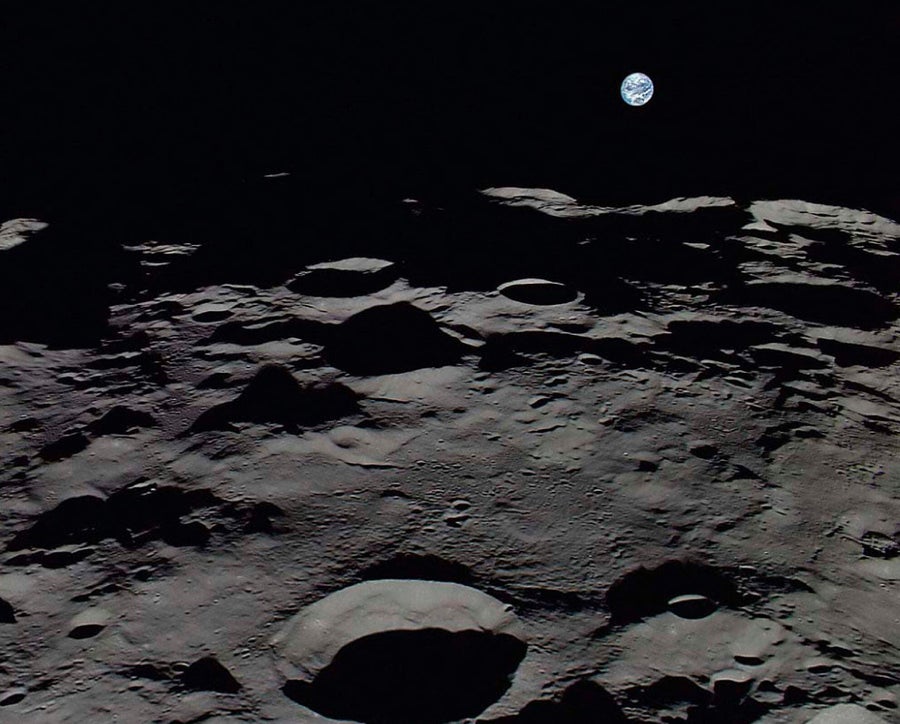
There might be less water on the moon than we’d hoped

Leave a comment

Click the link below the picture

.

When Apollo 11 astronauts returned to Earth after accomplishing history’s first-ever crewed moon landing, they brought back nearly 50 pounds of moon dust and rocks. Researchers who initially analyzed the material’s parched composition came to an important (and flawed) conclusion: the moon was bone dry.

Undeterred, in all the decades since, some scientists kept up the search for lunar water, ultimately finding traces of it in samples returned by other moon missions. Hints of a potentially revolutionary breakthrough emerged in the 1990s, when a U.S. spacecraft, Clementine, spied tentative signs of water ice at the floors of craters called permanently shadowed regions (PSRs) around the lunar south pole. The case for water in lunar PSRs has grown across the years, but scientists are still struggling to pin down just how much might be there. Now, a new study published today in Science Advances suggests the likely answer is “not much.”

Analyzing images of the moon’s darkest areas from ShadowCam, a NASA instrument on the Korea Pathfinder Lunar Orbiter, the study’s authors determined that, in most of the moon’s darkest craters, water makes up less than about 20 to 30 percent of the material by weight—and that many may have no surface ice at all.

“I think, based on what data we have now…, we are pretty sure there is ice on the surface,” says Shuai Li, lead author of the study and a planetary geologist at the University of Hawaii at Manoa. The multibillion-dollar question remains just how abundant that ice is—and thus how much future explorers might rely on it for producing potable water, manufacturing rocket fuel, or merely studying its composition to better determine how it fits into the bigger picture of H2O’s origins and evolution on the moon.

This latter matter has scarcely influenced competing Chinese and American efforts to build a moon base but could prove crucial for efforts to learn more about water’s history throughout the entire solar system. The bulk of the moon’s water was likely delivered via asteroid and comet impacts about four billion years ago, says David Kring, leader of the Center for Lunar Science & Exploration, who was not involved in the study. So tracking that water’s abundance and distribution across the lunar surface could constrain the nature and number of the water-rich projectiles that are thought to have populated the inner solar system at that time.

Whatever water ice exists in lunar PSRs wasn’t necessarily deposited there directly by infalling asteroids and comets; rather a process called “cold trapping” could have allowed ice to accumulate on dark, frigid crater floors on the moon via whiffs of impactor- or solar-wind-derived water vapor that wafted in from elsewhere. Similar processes are at play on other celestial bodies, such as Mercury and the dwarf planet Ceres. And for their new study, the researchers used preexisting measurements of water ice abundance within Mercury’s PSRs to better calibrate their analysis of ShadowCam images of lunar PSRs.

Their result, the authors say, sets an upper limit on just how much water ice exists at the surface inside the moon’s most shadowy craters. Ice signaled its presence via the scattering and reflectance of light, as seen by ShadowCam. Because the instrument, which has a detection limit of about 20 to 30 percent ice by weight, didn’t pick up on these telltale signs in most PSRs, the research team is confident that most of these regions either lack ice or have lower concentrations of it—at least on the surface. The results are somewhat ambiguous as to how much ice may lurk unseen beneath layers of overlying ice-sparse material.

So the search will continue. Li and his colleagues say the natural next step is to build and use better instruments that could identify even minuscule amounts of water ice in lunar soil. But others argue direct exploration of the treacherously dark and cold depths of lunar PSRs will offer the best chance of solving this mystery.

“Orbital measurements like those that are reported in the current paper are fabulous in that they can provide broad regional surveys, but oftentimes what you’re looking for can only be addressed by in situ, ‘boots on the ground’ exploration activities,” Kring says. “The sooner that we get robotic and human assets on the lunar surface to investigate this particular issue, the sooner we’ll have some definitive answers.”

.

https://static.scientificamerican.com/dam/m/67f3d2362218d827/original/3APCCFD.jpg?m=1773870091.945&w=900

NASA’s ShadowCam photographed some of the moon’s darkest regions, including the permanently shaded regions at the bottom of craters. JAXA/NHK/ZUMAPRESS.com/Alamy

.

.

Click the link below for the complete article:

https://www.scientificamerican.com/article/there-might-be-less-water-on-the-moon-than-wed-hoped/

.

__________________________________________

How To Help Teachers Most If You Don’t Have Time To Volunteer

Leave a comment

Click the link below the picture

.

The world needs its homeroom moms, the ones who are handing out snacks at every class party and cleaning up behind every field day. And maybe you are that parent in your heart, but your 9-to-5 means you rarely (OK, never) get the opportunity to help out during school events. You love your kid’s teacher and know they’re not getting paid the very large sum they deserve. So, how can you best support your child’s teacher if you don’t have time to volunteer during the day?

If you’re wondering, just ask. There might be opportunities outside of regular school hours to pitch in, like helping decorate for special events in the evenings or joining the PTA. Don’t assume you can’t be helpful at all just because you can’t volunteer in class to help serve Thanksgiving lunch or chaperone the zoo field trip. Even if the teacher doesn’t have any needs right now, they will remember your kindness and your offer, and they’ll probably take you up on it before long. And if you’d like some concrete ideas to work with, say no more.

Supplies are always welcome.

There’s a big influx of new supplies at the beginning of the school year and then…crickets. You can message your child’s teacher to see what they need specifically, but there are some supplies that are a forever need.

“Definitely supplies, always. Expo markers, pencils in bulk, tissues, hand sanitizer, and whatever that specific teacher uses. Also, for bigger or individual supplies, send an extra. I request scientific calculators, and sometimes kids will come in with an extra to have for the room or to give to a kid who doesn’t have one or forgot theirs. That’s the best,” says Martha O’Brien, a middle school math teacher in Virginia.

To be maximally helpful with minimal effort, you could also just set some supplies to auto-ship to your child’s teacher.

Check in to see if the teacher could use a reward for their class.

“I have a parent who emails me periodically and asks if there’s anything I want to incentivize my kids with if they’re not turning in homework and stuff, and she’ll get donuts or pizza for them, and that’s so helpful,” says Anna Morgan, an English language arts teacher in Florida.

Ask if there are tasks you can help with at home.

Especially for elementary school teachers, they may be putting together projects that require a lot of cut-outs or sorting of supplies to be handed out in packets, O’Brien says. If so, the teacher can send everything home with your child for you to cut out or put together while you binge a show after dinner. It’s a great way to volunteer some time and elbow grease in the evenings when you’re available, and free that time up for your child’s teacher to do one of the other 20 tasks on their plate.

Dedicate some time to making sure your kid is actually excited about school.

Yes, this does make a teacher’s job easier.

“The biggest help is making sure every parent is fully involved in the learning process. Also, they can be verbally encouraging to their child’s teacher and make sure their child knows school is a responsibility, but is also a fun place to be. This can be as easy as telling your child that you wish you were still able to go to school and about some positive experiences you had,” says Staci Pendry, a K-8 music teacher. “Message the teacher once every few weeks just to check in on them and say a specific thing you noticed that the teacher is doing well. That little note is worth all the volunteer hours.”

Bring in snacks. They will be put to good use.

Teachers all over Reddit say they often end up buying classroom snacks out of their own paychecks. A Costco-sized carton of Goldfish will never not be appreciated. As one middle school teacher posted, “Classroom snacks make all of the difference. I provide them to every child, every day. The kids are hungrier than they have ever been in my nearly 20 years of teaching, and inflation is making this an expensive commitment. Help a teacher get snacks for the classroom.”

Help with upkeep of special areas around campus.

If you can spend some time there on a weekend occasionally, maybe there’s an opportunity to help on the school grounds. My son’s school has chickens — does their coop need any repairs or improvements? Last year, our guidance counselor asked for donated planters and flowers to beautify the school’s entrance, and parents provided the necessary items. One Reddit poster shared that a friend of theirs “took over a school’s abandoned gardening program. He fixed up the garden and kids come once a week to learn about how plants grow. He would be tending a garden at home anyway.”

Communicate with your child’s teacher if something is wrong.

Pendry also encourages parents to check in and keep teachers up to date on what their child is saying about their school experience at home. They’re one person overseeing a classroom full of kids, but you have special insight on your own child and what happens during their day. Again, helping your child want to be at school and removing any negativity keeping them from learning is a big help to teachers.

“If anything comes up that is bothering your little one, make sure you reach out to the teacher. We know a lot, but can’t always know everything. Letting us know what’s happening is a way to help make sure your child feels safe and heard and wants to come back to school,” she says.

Attend school board meetings to advocate for funds and resources your teacher needs.

Voicing your support and showing up to evening meetings shows school board leadership what really matters to parents and teachers. You may not be able to judge the science fair during the day, but you can be vocal in your support of more funding for crucial programs in your district.

.

https://imgix.bustle.com/uploads/image/2025/7/28/23eb9b17/helpingteacher_header.jpg?w=720&h=810&fit=crop&crop=focalpoint&fp-x=0.5101&fp-y=0.463When you can’t get there during the day, but you still want to show up.

.

.

Click the link below for the complete article:

https://www.romper.com/life/how-to-help-teachers-most-if-you-dont-have-time-to-volunteer

.

__________________________________________

Trump Officials Bypass Congress to Sell Weapons to U.A.E., Kuwait and Jordan

Leave a comment

Click the link below the picture

.

The Trump administration has declared a wartime emergency to bypass Congress and push through more than $23 billion in weapons sales to allies in the Middle East, the second time since the start of the war with Iran that it has circumvented the normal congressional approval process.

Secretary of State Marco Rubio determined that “an emergency exists requiring the immediate approval of critical arms transfers for Middle East partners currently under attack by Iran,” the State Department said in a statement on Thursday.

The Trump administration first declared an emergency soon after the U.S. and Israel launched joint strikes on Iran, in order to bypass Congress on the sale of more than 20,000 bombs to Israel. The Biden administration had also twice used an emergency declaration to sell weapons to Israel, for use during the Gaza war.

Such a declaration, while permitted under the Arms Export Control Act, is used by the White House and State Department only on rare occasions to sidestep the House and Senate committees that review and approve arms transfers. Mr. Rubio’s skirting of that congressional review process twice in less than two weeks is the latest move by the Trump administration to sidestep congressional oversight of the war.

The new proposed sale to the United Arab Emirates, Kuwait, and Jordan encompasses 11 arms orders, according to the State Department. Some of the proposed sales had been under informal review by lawmakers, at least one of whom had yet to sign off. But the administration had not sent Capitol Hill even preliminary notice for a majority of the arms transfers it announced on Thursday, according to a U.S. official who spoke on the condition of anonymity to discuss sensitive arms transactions.

Asked for comment, Representative Brian Mast, Republican of Florida and the chairman of the House Foreign Affairs Committee, said Mr. Rubio had “wisely” decided to declare an emergency and go around Congress after the top Democrat on his panel, Representative Gregory W. Meeks of New York, had refused to approve some of the proposed exports.

“He alone is holding up sales of needed weapons to Israel, U.A.E., and others,” Mr. Mast said of his Democratic counterpart.

Mr. Meeks said in a statement that he supported “our partners’ ability to defend themselves,” but added: “That support does not give this administration a blank check to ignore the law or Congress.”

Senator Jeanne Shaheen of New Hampshire, who also is among those who review arms transfers as the top Democrat on the Foreign Relations Committee, said partners in the region were “bearing the brunt of the Trump administration’s poorly planned war,” and that the United States “must do what we can to defend them.”

But, she added in a statement, the State Department’s “rushed decision to use an emergency authority and bypass Congress to send them arms highlights the administration’s frantic state” and its “lack of preparation and inability to incorporate allies, partners, and Congress on the front end of major decisions like instigating a war.”

The informal review process for arms sales is a long-established norm that is the main vehicle for congressional oversight over weapons transfers. After the State Department sends a list of proposed sales to the House Foreign Affairs Committee and the Senate Foreign Relations Committee, the top lawmaker from each party on those panels reviews the proposals.

Any of those four lawmakers can ask questions of the State Department for weeks or months before deciding whether to sign off. Once the administration gets approval from all four, it gives formal notification to Congress of the sales. The law allows Congress to block the transfers if both the House and Senate push through resolutions to do so within 30 days, but that rarely happens.

For the Emirates, the export list includes Chinook helicopters, drones, Patriot missiles and air-to-air missiles, kits to convert unguided bombs to guided ones, a THAAD advanced missile defense system radar and other equipment, an anti-drone system and F-16 fighter jet upgrades and munitions, according to a breakdown obtained by The New York Times that was more complete than the public announcements from the State Department.

Kuwait would purchase billions of dollars of air and missile defense equipment, and for Jordan, there are F-16 fighter jet upgrades.

In 2019, the Trump administration declared a similar emergency with Iran to fast-track the sale of over $8 billion in munitions to the U.A.E. and Saudi Arabia, prompting an investigation by the State Department’s inspector general. Congress passed bipartisan resolutions to block the sales, but Mr. Trump vetoed the measures.

Several Senate Democrats have said they plan to force a similar vote next week on resolutions of disapproval for the weapons sales to Israel for which the State Department bypassed Congress in the early days of the war. Democrats have in the past split on votes to block arms to Israel.

“I would hope that my colleagues understand that it is absurd providing some 20,000 more bombs to Israel to continue the incredible destruction” in Iran and Lebanon, said Senator Bernie Sanders of Vermont, an independent who caucuses with the Democrats and is spearheading the measures.

More on the Fighting in the Middle East


  • Attacks on Energy Fields: Israel launched a major attack on an Iranian gas field this week, prompting retaliation by Iran against Gulf States. President Trump’s attempt to distance his administration from the strike underscored the diverging aims of the United States and Israel as their war against Iran grinds on.

  • Diary of War: In an online journal, the 44-year-old son of Iran’s president offers a mix of personal anecdotes and glimpses behind the scenes as Iranian leaders are picked off one after another.

  • Marking Nowruz During A War: As the Iranian new year begins, those in the country are reckoning with bombardment, repression, and economic misery. And the holiday has brought complicated feelings for some Iranians in New York who are fearful for their relatives in Iran.

  • Muted Eid Celebration: For Lebanese families displaced by Israeli airstrikes, the joy that usually marks the end of Ramadan has been replaced by uncertainty and hardship.

  • Saudi’s Response to Iran: Prince Faisal bin Farhan, the foreign minister, said Saudi Arabia was prepared to take military action if necessary, after waves of missile and drone attacks.

  • Energy Infrastructure: Attacks on oil and natural gas facilities could make it much harder for Persian Gulf countries to rebuild and restart production when the war eventually ends.

  • In One Image: Near the center of Beirut, a photo of a Lebanese cafe captures the aftermath of an Israeli strike.

.

https://static01.nyt.com/images/2026/03/19/multimedia/19israel-iran-arms-sales-vmcb/19israel-iran-arms-sales-vmcb-jumbo.jpg?quality=75&auto=webp

Secretary of State Marco Rubio determined that “an emergency exists that requires the immediate sale” of weapons to the United Arab Emirates, Kuwait, and Jordan, according to his department. Credit…Eric Lee for The New York Times

.

.

Click the link below for the complete article:

https://www.nytimes.com/2026/03/20/us/politics/wartime-emergency-congress-weapons.html

.

__________________________________________

This overlooked organ may be more vital for longevity than scientists realized

2 Comments

Click the link below the picture

.

As far as organs go, the thymus is underrated. This little-known gland sits inside the chest next to the heart and the lungs. And while we typically retain it into adulthood, it is most active before and during puberty. At that time, the thymus is largely responsible for developing T cells, a critical type of white blood cell that help to fight infections. Its role in adults, however, has largely been overlooked for years, in part because it shrinks (and is replaced with fat tissue) as we age—a signal scientists had interpreted as meaning it was less relevant.

But now a pair of new studies suggest the organ may be far more important for our long-term well-being than we thought. The findings jibe with an emerging consensus that the immune system plays a major role in how well we age.

In one study published on Wednesday in the journal Nature, researchers used artificial intelligence to analyze around 27,000 patient computed tomography (CT) scans and medical records to reveal that the health of the thymus may be linked to whether an individual develops cardiovascular disease or lung cancer, or dies from any cause.

The finding is in an important “puzzle piece” for understanding long-term health, says the study’s senior author, Hugo Aerts, a researcher at Mass General Brigham and a professor at Harvard Medical School and Maastricht University in the Netherlands.

The AI analysis found “enormous variation” in the health of the thymus between individual people, Aerts says. “In some people, it stayed very active until a very old age. And [in] other people, it actually declined very rapidly at a younger age.”

Importantly, thymus health correlated with a person’s overall health. People who had a healthy thymus tended to live longer and were less likely to develop lung cancer or cardiovascular disease—even after accounting for factors such as what someone’s age or sex was and whether they smoked—than people with a less healthy thymus.

And in a related study also published in Nature on Wednesday, Aerts and his colleagues found that, among cancer patients receiving immunotherapy, those who had a healthier thymus tended to have better treatment outcomes.

“What these two studies show is that almost this forgotten organ, the thymus, may actually play a very central role in our health throughout life,” Aerts says.

“Increasingly, different lines of research are converging on the idea that immune competence—particularly T-cell-mediated immunity—is a central determinant of healthy aging,” says María Mittelbrunn, an immunologist at the Spanish Research Council and a visiting professor at Columbia University. Previous research has shown that patients who had their thymus removed experienced worse health outcomes years later, for example.

The research isn’t conclusive, however. The studies identify a correlation between the thymus and long-term health outcomes—but not a causal effect. It’s possible that the thymus could be “acting as a proxy for overall physiological health,” Mittelbrunn says, rather than determining it.

Patients included in the new research who had better thymus health also tended to have lower inflammation. “This could suggest that what is really being captured is a broader state of low inflammation and better global organ function rather than a thymus-specific effect,” Mittelbrunn says. It’s also possible other organs could show a similar trend, she adds.

What remains “compelling” is the message that “a well-functioning immune system is likely one of the most impactful factors in maintaining health,” Mittelbrunn says.

Aerts says more research is needed to fully understand how thymus health affects longevity. But the studies offer “new knowledge,” he says, and send a signal that the thymus deserves more attention and research.

“It’s like, ‘Hey, this organ—we should not forget about it,’” he says.

.

https://static.scientificamerican.com/dam/m/62b2e3c385e44afe/original/thymus.jpg?m=1773870201.478&w=900

An illustration of the thymus. janulla/Getty Images

.

.

Click the link below for the complete article:

https://www.scientificamerican.com/article/this-overlooked-organ-may-be-more-vital-for-longevity-than-scientists/

.

__________________________________________

Visiting “Mystic Outlands” Is 2026’s Most Escapist Travel Trend

Leave a comment

Click the link below the picture

.

I’ve always had a thing about fog. If the morning sky is cloaked in mist, I’m happy as a clam. It’s a condition I’ve been afflicted with my entire life (and one that’s procured quite a bit of teasing over the years), but there’s something about the mysterious nature of it all that improves my mood and boosts my creativity. As you might imagine, when murmurings of 2026’s “mystic outlands” trend began bubbling up, I felt as though I had met my people. If this is the first you’re hearing of it, allow me to show you the ropes: this trend was coined by Pinterest Predicts and centers on millennial and boomer travelers seeking out “distant ruins swallowed by mist, naturally-occurring spirals, and moody, enchanting forests.” More or less: Scottish Highlands vibes.

But digging a bit deeper into the psychology behind why travelers might be seeking out so-called mystical destinations, I’d argue it’s less about the aesthetic and more about the transformation. The metaphorical mist, if you will. “A few defining elements tend to surface,” says Scott Dunn’s Simon Hunt. “A palpable sense of energy tied to the land, ancient rituals and living traditions, otherworldly landscapes, and experiences that invite reflection.” Operating within those parameters, the mystic outlands trend extends to some of the world’s most mesmerizing corners.

“These journeys often take place in rare or remote environments where silence, scale, or isolation heighten awareness, and where…time-honored traditions invite reflection rather than spectacle,” explains Timbuktu’s founder and CEO Johnny Prince. This brings up a key point: while notions of moody forests and mysterious spirals might suggest a solo journey, a mystical travel experience is about connecting to the human experience. A “renewed perspective on how others live, believe, and find meaning in the world,” as Prince puts it.

Keeping this in mind, continue ahead for mind-bending travel destinations—some covered in mist, yes, others of the metaphorical variety. From the haunting coastline of Namibia to off-road adventures in Iceland, let the 13 trips ahead inform your next adventure.

The coastal deserts of Namibia are as perplexing to the eye as they are stirring to the soul. “The country offers landscapes like nowhere else on earth,” says Jennifer Morris of Abercrombie & Kent. The Skeleton Coast is a remote stretch in Northern Namibia named for its shipwrecks and whale skeletons, but it’s the intense fog and mesmerizing convergence of desert sand and Atlantic Ocean that truly renders it a mystical destination. Further inland and to the south, Wolwedans Boulders Camp sits atop an island of granite and sandy plains found within a private nature reserve deep in the desert. “[Come for] the dark sky reserve, incredible wilderness, and peace,” says Prince.

Mongolia is the second most sparsely populated territory in the world, which makes a journey to its vast wilderness feel especially compelling. When contemplating why the country is imbued with mysticism, Abercrombie & Kent’s Paul Medley points to a few traits: wide-open spaces, nomadic culture, wind across the steppes, soaring mountains, fossils, and dunes. As one Vogue writer observes, Mongolia is “still relatively untouched by modern life,” and adventures are untamed—epic horse rides through the Gobi Desert, trekking to Buddhist temples in the mountains, and meditative hikes around the crystal blue Ugii Lake are all on the table.

Rising 348 meters above the Northern Australian desert plain, Uluru is a massive sandstone monolith—the largest in the world—formed around 550 million years old. The Uluru–Kata Tjuṯa National Park (a UNESCO World Heritage site) includes the monolith itself and rock domes to the west, and is a sacred place to the Aṉangu people, who are among the world’s oldest living cultures. A visit to this mystical outback is, as Medley puts it, otherworldly. An Aṉangu-led tour of ancient caves reveals creation stories (or ‘Dreamtime’), and a moonlit supper in a safari-style camp offers the chance to soak in the learnings from the day.

You haven’t seen Iceland until you’ve experienced a Super Jeep adventure into the heart of its most mystical landscapes. With these heavily modified 4×4 vehicles, you can access the country’s most rugged and remote terrain, including glaciers and lava fields. Zip around hidden gems like Landmannalaugar’s steaming hot springs, brave river crossings to witness the towering Haifoss waterfall, and bask in the freedom to explore at your own pace. Or, if you prefer not to drive yourself, Black Tomato’s epic Iceland itinerary takes travelers into the Thórsmörk valley to traverse lush gorges and three glaciers (complete with a picnic in the wild), wrapping up the day at the turf-covered houses at Torfhús Retreat.

As one of the world’s earliest Christian nations, Ethiopia makes for quite the enigmatic travel destination. “The religion was established here as early as the 4th century,” Prince says, “and the Ethiopian Orthodox Church remains deeply woven into daily life.” The community is guided by a liturgical calendar, which Prince explains makes every day feel like a sacred moment. There are several festivals throughout the year, including Timket (Epiphany) in January (“the most vibrant and visually spectacular”), Meskel in September, and the spiritual observances of Fasika (Easter) and Genna, among others. “Adding to its distinct cultural rhythm, Ethiopia also follows its own calendar and marks the New Year on September 11th, underscoring the country’s unique spiritual and historical identity,” Prince adds.

The very mention of Japan tends to conjure images of misty forests and snow-capped mountains, usually with a remote Shinto shrine or Buddhist temple tucked into the landscape. Those mountains, in particular, offer travelers an ideal setting for a mystic-inflected journey. “Imagine spending the night in a traditional temple lodging alongside Buddhist monks, waking before dawn to witness their chanting and morning rituals, practicing calligraphy and hand-copying sacred sutras, and walking through a lantern-lit cemetery where great Buddhist spirits are still believed to reside,” Prince says of a visit to Mount Koya. “This is a transformative experience in Japan.” Then there’s Mount Fuji, the country’s most famous peak. “The view from the summit is among the most extraordinary in the world,” Prince says, “To stand atop an active volcano, above the clouds, as the sun rises, is a profoundly transformative experience.

”The Scottish Highlands are like a central hub for the mystic traveler: mysteriously deep lochs, rolling peaks cloaked in fog, and vast moors painted in heather’s signature mauve hue. Naturally, this is prime road trip country. A driving itinerary in this region of the country can include a bit of everything—castle ruins, local cuisine, and the famous Highland cows, of course. As for accommodations, only a stay at The Fife Arms will do. This art-filled hotel is, as Vogue’s senior lifestyle editor describes, “the full-blown, old-school Highlands fantasy.

”With its expansive jungles, ancient rituals, and extraordinary biodiversity, Hunt points to the Amazon rainforest in Peru and Ecuador as a quintessential mystical experience.“It’s guided by the ancestral wisdom of Indigenous communities whose spiritual practices are inseparable from the land,” he says. By learning how local communities live in harmony with the rainforest, travelers come away from the journey with a “profound sense of connection, healing, and transformation.” If you’re interested in a multi-day retreat, head for Korimana in Ecuador’s primary cloud forest of La Maná. “Korimana stands at the confluence of two extraordinary forces: the crystalline aquifers of Cotopaxi—Ecuador’s most revered snow-capped volcano—and the magnetic resonance of Quilotoa, a once-mighty volcano that collapsed into itself thousands of years ago,” explains Abercrombie & Kent’s Adam Fogg.

You shouldn’t travel somewhere just for the photo, but what a photo do the Uyuni salt flats make. This 10-billion-ton salt reserve—the world’s largest—spans over four thousand square miles and was formed by dried prehistoric lakes. During the rainy season of November to March, it transforms into a gargantuan reflective mirror. “Bolivia’s Salar de Uyuni brings new meaning to the idea of mystical travel,” says Hunt, sharing that the destination offers some of the clearest skies on earth. “Visitors can get up close with the Milky Way, planets, moon craters, Saturn’s rings, and other celestial wonders, while ancient cosmologies that connect earth and sky add a layer of spiritual resonance,” he says.

“India is always at the top of my list for travelers seeking depth and meaning,” explains Lili LeBaron of Scott Dunn. The massive country is an epicenter for spirituality, but Varanasi along the Ganges is perhaps the most frequently cited destination for a transformative experience. “Visitors can witness daily rituals that have been practiced for thousands of years, creating an incredibly powerful and emotional experience,” LeBaron says. One such ritual is the Aarti ceremony, which Abercrombie & Kent’s Jennifer Morris explains is a ceremonial expression of deep love. “India allows you to reflect on your own day-to-day and be more curious and mindful towards other people, cultures, and food,” Morris says.

Bali’s reputation as a spiritual epicenter is no secret, but beyond the well-known areas of Ubud and Uluwatu, there’s plenty of room to experience the island’s unique Balinese Hindu traditions in a remote setting. “In places like Munduk [to the north] and East Bali, temple ceremonies and water blessings are a natural part of daily life, offering travelers authentic experiences that connect them to the culture,” says LeBaron.

Sacred water springs, solstice ceremonies, and full-moon gatherings—that’s common fare for the vibrant Pagan community in Glastonbury. This small English town in Somerset is perhaps better known for its namesake music festival (which actually takes place on a dairy farm in the village over), but for the mystics among us, it’’s ground zero for practitioners like druids and Wiccans. Visitors to the region who are staying at The Newt in Somerset can sign up for a tour with a local mystic who leads the group in a circle casting ceremony before trekking up the Tor (a striking conical hill) to reach St. Michael’s Tower. For a ‘misty’ mix of Arthurian legends and Pagan mysticism, a visit to Glastonbury won’t disappoint.

You probably know it as Easter Island, but locally, this volcanic island goes by Rapa Nui. It’s famous, of course, for the majestic stone statues called moai, which represent ancestral figures from the region’s Polynesian culture and are best explored with a local guide who can share the legends behind them. Beyond archaeology, outdoor adventure is everywhere: hike one of the island’s three volcanoes, scuba dive off the coastline, or ride horseback along hidden trails. Remote and mysterious, Rapa Nui continues to awe visitors who wonder how its earliest navigators found this isolated corner of the Pacific.

.

https://assets.vogue.com/photos/699471a9d3ae360f336bb6d1/master/w_1600,c_limit/1175952862Photo: Getty Images

.

.

Click the link below for the complete article:

https://www.vogue.com/article/mystic-outlands-travel-trend

.

__________________________________________

Israeli Officials Said U.S. Was Told About South Pars Attack

Leave a comment

Click the link below the picture

.

An Israeli strike on Iran’s South Pars gas field was coordinated with the Trump administration in advance, according to three Israeli officials, despite President Trump’s initial assertion in a social media post that the United States “knew nothing about” it.

“The United States knew nothing about this particular attack,” Mr. Trump wrote in the social media post late Wednesday, saying that Israel had “violently lashed out.”

A day later, Mr. Trump appeared to have changed course.

Speaking to reporters Thursday at the White House, Mr. Trump implied that he had spoken about the strike ahead of time with Prime Minister Benjamin Netanyahu of Israel.

“I told him, don’t do that,” Mr. Trump said. He went on to say, “we’re independent. We get along great. It’s coordinated.”

Israel has not commented publicly on the attack, carried out on Wednesday, or on Mr. Trump’s effort later Wednesday to distance the United States from it.

Three Israeli officials briefed on the South Pars strike said on Thursday that the United States was informed before the attack. They spoke on the condition of anonymity because of the sensitive diplomacy.

Mr. Trump added in his social media post that Qatar, a U.S. ally, “was in no way, shape or form, involved with it,” nor “had any idea that it was going to happen.”

The South Pars gas field is shared between Qatar and Iran. Hours after Wednesday’s attack on South Pars, natural gas facilities in Qatar were hit by strikes. Qatar blamed Iran.

The attacks were the latest in a series of escalating strikes on energy infrastructure that have sent global oil and gas prices soaring. South Pars is part of the largest gas field in the world. Qatar is the world’s third-largest exporter of liquefied natural gas.

The war began on Feb. 28 when Israel and the United States jointly attacked Iran.

Israeli analysts said the strike on South Pars may have been intended to warn Iran to stop effectively blocking the Strait of Hormuz, a major transit route for global oil. Since Iran uses most of its natural gas domestically, the strike could have been meant to signal to the regime that Israel could do much more to disable Iran than it has so far.

“The strike attempted to send a broad signal to whoever is in charge in Iran — and that is very unclear — that Israel can paralyze the whole electricity network in the country,” said Ehud Yaari, an Israel-based fellow of the Washington Institute for Near East Policy.

“If you stop the electricity supply,” he said, “in many ways you stop the country.”

Mr. Yaari added that the coordination between the United States and Israel was so close and coordinated over the course of this war that it was implausible Israel would carry out such a strike without Washington being informed beforehand.

Mr. Trump said in his post a “relatively small section” of the facility had been hit. He said that “NO MORE ATTACKS WILL BE MADE BY ISRAEL” on the South Pars field.

But, he added, if Iran was to “unwisely” attack Qatar’s natural gas facilities again, the United States would “massively blow up” the entire South Pars gas field “with or without the help or consent of Israel.” Iran vowed to retaliate for the Israeli strike on South Pars, saying it would attack oil and gas targets throughout the Gulf.

On Thursday, an Iranian military spokesman, Ebrahim Zolfaghari, said Iran had struck energy facilities “considered part of U.S. interests.”

In a statement published by state media, he warned that if Iran’s energy sites were targeted again, retaliatory strikes would continue until the “complete destruction” of the energy infrastructure of the United States and its allies in the region. He did not specifically refer to the South Pars strike.

Israel insists that it is aligned with Washington on all targets in the war that the two countries are jointly waging against Iran.

More on the Fighting in the Middle East


  • Attacks on Energy Fields: Iran and Qatar accused Israel of attacking the Iranian part of a giant offshore natural gas field that the two countries share, sending the prices of oil and natural gas soaring and worsening a dire energy crisis in Iran. President Trump said the United States was not involved, even as he threatened to destroy it.

  • Iran’s Residents: Iran has imposed a near-total internet blockade for most Iranians, according to watchdog groups, as the regime tries to suppress communication. For many Iranians living under relentless airstrikes, each day has brought a new level of anger and fear.

  • U.S. Intelligence: Top U.S. intelligence officials directly contradicted one of the Trump administration’s justifications for going to war, repeating the intelligence community’s conclusion that Iran was years away from developing missiles capable of hitting the United States.

  • Palestinians Killed: At least three were killed in the West Bank during an Iranian missile attack, Palestinian officials said. Israel blamed an Iranian missile, while Palestinians said the deaths were caused by an errant Israeli aerial defense interceptor.

  • A Familiar Pattern: Iran’s military retaliation, along with the political defiance of its new leaders, evokes a decades-old pattern of unrealized goals for American interventions in the region.

  • In One Image: Near the center of Beirut, a photo of a Lebanese cafe captures the aftermath of an Israeli strike.

.

https://static01.nyt.com/images/2026/03/19/multimedia/19israel-iran-response-jfcb/19israel-iran-response-jfcb-jumbo.jpg?quality=75&auto=webpRefineries at the South Pars gas field in 2019. Credit…Vahid Salemi/Associated Press

.

.

Click the link below for the complete article:

https://www.nytimes.com

.

__________________________________________

NASA’s Perseverance Mars rover discovers even older lost rivers at Jezero Crater

Leave a comment

Click the link below the picture

.

The latest evidence that Mars was once a warmer, wetter world comes from a surprising place—the hidden subsurface depths of Jezero Crater—rather than its surface, which NASA’s Perseverance rover has explored for the past five years. The site of a vast, dried-up lake, Jezero also hosts ancient river deltas. Laid down by flowing water as early as 3.7 billion years ago, these deltas are so sprawling that they can be seen from orbit. Now, however, Perseverance’s ground-penetrating radar has found signs of an even older river-and-delta system at Jezero that is buried deep beneath the surface.

Published today in the journal Science Advances, the findings suggest the Red Planet’s window of habitability stretches even further back in time than many scientists had imagined.

“It extends the window of fluvial deposition on Mars,” says Emily Cardarelli, a scientist at the University of California, Los Angeles, and the study’s lead author. “On Earth, those conditions produce minerals that can preserve fossils.

Jezero is the crash site of an asteroid that slammed into Mars’s surface almost four billion years ago. NASA chose it as Perseverance’s exploration zone because it has a wealth of fluvial features that hint that the crater was once ripe for life—and for preserving life’s telltale traces in stone. The new study relies on data from 78 traverses of the area from September 2023 to February 2024.

The rover used its radar capabilities to study layers of sediment buried more than 35 meters below ground—nearly twice as deep as it had previously probed—where it registered echoes of even older river-carved slopes and sinuous, meandering channels. These subsurface features, the researchers say, formed as early as 4.2 billion years ago, hundreds of millions of years before the water-washed terrain that Perseverance has been studying on the surface. That means there were multiple sustained periods of water flow in the crater’s history—multiple opportunities scattered across Jezero’s deep past in which it might have harbored life.

The result also reinforces that Mars is now a planet that is almost frozen in time, with lands that are far more undisturbed than any on Earth. “The fact that we have this record of this age is remarkable,” Cardarelli says. On Earth, rocks of a similar age lost any clear signature of ancient rivers long ago. “They’ve been heated, they’ve been squished, and they’ve been altered by water,” she says. “They’ve had a rough time.

With this more intact geological record, astrobiologists hope Mars can yield not only the first-ever smoking-gun proof of extraterrestrial life but also clearer data on how that life emerged in the first place. This question, it turns out, could be of equal importance for understanding life’s origins on Earth as well: circumstantial evidence suggests that ancient asteroid impacts much like the one that carved out Jezero Crater could have also exported any early Martian life to our own world.

The newfound buried river delta “is very clear evidence for a long duration of activity,” says Jack Mustard, a planetary scientist at Brown University, who has extensively studied Jezero Crater. “And that’s very exciting to have,” Mustard says the distinct delta beneath the soil isn’t surprising because sporadic periods of flow are common in the formation of rivers and lakes. “If you were to ask someone how the Mississippi Delta formed,” he says, “you would see multiple episodes of overlapping deltas.”

Cardarelli says that we haven’t heard the last about Jezero from Perseverance. “There’s a lot more to say about this particular area—and other areas within the crater,” she says. “We’re still digesting all our data.”

.

https://static.scientificamerican.com/dam/m/710053839c59a280/original/jezerocrater-cropped.jpg?m=1773854031.932&w=900

Jezero Crater is a hot spot for scientists seeking evidence of past life on Mars, thanks to this site’s ancient river deltas that could contain preserved biosignatures. NASA/JPL/JHUAPL/MSSS/Brown University

.

.

Click the link below for the complete article:

https://www.scientificamerican.com/article/nasas-perseverance-mars-rover-discovers-even-older-lost-rivers-at-jezero/

.

__________________________________________

Republican leaders reject demands for public hearings on Trump’s war with Iran

Leave a comment

Click the link below the picture

.

As the Iran war stretches into its third week, Democrats say they’re done with all of the classified briefings from top administration officials.

They now want public hearings into whether President Donald Trump plans to put U.S. boots on the ground in Iran, secure nuclear material there, and how he plans to end the deadly conflict in the Middle East.

Few Republicans agree such hearings are needed. House Speaker Mike Johnson, R-La., went even further, suggesting that public hearings would compromise the operation in Iran.

Sen. Tim Kaine, D-Va. who has led unsuccessful efforts to pass war powers resolutions to rein in Trump’s military operations, said that Trump “hasn’t given a rationale that’s convincing for this. … We have now said we’re tired of the classified briefings. We’re tired of hiding this from the public.”

“When you keep something in secret, there’s a reason you keep it in secret because you don’t believe it will stand analysis in the light of day,” he said.

Sen. Chris Murphy, D-Conn., a member of the Foreign Relations Committee, agreed. “If this administration thinks it can defend this war — I don’t know how it can — then it should send Pete Hegseth and Marco Rubio to the Senate next week for a hearing in front of the relevant committees,” Murphy said of Trump’s secretaries of Defense and State.

If Republicans ignore their demands, Murphy and Kaine said, Democrats will force more votes on Trump’s war powers, putting more political pressure on the GOP.

“I think they’ll lose votes in the Senate if they actually have to go in front of the American public and explain why gas prices are so high, explain whether we’re engaged in regime change or whether we’re not, explain how they’re going to get the nuclear weapons and the nuclear material without the ground invasion,” Murphy said. “I don’t think they have answers for any of that.”

There’s confusion on and off Capitol Hill about Trump’s strategy with Iran. Who exactly will seize Iran’s nuclear materials? Does the president want regime change? And how does he intend to end Iran’s blockade of the Strait of Hormuz, which is causing oil prices to climb?

Just this week, NATO allies and other nations rejected Trump’s pleas to help pressure Iran to end its blockade of the key waterway. The president then wrote: “WE DO NOT NEED THE HELP OF ANYONE!”

One key Republican, Sen. Lindsey Graham of South Carolina, who had been privately and publicly urging Trump to strike Iran this year, said he believes Republicans should hold public hearings at the “appropriate” time.

“I think we need to. I think we need to showcase what we did and why we did it, but we’re in the middle of doing it,” said Graham, who is running for re-election this year. “But it’s very important for me to tell people back home, Americans over there have to be over there to prevent the Ayatollah from getting a nuclear weapon.”

Sen. Mike Rounds, R-S.D., a member of Armed Services, said he has no objection to doing public hearings, “but I still want my classifieds.”

And retiring Sen. Thom Tillis, R-N.C., conceded that hearings will happen “at some point” because “we have to learn from our successes; we have to learn from any mistakes.”

.

https://media-cldnry.s-nbcnews.com/image/upload/t_fit-1000w,f_auto,q_auto:best/rockcms/2026-03/260317-Mike-Johnson-aa-300-59d1f9.jpgHouse Speaker Mike Johnson, R-La., said public hearings “would adversely affect our mission.”Anna Moneymaker / Getty Images

.

.

Click the link below for the complete article:

https://www.nbcnews.com/politics/congress/republican-leaders-reject-demands-public-hearings-trumps-war-iran-rcna263956

.

__________________________________________

Trump Promised the ‘World’s Lowest’ Drug Prices. We Checked the Numbers.

Leave a comment

Click the link below the picture

.

President Trump and top federal health officials have repeatedly claimed that their new website, TrumpRx, offers Americans the world’s lowest prices on prescription drugs.

“I took prescription drugs, a very big part of health care, from the highest price in the entire world to the lowest,” Mr. Trump said during his State of the Union address last month.

That is not true, according to a review by The New York Times and the German news organizations Süddeutsche Zeitung, NDR, and WDR.

The drugs listed on TrumpRx can cost American patients up to hundreds or thousands of dollars, while a patient walking into a German pharmacy pays next to nothing. The German health system foots the bill, and records show that, more often than not, it pays less than what the Trump administration negotiated for Americans.

The TrumpRx website shows the prices that the administration negotiated for a few dozen of the several thousand prescription medications in the United States. The list includes almost none of the most widely used drugs, like statins, or ultra-expensive drugs like cancer therapies.

Some well-known drugs on the list are Xeljanz, for autoimmune conditions, and Farxiga, for diabetes and heart and kidney problems. Both are cheaper in Germany, a rare example of a country that makes its negotiated drug prices public.

The biggest names on TrumpRx are two blockbuster weight-loss drugs — Wegovy and Zepbound. Both are available for lower out-of-pocket prices at pharmacies in wealthy countries around the world. In some cases, Americans pay about twice as much as patients overseas.

Higher price for Wegovy on TrumpRx

How much patients pay out of pocket at a pharmacy, without using insurance, for a four-week supply of a medium dose (one milligram) of Wegovy, Novo Nordisk’s injection for weight loss.

Some countries, like Germany, mandate the same prices at every pharmacy. In the other countries, some pharmacies may charge more or less than the price in the chart.

Source: Prices at local pharmacies.

Rebecca Robbins/The New York Times

The review by The Times and its German partners is an assessment of one of Mr. Trump’s signature domestic issues. With gas prices rising because of the unpopular war in Iran, the president is counting on his drug policy to resonate with voters who are concerned about affordability. Mr. Trump has repeatedly claimed that this policy alone should be enough to carry Republicans to victory in November’s midterm elections.

Our analysis shows that with some drugs, Mr. Trump appears to have modestly narrowed the gap between European and U.S. prices. But the gap persists, and the reality does not match his hyperbole. That is particularly true for patent-protected drugs, which consistently were cheaper in Germany.

White House officials and pharmaceutical companies contested our findings. They argued that the gap disappears after adjusting for the economic conditions in every country. That means that TrumpRx prices can count as cheaper, even when the price is higher.

The administration did not provide enough detail about how it ran those numbers for that claim to be checked. We examined raw numbers, comparing prices in U.S. dollars.

“By any objective measure, no president has accomplished what President Trump has in the past year alone to lower prescription drug prices for American patients,” Kush Desai, a White House spokesman, said.

Mr. Trump has long complained that Americans pay too much for medicines while Europeans pay too little. The president diagnosed a real disparity: Brand-name drugs in the United States have been shown to be three times as expensive, on average, as those in other wealthy nations.

.

https://static01.nyt.com/images/2026/03/18/multimedia/18int-drug-prices-01-tkfl/18int-drug-prices-01-tkfl-jumbo.jpg?quality=75&auto=webpPresident Trump unveiled the TrumpRx website last month. Visitors to the site are greeted by a promise: “Find the world’s lowest prices on prescription drugs.” Credit…Kenny Holston/The New York Times

.

.

Click the link below for the complete article:

https://www.nytimes.com

.

__________________________________________

Brain implant allows people who are paralyzed to type using their thoughts at speed of texting

Leave a comment

Click the link below the picture

.

For people with near-total paralysis, the ability to communicate easily in real time is a challenge. For years, scientists have been working to remedy that by developing devices that can decode brain signals and translate them into computer cursor movements or text.

These devices are a type of brain-computer interface, or BCI, and they consist of electrode chips that are implanted inside the brain to listen to and decode the electrical whispers of neurons. In the past, BCIs allowed people to type using a virtual keyboard, but the speed was frustratingly slow. Now, however, a team of scientists report that their BCI keyboard helped two people with paralysis type at speeds of up to 22 words per minute—nearly as fast as the average person can text using a smartphone. The findings were published today in Nature Neuroscience.

“This is an important technical advance that brings brain-computer typing much closer to practical communication speeds for people with paralysis,” says Edward Chang, a professor of neurological surgery at the University of California, San Francisco, who was not involved in the study.

“At about 22 words per minute, this is among the fastest motor-cortex typing BCIs yet and dramatically faster than most earlier neural spellers,” says Chang, who has worked on another speech-decoding BCI.

BCI technology has advanced significantly since its genesis in the 1960s, when researchers began using single electrodes implanted in the brains of monkeys to record their neural activity. In 2006, a consortium of researchers called BrainGate reported that a BCI allowed people with paralysis to control a computer cursor and operate a prosthetic hand. In recent years, the BrainGate BCI was used to control a virtual keyboard with a cursor and to decode letters from handwriting areas of the brain. Other groups’ BCIs have decoded words or short phrases directly from speech-related brain regions, too.

Previous versions of these brain-typing systems required participants to control a cursor on a screen and individually select letters, “which is far slower than being able to access any key at any time using your fingers,” says lead study author Justin Jude, a postdoctoral researcher at BrainGate, based at Brown University, and an appointed research fellow at Massachusetts General Hospital and Harvard Medical School.

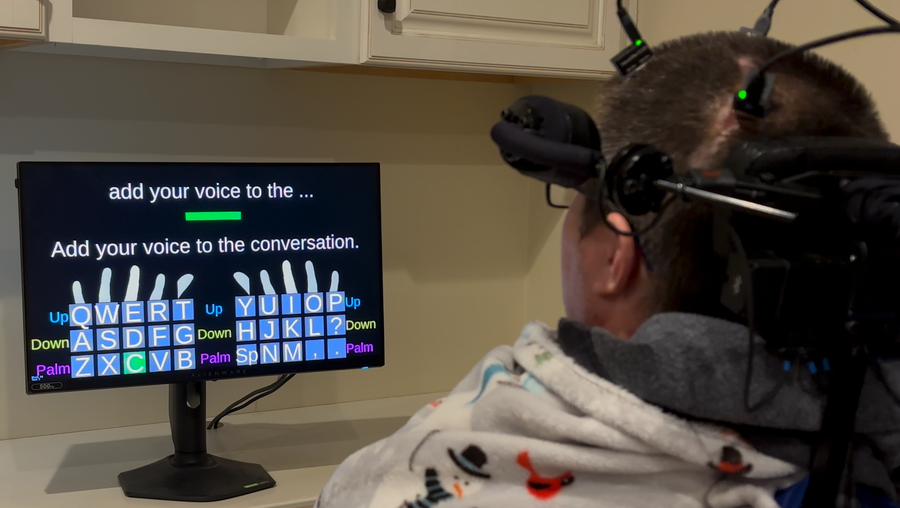
In the new paper, Jude and his colleagues trained their BCI using artificial intelligence to recognize intended hand or finger movements from a part of the brain’s movement area, called the precentral gyrus, as participants tried to move their paralyzed hands or fingers. The AI model predicted the letters on a QWERTY keyboard that the movements most likely corresponded to. They tested their system in two participants: one person with amyotrophic lateral sclerosis, a progressive neurological disease that causes paralysis, and one with a spinal cord injury that left them paralyzed but still able to speak.

Using the device, the latter participant was able to type at 110 characters or 22 words per minute, with a word error rate of 1.6 percent. The other participant’s typing was slower but still impressive for someone who lacked the ability to speak. By comparison, several years ago, the BrainGate handwriting BCI achieved speeds of 90 characters per minute (about 18 words per minute). Another previous BCI that was implanted in a speech-related brain region by Chang and his colleagues was used to achieve a typing speed of 78 words per minute, but the median word error rate was far higher—25 percent.

“One of the things that we talk about a lot is the speed of communication. The reason we do that is not just to have a faster system than someone else,” says Daniel Rubin, a critical care neurologist at Massachusetts General Hospital and an assistant professor of neurology at Harvard Medical School, who was a co-author of the new study.

People who have lost the ability to speak and to use their hands might be able to employ an eye-tracking system to type, but this method is slow. “Communication speed matters, because being part of a conversation matters,” Rubin says.

The researchers say the QWERTY keyboard system is more successful than the version that decoded mental handwriting. It remains to be seen, however, whether decoding from brain regions that control finger movement or from speech-related regions is a better strategy overall, Chang says. Signals in the brain’s motor cortex are easier to decode, but those in speech-related areas might be faster and more direct.

The technology is not ready for widespread use yet; the study was small, and the device requires brain surgery, which carries risks. “The biggest limitations are the small number of participants and the need for invasive intracortical implants,” Chang says.

Another limitation is the need to calibrate the BCI each time before it can used. “It’s almost like a musical instrument, and you have to tune it each day,” Rubin says. Having an instrument that can tune itself is a big goal for the field, he says.

Several companies are developing commercial BCIs, primarily for use in people who are paralyzed. Perhaps the most hyped has been Elon Musk’s Neuralink, but there are others, such as Paradromics and Synchron. (Some of the study authors consult for these companies and receive research funding from them.)

China recently approved the first invasive BCI for use in people with a form of partial paralysis. No such devices have been approved by the Food and Drug Administration for use by people with paralysis in the U.S.

.

https://static.scientificamerican.com/dam/m/2527f52d78b90cdb/original/braingate.png?m=1773681632.425&w=900

A BrainGate participant types using a brain implant. BrainGate Consortium

.

.

Click the link below for the complete article:

https://www.scientificamerican.com/article/brain-implant-allows-people-who-are-paralyzed-to-type-using-their-thoughts/

.

__________________________________________

Older Entries

Amor Entre Estrellas

¡Bienvenido de vuelta viajero!

Heart of Loia `'.,°~

so looking to the sky ¡ will sing and from my heart to YOU ¡ bring...

Michael Ciullo

CEO and Founder of Nsight Health

MRS. T’S CORNER

https://www.tangietwoods

Nelson MCBS

Catholic News, Prayers, HD Images, Rosary, Music, Videos, Holy Mass, Homily, Saints, Lyrics, Novenas, Retreats, Talks, Devotionals and Many More

Global geopolitics

Decoding Power. Defying Narratives.

Talk Photo

A creative collaboration introducing the art of nature and nature's art.

Movie Burner Entertainment

The Home Of Entertainment News, Reviews and Reactions

Le Notti di Agarthi

Hollow Earth Society

C r i s t i a n a' s Fine Arts ⛄️

•Whenever you are confronted with an opponent, conquer him with love.(Gandhi)

TradingClubsMan

Algotrader at TRADING-CLUBS.COM

Comedy FESTIVAL

Film and Writing Festival for Comedy. Showcasing best of comedy short films at the FEEDBACK Film Festival. Plus, showcasing best of comedy novels, short stories, poems, screenplays (TV, short, feature) at the festival performed by professional actors.

Bonnywood Manor

Peace. Tranquility. Insanity.

Warum ich Rad fahre

Take a ride on the wild side

Madame-Radio

Découvre des musiques prometteuses (principalement) dans la sphère musicale française.

Ir de Compras Online

No tiene que Ser una Pesadilla.

Kana's Chronicles

Life in Kana-text (er... CONtext)

Cross-Border Currents

Tracking money, power, and meaning across borders.

Jam Writes

Where feelings meet metaphors and make questionable choices.

emotionalpeace

Finding hope and peace through writing, art, photography, and faith in Jesus.

WearingTwoGowns.COM

The Community for Wounded Healers: Former Medical Students, Disabled Nurses, and Faith-Fueled Pivots

...

love each other like you're the lyric to their music

Luca nel laboratorio di Dexter

Comprendere il mondo per cambiarlo.

Tales from a Mid-Lifer

Mid-Life Ponderings

Creative

Travel,Tourism, Life style "Now in hundreds of languages for you."

freedomdailywriting

I speak the honest truth. I share my honest opinions. I share my thoughts. A platform to grow and get surprised.

The Green Stars Project

User-generated ratings for ethical consumerism

Cherryl's Blog

Travel and Lifestyle Blog

Sogni e poesie di una donna qualunque

Questo è un piccolo angolo di poesie, canzoni, immagini, video che raccontano le nostre emozioni

My Awesome Blog

“Log your journey to success.” “Where goals turn into progress.”

pierobarbato.com

scrivo per dare forma ai silenzi e anima alle storie che il mondo dimentica.

Thinkbigwithbukonla

“Dream deeper. Believe bolder. Live transformed.”

Vichar Darshanam

Vichar, Motivation, Kadwi Baat ( विचार दर्शनम्)

Komfort bad heizung

Traum zur Realität

Chic Bites and Flights

Savor. Style. See the world.

ومضات في تطوير الذات

معا نحو النجاح

Broker True Ratings

Best Forex Broker Ratings & Reviews

Blog by ThE NoThInG DrOnEs

art, writing and music by James McFarlane and other musicians

fauxcroft

living life in conscious reality

Srikanth’s poetry

Freelance poetry writing

JupiterPlanet

Peace 🕊️ | Spiritual 🌠 | 📚 Non-fiction | Motivation🔥 | Self-Love💕