Online opinion polling and data analytics company Civiqs has polled more than 30,000 US citizens on how they think President Donald J. Trump is faring in his job during his second term as POTUS. Specifically, the question put to the cross-section of America was, ‘do you approve or disapprove of the way Donald Trump is handling his job as president?’ The results show that Trump’s approval ratings remained mostly steady across the country this past week, though a few states saw some notable shifts. Overall, 54% of those polled currently disapprove of Trump’s presidency, while 43% approve, and 3% neither approve not disapprove (Pictures: Getty Images)
Many in the world woke to the news on 22 June that the United States had bombed nuclear sites in Iran, with the goal of destroying the nation’s ability to produce nuclear weapons. The raids targeted Iran’s uranium-enrichment facilities in Fordow and Natanz, and its nuclear research centre in Isfahan, using stealth bombers to drop massive ‘bunker-busters’, and cruise missiles.
Although Iran says its nuclear programme is for peaceful purposes, experts have long assessed that Iran was close to having the capability of building nuclear weapons if it chose to do so. The US attacks followed a bombing campaign by Israel, which has since carried out further attacks on Iranian nuclear facilities. On 23 June, the International Atomic Energy Agency reported that “very significant damage is expected to have occurred” at the underground Fordow site.
Researchers at academic institutions and think tanks are also assessing the potential impacts of the attacks on Iran’s nuclear capabilities. Analysts have said that the attacks probably set the nuclear programme back substantially, but not permanently. In particular, Iran could have moved stockpiles of highly-enriched uranium, and perhaps some enrichment centrifuges, elsewhere. David Albright, a nuclear policy specialist and president of the Institute for Science and International Security in Washington DC, spoke to Nature about what researchers know.
How do you assess the impact of the bombings on Iran’s nuclear capabilities?
There aren’t many researchers who are able to assess the impact of the bombings. We have decades of experience with the Iranian nuclear programme, so we know their facilities and activities very well. And we have great access to satellite imagery — which we have to buy. We try to buy some every day. And we utilize analysts who have decades of experience to analyze these images. We also have lots of contacts with governments, and we have colleagues who also have contacts with governments.
A lot of the damage is on the surface, so it’s a question of knowing what the building did [in terms of its role in the nuclear program]. We rely on our repository of information about the sites that are attacked. So it’s pretty straightforward.
Obviously, more problematic is the underground sites. When we initially assessed Israel’s bombing of Natanz, three days later I saw a very small crater above the underground hall. I could work out and link it to a type of Earth-penetrator weapon that Israel is known to have. It would leave a really small crater when it went in, and the damage would be underground. The United States bombed it with a much more powerful Earth penetrator. So damage is probably more extensive.
How and when will we know for sure the extent of the damage?
As nuclear experts, we’d like to see this done with diplomatic agreements, where Iran would allow intrusive inspections into its programme. If that does not happen, then it’s the job of US and Israeli intelligence to assess the damage. They’re looking at communications intercepts, or trying to recruit people on the inside to reveal information.
Would there be radioactive materials detected outside Natanz, Esfahan and Fordow if the attacks were successful?
So far, the IAEA reports no such leaks. And it appears that Iran had moved the enriched uranium stockpiles in the days before the bombings. The United States has said that the target of its bombings was the facilities, so they understand they are not getting at the nuclear material.
Can shockwaves damage enrichment facilities even without a direct hit?
Shockwaves can cause a lot of damage. They will push against the centrifuges, and if they’re spinning, it can cause the rotor inside to crash against the wall. It’s anyone’s guess how much is destroyed without additional information. But the idea of the US bombing was that Israel may not have done enough damage.
.
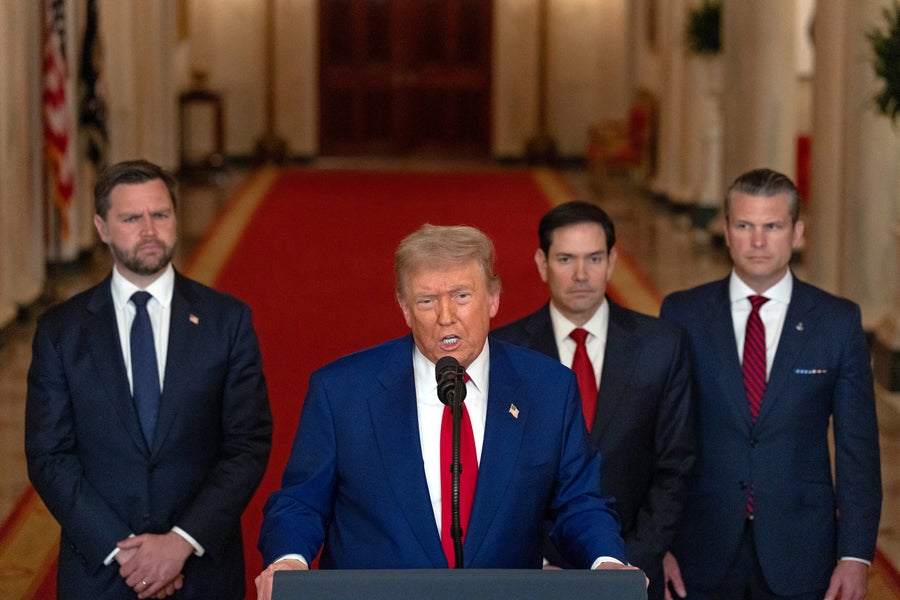
U.S. President Donald Trump with members of his cabinet following strikes on Iran. Carlos Barria/Pool/AFP via Getty
Hackers backing Tehran have targeted U.S. banks, defense contractors and oil industry companies following American strikes on Iranian nuclear facilities—but so far have not caused widespread disruptions to critical infrastructure or the economy.
But that could change if the ceasefire between Iran and Israel collapses or if independent hacking groups supporting Iran make good on promises to wage their own digital conflict against the U.S., analysts and cyber experts say.
The U.S. strikes could even prompt Iran, Russia, China, and North Korea to double down on investments in cyberwarfare, according to Arnie Bellini, a tech entrepreneur and investor.
Bellini noted that hacking operations are much cheaper than bullets, planes or nuclear arms—what defense analysts call kinetic warfare. America may be militarily dominant, he said, but its reliance on digital technology poses a vulnerability.
“We just showed the world: You don’t want to mess with us kinetically,” said Bellini, CEO of Bellini Capital. “But we are wide open digitally. We are like Swiss cheese.”
Hackers have hit banks and defense contractors
Two pro-Palestinian hacking groups claimed they targeted more than a dozen aviation firms, banks and oil companies following the U.S. strikes over the weekend.
The hackers detailed their work in a post on the Telegram messaging service and urged other hackers to follow their lead, according to researchers at the SITE Intelligence Group, which tracks the groups’ activity.
The attacks were denial-of-service attacks, in which a hacker tries to disrupt a website or online network.
“We increase attacks from today,” one of the hacker groups, known as Mysterious Team, posted Monday.
Federal authorities say they are on guard for additional attempts by hackers to penetrate U.S. networks.
The Department of Homeland Security issued a public bulletin Sunday warning of increased Iranian cyber threats. The Cybersecurity and Infrastructure Security Agency issued a statement Tuesday urging
organizations that operate critical infrastructure like water systems, pipelines or power plants to stay vigilant.
While it lacks the technical abilities of China or Russia, Iran has long been known as a “chaos agent” when it comes to using cyberattacks to steal secrets, score political points or frighten opponents.
Cyberattacks mounted by Iran’s government may end if the ceasefire holds and Tehran looks to avoid another confrontation with the U.S. But hacker groups could still retaliate on Iran’s behalf.
In some cases, these groups have ties to military or intelligence agencies. In other cases, they act entirely independently. More than 60 such groups have been identified by researchers at the security firm Trustwave.
These hackers can inflict significant economic and psychological blows. Following Hamas’ Oct. 7, 2023, attack on Israel, for instance, hackers penetrated an emergency alert app used by some Israelis and directed it to inform users that a nuclear missile was incoming.
“It causes an immediate psychological impact,” said Ziv Mador, vice president of security research at Trustwave’s SpiderLabs, which tracks cyberthreats.
Economic disruption, confusion and fear are all the goals of such operations, said Mador, who is based in Israel. “We saw the same thing in Russia-Ukraine.”
Collecting intelligence is another aim for hackers
While Iran lacks the cyberwarfare capabilities of China or Russia, it has repeatedly tried to use its more modest operations to try to spy on foreign leaders—something national security experts predict Tehran is almost certain to try again as it seeks to suss out President Donald Trump’s next moves.
.
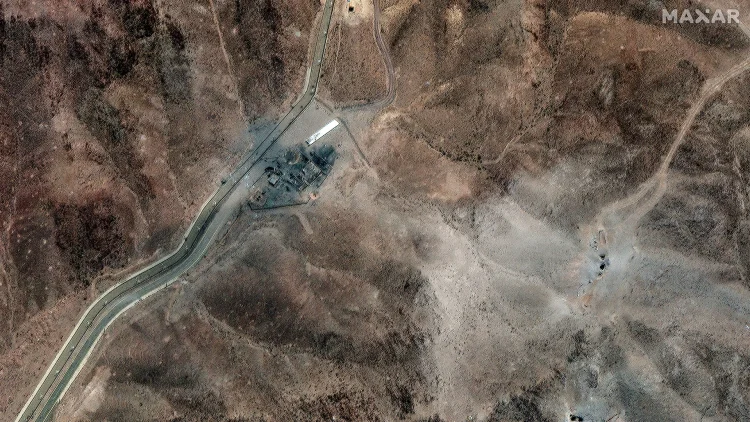
This Tuesday, June 24, 2025, satellite image provided by Maxar Technologies shows damage at Fordo enrichment facility after strikes in Iran on June 23. [Photo: Maxar Technologies via AP]
The long-awaited Vera C. Rubin Observatory, a cutting-edge new telescope perched atop a mountain in Chile, released its first images of the universe on June 23—and its views are just as jaw-dropping as scientists hoped.
The new images come from only 10 hours of observations—an eyeblink compared with the telescope’s first real work, the groundbreaking, 10-year Legacy Survey of Space and Time (LSST) project. On display are billowing gas clouds that are thousands of light-years away from our solar system and millions of sparkling galaxies—all emblematic of the cosmic riches that the observatory will ultimately reveal.
“You can see here a universe teeming with stars and galaxies,” said Željko Ivezić, an astronomer at the University of Washington and director of the Rubin Observatory, during a live event held by the observatory. “The seemingly empty, black pockets of space between stars in the night sky when you look at it with unaided eyes, are transformed here into these glittering tapestries.”
The Rubin Observatory released several videos to highlight the strengths of the new telescope, which captures images that are too enormous to meaningfully grasp with our perception, Ivezić explained. Each of them would require 400 high-definition televisions, a space the size of a basketball court, to display at full detail.
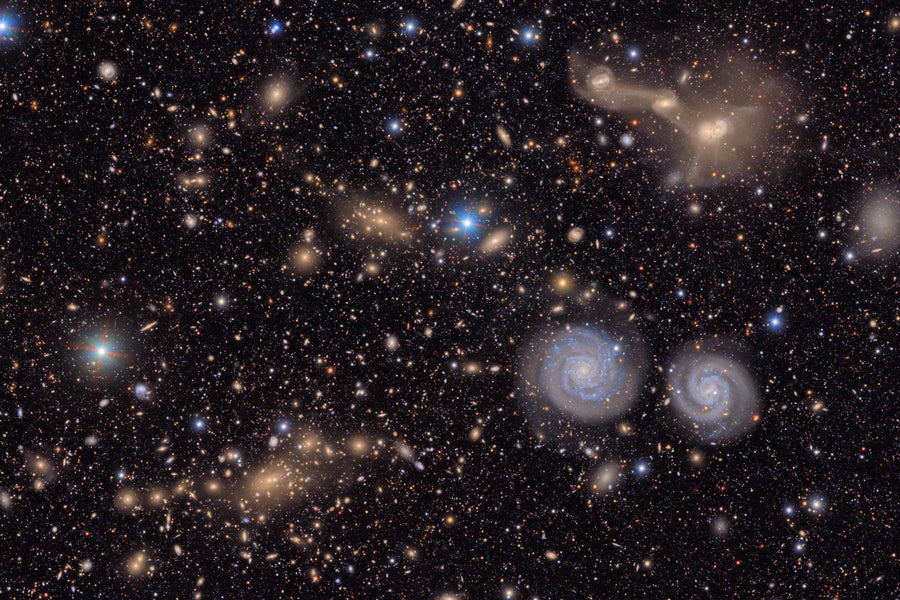
Among the sights that Rubin captured are individual detail images that show portions of the Virgo Cluster, a massive clump of galaxies located in the constellation of the same name
And the appeal of these images isn’t just aesthetic. “When I look at the images, I often don’t pay attention to the beautiful nearby galaxies; I look at the little fuzzballs,” said Aaron Roodman, a physicist at Stanford University and program lead for the Rubin Observatory’s LSST Camera, during the live event. “Many of those galaxies are five, perhaps even 10 billion light-years away and have up to 100 billion stars in them. And those are the galaxies that we use the most if we want to study the expansion of the universe and dark energy.
”Understanding dark energy—the mysterious force that propels the accelerating expansion of the universe—and the equally enigmatic dark matter, which shapes the cosmos but can’t be directly detected by scientists, represents one of the four key science pillars of the Rubin Observatory. The others include cataloging the solar system, mapping the Milky Way and exploring so-called transient phenomena that change over time.
.
A small section of the Vera C. Rubin Observatory’s total view of the Virgo Cluster shows two prominent spiral galaxies (lower right), three merging galaxies (upper right), several groups of distant galaxies, many stars in the Milky Way galaxy, and more. NSF-DOE Vera C. Rubin Observatory
Although it’s shown us the Universe as we’ve never seen it before — deeper, earlier, and at longer wavelengths — it’s important to remember that the main goals of JWST didn’t have anything to do with the quality of pictures it would acquire, but rather for the science questions that they’d reveal the answer to. One of puzzles was simple: we know that the Universe is full of stars and galaxies today, whose light we can easily see, but that early on, there were no stars and galaxies, and the Universe was instead filled with neutral atoms. How, then, did all of those neutral atoms become ionized once again, enabling us to see the Universe and all the starlight generated within it?
The simple answer, of course, would have to be stars. It must be that the Universe formed stars in sufficient numbers, eventually, to produce enough high-energy (e.g., ultraviolet) light so that all of those once-neutral atoms then became ionized, allowing starlight to pass through space unimpeded. But where were those stars located? What types of galaxies housed them? And when, exactly, did all of those stars form to drive this process, known as reionization?
The simple answer, of course, would have to be stars. It must be that the Universe formed stars in sufficient numbers, eventually, to produce enough high-energy (e.g., ultraviolet) light so that all of those once-neutral atoms then became ionized, allowing starlight to pass through space unimpeded. But where were those stars located? What types of galaxies housed them? And when, exactly, did all of those stars form to drive this process, known as reionization?
When most of us think about the distant Universe, we think about images like the one you see above: deep field images, acquired with our most powerful space telescopes, including Hubble and JWST. It appears that what we’re seeing is stars and galaxies everywhere, limited only by the amount of time we spend observing and the capabilities of our instruments. But that’s not quite true; there aren’t stars and galaxies absolutely everywhere, as even with infinite amounts of observing time, we wouldn’t see starlight coming from all regions of space.
.
This JWST field of view is focused not on galaxy cluster Abell 2744, shown here, but rather on the young, low-mass, intensely star-forming galaxies found at much greater distances behind the cluster. The cluster acts like a magnifying lens, allowing 83 young, low-mass starburst galaxies to be identified, 19 of which are shown in white diamonds here. Credit: NASA/ESA/CSA/Bezanson et al. 2024 and Wold et al. 2025
.
.
Click the link belowfor the complete article (long article):
The Vera C. Rubin Observatory released its first images, showcasing millions of galaxies. The images are also expected to reveal thousands of previously unknown space objects.
The challenge sounds unreal: How do you blast a hole through a mountain of concrete and granite and then blow up what hides beneath it―all without crossing the nuclear line? The solution is a bomb that weighs 30,000 pounds, about as much as a city bus, but that is compressed into a cylinder roughly 20 feet long and 2.5 feet thick. Since the Israel-Iran conflict broke out last week, much speculation has centered on this weapon: the GBU-57/B, the most powerful nonnuclear bomb that is capable of destroying targets deep below the earth. The question many are asking is whether the U.S.—the only country possessing the bomb—will supply it to Israel.
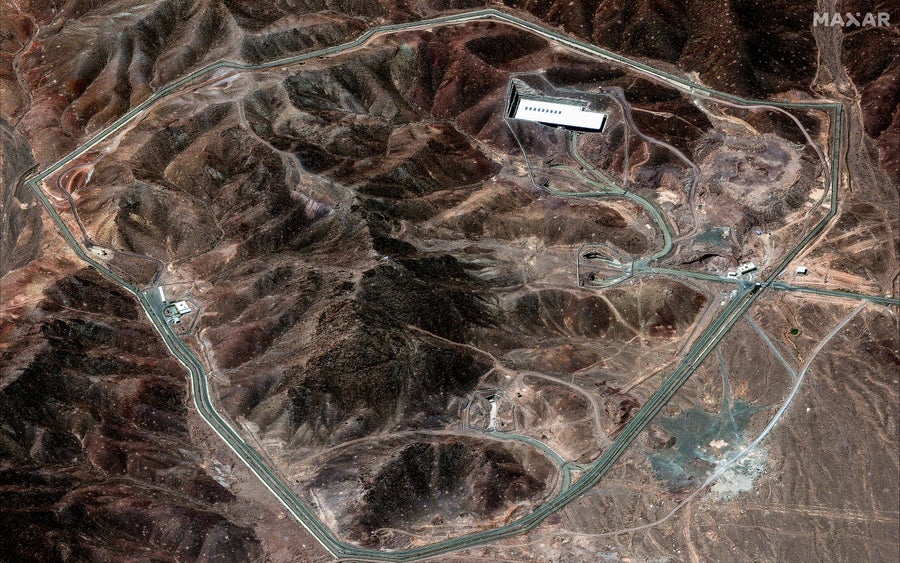
To understand what the GBU-57/B is and why Israel might want the weapon, it is important to understand the presumed target: Fordo, Iran’s most advanced nuclear enrichment facility, which lies 18 miles northeast of the central city of Qom. According to an Institute for Science and International Security report, the site has the ability to produce enough highly enriched uranium to make a nuclear warhead in the span of mere days. It is also ensconced deep beneath a mountain, under 260 to 300 feet of rock that is reinforced with concrete, and surrounded by a ring of air-defense batteries. After Israel bombed Iraq’s nuclear reactor in 1981 and Syria’s in 2007, Iran decided to spread its nuclear program out over multiple sites, with its crucial elements hidden so deep beneath the earth that not even Israel’s 5,000-pound bunker busters could reach them. Intelligence reports suggest Iran began construction in 2002, while Iran has said that work began in 2007. Tehran acknowledged the site’s existence only in September 2009.
The first three letters in GBU-57/B stand for “guided bomb unit” (a precision bomb that can home in on its target), and it’s the 57th design in the series of such bombs. The second B refers to the bomb’s iteration (designations such as A/B, B/B, C/B, and so on are used for each adjustment made by military engineers). After the U.S.’s 2003 invasion of Iraq, engineers studied bunker strikes with smaller and older GBU models and found that they hadn’t penetrated deeply enough and had done limited damage. The military required a more powerful weapon that would respect the “nuclear taboo,” a widely accepted international consensus that the use of nuclear weapons is morally abhorrent and dangerous because it creates radioactive fallout, invites escalation, and risks driving allies and neutral states into diplomatic revolt. GBU-57/B—also known as a Massive Ordnance Penetrator (MOP)—was a solution. Its Air Force fact sheet sums it up as “a weapon system designed to accomplish a difficult, complicated mission of reaching and destroying our adversaries’ weapons of mass destruction located in well protected facilities.”
When dropped from 50,000 feet, the cruising ceiling for the B-2 Spirit bomber, the GBU-57/B uses sophisticated fins to guide it to its target. While the exact impact velocity is classified, it is estimated to exceed Mach 1—the speed of sound (767 mph). This strike delivers 800 to 900 megajoules (about 758,000 to 853,000 British thermal units) of kinetic energy—comparable to a 285-ton Boeing 747-400 touching down at 170 mph or a 565-ton Amtrak Acela train moving at 120 mph. With the bomb, however, all that energy is concentrated into a tiny area. According to a 2012 Congressional Research Service briefing, the GBU-57/B has been reported to burrow through 200 feet of concrete or bedrock with a density of 5,000 pounds per square inch (comparable to the strength of bridge decks or parking-garage slabs). Then its 5,300-pound explosive charge detonates.
The GBU-57/B is designed to enhance this ability to pierce deep below the surface. Its nose has an ogive shape, like that of a Gothic arch. Just as such arches are known for distributing weight effectively, the bomb’s nose has no sharp corners that cause air drag. Then, upon impact, the rounded shape spreads the initial crushing load gradually through the bomb’s steel casing
instead of concentrating it at one brittle point. This allows the casing to remain intact as it bores into the earth. The casing also has high sectional density. In this context, sectional density refers to the ratio of an object’s mass to the size of the face that first meets whatever surface the object is moving through. A hammer striking a board has high sectional density because it concentrates its mass in a small area; a pillow does not. In the case of the bomb, a great deal of mass and momentum is packed behind a small point. Whereas the ogive nose minimizes drag and structural shock, the high sectional density concentrates velocity and force, allowing the bomb to punch deep into stone.
About one fifth of the warhead’s 5,342-pound total weight is made up of two explosives: 4,590 pounds of AFX-757 plus 752 pounds of PBXN-114. Both create a larger blast than earlier bombs while being sufficiently insensitive to survive the shock of the initial strike. The detonation itself is timed by a specialized fuse that can be programmed from within the bomber cockpit. The fuse “counts” layers of rock or concrete, “hears” the hollow of a tunnel or chamber and then fires a detonator into the smaller PBXN-114 charge so that the main charge explodes only after the bomb has bored well inside the target. The released energy is roughly equivalent to about three to four tons of TNT. But because so much of the bomb’s 30,000 pounds is hardened steel, much of its destructive effect comes from its kinetic punch, delivered at sonic speed.
Though suspected of having nuclear weapons, Israel has so far respected the nuclear taboo. To destroy Fordo without them, it would need both the GBU-57/B and a B-2 Spirit bomber, the only aircraft designed to drop the bomb (it’s capable of releasing two, one from each bay). Otherwise Israel could, in theory, only chip at Fordo’s periphery—by destroying power sources, collapsing entrances or sending saboteurs—while uranium continues to be enriched below. Fordo is so well protected that a Royal United Services Institute op-ed states that “even the GBU-57/B would likely require multiple impacts at the same aiming point to have a good chance of penetrating the facility.” Despite media claims that GBU-57/B bombs were used to strike Houthi targets in Yemen, the U.S. Air Force states that these weapons have never been used in combat and that only a few dozen are stockpiled. So far, the U.S. has refused to hand Israel any of them—or the B-2 Spirit bomber required to drop them and collapse a mountain.
.
Maxar satellite imagery overview of the Fordo enrichment facility in Iran on June 14, 2025. No visible damage is observed. Maxar Technologies/Getty Images
Hmmmmm…could Thomas Massie save the Republican party and “Make Democracy Great Again”
Click the link below the picture
.
MAGA doesn’t want him, doesn’t know him, and doesn’t respect him,” President Donald Trump wrote in a lengthy tirade against Thomas Massie, a Republican congressman from Kentucky who has criticized the President over a number of issues from war with Iran to the so-called One Big Beautiful Bill.
“He is a negative force who almost always Votes ‘NO,’ no matter how good something may be. He’s a simple minded ‘grandstander’ who thinks it’s good politics for Iran to have the highest level Nuclear weapon, while at the same time yelling ‘DEATH TO AMERICA’ at every chance they get,” Trump posted on Sunday.
He added: “MAGA should drop this pathetic LOSER, Tom Massie, like the plague!”
Massie responded with a tongue-in-cheek post on X that the President “declared so much War on me today it should require an Act of Congress.” Massie joined last week with a number of Democratic lawmakers to raise the alarm over potential U.S. military intervention in the Middle East without constitutionally-mandated congressional authorization.
While Massie won’t face a reelection contest until 2026, Trump has already unveiled a plan to challenge him and further enforce loyalty within the GOP ranks.
“The good news is that we will have a wonderful American Patriot running against him in the Republican Primary, and I’ll be out in Kentucky campaigning really hard,” Trump added, without naming a prospective primary opponent. “MAGA is not about lazy, grandstanding, nonproductive politicians, of which Thomas Massie is definitely one.”
Massie, who is known for his outspoken libertarian views, has survived primary challenges before and told Axios, which reported on the effort to oust him, that “any serious person considering running should spend money on an independent poll before letting swampy consultants take them for an embarrassing ride.”
Who is Thomas Massie?
Massie, 54, was born in West Virginia and earned bachelor’s and master’s degrees in engineering from MIT in the 1990s before turning to local politics in 2010, when he ran and won the race for Judge Executive of Lewis County, Ky., amid the Tea Party wave.
In 2012, after then-Rep. Geoff Davis announced his retirement in Kentucky’s deep-red 4th congressional district, Massie, who described himself as a “constitutional conservative,” won the Republican primary in a landslide. When Davis resigned early, Massie won the same-day special election and general election to succeed him, taking office two months earlier than his fellow freshmen representatives elected in 2012.
One of Massie’s first moves was to vote in January 2013 against party leader John Boehner for Speaker, opting instead to vote for fellow libertarian Justin Amash. (Boehner narrowly won the speakership but would go on to resign in 2015. Amash would go on to not run for reelection in 2020 and temporarily leave the Republican Party after earning Trump’s wrath for consistent criticism of the President and supporting his impeachment.)
Since then, Massie has made a name for himself by regularly voting against bills, often breaking with his caucus and sometimes siding with Democrats. In 2013, Politico dubbed him “Mr. No.”
In 2016, Massie said he would vote for Trump but do everything he could to “rein him in” if he acts unconstitutionally. In 2017, Massie tried to explain how the same movement that propelled him into office could also propel someone like Trump, telling the Washington Examiner: “All this time, I thought they were voting for libertarian Republicans. But after some soul searching I realized when they voted for Rand and Ron [Paul] and me in these primaries, they weren’t voting for libertarian ideas—they were voting for the craziest son of a b—– in the race. And Donald Trump won best in class.”
During Trump’s first term, Massie was among a small group of Republicans who joined Democrats in trying to override Trump’s veto of legislation that would block his national emergency declaration at the border in 2019. That same year, he was the sole Republican to vote against a resolution opposing the boycott, divestment, and sanctions movement targeting Israel, and he was the sole no-vote across both parties on the Hong Kong Human Rights and Democracy Act.
.
Rep. Thomas Massie (R, Ky.) speaks to reporters after a House GOP caucus meeting at the U.S. Capitol on June 4, 2025.Kevin Dietsch—Getty Images
The Mona Lisa has been the subject of awe and fascination for centuries, with experts from around the world desperate to solve the mystery behind her iconic, enigmatic smile.
Now, thanks to X-ray technology, scientists have begun to uncover the secrets of Leonardo da Vinci’s legendary portrait, and explain how he was able to create something so mind-bending with just a few strokes of a brush.
The research, published in the Journal of the American Chemical Society on Wednesday, suggests that the Italian Renaissance master may have been in a particularly inventive mood when set about crafting the piece in the early 16th century.
“He was someone who loved to experiment, and each of his paintings is completely different technically,” Victor Gonzalez, the study’s lead author, told the Associated Press..
Gonzalez, who has studied the chemical compositions of dozens of works by Leonardo and other artists, discovered that there was something special about the paint used for the Mona Lisa.
Specifically, the researchers found a rare compound, called plumbonacrite, in Leonardo’s first layer of paint.
The discovery confirmed that Leonardo most likely used lead oxide powder to thicken and help dry his paint as he began working on the portrait.
He is thought to have dried the powder, which has an orange colour, in linseed or walnut oil by heating the mixture to make a thicker, faster-drying paste.
“What you will obtain is an oil that has a very nice golden colour,” Gonzalez said. “It flows more like honey.”
Carmen Bambach, a specialist in Italian art and curator at New York’s Metropolitan Museum of Art, who was not involved in the study, called the research “very exciting”.
She emphasised that any scientifically proven new insights into Leonardo’s painting techniques are “extremely important news for the art world and our larger global society.”
Finding plumbonacrite in the Mona Lisa attests “to Leonardo’s spirit of passionate and constant experimentation as a painter—it is what renders him timeless and modern,” Bambach said.
Film and Writing Festival for Comedy. Showcasing best of comedy short films at the FEEDBACK Film Festival. Plus, showcasing best of comedy novels, short stories, poems, screenplays (TV, short, feature) at the festival performed by professional actors.





 .
.

 This JWST field of view is focused not on galaxy cluster Abell 2744, shown here, but rather on the young, low-mass, intensely star-forming galaxies found at much greater distances behind the cluster. The cluster acts like a magnifying lens, allowing 83 young, low-mass starburst galaxies to be identified, 19 of which are shown in white diamonds here.
 .
.


 Secrets revealed
 James' World 2