Home

Yemen’s Houthis Have Entered the Iran War. What You Need To Know

Leave a comment

Click the link below the picture

.

Yemen’s Houthi movement announced its entry into the Iran war by firing a barrage of ballistic missiles at southern Israel on Saturday, opening a new front in a regional conflict that President Donald Trump has said is close to ending. 

Brigadier-General Yahya Saree, a military spokesman for the Iran-allied group, said in a message broadcast on a Houthi satellite network that the attack had targeted “sensitive Israeli military sites”. 

He added that the attacks would continue “until the aggression against all fronts of the resistance ceases,” referring to Iran and its ally Hezbollah.  

The Israeli military said it identified the launch of a missile from Yemen and “intercepted the threat.”

The Houthis have repeatedly warned that they would enter the war on the side of Iran, which has supplied them with ballistic missile technology for years.   

The long-threatened entry of the group into the fray adds a new front to the regional conflict that began on Feb. 28 with a joint United States-Israeli attack on Iran that killed the country’s Supreme Leader Ali Khamenei. 

In the month since, Iran’s counterattacks have struck U.S. bases across the Gulf, strategic Gulf infrastructure, and drastically slowed shipping in the Strait of Hormuz. 

Those attacks have had a dramatic impact on global oil and energy prices, and sent gas prices in the U.S. skyrocketing.  

Another Strait   

The Houthis played a similarly outsized role in upending global shipping between November 2023 and January 2025 when they attacked over 100 merchant vessels in the Red Sea in a campaign of solidarity with Palestinians during the Gaza war. 

The group regularly launched missiles towards Israel during the same period—although most were intercepted. Israel responded with heavy airstrikes against Houthi targets in Sanaa and across the group’s territory.

Thomas Juneau, a professor at the University of Ottawa’s Graduate School of Public and International Affairs and an associate fellow with Chatham House, tells TIME that if Houthi strikes remain limited to a small number of direct attacks on Israel, “they will not have a major impact on the evolution of the war.” 

“As we saw in past rounds of strikes, Israeli anti-missile defenses are able to intercept most Houthi missiles and drones; those that succeed in evading Israeli defenses have caused limited damage,” he says. 

But if the group decides to attack shipping on the Red Sea again, that would change things. 

“The Houthis would cause a much more important impact on the war if they were to start targeting maritime shipping in the Red Sea and try to close the Bab al-Mandab Strait. This would amplify the war’s already strong impact on oil and natural gas prices and on the global economy,” he says.

Attacks on the Red Sea and the Bab al-Mandab Strait would likely disrupt traffic through the Suez Canal, through which around 15% of global maritime trade — including 30% of container ship traffic—travels each year. 

Who are the Houthis?

The Houthis are a Yemeni political and military group that emerged in the 2000s and now control much of northern Yemen. The group is named after its founder, Hussein al-Houthi, and draws from the Zaydi branch of Shiite Islam. 

Although they are backed by and allied with Iran, the Houthis are not a straightforward proxy, and they often prioritize their own domestic interests. And although Iran has supplied it with sophisticated ballistic missile technology, the group has also developed the ability to assemble and manufacture its own weaponry inside Yemen.

The group rose to prominence after capturing Sanaa in 2014. That sparked a brutal civil war against the internationally recognized government and a Saudi Arabian-led bombing campaign. The Houthis proved remarkably resilient against that air campaign, which relied on U.S. support and killed an estimated 9,000 civilians.

The group has since faced two bombing campaigns by two successive U.S. administrations.

Joe Biden, Trump’s predecessor, launched airstrikes against Yemen on January 10, 2024, “in direct response to unprecedented Houthi attacks against international maritime vessels in the Red Sea.”

Those strikes failed to deter the Houthis and only stopped when a ceasefire was brokered between Israel and Hamas in January 2025.

The Houthis resumed their attacks when Israel imposed a blockade on food and aid entering Gaza in March 2025.

Trump launched his own bombing campaign in April 2025 to stop those attacks, which ended when the Trump Administration struck a deal with the Houthis in May to end airstrikes if the group stopped attacks on shipping. The deal did not include an agreement to stop attacks against Israel, which continued until an eventual ceasefire was reached in Gaza.

After striking a truce with the Houthis, Trump said of the group: “We hit them very hard. They had a great capacity to withstand punishment.” 

You could say there’s a lot of bravery there,” he added. 

‘Outlast the war itself’

The Houthis launches come as the U.S. and Iran are reportedly engaged in indirect negotiations for the first time since the war began, and Trump’s top officials are signaling that the war may be over within weeks, despite no sign of a diplomatic breakthrough. 

Secretary of State Marco Rubio said on Friday that U.S. military operations were expected to be concluded in “weeks, not months”.

Trump has also implied that his Administration’s objectives in Iran have been achieved and signaled the war could end within the four to six-week timeline the White House initially set out.  

“We estimated it would take approximately four to six weeks to achieve our mission, and we’re way ahead of schedule,” the President said during a Cabinet meeting on Thursday.  “If you look at what we’ve done in terms of the destruction of that country, I mean, we’re way ahead.” 

uneau says that the Houthis may be able to exert some limited influence over Trump’s timeline. 

“The answer here depends on whether the Houthis further escalate or not,” he says. 

“If Houthi involvement remains limited to occasional strikes on Israel that cause little or no damage, the American calculus does not change much. If the Houthis do start attacking shipping in the Red Sea again, however, pressure on President Trump will ramp up, given that the impact on oil prices and on the global economy will be amplified.” 

“This impact, crucially, will outlast the war itself, given mounting supply chain disruptions—and could therefore hurt Republicans more as we approach the November midterm elections,” he adds.  

.
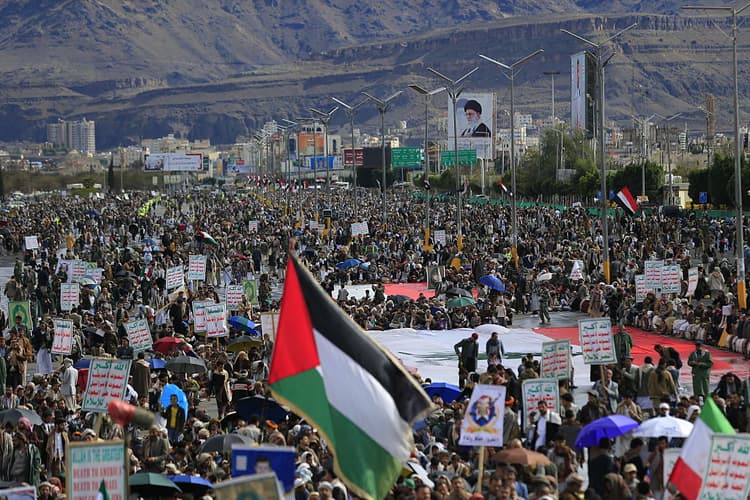
https://gcp-na-images.contentstack.com/v3/assets/bltea6093859af6183b/blt8ab3456dbe8342dc/69c826a48b4210d3fe0c3c61/GettyImages-2268081326.jpg?branch=production&width=750&quality=75&auto=webp&crop=3%3A2A Palestinian flag is raised as Houthis rally in solidarity with Iran and Lebanon, amid the US-Israeli war with Iran, in the Yemeni capital Sanaa on March 27, 2026. Mohammed Huwais—AFP via Getty Images

.

.

Click the link below for the complete article:

https://time.com/article/2026/03/28/iran-war-news-houthis-israel/

.

__________________________________________

The Iran War is Revealing the Messy Middle of Our Renewable Energy Transition

Leave a comment

Click the link below the picture

.

America’s war on Iran began with what was meant to be an intimidating performance of overwhelming air power. Quickly, it became another kind of conflict, with low-cost missiles and drones effectively neutralizing a superpower by punishing its allies and paralyzing energy flows. By the time President Trump tried to threaten Iran into reopening the Strait of Hormuz with a 48-hour ultimatum, it was clear not just that the strait had become America’s singular strategic fixation but that the whole campaign was now a war about energy, in which oil prices and gas plants had become the central theater of conflict.

With Russia’s invasion of Ukraine and the supply-chain disruptions of Covid, the war in Iran marks the third major energy shock in just a handful of years, years in which fossil loyalists argued that the green transition risked intolerable turmoil and political leaders cooled off on climate urgency in the name of “energy security.”

The world is still feeling the sting of the last shock, and the new one promises a brutal long tail, as well; the head of the International Energy Agency has called the war in Iran “the greatest global energy security threat in history.” One-fifth of the world’s liquefied natural gas flows through the Strait of Hormuz, along with perhaps one-fifth of its oil — and though the direct costs of the blockade have generated the most attention, the downstream price spikes are just as concerning. Across much of Asia and parts of Africa, fuel shortages and blackouts are likely. The world could be pulled into recession by the force of energy inflation, even if outright conflict subsides soon, and the higher costs of everything, including the inputs for semiconductors, the Financial Times has warned, might pop the A.I. bubble that is keeping the American economy afloat. A food crisis to dwarf the one that followed the invasion of Ukraine could follow, as the war disrupts not just the price of food but also the global flow of fertilizer — another product of fossil fuels — on the brink of planting season.

That so much could be pulled down the drain by a somewhat goal-less war of choice is partly a result of inept or indifferent planning. But this war is also a new kind of conflict, given shape by fossil-fuel turmoil and the uncertainty brought about by the energy transition of the last decade.

By many metrics and from many vantages, green energy has been a dizzying, ecstatic success. Renewables have grown faster than any new source of energy in history, surpassing nearly all expectations. But we are still in the middle of that transition, with the end of the old paradigm, built on oil and gas and coal, still decades away.

Climate advocates and energy analysts like to say that in the postcarbon future, the geopolitics of energy will be defanged. In the meantime, the energy transition has tightened fossil-fuel markets and concentrated fossil-fuel supply, drawing investment away from aging infrastructure. This has made energy supply somewhat more vulnerable to shock and energy infrastructure more attractive to military targeting. Even wars of choice unfold in a global context, and Iran is no different: a new age of resource conflict arising just as the old energy order was being upended, but before the new one has really taken hold.

Call it a midtransition war.

You can date the very beginning of the long green transition to the energy crises of the 1970s: Jimmy Carter slapping solar panels on the White House roof, France going all in on nuclear power, those first earnest lectures about “energy efficiency.” The price of solar panels fell 99 percent in the 50 years that followed, but global uptake was painfully incremental. It was only in the decade after the signing of the Paris Agreement in 2015 that the world really started to believe that renewables might soon dominate the energy future. Money followed, with worldwide investment in fossil fuels dropping by more than a third between 2015 and 2020 and clean-energy investment growing nearly twice as high since.

But global transformations take time, and for all the rapid green progress, we are still drawing a majority of our energy from legacy systems burning through fossil fuels.

The term “midtransition” comes from Emily Grubert, an environmental sociologist who uses it to describe just how messy decarbonization might be, even if it all goes inspiringly well. Take, just for instance, gas stations: How many of them should there be, once electric vehicles take over the roads while charging exclusively in garages and driveways, and what should we do about all the others made redundant? Or think about the electricity grid, which nearly everyone, considering the energy future now agrees must be rapidly expanded: Elsewhere in the world, users have flocked to rooftop solar to secure their own energy needs, shrinking their carbon footprints but also destabilizing the grid by depriving it of customers and revenue. What happens to the global shipping industry as the world moves away from fossil fuels, given that they account for some 40 percent of all shipping by volume? Literally: What are we supposed to do with all those tankers? This is the midtransition in energy.

There is also a midtransition in geopolitics, already underway. Look, for example, at the Arab gulf countries, petrostates that have spent the last decade channeling oil profits into Big Tech venture capital, bringing them further into alignment with the United States and Israel. Or at China, which now spends hundreds of billions on clean-energy investments abroad while maintaining a fossil-fuel partnership with Russia — and Iran.

And then there’s the midtransition in war. Though Vladimir Putin offered a mesmerizing array of justifications when he invaded Ukraine in 2022, Europe’s energy transition offered its own logic — or rather, its own timeline. The continent’s ambitious net-zero commitments meant that Europe was planning to move away from imports of gas, inevitably cutting Russia’s energy leverage over NATO. When the Nord Stream pipelines were blown up that September, it seemed so hard to understand that many assumed Russia was to blame. But even American intelligence now believes it was the Ukrainians, effectively applying the same midtransition principle in reverse: Blowing up the pipeline ensured that Ukraine’s NATO allies couldn’t make up with Russia easily and pushed Europe faster along its path of decarbonization. This used to be called ecoterrorism; now it was the strategic work of hardheaded nation states.

In Foreign Affairs last fall, Jason Bordoff and Meghan L. O’Sullivan declared “the return of the energy weapon.” For most of the modern era, they wrote, energy was a familiar tool of great power coercion. But over the last half-century, since the 1973 oil crisis, global powers had managed to mostly avoid the old conflicts and smooth out once-familiar disruptions. Citizens across the rich world were lulled into the expectation that the energy system would always work reliably for them. “Today, that complacency has been upended,” they wrote, with the global order and the energy system fragmenting at the same time. And that was before Trump ordered the kidnapping of President Nicolás Maduro of Venezuela, partly to secure a new source of oil, and before the United States stumbled into a global energy crisis by trying to bomb a petrostate into regime change. No one has ever started a war over solar panels, as any climate activist will tell you. And the economic blast radius of the Iran conflict is large enough that it’s hard to miss the argument it makes for rapid decarbonization. Why continue to rely so heavily on imports from erratic authoritarians overseas when you can instead harvest the bountiful sun, wind, hydropower, and geothermal found nearly everywhere on earth?

In a time of resource wars, you get to reap additional rewards, too. The most outspoken Western critic of the war in Iran has been Prime Minister Pedro Sánchez of Spain, a country that has doubled its renewable capacity in the last five years and cut the influence of fossil fuels on its electricity price by 75 percent. The Spanish energy transition is far from complete, but the country has already bought back the right to speak its conscience.

Not that a renewable future will be a peace-loving utopia. There are already heated trade wars over the minerals necessary for the batteries that power electric vehicles. The United States’ recent escalation with China reached its boiling point over rare-earth metals, and Trump grew thirsty for Greenland seemingly on the same basis. (As it turns out, Greenland doesn’t actually have particularly great rare-earth deposits, which aren’t all that rare anyway.) Lithium and cobalt mining are a source of intense conflict in countries from Bolivia to Congo. It’s not hard to imagine those fights spiraling out of control, with consequences all down the global supply chain.

Beyond the famous petrostates, plenty of governments across the developing world depend on tax revenue from energy companies or direct funding from state-owned fossil-fuel enterprises. That funding will dry up more quickly the faster the transition goes, leaving those states precarious and vulnerable. Anytime the world map of literal power changes, the political hierarchy shifts, too.

Then there’s the issue of water. In Iran, a six-year drought has pushed the country to the brink of what is called “water bankruptcy,” with regular supply curtailments and street protests demanding “water, electricity, life.” In December, taps in Tehran’s south began to run dry. Then came larger protests, brutal crackdown, and now war.

Already, desalination has become a miraculous lifeline in an increasingly inhospitable and unforgiving land, with parts of the Gulf drawing 90 percent of their drinking water from desalination plants. Over the last few years, the global green-energy boom has fed a dream that such free and abundant power will allow desalination to transform water-starved regions into oases. But what looks in the distance like techno-utopianism appears, in the meantime, more like a terrifying military vulnerability: Two desalination plants have already reportedly been struck — one in Iran, with the Iranians blaming the United States, and one in supposed retaliation by an Iranian drone in Bahrain.

This is all happening on a planet in the middle of its own transition, one that may well last thousands or even millions of years and to which few nations have even begun to properly adapt. In the meantime, vulnerabilities proliferate like heat.

More on the Fighting in the Middle East


  • A Toothless Iran?: A recent wave of strikes across the Middle East shows that Tehran has not lost the capacity to retaliate.

  • Global Reliance on Natural Gas: From Western Europe to East Asia, countries are scouring the globe for natural gas after the war cut off the Persian Gulf fuel that they relied on to cook dinner, heat homes, and generate electricity. The United States, as the world’s biggest gas exporter, will almost certainly benefit from this upheaval, at least in the short term.

  • Journalists Killed in Lebanon: An Israeli strike killed two prominent Lebanese television journalists and a cameraman, according to their news organizations and Lebanese officials. Israel accused one of the reporters of being a Hezbollah operative. Lebanon’s president said they were journalists and condemned the killings. The funerals drew hundreds of mourners.

  • Houthis Attack Israel: The Iran-allied rebel group in Yemen joined the widening war with an unsuccessful missile attack on Israel.

.

https://static01.nyt.com/images/2026/04/06/magazine/06mag-context-1/06mag-context-1-superJumbo.jpg?quality=75&auto=webpPhoto illustration by Chantal Jachan

.

.

Click the link below for the complete article:

https://www.nytimes.com

.

__________________________________________

An AI-authored paper just passed peer review. The scientific community isn’t ready

Leave a comment

Click the link below the picture

.

Science has always relied on a curious human’s mind forming a hypothesis, designing an experiment, analyzing the results, and presenting the case to that person’s peers. Over centuries, we’ve built better tools such as electron microscopes, particle accelerators, and supercomputers, but the core loop of scientific discovery has remained stubbornly human. Now, for the first time, that loop has started with a new kind of mind.

So far, scientists have often had artificial intelligence help them with solving a predefined, narrow task, such as folding proteins, says Jeff Clune, a professor of computer science at the University of British Columbia. “We’re saying the AI gets to be the scientist,” he says.

In a recent Nature study, Clune and his colleagues unveiled the AI Scientist, an AI system that wrote a paper without human involvement that passed peer review for a workshop at the 2025 International Conference on Learning Representations (ICLR), a top-tier venue in the field of machine learning. The paper was mediocre, according to Clune and other experts. But its existence marks a turning point that the scientific community is only beginning to grapple with: AI has quickly moved from assisting scientists to attempting to be one.

The AI Scientist comprises multiple modules. After it is given a general topic prompt by researchers, it surveys available literature and generates hypotheses. “We’re just giving it a general direction like ‘Come up with something interesting to study on how the AI learns,’” Clune explains. The system then evaluates and refines those ideas, filtering out any that are not novel. From there, further modules plan and execute experiments, analyze and plot the data, and, finally, write the paper. It even does its own internal peer review process to find flaws in its papers, Clune says. (The system relies on existing foundation models such as Anthropic’s Claude Sonnet or OpenAI’s GPT-4o; the team’s contribution is the pipeline orchestrating these models).

To see if The AI Scientist’s output could meet human standards, the team submitted three papers generated by it to the I Can’t Believe It’s Not Better (ICBINB) workshop at the 2025 ICLR. One was accepted. (The conference organizers gave their permission for the AI-generated papers to be submitted, and all of the AI Scientist’s papers were withdrawn from the conference after the review process.)

The team behind the AI Scientist admits the bar for this workshop was lower than that of a main conference publication. “Would a mediocre graduate student get one paper in three accepted at a place that accepts 70 percent of papers? Sure!” says Jodi Schneider, an associate professor of information sciences at the University of Wisconsin–Madison, who was not involved in Clune’s study.

The AI’s papers “are okay but not great,” Clune says. To him, some of the AI’s ideas seemed truly creative, yet the system struggled with execution. “The logic and the writing and the thinking throughout the whole paper didn’t all fit together beautifully,” he notes. Further issues included hallucinated references, duplicated figures, and a lack of methodological rigor.

Overall, Clune and his colleagues’ new study has received a lukewarm reception. “The approach is agentic and without any real novelty,” says Maria Liakata, a professor of natural language processing at Queen Mary University of London, who was not involved in the work.

There was one metric, though, where the AI Scientist did outperform human researchers by a huge margin: it produced a formally passable paper on machine learning within 15 hours at a cost Clune estimated to be around $140. Compare that with the capability of a graduate student, who might take a full semester to write their first accepted workshop paper, according to Schneider.

As costs drop and output speeds increase, AI-authored papers present the scientific community with an immediate challenge. “The AI-written papers are probably going to make things much worse,” warns Yanan Sui, an associate professor at Tsinghua University in China and the senior workshop chair for ICLR 2026.

To safeguard against this flood, top-tier venues have begun setting limits. “There are strict rules for the main conference that do not allow submission of purely AI-written papers,” Sui says. The compromise, for now, is forced transparency—the authors using AI must clearly state how it was used. Sui admits, though, that journals and conferences usually lack the tools to reliably detect AI-generated contributions.

The tools to autonomously write these contributions, meanwhile, have already started to proliferate. Intology claimed its AI Zochi passed peer review for the main proceedings of the 63rd Annual Meeting of the Association for Computational Linguistics (though human researchers were involved in areas such as verifying results before submission and communicating with peer reviewers). Another group, called the Autoscience Institute, stated that its AI system created papers that were accepted at ICLR workshops before the AI Scientist.

“We’re not going to be able to remove the power to generate AI scientific papers,” says Aaron Schein, a data scientist at the University of Chicago and one of the ICBINB workshop organizers. “This technology is only going to get better. I don’t think there’s anything to do about that.”

But what if one day the AI-generated papers stop being mediocre?

Clune sees the transition unfolding in two phases. “In the very short term, you’re going to get a lot of slop and garbage, and the peer review systems are going to have to deal with that,” he says. But eventually, he argues, AI systems will be far better at science than human researchers. “I predict the AI Scientist actually marks the dawn of a new era of rapid scientific advances,” Clune claims, imagining humans reduced to curators witnessing AI achieve scientific wonders.

Liakata, though, thinks there’s still something for us humans to do. “I believe the future is not fully autonomous scientific discovery but advanced human-agent interaction where the human can scrutinize and contribute to the process,” she says.

.

https://static.scientificamerican.com/dam/m/76584e434ac0f6a/original/Man-between-paper-stacks.jpg?m=1774537283.846&w=900

AI can generate research infinitely faster than humans can read it, threatening to bury an already strained peer-review system under a mountain of automated submissions. Vince Talotta/Toronto Star via Getty Images

.

.

Click the link below for the complete article:

https://www.scientificamerican.com/article/ai-wrote-a-scientific-paper-that-passed-peer-review/

.

__________________________________________

‘No Kings’ rallies draw crowds across US against Trump Adminstration

Leave a comment

Click the link below the picture

.

‘No Kings’ rallies draw crowds across US against Trump Adminstration

.

Tens of thousands of people have joined “No Kings” protests across the U.S. against the war in Iran and President Donald Trump’s actions. (AP video by Mike Pesoli, Mark Vancleave, and Emily Wang)

.

.

Click the link below for the complete article:

https://ca.news.yahoo.com/news/no-kings-rallies-draw-crowds-014705700.html

.

__________________________________________

A Show of Defiance Across the Nation It’s the third time that the coalition behind the “No Kings” movement has organized events to protest President Trump and his policies. In the United States, more than 3,000 demonstrations were planned.

Leave a comment

Click the link below the picture

.

In big cities and small towns across the world, protesters gathered for thousands of rallies against President Trump and his policies and actions, with the self-stated goal of fighting dictatorship.

Demonstrators, including elected officials and community leaders, chanted defiant messages and carried homemade signs that condemned the war in Iran, threats against voting rights, and the White House’s mass deportation push, among other topics. Organized by a coalition of activist groups under the banner “No Kings,” it was the third such countrywide protest in the past 10 months.

No Kings organizers said eight million people took part, one of the largest protests in recent history. Their estimates in some cities were higher than those of local public safety officials. The New York Times is doing its own reporting on some of the turnout, but has not independently confirmed the numbers from the thousands of protest sites.

One of the largest rallies took place outside the Minnesota Capitol, where the singer Bruce Springsteen performed “Streets of Minneapolis,” which he wrote to protest the immigration crackdown that led to the fatal shootings of two American citizens by federal agents in January.

“They picked the wrong city,” Mr. Springsteen told the large crowd, adding that “these invasions of American cities will not stand.”

In Washington, D.C., some protesters marched to the military base where Stephen Miller, the White House official overseeing the mass deportation push, has been residing. Some chanted, “Stephen Miller’s got to go,” and “We’ve got the people outside your door.”

Protesters marched down small-town main streets and thoroughfares, many bundled up to withstand chilly temperatures. Attendees at small gatherings, including one in Richmond, Ky., waved American flags as drivers signaled support by honking. In Atlanta, protesters chanted for an end to immigration raids.

Demonstrators seized upon topics where they said there was overreach by the Trump administration, including health care and the environment.

A White House spokeswoman, Abigail Jackson, called the protests “Trump derangement therapy sessions” in a statement on Thursday.

The protests, organizers have said, intentionally lack a single, specific demand but rather seek to harness energy on a wide variety of grievances regarding Mr. Trump and his policies.

Like many silver-haired protesters gathered at Auditorium Shores, a riverside park in Austin, Texas, Gilbert Martinez, a 93-year-old Korean War veteran, sees Mr. Trump as reckless and rebellious. And that’s not aligned with the values Mr. Martinez has spent his life preaching.

He called the attack on Iran a “diversion.”

“That idiot is going to cause a lot of good military people to lose their lives,” he said.

A longtime local business leader, Mr. Martinez is from the Texas Panhandle and says he can trace his family lineage to El Paso. He started Austin’s Hispanic Chamber of Commerce in 1973, he said, because in those days, downtown was a “backwater” devoid of Hispanic-owned businesses.

“I’m an American,” Mr. Martinez said. “We didn’t just get here.”

Chicagoans gathered at Grant Park, where Saira Bensett, 60, a retired zoological worker, described the turnout as cathartic.

“When I watch the news, it’s often too much — the emotions I feel make me feel like I’m alone,” she said. “So I wanted to be here to feel like I’m not by myself.”

Lt. Gov. Juliana Stratton of Illinois, who is also the Democratic nominee for a Senate seat, told a crowd, “We all know the power of turning our anger into action.”

Many who gathered outside the Minnesota State Capitol said they had been driven to protest by the tumultuous monthslong presence of federal immigration officers in the Twin Cities region.

“We don’t want to walk out our door in fear,” said Chas Jensen, 68, who has lived in St. Paul his entire life and marched with his wife, Kitty Warner. “I’ve seen a lot over the years, but nothing like this.”

“It’s been hell, the last few months,” added Sadikshya Aryal, who came from South Minneapolis with her husband and two friends. Ms. Aryal, 32, still carries her passport whenever she leaves her house, she said.

Attendees said they felt the area had not returned to normal since the immigration operation but were comforted by how many people showed up Saturday.

“As much as it can feel helpless, this shows it’s not,” said Ms. Warner, 80.

The Minnesota governor, Tim Walz, gave a fiery address from behind a row of bulletproof glass panels, which underscored fears of political violence. Referring to the president’s oft-stated disdain for Somali immigrants, Mr. Walz said that their grandchildren would remain in the United States long after “the orange clown is in the dustbin of history.”

In New York City, Valerie Tirado said she decided to attend an anti-Trump demonstration for the first time because her son, a Marine, was set to be deployed to the Middle East.

“Trump is using these military men as pawns, just to flex,” said Ms. Tirado, 60, a registered Democrat.

Spouses Michael Bianco and Susan Draper said they had demonstrated in the streets for causes they support since 1968. What struck them most about Saturday’s was how many people their age were on the streets.

“I want to express my disdain,” said Ms. Draper, 77, a retired N.Y.U. urban anthropology professor.

Eileen McHugh, 59, traveled an hour from her Republican-leaning town in Westchester County to protest at Columbus Circle.

“The whole Republican Party has blood on their hands,” Ms. McHugh said. “Bombing boats in Venezuela and schools in Iran is murder.”

While immigration policy was the focus of past No Kings protests in Atlanta, demonstrators on Saturday drew attention to the war in Iran, the toll the partial government shutdown is taking on air travel, and a bill Republicans are championing to tighten voting rules.

“They just keep pushing the limits every day to see how far they can take their regime,” said Alan Reed, 72, who attended the protest using a walker and had a rainbow flag draped over his back. “To see how much authority they can grab, until they can cancel our elections.”

Nicholas Phillips, 34, of Long Beach, Calif., cooled himself outside Los Angeles City Hall with a rainbow fan, joined by friends.

Mr. Phillips, who is gay, said he came to protest the Trump administration’s anti-transgender policies and the potential for the Supreme Court to reverse the country’s marriage equality laws.

“It’s important to show up,” he said.

Later in the day, tensions escalated toward a separate group of protesters who had gathered outside of the Metropolitan Detention Center. Tear gas was deployed, and rubber bullets were shot into the crowd. The police declared an unlawful assembly, formed a line, and made several arrests.

In statements on social media, the Los Angeles Police Department said that federal authorities had used nonlethal measures to move the crowd back after protesters were warned not to throw items or try to tear down the gate.

A city councilor, Sameer Kanal, described “a sea of Portlanders” in a park near downtown. Many were wearing the inflatable animal costumes that have made the city’s anti-immigration rallies a viral sensation.

Deana Fredericks, 65, was among a group of women wearing outfits inspired by “The Handmaid’s Tale,” a show drawn from the Margaret Atwood novel that depicts a totalitarian society in which women are treated as property. “We’re concerned about women’s rights, but it’s also gone beyond that,” she said, citing the Iran war and voting rights.

Later, outside an Immigration and Customs Enforcement facility in Portland, hundreds of protesters gathered, with some breaking open a gate at the entrance of the building. The authorities pushed them back. State and city police officers arrived to further break up the crowd.

No Kings protesters gathered at the park at Pier A in Hoboken on the banks of the Hudson River on a chilly morning. A local folk singer, Ed Fogarty, played the classic Bob Dylan protest song “Blowin’ in the Wind.”

Noah Schwartz, 54, one of the organizers of a march from Jersey City to Hoboken, used a bullhorn to lead the crowd in a chant.

“We will not stop our fun, our joy, our democracy,” he said. “Say it once, say it twice! We will not put up with ICE!”

Protesters with signs slung over their shoulders streamed into Anchorage’s Town Square Park, as temperatures hovered around 20.

Lynette Moreno-Hinz, a 67-year-old cabdriver from Anchorage, played a skin drum for the crowd. Ms. Moreno-Hinz, who is Tlingit, said she was protesting because Alaska Natives are concerned about federal support for myriad tribal programs. “He’s taking away the money for our Native people,” she said, referring to Mr. Trump.

The No Kings movement debuted in February 2025 on Presidents’ Day. The decentralized coalition had a stronger showing last June, on the day Mr. Trump marked his birthday by ordering the military to stage a large parade in Washington, D.C. The groups reported an even larger turnout in October.

In London, demonstrators carried scowling bobbleheads of Mr. Trump; the first lady, Melania Trump; and Vice President JD Vance. Caricatures of Elon Musk, Stephen Miller, and Kristi Noem also hovered over the crowd.

Carmen Kingston, a New Yorker who has lived in Britain for a decade, carried a poster with the words “Minab Massacre,” referring to the strike on an elementary school in Iran that killed at least 175 people, most of them children.

The war, she said, is “part of a domestics political climate that includes the erosion of democratic institutions, democratic guardrails, and unaccountable violence.”

More on the Fighting in the Middle East


  • Houthis Attack Israel: The attack by the Iranian-backed militia in Yemen marked an escalation in the conflict, bringing in a new actor who threatened to expand the war’s reach across the region.

  • Strike on U.S. Base: A combined missile and drone attack by Iran injured 12 American troops, two of them seriously, at Prince ​Sultan Air Base in Saudi ​Arabia, two U.S. officials said.

  • Iran’s Information War: With help from Russia, China, and A.I. tools, Iran is spreading content designed to exploit opposition to the U.S.-Israeli campaign and to deflect from its own considerable losses on the battlefield. Both U.S. and Iranian officials alike have used memes to taunt each other.

  • Attacks on Iranian Infrastructure: Strikes on Iran’s industrial infrastructure widened, with attacks on two major steel production complexes that are vital to the country’s economy, along with other industrial sites. Iran attributed the strikes to Israel.

.

https://static01.nyt.com/images/2026/03/28/multimedia/28nat-nokings-visualstack-bjcp/28nat-nokings-visualstack-bjcp-superJumbo.jpg?quality=75&auto=webp

Protesters gather in front of the Idaho State Capitol during the No Kings Day protest in Boise, Idaho. Credit…Loren Elliott for The New York Times

.

.

Click the link below for the complete article (and many pictures):

https://www.nytimes.com

.

__________________________________________

Earth’s magnetic field may be more powerful than we thought

Leave a comment

             Click the link below the 2nd picture

.

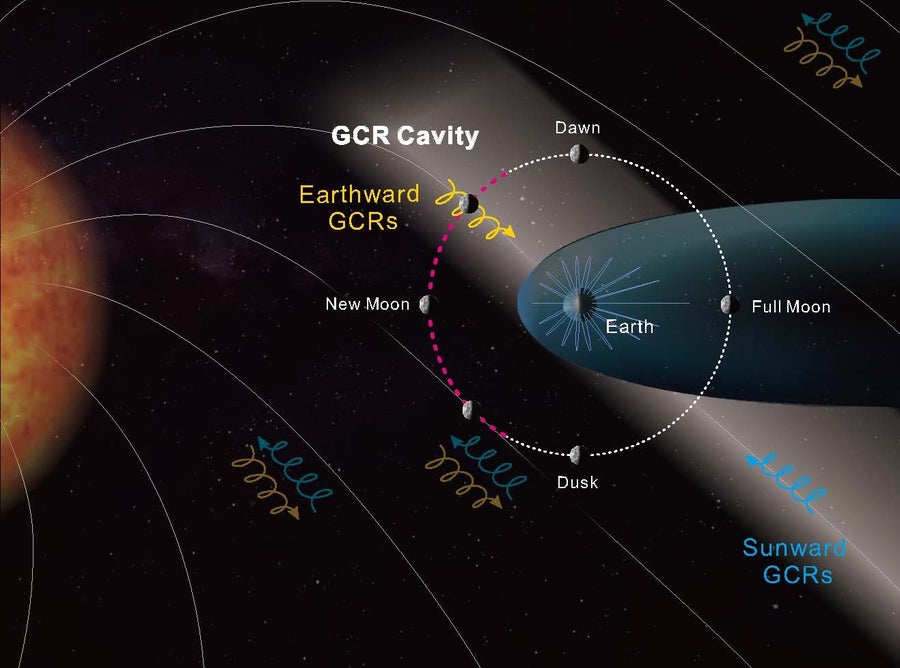
Barreling through the universe with incredible power and speed, galactic cosmic rays are a major source of radiation in space. But thanks to Earth’s strong magnetic field, these charged particles don’t usually make it directly to our planet, so we are protected from the radiation’s damaging effects. This field may be doing much more: new data collected by China’s Chang’e 4 lunar lander shows that our magnetic field’s influence is so powerful that it extends farther into space than previously believed—stretching even beyond the moon.

n a study published on Wednesday in Science Advances, researchers describe a “cavity” in space between Earth and the moon where cosmic rays are deflected by Earth’s magnetic field. This suggests that the effects of our planet’s magnetism are present much farther from us than anyone could have expected.

This graphic shows the shaded region where gravitational cosmic rays are deflected by Earth’s magnetic influence.

Gravitational cosmic rays spiral through the heliosphere, but Earth’s magnetic influence shields a large area of space from some of the particles. From “A Galactic Cosmic Ray Cavity in Earth-Moon Space,” by Wensai Shang et al., in Science Advances, Vol. 12, No. 13; March 25, 2026

Launched in 2018, Chang’e 4 was the first spacecraft to land on the far side of the moon. Among the many scientific instruments onboard was the Lunar Lander Neutron and Dosimetry experiment, which was designed to measure the radiation future astronauts might experience if they were to land there. Scientists had long assumed most of the moon lay beyond the protection of Earth’s magnetic field, but in 2019, scientists began noticing something odd about the experiment’s data that suggested the moon was somewhat protected from galactic cosmic rays.

The finding came as “a surprise,” says Robert Wimmer-Schweingruber, a co-author of the study and a physicist at Kiel University in Germany. “Personally, I didn’t believe it for a long, long time. I thought it was an artifact in the data until we did a lot of statistical tests.”

Galactic cosmic rays originate from a variety of sources in space, such as stars, supernovae, and black holes. These diverse origins mean that by the time the rays get near Earth, they don’t all carry the same level of energy. The highest-energy particles move quickly through the solar system, while some of the weaker particles linger—and their radiation could affect astronauts, Wimmer-Schweingruber says.

“These low-energy particles weren’t that interesting to us until we saw this effect, and then we realized this is actually important for the skin dose of astronauts,” he says.

Shielding astronauts from the dangers of radiation is critical to ensuring a human presence in space. This means creating materials that are light enough to bring into space but protective enough to keep radiation at bay, says Philip Metzger, a professor of planetary science and space technology at the University of Central Florida, who was not involved in the new study. Knowing more about the distribution of radiation in space, and especially between the moon and Earth, could help scientists plan safer missions.

For example, if NASA’s plan to put humans on the moon in a semipermanent capacity comes to pass, then it may make sense for astronauts to schedule activities outside any sheltered habitats while the moon is within the influence of Earth’s magnetic field.

“It is brilliant research, and it just shows us that the more we study phenomena outside of our planet, the more we discover we don’t know,” Metzger says. “That’s why we need to do space missions.”

.

https://static.scientificamerican.com/dam/m/48c361db08f0b4d0/original/iss048-e-61111.jpg?m=1774468145.54&w=900

Though it is far from Earth’s magnetic core, the moon feels even more of the core’s effects than scientists previously thought. NASA

.

.

Click the link below for the complete article:

https://www.scientificamerican.com/article/earths-magnetic-field-may-be-more-powerful-than-we-thought/

.

__________________________________________

What Is REM Sleep? Definition and Benefits

Leave a comment

Click the link below the picture

.

Rapid eye movement, or REM sleep, is the final phase of the four stage cycle that occurs during sleep. Unlike non-REM sleep, the fourth phase is characterized by an increase in brain activity and autonomic nervous system functions, which are closer to what is seen during the awakened state. Similar to non-REM sleep stages, this stage of sleep is primarily controlled by the brainstem and hypothalamus, with added contributions from the hippocampus and amygdala. Additionally, REM sleep is associated with an increase in occurrence of vivid dreams. While non-REM sleep has been associated with rest and recovery, the purpose and benefits of REM sleep are still unknown. However, many theories hypothesize that REM sleep is useful for learning and memory formation.

Key Takeaways: What Is REM Sleep?

  • REM sleep is an active stage of sleep characterized by increased brain wave activity, return to awake state autonomic functions, and dreams with associated paralysis.
  • The brainstem, particularly the pons and midbrain, and the hypothalamus are key areas of the brain that control REM sleep with hormone-secreting “REM-on” and “REM-off” cells.
  • The most vivid, elaborate, and emotional dreams occur during REM sleep.
  • The benefits of REM sleep are uncertain, but may be related to learning and storage of memory.

REM Definition

REM sleep is often described as a “paradoxical” sleep state due to its increased activity after non-REM sleep. The three prior stages of sleep, known as non-REM or N1, N2, and N3, occur initially during the sleep cycle to progressively slow bodily functions and brain activity. However, after the occurrence of N3 sleep (the deepest stage of sleep), the brain signals for the onset of a more aroused state. As the name implies, the eyes move rapidly sideways during REM sleep. Autonomic functions such as heart rate, respiratory rate, and blood pressure begin to increase closer to their values while awake. However, because this period is often associated with dreams, major limb muscle activities are temporarily paralyzed. Twitching can still be observed in smaller muscle groups.

During REM sleep, brain wave activity measured on an electroencephalogram (EEG) also increases, as compared to the slower wave activity seen during non-REM sleep. N1 sleep shows slowing of the normal alpha wave pattern noted during the awake state. N2 sleep introduces K waves, or long, high-voltage waves lasting up to 1 second, and sleep spindles, or periods of low voltage and high-frequency spikes. N3 sleep is characterized by delta waves, or high voltage, slow, and irregular activity. However, EEGs obtained during REM sleep show sleep patterns with low voltage and fast waves, some alpha waves, and muscle twitch spikes associated with transmitted rapid eye movement. These readings are also more variable than those observed during non-REM sleep, with random spiking patterns at times fluctuating more than activity seen while awake.

REM and Your Brain

During REM sleep, brain wave activity measured on an electroencephalogram (EEG) also increases, as compared to the slower wave activity seen during non-REM sleep. N1 sleep shows slowing of the normal alpha wave pattern noted during the awake state. N2 sleep introduces K waves, or long, high-voltage waves lasting up to 1 second, and sleep spindles, or periods of low voltage and high-frequency spikes. N3 sleep is characterized by delta waves, or high voltage, slow, and irregular activity. However, EEGs obtained during REM sleep show sleep patterns with low voltage and fast waves, some alpha waves, and muscle twitch spikes associated with transmitted rapid eye movement. These readings are also more variable than those observed during non-REM sleep, with random spiking patterns at times fluctuating more than activity seen while awake.

The major portions of the brain activated during REM sleep are the brainstem and the hypothalamus. The pons and midbrain, in particular, and the hypothalamus contain specialized cells known as “REM-on” and “REM-off” cells. To induce the transition to REM sleep, REM-on cells secrete hormones such as GABA, acetylcholine, and glutamate to instruct the onset of rapid eye movements, muscle activity suppression, and autonomic changes. REM-off cells, as their name implies, induce the offset of REM sleep by secretion of stimulatory hormones such as norepinephrine, epinephrine, and histamine.

The hypothalamus also contains stimulatory cells known as orexin neurons, which secrete the hormone orexin. This hormone is necessary for maintaining wakefulness and arousal from sleep and is often decreased or absent in people with sleep disorders. The hippocampus and amygdala are also involved in REM sleep, specifically during periods of dreams. These areas of the brain are most notable for their functions in memory and emotional regulation. An EEG will show increased hippocampal and amygdala activity with the presence of high voltage, regular waves known as theta waves. 

Dreams and REM Sleep

Although dreams can occur in other stages of sleep, the most vivid dreams occur during REM sleep. These dreams are often elaborate and emotional experiences of imagined life, most often associated with sadness, anger, apprehension, or fear. A person can also more readily recall a dream when awakened from REM sleep rather than from non-REM sleep. The purpose of dream content is not currently understood. Historically, neurologist and father of psychoanalysis Sigmund Freud suggested that dreams were a representation of unconscious thought, and therefore each dream had deeply significant meaning. His dream interpretation, however, is not a universally accepted theory. An opposing hypothesis proposes that dream content is a result of random brain activity that occurs during REM sleep, rather than a meaningful interpretive experience.

Benefits of REM Sleep

Sleep in general is necessary for health and well-being, as mild sleep deprivation increases risk for chronic health conditions and severe sleep deprivation can lead to hallucinations or even death. While non-REM sleep is required in order to survive, the benefits of REM sleep remain inconclusive. Studies in which participants were deprived of REM sleep by waking have shown no obvious adverse effects. Some drugs, including MAO antidepressants, lead to drastically decreased REM sleep without issue for patients even after years of treatment.

Due to the lack of conclusive evidence, many hypotheses exist concerning the benefits of REM sleep. One hypothesized benefit relates to the association of REM sleep and dreams. This theory suggests that certain negative behaviors, which should be “unlearned,” are rehearsed through dreams. Actions, events, and sequences related to fearful situations are often the subject of dreams and are therefore appropriately erased from the neural network. REM sleep is also proposed to help transfer memories from the hippocampus to the cerebral cortex. In fact, the cyclical occurrence of non-REM and REM sleep is often thought to enhance the body’s physical and mental rest as well as aid in memory formation.

.

Woman DreamingREM sleep is an active stage of sleep characterized by increased brain wave activity. Jamie Grill / Getty Images

.

.

Click the link below for the complete article:

https://www.thoughtco.com/what-is-rem-sleep-definition-4781604

.

__________________________________________

Trump Administration Live Updates: House Rejects D.H.S. Funding as White House Orders Pay for T.S.A. Workers

Leave a comment

Click the link below the picture

.

  • D.H.S. Shutdown: House Republicans angrily rejected a measure passed by their Senate counterparts early Friday that would have restored most funding for the Department of Homeland Security, deepening an intraparty feud that will most likely extend a partial shutdown of the agency. In a move to address weeks of long lines at airport security checkpoints, the White House said that it had ordered the Department of Homeland Security to pay employees of the Transportation Security Administration out of existing funds.

  • Patel Hack: Emails and photographs stolen from a personal email account of Kash Patel before his time as the director of the F.B.I. circulated online on Friday. But there were questions about who had carried out the cyberattack and when the intrusion had taken place.

House Republicans revolt over bill to reopen D.H.S., deepening shutdown rift.

House Republicans on Friday angrily rejected a Senate-passed deal to reopen the Department of Homeland Security, threatening to extend the agency shutdown that has crippled airports in a fit of outrage over the agreement their own party struck with Senate Democrats to end the crisis.

After quickly assessing the compromise that passed the Senate early Friday, conservative House Republicans tore into it in harsh terms. They derided it for hewing too closely to the Democratic position by omitting money for Immigration and Customs Enforcement and Border Patrol, the two agencies responsible for carrying out President Trump’s immigration crackdown, which are operating under previously approved funds.

Representative Katherine Clark of Massachusetts, the No. 2 Democrat, just hit on the logistical hurdle facing any bill that House Republicans try to pass to temporarily fund all of the Homeland Security Department, including ICE and Border Patrol: “The Senate is gone.” House members “know fully well what they’re doing” is continuing the shutdown, she added.

Even if he could pass the stopgap bill, and senators abandoned their spring break plans to hurry back to Washington, Senate Democrats would likely reject the House bill.

Representative Hakeem Jeffries of New York, the minority leader, said House Democrats would vote to pass the Senate-approved bill to partly fund the Department of Homeland Security if Speaker Mike Johnson were to put the measure on the floor. Jeffries added: “This should end, and could end today.”

House Republicans are gearing up to vote on a different measure that would fund the entire agency though May 22, and a majority of Democrats are expected to oppose it. It would need to be voted on by the Senate.

President Trump criticized the Senate-passed Homeland Security funding bill, saying it “wasn’t good” and “wasn’t appropriate” in a call with Fox News. Trump said it was unacceptable that the bill advanced out of the Senate and was delivered to the House without funding for Immigration and Customs Enforcement: “In my opinion, you can’t have a bill that’s not going to fund ICE.”

The Department of Homeland Security said Transportation Security Administration officers should begin receiving paychecks as early as Monday. “Today, at the direction of President Trump and the Secretary of Homeland Security Markwayne Mullin, TSA has immediately begun the process of paying its workforce,” a department spokesperson said in a statement.

Megan Mineiro

Speaker Mike Johnson said President Trump supported the plan to pass a short-term funding bill for the Department of Homeland Security. “He understands exactly what we’re doing and why,” Johnson added.

Johnson said House Republicans would vote to send the measure to fully fund the agency to the Senate “as soon as possible,” when asked if his chamber would take up the stopgap bill on Friday.

Hacked files of Kash Patel, before his time as F.B.I. director, circulate online.

Emails and photographs stolen from a personal email account of Kash Patel, the director of the F.B.I., circulated online on Friday, as hackers who claimed to be part of a group affiliated with Iranian intelligence took responsibility for the release.

The release of materials from before Mr. Patel’s time as F.B.I. chief appeared to be an effort to embarrass him as the war in Iran nears its first month. But there were questions about who had carried out the cyberattack, and it remained unclear when the intrusion had taken place.

A performer being sued by the Kennedy Center asked the judge to toss the case, calling it ‘retaliatory.’

Lawyers for a jazz musician who was sued by President Trump’s allies at the Kennedy Center asked a judge on Friday to toss out the lawsuit, calling it an attempt to stifle his protest of the organization’s takeover.

In December, Richard Grenell — at the time, the center’s president and a close ally of Mr. Trump’s — threatened to sue Chuck Redd, a jazz percussionist, for $1 million after Mr. Redd said he would not hold an annual Christmas Eve concert at the facility. Mr. Redd cited his opposition to renaming the performing arts center in honor of Mr. Trump.

The Defense Department argued in a court filing today that media rules it released this week did not defy a court order. The filing is the latest volley in a lawsuit filed by The New York Times in December, which claims that restrictions on journalists that the department adopted in October 2025 are unconstitutional.

The judge in the case, Judge Paul Friedman of the U.S. District Court of the District of Columbia, sided with The Times last week. On Monday, the Defense Department issued a revised policy and also announced the closure of journalists’ work space inside the Pentagon. The Times has argued that the moves violate the judge’s order.

In its filing on Friday, the Pentagon laid out why it believed the department was in compliance with the order. Judge Friedman has scheduled a hearing in the case on Monday.

Another senior House Republican will retire as a midterm exodus grows.

Representative Sam Graves, the 13-term Missouri Republican who leads the Transportation and Infrastructure Committee, said on Friday that he would retire in January, the latest powerful member of his party to leave Congress ahead of midterm elections in which it is bracing for big losses.

“It’s time to pass the torch and allow a new guard of conservative leaders to step forward and chart a path forward for Missourians,” he said in a statement announcing his decision to depart Washington at the end of his term. “This wasn’t an easy decision, but it’s the right one. I believe in making room for the next generation.”

A federal judge in Rhode Island sided with a union of Veterans Affairs workers, finding that the Trump administration had ignored her previous order to reinstate a contract with the workers it had canceled last year. Judge Melissa R. DuBose gave the government until Tuesday to show it had taken concrete steps to reimplement the agreement.

The House Ethics Committee said it had found violations in 25 of the 27 counts against Representative Sheila Cherfilus-McCormick, the Florida Democrat accused of embezzling $5 million of federal disaster money to support her congressional campaign.

The bipartisan vote came after a rare public hearing yesterday that lasted well into the night. Cherfilus-McCormick’s ethics trial was the first time in 16 years that the typically secretive panel had held a public hearing regarding the actions of a sitting lawmaker.

The adjudicatory panel will now schedule a hearing of the full panel to determine its recommendations for sanctions or expulsion. After that, the entire House will vote on the recommendation on the floor.

Hegseth strikes two Black and two female officers from a promotion list.

Defense Secretary Pete Hegseth is blocking the promotion of four Army officers to be one-star generals, a highly unusual move that has prompted some senior military officials to question whether the officers are being singled out because of their race or gender.

Two of the officers targeted by Mr. Hegseth are Black and two are women on a promotion list that consists of about three dozen officers, most of whom are white men, senior military officials said.

Trump’s signature is set to appear on U.S. currency.

President Trump’s signature will appear on U.S. dollars later this year, the Treasury Department said on Thursday. The decision to have Mr. Trump’s John Hancock on America’s paper currency represented an unprecedented change, one that the department said was being made in honor of the United States’ 250th anniversary.

Mr. Trump is set to become the first sitting U.S. president to have his signature on the greenback. His name will appear alongside that of Treasury Secretary Scott Bessent. As a result, the U.S. treasurer, whose name has been on the currency for more than a century, will not appear on the currency.

The Latest on the Trump Administration


  • Standoff With Iran: President Trump’s war with Iran is testing the limits of his unorthodox diplomatic style as he grasps for a deal to end the conflict, relying on a jumble of emissaries that reflect his improvisational approach.

  • Army Promotions Blocked: Defense Secretary Pete Hegseth is blocking the promotions of two Black officers and two women to be one-star generals, a highly unusual move that has prompted some officials to question whether the officers are being singled out because of their race or gender.

  • Pentagon-Anthropic Dispute: A federal judge temporarily stopped the Department of Defense from labeling Anthropic as a security risk, in a reprieve for the start-up that has been in a dispute with the Pentagon over the use of A.I. in warfare.

  • Brazilian Gangs: The Trump administration is weighing designating Brazil’s two biggest drug gangs as terrorist groups, after lobbying by two sons of former

  • ‘No Kings’ Protests: More than 3,000 demonstrations are scheduled across the country on Saturday to condemn an array of Trump’s policies and to express general discontent toward the president, whom the protesters view as acting like a monarch.

  • Signature on Currency: Trump will become the first sitting president with his signature on the U.S. dollar, the Treasury Department said, in honor of the United States’ 250th anniversary this year.

.

https://static01.nyt.com/images/2026/03/27/multimedia/27trump-news-mike-cqwg/27trump-news-mike-cqwg-jumbo.jpg?quality=75&auto=webpSpeaker Mike Johnson dismissed the Senate bill as “a joke” and said House Republicans would instead advance a measure to fully fund the agency. Credit…Eric Lee for The New York Times

.

.

Click the link below for the complete article:

https://www.nytimes.com

.

__________________________________________

Jury finds Meta and YouTube negligent in landmark social media addiction case

Leave a comment

Click the link below the picture

.

Meta and YouTube are liable for operating apps that are addictive and damaging to young people’s mental health, a jury found in the first-ever trial of its kind to weigh social media’s harms.

The legal arguments presented by the plaintiffs echoed some of those brought against big tobacco in the 1990s, which ultimately led to restrictions against tobacco companies targeting ads or products toward young people, among other remedies to restrict their influence.

The jury ordered the companies to pay $3 million to the plaintiff, a 20-year-old woman identified in court as Kaley G.M. Meta was ordered to pay 70 percent of the damages, and YouTube was ordered to pay 30 percent. During the trial, Kaley G.M. testified that using social media as a child and as a teenager gave her anxiety and made her feel insecure about her looks. Her lawyers alleged that the features and design of social media apps are intentionally addictive, while “like” buttons feed teens’ need for social validation.

The case is one of several that are being brought against the social media companies Meta, TikTok, YouTube, and Snap on behalf of 1,600 plaintiffs, including hundreds of families and 250 school districts. It is a “bellwether trial,” meaning its outcome could affect how other lawsuits against social media companies play out.

Before the trial began, TikTok and Snap reached an undisclosed settlement with the plaintiffs involved in the case. Over the course of the seven-week trial, lawyers for Meta and YouTube, which is owned by Google, argued that their platforms are safe for the majority of young users.

“For years, social media companies have profited from targeting children while concealing their addictive and dangerous design features,” said the plaintiff’s lawyers in a statement released to the media. “Today’s verdict is a referendum—from a jury, to an entire industry—that accountability has arrived.”

“We disagree with the verdict and plan to appeal. This case misunderstands YouTube, which is a responsibly built streaming platform, not a social media site,” said Google spokesperson José Castañeda in a statement.

Meta provided a separate statement to the media in which it said, “We respectfully disagree with the verdict and are evaluating our legal options.” The company did not immediately respond to a request for comment from Scientific American.

.

https://static.scientificamerican.com/dam/m/1d997f181136bd0c/original/social-media.jpg?m=1774460661.816&w=900Photo by Anna Barclay/Getty Images

.

.

Click the link below for the complete article:

https://www.scientificamerican.com/article/jury-finds-meta-and-youtube-negligent-in-landmark-federal-social-media/

.

__________________________________________

At Age 24, He Ditched Becoming a Lawyer to Open a Coffee Shop. Last Year It Brought In $40 Million.

Leave a comment

Click the link below the picture

.

Key Takeaways

  • Gregorys Coffee has grown from one small Park Avenue bar in 2006 to 53 locations nationwide, with typical stores now doing over $1 million in annual sales.
  • Revenue reached about $40 million last year and is projected to hit roughly $45 million this year.
  • Gregorys Coffee founder and CEO Gregory Zamfotis attributes the growth to quality coffee, roasted in-house.

Two decades ago, Gregory Zamfotis was at a crossroads. He was a second-year law student at Brooklyn Law School and had just been offered a full-time position at a real estate law firm. The only problem was that Zamfotis wanted to open his own business. 

“I grew up in the food business,” he explains in a new interview with Entrepreneur. “My father operated a number of concepts in New York City, so I grew up working with him.”

Zamfotis worked at his father’s sandwich shop during his time in law school. By the end of his education, he was effectively running the place. He wound up “really enjoying” the work and considering it as a potential career. He knew he wanted to start a business of his own one day, separate from his father’s endeavors. So after graduating from law school, he took his interest and passion for coffee and his experience working in food service, and decided to open his own coffee shop. He was 24 years old. 

“If you were in the Midtown Financial District, the areas where the majority of New Yorkers are spending their time working, the only options for coffee really were Starbucks or Dunkin,” Zamfotis says. “I thought that was a huge opportunity because I grew up working there. I wanted to take what I had learned, apply it to the coffee industry, and do it in a part of the city that was extremely underserved at the time.”

Zamfotis started by opening one coffee bar on Park Avenue and decided it would simply be better than anything around it. The plan was to obsess over the drinks, the ingredients and the feel of the place until it earned a permanent slot in New Yorkers’ daily routines.

Day after day, cup after cup, that little shop turned into a magnet for regulars who didn’t just like the coffee; they were loyal to the brand. The identity sharpened around bold, playful branding and a menu that refused to cut corners. 

“We wanted to do a quality specialty coffee operation in a volume setting,” Zamfotis says, describing early days when he put in “70 to 80 hours a week” at the store to make sure it ran exactly as he envisioned.

What surprised him

What Zamfotis didn’t fully understand at the time was how hard it would be to do coffee exceptionally well at scale. “I guess I was surprised at just how complex doing coffee really well was,” he says. “The only way we were gonna win is if we could differentiate ourselves from the national players or the other people doing coffee around the block.”

That realization pushed him into a kind of self-imposed coffee bootcamp. He visited shops, attended conferences, and immersed himself in the craft. “I had to spend a lot of time and energy not only visiting other coffee shops, traveling, going to conferences, listening to speakers, and just pouring myself literally into all things coffee, to make myself an expert,” he says.

That work changed the culture and the product. “There’s a difference between doing things well and doing things great,” he explains. As he elevated the coffee program and training standards, customers began noticing the difference — and kept their daily habit. “Customers, maybe in the beginning, were coming because of all the other things…great service, fast, good-looking store…then once I started to elevate the coffee program higher and higher, while also keeping all those other elements so strong, that’s when we really started to make things better,” he says. 

Today, Gregorys roasts its own beans in Long Island City, bakes fresh pastries, and emphasizes personalization — from milk choices to syrup levels — while still moving fast. The goal, Zamfotis says, is that customers should feel like they’re sacrificing nothing: not time, not quality, not options.

Scaling from one store to 53 — and to $45 million

Zamfotis estimates the first shop took 12 to 18 months to find consistency; the company hit the $1 million annual sales mark around year two or three. That traction gave him the confidence to open a second location roughly two and a half years after the first — and it was an instant hit. 

“When the first location may have taken 12 to 18 months to stabilize, the second location was stable from the get-go…very busy from the day we opened,” he says.

From there, growth became a function of systems and people. “I’ve always said you can only grow as fast as the people [you have] to help execute,” Zamfotis says. For about 12 years, every single person in a position of authority at Gregorys was promoted from within, often starting as baristas.

That philosophy helped the company expand from two stores to 53 across New York, New Jersey, Washington, D.C., Florida, California, Arizona, and Tennessee. The financials now reflect that footprint. “Last year we did just around $40 million,” Zamfotis says. “This year, I believe the projection is closer to like $45 million.”

Exploring franchising

At some point, Gregorys hit a crossroads: keep grinding out corporate stores one by one, or admit that the “incredible box” they’d built was strong enough to share with other operators and scale faster than a single team ever could. That’s when Craveworthy Brands and its CEO Gregg Majewski stepped in as managing partner and corporate operator in August 2025, bringing a platform built for franchising, from training to shared services that could support a national push.

“We knew that if we wanted to continue to grow the brand at the speed that was necessary, the only way was to attach to franchising,” Majewski tells Entrepreneur in a new interview. 

Now, with a 20-year track record and a typical store pulling in roughly $1 million in annual revenue (with high performers around $1.6 million and drive-thru models at about $1.4 million), Gregorys is no longer just the underdog Park Avenue café. It’s a New York–forged coffee brand stepping into the franchise spotlight, aiming to sell 50 to 75 locations in its first year of franchising this year and inviting operators to go toe-to-toe with the biggest coffee players in America.

“Any brand that’s been around the industry as long as that and has been successful in as many markets as it has over the 20-year timeframe is perfect for franchising — especially when you built your reputation in one of the hardest cities in the world to operate in, New York,” Majewski says. Gregorys has “a group of regulars that absolutely live and die [for] this brand,” Majewski explains. 

Craveworthy Brands brings scale muscle to franchising ambition. The firm has 21 brands in its portfolio, eight of which are already franchising, and it provides the infrastructure that early franchisees often lack: training, shared services, construction support, and operational systems built to replicate performance across stores. Craveworthy’s portfolio includes brands like Big Chicken, Taffer’s Taver,n and Genghis Grill. 

For would-be franchisees, Gregorys is now pitching itself as a way into a coveted segment that can otherwise be hard to access. Majewski notes that “some of the bigger players are sold out or aren’t accepting.” Gregorys offers a build-out cost “anywhere from $200,000 to $700,000,” he says.  

Why franchising works

Majewski is clear about why he believes franchising works, not just for Gregorys but across Craveworthy’s portfolio. On the franchisor side, the hurdle is ensuring systems and procedures are in place so the company can train effectively and execute the product consistently. 

On the franchisee side, the challenge is more psychological: “following the systems and procedures and reminding yourself that you bought into a system,” he says. The promise is that if the system is well designed and properly followed, it exists “for a reason so you can be successful.”

Majewski insists that culture is the differentiator in a successful franchise. He says success comes from “establishing an incredible culture in the system” and making sure operations are simple enough to replicate. “If any concept is ever too complicated, you can’t have the consistency,” he explains. 

The goal is that “when you walk into a store in Indiana or a store in California, you get the same experience,” he says. For Gregorys, that means protecting not only the coffee quality and menu but also the feel of a brand born on Park Avenue and refined in New York City’s daily grind.

.

https://www.entrepreneur.com/wp-content/uploads/sites/2/2026/03/Gregory-Zamfotis-1.jpeg?resize=1024,868Gregory Zamfotis. Credit: Gregorys Coffee

.

.

Click the link below for the complete article:

https://www.entrepreneur.com/franchise-profile/how-he-grew-gregorys-coffee-to-45-million-in-revenue

.

__________________________________________

Older Entries Newer Entries

MRS. T’S CORNER

https://www.tangietwoods

Amor Entre Estrellas

¡Bienvenido de vuelta viajero!

Heart of Loia `'.,°~

so looking to the sky ¡ will sing and from my heart to YOU ¡ bring...

Michael Ciullo

CEO and Founder of Nsight Health

Nelson MCBS

Catholic News, Prayers, HD Images, Rosary, Music, Videos, Holy Mass, Homily, Saints, Lyrics, Novenas, Retreats, Talks, Devotionals and Many More

Global geopolitics

Decoding Power. Defying Narratives.

Talk Photo

A creative collaboration introducing the art of nature and nature's art.

Movie Burner Entertainment

The Home Of Entertainment News, Reviews and Reactions

Le Notti di Agarthi

Hollow Earth Society

C r i s t i a n a' s Fine Arts ⛄️

•Whenever you are confronted with an opponent, conquer him with love.(Gandhi)

TradingClubsMan

Algotrader at TRADING-CLUBS.COM

Comedy FESTIVAL

Film and Writing Festival for Comedy. Showcasing best of comedy short films at the FEEDBACK Film Festival. Plus, showcasing best of comedy novels, short stories, poems, screenplays (TV, short, feature) at the festival performed by professional actors.

Bonnywood Manor

Peace. Tranquility. Insanity.

Warum ich Rad fahre

Take a ride on the wild side

Madame-Radio

Découvre des musiques prometteuses (principalement) dans la sphère musicale française.

Ir de Compras Online

No tiene que Ser una Pesadilla.

Kana's Chronicles

Life in Kana-text (er... CONtext)

Jam Writes

Where feelings meet metaphors and make questionable choices.

emotionalpeace

Finding hope and peace through writing, art, photography, and faith in Jesus.

WearingTwoGowns.COM

The Community for Wounded Healers: Former Medical Students, Disabled Nurses, and Faith-Fueled Pivots

...

love each other like you're the lyric to their music

Luca nel laboratorio di Dexter

Comprendere il mondo per cambiarlo.

Tales from a Mid-Lifer

Mid-Life Ponderings

Creative

Travel,Tourism, Life style "Now in hundreds of languages for you."

freedomdailywriting

I speak the honest truth. I share my honest opinions. I share my thoughts. A platform to grow and get surprised.

The Green Stars Project

User-generated ratings for ethical consumerism

Cherryl's Blog

Travel and Lifestyle Blog

Sogni e poesie di una donna qualunque

Questo è un piccolo angolo di poesie, canzoni, immagini, video che raccontano le nostre emozioni

My Awesome Blog

“Log your journey to success.” “Where goals turn into progress.”

pierobarbato.com

scrivo per dare forma ai silenzi e anima alle storie che il mondo dimentica.

Thinkbigwithbukonla

“Dream deeper. Believe bolder. Live transformed.”

Vichar Darshanam

Vichar, Motivation, Kadwi Baat ( विचार दर्शनम्)

Komfort bad heizung

Traum zur Realität

Chic Bites and Flights

Savor. Style. See the world.

ومضات في تطوير الذات

معا نحو النجاح

Broker True Ratings

Best Forex Broker Ratings & Reviews

Blog by ThE NoThInG DrOnEs

art, writing and music by James McFarlane and other musicians

fauxcroft

living life in conscious reality

Srikanth’s poetry

Freelance poetry writing

JupiterPlanet

Peace 🕊️ | Spiritual 🌠 | 📚 Non-fiction | Motivation🔥 | Self-Love💕

Sehnsuchtsbummler

Reiseberichte & Naturfotografie