Home

The weight-loss drug rivalry heats up as another GLP-1 pill gains FDA approval

Leave a comment

Click the link below the picture

.

The U.S. Food and Drug Administration’s approval of Eli Lilly’s once-daily pill orforglipron as a weight loss and obesity treatment this week was the fastest approval of a new medication in decades. Clinical trial results showed that the highest doses of the oral medication, which will be marketed as Foundayo, caused people to lose an average of 27 pounds after 72 weeks of treatment.

The new oral medication is the latest glucagonlike peptide 1 (GLP-1) drug in the rapidly expanding market. Foundayo is the second GLP-1 weight-loss pill to gain FDA approval; Novo Nordisk’s once-a-day Wegovy pill was approved in December 2025. Experts hope that having more options for these popular weight-loss and type 2 diabetes treatments will drive down costs and offer people more flexibility.

“Generally, it’s much easier to make pills and distribute them,” compared with injectable drugs, says Daniel Drucker, an endocrinologist at the University of Toronto, who has previously consulted for Eli Lilly. “That should be an advantage in really getting the drug to a much wider population.”

In the latest phase 3 trial of orforglipron, three doses of the drug were compared with a placebo in 1,613 people with type 2 diabetes who were overweight or had obesity. After 72 weeks, people on the six-milligram dose lost 5 percent of their body weight, those on 12 milligrams lost 7 percent, and those on 36 milligrams lost nearly 10 percent.

A clinical trial found a 25-mg dose of the Wegovy pill caused nearly 17 percent weight loss in 64 weeks. And in another clinical trial, injections of 15-mg doses of tirzepatide (the active ingredient in Eli Lilly’s weight-loss injectable Zepbound) resulted in an average of about 21 percent body-weight reductions after 72 weeks.

“It’s not as high of weight loss as tirzepatide and not as high as some of the things that we’ll see coming down the pipeline in the next six months to a year, but I think there’s room for all of those [medications],” says Deborah Horn, director of obesity medicine at UTHealth Houston, who led the most recent trial on Foundayo. (Horn consults for Eli Lilly.)

The various forms and levels of effectiveness of these drugs could provide more individualized treatments, she says. For instance, another recently completed trial by Eli Lilly investigated if people who were initially treated with an injectable GLP-1 drug could eventually transition to an oral version like Foundayo and still maintain the weight loss and health benefits. The results have been submitted for peer-reviewed publication.

“A lot of people are asking the question: ‘If I do these injectables for a year and get to a healthy place, could I transition to this oral medication and keep the weight off?’” Horn says. “That data will be available very soon.”

Foundayo works similarly to other GLP-1 drugs, such as semaglutide—the active ingredient in the injectable and pill forms of Wegovy. The new oral drug latches on to the receptors for the gut hormone GLP-1 to make people feel satiated and slow down stomach emptying, causing them to eat less and ultimately lose weight. The Wegovy pill and all currently available injectable versions of the drug are peptides, or short chains of amino acids, that are similar to the body’s GLP-1, whereas Foundayo is a nonpeptide small molecule. That comes with several advantages, Horn says.

Because Semaglutide is a peptide, it quickly degrades in the acidic environment of our stomach, Horn explains. The Wegovy pill has a special ingredient that shields it from some erosion, but people must still take it on an empty stomach to ensure it’s properly absorbed. As a nonpeptide, Foundayo can be absorbed through the gut without breaking down, and that means it can be taken anytime, regardless of when you eat, drink or take other medications.

Such small-molecule-based drugs are also generally easier and cheaper to manufacturer than peptides. “In terms of distribution, it gets rid of things like cold storage and plastics for [injection] pens,” Horn says.

In a press release about Foundayo’s approval, Eli Lilly listed the starting price for the drug at $25 per month for people who have commercial insurance and enroll in the company’s Foundayo savings card program. Out-of-pocket costs start at $149 per month and go up to $349 for higher doses, according to material an Eli Lilly spokesperson shared with Scientific American. Starting in July, the drug is expected to be available for $50 to eligible individuals on Medicare Part D—a federal prescription drug benefit program for adults who are aged 65 and older or have certain disabilities.

Eli Lilly’s announcement lists several tablet doses, starting at 0.8 mg and up to 17.2 mg—the pill with the maximum dosage of 17.2 mg is reported have an efficacy equivalent to the 36-mg dose tested in trials, according to the company spokesperson. Further information isn’t yet publicly available on the pricing of the various doses. The FDA’s news release about the approval describes a schedule that gradually increases doses over time—a titration scheme similar to that of other GLP-1 drugs that helps the body adjust to the medication, Drucker explains. “We’ve seen with every single one, if you start too high and increase the dose too quickly, you get sick,” he says.

Similar to other GLP-1 medications, Foundayo causes nausea, vomiting, diarrhea and other gastrointestinal side effects. In the recent trial, participants on the highest 36-milligram dose had about a 2 percent greater risk of a serious adverse event, compared with those given a placebo. Rates of treatment discontinuation—most commonly from gastrointestinal symptoms—were higher, at 6 to 10 percent, depending on the dose, for those who received the pill, compared with a rate of 4 percent for those who received the placebo. The trials find Foundayo to be very safe, but Drucker notes that people should continue to keep a watchful eye on any new drug.

For peptide-based GLP-1 drugs, “we have 21 years of safety data,” he says. “Whenever we have a new medicine, we always restart the clock in terms of safety.”

In a response to Scientific American’s request for comment, the Eli Lilly spokesperson said that the FDA reviewed the company’s “robust clinical data package” and that the approval establishes “Foundayo’s strong safety and efficacy profile.”

Foundayo and other weight-loss drug candidates in the works could increase supply and help with affordability of GLP-1 drugs overall—though that might take some time, Horn says. “I don’t think we’re at very, very inexpensive yet, but I think we will get there as more and more GLP-1s and other medicines become available.”

.

https://static.scientificamerican.com/dam/asset/6e9fe02b-96a3-4fe9-a4a5-88ef0de1b8d9/GettyImages-2243677133_web.jpeg?m=1775148245.766&w=900Smith Collection/Gado/Getty Images

.

.

Click the link below for the complete article:

https://www.scientificamerican.com/article/how-eli-lillys-new-glp-1-pill-stacks-up-against-wegovy-and-other-weight-loss/

.

__________________________________________

I’ve Covered Women in the Workplace for 15 Years. Something Alarming Is Happening.

2 Comments

Click the link below the picture

.

“Believe women” was the defining message of the #MeToo movement. Today, there’s a new one: Erase women.

The Trump administration’s attack on diversity, equity, and inclusion has rolled back decades of progress for women, who now face a widening gender pay gap and narrowing employment protections. In the process, discussions about women have become a third rail, a toxic topic that is too politically charged to touch. Companies, universities, law firms, and cultural institutions are all expunging references to “women” and “gender,” even under the most benign circumstances.

The Trump administration has defined “illegal D.E.I.” as “programs, initiatives, or policies that discriminate, exclude or divide individuals based on race or sex.” But in practice, President Trump’s allies have questioned whether women deserve a place in the workforce at all. They have blamed women for last year’s California wildfires and slammed the conservative Supreme Court justice Amy Coney Barrett as a “D.E.I. hire” for a ruling they didn’t like. Defense Secretary Pete Hegseth is purging the military of senior female officers after complaining that the armed forces had become “effeminate.” Women’s names have disappeared from museums, parks, monuments, and even the Arlington National Cemetery.

Terrified of being the administration’s next target, organizations are descending into the realm of the absurd. A researcher focused on maternal health removed references to gender-based discrimination in order to receive federal funding. A medical trade publication warned scientists to avoid words such as “female” and “women” in grant applications. After Senator Ted Cruz of Texas released a list of supposedly “woke” National Science Foundation grants last year, ProPublica found that some were included merely because their project descriptions included words like “female,” as in a female research scientist, or “diversify,” as in the biodiversity of plants.

It’s a fun-house mirror moment. For more than a decade, while reporting on women in the workplace, I’ve seen my inbox clogged with companies boasting about their work championing female employees. But most firms I contacted for this piece begged me to keep them out of it. At a recent event about working women, I asked a room of human resources executives whether their firms’ diversity efforts were continuing, and every hand shot up. When I asked who would talk about it publicly, almost every hand quickly went down. Executives say they fear not just the administration, but also right-wing activists and misogynistic trolls who might target them.

Even companies with excellent track records in promoting women don’t want to mention it. In a recent Harvard Business Review article, the sociologists Frank Dobbin and Alexandra Kalev identified several initiatives available to all employees that can actually be more effective than D.E.I. programs in boosting outcomes for marginalized groups. They highlighted the successes of IBM’s formal mentorship programs, Walmart’s training academy, and Gap’s family-friendly scheduling options. All three companies recorded increases in the percentage of women and people of color in senior roles.

Just don’t ask IBM, Walmart, or Gap to elaborate on those impressive findings. I did. All declined.

It may seem perfectly reasonable, even admirable, for companies to keep their mouths shut as they continue to advance diversity goals. After all, nobody wants to be a target. In previous years, too many companies went overboard, with lots of cheap talk about diversity and not enough action. The problem is that silencing the conversation risks undoing years of progress at a time when women are still underrepresented in business and public life. As women are erased from the narrative, injustices against them go unnoticed.

Already, incidents that in years past would have prompted public outrage are being met with silence. Just last month, in a stunning reversal, the United States for the first time in 70 years refused to sign off on the U.N. Commission on the Status of Women’s annual principles, an anodyne set of statements including a reaffirmation of its “commitments to gender equality” and a call to repeal “gender discriminatory provisions.” A U.S. representative to the U

My guess is that you haven’t heard about this historic repudiation. It’s not your fault: It got almost no public attention.

Firms are even cutting funding for employee resource groups — affinity groups centered on women, ethnic and racial minorities or L.G.B.T.Q. communities — despite the fact that many aren’t in the administration’s cross hairs. In previous years, companies “would brag about what they’re doing,” Shelley Correll, a sociologist at Stanford University, told me. Now, companies are “canceling E.R.G.s that aren’t illegal,” she says. It’s “an overreaction to what even Trump is asking them to do.”

As a result, last year, an annual report on women in the workplace found that women have “less career support and fewer opportunities to advance.” One previous champion of women’s advancement, Meta’s chief executive, Mark Zuckerberg, now says companies need more “masculine energy.”

Other marginalized groups have also been targeted. In the wake of George Floyd’s murder in 2020, corporations jumped to make grand statements and pledge billions of dollars to combat discrimination. Most of those efforts, including initiatives to boost female employees, turned out to be empty platitudes or just plain failures.

The erasure of women from the national narrative has long been a key strategy authoritarian leaders use to destroy democracies. In Turkey, President Recep Tayyip Erdogan has declared that women aren’t equal to men. In Russia, some forms of domestic violence have been decriminalized. And in Hungary, Prime Minister Viktor Orban’s government has urged women to focus on childbearing, not its large pay gap. A primary feature of the “autocrat’s playbook” is “reversing progress on gender equality and women’s rights,” the Harvard scholars Erica Chenoweth and Zoe Marks have written.

Now, women’s rights are eroding in the United States. The Trump administration has called for resurrecting “traditional” nuclear families where the mother is a homemaker. JD Vance argued that having more women in the workforce results in “unhappier, unhealthier children.” The administration recently sued a Coca-Cola distributor for hosting a women’s retreat, alleging it discriminated against men. Trump allies have even suggested stripping women of the right to vote.

When women mobilize, countries are more likely to be egalitarian democracies. That’s why authoritarians fear women. The rest of us shouldn’t.

.

https://static01.nyt.com/images/2026/04/07/opinion/07lipman/07lipman-superJumbo.jpg?quality=75&auto=webpTara Booth

.

.

Click the link below for the complete article:

https://www.nytimes.com/

.

__________________________________________

Artemis II crew head for home after travelling further from Earth than anyone before

2 Comments

Click the link below the picture

.

Summary

  • The Artemis II astronauts are bound for Earth after conducting a historic lunar fly-by and witnessing a total solar eclipse from their spacecraft

  • Commander Reid Wiseman says the Orion spacecraft crew “saw sights that no human has ever seen”, while pilot Victor Glover says there are “no adjectives” to describe what they observed

  • The spacecraft reached its maximum distance from Earth – 252,756 miles (406,771km) – during the lunar fly-by. The crew had already broken the previous record for the furthest distance humans have travelled into space

  • The astronauts lost connection with NASA while behind the Moon – the outage was expected and lasted around 40 minutes

  • “It is so great to hear from Earth again,” said mission specialist Christina Koch as she broke the silence from the spacecraft

  • US President Donald Trump tells the astronauts that they have “made history and made all America really proud” – and invites them to the White House

  • The astronauts are due to splash down in the Pacific Ocean off the west coast of the US at 20:07 eastern US time on Friday (01:07 BST Saturday)

Crew were well-prepared for testing mission, says astronaut

Meganne ChristianI
Image source, European Space Agency

It is hoped the Artemis II mission will help to usher in a new era of space travel – and one of those hoping to be part of it is Dr Meganne Christian, a reserve astronaut with the European Space Agency.

The dual British national began training in January 2025 after being selected from thousands of applicants, getting a taste of the rigorous preparations the Artemis crew will have gone through for moments like losing contact with Earth.

She tells BBC Radio 4’s Today programme the astronauts will have performed “simulation after simulation, knowing what’s going to happen in any given moment – they were ready for it”.

Asked about the importance of this mission, she says: “This is a test flight, preparing us for the future of exploration, preparing us for future landing sites… We are not just going to the moon, we are going there to stay.”

  1. Moon crater to be named after astronaut’s late wifepublished at 02:56

    There was a poignant moment onboard the capsule yesterday when conversation turned to proposing names for craters on the Moon to memorialise this record-breaking voyage.

    One of the craters should be named Integrity after their Orion spacecraft, the crew agreed – while another should be named after astronaut Reid Wiseman’s late wife Carroll who died in 2020.

    The name proposals will need to be formally submitted to the International Astronomical Union,which governs the naming of features in space – but we suspect they’ll be open to the suggestion.

  2. Astronauts clock off for the night after record-breaking daypublished at 02:30

    Esme Stallard
    Science reporter

    We’ve just heard from the crew onboard the Orion spacecraft, who have bid goodnight to the teams on Earth after a day which saw them surpass a space-travel record.

    Mission control tells the astronauts: “We got a sneak peek at your imagery. It is absolutely stunning, we are all completely in awe of the work you did today.

    “Thank you so much for bringing us on this journey with you. We hope you have sweet dreams of Moon joy.”

    The crew replies: “We’re glad they’re appreciated. We certainly appreciate it up here.”


    Artemis II is ‘kick-off for the next generation of space exploration’published at 02:10

    Dr Nicola Fox, a white lady with brown hair, sat in a room with curtains drawn and a lamp on, smiling at the camera.

    Nasa’s head of science Dr Nicola Fox says the Artemis II Moon mission is all about “doing the work to set up that sustained presence on the Moon”.

    Artemis IV, which is expected to launch in early 2028, will land humans on the Moon for the first time since 1972, Fox tells BBC Breakfast.

    She says Nasa’s ultimate goal is to have astronauts living and working there continuously, which will pave the way for the “next giant leap in exploration, to send crews to Mars”.

  3. Gravity in control and instant death awaits outside spacecraft, says ex-astronautpublished at 01:50

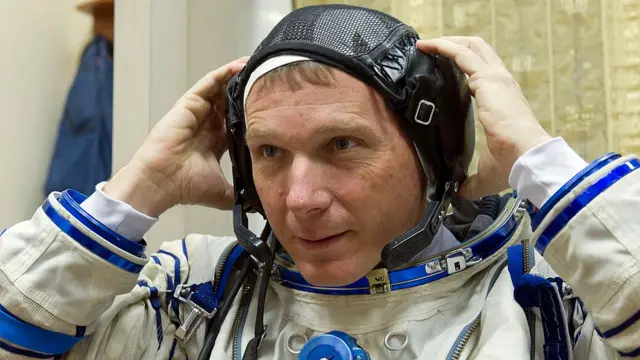
    Terry Virts in an astronaut suit
    Image source, Getty Images

    Retired Nasa astronaut Terry Virts, who was formerly commander of the International Space Station, says the crew of the shuttle had to allow gravity to take over in order to slingshot the moon.

    He says: “They are in deep space with no way to be rescued, getting the harshest radiation that doesn’t even exist on Earth, surrounded by instant death just a few millimetres outside of that thin aluminium shell.

    “The entire 10-day mission is not exactly super safe but basically nothing happened today. The only thing that happened today was the moon flew by the capsule.

    “They didn’t do a manoeuvre – they allowed the moon’s gravity to kind of bend the shape of their trajectory 180 degrees and bring them back to Earth.

    “So it wasn’t like they had to do a big complicated manoeuvre or docking or landing or anything like that.

    “Sir Isaac Newton is in charge – gravity is what’s manoeuvring the capsule now.”

    Satellites have been here before – but human eyes have notpublished at 01:31

    Esme Stallard
    Science reporter

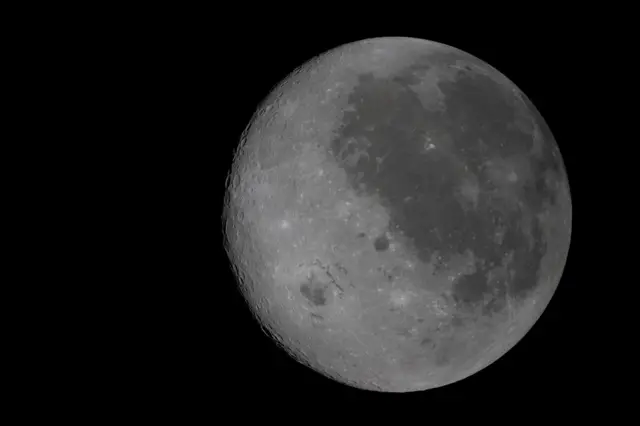
    The Moon
    Image source, NASA

    Now contact has successfully been remade with the Artemis II crew I am frantically refreshing the Nasa’s photos stream, which will bring us all the images they took while observing the far side of the Moon.

Both the record distance, illumination levels and particular orbit means that the crew have seen sights that no human has ever laid their eyes on.

They have digital cameras with them which they are using to capture the sights – but it is what they saw from the spacecraft that has many scientists back on Earth most excited.

Both China and India have sent probes over this side in the last few years to capture images – so is having humans see it for themselves exciting from a scientific point of view, or purely in terms of human exploration?

Chris Lintott, professor of astrophysics at the University of Oxford and co-host of BBC’s series The Sky at Night, told my colleague Georgina Rannard: “The value of the images coming back from Artemis and its crew is artistic, not scientific.”

And yet, ask any former geology student like me and you are still trained to make observations and sketches with the human eye. Science puts great store by our own inbuilt cameras.

Abbie MacKinnon, curator of the Science Museum’s space gallery, says: “I know we have… satellite imagery and everything like that. It’s just not the same as humans there deciding what images to take and what looks good.” 

  1. Now contact has successfully been remade with the Artemis II crew I am frantically refreshing the Nasa’s photos stream, which will bring us all the images they took while observing the far side of the Moon.

    Both the record distance, illumination levels and particular orbit means that the crew have seen sights that no human has ever laid their eyes on.

    They have digital cameras with them which they are using to capture the sights – but it is what they saw from the spacecraft that has many scientists back on Earth most excited.

    Both China and India have sent probes over this side in the last few years to capture images – so is having humans see it for themselves exciting from a scientific point of view, or purely in terms of human exploration?

    Chris Lintott, professor of astrophysics at the University of Oxford and co-host of BBC’s series The Sky at Night, told my colleague Georgina Rannard: “The value of the images coming back from Artemis and its crew is artistic, not scientific.”

    And yet, ask any former geology student like me and you are still trained to make observations and sketches with the human eye. Science puts great store by our own inbuilt cameras.

    Abbie MacKinnon, curator of the Science Museum’s space gallery, says: “I know we have… satellite imagery and everything like that. It’s just not the same as humans there deciding what images to take and what looks good.”

  2. Key moments from the Artemis II lunar fly-bypublished at 00:56

    Media caption,

    Watch: Artemis II mission loses contact with Earth for 40 minutes

    It has been a historic day for the Artemis II crew, who are now bound for Earth after completing a fly-by of the Moon. Here’s what has happened over the past few hours:

  3. Amazing and busy day for Nasa’s scientistspublished at 00:37

    Rebecca Morelle
    Science editor

    We spoke to Nasa’s head of science Dr Nicola Fox after the fly-by.

    She said it had been an amazing – and very busy – day for the science team here at mission control.

    The astronauts have spent years preparing for this part of the mission, studying lunar science with the team here – and Fox said the crew had aced their test, providing fantastic lunar observations.

    As a solar scientist, she was particularly excited about the eclipse.

    She’s gazed at many of these celestial events, but said this one, with such an unusual vantage point, looked very different from any she’d seen on Earth.

  4. What the Artemis astronauts said after regaining communication with Earthpublished at 00:23

    There was much anticipation during the 40 minutes when Orion was not able to contact Earth.

    After the Artemis crew returned from the far side of the moon, mission specialist Christina Koch broke the silence.

    Here is what Koch said:

    “Houston, Integrity, comm check.

    It is so great to hear from Earth again…

    To Asia, Africa and Oceana, we are looking back at you, we hear you can look up and see the moon right now. We see you too.

    When we burned this bird towards the moon, I said that we do not leave Earth, but we choose it and that is true.

    We will explore, we will build, we will build ships, we will visit again.

    We will construct science outposts. We will drive rovers, we will do radio astronomy, we will found companies, we will bolster industry.

    We will inspire but ultimately we will always choose Earth.

    We will always choose each other.”

  5. The long journey homepublished at 23:55

    After travelling a record-breaking 252,756 miles (406,771km) from Earth and circling past the moon, the Artemis II astronauts are on their way home.

    It will take them about four days to journey back, with a splashdown in the Pacific Ocean off the west coast of the US expected at 20:07 eastern US time 10 April (01:07 BST 11 April).

    Teams will collect the astronauts from the water in helicopters and take them to the a nearby US Navy ship.

    They will have medical checks aboard the ship as they head back towards land, Nasa says.

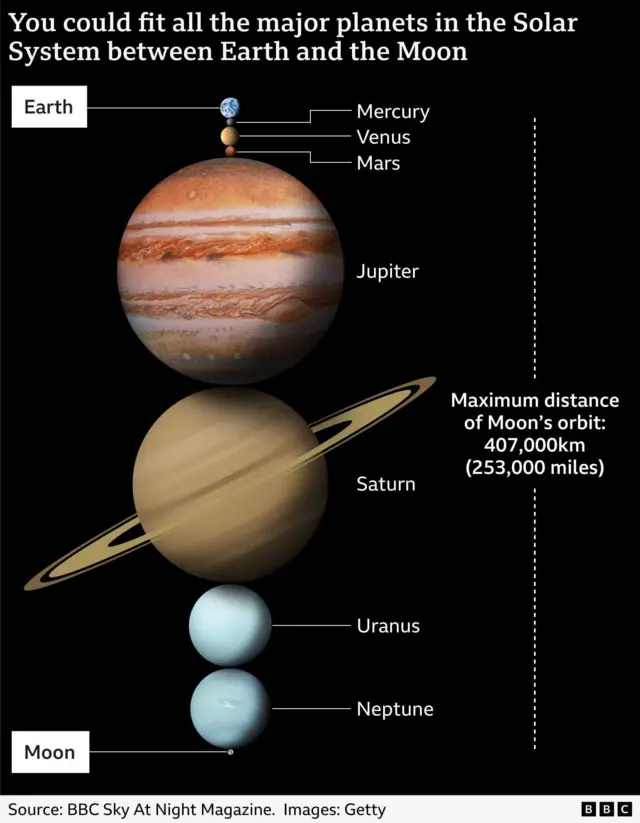
    Infographic titled “You could fit all the major planets in the Solar System between Earth and the Moon.” The graphic shows Earth at the top and the Moon at the bottom, with all the other planets stacked vertically between them to illustrate their combined width. From top to bottom, the planets shown are Mercury, Venus, Mars, Jupiter, Saturn with its rings, Uranus, and Neptune. A dotted vertical line on the right marks the maximum distance of the Moon’s orbit: 407,000 km (253,000 miles). Labels identify each planet and the Earth–Moon endpoints.
  6. Trump tells astronauts ‘you’ve made history’ – a recap of his call to spacepublished at 23:16

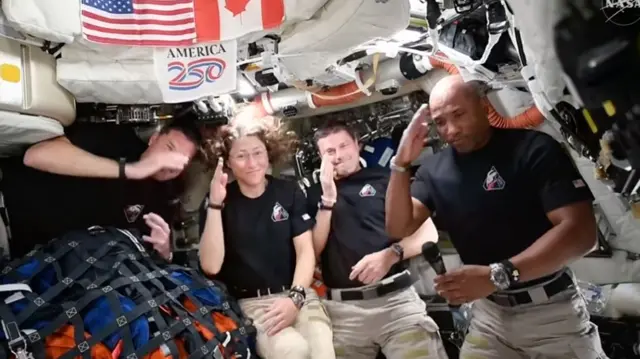
    Four astronauts saluting to the camera while in the Artemis II spacecraft.
    Image source, NASA

    US President Donald Trump had a short conversation with the four astronauts aboard the Orion spacecraft. As a microphone floated in front of the astronauts on their journey back to Earth, Trump praised the crew for their achievements.

    • He told the Artemis II crew that they had “made history” by breaking the record for the furthest distance travelled from planet Earth
    • Astronaut Victor Glover told the US president that he said “a little prayer” when the spacecraft briefly lost contact with Nasa, while Commander Reid Wiseman said they had seen sights “that no human has ever seen”
    • There were also several references to Mars throughout the call; Commander Reid Wiseman told the president that all of the crew had commented “how excited we are to watch this nation and this planet become a two planet species”
    • Canadian Space Agency astronaut Jeremy Hansen also gave a special thanks to Trump on behalf of Canada; Trump responded by saying he had spoken to Canadian Prime Minister Mark Carney and former Canadian ice hockey player Wayne Gretzky, who had both expressed how proud they were of Hansen and the Artemis II crew
    • The president invited the four astronauts to the White House once they return to Earth – he said he rarely asks for autographs, but he wanted to get theirs
  7. Trump invites crew to White Housepublished at 22:44

    Before the call ended, Trump said he will be seeing the Artemis crew at the White House once the mission is complete.

    “I’ve been pretty busy also, as you know, but I will absolutely find the time,” Trump said, before adding he would like to give “a big salute on behalf of the American people and beyond that”.

    “Thank you for that, Mr President,” pilot Victor Glover replied.

  8. ‘Saw sights that no human has ever seen’published at 22:39

    Trump continues with questions, asking the crew: “What is the most unforgettable part of this really historic day?”

    Commander Reid Wiseman was the first to respond, and starts by saying that the call from the president was “certainly very special to all of us”.

    “We saw sights that no human has ever seen, not even Apollo, and that was amazing for us,” said Wiseman.

    He went on to explain the crew’s observations of the solar eclipse, and said all four of the crew had commented on how “excited we are to watch this nation and this planet become a two-planet species” in reference to goals of future ventures to Mars.

  9. Trump asks crew what it was like to lose contact with Earthpublished at 22:36

    Trump asks the Artemis crew: “What was your feeling when you had no communication all of a sudden?”

    Astronaut Victor Glover answers by saying he said “a little prayer” but then had to keep working to record scientific observations of the far side of the moon.

    “We were busy up here and working really hard, and I must say it was actually quite nice,” Glover adds.

  10. Trump congratulates Artemis crew and Nasapublished at 22:31

    Trump continues and says: “Humans have really never seen anything quite like what you’re doing.”

    “It’s really special.”

    He then congratulates each crew member of the Artemis crew and the entire team at Nasa.

  11. Trump speaking to Artemis II crew nowpublished at 22:29

    US President Donald Trump is speaking directly to the crew aboard Artemis II in a surprise appearance.

    “Today, you’ve made history and made all America really proud, incredibly proud,” he tells the four astronauts.

    “We have a lot of things to be proud of lately, but this is… there’s nothing like what you’re doing, circling around the moon for the first time in more than a half century, and breaking the all time record for the farthest distance from planet Earth.”

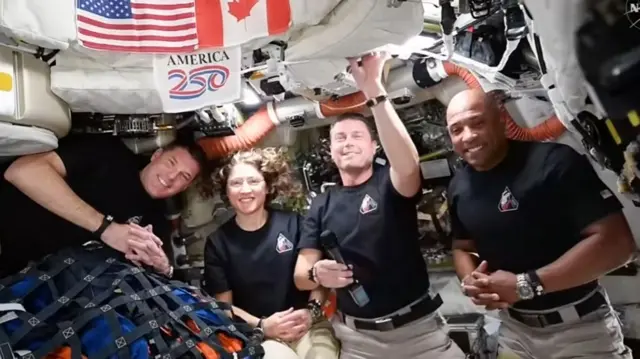
    Four astronauts float inside a spacecraft, one holds a microphone. All are smiling.
    Image source, NASA
  12. Watch the moment Artemis II regains contact with Earthpublished at 22:12

  13. Eclipse observation period endspublished at 21:46

    The Nasa science crew has just signed off, thanking the Artemis II crew for their observations.

    Mission control says the solar eclipse observation period has closed, and the team aboard the Orion spacecraft will now begin “down-linking” all of the images and data they have captured over the past seven hours of observation.

  14. Not enough adjectives to describe observations, astronaut sayspublished at 21:32

    Artemis II pilot Victor Glover has just told the crew on the ground that what the four astronauts are currently seeing is “truly hard to describe”.

    “I know this observation won’t be of any scientific value but I’m really glad we launched on April 1st, because humans have probably not evolved to see what we are seeing,” he tells them.

    Commander Reid Wiseman jumped in with his observations:

    “It’s just indescribable. No matter how long we look at this, our brains are not processing this image in front of us. It is absolutely spectacular, surreal… there’s no adjectives, I’m going to need to invent some new ones, there’s absolutely no words to describe what we are looking at out this window.”

    As Glover described something he said was orange, the crew on the ground said the reddish object was likely Mars.

    “Good opportunity to look to the future of where we’re going,” mission control tells the four aboard the Orion spacecraft.

    The crew joked they wanted 20 new superlatives added to the mission summary tomorrow, to assist with their descriptions.

  15. ‘The Earth is so bright out there’published at 21:24

    Earlier we heard Nasa astronaut Victor Glover describe what he was seeing during the solar eclipse period as “sci-fi” and “unreal”. He also described the view of the corona of the sun.

    Here is what he said:

    This continues to be unreal.

    The Sun has gone behind the Moon and the corona is still visible, and it’s bright and creates a halo almost around the entire moon.

    But when you get to the Earth side, it’s the Earth shine that’s already shown.

    I mean almost seconds after the Sun set behind the Moon, you could see Earth shine.

    The Earth is so bright out there and the Moon is just hanging in front of us.

    This black orb out in front of us now, not the blackness but the grey that blends and drifts into the blackness. We can see stars and planets behind it.

    Christina is in window one, Reid is in window two with the long lens and Jeremy is describing it in window three.

    It is quite an impressive sight.

You can still see the horizon with a brighter… where the sun set on that side of the Moon. And the Earth shine is very distinct and it creates quite an impressive visual illusion.

Wow it’s amazing.”

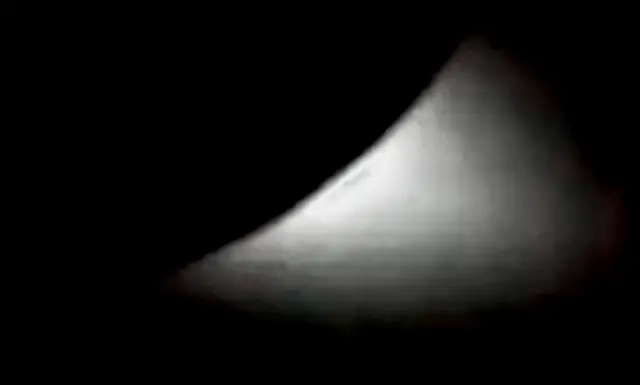
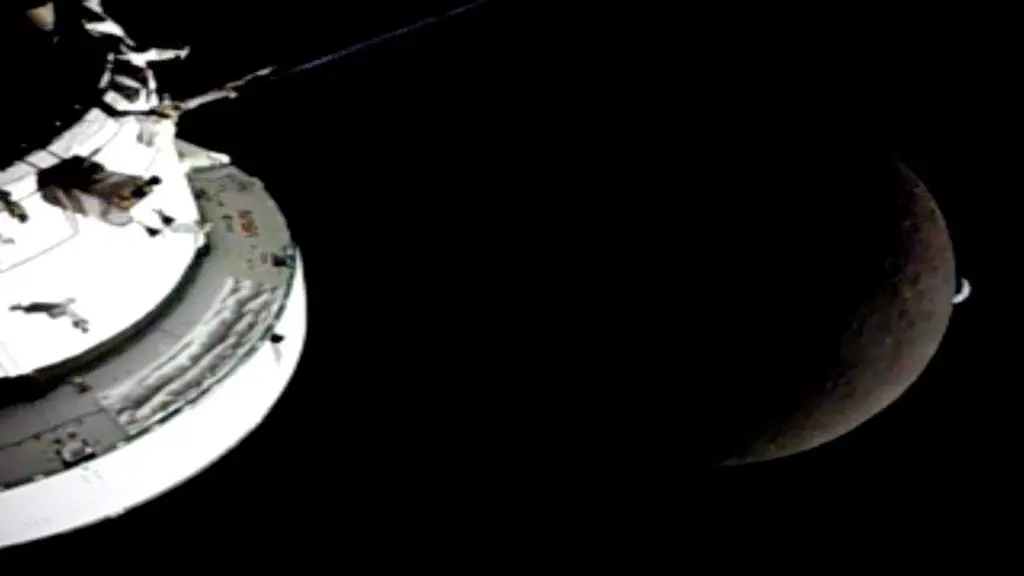
A black and white low-resolution image shows a solar eclipse as seen by the Artemis II astronauts

Image caption,An image of the solar eclipse

.

https://ichef.bbci.co.uk/ace/standard/1024/cpsprodpb/145b/live/93bf3700-320a-11f1-b297-95b0a0a8331e.jpg.webpFrom space

.

.

Click the link below for the complete article (differs slightly:

https://www.bbc.com/news/live/clyr8k06jv7t

.

__________________________________________

Live Updates: Artemis II Crew Takes Call From Trump After Historic Journey Around the Moon

Leave a comment

Click the link below the picture

.

As they traveled back toward Earth following a solar eclipse and a communications blackout, President Trump called the space capsule to praise the four astronauts on their success.

On the sixth day, 248,655 miles from Earth, four people ventured farther from home than any human being who has ever lived.

Embraced by the moon’s gravitational pull, four astronauts accelerated Monday afternoon on a path to swing around the lunar far side, five days after launching on the Artemis II mission from the Kennedy Space Center in Florida.

President Trump calls the Artemis II astronauts after their historic journey.

President Trump spoke with the astronauts of the Artemis II mission hours after their spaceship swung around the far side of the moon and took them farther from Earth than any humans on Monday.

“You’ve made history and made all America really proud,” Mr. Trump said, and later acknowledged the contribution of the Canadian member of the mission, Jeremy Hansen.

Jared Isaacman wrapped up the Q&A by thanking the astronauts for taking us to the moon with them. “We are just honored to be a part of that,” Reid Wiseman said.

When asked how this mission change’s humanity’s future among the stars, Victor Glover, the mission’s pilot, said he had huge expectations for what’s coming next.

Isaacman next asked what thoughts filled the astronauts’ minds when they were out of contact. The mission specialist, Jeremy Hansen, said they were so busy that they just tried to do a good job collecting science observations. But Reid Wiseman added they had a a brief moment eating maple cookies to celebrate Canada’s participation in Artemis II.

Isaacman then asked what were some words that come to mind when the astronauts try to wrap their minds around this very unique experience.

Christina Koch said, “Humility,” talking about all the people who came before.

Next question: what advice would you pass on to the Artemis III mission, which is to orbit the Earth and test docking with lunar landers in 2027. The pilot, Victor Glover, says they’ve been taking notes to pass on. How the astronauts pack is apparently very important. He also brought up the troubles with the toilet. Isaacman, in response, acknowledged, “We definitely have to fix some of the plumbing.”“What inspires you?” is the next question to the crew. Wiseman, noting he is now over 50, says it all comes back to family.

Reid Wiseman, the mission commander, said, “We’ve got to explore. We’ve got to go farther.”“I’m not ready to go home,” Christina Koch said, who noted how much fun she’s having in spite of the cramped quarters.

.

https://static01.nyt.com/images/2026/05/06/multimedia/06moon-flyby-pinned-post-gtzk/06moon-flyby-pinned-post-gtzk-jumbo.jpg?quality=75&auto=webpNASA’s Lunar Science Team at Johnson Space Center in Houston watching the Artemis II flyby of the Moon.Credit…Cassandra Klos for The New York Times

.

.

Click the link below for the complete article:

https://www.nytimes.com

.

__________________________________________
Isaiah 59:14, Jeremiah 5:21

12 Comments


.

.

“It is not 

Necessary for a presidential candidate to be able to read or even write even a congenital idiot can run for the presidency of the United States of America and serve if you were elected “

Edgar Rice Burroughs 


EVIL PEOPLE

They had been long accustomed to do evil. They were taught to do evil; they had been educated and brought up in sin; they had served an apprenticeship to it, and had all their days made a trade of it. It was so much their constant practice that it had become a second nature to them. – Matthew Henry


“When a clown moves into a palace, he doesn’t become a king, the palace instead becomes a circus. — Turkish proverb,”


Hmmmmm…History is repeating itself yet again!


Isaiah 59:14

New Living Translation

14 Our courts oppose the righteous,
and justice is nowhere to be found.
Truth stumbles in the streets,
and honesty has been outlawed.


Jeremiah 5:21

New Living Translation

21 Listen, you foolish and senseless people,
with eyes that do not see
and ears that do not hear.

.

__________________________________________

Isaiah 59:9-15

8 Comments

.

This sounds just like today’s World although it was written about Israel in Babylonian captivity.

History repeats itself

Isaiah 59:9-15

New Living Translation

So there is no justice among us,
and we know nothing about right living.
We look for light but find only darkness.
We look for bright skies but walk in gloom.
10 We grope like the blind along a wall,
feeling our way like people without eyes.
Even at brightest noontime,
we stumble as though it were dark.
Among the living,
we are like the dead.
11 We growl like hungry bears;
we moan like mournful doves.
We look for justice, but it never comes.
We look for rescue, but it is far away from us.
12 For our sins are piled up before God
and testify against us.
Yes, we know what sinners we are.
13 We know we have rebelled and have denied the Lord.
We have turned our backs on our God.
We know how unfair and oppressive we have been,
carefully planning our deceitful lies.
14 Our courts oppose the righteous,
and justice is nowhere to be found.
Truth stumbles in the streets,
and honesty has been outlawed.
15 Yes, truth is gone,
and anyone who renounces evil is attacked.

The Lord looked and was displeased
    to find there was no justice.

.

__________________________________________
Words From a Follower of Christ

4 Comments

Click the link below the picture

.

You might find these videos enlightening!

.

A. R. Bernard: one of many

.

.

Click the link below for the videos:

https://www.youtube.com

.

__________________________________________
Why experts called off a major humpback whale rescue effort

Leave a comment

Click the link below the picture

.

A humpback whale nicknamed Timmy that has been stranded in the Baltic Sea off Germany will be left to die; all rescue efforts have been called off, according to Till Backhaus, environment minister of the German state where the whale is now stranded.

The 12- to 15-meter-long whale became stuck on sandbanks a few times at the end of March—in one incident, it was freed with the help of an excavator that dug an escape channel, and in another, it freed itself. Currently, Timmy is beached on a small island near the port of Wismar, Germany, in the Baltic. Reports suggest the animal, which is thought to be male but whose sex has not been fully confirmed, is exhausted, breathing irregularly, and hardly moving.

Marine biologist and whale conservationist Fabian Ritter has been following the situation in the media and has been in regular contact with those on the ground. Scientific American’s German-language sister publication Spektrum der Wissenschaft spoke with Ritter about the difficult decision to halt rescue efforts and needed changes in policy and individual actions around such incidents.

Experts and others have voiced varying opinions about the state of the whale’s health. Why has that been so difficult to assess?

We are primarily dependent on external signs from the animal’s behavior. Is it breathing regularly, and how forcefully [is it doing so]? What does [its] skin look like? What is its general condition? These are things we can only roughly assess. What we do know, however, is that the humpback whale has endured weeks of suffering because it was entangled in a fishing net, which has certainly weakened it considerably. And there are still pieces of the net in its mouth, which is why it might not be able to eat, even if it wanted to. It is growing weaker and is now likely nearing the end of its life.

Throughout this saga, have you seen any hopeful signs that the whale might pull through?

Five or six days ago, I gave the whale no chance at all—and was then surprised when it freed itself again. But my hopes remained low. In the past few days, it has only circled a few times and then settled down again. This suggests that it is pretty much at its physical and mental end.

If the whale had made it to the open sea, would it be safe?

Had [the whale] gotten moving again and swum in the right direction, [it] would have still had hundreds of kilometers to go to reach the Atlantic. It was certainly within [the whale’s] grasp that [the animal] would have found [its] way. But the net in [its] mouth is likely causing [it] pain and preventing [it] from eating much, if anything. Ultimately, that would be a death sentence, no matter how far [it] manages to swim.

What exactly is the next step? Will this marine mammal just die naturally? There has also been talk of euthanasia.

Euthanasia has been ruled out by all involved. Such an undertaking is logistically too difficult, especially because the animal is currently lying on muddy ground. And then there’s the question of how exactly it would be done. There are three possibilities: One could, for example, inject a high dose of toxin. But no one knows how much a humpback whale would need. The second option is the use of high-caliber firearms. The problem with this is that the shot would have to be extremely precise; otherwise the animal would suffer even more. The third option would be an explosive device. While this would be the most effective, what if cameras were rolling? The world would be watching. No, that wouldn’t be a good solution. [More about whales: Scientists saw a sperm whale giving birth. And then things got weird]

What happens after the death of the marine mammal?

The carcass [will be] hauled onshore with heavy equipment, and veterinarians [will] thoroughly examine it: blood tests, internal injuries, pollutant levels, parasites. Naturally, everyone is interested in determining the actual damage the net caused in its mouth or digestive tract. Afterward, the whale must be butchered and disposed of.

How did the whale get into this predicament? Is there any more information about it now?

The main reason is likely the net. It’s unclear whether [the whale] got entangled in it in the Baltic Sea or already in the North Atlantic. If the latter is true, [the animal] arrived weakened and was therefore already in great distress. Another possibility is that [it] ended up in the Baltic Sea as a stray—perhaps with a preexisting condition and disorientation. Reasons for this could include hearing damage from underwater noise. Sometimes humpback whales simply appear in unexpected areas. Therefore, it’s possible [it] was simply curious and ended up in the Baltic Sea for that reason. Such things happen from time to time.

What is the most likely scenario?

[The whale] probably got lost. I think it’s rather unlikely that [the animal] deliberately swam into the Baltic Sea. What is certain is that when [it] was first sighted [in early March], the net was already wrapped around [its] body. That certainly made [its] predicament worse.

Although the whale has been largely freed from the lines, its situation hasn’t improved. Could there be a deeper problem with the whale’s ability to navigate?

The question is: How exactly does [it] navigate in the Baltic Sea? Does [it] use [its] sense of taste, Earth’s magnetic field, [its] hearing? Or does [it] orient [itself] by water temperature? Experts are debating which is the most important sense for a baleen whale. The fact is, [this whale] is getting weaker, and with that, [its] senses are diminishing. And perhaps [it] is also losing the motivation, the strength, and the ability to decide where to swim.

How do you assess the measures taken to save the humpback whale in retrospect?

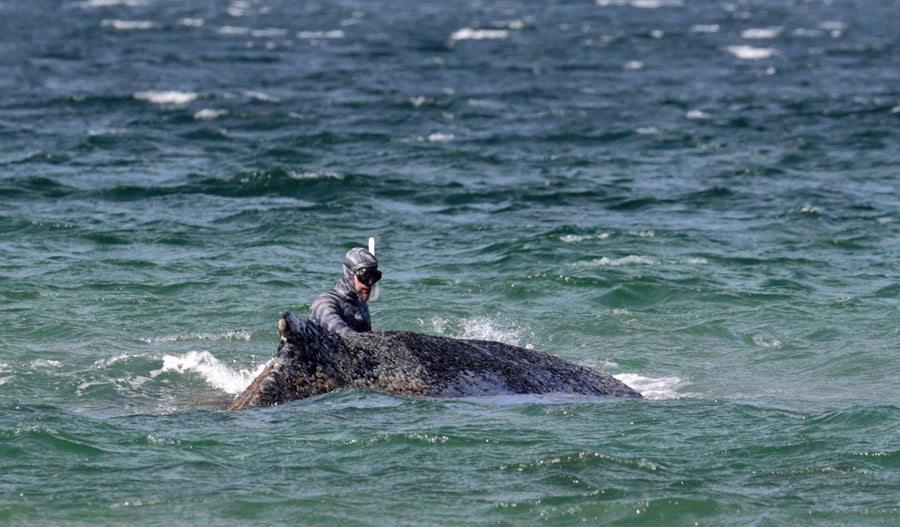
That’s a difficult question. From my perspective, the strategy was sound. Giving the animal periods of rest and then motivating it again—that was the right approach. The decision to enter the water with it was rather unwise, however. If you ask whale experts from rescue teams worldwide, they all say the same thing: don’t go into the water with the whale—and certainly not alone. A careless movement could lead one to be struck by a fluke or otherwise injured. There’s no easy solution for such situations. The team from the Institute for Terrestrial and Aquatic Wildlife Research (ITAW), the German Oceanographic Museum and Greenpeace ultimately used a trial-and-error approach to see what could be done. If the whale dies, no one on the rescue team can be blamed afterward. The odds were stacked against them from the start.

And what about the decision not to remove the gillnet from the mouth—was that the right call?

I think they should have tried. When the whale was still in [Timmendorf Strand, Germany], there was at least a chance. But that was only possible with a specialized team and specialized equipment. In hindsight, though, we should be thinking more about what we can do differently in the future to prevent whales from ending up in this situation again. After all, it’s a very visible and tragic victim of fishing.

What types of political action could help these situations?

Marine conservation organizations working to protect whales have long been calling for an end to bottom trawling and gillnet fishing—at least within protected areas. These fishing methods destroy habitats and are responsible for horrendous bycatch. Every year, 300,000 whales and dolphins die worldwide, along with millions of seabirds, not to mention sharks. Thousands of harbor porpoises are killed in nets in Europe every year. And that’s despite the fact that they are a strictly protected species.

How is it even possible that fishing is taking place in a marine protected area?

We marine conservationists have been asking ourselves this question for decades. Fishing is just one of many uses [for protected areas]. Shipping, gravel extraction, tourism, and military exercises also take place in protected areas; some even contain wind farms. It’s absurd what’s going on in these so-called protected areas today.

Do you see any chance of this current case bringing about a change of heart?

Yes, because the connection couldn’t be clearer. Backhaus is now called upon to give serious consideration to the problem of bycatch in gillnet fisheries. I hope that the fate of the lost whale will serve as a wake-up call and motivate people to take action. And by that, I don’t just mean politicians—we are all called upon to act. Ultimately, with every tuna steak, every salmon fillet or every cod on our plates, we are contributing to the plundering of the oceans. At least, that’s the case if the fish don’t come from explicitly sustainable fisheries or aquaculture.

Isn’t the fact that so many people are touched by the whale’s fate a good sign? Is a shift in values perhaps taking place?

I think this could be an opportunity for a shift in values. We should recognize that our emotion reveals an ambivalence. We’re anxiously following the plight of the humpback whale, yet at the same time, we have salmon fillets and sausages sitting in our refrigerators. If the fate of a whale affects us so deeply, then the deaths of the 300,000 marine mammals that perished in nets should also affect us deeply. We urgently need to ask ourselves: How should we treat the oceans and animals? These are indeed profound ethical questions, but the story needs to be brought to this level. If we translate our compassion into action, the whale’s death will not have been in vain.

.

https://static.scientificamerican.com/dam/asset/a4136634-7751-4e30-8926-2802331e669f/3E4E7PR-alamy-humpback-whale-biologist.jpeg?m=1775160760.473&w=900

Marine biologist Robert Marc Lehmann tries to help the stranded whale on a sandbank off Niendorf in the Baltic Sea on March 26, 2026. IMAGO/Susanne Hübner, Susanne Huebner via Alamy

.

.

Click the link below for the complete article:

https://www.scientificamerican.com/article/why-humpback-whale-rescue-effort-got-called-off/

.

__________________________________________
Think Robots Are Impressive Now? Just Wait Until They Have 6G

Leave a comment

Click the link below the picture

.

This next-generation network technology won’t just make our phones faster; it’ll unlock new capabilities in robots, turning them into all-sensing, always-learning fleets.

Why are there so many robots at a show focused on phones? This is the question I asked myself as I roamed the halls of Mobile World Congress, on the lookout for the most exciting technology that will define the next few years.

The first and most obvious answer is that robots draw crowds. A dancing humanoid is an easy way to attract people to your booth. But to see the robots at this year’s MWC purely as a publicity stunt would be to ignore the bigger conversation happening around robots and connectivity.

Already in 2026, we’ve seen major leaps forward in robotics, with companies including Boston Dynamics and phone-maker Honor showing off humanoid robots designed for industry and home environments. But there is yet another level to unlock, and it relies on 6G — the next-generation network technology set to succeed 5G in 2030 and beyond.

On the surface, 6G and robotics might seem distinctly unrelated — beyond being technologies of a future that we’re not living in quite yet. But in this future, 6G will open new doors for humanoid robots that’ll transform them from clunky, standalone mechanical figurines into efficient fleets, where individuals will form part of an all-sensing, always-learning ecosystem.

This will happen first in industry, then in hospitality and care environments, before potentially landing in our homes. It’s an exciting prospect, but as the experts I spoke to at MWC last month cautioned, there’ll be some big leaps in technology required before they, and we, are ready for that.

The power of 6G

To understand how 6G will unlock new possibilities for robots, let’s start with the special capabilities the network technology will have. 

The first is that 6G will act as a sensor network, with sensors embedded into both the robots and their environments, Qualcomm’s executive vice president of Robotics Nakul Duggal told me. 

This allows the 6G radio to act like radar — constantly scanning and mapping its surroundings in real time to detect obstacles. Imagine a robot attempting to navigate a crowded environment: The 6G network should quickly and cheaply help create a kind of virtual map for it to do so safely.

Second, there’s the pure speed at which 6G will communicate vast reams of data. The 5G networks we currently use aren’t necessarily built to handle AI requests, but the 6G networks will be, providing a consistent, low-latency, relatively low-power way to process intelligence and deliver that intelligence to robots, according to Frank Long, associate director of intelligent services at deep tech research firm Cambridge Consultants. 

Private 5G networks combined with edge AI (relying on devices for computing, not just the cloud) can fill the gap for now, but public networks, not so much. By contrast, Long said, “with 6G you can pretty much have that quality of service guarantee.”

Cambridge Consultants brought a demo of an autonomous humanoid robot to MWC that can pick up and place down a box based on where it sees you pointing. The gesture recognition, plus the ability to react in real time, while varying its grip to pick up something that might be on an angle, requires an enormous amount of compute power. (The demo was powered by a private 5G network.)

Whether robots are connected to the cloud, or to each other in a peer-to-peer fleet, the network will need to handle their intelligence demands at speed. For robots to be constantly talking to the infrastructure around them — and to each other — a strong, reliable uplink will be required, explained Anshuman Saxena, general manager of robotics at chipmaker Qualcomm.

He gave the example of two robots working in a retail environment where one is unloading soda cans from a truck, and another is restocking shelves. They’ll need to align on how to read the space around them to complete each task, including understanding how many cans will need placing, and when they’ll be ready.

“The only way is this robot, while shelving, goes to the back door entry of the truck that is getting unloaded and sees what is available,” said Saxena. “Or the robot that’s unloading is communicating the bigger picture to every other robot, so that we have a view of where the things are placed, so that they can plan.”

This is what’s known as long-horizon planning, where a robot isn’t just focusing on the immediate task but thinking about how that task fits into a broader context over a longer timeframe within a dynamic and unstructured environment. In other words, it’s performing the kind of ongoing mental multitasking that humans do on a daily basis, reacting at speed to what’s going on around us, while also considering what’s next. In the Cambridge Consultant demo, the robot was capable of thinking 16 steps ahead.

Meanwhile, lightning-fast 6G will help robots make split-second decisions, based on feedback not just from their own sensor-packed bodies, but from other robots and tech in the environment. “The retail stores have cameras,” said Saxena. “It’s not a robot, but it can be the eyes of the robot.”

For robots, every day will be a school day

In your own home, you might have only a single humanoid robot. But that won’t be as different from the retail scenario as you may think.

That’s because many of the devices you own, including your phone and security cameras, can already communicate with each other, and the robot will be just another one in the mix. Or maybe you’ll have one humanoid and a bunch of smaller robots designed for specific tasks.

“There is a fleet aspect in the products that we use,” Duggal said. “You don’t feel that, but that is exactly how the product is working.” 

Keep in mind that your phone is both a physical object itself and all the software and data that are managed elsewhere. The phone also provides feedback to refine that software, as will the 6G-equipped robots.

“So a robot is going to be performing a certain physical task, and while it may perform it in your home, if it’s also performing the same task in many other homes, there is this aspect of learning and deployment,” Duggal said.

This continuous learning is perhaps one of the biggest challenges that 6G is expected to help solve in robotics. Robots and AI will need massive amounts of real-world data that today’s networks can’t keep up with, even for mundane tasks.

For example, picking up and serving you a cup of coffee, which involves dexterity and balance, with the added element of heat. A robotic arm might not care about the temperature. “But if it is hot, how would we react?” said Saxena. “We would just quickly leave it, which is a very fast reaction time.” 

The speed of 6G networks will be essential. By the time a robot arrives in our homes, we will want to know that it shouldn’t hand us a scalding-hot drink and how to protect itself from damage.

Much of this learning might have taken place in hotels or restaurants, where overnight, robots load and unload dishwashers and reset the kitchen. The robot will bring that training into your home, where it’ll still need to further learn about your unique layout and routine. This will likely be a time-consuming process.

“It’s going to be incredibly challenging,” said Long. “Put it this way, members of my immediate family still struggle with opening the baby gate in my stairs, even after extensive training. So a robot, I think, might be a few years away from opening that baby gate.”

Readying robots for 6G… and our homes

But 6G is not expected to roll out widely until at least 2030. What are the robots that companies are already building and deploying to do until then?

They’re making the leaps and bounds they can with the networks of today. “So you’re not waiting for 6G,” Saxena said, “but when the connectivity comes along, you are talking about experiences which can be way beyond what robotics can do [today].”

While the confluence of robotics and 6G will indeed unlock some hitherto unseen next-level robotics, there is plenty that robots can learn in the meantime — particularly when it comes to improving dexterity — to prime them to take advantage of better connectivity. That’s especially true if we’re ever to consider inviting humanoids into our homes, an idea that feels, at least for now, like something worth delaying until at least the 6G-enabled 2030s — if not beyond.

.

https://www.cnet.com/a/img/resize/75094cedeedddd58cdf0ec874a0f8684485c9ccd/hub/2026/04/03/2dbef5a0-fbb8-41ea-8c5d-f44d6f762940/image-15.png?auto=webp&fit=crop&height=675&width=1200

The confluence of two seemingly distinct technologies will result in new capabilities for robots. Jeffrey Hazelwood/Katie Collins/CNET

.

.

Click the link below for the complete article:

https://www.cnet.com/tech/computing/think-robots-are-impressive-now-just-wait-until-they-have-6g/

.

__________________________________________

Iran War Live Updates: U.S. Rescues Downed Air Force Officer Deep Inside Iran, Trump Says

Leave a comment

Click the link below the picture

.

Here’s the latest.

An Air Force weapons officer whose fighter jet had been shot down in Iran was rescued by U.S. Special Operations forces in a risky Saturday night mission that took commandos deep into enemy territory, said current and former U.S. officials briefed on the operation.

President Trump confirmed in social media post just after midnight that the stranded officer had been brought out of Iran safely by U.S. forces. “He sustained injuries, but he will be just fine,” Mr. Trump said. He added the there were no U.S. casualties among the rescuers.

President Trump said in a social media post just after midnight that the Air Force officer whose jet was shot down in Iran had been brought out safely by U.S. forces. “He sustained injuries, but he will be just fine,” Trump said.

Commandos save crew member of U.S. warplane shot down deep in Iran.

An Air Force officer whose fighter jet had been shot down in Iran was rescued by U.S. Special Operations forces in a risky Saturday night mission that took commandos deep into enemy territory, said current and former U.S. officials briefed on the operation.

The rescue followed a life-or-death race between U.S. and Iranian forces that stretched over two days to reach the injured airman, who was a weapons officer, the officials said. In the end, U.S. commandos extracted the officer in a massive operation that involved hundreds of special operations troops.

There were no U.S. casualties among the rescue team, a senior U.S. military official said. All the commandos, and the weapons officer returned safely. Rescue planes flew to Kuwait to treat the injured weapons officer.

A building housing several government ministries in Kuwait was significantly damaged after it was targeted by an Iranian drone on Saturday evening, the country’s Ministry of Finance said. The Ministries Complex houses agencies, including the finance, justice, and industry and commerce ministries. No casualties were reported, the ministry said, adding that employees would work remotely on Sunday.

Kuwaiti authorities said early Sunday that drone strikes they attributed to Iran significantly damaged two power and water desalination plants, forcing the shutdown of two electricity-generating units. Kuwait Petroleum Corporation also said its oil complex in the Shuwaikh district in Kuwait City was targeted by Iranian drones early Sunday, sparking a fire, causing damage, and prompting the evacuation of the building. No casualties were reported in either attack, the company and Kuwait’s Ministry of Electricity, Water and Renewable Energy said in a joint statement.

The Human Rights Activists News Agency reported that at least nine civilians were killed across Iran in the past 24 hours during U.S. and Israeli strikes. The group recorded 272 attacks in 14 provinces on Saturday, with a total of at least 184 people injured or killed. Tehran saw the highest number of strikes, followed by Khuzestan and Isfahan.

Here’s what happened in the war in the Middle East on Saturday.

U.S. forces on Saturday continued their search for an American crew member whose fighter jet was shot down over Iran on Friday, as the Israeli military struck a major petrochemical complex in Iran.

The search-and-rescue operation for the missing airman entered its second day after Iran brought down an Air Force F-15E fighter jet carrying two crew members. U.S. officials said on Friday that one had been rescued but have since offered no updates on the operation to recover the second airman.

Israel struck Iran’s largest petrochemical complex.

Israel attacked Iran’s largest petrochemical industrial complex in the city of Mahshahr on Saturday, a move that has effectively shut down all production across the sprawling complex, according to two senior Iranian oil ministry officials.

The airstrikes targeted two utility plants, known as Fajr 1 and Fajr 2, that provided the over 50 petrochemical plants operating inside the complex with the basic services needed to function — gas, power and industrial water, among others — according to Iranian state media reports and the two senior Iranian oil ministry officials, who spoke on condition of anonymity to discuss sensitive matters.

.

https://static01.nyt.com/images/2026/04/04/multimedia/04HP-IRAN-tqmh/04HP-IRAN-tqmh-threeByTwoMediumAt2X.jpg?quality=75&auto=webpA screenshot of U.S. aircraft over southwest Iran on Friday

.

.

Click the link below for the complete article:

https://www.nytimes.com

.

__________________________________________

Older Entries

MRS. T’S CORNER

https://www.tangietwoods

Amor Entre Estrellas

¡Bienvenido de vuelta viajero!

Heart of Loia `'.,°~

so looking to the sky ¡ will sing and from my heart to YOU ¡ bring...

Michael Ciullo

CEO and Founder of Nsight Health

Nelson MCBS

Catholic News, Prayers, HD Images, Rosary, Music, Videos, Holy Mass, Homily, Saints, Lyrics, Novenas, Retreats, Talks, Devotionals and Many More

Global geopolitics

Decoding Power. Defying Narratives.

Talk Photo

A creative collaboration introducing the art of nature and nature's art.

Movie Burner Entertainment

The Home Of Entertainment News, Reviews and Reactions

Le Notti di Agarthi

Hollow Earth Society

C r i s t i a n a' s Fine Arts ⛄️

•Whenever you are confronted with an opponent, conquer him with love.(Gandhi)

TradingClubsMan

Algotrader at TRADING-CLUBS.COM

Comedy FESTIVAL

Film and Writing Festival for Comedy. Showcasing best of comedy short films at the FEEDBACK Film Festival. Plus, showcasing best of comedy novels, short stories, poems, screenplays (TV, short, feature) at the festival performed by professional actors.

Bonnywood Manor

Peace. Tranquility. Insanity.

Warum ich Rad fahre

Take a ride on the wild side

Madame-Radio

Découvre des musiques prometteuses (principalement) dans la sphère musicale française.

Ir de Compras Online

No tiene que Ser una Pesadilla.

Kana's Chronicles

Life in Kana-text (er... CONtext)

Jam Writes

Where feelings meet metaphors and make questionable choices.

emotionalpeace

Finding hope and peace through writing, art, photography, and faith in Jesus.

WearingTwoGowns.COM

The Community for Wounded Healers: Former Medical Students, Disabled Nurses, and Faith-Fueled Pivots

...

love each other like you're the lyric to their music

Luca nel laboratorio di Dexter

Comprendere il mondo per cambiarlo.

Tales from a Mid-Lifer

Mid-Life Ponderings

Creative

Travel,Tourism, Life style "Now in hundreds of languages for you."

freedomdailywriting

I speak the honest truth. I share my honest opinions. I share my thoughts. A platform to grow and get surprised.

The Green Stars Project

User-generated ratings for ethical consumerism

Cherryl's Blog

Travel and Lifestyle Blog

Sogni e poesie di una donna qualunque

Questo è un piccolo angolo di poesie, canzoni, immagini, video che raccontano le nostre emozioni

My Awesome Blog

“Log your journey to success.” “Where goals turn into progress.”

pierobarbato.com

scrivo per dare forma ai silenzi e anima alle storie che il mondo dimentica.

Thinkbigwithbukonla

“Dream deeper. Believe bolder. Live transformed.”

Vichar Darshanam

Vichar, Motivation, Kadwi Baat ( विचार दर्शनम्)

Komfort bad heizung

Traum zur Realität

Chic Bites and Flights

Savor. Style. See the world.

ومضات في تطوير الذات

معا نحو النجاح

Broker True Ratings

Best Forex Broker Ratings & Reviews

Blog by ThE NoThInG DrOnEs

art, writing and music by James McFarlane and other musicians

fauxcroft

living life in conscious reality

Srikanth’s poetry

Freelance poetry writing

JupiterPlanet

Peace 🕊️ | Spiritual 🌠 | 📚 Non-fiction | Motivation🔥 | Self-Love💕

Sehnsuchtsbummler

Reiseberichte & Naturfotografie