Casserole dishes may have gone out of style, but they can still turn a tidy profit
Iconic cookware
Whether you opted for snowflakes or daisies, Pyrex dishes were a staple of the ’70s and ’80s. If you’ve got any of this iconic cookware hiding in your cupboard or stored away with the festive mugs, we recommend a bit of Spring cleaning.
You’re not guaranteed a goldmine, with some dishes on eBay starting from around £10, but there’s a chance you may get lucky: Some vintage CorningWare sets are currently up for sale in the hundreds. And, it doesn’t stop there! A 2-piece CorningWare set is currently up for over £7,300.
Lettera 22 typewriter on a black background.
Click, clack, thunk. It’s the sound of a stressed Seventies secretary at work
Typewriters
When convenience starts removing the more whimsical side of life, like the melodic clunk of a typewriter, we all seem to long for something less streamlined and more mechanical.
A hand-typed letter certainly has something more special to it than a text, and the vintage technology is readily available. Prices start at about £30 on eBay, but special edition machines can head upwards of £700.
VCR recorder
Nothing beats your favourite film on demand, except maybe a hidden treasure in the attic
VCR recorder
If you remember the day you stopped running from the bus to your TV set at home, there’s a chance you’ve encountered a VCR. Long before streaming services, when the thought of Netflix or Amazon Prime would be tantamount to a hoverboard, a video recorder made you the coolest kid on the block.
Watching films or recording the latest episode of your favourite show might not sound revolutionary now, but we’re clearly feeling nostalgic for early tech inventions. You could make a good profit with one VCR recorder listed for over £250 and others circling £100.
Luke Skywalker action figure in original packaging.
Luke Skywalker fronted the beloved sci-fi franchise and made it onto wishlists around the world
Luke Skywalker action figure
In a galaxy far, far away, ’70s kids sat in the cinema not knowing they were watching history unfold on the big screen. Childhood toys naturally hold a special place in our hearts, even when Luke’s telekinetic powers failed to materialise in our own lives. If your birthday list included a figurine or two, now would be the time to dig them out. Unboxed figurines start at about £30 on eBay – dependent on rarity and, of course, condition. Sotheby’s 2015 auction is sure to excite you. Just over 10 years ago, a boxed figurine sold for almost £20,000.
Train sets
Choo, chug or chuff, your old train sets are steaming ahead to a new owner
Train sets
Train connoisseurs take their model railways seriously, and if you were lucky enough to discover your passion early on, it might be time to pick up that whistle once more. Hornby is an iconic brand and sets of these beloved toys go for around £100 on eBay, with some active listings reaching over £2000. That’s a first-class ticket to a healthier bank balance (and a tidier downstairs cupboard).
IKEA furniture
Early IKEA is a coveted find for furniture lovers
IKEA furniture
Vintage furniture has a reputation for quality, from raw material to long-lasting construction. While IKEA might bring to mind horror stories of flatpack arguments, even the Swedish furniture company has a more, if you’ll pardon the pun, solid reputation in its past production lines.
Their 1970s Cavelli armchair could potentially go for over £10,000, and even older models can fetch more. In other words, it might be worth looking for gold in the sofa itself, rather than just its cushions.
Original Sony Walkman shown with orange headphones in an exhibition case.
The original ‘Walkman’ made music portable, and buyers are keen to splash out on that heady nostalgia
Original ‘Walkman’
The first Sony ‘Walkman’ snuck in just before the decade’s end, arriving in stores in 1979. Private listening wasn’t just confined to a slammed bedroom door; now you could moodily walk through the local park with headphones blaring AC/DC’s Highway to Hell.
If you’re happy parting with your ‘Walkman’ in favour of a Bluetooth headset, it could be worth a rummage in your cupboards. Complete kits are listed for as much as £1,500 on eBay. Perfect pocket money for a new set of vinyl records – wait, vinyl’s back too?
Israeli forces advanced in southern Lebanon on Monday, raiding new territory as part of a stated effort to expand a military-controlled buffer zone as it steps up its campaign against the Iran-backed armed group Hezbollah.
Israeli fighter jets also bombarded the southern outskirts of Beirut, the Lebanese capital, sending huge explosions echoing throughout the city. Earlier on Monday, Israel had threatened to begin attacking sites affiliated with Al-Qard Al-Hasan, Hezbollah’s de facto bank.
Israeli ground forces began raiding an area close to the border with Lebanon, the military said in a statement, after advancing in the border area over recent days and seizing new sites inside Lebanon.
Nearly 400 people had been killed, including more than 80 children, in the conflict in Lebanon as of Sunday, according to the Lebanese health ministry. Edouard Beigbeder, the regional director for UNICEF, the United Nations’ children’s agency, called the death toll “a stark testament to the toll that conflict is taking on children.”
The Israeli military said on Sunday that it had killed more than 190 militants, without commenting on the rest of the dead.
The conflict ignited last week, when Hezbollah launched a rocket attack against Israel, in retaliation for the killing of Ayatollah Ali Khamenei, whom Israel assassinated in the opening strikes of the U.S.-Israeli war with Iran. Since then, the Israeli military has responded with an escalating military campaign across Lebanon.
Lebanon’s Parliament announced on Monday that it would postpone for two years legislative elections that had been set to take place in May because of the conflict. The Lebanese government has faced considerable pressure to disarm Hezbollah, which is also an entrenched political party and social movement.
Hezbollah is facing rising public frustration at home, where some Lebanese say they have now been dragged unwillingly into a dangerous and deadly confrontation with Israel without any clear benefit.
Analysts say the Israeli actions could signal that a wider ground invasion in Lebanon is in the works. The Israeli military has called up roughly 100,000 reserve soldiers as part of the war with Iran, some of whom have been sent to the northern border.
Lt. Col. Nadav Shoshani, an Israeli military spokesman, dismissed that prospect. “This is part of our forward defense posture. This is a measure to make sure that our troops in those positions are safe,” Lt. Col. Shoshani told reporters on Monday.
More on the Fighting in the Middle East
Iran’s De Facto Leader: Ali Larijani, the head of Iran’s Supreme National Security Council and a close confidant of Ayatollah Ali Khamenei, said Iran was determined to avenge the killing of Khamenei.
Israel Strikes Oil Facilities: The Israeli military struck several Iranian fuel sites, sending huge balls of fire and smoke into the air and causing explosions in Tehran and the neighboring city of Karaj. The attacks appeared to be the first on the country’s energy infrastructure since the war began.
Desalination Plants: Water desalination plants have come under attack in Iran and on the Persian Gulf island of Bahrain, threatening a resource vital to life in the harsh desert climates of the region.
Iran’s Uranium: American intelligence agencies have determined that Iran or potentially another group could retrieve Iran’s primary store of highly enriched uranium even though it was entombed under the country’s nuclear site at Isfahan by U.S. strikes last year, according to multiple officials familiar with the classified reports.
The Spine of a Militarized State: With their pervasive military, political, and economic clout, the Islamic Revolutionary Guards Corps are often considered the main impediment to regime change, or any change, in Iran.
Global Divisions: Brazil, China, and Russia all denounced the U.S.-Israeli attacks, but other nations in the BRICS group haven’t, even though Iran is a fellow member.
U.S. Service Members: Another American service member has died in the war with Iran, the Pentagon said on Sunday, bringing the number of U.S. troops killed in the conflict to seven.
U.S. Assessment on Regime Change: A report by the National Intelligence Council completed before the United States and Israel launched attacks on Iran assessed that even a large-scale military assault on the country would be unlikely to topple its theocratic government, according to U.S. officials briefed on the work.
.
An airstrike in the Dahiya neighborhood in the southern outskirts of Beirut, in Lebanon, on Monday. Credit…Diego Ibarra Sanchez for The New York Times
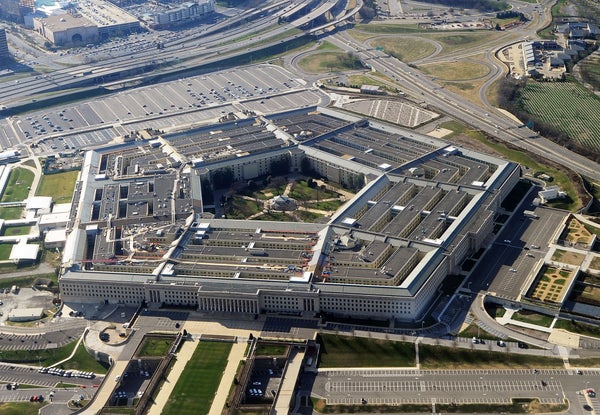
The Pentagon has put Anthropic on the clock. On Thursday, the Department of Defense formally notified the company that it has been deemed a “supply chain risk”—a label that has turned its artificial intelligence systems, including its flagship model, Claude—into a liability.
The move escalates a dispute that has been brewing for weeks over Anthropic’s safety-first ethos—its commitment to limit how its technology is deployed—and the DOD’s demand for unfettered control.
The Pentagon is phasing out Claude, one of the world’s most advanced AI models, from its classified networks within six months. On paper, swapping one model for another appears quick. “It’s simple to swap out the models and to install new ones,” according to a source close to Palantir—a defense-tech giant that has partnered with Anthropic to host Claude inside secure military networks.
The hardest part begins after the model is gone, rewiring everything that’s been built around it.
Claude is what’s known as a frontier model, an AI capable of executing complex, multistep tasks on its own. That’s not how the DOD currently uses it. Lauren Kahn, a researcher at Georgetown University’s Center for Security and Emerging Technology and a former Pentagon official, describes its deployment as more like a chatbot than a free-roaming agent. Claude sits “on top” of existing software, she says, and shows up only in certain places—tightly controlled corners of a classified environment. And it isn’t connected to “effectors,” she says, meaning that it can’t “launch an effect”—a weapon command, for example—“in the real world.”
In late 2024, Anthropic became the first AI company to clear the Pentagon’s classified hurdles. Until recently, Claude was the only large language model publicly known to be operating in that environment. Accessed through tools like Claude Gov—which became a preferred option for some defense personnel, according to Bloomberg—the system taps into enormous data pipelines to turn a flood of unstructured information into readable intelligence. In other words, Claude summarizes information for the Department of Defense, but it can’t pull a trigger.
Once people rely on a tool, it can be hard to let it go. Each integration must be offboarded piece by piece. And whatever replaces Claude must clear strict security reviews and approvals before it touches a classified system. Software changes inside the Pentagon can be “excruciating,” Kahn says. Even something as simple as installing Microsoft Office “takes months and months and months.”
At press time, Anthropic did not respond to multiple requests for comment from Scientific American. The Department of Defense declined to discuss the specifics of the transition.
Unlearning Claude
Every AI model fails in its own characteristic ways. Operators who’ve spent months using Claude learn those quirks through trial and error: which prompts land badly, which outputs require a second look.
Kahn studies automation bias, the tendency of human operators to overdelegate to machines. “I worry about a slightly heightened risk of automation bias in the early stages as they’re working out the kinks,” she says. People will check for Claude’s mistakes while the replacement model makes new ones. The personnel most exposed to the transition will be the power users who built the most customized work flows and learned the model’s downsides well enough to exploit its strengths.
While Pentagon personnel brace for the operational transition, the messy details of the political standoff have spilled into public view. Late on Thursday, Anthropic CEO Dario Amodei published a blog post vowing to challenge the government’s “supply chain risk” designation in court, arguing the statute is typically reserved for foreign adversaries. Behind the scenes, the standoff appears to have devolved into a game of chicken. Emil Michael, the Pentagon official who’s led the department’s negotiations with Anthropic, posted on X that talks with the company are dead. And Amodei is reportedly scrambling to resuscitate them.
Meanwhile, the DOD is already moving on. Within hours of Anthropic’s official blacklisting, OpenAI announced it had signed a deal to deploy its models on the military’s classified networks, securing the contract its rival had just lost.
Anthropic was willing to risk eviction from the U.S. government rather than compromise its safety-first ethos. Its replacement initially accepted the Pentagon’s demand for unfettered operational flexibility—only to hastily add the very surveillance guardrails that Anthropic advocated for after OpenAI CEO Sam Altman faced massive internal and public backlash. The swap may not be so simple after all.
.
The Department of Defense is phasing Anthropic’s Claude out of its classified networks within six months, triggering a complex transition for military personnel. AFP/Stringer/Getty Images
With each generation, parenting styles seem to undergo some sort of transformation. Gen X parents—who are often considered the first latchkey kids—focused on involved parenting (or in extreme cases, helicopter or stealth parenting), while 3 out of 4 Gen Y (or millennial) parents focus on gentle parenting.
Meanwhile, new research indicates that Gen Z parents are moving away from the approaches of their parents and grandparents and creating their own hybrid parenting style. They are focusing on cycle-breaking and cause-and-effect parenting—or a hybrid parenting style, depending on the situation. In fact, only about 38% of Gen Z parents with kids aged 0 to 6 years old use gentle parenting, according to a survey conducted by Kiddie Academy.
“The vast majority—or 4 out of 5—parents polled agree that there’s no one-size-fits-all approach when it comes to parenting,” says Casey Miller, CEO of Kiddie Academy. Most Gen Z parents, he says, aim for a hybrid approach that blends an average of three different parenting styles.
Digging in to the Survey on Gen Z Parenting
Kiddie Academy surveyed 2,000 parents of children aged 0 to 6 years old and found that 54% of Gen Z parents prioritize preparing their kids for the real world, while their millennial counterparts focus more on supporting their children mentally and emotionally. Meanwhile, Gen Z parents feel gentle parenting only works for some situations.
“In general, younger parents believe parenting styles should be blended and used depending on the circumstances,” says Miller.
According to the survey, these younger parents are using a variety of new styles. For instance:3
37% are using cycle breaking (or healing generational trauma)
31% are prioritizing cause and effect (or real-world consequences)
20% are using child-led parenting
“Our survey also asked parents how they might manage real-life situations, such as if their child threw a tantrum in the car,” says Miller. “Forty-two percent of parents would pull the car over until their child calmed down, while 40% would wait until they returned home to provide consequences, and 34% would take their toys away for the remainder of the ride. These reactions blend the cause-and-effect parenting emphasis with a traditional authoritative parenting style for a hybrid approach.”
Overall, Miller says the shift away from gentle parenting is part of a larger trend of blending parenting styles and focusing on each individual child.
“Seven in 10 parents are choosing parenting styles based on what their child needs, as opposed to the 23% who are trying to make their preferred style work regardless of their child’s personality,” says Miller.
Where Gentle Parenting Might Be Lacking
Gentle parenting emphasizes empathy and respectful communication without harsh punishment, explains Cynthia Vejar, PhD, LPC, program director and associate professor of Clinical Mental Health Counseling at Lebanon Valley College.
The shift of Gen Z parents away from gentle parenting suggests less pressure to adhere to a single brand of parenting or to pursue labels. “Instead of chasing these types of labels, parents might instead focus on what kinds of behavior is most or least ideal in their household,” says Dr. Vejar.
Gentle parenting also may be unappealing because it can require a lot of emotional labor from the parent, says Lexi Berard, MA, AMFT, a psychotherapist with Life After Birth. To be effective, parents must have high emotional intelligence and strong emotional regulation skills, she says. In fact, one study found that more than one-third of “gentle parents” report burnout.4
“Gentle parenting is really hard, and some parents are finding themselves frustrated,” adds Berard. “A big misperception about this parenting style is that by acknowledging the feeling, you can avoid tantrums. This isn’t true. No parenting style completely avoids tantrums; it’s about how you as the parent respond.”
Gentle parenting also asks you to be present with the tantrum, acknowledge the feeling, and wait for it to pass, she says. “I think many parents are drawn to other styles that tell them it’s OK to not sit in difficult, uncomfortable feelings, and don’t shame them for getting frustrated with their children,” says Berard.
‘Cycle‑Breaking’ vs. Hybrid Parenting
When parents take a hybrid approach to parenting, they often incorporate several different parenting styles in order to create their own unique version of parenting. At its core, hybrid parenting involves considering your family’s goals and values, as well as your temperament and your child’s temperament, and parenting in a way that makes sense for you and your child.
“Hybrid parenting looks like holding two things at once,” explains Emily Guarnotta, PsyD, PMH-C, a licensed clinical psychologist, certified perinatal mental health specialist, and owner of Phoenix Health. “It’s considering your child’s feelings while also holding your boundaries.”
For example, let’s say your child is screaming because they want more screen time. “A permissive approach would be to give in and allow them to have more screen time,” says Dr. Guarnotta. “A hybrid approach acknowledges the feeling, but also maintains the boundary.”
As for cycle-breaking parenting, it requires parents to examine how they were raised, identify the impact it had on them, and evaluate how they would like to do things differently with their children, says Berard.
Why Parenting Styles May Be Shifting
Boomer and Gen X parents were raised with more authoritarian and traditional approaches that emphasized obedience, respect for authority, and independence, says Dr. Guarnotta. But millennial parents were the ones to spearhead the gentle parenting movement in reaction to their own childhoods, she says.
“Gen Z parents are new to the conversation,” says Dr. Guarnotta. “They grew up seeing millennial parents document their struggles with burnout, and they want to find a place in the middle.”
What seems to be losing favor among younger parents is the notion that you need to stick to only one parenting philosophy. The idea that you have to be gentle 100% of the time is being replaced by a flexible, hybrid approach.
Dr. Guarnotta also says that this shift is not necessarily a rejection of gentle parenting, but an evolution of it.
“Parents today are asking, ‘What is sustainable and realistic for my family?’ We’re seeing a pushback against picture-perfect parenting and an emphasis on being authentic and considering parental mental health,” says Dr. Guarnotta.
The benefits of this model are significant, says Dr. Vejar, explaining, “Parents who intentionally reflect on family patterns are more likely to have a parenting style that is proactive and devoid of knee-jerk tendencies that are familiar and automatically passed down throughout the generations.”
Plus, she says the combination of empathy and consistent consequences have a best-of-both-worlds approach. They integrate the strongest aspects of different parenting philosophies to avoid lopsided outcomes.
“However, there are risks when parenting styles become reactionary in nature—such as, ‘I resented my parents for doing X, so I’m going to do the opposite,’” says Dr. Vejar. “A balanced, reflective stance helps parents avoid swinging wildly from one extreme to the other.”
Parents today are asking, ‘What is sustainable and realistic for my family?’ We’re seeing a pushback against picture-perfect parenting and an emphasis on being authentic and considering parental mental health.
— Emily Guarnotta, PsyD, PMH-C
What This Means for Parents Today
There’s a lot of noise out there for parents. “We have Google and ChatGPT at our fingertips as well as influencers on social media telling us what to do, what not to do, and how small things can have massive impacts on your children (whether true or not),” says Berard.
She says it’s a natural response to be overwhelmed by this information overload and to respond by throwing your hands up and going back to what feels right, versus what others are telling you to do.
The beauty of a hybrid approach to parenting means that you have the permission to let go, adds Dr. Guarnotta. Take what works from gentle parenting and other parenting styles and leave the rest. Also consider your own emotional well-being, which is important for the marathon of parenting, she says.
“It’s more sustainable for parents long-term,” says Dr. Guarnotta. “It’s also clearer for children, as they are being given boundaries. And it’s authentic. It allows parents to be human without trying to be perfect all of the time.”
Iran has named Mojtaba Khamenei, a son of the country’s slain supreme leader, as his father’s successor, according to a statement from top clerics published on state media. His ascension, announced early Monday morning, signals the government’s desire for continuity as Iran faces expanding attacks from the United States and Israel nine days into the war.
Mojtaba Khamenei, 56, was appointed by a committee of senior Shiite clerics after Ayatollah Ali Khamenei, the highest authority in the country for more than three decades, was killed in an airstrike during the opening blow of the U.S.-Israeli war on Iran. He is known for having close ties to Iran’s Islamic Revolutionary Guards Corps and takes the helm not just as Iran’s new religious and political authority but also as the commander in chief of its armed forces.
Iran’s military and hard-line political forces trumpeted the selection of Mojtaba Khamenei, a son of the recently killed supreme leader, Ayatollah Ali Khamenei, as his father’s successor, celebrating the ascension of one of their own.
The powerful Islamic Revolutionary Guards Corps endorsed Mr. Khamenei in a statement, praising him as a “new dawn and a new phase for the revolution and the Islamic republic’s rule.” Mr. Khamenei, 56, was seen as their favored candidate. He is believed to have especially close ties with the Revolutionary Guards because he served in their ranks during the last years of the Iran-Iraq war.
Iran’s state television switched from somber coverage of war and religious mourning to upbeat revolutionary anthems after the selection of Mojtaba Khamenei as the new supreme leader. It amplified voices supporting him, cutting to scenes of large crowds celebrating in public squares in different cities. State media, highly censored and controlled by the country’s hardline faction, did not interview opponents or show chants heard in Tehran against the new leader.
Here’s what happened in the conflict on Sunday.
Iran named Mojtaba Khamenei, a son of Ayatollah Ali Khamenei, the country’s slain supreme leader, as his father’s successor, according to a statement from top clerics published on state media early Monday local time. As the U.S.-Israeli war continued, the Pentagon announced that a seventh U.S. service member had died after sustaining injuries last week from an Iranian strike on a Saudi military base where American troops were stationed.
Here’s what else happened on Sunday.
Several Iranians opposed to the government and hoping war would bring an end to the clerical rule said in messages that they feared the younger Khamenei would rule with an iron fist and double down on hostility toward the U.S. and Israel. Alireza, an engineer from Tehran, said he believed the selection was a sign that conditions will get much worse.
.
Mojtaba Khamenei, center, the son of the Iranian Supreme Leader Ayatollah Ali Khamenei, in 2019. Credit…Rouzbeh Fouladi/Middle East Images, via Agence France-Presse — Getty Images
A new catalog of gravitational waves more than doubles the known number of these spacetime ripples
When black holes collide, the crash generates ripples in the fabric of spacetime—gravitational waves. These distortions travel far out into the universe, but by the time they reach Earth, they have become faint, making them extremely hard to detect. Thanks to a global network of observatories—called the Laser Interferometer Gravitational-Wave Observatory (LIGO), Virgo, and the Kamioka Gravitational-Wave Detector (KAGRA)—scientists have found scores of these tiny wobbles in spacetime. And now the collaboration has released its latest dataset, more than doubling the number of detections.
The results reveal that our universe is reverberating with cosmic collisions. Some of the waves stem from pairs of black holes colliding, and others appear to have come from crashing black holes and neutron stars—the dense, dead cores of massive stars—as well as from two neutron stars smashing together.
The new catalog also reveals a greater variety of known black holes, including some that appear lopsided, and others that spin incredibly fast. Together, the observations are “phenomenal,” says Zsuzsanna Márka, an associate research scientist at Columbia University, who was previously involved in the LIGO-Virgo-KAGRA collaboration.
“We are really pushing the edges, and are seeing things that are more massive, spinning faster, and are more astrophysically interesting and unusual,” said Daniel Williams, a research fellow at the University of Glasgow and a member of the collaboration, to MIT News.
Doing so can help answer one the holy grails of the field, says Szabolcs Márka, a professor of physics at Columbia University, who has worked on LIGO and is married to Zsuzsanna Márka. “What is beyond Einstein’s general relativity theory? Large catalogs are paving the way towards deep understanding of these enigma,” he says.
According to the theory, mass warps the shape of spacetime, causing objects to travel on curving pathways near heavy masses. The gravitational waves produced by these cosmic collisions will reveal new details about this warping that can confirm or challenge the predictions of Einstein’s theory.
The catalog will be detailed in the Astrophysical Journal Letters, and a paper about it was recently published online in the journal. Soon, it may be possible to release real-time data from the collaboration, the Márkas say.
“Each new gravitational-wave detection allows us to unlock another piece of the universe’s puzzle in ways we couldn’t just a decade ago,” said Lucy Thomas, a co-author of the paper and a postdoctoral researcher at the California Institute of Technology’s LIGO Lab, to MIT News. “It’s incredibly exciting to think about what astrophysical mysteries and surprises we can uncover with future observing runs.”
.
MARK GARLICK/SCIENCE PHOTO LIBRARY via Getty Images
A week into their war on Iran, the United States and Israel have attacked a vast array of targets — about 4,000 in all — from the land, air, and sea.
The bombing campaign, one of the most intense periods of strikes involving U.S. forces in decades, reveals a broad strategy. The United States and Israel are seeking to loosen the grip of Iran’s repressive security and intelligence services and possibly topple its authoritarian government. They are also trying to eliminate Iran’s ability to produce and launch missiles, to seriously degrade its navy, and to prevent the country from being able to produce nuclear weapons.
President Trump said on Friday that the conflict would continue until Iran’s “unconditional surrender,” indicating that the war may just be getting started. But so far, Iran has not folded.
The bombing has killed the country’s supreme leader and other top officials, but the Islamic government that has ruled the country since 1979 remains in place. Though it has been weakened, Iran’s military is still firing missiles and drones at Israel and at countries in the region where U.S. troops are deployed. The vast Iranian security forces also appear to be intact. And while the United States and Israel have struck at least one site at the heart of Iran’s nuclear program, the extent of the damage is unclear.
In the first minutes of the war, Israel sought to paralyze the chain of command in Iran. Israeli warplanes fired a barrage of missiles that struck the Iranian leadership compound in central Tehran.
At the time, senior Iranian national security officials had gathered in one building at the compound. The supreme leader, Ayatollah Ali Khamenei, was in another building.
Among those who died in the attack last weekend was Ayatollah Khamenei. Israel later hunted down the highest-ranking Iranian commander responsible for operations in Lebanon, killing him in Tehran.
Mr. Trump has said that several potential successors to Khamenei are now dead, and that he wants a say in the selection of Iran’s next leader. The United States and Israel are undoubtedly looking for opportunities to kill more Iranian officials they want out of the picture.
The bombing campaign has targeted the security and intelligence agencies responsible for the repression of dissent in Iran. The aim is to weaken the regime’s grip on power.
Among the targets is Iran’s most powerful military force, the Islamic Revolutionary Guard Corps, and the Basij, a plainclothes militia affiliated with the Guards. Israel said it had used dozens of warplanes in one attack to blast a compound in eastern Tehran that served as the headquarters for the Basij, the Guards, and the Quds Force, the arm of the Guards responsible for foreign operations.
Israel estimates that hundreds of Basij and Guards personnel have been killed, along with thousands of other security personnel. The Pentagon said it had bombed sites linked to the Guards, which, along with its proxies, has targeted Americans in numerous attacks over the decades. In addition, the United States and Israel have struck detention centers and television and broadcasting facilities.
Missiles and Defense
Perhaps the most vital part of the U.S.-Israeli campaign has been the effort to establish air superiority with attacks on Iranian air defenses, missile depots and launchers, and air bases.
The Israeli military says that more than 300 Iranian missile launchers and about 150 air defense systems have been disabled, and that it was continuing to target the country’s ballistic missiles and launch sites.
The United States says it has crippled Iran’s navy, destroying 30 vessels, including a submarine. The American military used a submarine to fire a torpedo and sink an Iranian warship in the Indian Ocean, and also struck an Iranian drone carrier ship.
The aim of the naval operations is to weaken Iran’s capacity to menace shipping in the Strait of Hormuz, which carries a fifth of the world’s oil exports and significant quantities of natural gas.
Nuclear Program
The United States and Israel say they are determined to prevent Iran from building nuclear weapons.
In June, the two nations carried out attacks in Iran that Mr. Trump said had “destroyed” the country’s nuclear potential. But U.S. and Israeli forces have resumed striking the Iranian nuclear infrastructure, attacking the Natanz site, where Iran has produced a vast majority of its nuclear fuel.
The site is considered the heart of the country’s nuclear program. Satellite imagery shows that the new strikes destroyed the entrances to an underground cavern at Natanz that held centrifuges for uranium enrichment. It is not clear whether Isfahan and Fordo, two other sites that were struck in the 12-day war between Israel and Iran in June, have been targeted again.
This week, Israel destroyed a previously secret underground facility in Minzadehei, northeast of Tehran, that it said was used to develop parts for a nuclear weapon. Yechiel Leiter, the Israeli ambassador to Washington, said Iran had “intended to pair nuclear-enriched uranium with a missile delivery system” at the compound.
More on the Fighting in the Middle East
Leadership Rift in Iran: Masoud Pezeshkian, the Iranian president, apologized for Iranian strikes on Gulf states before backtracking after criticism from other Iranian leaders. Despite his remarks, Iran has continued its attacks.
U.S. Assessment on Regime Change: A report by the National Intelligence Council completed before the United States and Israel launched attacks on Iran assessed that even a large-scale military assault on the country would be unlikely to topple its theocratic government, according to U.S. officials briefed on the work.
Iran’s Navy: The country’s naval forces have suffered heavy losses in the first week of U.S. and Israeli strikes, according to a New York Times analysis of satellite data and videos. But challenges remain for U.S. and Israeli forces seeking to neutralize it completely.
Europe’s Role: European leaders are facing diplomatic headwinds and criticism at home as they take part in a conflict they did not seek.
Russia Sharing Intel with Iran: The information has included satellite imagery showing the locations of military personnel, according to U.S. officials. But some officials played down the significance of the partnership.
Food Production: The Persian Gulf is a major source of fertilizers, making the conflict disruptive to the global production of food. And those in the most vulnerable countries could face hunger.
.
Sources: Satellite images by Vantor (first three images) and Planet Labs (bottom right).The New York Times
A continental collision trapped oil within what is today Iran. The same collision explains why that oil is trapped behind the Strait of Hormuz now.
One fifth of the world’s oil and liquefied natural gas shipments typically pass through the narrow Strait of Hormuz on their way out of the Persian Gulf. But the Strait was effectively closed soon after the U.S. and Israel began attacks on Iran on February 28, causing oil and gas prices to spike and setting off concerns of a looming energy crisis.
It’s a geopolitical predicament but also a geological one. The reason for such a tight exit from the Gulf also explains why the region has such rich oil and gas deposits in the first place: a continental collision millions of years in the making.
Iran sits on the line where the Arabian tectonic plate, which hosts Saudi Arabia and the Persian Gulf, crunches into the Eurasian plate. This continent-to-continent crash has rucked up the earth to form the Zagros, a long line of mountains in Iran that push down on the Arabian plate and flex it like a bent ruler. The flexing creates a low point in Earth’s crust called a foreland basin, which traps massive amounts of hydrocarbons. This basin also collects water, creating the long, narrow Persian Gulf.
“It’s a combination of geological facts that leads to these huge oil and gas reserves in the Middle East on both sides of the Persian Gulf,” says Mark Allen, a professor of Earth sciences at Durham University in England.
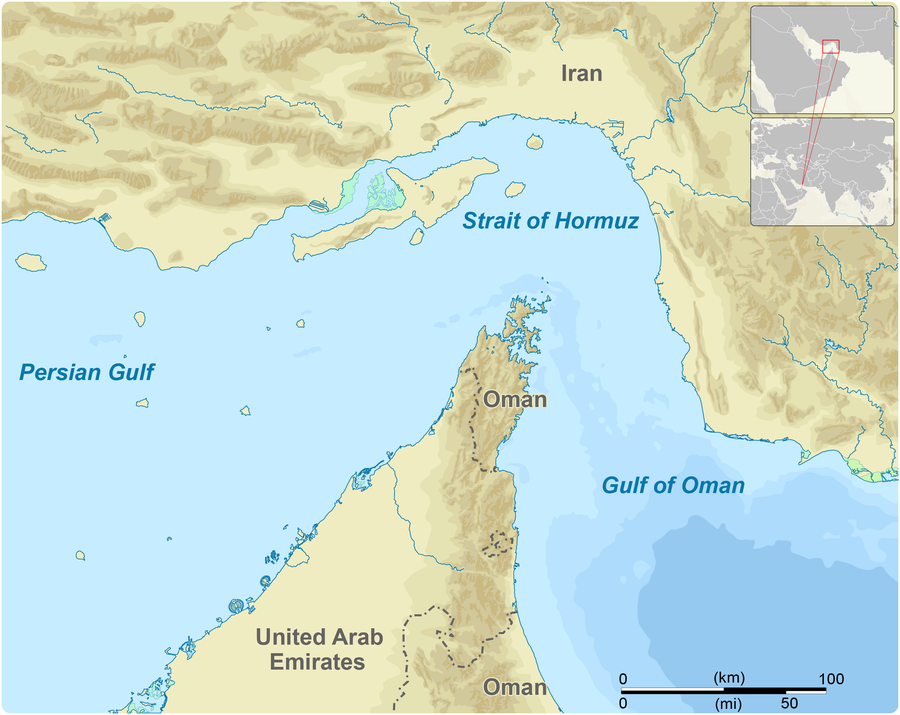
Goran tek-en (CC BY-SA), modified by Amanda Montañez
Hundreds of millions of years ago, the northern edge of what is now the Arabian plate was a “passive margin,” acting as a boundary between continental and oceanic crust that is tectonically quiet, says Edwin Nissen, a professor of Earth and ocean sciences at the University of Victoria in British Columbia. The Eastern Seaboard of the U.S. is a modern example of this arrangement.
Over epochs, this quiet margin saw sea levels rise and fall, and as a result, it built up layer after layer of organic-rich shale, porous sandstone, fractured limestone, salt, and hard capstone, Nissen says. The organic material, buried deep, transformed into oil and natural gas under tremendous pressure and heat. Sandstone and limestone provided fissures and fractures where these hydrocarbons could sit, and caprock kept everything in place.
Today, this geological region contains an estimated 12 percent of the world’s oil reserves, according to a 2024 review in Results in Earth Sciences.
Those kilometers-deep layers were still present when the Arabian plate, driven by the opening of the Red Sea on its southwestern side, began scooting toward the northeast and ramming into Eurasia around 30 million years ago. Like the hoods of two cars in a traffic accident, the continents crunched together, simultaneously shortening and flexing. The Arabian and Eurasian plates continue to move toward each other at around 20 millimeters a year, sometimes triggering deadly earthquakes.
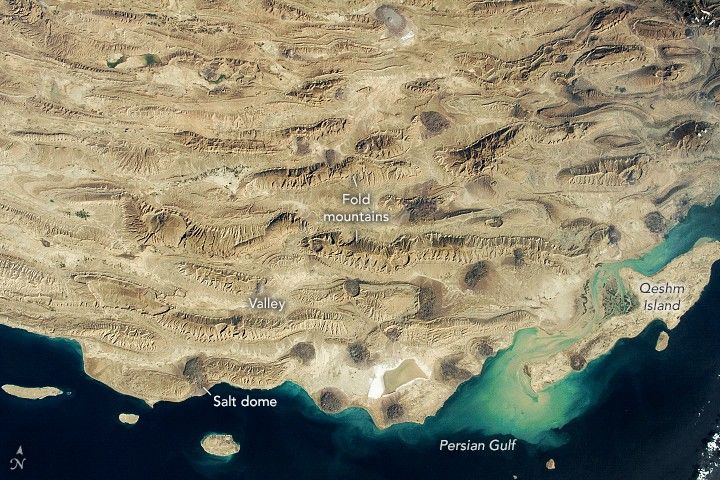
The collision created the Zagros fold-and-thrust belt, which is a “geologist’s dream,” Allen says. The belt consists of a mountain range 1,600 kilometers long, stretching from eastern Turkey all the way to the Strait of Hormuz at the end of the Persian Gulf. Though processes such as glaciation and erosion largely shape the profile of most mountains, the Zagros Mountains trace the literal folds of the continental collision in long, unbroken ridges. The mountains themselves are too deformed to hold hydrocarbons. But nearby, where the topography is more subtle, similar underground folding traps oil and gas in giant fields. “The Zagros has everything going for it for oil and gas,” Nissen says.
The undulating topography of the Zagros Mountains in Iran can be seen in this image taken by an astronaut aboard the International Space Station. Qeshm Island sits on the northeast side of the Strait of Hormuz, on the Iranian side. NASA Earth Observatory image, using data from NASA/GSFC/METI/ERSDAC/JAROS, and U.S./Japan ASTER Science Team
The weight of the mountains pushing down on the crust created the Persian Gulf Basin. Because the Zagros Mountains depress the crust in a narrow and shallow region, the Gulf is only 110 meters deep and 340 km wide at most. At the Strait of Hormuz, the Musandam Peninsula, which includes parts of northern Oman and the northern United Arab Emirates, further narrows the Gulf to only about 55 km across.
The Strait, too, is a result of the collision of continents: Much of Oman is made of the Semail Ophiolite, a huge chunk of oceanic crust that got pushed onto land when the ancient ocean between the Arabian and Eurasian plates closed. According to Renas Koshnaw, a research associate at Georg-August University of Göttingen in Germany, who studies the region, the Strait is more narrow than the rest of the Gulf because of the rigid rock of the Musandam Peninsula, which sticks out perpendicular to the Zagros Mountains. When the collision between Arabian and Eurasian plates forced these two features together, the peninsula forced the mountain front, and thus the Gulf, to bend like a kink in a hose.
The Strait is “ultimately there because of the geology, but the impact on humans at this present time is that you’ve got a marine bottleneck,” Allen says. “The tankers don’t have much room to sit in, and they’re sitting very close to the Iranian coast.”
.
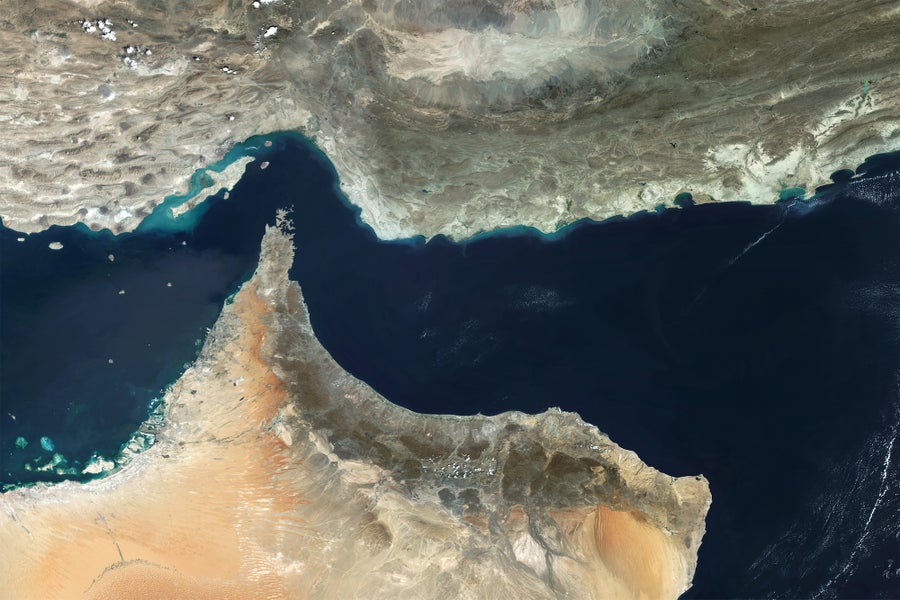
Satellite view of the Strait of Hormuz, a critical chokepoint for global energy supply, connecting the Persian Gulf to the Gulf of Oman. Gallo Images/Orbital Horizon/Copernicus Sentinel Data 2025/Getty Images
Using smart words can make a strong impression in important situations like job interviews or school.
It’s important to use big words wisely so you don’t confuse or annoy people around you.
There are many fun and easy words that can help you sound smarter in everyday conversations.
Do you remember how exciting it was when you learned to say supercalifragilisticexpialidocious? Didn’t you feel smart? Just because you’re older, doesn’t mean acronyms and emojis should be your main form of communication. After all, if you want to be successful in life, you have to make an unforgettable first impression.
Why Word Choice Is Important
Having a strong vocabulary allows you to communicate in a thoughtful and intelligent way. Whether you’re trying to land a job, impress your 3rd-period teacher, or nail a scholarship interview, your ability to choose your words carefully will help you stand out. But here’s something to consider: overusing complex language can turn people off, so it’s best to test out a few new words at a time and see what kind of reaction you get.
Chances are, you’ve seen (or maybe even used) a few of these words. And while there are hundreds of words that can make you sound smarter, some are definitely more fun (and easier) than others to use. So, the next time you’re toe-to-toe with your AP English teacher, ditch the toady act and impress her with a few of these scintillating words instead.
Words to Add to Your Vocabulary
Accolade: a mark of acknowledgement; an honor. Even though he received numerous accolades at the senior awards night, Ben is still one of the most humble people I know.
Acquiesce: to go along with something without protest, even if you don’t really want to.My grandma loves the ballet and bought tickets for us to go. I really wanted to watch the basketball game, but her sweet smile eventually caused me to acquiesce.
Bamboozle: conceal one’s true motives; to cheat or deceive another person.I got bamboozled by my buddy to buy him a pair of new shoes even though his mom picked up a pair yesterday.
Camaraderie: trust existing between friends who spend time together; a spirit of familiarity.There was a sense of camaraderie among the soccer team after they spent two weeks together at a wilderness camp.
Conundrum: a difficult problem.Looks like you have a bit of conundrum, but that’s what happens when you cheat on a test, and the teacher finds out.
Idyllic: peaceful, happy, pleasing.The outdoor classroom at our school is in an idyllic location because you can see the mountain range and several acres of forest from every open window.
Impeccable: faultless or without defect; incapable of wrongdoing.Have you ever had that one teacher who won’t accept any work unless it’s impeccable? There’s no way my essays are ever going to be that perfect.
Perfunctory: something done without much care or attention.You did a perfunctory job, including descriptive words in this essay. Next time, I expect you to show more interest in what you are writing.
Ruminate: to think about something thoroughly and in great detail.People who struggle with anxiety tend to ruminate and fixate on their thoughts.
Tempestuous: identified by explosive conditions.My older brother’s tempestuous relationship with our mom has led to very little communication between the two of them.
Tenuous: very weak or slight and likely to change.We’re not sure if our boating store is going to survive this harsh winter season. Your employment will remain a bit tenuous until we know the total number of sales from this month.
Vacillate: to go back and forth between two points, waver between different opinions, or to be indecisive.When I ask my sister where she’s going to college, she vacillates between her two favorite schools, but I know she will eventually make the best decision for her.
Vitriolic: harsh or corrosive in tone.The student body election turned into an argument reaching vitriolic levels. The two candidates ended their speeches by shouting harmful words at each other.
Wheelhouse: a metaphor for an individual’s area of comfort or expertise.I need you to cover this story about the construction at our school, even though it’s not in your wheelhouse.
Zealous: displaying or feeling energetic support for a person, cause, etc.My neighbor has been a zealous supporter of animal rights for as long as I’ve known her.
Film and Writing Festival for Comedy. Showcasing best of comedy short films at the FEEDBACK Film Festival. Plus, showcasing best of comedy novels, short stories, poems, screenplays (TV, short, feature) at the festival performed by professional actors.





:max_bytes(150000):strip_icc()/PARENTS-gen-z-parents-3da323279ddc4cf68f883fbc4d63aa34.jpg)


 MARK GARLICK/SCIENCE PHOTO LIBRARY via Getty Images




:max_bytes(150000):strip_icc()/GettyImages-629247108-5a85d2bcae9ab80037ce470b.jpg)
 James' World 2