Home

Trump Administration Reinstates $2 Billion in Mental Health and Addiction Funding

Leave a comment

Click the link below the picture

.

As of January 15, the Trump administration has walked back a plan to slash U.S. federal funding for mental health and addiction programs, a move that experts have said would have exacerbate the country’s already acute drug crisis.

The loss would have totaled some $2 billion in grants from the Substance Abuse and Mental Health Services Administration (SAMHSA), NPR reported, citing unnamed sources. The number of grants targeted may have been as high as 2,800, according to STAT.

Before the cuts were rolled back, Daniel Ciccarone, a professor of addiction medicine at the University of California, San Francisco, told Scientific American that “this is going to cost American lives, no doubt.”

“It’s an utter shame, given the fact that overdoses are on the decline,” he said. “Now is not the time to let up on our efforts.”

On Wednesday, the U.S. Centers for Disease Control and Prevention released data showing that estimated drug overdose deaths between August 2024 and August 2025 declined by nearly 21 percent compared with the previous year.

The decline in overdose deaths in the U.S. is not by chance, said Regina LaBelle, a professor of addiction policy at Georgetown University, to SciAm on Wednesday.

“The federal government invested in state and community-based efforts to prevent substance use, treat people with substance use disorder, and support recovery. The funding cuts made by the administration today reflect a retreat from these investments,” she said.

Ciccarone noted to SciAm that the opioid epidemic has disproportionately affected red states. “The Trump administration, in both terms, could be claiming some credit for the reduction in deaths,” he said. “It doesn’t make any sense.”

Speaking to SciAm on Wednesday, Caleb Banta-Green, a research professor at the University of Washington, who studies drug trends, said that the then proposed cuts would effectively “gut” lifesaving services for people all across the country. “In addition to saving lives and supporting recovery, treating substance use disorder is the most impactful way to reduce ‘demand’ for drugs, with its upstream impacts on drug trafficking and manufacturing,” he said. Combating drug trafficking has been a priority of the Trump administration.

“The bottom line is that federal investment in mental health and addiction services saves lives,” said Arthur C. Evans, Jr., CEO of the American Psychological Association, in a statement on Wednesday. “Abruptly cutting this support, including to school-based and other youth-focused mental health programs, threatens to destabilize mental health care in our communities and puts our most vulnerable populations at risk.”

The U.S. Department of Health and Human Services and SAMHSA did not immediately respond to a request for comment.

.

https://static.scientificamerican.com/dam/m/54fc7897e1310272/original/mental-health.jpg?m=1768416395.981&w=900dragana991 via Getty Images

.

.

Click the link below for the complete article:

https://www.scientificamerican.com/article/trump-administration-slashes-mental-health-and-addiction-grants-report/

.

__________________________________________

Archbishop for U.S. Military Says It’s ‘Morally Acceptable’ for Troops to Disobey Orders Amid Escalating Trump Threats

Leave a comment

Click the link below the picture

.

The archbishop for the U.S. military services said that it “would be morally acceptable” for troops to disobey orders that go against their conscience as the Trump Administration ramps up its military actions and threats, joining other prominent Catholic leaders in sounding alarms over President Donald Trump’s aggressive foreign policy moves.

“It would be very difficult for a soldier or a marine or a sailor to by himself disobey an order,” Archbishop Timothy P. Broglio told the BBC Sunday. “But strictly speaking, he or she would be, within the realm of their own conscience, it would be morally acceptable to disobey that order, but that’s perhaps putting that individual in an untenable situation, and that’s my concern.”

When asked if he was “worried” about the troops in the archdiocese he oversees, Broglio responded: “I am obviously worried because they could be put in a situation where they’re being ordered to do something which is morally questionable.”

Broglio, who has served as the head of the Washington, D.C.-based archdiocese of the U.S. military since 2007, specifically pushed back against Trump’s repeated threats to annex Greenland. 

“Greenland is a territory of Denmark,” the archbishop said. “It does not seem really reasonable that the United States would attack and occupy a friendly nation.”

Read more: Trump Warns There’s ‘No Going Back’ on Greenland and Accuses U.K. of ‘Act of Great Stupidity.’

A number of other high-ranking Catholic bishops and Pope Leo XIV have also raised vocal concerns in recent weeks as U.S. forces deposed Venezuelan President Nicolás Maduro, and the President has levied threats against several other countries and territories, including in his renewed push to acquire Greenland. The Pope, who—along with a number of U.S. bishops—has also challenged Trump’s immigration crackdown, recently condemned a “diplomacy based on force” in an annual speech at the Vatican.

“War is back in vogue and a zeal for war is spreading,” the pontiff stated. He went on to call for respect for “the will of the Venezuelan people,” given “recent developments,” and spoke about several other areas around the world afflicted by conflict.  

On Monday, three senior cardinals leading U.S. dioceses released a joint statement inspired by Leo’s comments, in which they called into question “the moral foundation for America’s actions in the world.”

“The events in Venezuela, Ukraine and Greenland have raised basic questions about the use of military force and the meaning of peace,” Cardinals Blase Cupich, archbishop of Chicago; Robert McElroy, archbishop of D.C.; and Joseph Tobin, archbishop of Newark wrote, adding, “Our country’s moral role in confronting evil around the world, sustaining the right to life and human dignity, and supporting religious liberty are all under examination.” 

They went on to call for a “genuinely moral foreign policy” and stated that “military action must be seen only as a last resort in extreme situations, not a normal instrument of national policy.”

Trump has also faced pushback over foreign policy from a number of world leaders and congressional lawmakers, including some members of his own party.

In November, six Democratic lawmakers released a video in which they told members of the military and intelligence community not only that they could decline to follow unlawful orders, but that they must. 

“Our laws are clear: You can refuse illegal orders,” the lawmakers said. “You must refuse illegal orders. No one has to carry out orders that violate the law or our Constitution.”

The group of politicians, all of whom are either veterans or former intelligence analysts, included Sen. Elissa Slotkin of Michigan, Sen. Mark Kelly of Arizona, Reps. Chris Deluzio and Chrissy Houlahan of Pennsylvania, Rep. Maggie Goodlander of New Hampshire, and Rep. Jason Crow of Colorado. They didn’t reference any specific orders troops might be receiving. But the video came as Trump faced scrutiny over his deployment of troops to multiple cities in the U.S. amid his crackdown on crime and immigration and the deadly strikes his Administration was carrying out on boats in the Caribbean and eastern Pacific that it alleged were transporting drugs.

Trump accused the group of “seditious behavior, punishable by death” in the wake of the video’s release, and the lawmakers have said they are being investigated by the Administration over their participation in it. 

Read more: Is It ‘Seditious’ or ‘Illegal’ to Urge the Military to Refuse Unlawful Orders? Legal Experts Weigh In

Deluzio, Houlahan, and Goodlander said last week that they had received inquiries from the Justice Department over the video last week, while  Slotkin and Crow said that Jeanine Pirro, the U.S. attorney general in D.C., had reached out to them for interviews. 

The Pentagon has also taken steps to demote Kelly, a retired Navy captain, and thereby reduce his military pension. Kelly sued Defense Secretary Pete Hegseth, saying the move was unconstitutional. 

Under the Uniform Code of Military Justice, members of the military swear an oath of enlistment to “obey the orders of the President of the United States and the orders of the officers appointed over me.” There is a strong presumption that orders are lawful under military law, but service members are allowed to disobey unlawful orders and can even be prosecuted for carrying out patently illegal orders, such as war crimes. Though Trump and other Administration officials have contended that the lawmakers’ comments in the video were “seditious” and violated the law, legal experts told TIME that there was nothing illegal about their message.

Broglio’s comments come as Trump is set to arrive in Davos, Switzerland, to attend the World Economic Forum, where his plans to take over Greenland are expected to be discussed with European leaders in what is being seen as an emergency summit.

.

https://time.com/redesign/_next/image/?url=https%3A%2F%2Fapi.time.com%2Fwp-content%2Fuploads%2F2026%2F01%2Fmilitary-orders-trump-venezuela-greenland-catholic-leaders.jpg%3Fquality%3D85%26w%3D1800&w=1920&q=75Jose Luis Magana—AP Photo/File

.

.

Click the link below for the complete article:

https://time.com/7353662/trump-military-orders-disobey-venezuela-greenland-europe-catholic-leaders/

.

__________________________________________

Nationwide ‘Free America’ Walkout Held in Protest of Trump

Leave a comment

Click the link below the picture

.

People across the country walked out of school and work on Tuesday afternoon as part of a nationwide walkout to protest the Trump Administration.

Dubbed the “Free America Walkout,” the protest took place on the anniversary of President Donald Trump’s second inauguration. The movement is protesting the actions Trump has taken since returning to office, including Immigration and Customs Enforcement (ICE) raids, National Guard deployments, and threats to transgender rights.

“One year into Trump’s second regime, we face an escalating fascist threat,” the Free America website reads. “It is time for our communities to escalate as well. On January 20 at 2 PM local time, we will walk out of work, school, and commerce. We will withhold our labor, our participation, and our consent. A free America begins the moment we refuse to cooperate. This is not a request. This is a rupture. This is a protest and a promise. In the face of fascism, we will be ungovernable.”

The Women’s March, one of the organizing partners behind the walkout, shared a video on X of the protest beginning in Washington, D.C. on Tuesday afternoon, as well as photos of a similar demonstration in Brooklyn, New York, in which protesters can be seen holding “Free America” signs.

“This is what democracy looks like,” the Women’s March wrote on X. “This is what fighting fascism looks like.”

The Women’s March also shared a video of a walkout in Oklahoma City, writing on X, “Red state. Real resistance. Feminists and their allies are walking out on fascism.” And the account posted photos of protesters in Minnesota, some of whom can be seen carrying signs that said, “ICE out for good” and “Do your job, Congress.”

Minnesotans walked out today. In the face of weeks of dehumanizing rhetoric by the right. In the face of weeks of violent and unlawful attacks by ICE agents. In the aftermath of the tragic murder of Renee Good. In freezing temperatures,” the Women’s March wrote on X. “They organize. They fight back. They walk out. We stand with Minnesota.”

Earlier this month, Renee Nicole Good—a 37-year-old U.S. citizen and mother of three—was shot and killed by an ICE agent in Minneapolis. Trump Administration officials have accused Good of attempting to run over the agent with her car, claiming the shooting was an act of “self-defense.” But videos of the incident appear to contradict that characterization, and local leaders have strongly disputed the Administration’s portrayal. Good’s death sparked widespread outrage, and ignited protests in Minneapolis and across the country—from major cities to small-town America—over the Trump Administration’s aggressive immigration enforcement tactics.

About 4 in 10 Americans approve of the President’s performance in his second term thus far, according to an AP-NORC poll conducted earlier this month. That’s roughly the same approval rating that Trump received at the start and end of his first term, though there were periods where that number fluctuated, according to AP-NORC data. Approval of his policies in different areas varied, however. The most recent poll—which was conducted after the fatal shooting of Good—found that only 38% of Americans approve of how the President is addressing immigration issues, a double-digit decline from the 49% who approved of his immigration policies in March.

.

https://time.com/redesign/_next/image/?url=https%3A%2F%2Fapi.time.com%2Fwp-content%2Fuploads%2F2026%2F01%2Ffree-america-walkout-trump.jpg%3Fquality%3D85%26w%3D1024&w=1920&q=75Michael M. Santiago—Getty Images

.

.

Click the link below for the complete article:

https://time.com/7353699/trump-free-america-walkout-protest/

.

__________________________________________

Stocks Post Biggest Drop in Months as Tensions Over Greenland Mount

Leave a comment

Click the link below the picture

.

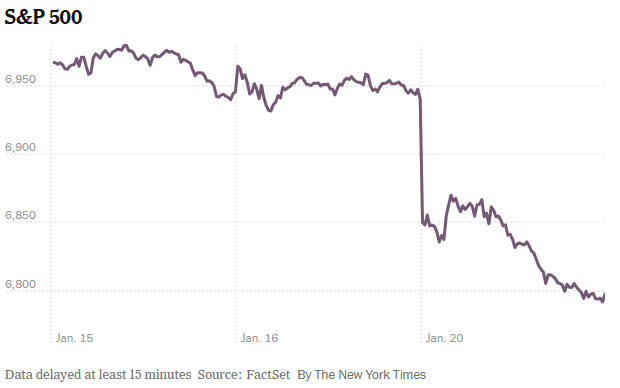
President Trump’s intensifying standoff with European leaders over the fate of Greenland prompted a sharp response from investors Tuesday, with the value of U.S. stocks, the dollar, and government bonds all falling.

The S&P 500 dropped over 2 percent for the first time since October, as investors reacted to Mr. Trump’s increasing threat of higher tariffs on European allies unless they supported his plans for America to take control of Greenland. The Vix volatility index, known as Wall Street’s fear gauge, rose to its highest level since November.

Tuesday’s opening decline was the index’s biggest since April, when Mr. Trump first proposed sweeping tariffs on nearly all of America’s trading partners. And while the sell-off remained contained for now, with the S&P 500 still close to its record high, the moves showed a clear increase in investor concern over the future of the established world order. Investors had become inured to geopolitical upheaval in recent years because it has typically had little impact on corporate profits.

Investors’ confidence wavered on Tuesday even as Mr. Trump boasted about a long list of embellished achievements in remarks to reporters, among them the strength of investments in the United States and the stock market’s returns over the course of his first year in office.

“We have the hottest country in the world right now,” Mr. Trump said.

The moves in financial markets told a different story. Often when stocks are roiled by geopolitical upheaval, investors flock to the safety of other U.S. assets, like the dollar or government bonds. But in a sign that investors were embracing a “sell America” trade and moving away from U.S. assets altogether, both the dollar and U.S. government debt lost value on Tuesday.

Eric Teal, chief investment officer at Comerica Wealth Management, said investors should be “playing defense at this juncture,” focusing on geographic and sector diversification while the current uncertainty lingers.

The dollar index, which pits the currency against a basket of currencies that represent America’s major trading partners, fell 0.8 percent. The dollar weakened against the euro, British pound, and Norwegian Krone.

The Swiss Franc, another haven in times of uncertainty, strengthened almost 1 percent against the U.S. dollar. Gold and oil prices also climbed higher, with the precious metal up 1.8 percent in another sign of investor caution.

The 10-year U.S. Treasury yield, which moves inversely to price, also rose, meaning its value declined. This yield acts as one of the most important interest rates in the world by underpinning interest rates across consumer and corporate debt.

The yield rose to its highest level since August, undermining the administration’s efforts to move interest rates lower. Scott Bessent, the Treasury secretary, pointed to rising bond yields in Japan as a factor helping push U.S. yields higher.

Andrew Brenner, head of international fixed income at National Alliance Securities, said that Mr. Trump “has a path to lower rates and less controversial path with Greenland, but the question is will he take it?” He warned investors on Tuesday to expect “major volatility.”

Tuesday’s trading was the first chance U.S. markets had to react to Mr. Trump’s escalating threats toward Europe over the weekend with the U.S. stock market closed on Monday in honor of Martin Luther King’s Birthday.

Despite the modest sell-off, major stock indexes remain close to record highs after a third consecutive double-digit rise in 2025.

Commerce Secretary Howard Lutnick, speaking on a panel discussion at the World Economic forum in Davos, Switzerland, on Tuesday, defended the Trump administration’s “America First” policies even as it has rattled investors and trading partners.

“Everyone said, ‘You are going to do all these tariffs, you are going to destroy the world,’” he said. “The world’s stock markets are up. Which ones of them? All of them.”

Investors have mostly looked through geopolitics in recent years, as the tangible detrimental effect to corporate profits has been limited. The sharp moves on Tuesday suggest a heightened nervousness among investors about the administration’s persistent pursuit of a European ally’s territory.

European stock markets also fell on Tuesday, with bourses in Germany, France, and the United Kingdom all moving roughly 1 percent lower.

.

Stock Drop– Greenland

.

.

Click the link below for the complete article {sound on to listen}:

https://www.nytimes.com/2026/01/20/business/stocks-trump-greenland-tariffs.html

.

__________________________________________

America’s Air Is About to Get Dirtier—And More Dangerous

Leave a comment

Click the link below the picture

.

For more than five decades, the Clean Air Act has prevented millions of premature deaths, hospitalizations, and lost work and school days. By one official reckoning in 2011, the act’s limits on harmful pollution has benefited the U.S. economy to the tune of $2 trillion by 2020, in contrast with $65 billion in costs to implement regulations.

But now the U.S. Environmental Protection Agency is abruptly changing how it enforces at least parts of the Clean Air Act by not calculating the economic benefits of some regulations. The seemingly inevitable result is that Americans will soon breathe noticeably dirtier air and see worse health outcomes, experts say.

“I don’t think anyone wants to go back to … not being able to see anything,” says Camille Pannu, an environmental law expert at Columbia University.

The EPA will no longer consider the dollar value of lives saved or other ill effects averted by placing limits on fine particulate matter with the designation PM2.5 or ozone emissions in at least some cases, the New York Times reported on Monday. Instead, the agency will only calculate the cost to industry to enforce the act’s rules.

To get a sense of why this matters, it is important to understand what ozone and PM2.5 do to our body. PM2.5 describes particles that have a diameter smaller than 2.5 microns. They are tiny enough to enter the bloodstream, lodge deeply in the lungs and cross the blood-brain barrier. PM2.5 has been liked to diabetes, obesity, dementia, cancer, low birth weight, and asthma. Ozone, a key ingredient of smog, is particularly dangerous for people with asthma and other lung diseases, especially children.

The Clean Air Act was enacted precisely because the health effects of bad air are population-wide and difficult to evaluate. In other words, without estimating costs, even imperfectly, “everything is costly, and nothing is worth regulating,” Pannu says.

In a document reviewed by the New York Times, an EPA official cited language that argued that how the dollar value of the benefits of the regulation was calculated “provided the public with false precision and confidence.” Yet experts point out that that is part of the point: the act’s authors “wanted to have EPA regulate even if the science was uncertain,” says Lisa Heinzerling, an environmental law expert at Georgetown University.

Different presidential administrations have taken distinct approaches to totaling up the value of those benefits, but the science underlying these estimates is well established.

For decades, researchers have compared places with higher and lower levels of pollutants and have looked at differences in premature deaths and other negative health outcomes while controlling for other factors that could affect those numbers. Those analyses are then combined with economic studies that estimate the “value of a statistical life” by looking at, for example, the amount of lost wages incurred when a parent stays home with a child who is experiencing an asthma attack. Because this work has been going on for so long, it means researchers can feel confident in the value they arrive at, says Rachel Rothschild, an environmental law expert at the University of Michigan.

Independent analyses have also been conducted that showed PM2.5’s “harms were so significant” and “the benefits [of the Clean Air Act] were so enormous” that they far outweighed the costs of implementing the law, Rothschild says. The Clean Air Act’s regulations “pay for themselves; they pay for the entire EPA,” Heinzerling agrees.

A 2016 analysis from the University of Chicago found that people in the U.S. had gained 336 million life-years, a measure of how long people are expected to live in a healthy condition, since amendments to the Clean Air Act were passed in 1970. And in 2011, the EPA estimated that updates to the act made in 1990 would prevent more than 230,000 early deaths, 75,000 cases of bronchitis, 120,000 emergency room visits, and 17 million lost workdays by 2020. About 85 percent of these benefits stem from deaths avoided because of reductions in particular matter alone.

Estimates of cost are also inherently uncertain. And according to Rothschild, past EPA analyses have almost always found the agency overestimated those costs. She and others expect this move to be challenged in court.

It is also unclear how widely this new policy may be applied. Documents cited by the New York Times’ reporting suggest it will apply to proposals from the agency’s Office of Air and Radiation, with the consequences including repeals of limits on greenhouse gas emissions. The Times also cited similar language to what the EPA emails mentioned in a regulatory impact analysis posted on Monday concerning limits on nitrogen dioxide and sulfur dioxide from combustion turbines at gas-burning power plants. Such plants are in demand at data centers to fuel their considerable power needs.

The EPA is legally required to provide its rationale and any data it is relying on to make such decisions, Heinzerling says.

In a statement in response to detailed questions from Scientific American, an EPA spokesperson said the agency is continuing to consider the impacts of PM2.5 and ozone on human health, adding that “the agency will not be monetizing the impacts at this time.”

“EPA is fully committed to its core mission of protect human health and the environment,” the statement continued.

The EPA spokesperson also noted that the previous Biden administration did not calculate the value of health benefits for some rules under the Clean Air Act, including for PM2.5. Rothschild says that some past administrations may have not quantified the benefits of every proposed regulation—particularly those that were very difficult to calculate. But, she says, “the health benefits from reducing particulate matter and ozone are some of the easiest to quantify and monetize out of all types of environmental pollution.”

“It’s disappointing that the EPA isn’t interested in making the best decision for the public,” Rothschild says.

.

https://static.scientificamerican.com/dam/m/3d19d78223a393f7/original/GettyImages-161975057_web.jpeg?m=1768423831.675&w=900

Smog in Denver in January 1974. Bill Wunsch/The Denver Post via Getty Images

.

.

Click the link below for the complete article:

https://www.scientificamerican.com/article/eroding-the-clean-air-act-will-make-america-sicker-dirtier-and-poorer/

.

__________________________________________

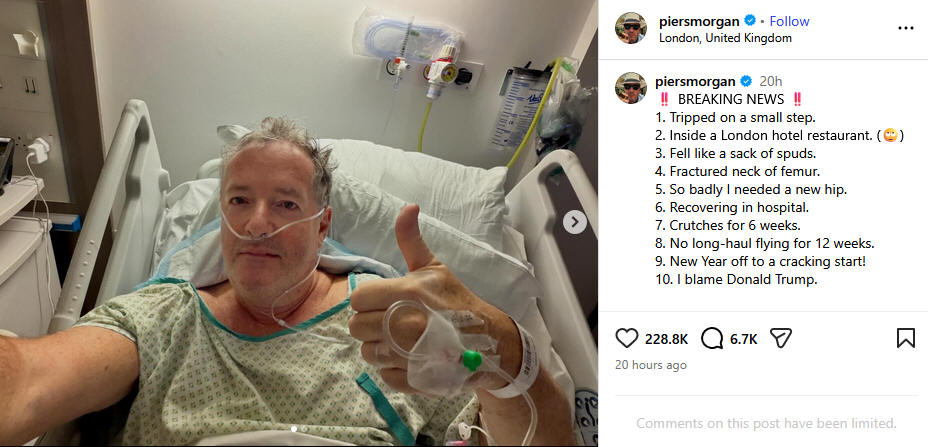
Piers Morgan hospitalized after suffering fall

2 Comments

Click the link below the picture

.

On Instagram, Morgan also shared a photo of an X-ray that showed his fracture.

Piers Morgan apologizes to Jay-Z and Beyoncé after Jaguar Wright interview

According to the American Academy of Orthopaedic Surgeons, femoral shaft fractures usually require surgery and take between three and six months to completely heal.

“A broken femur is a serious injury that requires immediate medical care,” the Cleveland Clinic explains. “Broken femurs are treated with surgery and physical therapy. It can take months for your broken femur to heal. You can break your femur by being in a car crash, falling or being shot. Elderly people who are prone to injuries from falls can break their femurs.”The Mayo Clinic also notes that a hip replacement is a surgery to remove and replace damaged sections of the hip joint, and replacement parts “are usually made of metal, ceramic, and hard plastic.”

Piers Morgan doubles down on Duchess Meghan’s Oprah interview: ‘I still don’t’ believe her

Morgan currently serves as host of the online talk show “Piers Morgan Uncensored.” He previously hosted “Piers Morgan Live” on CNN and has held roles at British tabloids, including News of the World and The Sun. Morgan, who has stirred backlash over the years for his commentary on topics including Duchess Meghan, is also a former judge on “America’s Got Talent.”

.

.

.

Click the link below for the complete article:

https://ca.news.yahoo.com/piers-morgan-hospitalized-suffering-fall-181516689.html

.

__________________________________________

China’s Birthrate Plunges to Lowest Level Since 1949

Leave a comment

Click the link below the picture

.

Declaring childbirth a patriotic act. Nagging newlyweds about family planning. Taxing condoms.

To get its citizens to have babies, the Chinese Communist Party has pulled every lever.

The efforts have largely failed. For the fourth year in a row, China reported more deaths than births in 2025 as its birthrate plunged to a record low, leaving its population smaller and older.

The government on Monday said 7.92 million babies were born last year, down from 9.54 million in 2024. The number of people who died in 2025, 11.31 million, continued to climb. The latest population figures were reported alongside economic data that showed China’s economy grew 5 percent in 2025.

The number of births for every 1,000 people fell to 5.63, the lowest level on record since the founding of the People’s Republic of China, according to official government data.

Around the world, governments are contending with falling birthrates. But the problem is more acute for China: Fewer babies mean fewer future workers to support a rapidly growing cohort of retirees. A worsening economy has made addressing the challenge even more difficult.

“China is facing a severe challenge posed by an extremely low fertility rate,” said Wu Fan, a professor of family policy at Nankai University in eastern China.

China’s top leaders have redoubled their efforts to try to boost the national birthrate enough to reverse the decline, something that demographers have said is probably impossible now that China has crossed a demographic threshold where its fertility rate, a measure of the number of children a woman has over a lifetime, is so low that its population is shrinking.

Xi Jinping, China’s top leader, has called for a “new type of marriage and childbearing culture,” entreating officials to influence young people’s views on “love and marriage, fertility and family.” Local officials have responded with increasingly ham-handed measures to get citizens to have babies, including tracking women’s menstrual cycles and issuing guidelines to reduce abortions that are medically unnecessary.

Many of the measures have been met with a collective shrug by young people who do not want to start a family.

On Jan. 1, officials placed a 13 percent value-added tax on contraceptive drugs and condoms, a move that has been met with a mix of indifference, mockery, and derision.

While that policy was not explicitly directed at boosting the birthrate, it was immediately interpreted by a skeptical public as yet another futile attempt to encourage more children.

Jonathan Zhu, 28, said the price increase would have little effect on his habits. “I’ll still use them,” he said, citing financial pressure as his reason for delaying fatherhood until marriage. His girlfriend, Hu Tingyan, 26, agreed, noting that the cost of condoms does not influence her willingness to have children. “I don’t feel the time is right yet,” she said.

On Chinese social media, people commented that the price increase was annoying, but it was still cheaper than raising a child. Others pointed out that condoms had more than one purpose.

“Which ‘genius’ came up with this brilliant move?” asked Ke Chaozhen, a lawyer based in Guangdong. “The state is urging marriage and births in such a subtle way — are they afraid that we marriage and family lawyers will go out of business?” he mused on social media.

Other comments were deemed so incendiary by state-directed censors that they were scrubbed from Chinese social media platforms.

Some of the government’s other baby-boosting measures, such as offering cash and subsidized housing for couples, have also failed to move the needle.

“The empirical evidence from other countries so far is that monetary incentives have almost no effect in raising fertility,” said Wang Feng, a professor of sociology at the University of California, Irvine.

For many young people, the high costs of raising a child are especially discouraging amid a slowing economy and a property crisis. In addition, youth unemployment remains high, and many recent college graduates are struggling to land a steady paycheck, falling back on their parents with little support from a threadbare social welfare system.

“With China’s economic woes, young people may want to wait and see, and that’s not good news for raising fertility,” Mr. Wang said.

China arrived at this problem much sooner than it anticipated it would, even a decade ago, when officials relaxed the one-child policy to permit couples to have two children. (It adjusted its birth policy again to allow three babies in 2021.) This has left the government with less time to fix its severely underfunded pension and health care systems.

At the same time, China has experienced a sudden and rapid decline in the working-age population, as the number of citizens age 60 and over is projected to reach 400 million by 2035. Young people often express reluctance to contribute to the public pension fund because of the financial burden.

A low retirement age has complicated things. The government raised it last year for the first time since the 1950s and plans to gradually increase the official age by 2040 to 63 for men, 58 for women in office jobs, and 55 for women in factories. However, it remains among the lowest in the world.

More recently, some party officials have even offered cash rewards to successful matchmakers, hoping to spur a baby boom by getting more people to marry.

Jia Dan, 46, understands the scope of the challenge. When he was single, Mr. Dan began hosting matchmaking events in Beijing in 2012 as a side project. Soon, he found a girlfriend. (They later married.) His events became so popular that he decided to turn them into a full-time business in 2018.

Since then, two things have become clear to him. It’s always the men who return. Women rarely attend more than once.

More glaringly, most people don’t seem to want to get married.

“You can really feel that the number of people in Beijing who actually want to get married is shrinking,” he said. “More and more young people just don’t want to do it anymore.”

.

https://static01.nyt.com/images/2026/01/19/multimedia/19Biz-China-Population-01-bcwf/19Biz-China-Population-01-bcwf-superJumbo.jpg?quality=75&auto=webpDespite sweeping efforts to boost births, China’s population has shrunk and aged for a fourth straight year as deaths again outnumbered births. Credit…Wu Hao/EPA, via Shutterstock

.

.

Click the link below for the complete article:

https://www.nytimes.com/2026/01/18/business/china-population-data.html

.

__________________________________________

Americans Overwhelmingly Support Science, but Some Think the U.S. Is Lagging Behind

Leave a comment

Click the link below the picture

.

Americans are proud of their country’s science prowess: a majority believe it is important for the U.S. to be a world leader in science, according to the Pew Research Center’s latest report on trust in science.

The number of people who hold this view is five percentage points higher than it was in 2023, the last time Pew asked the same question, according to data from more than 5,000 people surveyed in October 2025.

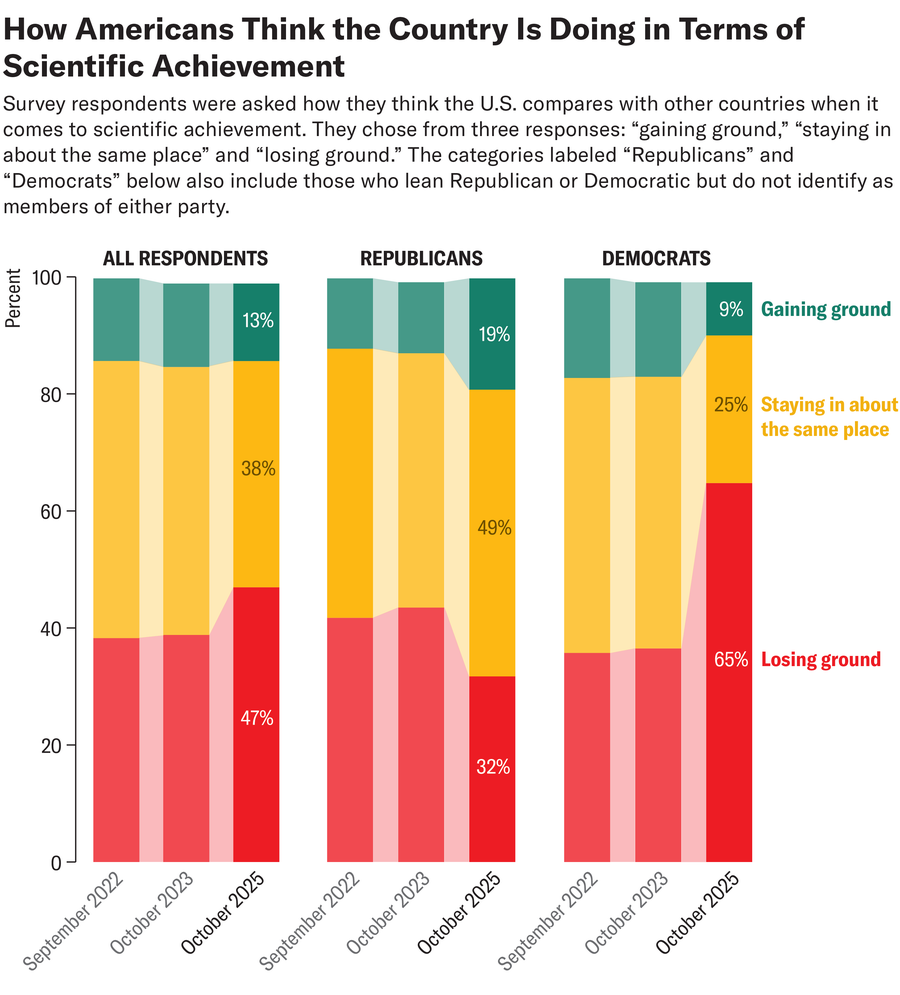
But people who voted Democratic in the 2024 presidential election tended to hold a very different view than Republican voters on whether the country is living up to its promise. Between 2023 and 2025, the proportion of Democrats who believe that the U.S. is losing ground in science compared with other countries jumped by 28 percentage points. About two-thirds of Democrats now hold this view.

Republicans are more positive about the country’s standing in science—a complete switch in sentiment since the last time Pew asked this question, says Brian Kennedy, one of the authors of the new report and a senior researcher at the Pew Research Center. And the split between both groups is far wider than it was at previous times when Pew asked the same question in the past five years, he says.

In 2022 and 2023, the difference between Democratic and Republican opinion was “far more modest,” Kennedy says, with both groups responses’ within 7 percentage points of each other. “Now we see this much bigger difference between Republicans and Democrats in our relative standing in science compared to other countries.

Last year, the Trump administration cut federal funding for science. The administration slashed millions of dollars in grants for science across myriad disciplines and walked back its own research and regulations based on science, particularly in the areas of climate change, health, and medicine. Meanwhile, experts have warned of a “brain drain,” partly motivated by the administration’s strict immigration policies, with researchers choosing to study or live overseas instead of in the U.S.

Despite these cuts, the majority of Americans—84 percent—thought federal investments in science aimed at advancing knowledge were worthwhile. Republican voters, however, were more likely than their left-leaning peers to be open to private companies playing a key role in science, Kennedy says.

“One thing we’ve seen in our surveys over a number of years is that support for science funding is pretty widespread among both Republicans to Democrats,” he says. “This is a pretty consistent finding.”

Indeed, lawmakers on both sides of the aisle have advanced several legislative efforts to claw back some of the targeted federal funding for science agencies.

Ultimately, the report shows that Americans’ trust in science and scientists remains broadly strong—but not as strong as it was before the COVID pandemic. During 2020 and 2021, public trust cratered. And while it has recovered somewhat, it remains lower than it was before that period.

“There’s a broader context of trust and confidence going on in society,” Kennedy says. Still, he points out that Pew survey participants have consistently ranked scientists among the most trustworthy groups in society for the past 10 years. “Scientists have consistently ranked toward the top with the military, while elected officials generally were ranked toward the bottom,” he says.

.

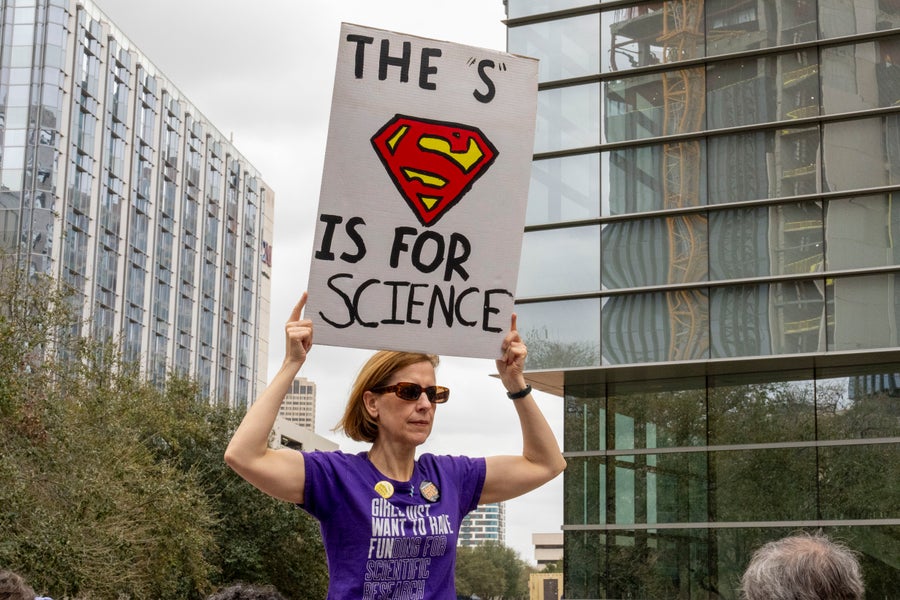
https://static.scientificamerican.com/dam/m/66ceb0b062fc9e46/original/Pro-science-protestor.jpg?m=1768472744.076&w=900

Houston Chronicle/Hearst Newspapers / Contributor via Getty Images

Stacked bar charts show percentages of survey respondents who said the U.S. was gaining ground, staying in about the same place or losing ground when it came to scientific achievement compared with other countries.

Amanda Montañez; Source: Do Americans Think the Country Is Losing or Gaining Ground in Science? Pew Research Center, January 15, 2026 (data)

.

.

Click the link below for the complete article:

https://www.scientificamerican.com/article/americans-overwhelmingly-support-science-but-some-think-the-u-s-is-lagging/

.

__________________________________________

A$AP Rocky Shared How Fatherhood Changed Him and I Couldn’t Agree More

Leave a comment

Click the link below the picture

.

I’ll never forget the moment the nurse asked me, “Are you ready to hold your daughter?” With tears running down my cheeks, I nodded.

It was nearly six years ago that I became a father, and I can say without a doubt that being a dad has made me a more emotional and well-rounded person. I never used to cry at a sad movie—not even Bambi’s mom got me! Now, I’m probably sobbing at 50% of Bluey episodes.

I certainly wasn’t the type to acknowledge, let alone have, deep, introspective thoughts about my emotions. I still have room to grow in that department, but my 5- and 3-year-olds have helped me improve tenfold.

While we often discuss how parenthood impacts mothers, too little attention is given to fathers and the changes they, too, face as they enter this chapter of their lives.

One father who recently discussed the topic is rapper and fashion icon A$AP Rocky, who spoke about parenting, among other topics, during a recent lengthy interview with W Magazine.

How A$AP Rocky Says He’s Changed Since Becoming a Father

The New York City native rose up through the rap scene in the early 2010s, blending fashion, innovative music trends, and pure confidence into a highly successful multi-decade career. These days, the 37-year-old rapper, born Rakim Mayers, is in a new era: fatherhood.

The rapper, who shares three children with fellow musician Rihanna, said that becoming a dad has caused him to let his guard down.

“I am way more emotional,” he told W Magazine, adding that before kids, he was “probably cold-hearted.” 

But now? “I’m a loving kind of fella,” he shared.

This is a noticeable change from the guarded persona that once defined his music and public identity. Fatherhood, he said, opened doors he didn’t even know were closed.

However, that doesn’t mean he’s lost his edge. When asked what he’d do if someone tried to date his daughter, Rocky said, “I’m going to pray for them.”

Jokes aside, Rocky’s perspective reflects a bigger evolution that many fathers experience for the first times in their lives. I’m no exception to that.

How These Changes Reflect My Own Experience

I wouldn’t say that I was necessarily emotionally guarded. It’s more that becoming a parent has made me realize certain emotional traits about myself I probably wouldn’t have paid much attention to otherwise.

For instance, I’ve always struggled with anxiety and, sometimes, a crippling need to be achieving something. Most people who know me well could tell you that. However, it was really put into a new perspective when I saw my children with my exact anxiety mannerisms.

I’m not exaggerating when I say exact. It was like going into a time machine to see a 3-foot-tall me having the same nervous reaction. This has helped me prioritize identifying when anxiety is taking over, or ideally, even before it gets to that point.

And conversely, I’m now more able to connect with my daughter and son. When I can see them going through that emotional anguish, I tell them I know how those butterflies in the stomach or weight on the chest feels. I’ve been there, and that’s OK, I say.

This is not a self-awareness I would have had without children.

So while I cry at movies more, and can help my kids work through tough emotional moments, becoming a father has made even more of a difference than that. It feels like my whole DNA has changed.

It makes sense, according to Zachary Barnes, PhD, a father of two and associate professor of literacy who researches self-regulation in children at Austin Peay State University. He adds that we need more fathers speaking up about the emotional demand of fatherhood.

“Being a father literally unlocks a part of your brain that deals with attachment. That is such a powerful thing,” says Dr. Barnes. “The moment I was able to hold my sons for the first time, I cried. And parenthood is all about meeting the emotional needs of your children. You are now practicing empathy every single day, and that will make you more emotional.”

How Other Fathers Can Embrace Their Own Emotions

Many fathers are probably caught off guard, experiencing this flood of emotions for the first time. I know I was. I did expect it to be a world-changing experience. But I definitely wasn’t expecting the waterworks. And I didn’t expect to feel the level of foundational pride and joy with every life stage my kids enter.

Aneal Bharath, an educational psychologist, former school counselor, and child protection officer, says that if fatherhood has “cracked you open in ways you didn’t expect, you’re not broken.”

“You’re changing,” Bharath says. “That emotional intensity isn’t weakness; it’s evidence that you care. Permit yourself to feel it. You’re not just raising children, you are reshaping what fatherhood looks like for them when it’s their turn, if they so choose.”

Like myself, Dr. Barnes says there are certain videos or TV episodes that he just can’t watch the same way now as a parent. The same is true with my social media habits.

Now, more than probably half of the accounts I follow online are dad content. That isn’t just for the funny and relatable TikToks, but also for the content creators who open up and discuss the hardships that come with day-to-day fatherhood.

“When we see those with big platforms talking about it, that is extremely helpful,” says Dr. Barnes. “I still think it can be hard for us fathers to talk about how we are feeling about fatherhood. The ups and downs. The happiest moments when your children walk for the first time, and the scary moments when you have to rush your kid to the hospital because of how sick they are. These experiences are all training your emotional capabilities.”

The emotional growth isn’t just a benefit for myself. Experts agree it’s also a huge gain for your family.

“That softer, more present, emotionally available version of you? That’s not a downgrade,” Bharath says. “That’s the dad your family actually needs.”

And it feels great to be the dad your children need. After all, that’s what it’s all about, right?

.

https://www.parents.com/thmb/r2Nbs-bf8SvtA6H5Z7trHIbdou0=/750x0/filters:no_upscale():max_bytes(150000):strip_icc()/PARENTS-ASAP-rocky-bf406e2c8d0c46ab8d628392e6dd32b3.jpgA$AP Rocky. Photo: GettyImages/Mike Coppola

.

.

Click the link below for the complete article:

https://www.parents.com/asap-rocky-is-right-about-fatherhood-11886307

.

__________________________________________

Fear in Nature and Politics!

Leave a comment

Hmmmm … Is this what fear in politics looks like inside? Do sycophants live in fear?

.

In nature, fear is detected through a combination of physiological responses, behavioral cues, and environmental signals, often by predators or other animals who sense vulnerability in their prey or competitors. Here’s how various mechanisms work:
.
1. Predator Sensory Systems:
Sight: Many predators can detect the body language and movements of prey that indicate fear. For example, fearful animals may freeze, run erratically, or display signs of stress, such as rapid breathing or dilated pupils.
Smell: Predators like wolves, big cats, and even scavengers can detect fear through changes in scent. Fear can trigger the release of certain hormones, such as adrenaline, which are detectable in the sweat or pheromones of the prey.
Hearing: Some animals can hear the increased heartbeat or even distress calls of prey, which can signal fear. For example, some species of bats can use echolocation to detect changes in the sounds of prey as they flee or struggle.
.
2. Chemical Signals and Pheromones:
Many animals release pheromones when stressed or scared. These chemical signals can be picked up by others in the area, alerting them to potential danger or an emotional state. For example, certain species of ants release alarm pheromones when they feel threatened, prompting other ants to come to their aid or take defensive actions.
Humans and many mammals also release stress-related pheromones, which might be detected by others of the same species. For example, dogs can sense when humans are anxious or fearful through scent.
.
3. Body Language and Behavioral Cues:
Fear often alters posture and behavior. Animals in fear might exhibit “flight” responses (running away), “freeze” responses (immobility), or even “fight” responses (aggression or defensive behavior). These visible changes in body language, such as crouching, wide eyes, or a lowered head, can be easily detected by other animals, alerting them to the animal’s emotional state.
In some species, fear can lead to a specific vocalization (like a distress call), which can be heard by others and cause them to take action.
.
4. Environmental Changes:
Animals are very sensitive to environmental changes caused by fear. For instance, if an animal senses an approaching predator, the environment might shift as animals in the area scatter or hide. This creates a ripple effect where nearby prey species will detect this shift and react accordingly.
Prey species often detect fear in their environment through the absence or presence of specific signals. For example, if they hear a predator’s growl or see another animal running, it can serve as a warning that danger is near.
.
5. Empathy in Social Animals:
In some highly social species, such as primates, elephants, and dolphins, fear can be communicated through empathy. These animals may recognize fear in others, and their response can range from group flight behavior to protective actions for vulnerable individuals.
For example, elephants are known to respond to the fear of others by gathering together for protection or even altering their own behavior to comfort or protect a distressed group member.
.
6. Evolutionary Adaptations:
Over evolutionary time, species that could detect and react to fear in their environment were more likely to survive. For example, the ability to detect fear signals—whether visual, auditory, or chemical—would enhance an animal’s chances of avoiding predators or other threats.
Some prey species, such as deer, can detect the scent of predators (like wolves or humans) and instantly become alert, which could give them enough time to escape.
.
In short, fear is often detected through a combination of sensory inputs and behavioral signals that trigger instinctive responses, allowing animals to avoid danger or react to it. Whether it’s a predator tracking the signs of fear or prey detecting environmental cues, nature has developed multiple ways to recognize and respond to fear.
.

 Sycophants:

.
A sycophant’s behavior is often driven by fear, but it’s not always the fear of physical harm. More typically, a sycophant is afraid of losing favor, status, or position with those they seek to please. They might be fearful of rejection, of not being seen as valuable or important, or of being out of the loop in certain power dynamics. This fear leads them to excessively flatter or serve someone in a way that feels insincere or manipulative.
So, while it might not be the classic, primal fear of danger, it’s a type of anxiety or insecurity rooted in social standing and the desire for approval or protection.

.

__________________________________________

Older Entries Newer Entries

Adam Rogers - Comedian

Finding The Funny in Life’s Everyday Chaos

Global geopolitics

Decoding Power. Defying Narratives.

Talk Photo

A creative collaboration introducing the art of nature and nature's art.

Movie Burner Entertainment

The Home Of Entertainment News, Reviews and Reactions

Le Notti di Agarthi

Hollow Earth Society

C r i s t i a n a' s Fine Arts ⛄️

•Whenever you are confronted with an opponent, conquer him with love.(Gandhi)

TradingClubsMan

Algotrader at TRADING-CLUBS.COM

Comedy FESTIVAL

Film and Writing Festival for Comedy. Showcasing best of comedy short films at the FEEDBACK Film Festival. Plus, showcasing best of comedy novels, short stories, poems, screenplays (TV, short, feature) at the festival performed by professional actors.

Bonnywood Manor

Peace. Tranquility. Insanity.

Warum ich Rad fahre

Take a ride on the wild side

Madame-Radio

Découvre des musiques prometteuses dans la sphère musicale française (principalement, mais pas que...).

Ir de Compras Online

No tiene que Ser una Pesadilla.

Kana's Chronicles

Life in Kana-text (er... CONtext)

Cross-Border Currents

Tracking money, power, and meaning across borders.

Jam Writes

Where feelings meet metaphors and make questionable choices.

emotionalpeace

Finding hope and peace through writing, art, photography, and faith in Jesus.

WearingTwoGowns.COM

MOVING FORWARD...That's how WINNING is done!”-Rocky Balboa

...

love each other like you're the lyric to their music

Luca nel laboratorio di Dexter

Comprendere il mondo per cambiarlo.

Tales from a Mid-Lifer

Mid-Life Ponderings

Hunza

Travel,Tourism, precious story "Now in hundreds of languages for you."

freedomdailywriting

I speak the honest truth. I share my honest opinions. I share my thoughts. A platform to grow and get surprised.

The Green Stars Project

User-generated ratings for ethical consumerism

Cherryl's Blog

Travel and Lifestyle Blog

Sogni e poesie di una donna qualunque

Questo è un piccolo angolo di poesie, canzoni, immagini, video che raccontano le nostre emozioni

My Awesome Blog

“Log your journey to success.” “Where goals turn into progress.”

pierobarbato.com

scrivo per dare forma ai silenzi e anima alle storie che il mondo dimentica.

Thinkbigwithbukonla

“Dream deeper. Believe bolder. Live transformed.”

Vichar Darshanam

Vichar, Motivation, Kadwi Baat ( विचार दर्शनम्)

Komfort bad heizung

Traum zur Realität

Chic Bites and Flights

Savor. Style. See the world.

ومضات في تطوير الذات

معا نحو النجاح

Broker True Ratings

Best Forex Broker Ratings & Reviews

Blog by ThE NoThInG DrOnEs

art, writing and music by James McFarlane and other musicians

fauxcroft

living life in conscious reality

Srikanth’s poetry

Freelance poetry writing

JupiterPlanet

Peace 🕊️ | Spiritual 🌠 | 📚 Non-fiction | Motivation🔥 | Self-Love💕

Sehnsuchtsbummler

Reiseberichte & Naturfotografie

Spotlight Choices

astrology - life coaching - optimistic reality

INFINITE ENERGY

"قوتك تبدأ من هنا"