Home

Rebuilding Gaza will be a massive project. Here are 5 things to know

Leave a comment

Click the link below the picture

.

After more than 15 months of relentless Israeli air and ground assaults on Gaza, many of the tiny Palestinian enclave’s 2 million residents are homeless and scrambling to obtain basic necessities. If last week’s ceasefire holds, experts caution that rebuilding the devastated territory will take decades and cost tens of billions of dollars.

The three-phase ceasefire deal places the reconstruction of Gaza as the final phase, following a permanent end to the war. Dima Toukan, a nonresident scholar at the Middle East Institute, says it’s important to acknowledge that this last phase could be a long way off — or never happen at all.

“The path forward beyond the first phase of the agreement is fraught with challenges and remains unclear,” she says.

The United Nations estimates that $50 billion will be required to rebuild Gaza, which occupies an area about the size of Philadelphia on the Mediterranean coast between Israel and Egypt. Even the rosiest of estimates project it would take a decade. But other predictions are much more dire. A U.N. report issued in September estimates $18.5 billion worth of damage was done to Gaza’s infrastructure from the war’s start through the end of January 2024, and that once a ceasefire is reached, “a return to the 2007–2022 growth trend would imply that it would take Gaza 350 years just to restore GDP to its level in 2022.”

Here are five questions about the enormous reconstruction challenges faced by Gaza.

What is the scope of the destruction?

“At least a million people won’t have homes to return to,” says Shelly Culbertson, a senior researcher at the think tank RAND. Most utilities, such as electricity, sewage, water, and communications, are not working in Gaza, and the vast majority of hospitals and schools have been destroyed.

Somdeep Sen, an associate professor of international development at Roskilde University in Denmark, says, “What we have witnessed is not just the material destruction of Gaza but also the destruction of the very fabric of Palestinian life in the enclave.”n October, a year after the war began, the U.N. said Gaza’s human development index, a statistical measure that summarizes a country’s average human development, was expected to drop to a level not seen since 1955, “erasing over 69 years of progress” there.

Who will pay?

The biggest issue may be the most fundamental one: Where will the money come from? For obvious reasons, Israel is an unlikely source. Meanwhile, neither Egypt nor Jordan has the resources or political will to add much, Sen says.

Instead, wealthy Gulf states such as Qatar may have to step in, he says. Even so, “without a large cohort of donors committed to the long-term recovery of Gaza, reaching [the $50 billion] mark will be difficult,” he says.

Even without offering funding, Israel does have an important role to play, Sen says. “How Israel chooses to implement and interpret the ceasefire agreement and subsequently the nature/extent of its military control over the Gaza Strip will determine how much and how quickly the enclave can recover.”

As for funding, Culbertson, who has done extensive work on the West Bank and Gaza, says the U.S. and European Union are also likely to provide funds.

One key issue is whether Israel continues its “dual use” import restrictions for Gaza on items it deems could be used either for legitimate civilian purposes or to make weapons, Culbertson says. “The list … is fairly wide. It includes many materials necessary for reconstruction, like concrete, timber, rebar.”

What will be the biggest challenges?

Simply clearing debris will be a monumental task. Not only are there massive amounts of rubble to contend with, but it will have to be carefully handled for such things as unexploded ordnance, says Mark Jarzombek, an architectural history professor at the Massachusetts Institute of Technology.

Jarzombek has studied how cities such as Dresden, Germany — which was gutted by Allied bombing in 1945 — were able to recover after World War II.

War-era buildings were mostly made of brick and wood, he says. “When those were bombed, they left big piles of that stuff,” Jarzombek explains. As a result, postwar Dresden witnessed “brigades of women who would have wheelbarrows and go to the brick piles and then dump them in particular places.”

Not so in Gaza, where buildings are made out of steel and concrete, he says. “In other words, you can’t get just local civilians [to] … take the stuff apart. You need special equipment: You need bulldozers. You need cranes,” Jarzombek says.

.

https://npr.brightspotcdn.com/dims3/default/strip/false/crop/4042x2695+0+0/resize/800/quality/85/format/webp/?url=http%3A%2F%2Fnpr-brightspot.s3.amazonaws.com%2Ff6%2F78%2F89e976de430da2031e978541ccf7%2Fgettyimages-2193567763.jpg

On Jan. 16, following a truce announcement amid the war between Israel and Hamas, a child recovers books from the rubble of a building hit in Israeli strikes the previous night in Jabalia, in the northern Gaza Strip.  Omar Al-Qattaa/AFP via Getty Images

.

.

Click the link below for the complete article:

https://www.npr.org/2025/01/22/nx-s1-5262884/gaza-israel-reconstruction-war-palestinians

.

__________________________________________

AI Reads Your Tongue Color to Reveal Hidden Diseases

Leave a comment

Click the link below the picture

.

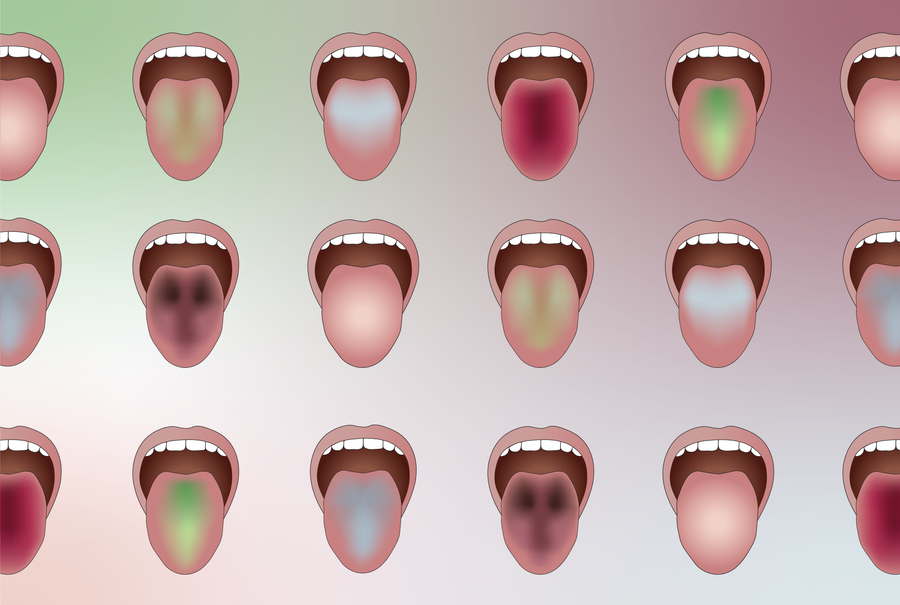
For thousands of years, traditional Chinese medicine (TCM) practitioners have checked patients’ tongues as part of a full examination, carefully scrutinizing their color, shape, and coating in an attempt to detect illness. TCM considers a tongue’s color especially telling, and now some researchers, encouraged by recent studies pointing toward a measurable association with health factors, are working to adapt this ancient diagnostic approach to today’s AI-based technology.

TCM remains a controversial topic in the global scientific community. The World Health Organization officially added TCM diagnoses to the 11th revision of the International Classification of Diseases, the global standard for health-information classification, in 2022. But most high-profile studies have treated the topic warily. “Despite the expanding TCM usage and the recognition of its therapeutic benefits worldwide, the lack of robust evidence from the EBM [evidence-based medicine] perspective is hindering acceptance of TCM by the Western medicine community and its integration into mainstream healthcare,” wrote the authors of a 2015 review article on TCM’s prospects. Still, pockets of strong academic interest persist.

In TCM, tongue color “is closely linked to the condition of the blood and qi [a Chinese term often translated into English as ‘vital energy’], making it a primary indicator for TCM practitioners in assessing a patient’s overall health,” says Dong Xu, whose research at the University of Missouri focuses on computational biology and bioinformatics and who co-authored a 2022 study on analyzing digital tongue images. But tongue examination can be highly subjective: it relies entirely on an individual practitioner’s color perception and analysis.

Frank Scannapieco, a periodontist, microbiologist, and oral biologist at the University at Buffalo, says that in Western medicine, no standardized clinical system is routinely used to monitor tongue features, although defined lesions on the tongue can serve as indicators for certain cancers, and some studies have linked tongue appearance to particular diseases such as breast cancer and psoriasis. Elizabeth Alpert, a dental health expert at the Harvard School of Dental Medicine, adds that tongue examination is often part of a routine screening for oral cancer by dentists and hygienists, but its accuracy depends on providers’ education and experience in clinical settings.

Massive developments in computing technology are causing some TCM-inspired medical researchers to take a new look at the tongue, however. The authors of a 2024 study in Technologies used machine-learning models to classify tongue colors and predict several associated conditions—including diabetes, asthma, COVID, and anemia—with a testing accuracy of 96.6 percent.A major challenge in previous tongue-imaging studies has been perception bias caused by varying light conditions, says the recent study’s co-author, Javaan Chahl, a roboticist and joint chair of sensor systems at the University of South Australia. “There have been studies where people tried to [diagnose via tongue color] without a controlled lighting environment, but the color is very subjective,” Chahl says.

To address this issue, Chahl and his team developed a standardized lighting system within a kiosk setup. Patients placed their heads in a box illuminated by LED lights, which emitted a stable and controllable wavelength of light, and exposed their tongues.

Chahl and his colleagues collected 5,260 images—both real tongue photographs found on the Internet and additional color-gradient images. They used them to train machine-learning models to recognize seven specific colors (red, yellow, green, blue, gray, white, and pink) at different saturation levels and in different light conditions.

The researchers confirmed that a healthy tongue usually appears pink with a thin white film; they found that a whiter-looking tongue may indicate a lack of iron in the blood. Diabetes patients often have a bluish-yellow tongue coating. A purple tongue with a thick, fatty layer could indicate certain cancers. COVID intensity (in people already diagnosed) can also influence overall tongue color, they found, with faint pink seen in mild cases, crimson in moderate infections and deep red in serious cases.

Next, they applied the most accurate of six tested machine-learning models to 60 tongue images, all taken using the team’s standardized kiosk setup at two hospitals in Iraq in 2022 and 2023. They then compared the experimental diagnoses with the patients’ medical records. “The system correctly identified 58 out of 60 images,” says study co-author Ali Al-Naji, now a medical engineering professor at the Middle Technical University in Iraq.

Al-Naji is now working on narrowing the focus for diagnosis to the tongue’s center and tip. His group is also using a new tongue dataset of 750 Internet images to examine tongue shape and oral conditions such as ulcers and cracks with the deep-learning algorithm YOLO. Eventually, Chahl would like to analyze more than just the tongue—perhaps the whole face.

Tongue color may possibly serve as a helpful biological marker of a person’s health state, but Xu cautions that it cannot stand on its own when it comes to making accurate clinical decisions. “The most fundamental limitation of current tongue-imaging systems is that tongue analysis represents only one component of a complete TCM diagnosis,” he says. And because image labeling is not widely standardized for this type of experiment, he adds, it’s harder to reproduce research findings.

.

https://static.scientificamerican.com/dam/m/7ff54fbcafadc2c1/original/saw1125Adva31_leadImage.png?m=1759757551.021&w=900Eve Lu

.

.

Click the link below for the complete article:

https://www.scientificamerican.com/article/ai-scans-tongue-color-to-predict-diseases/?_gl=1*tg5w47*_up*MQ..*_ga*MTQxNjU1Mjc4NC4xNzYwNzc3NTAz*_ga_0P6ZGEWQVE*czE3NjA3Nzc1MDIkbzEkZzAkdDE3NjA3Nzc1MDIkajYwJGwwJGgw

.

__________________________________________
I Wore Meta’s Ray-Ban Display Smart Glasses—And Saw the Future Through One Eye

Leave a comment

Click the link below the picture

.

I’ve been reviewing smart smart glasses for years, and while many have shown promise, none have truly delivered detailed visual information in a way that feels natural and untethered. Some, like the Rokid Glasses, come close—but they’re consistently held back by technical shortcomings, clunky controls, and a lack of refinement. The new Meta Ray-Ban Display could be the pair to change that. I had the chance to try them out at a demo event in New York, and I came away genuinely impressed. There’s still more testing to do before I can say if they’re worth $799 (especially with the month-plus waitlist just to book a demo), but based on this first hands-on experience, the potential is clear.

Display: A Full-Color AR View

The Meta Ray-Ban Display’s waveguide display is the best of its type I’ve seen yet, for several reasons. To clarify exactly what that means, I should first explain waveguide display technology.

Displays in smart glasses can be separated into two categories: prism and waveguide. Both use tiny projectors to send an image to your eyes, but they differ in terms of how the image actually reaches your eyes. Prism displays use angled lenses, located behind the front lenses, to redirect projected light toward the eyes, much like a prism. These lenses are bulky, and while you can see through them, they can dim and obscure your view even when the display is turned off. The advantage is that they can show high-resolution, full-color images with a wide field of view. 

Waveguide displays use a single lens with special patterns etched into it. They’re far lighter than prism displays and completely transparent when not in use, but the trade-off is that they have significantly lower resolutions and fields of view. They’re also usually monochrome: Other waveguide-equipped models I’ve tested, including the Even Realities G1, Vuzix Z100, and Rokid Glasses, all have green-only displays.

The Meta Ray-Ban Display solves at least one of those problems. It features a full-color waveguide display, and considering the challenges of the technology, it’s truly stunning. When I tried on the glasses, colors looked surprisingly vibrant, and the picture was quite bright in a reasonably well-lit room. Even though the resolution is only 600 by 600 and the field of view is a tiny 20 degrees, to my eye, menus, text, pictures, videos, and even maps were large and sharp enough to read easily. 

I say eye singular, because the display is only built into the right lens. This could be awkward for users with a dominant left eye, but I didn’t have any difficulty reading it. Moreover, I could easily see everything in front of me, both around the projected image and through the other, clear lens. I couldn’t take them outside to see if the display is still visible against a sunny day, a challenge of waveguide displays.

I’ve used prism smart glasses with bigger, sharper, and more colorful displays before; I’m writing this with an XReal One Pro connected to my laptop right now. However, prism displays are bulky and make the glasses difficult to see through. Even if my laptop wasn’t tethered by a cable to the One Pro glasses, I wouldn’t feel comfortable wearing them while walking around. The Meta Ray-Ban Display is a different beast, and while it wouldn’t be my first choice for remote work or movie watching, I can definitely see myself using it on the go.

The waveguide in the right lens is nearly invisible, which might not seem important unless you’ve tried competing smart glasses. The waveguides on every other pair I’ve used have appeared to outside observers as distinct rectangles with weird, colorful reflections. The actual details of what the displays show couldn’t be seen, but they’ve still been invariably distracting to anyone I talked to while wearing them. On the Meta Ray-Ban Display, I didn’t see a hint of the waveguide from the outside. At least, I couldn’t see it in the lighting of the specific room where I had the demo. It might still be visible under different lighting conditions, but from my early testing, it’s the least outwardly recognizable waveguide I’ve seen so far.

Controls: You Use Your Fingers


The Meta Neural Band enables gesture controls (Credit: Will Greenwald)

More than the color display, the biggest draw of the Meta Ray-Ban Display is its controller. It uses what Meta calls a Neural Band, a wristband that uses electromyography (EMG) to track hand gestures. Instead of sensors directly on your hand or a camera array constantly watching it like on the Apple Vision Pro, the Neural Band measures tiny movements on your arm to determine what your hand is doing.

In my short demo, the Neural Band controls worked better than I expected. Gestures are simple: Curve your fingers inward and swipe your thumb up, down, left, and right on the side of your index finger to move the cursor in different directions, pinch with thumb and index finger to click, pinch with thumb and middle finger to go back, double-pinch with thumb and middle finger to sleep and wake the display, and double-tap your thumb against the side of your index finger to bring up the AI assistant. There’s also a contextual gesture where you hold your thumb and index finger together and rotate them, as if turning a knob, which can adjust the volume or zoom in and out, depending on the situation. 

.


(Credit: Will Greenwald)

.

.

Click the link below for the complete article:

https://www.pcmag.com/news/i-wore-metas-ray-ban-display-smart-glasses-and-saw-the-future#

.

__________________________________________

Race and The Church of Jesus Christ of Latter-day Saints

Leave a comment

From

Click the link below the picture

.

Overview

Race is a concept that categorizes people based on the color of their skin or other physical features. Unfortunately, race is often used to justify mistreatment or to suggest that one group is better than another. The Church of Jesus Christ of Latter-day Saints teaches that everyone is an equal child of God regardless of race, ethnicity, background, skin color, or nationality. The Book of Mormon teaches that “all are alike unto God.”

God loves all His children. We are equal in His eyes, and He recognizes our divine potential to progress and become like Him. He wants each of us to return to live with Him and receive eternal life. Our differences bring beautiful variety to our lives. While we may judge one another based on outward appearance, “the Lord looketh on the heart.”

Racism has been a challenge throughout history across many cultures. Latter-day Saints are not immune from the tendency toward racist attitudes and actions. President Russell M. Nelson taught: “The Creator of us all calls on each of us to abandon attitudes of prejudice against any group of God’s children. Any of us who has prejudice toward another race needs to repent!”

What do we know about the origins of the priesthood and temple restriction?

Historical records show that a few Black men were ordained to priesthood offices during Joseph Smith’s lifetime. At least one Black man, Elijah Able, participated in the washing and anointing ceremony in the Kirtland Temple. In 1847, Brigham Young spoke approvingly of the priesthood service of Q. Walker Lewis, a Black elder living in Massachusetts.

Five years later, in 1852, in the Utah territorial legislature, Brigham Young announced that Black men of African descent could not be ordained to the priesthood. The restriction also meant that men and women of Black African descent could not participate in the endowment and sealing ordinances in the temple. However, Brigham Young also stated that Black Saints would eventually “have the privilege of all [that other Saints] have the privilege [of] and more.”

Brigham Young’s explanation for the restriction drew on then-common ideas that identified Black people as descendants of the biblical figures Cain and Ham. The Church has since disavowed this justification for the restriction, as well as later justifications that suggested it originated in the pre-earth life.

There is no documented revelation related to the origin of the priesthood and temple restriction. Church Presidents after Brigham Young maintained the restriction, in spite of increasing social pressure, because they felt they needed a revelation from God to end it.

Church leaders today counsel against speculating about the origins of the restriction. For example, President Dallin H. Oaks has taught: “To concern ourselves with what has not been revealed or with past explanations by those who were operating with limited understanding can only result in speculation and frustration. … Let us all look forward in the unity of our faith and trust in the Lord’s promise that ‘he inviteth them all to come unto him and partake of his goodness; and he denieth none that come unto him, black and white, bond and free, male and female’ (2 Nephi 26:33).”

How did the priesthood and temple restriction end?

President Brigham Young and subsequent Church Presidents taught that the priesthood and temple restriction would one day end. Several affirmed that lifting the restriction would require a revelation from God.

During the period when the restriction was in place, Black men and women received witnesses of the Restoration of the gospel of Jesus Christ, joined the Church, and served faithfully.

After praying for guidance, Church leaders in the 20th century made changes to the way the restriction was implemented, opening the way for larger numbers of Latter-day Saints to be ordained and participate in temple ordinances. Presidents George Albert Smith and David O. McKay authorized the ordination of previously restricted ethnic groups in the Philippines and Fiji. And President McKay discontinued an earlier policy requiring prospective priesthood holders in racially mixed South Africa to trace their lineage out of Africa.

Several individuals close to President McKay reported that he prayed to know the Lord’s will regarding the restriction, but did not receive the direction to lift it at that time.

.

https://www.churchofjesuschrist.org/imgs/3cb209e1c75211ed9b0eeeeeac1e544ff68c9e13/full/%21640%2C/0/defaultLDS

.

.

Click the link below for the complete article:

https://www.churchofjesuschrist.org/study/manual/gospel-topics/race-and-the-church-of-jesus-christ-of-latter-day-saints?lang=eng

.

__________________________________________

Why Scammers Target Seniors—And What You Can Do about It

Leave a comment

Click the link below the picture

.

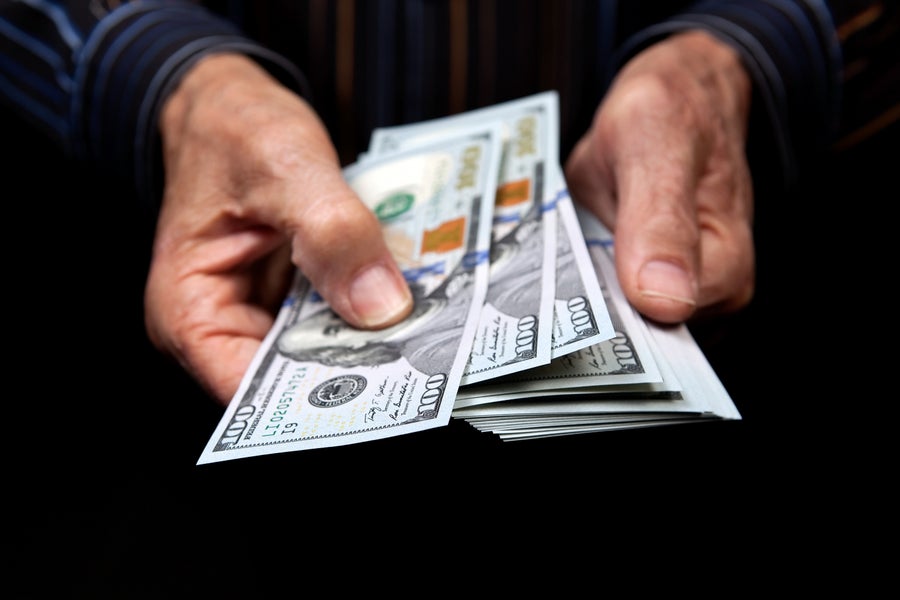
Anthony, an older man from California, told ABC7 Los Angeles last October that he had been scammed out of $25,000 by means of a voice generated by artificial intelligence. Anthony, who declined to give his last name, got a call from his son, as he believed, who told him that he’d gotten into a car accident and hit a pregnant woman who was hospitalized. Soon after Anthony hung up, another person called claiming to be his son’s lawyer. This caller said that $9,200 was needed immediately for bail or else Anthony’s son would be jailed for a month and a half.

AI has brought to a boil a problem that has been simmering for several decades. Older adults report financial exploitation to be the most frequent form of abuse they experience, with estimated annual losses as high as $28 billion in the U.S. alone. As the fastest-growing and wealthiest segment of the population, currently controlling 65 percent of the U.S.’s total wealth and $13 trillion in home equity wealth, older adults are increasingly likely to be targeted by scammers. Their vulnerability to scams stems from the many and diverse challenges of aging. These include declines in cognition, alterations in life circumstances (such as the death of a spouse), and difficulty keeping up with the constantly changing technological landscape.

Scammers use sophisticated tactics that prey on the vulnerabilities of older adults, inciting panic and inducing isolation so that individuals make decisions alone and quickly. Anthony, for instance, rushed to the bank and withdrew the money demanded and gave it to someone who came to his home. Then he received another phone call from a person posturing as a second lawyer. The accident victim had passed away, the caller said, which meant Anthony’s son’s predicament had worsened, and the amount needed for bail had gone up—$15,800 was now required. Shaken, Anthony paid again. It was only after this second payment that his daughter suggested to him that he might have been scammed.

No matter the amount of money lost, being scammed can damage mental and physical health, erode self-confidence, and diminish one’s quality of life. It can even contribute to premature death, as found by Jason Burnett of the McGovern Medical School at the University of Texas Health Science Center at Houston and colleagues. Fortunately, however, many people are able to detect a scam and walk away. How do they do that, and can their methods be used by others?

We decided to find answers to these questions. In 2016, we began conducting town hall meetings, self-report surveys, focus group discussions and in-depth individual interviews with nearly 300 residents of a large retirement community in Florida about their experiences with financial exploitation. Most everyone we talked to said that they had moved to the retirement community because they believed that they would not have to worry about crime—they would be living behind security gates, and all their neighbors would be older people.

In fact, however, they were being targeted by scammers more often since they had moved to the retirement community, which provided a concentration of wealthy and vulnerable adults. Almost immediately after moving into their new homes, many received phone calls, e-mails, and knocks on the door offering fraudulent services for home and auto repair, prizes and sweepstakes, and financial planning. They quickly had to learn to be vigilant.

Their main strategies to avoid being scammed: maintaining a skeptical mindset and keeping well informed about fraud and the diverse tactics used by scammers, e

specially during stressful times when they were consumed with other factors, such as a serious illness. “I keep up to date about fraud or scams,” Richard, then age 64, told us in an interview during our research. “I read all articles on scams. You really have to educate yourself.” (We changed the names of those we interviewed for privacy.) Protection against scams comes from continual education that helps older people develop and sustain their skepticism while also increasing their confidence in their ability to make smart, informed decisions.

Scams Old And New

AI has introduced novel ways for fraudsters to trick older adults through replicated or altered voices, videos, photographs and documents. Recent and novel scams that affect older adults include calls, texts, or e-mails that come as urgent messages from someone pretending to be a government official or law enforcement officer, requiring payment for what they claim is missed jury duty, unpaid highway tolls, or parking and traffic tickets. Failure to send money immediately, individuals are told, will result in their arrest or deportation.

At the same time, some long-standing scams continue to occur—but more frequently and with greater sophistication, making them more difficult to avoid. Lottery and sweepstakes scams remain common. Offenders, typically impersonating well-known celebrities or organizations, contact a person out of the blue and tell them that they have won a prize. To claim winnings, the scammers stress, individuals must send the money right away—sometimes thousands of dollars—to cover “taxes,” “shipping,” or “processing fees.” Even though no prize will ever arrive, scammers continue to contact their victims to convince them that more money must be sent.

Many variations on this theme exist. For example, the FBI first began receiving reports of the “grandparent scam” in 2008. This kind of fraud, resembling that experienced by Anthony, exploits a person’s emotions, inciting fear and anxiety, by impersonating a grandchild or other family member in distress. Offenders often demand that money be provided quickly and through gift cards or wire transfers, which don’t require identification to collect. Sometimes scammers have even sent couriers to their targets’ homes to collect money.

These scams have been around for decades, but persist as significant threats to older adults. They regularly top lists provided by law enforcement and advocacy groups of the most common scams targeting older adults. (The lists also often include government impersonation, tech suppor,t and financial services scams.) Not least, older adults are also increasingly targeted for scams involving medical procedures, insurance, auto and home repair, and sales.

Ralph, a highly decorated war veteran from Florida, and his wife received a phone call selling unlimited cruise vacations for one year from a seemingly reputable company. After paying $2,000 from their limited fixed income and savings, the couple never received confirmation of their purchase or information about how to redeem their vacations. Months passed, and Ralph, then age 90, sought help from the police. Eventually, a law enforcement official met with Ralph to tell him the case had to be closed without a resolution. As tears ran down his face, Ralph told the official, “It’s not about the money. I just feel so stupid.” This sense of helplessness, embarrassment, and utter misery is what so many scam victims report feeling.

Older adults can also be scammed by romantic partners, friends or family members. Tragically, nearly 50 percent of scams involve the people who are closest to older adults; these cases seldom get reported to law enforcement. Another common tactic: offenders scan obituary columns in local newspapers to befriend a widow or widower at a time when they are vulnerable. John, then age 67, told us that someone from local funeral homes “reminds women to never put an obituary [in the newspaper] because you are a target, and the minute that that goes in there, some crook is reading that to see if they can make a connection with you—‘Oh, your late husband was an Air Force pilot; I was a pilot, too’—and they use that to eventually get at their money.”

Why do people fall for these types of scams? The people with whom we talked reported that at the time of victimization—and regardless of whether the scam was routine or new—their judgement became so clouded that they lost their ability to be skeptical. They made spur-of-the moment decisions that were uncharacteristic of those they would have made in preceding months or years. Certain factors compound this problem.

Research suggests that older adults struggle more to anticipate financial losses, have higher levels of trust for strangers, and have a lower ability to detect deceptions compared with younger adults. These differences, both cognitive and psychological, may reflect age-related changes to the brain. Older adults also face an increasing frequency of setbacks to their physical and emotional health, which can reduce their self-confidence and hinder their skepticism. “I was in the hospital, depressed, and couldn’t hear that well anymore. When a [financial] planner called, I just wasn’t in the right place,” Anne, then age 78, said to us. “I should have known better. I did know better, but … I was just so depressed.” Peter Lichtenberg, a researcher at Wayne State University, and colleagues reported in 2016 that symptoms of depression were associated with an increased risk of fraud among older adults.

Social isolation also constitutes a significant factor. The loss of loved ones that comes with aging can shrink social networks and add to people’s vulnerability. “I have nobody. I don’t have anybody,” Harold, then age 75, told us. “My brother passed away. My sister is lingering in a nursing home…, and that’s it…. Losing support systems is terrifying, especially for us older folks.” In 2018, Marti DeLiemaof the University of Minnesota observed that the lack of a trustworthy network of friends or family best distinguished the older adults who had been defrauded from those who had not.

.

https://static.scientificamerican.com/dam/m/38db539a3cfc718/original/older_hands_holding_cash.jpg?m=1759857448.209&w=900BanksPhotos/Getty Images

.

.

Click the link below for the complete article:

https://www.scientificamerican.com/article/why-scammers-target-seniors-and-what-you-can-do-about-it/?_gl=1*19sf543*_up*MQ..*_ga*MTQxNjU1Mjc4NC4xNzYwNzc3NTAz*_ga_0P6ZGEWQVE*czE3NjA3Nzc1MDIkbzEkZzAkdDE3NjA3Nzc1MDIkajYwJGwwJGgw

.

__________________________________________

Proxy advisor ISS recommends Tesla shareholders oppose Elon Musk $1 trillion pay plan

Leave a comment

Click the link below the picture

.

Top proxy advisor Institutional Shareholder Services is recommending that Tesla investors vote against a pay plan for CEO Elon Musk that would grant him nearly $1 trillion more in stock.

The “mega performance equity award” to Musk, designed to retain the CEO long-term, “has an astronomical grant value conditioned upon far-reaching performance targets that, if achieved, would create enormous value for shareholders,” ISS wrote on Friday.

Tesla’s 2025 annual shareholder meeting and proxy vote is scheduled for Nov. 5. The company is scheduled to report third-quarter results on Wednesday.

ISS said that while some shareholders may support the pay plan, “there are unmitigated concerns surrounding the special award’s magnitude and design.”

Musk’s plan, if approved, would be the largest ever awarded to a public company CEO. It could net Musk up to an additional 12% stake in Tesla, should the company hit a market cap of $8.5 trillion and achieve other goals.

Tesla disagreed with the ISS recommendations.

In a post on X, which is owned by Musk, the automaker accused ISS of missing “fundamental points of investing and governance,” and complained that the advisors had previously “recommended against compensation that shareholders have voted on twice before (and that Elon has already earned), as well as the 2025 CEO Performance Award (where Elon receives nothing unless shareholders win big).”

The company urged shareholders to vote with the board’s recommendations on all proposals on the 2025 proxy.

ISS previously advised investors to reject a “ratification” of Musk’s 2018 CEO pay package, which was worth an estimated $56 billion at the time.

The Delaware Court of Chancery ruled early last year that the 2018 pay plan had been improperly granted by the Tesla board and must be rescinded. The ruling said Tesla hid crucial details from shareholders that they were entitled to before voting, and that Musk had controlled the board.

Musk has appealed that court’s decision to the Delaware State Supreme Court, with opening arguments in the appeal heard by a panel of judges this week.

Representatives for ISS declined to comment beyond the report.

ISS, along with Glass Lewis and smaller peers, can influence how shareholders decide to cast their votes at annual elections. Musk accused ISS and Glass Lewis in 2023 of effectively controlling the stock market because of their influence with passive or index funds in some matters. He also baselessly compared ISS to a terrorist organization.

Musk will be able to vote his own shares in the vote concerning his future pay. He holds at least 13.5% of Tesla’s voting power, according to the most recent available disclosures on his stake. Those holdings alone could be enough to secure approval for the nearly $1 trillion pay package.

In September, Musk added to his ownership of Tesla stock buying another $1 billion worth of shares.

Among other ISS recommendations, the firm also suggested that shareholders should vote against giving Tesla’s board authorization to invest in xAI, the AI company that Musk started in March 2023 but only disclosed publicly in July that year. Tesla has sold tens of millions of dollars worth of its Megapack battery energy storage systems to xAI.

ISS also recommended against voting to reinstate Tesla board member Ira Ehrenpreis, a longstanding and close friend of Musk.

In May, Tesla changed its corporate bylaws to limit shareholders’ ability to sue for a breach of fiduciary duties so that only a shareholder that owns at least 3% of the company’s stock can bring what’s called a “derivative” action. Ehrenpreis presided over Tesla’s governance committee at the time that change was made without a shareholder vote.

.

https://image.cnbcfm.com/api/v1/image/108168278-17518962972025-06-13t010710z_885255829_rc2gk1a9xltd_rtrmadp_0_space-warfare.jpeg?v=1753301789&w=1480&h=833&ffmt=webp&vtcrop=y

Elon Musk, CEO of SpaceX and Tesla, attends the Viva Technology conference at the Porte de Versailles exhibition center in Paris on June 16, 2023.  Gonzalo Fuentes | Reuters

.

.

Click the link below for the complete article:

https://www.cnbc.com/2025/10/17/proxy-advisor-iss-opposes-tesla-ceo-elon-musk-1-trillion-pay-plan.html

.

__________________________________________

Prosecutor Who Rejected Trump’s Pressure to Charge James Is Fired

Leave a comment

Click the link below the picture

.

A federal prosecutor who resisted President Trump’s demands to bring charges against Letitia James, the New York state attorney general, was fired along with her deputy on Friday evening, according to three people familiar with the matter.

The dismissal of the prosecutor, Elizabeth Yusi, was the latest fallout from attempts by career Justice Department officials to pump the brakes on Mr. Trump’s wide-ranging efforts to seek retribution against his perceived political opponents.

Ms. Yusi, who oversaw major criminal cases in the Norfolk office of the U.S. attorney’s office for the Eastern District of Virginia, had pushed back against Mr. Trump’s public calls for Ms. James to be indicted, telling colleagues that she had not found probable cause to file charges, the people familiar with the matter said. It was not immediately clear why her deputy, Kristin G. Bird, had also been fired.

The Justice Department did not immediately respond to a request for comment.

Despite the concerns career prosecutors raised about the case, Mr. Trump’s inexperienced handpicked choice to lead the prosecutors’ office, Lindsey Halligan, secured an indictment against Ms. James last week, accusing her of mortgage fraud. The indictment said Ms. James had falsely claimed in loan documents that she would use a home she had purchased in Norfolk, Va., as a secondary residence, but instead had used it as a rental property, allowing her to receive favorable terms that saved her close to $19,000.

The firings of Ms. Yusi and Ms. Bird came less than a month after Ms. Halligan’s predecessor, Erik S. Siebert, resigned under pressure from Mr. Trump. Mr. Siebert, who had been chosen by the president to run the office, had taken a stand against his desire to seek charges against another of his adversaries: James B. Comey, the former F.B.I. director.

In the end, Ms. Halligan did Mr. Trump’s bidding in that case, too, personally presenting a case to a grand jury last month and securing an indictment against Mr. Comey that accused him of lying to Congress and obstructing a congressional proceeding.

The U.S. attorney’s office in the Eastern District of Virginia, which has traditionally handled some of the country’s most significant terrorism and national security cases, has been battered by dismissals and resignations, stemming from the cases against Ms. James and Mr. Comey. Ms. James and Mr. Comey have both denied the charges against them.

Maya Song, the office’s former first assistant U.S. attorney, was fired in the wake of Mr. Comey’s indictment, as was her replacement, Maggie Cleary, a well-known conservative lawyer in Virginia.

Mr. Comey’s son-in-law, Troy Edwards Jr., who handled national security cases, resigned in protest shortly after the indictment was returned. And Mr. Edwards’s boss, Michael P. Ben’Ary, was dismissed after a pro-Trump social media influencer wrongly accused him in an online post of having questioned the indictment of Mr. Comey.

.

https://static01.nyt.com/images/2025/10/25/multimedia/17dc-justice/25dc-comey-vbzg-jumbo.jpg?quality=75&auto=webpPresident Trump’s handpicked acting U.S. attorney, Lindsey Halligan, secured an indictment against the New York attorney general last week after other prosecutors resisted seeking charges. Credit…Evan Vucci/Associated Press

.

.

Click the link below for the complete article:

https://www.nytimes.com/2025/10/17/us/politics/trump-prosecutor-fired-letitia-james.html

.

__________________________________________

New Clues Suggest San Andreas and Cascadia Faults May Produce Synchronized Earthquakes

Leave a comment

Click the link below the picture

.

The West Coast of North America is a geologically tumultuous zone where tectonic plates collide, subducting under and scraping past one another. Over the eons, this activity has regularly caused major earthquakes. New research reveals that some of these seismic events may have happened in sync along the coast’s two major faults: the San Andreas Fault and the Cascadia Subduction Zone.

A team of researchers analyzed a trove of seafloor sediment from the region where the faults meet off the coast of northern California. The researchers’ findings, published recently in Geosphere, reveal that the fault systems have produced several synchronized earthquakes over the past 3,000 years.

Chris Goldfinger, an Oregon State University marine geologist and lead author of the new paper, compares the process to tuning an analog radio, in which the device’s oscillators are synced up to convert incoming signals. “When you tune an old radio, you’re essentially causing one oscillator to vibrate at the same frequency as the other one,” he says. “When these faults synchronize, one fault could tune up the other and cause earthquakes in pairs.”

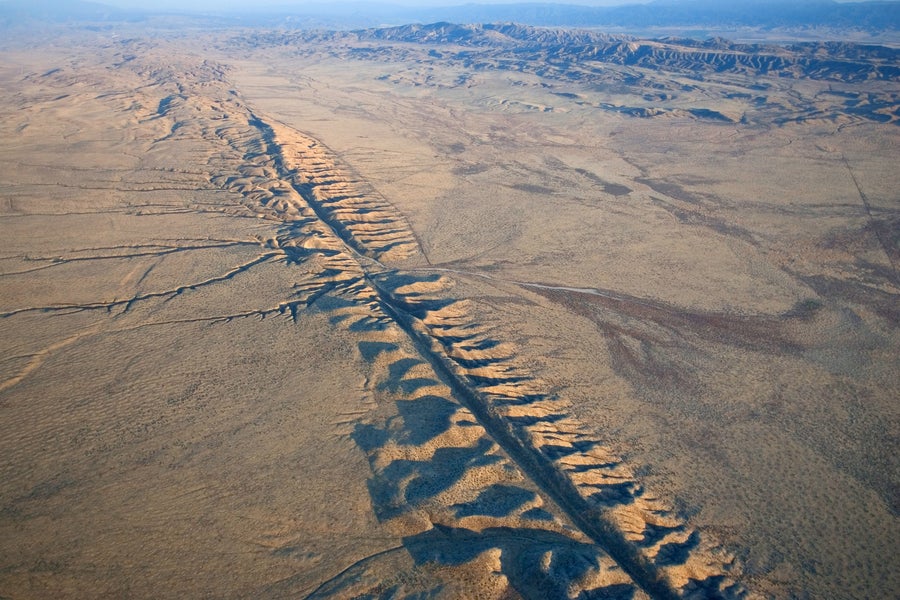
The Cascadia Subduction Zone, where the Juan de Fuca and Gorda plates slide underneath the North American Plate, stretches all the way from Vancouver Island to northern California to meet the San Andreas Fault. That fault extends south for 750 miles along a boundary where the North American and Pacific plates slide past each other.

Since 1999, Goldfinger and his team have been drilling into the seafloor at this tectonic crossroads, known as the Mendocino Triple Junction, to pull up cores that show a cross-section of the sediments that have built up there. For the new study, the researchers examined more than 130 sediment cores that record roughly 3,000 years of geological history. Many of the cores contained layered sediments known as turbidites, which are created by marine landslides that move large amounts of material around the ocean floor. Many of these landslides are caused by earthquakes, making turbidite layers a useful proxy for pinpointing past seismic events.

Most turbidites have coarser sediment layers at the bottom and finer silt-like sediment at the top, similar to what you get when you swirl a bucket of sand at the beach. But the turbidites in samples from the Mendocino Triple Junction “seem to be upside down with all the sand at the top,” Goldfinger says. “And as far as we know, gravity hasn’t changed.”

As they investigated the puzzling features, Goldfinger realized the cores contained two turbidites stacked on top of each other. This provides evidence of two separate earthquake events happening in quick succession—as the first earthquake was settling a layer of silt over the ocean floor, a second shock sent another avalanche of sand over top.

Some of the layered turbidites are so closely spaced that these events could have happened anywhere from within minutes to decades of each other. Analysis of the ages of shells in the sediments suggest there were at least eight large earthquakes along the San Andreas Fault over the past 3,000 years that occurred within decades of significant quakes along the Cascadia Subduction Zone.

Meng Wei, a marine geologist and geophysicist at the University of Rhode Island, says the idea that fault systems near each other could synchronize has been floating around for years and has been seen at smaller fault boundaries over short periods. But he says the new paper is impressive for illustrating that the phenomenon is possible with larger fault systems over thousands of years.

Though the Cascadia and San Andreas systems have apparently been linked for millennia, there seems to be some variability when it comes to the timing between successive quakes. Wei, who was not involved in the new study, says it is possible that the two faults could produce shaking within a few years of each other at some point in the future, but more research is needed to gauge how one quake triggers another. “Even if these two faults are synchro, the time interval between earthquakes can still be decades,” he adds.

The two systems are also not in perfect sync. The team discovered that some temblors, including the 1906 earthquake that devastated San Francisco, were one-off events that were caused exclusively by movements along the northern San Andreas Fault.

.

https://static.scientificamerican.com/dam/m/67f6c411e3c7b5d9/original/san_andreas_fault_in_california.jpg?m=1760036090.04&w=900

An aerial view of the San Andreas Fault crossing the Carrizo Plain in California.  Cavan Images/Peter Essick/Getty Images

.

.

Click the link below for the complete article:

https://www.scientificamerican.com/article/the-san-andreas-and-cascadia-earthquake-faults-may-be-linked/?_gl=1*1jlz3ne*_up*MQ..*_ga*MTQ1NjQ5NjQwNC4xNzYwNjA5Nzg5*_ga_0P6ZGEWQVE*czE3NjA2MDk3ODgkbzEkZzAkdDE3NjA2MDk3ODgkajYwJGwwJGgw

.

__________________________________________

Black Couples Are Skipping Weddings And Investing In Real Estate Instead

Leave a comment

From

Click the link below the picture

.

Weddings are beautiful. And as beautiful as they are, they are also expensive. 

And while I still haven’t quite made my way down the aisle just yet, let’s say I’ve made my way through my fair share of weddings (as a bridesmaid in at least six, in fact). So I’ve seen some of the most grandiose of weddings, and also when couples decided to scale back. And almost in every instance, it’s been my friends who decided to be a bit more frugal (and use the money to invest in other ways), who have revealed being happy with the decision they made. While some of the others were kicking themselves for things they later thought just weren’t worth it.

It makes complete sense. In 2025, the national average cost of a wedding in the U.S. is hovering around $36,000. And that’s the national average. Because couples that I know in major cities such as New York, D.C., Atlanta and San Francisco have spent three and four times as much as that amount. For many couples, that’s a price tag that causes second thoughts: what if that same money went into something more lasting?

So what are we seeing happen? Well, more and more Black couples are choosing to redirect what would have been their wedding budget into buying a home. For some, that means opting for a modest courthouse ceremony and skipping the reception altogether. For others, it’s about scaling down a traditional wedding—maybe hosting a backyard gathering or an intimate dinner—so they can put tens of thousands toward a down payment instead. However it looks, the choice shows a growing sentiment that wealth-building should come before extravagance. And in this economy, when you sit and think about it, can you really blame them?

Weddings vs. Down Payments

The numbers make this decision easier to justify. A wedding that costs $36,000 is roughly equal to a nine percent down payment on a $400,000 home, the current median price in many U.S. markets. According to Bankrate, first-time homebuyers in 2024 put down a median of nine percent of a home’s purchase price. That means a wedding budget could realistically unlock the front door to a couple’s first home.

Wedding costs, meanwhile, continue to climb. And with the average income needed to buy a home increasing year after year, it can almost seem frivolous to put so much towards one day, when many can’t afford basic living expenses. So much so, that it’s painful to really even think about it if you’re a 2025 or 2026 bride. Inflation has hit everything from catering to floral design, and planners say couples can expect to pay more now than just five years ago. The “wedding tax”—the premium vendors add for bridal services—only widens the gap. Many couples leave the experience not just newly married but also newly indebted, with credit card balances or loans that linger far beyond the honeymoon. For Black couples, who already contend with systemic barriers to wealth-building, that kind of debt isn’t something we can afford to take on.

Closing The Gap

The racial wealth gap in America remains depressing, and homeownership is one of the clearest indicators of it. The National Association of Realtors reported that the Black homeownership rate in 2023 was just 44 percent, compared to 73 percent for White households. That nearly 30-point difference reflects decades of discriminatory lending practices, redlining, and unequal access to mortgage credit. But buying property is closing a generational gap that has kept Black families from accessing the same wealth-building opportunities as our White peers.

Encouragingly, the tide is shifting. In 2024, 62 percent of Black buyers were purchasing their first home, according to National Mortgage Professional. That’s a higher share than the overall first-time buyer market. It shows a determination among Black couples to prioritize ownership even if it means challenging cultural expectations around weddings. Skipping the traditional big day may raise eyebrows among family or friends, but for many couples, the long-term benefits outweigh the short-term optics.

Redefining Black Love

While the financial logic is clear, this trend is also cultural. Weddings have long been positioned as the ultimate milestone, especially in communities where public celebrations of love carry deep significance. The dress, the cake, and the first dance are rituals passed down across generations. Social media has amplified the pressure, with Instagram and TikTok serving as highlight reels of elaborate receptions (if you haven’t already been on #WeddingTok, save yourself and don’t get on that side — it can really warp your perception of how much weddings really cost). But as costs soar and economic realities shift, thankfully many Black couples are rewriting the narrative. They are showing that intimacy, stability, and shared vision can matter more than spectacle, and that’s really how it should be.

.

https://www.essence.com/wp-content/uploads/2025/09/GettyImages-2196467490-1200x900.jpg?width=1200Portrait of young couple in front of their home

.

.

Click the link below for the complete article:

https://www.essence.com/news/money-career/black-couples-choosing-homes-over-weddings/

.

__________________________________________

How the Bolton Indictment Compares to Trump’s Classified Documents Case

Leave a comment

Click the link below the picture

.

The indictment on Thursday of John R. Bolton, President Trump’s former national security adviser turned critic, over his handling of classified information invites comparison to Mr. Trump’s own indictment on similar charges.

Mr. Trump was accused of illegally holding onto classified documents after he left the White House in January 2021, and of obstructing the government’s efforts to retrieve them from his Florida club and residence, Mar-a-Lago. The case was dropped last year after Mr. Trump won the 2024 election.

Mr. Bolton is accused of illegally sending classified information to two close family members who did not have security clearances, and of illegally holding onto copies of those messages at his house in Maryland.

Here is a closer look at how the two cases compare.

Both men were accused of not taking the proper precautions to secure classified information.

In Mr. Trump’s case, he was accused of storing boxes with classified information in various insecure locations at Mar-a-Lago, including a bathroom and a ballroom stage. Because Mar-a-Lago is a club and not just a residence, many people could have gained access to the documents before the F.B.I. finally retrieved them in August 2022.

In Mr. Bolton’s case, he was accused of transmitting the entries using personal email accounts and an encrypted consumer messaging app that were not approved for sending and storing classified information. One of the email accounts was apparently hacked by Iran in 2021, the indictment said. And while his house had an approved facility for storing classified information while he was Mr. Trump’s national security adviser, it did not have one afterward.

The charges in the two indictments substantially overlap in one respect: Both men were charged with multiple counts of unauthorized retention of national defense information under Section 793(e) of Title 10 of the United States Code, part of a law known as the Espionage Act.

In both cases, prosecutors picked a subset of the files recovered from the men’s homes during court-authorized searches — presumably, documents that were sensitive enough to impress a jury, but not so sensitive that it would be risky to discuss them in court — and brought a count based on each. Mr. Trump was charged with 38 such counts, and Mr. Bolton with eight.

The indictments against both men cited their own public statements criticizing others for mishandling classified information, to underscore that they knew what they were doing was wrong.

In Mr. Trump’s case, the indictment cited numerous statements he made during the 2016 presidential campaign about the need to vigorously enforce laws meant to protect classified information. At the time, Mr. Trump was using that issue to attack his rival, Hillary Clinton, for having used a private email server while secretary of state.

In Mr. Bolton’s case, the indictment quoted extensively from comments he made in the spring of 2025 criticizing Trump administration officials who had discussed plans for an upcoming military strike in Yemen on the consumer app Signal, in a group chat that mistakenly included a journalist. Notably, the Justice Department under Mr. Trump did not treat that incident as a crime.

The charges in the two cases significantly diverged in another respect. Each man was charged with a set of offenses that the other did not face.

In Mr. Trump’s case, his obstruction of efforts to retrieve files — including allegations that he caused a false statement to be made to law enforcement agents and conspired to conceal files from them — was a major part of his case. He faced eight additional charges that derived from that alleged behavior, which the indictment documented at length.

Mr. Bolton’s indictment chided him for not telling the F.B.I. that he still possessed classified information when he reported that an apparent Iranian hacker had broken into his email account in 2021. But it did not charge him with obstruction.

Mr. Bolton was, however, charged with eight counts of unauthorized transmission of national defense information under Section 793(d), based on the allegations that he emailed or used a messenger app program to send diary entries to his relatives, even though they were not cleared to see classified information in them.

The indictment of Mr. Trump recounted two incidents in which he was accused of showing classified files to people who were not authorized to receive them when he was no longer president, including a recorded interview at his club in Bedminster, N.J., with a writer and publisher of a forthcoming book, along with two staff members, during which he apparently showed them a classified military plan for attacking Iran.

.

https://static01.nyt.com/images/2020/01/28/us/politics/16dc-explainer/16dc-explainer-jumbo-v2.jpg?quality=75&auto=webpJohn R. Bolton, the former White House national security adviser, in 2019 at the White House.Credit…Erin Schaff/The New York Times

.

.

Click the link below for the complete article:

https://www.nytimes.com/2025/10/16/us/politics/trump-bolton-indictment-documents.html

.

__________________________________________

Older Entries Newer Entries

Amor Entre Estrellas

¡Bienvenido de vuelta viajero!

Heart of Loia `'.,°~

so looking to the sky ¡ will sing and from my heart to YOU ¡ bring...

Michael Ciullo

CEO and Founder of Nsight Health

MRS. T’S CORNER

https://www.tangietwoods

Nelson MCBS

Catholic News, Prayers, HD Images, Rosary, Music, Videos, Holy Mass, Homily, Saints, Lyrics, Novenas, Retreats, Talks, Devotionals and Many More

Global geopolitics

Decoding Power. Defying Narratives.

Talk Photo

A creative collaboration introducing the art of nature and nature's art.

Movie Burner Entertainment

The Home Of Entertainment News, Reviews and Reactions

Le Notti di Agarthi

Hollow Earth Society

C r i s t i a n a' s Fine Arts ⛄️

•Whenever you are confronted with an opponent, conquer him with love.(Gandhi)

TradingClubsMan

Algotrader at TRADING-CLUBS.COM

Comedy FESTIVAL

Film and Writing Festival for Comedy. Showcasing best of comedy short films at the FEEDBACK Film Festival. Plus, showcasing best of comedy novels, short stories, poems, screenplays (TV, short, feature) at the festival performed by professional actors.

Bonnywood Manor

Peace. Tranquility. Insanity.

Warum ich Rad fahre

Take a ride on the wild side

Madame-Radio

Découvre des musiques prometteuses (principalement) dans la sphère musicale française.

Ir de Compras Online

No tiene que Ser una Pesadilla.

Kana's Chronicles

Life in Kana-text (er... CONtext)

Cross-Border Currents

Tracking money, power, and meaning across borders.

Jam Writes

Where feelings meet metaphors and make questionable choices.

emotionalpeace

Finding hope and peace through writing, art, photography, and faith in Jesus.

WearingTwoGowns.COM

The Community for Wounded Healers: Former Medical Students, Disabled Nurses, and Faith-Fueled Pivots

...

love each other like you're the lyric to their music

Luca nel laboratorio di Dexter

Comprendere il mondo per cambiarlo.

Tales from a Mid-Lifer

Mid-Life Ponderings

Creative

Travel,Tourism, Life style "Now in hundreds of languages for you."

freedomdailywriting

I speak the honest truth. I share my honest opinions. I share my thoughts. A platform to grow and get surprised.

The Green Stars Project

User-generated ratings for ethical consumerism

Cherryl's Blog

Travel and Lifestyle Blog

Sogni e poesie di una donna qualunque

Questo è un piccolo angolo di poesie, canzoni, immagini, video che raccontano le nostre emozioni

My Awesome Blog

“Log your journey to success.” “Where goals turn into progress.”

pierobarbato.com

scrivo per dare forma ai silenzi e anima alle storie che il mondo dimentica.

Thinkbigwithbukonla

“Dream deeper. Believe bolder. Live transformed.”

Vichar Darshanam

Vichar, Motivation, Kadwi Baat ( विचार दर्शनम्)

Komfort bad heizung

Traum zur Realität

Chic Bites and Flights

Savor. Style. See the world.

ومضات في تطوير الذات

معا نحو النجاح

Broker True Ratings

Best Forex Broker Ratings & Reviews

Blog by ThE NoThInG DrOnEs

art, writing and music by James McFarlane and other musicians

fauxcroft

living life in conscious reality

Srikanth’s poetry

Freelance poetry writing

JupiterPlanet

Peace 🕊️ | Spiritual 🌠 | 📚 Non-fiction | Motivation🔥 | Self-Love💕