If you are career-minded, you may think applying for a loftier position in another company is the best route. In fact, half of millennials expect to leave their current company within a year.
But it’s not always the right move. Advancing in your present company may be a smarter move. You already know the culture and the people. If you enjoy them, who is to say that you’d find something better elsewhere? Also, some companies reward loyalty. And why would you want to compete with hundreds of applicants in a chaotic job market?
If you are staying, hone your strategy. Follow these five steps to boost your likelihood of advancing.
1. ASK FOR VISIBLE ASSIGNMENTS
First, seek out high-profile assignments. You want to be seen as a go-getter.
Do this, and your boss and other leaders in the firm will regard you as a creative, productive worker with aspirational goals. I’m not talking about doing extra grunt work. I mean seizing opportunities to come up with innovative ideas and initiatives that impress others.
Commit to projects that reach beyond your department. You’ll open the door to new relationships with potential bosses in other departments. For example, you might lead a fundraising project, or help another executive with her presentation, or volunteer to speak at an International Women’s Day event in your company.
2. BUILD YOUR NETWORK AT THE COMPANY
It’s important to build your network within the firm. You’ll meet and gain the favor of leaders who recognize your talent and initiative. That can lead to important new relationships with strategically placed individuals.
Take part in activities where you can meet senior leaders. These include conferences, sports such as company golf tournaments, leadership forums, and training sessions. If there is someone in the company you admire and think you’d like to work for, find a way to get onto their calendar. You might have a mutual interest. Or, you might invite them to speak to your team as a guest expert. Be creative in setting up that meeting.
Once you’ve made that contact, broach the discussion about reporting to them. There might be an advertised position or not. Either way, if you want to work in that department, go for it, set up a meeting, and prepare to pitch yourself.
3. PREPARE A STRONG PITCH
If you’re job hunting in your present company, it might seem like overkill to prepare for each encounter. But you must do so—even for conversations with people who may not have a job to offer you at the moment. They may be able to recommend you to others.
CLIMATEWIRE | The Trump administration’s abrupt retreat from global climate action is threatening to delay a pivotal scientific report that can be used by countries to shape their responses to rising temperatures.
Delegates from more than 190 countries are meeting in Hangzhou, China, this week to make decisions related to the content and timing of the seventh assessment report by the Intergovernmental Panel on Climate Change, a U.N. body that evaluates the science behind climate change.
The conclusions of the assessments — which are released every five to seven years — help inform governments about the sources of greenhouse gas emissions, the pollution’s effects on the planet and the risks of not acting to curb it. The comprehensive reports are also integral to ascertaining whether countries are doing enough to reduce emissions — a process under the Paris climate agreement known as a stocktake.
The U.S. delegation was prevented from attending the IPCC meeting by the Trump administration, said a government official who was granted anonymity because they were not authorized to discuss the situation. The move follows
President Donald Trump’s announcement last month that he would immediately withdraw from the Paris deal.
Among the delegates who were blocked from attending the meeting is a federal scientist, Katherine Calvin, who was co-chairing one of three working groups that help assemble the next assessment. The Trump administration also halted a technical support unit that was backing that working group, according to two other government officials.
Losing that unit would ensure delays at the working group level of the assessment’s preparation, said one of those officials.
The State Department declined to comment.
Flouting the IPCC meeting is another signal that the Trump administration is pulling back from global climate engagement. U.S. officials did not attend a board meeting last week of the Green Climate Fund, the primary vehicle for helping poorer countries fund climate efforts. That’s been coupled with a complete assault on climate science at home, the shuttering of climate programs administered by the U.S. Agency for International Development and a broad freeze on foreign assistance.
There were already concerns among delegates and advocates about delays related to the IPCC’s seventh assessment following disagreements last year over some key elements of the report’s timeline. The main synthesis report is due in late 2029, but only after reports from the three working groups are completed. The idea is some of those would be published before the next stocktake in 2028.
“The Paris Agreement process must be informed by the best and latest available science,” a group of countries known as the High-Ambition Coalition urged in a statement Friday. Signatories include the United Kingdom, Germany, the European Union’s climate commissioner and several small island nations.
WASHINGTON — President Donald Trump and his vice president, JD Vance, on Friday effectively took the side of Russian dictator Vladimir Putin in his brutal invasion of Ukraine, calling visiting Ukrainian President Volodymyr Zelenskyy “disrespectful” and telling him he has “no cards” with which to negotiate.
“You’re either going to make a deal or we’re out, and if we’re out, you’ll fight it out. I don’t think it’s going to be pretty,” Trump said, berating Zelenskyy in the Oval Office in front of gathered reporters.
Vance added: “I think it’s disrespectful for you to come to the Oval Office to try to litigate this in front of the American media… You should be thanking the president for trying to bring you into this conference.”
Trump has been trying to coerce Zelenskyy into handing over Ukraine’s mineral rights in exchange for U.S. support, and the purpose of Zelenskyy’s visit was ostensibly to reach an agreement. Trump then told Zelenskyy that the Ukrainian leader was currently in no position to complain about the state of affairs, even though it was Putin, not Zelenskyy, who began the bloody three-year war.
“You don’t have the cards, but once we sign that deal, you’re in a much better position, but you’re not acting at all thankful. And that’s not a nice thing, I’ll be honest, that’s not a nice thing,” he said.
Trump and Vance’s insults of Zelenskyy came at the tail end of a nearly hour-long photo opportunity in which Trump invited questions. Trump grew visibly angry and ended media availability with: “I think we’ve seen enough.”
A planned joint news conference was canceled and Zelenskyy left the White House about an hour later. No agreement was signed.
By that point, Trump had already attacked Zelenskyy in a social media post:
“We had a very meaningful meeting in the White House today. Much was learned that could never be understood without conversation under such fire and pressure. It’s amazing what comes out through emotion, and I have determined that President Zelenskyy is not ready for Peace if America is involved, because he feels our involvement gives him a big advantage in negotiations. I don’t want advantage, I want PEACE. He disrespected the United States of America in its cherished Oval Office. He can come back when he is ready for Peace.”
Trump is trying to force Ukraine, which has been under a near-daily missile and drone barrage from Russia for three years, to turn over rare earth mineral deposits to the United States to pay for U.S. military aid the country was provided under former President Joe Biden.
The new efforts at coercion come six years after Trump’s first attempt to extort Ukraine, which had its origins in Trump’s choice to accept Russian help to win the 2016 election against Democrat Hillary Clinton.
During his discussion with Zelenskyy, Trump went off on a long tangent about the investigations into Putin helping Trump win the presidency in the first place in 2016. Although the details of Russian involvement were confirmed by both special counsel Robert Mueller’s probe and a separate inquiry by the Senate Intelligence Committee, Trump has lied that it was a “hoax.”
After sending his lawyer Rudy Giuliani to Ukraine to dig up evidence that Ukraine had tried to help Clinton in 2016, Trump attempted to extort the then-newly elected Zelenskyy into announcing an investigation into Biden, whom he most feared as an election opponent in 2020. Trump was impeached but not removed from office for that action.
Trump’s animosity toward Zelenskyy has clearly endured in the years since.
On Friday, Trump ranted about the investigations into Russia’s 2016 election interference in response to a question about how he could trust Putin to honor any peace agreement. Trump told reporters that Putin was similarly wronged by the investigations and then inexplicably dragged Biden’s son Hunter and California Democratic Sen. Adam Schiff into his answer:
“Let me tell you, Putin went through a hell of a lot with me. He went through a phony witch hunt where they used him in ‘Russia, Russia, Russia, Russia.’ You ever hear that deal that was a phony, that was a phony Hunter Biden, Joe Biden scam, Hillary Clinton, shifty, Adam Schiff, it was a Democrat scam, and he had to go through that. And he did go through it.”
Trump continued, “We didn’t end up in a war. And he went through it. He was accused of all that stuff. He had nothing to do with it. Came out of Hunter Biden’s bathroom. It came out of Hunter Biden’s bedroom. It was disgusting. And then they said, oh, oh, the laptop from hell was made by Russia, the 51 agents. The whole thing was a scam, and he had to put up with that. He was being accused of all that stuff.”
It was unclear exactly what Trump meant.
Trump claimed during his campaign to win back the presidency in 2024 that he would end the war in Ukraine prior to taking office. For years, he has claimed without evidence that Russia would never have invaded Ukraine had he remained in office in 2021 ― even though Russia was actively fighting to take Ukrainian territory in the eastern part of the country during Trump’s entire first term.
.
President Donald Trump and his vice president, JD Vance, on Friday effectively took the side of Russian dictator Vladimir Putin in his brutal invasion of Ukraine, calling visiting Ukrainian President Volodymyr Zelenskyy “disrespectful” and telling him he has “no cards” with which to negotiate.
Authorities investigating the deaths of Gene Hackman and his wife Betsy Arakawa believe Hackman likely died nine days ago, according to data recorded by his pacemaker.
Santa Fe County Sheriff Adan Mendoza told reporters at a Friday afternoon press conference that Hackman’s pacemaker last recorded an event on Feb. 17, though that doesn’t mean the pacemaker was implicated in his death.
Mendoza said an “initial interrogation” of the pacemaker showed “that his last event was recorded on Feb. 17, 2025,” which strongly suggests “that was his last day of life.”
The sheriff also confirmed earlier reports that authorities removed a handful of items from the legendary actor’s Santa Fe, New Mexico, home while executing a search warrant.
They include two green cellular devices, records from a medical diagnostics and health tracking company called MyQuest and a 2025 monthly planner. Officials also removed three types of medicine from the house: Diltiazem, typically used to treat high blood pressure; a thyroid medication; and Tylenol.
Mendoza declined to identify who was prescribed which medications, citing HIPAA laws.
The items were enumerated in a search warrant return released Friday and obtained by the Santa Fe New Mexican.
Hackman, 95, and Arakawa, 65, were found dead in the home Wednesday during a welfare check, along with one of their dogs. It’s unclear who died first, Mendoza said.
While the sheriff said there were “no apparent signs of foul play,” the circumstances were “suspicious enough in nature to require a thorough search and investigation.”
According to the affidavit, Hackman’s body was found in a mudroom near his cane, and he appeared to have fallen, while authorities found Arakawa in a bathroom with a space heater near her head.
A countertop near Arakawa had an open prescription bottle and pills scattered on its surface.
Mendoza told NBC’s Today Show earlier on Friday that the couple appears to have been deceased for “several days, possibly even up to a couple weeks,” based on the decomposition of their bodies.
.
Santa Fe County Sheriff Adan Mendoza speaks during a press conference at the Santa Fe County Sheriff’s Office on Feb. 28 in Santa Fe, New Mexico.Sam Wasson via Getty Images
CAPE CANAVERAL, Fla. — The private Athena lunar lander is on its way to the moon.
A SpaceX Falcon 9 rocket lifted off shortly after sunset this evening (Feb. 26), carrying Athena and NASA’s ride-along Lunar Trailblazer orbiter aloft against a darkening sky here at NASA’s Kennedy Space Center (KSC).
Athena — which was built by the Houston-based spaceflight company Intuitive Machines — carries 10 NASA science instruments, many of which are designed to hunt for signs of water ice. Lunar Trailblazer will do similar work from its higher perch. That’s a big priority for NASA, which aims to establish one or more human settlements on the moon via its Artemis program.
“I’m very excited to see the science that our tech demonstrations deliver as we prepare for humanity’s return to the moon and the journey to Mars,” Nicky Fox, associate administrator of NASA’s Science Mission Directorate, said during a prelaunch briefing today.
The Falcon 9 launched at 7:16 p.m. EST (0017 GMT on Feb. 27) this evening from KSC’s Launch Complex-39A. About 8.5 minutes later, the rocket’s first-stage booster came back to Earth for a landing on SpaceX’s A Shortfall of Gravitas droneship as planned. This was the ninth launch and landing of the Falcon 9 booster (B1083) supporting the IM-2 mission.
The Falcon 9’s upper stage rocketed onward. It deployed Athena into translunar injection orbit about 43.5 minutes after liftoff and Lunar Trailblazer four minutes later, as planned.
Athena’s mission is called IM-2, because it’s the second launch to the moon in as many years for Intuitive Machines. IM-2 is part of NASA’s Commercial Lunar Payload Services (CLPS) program, which seeks out commercial partnerships to deliver science and technology gear to the moon.
Athena’s ambitious mission focuses on the abundance of water ice and other resources near the moon’s south pole, and the prospect for future missions to utilize those resources for sustainable habitability in space — a process known as in-situ resource utilization (ISRU). To fulfil all IM-2’s objectives, the lander is carrying two secondary vehicles: a mini rover named MAPP (Mobile Autonomous Prospecting Platform) that was built by the Colorado company Lunar Outpost and Grace, an Intuitive Machines “hopper” robot that will explore the region around the landing site via a series of leaps.
IM-2 follows Intuitive Machines’ historic first mission, IM-1, by just over a year. The IM-1 lander, “Odysseus,” launched in February 2024, also on a CLPS flight. Odysseus managed to make it to the surface, pulling off the first-ever soft lunar landing by a private spacecraft. But the probe came in too fast and broke one of its landing legs, which caused it to tip over during the touchdown. As a result, the spacecraft’s high-gain antenna was blocked, preventing the transmission of some of the data that NASA had hoped to collect.
.
A SpaceX Falcon 9 rocket launches from NASA’s Kennedy Space Center, carrying the Intuitive Machines moon lander Athena. As part of NASA’s CLPS (Commercial Lunar Payload Services) program, Athena carries scientific experiments to search for water near the lunar south pole. Manuel Mazzanti/NurPhoto via Getty Images
My wife is a clinical social worker and therapist at an integrated health clinic in Massachusetts. This year, like other years, the staff recently received their year-end bonus. This bonus is a relatively paltry $1,000 and is standard across the staff, with no fluctuations based on merit. Everyone gets $1,000 (minus taxes). However, this year my wife took short-term medical leave. Her bonus was prorated to account for the time that she was on leave. Another woman, who was on maternity leave for part of the year, also received a prorated bonus. Is this discriminatory on the part of their employer or just unfair? Both these types of leave are perfectly legal and necessary and, speaking for my wife, enabled her to provide the best care that she could for her patients upon her return. Do these hardworking, dedicated women have any recourse to recoup the rest of their well-deserved bonuses?
— Disgruntled Husband, Massachusetts
It’s unfair, in my opinion, but in this case my opinion carries little weight. This is a legal question, and a very interesting — albeit complicated — one.
I spoke to Inimai Chettiar, president of A Better Balance, a nonprofit legal advocacy organization, to get her take. Ms. Chettiar says that if there’s a prorated bonus and it’s clearly based on performance, then what your wife and her colleague experienced was legal.
But what does “performance” mean? Does going on medical or maternity leave mean a person has demonstrated a lesser performance than, say, someone who didn’t? The additional wrinkle here is that you say in general everyone gets the same bonus, so it’s unclear that it is in fact a performance-based bonus.
This is one of those gray-area examples where it comes down to interpretation of the law and the individual circumstance, and whether your wife is being treated the same as other people who took leave. For example, if workers who took leave for something other than disability or medical reasons did NOT have their bonuses prorated, Ms. Chettiar says, that would clearly be discrimination under the Pregnancy Discrimination Act and Pregnant Workers Fairness Act, which make it illegal to retaliate against workers for being pregnant or because of pregnancy-related needs. In this case, however, it seems that your wife is being treated the same as her nonpregnant colleague.
Marylou Fabbo, an employment lawyer in Massachusetts, your home state, said it was important to know that there’s also the Family and Medical Leave Act, a federal statute that entitles
employees to take unpaid leave for specific medical or family-related reasons, which include a birth, a relative with health issues that require employee care or, as the website of Department of Labor says, “a serious health condition that makes the employee unable to perform the essential functions of his or her job.” Massachusetts has a fairly new paid-leave law that is similar to that federal law, Ms. Fabbo added.
In this circumstance, she said, while the prorated bonus didn’t sound strictly discriminatory, it didn’t sound particularly fair.
She suggested that it would probably in your wife’s best interest to consult an employment lawyer just to be sure. A statute like the Family and Medical Leave Act would probably require an employer “to pay the full amount, depending on the laws that are applicable to the particular employee,” Ms. Fabbo said.
And if you’re worried that the legal fees would exceed the bonus amount, she pointed out that many employment statutes, including those related to discrimination or failure to pay wages, required the employer to pay the employee’s legal fees if the employee won the case.
.
Credit…Photo illustration by Margeaux Walter for The New York Times
CLIMATEWIRE | Congress’ oversight arm has issued an unprecedented warning about the risks facing federal disaster aid.
The Government Accountability Office said staffing levels and other workforce issues at the Federal Emergency Management Agency “has limited its capacity to provide effective disaster assistance.” It added that FEMA “needs to strengthen its disaster workforce by addressing staffing gaps.”
A staffing shortage that persisted from 2019 to 2022 “continues to grow” and left the agency with minimal staffing when Hurricane Milton hit Florida in October, days after Hurricane Helene deluged the state and large parts of the Southeast, GAO found.
The warning coincides with President Donald Trump’s threats to shutter FEMA, and it came two weeks after his administration fired at least 200 people from the agency.
The report marks the first time GAO put disaster aid on its annual “High-Risk List,” which highlights areas of the federal government that are “seriously vulnerable” to waste, fraud and abuse or need transformation. In addition to FEMA’s staffing problems, the report noted that “natural disasters have become costlier and more frequent.”
The GAO did not mention Trump or the FEMA firings that were carried out by his administration.
Trump, who has assailed FEMA’s response to flooding caused by Helene in western North Carolina, created a council to review whether the agency should be disbanded. It’s led by Homeland Security Secretary Kristi Noem and Defense Secretary Pete Hegseth.
FEMA staffing is only one problem the GAO found with disaster response. Others include the fragmentation of federal disaster response across more than 30 entities and a complex process for individuals to get emergency help after a disaster.
“Survivors face numerous challenges receiving needed aid, including lengthy and complex application review processes,” the GAO said, echoing a concern that has been raised for years. “Reforming the federal government’s approach to disaster recovery and reducing fragmentation could improve service delivery to disaster survivors.”
Numerous federal entities provide disaster aid, including the departments of Housing and Urban Development, Transportation, and the Small Business Administration.
.
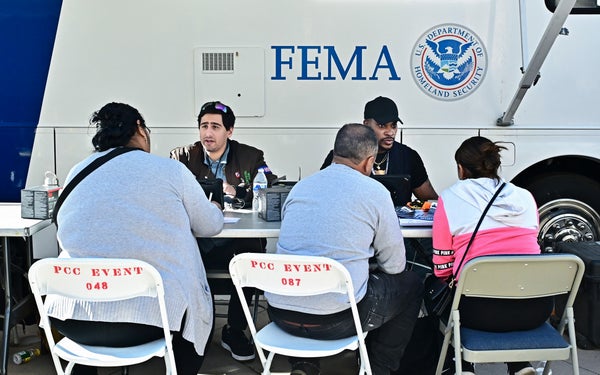
Fire-affected residents meet with FEMA officials on January 14, 2025 in Pasadena, California, where a FEMA Disaster Recovery Center opened to help homeowners, renters, businesses and non-profits with their economic recovery. Frederic J. Brown/AFP via Getty Images
When I was 17 in the late 1980s, I fell in love with a boy from work. He was 19 and from another country and when our work time was over, he had to fly home. What followed were many love letters (international phone calls were far too expensive then), every one of which I saw as fiercely romantic.
One day about six months into the relationship, a letter was waiting for me at home. My long-distance boyfriend often addressed letters with silly names or in-jokes. This time, he addressed the letter to “Mrs. [his last name].” My mother got very serious. She told me that this was possessive and too serious for our age, and that I had to write him a letter to break up with him immediately. I did, but I was still in love. Secretly, I kept writing the letters. I thought being “Mrs.” was romantic, and my mom was overreacting.
At age 21, after five years of separation by an ocean, I started an in-person relationship with him. It was deep and real love—or so I thought. By 24, I was being so emotionally abused and physically threatened, I barely knew my own name. This is how it happens. I was frozen and couldn’t seem to reconcile the dichotomy of my own life. I was deeply in love but was very confused by these behaviors because he would tell me how much he loved me while he was doing them. I was smart and educated. I knew about domestic violence, and I knew what he was doing was wrong, but no one had told me how to actually handle it—the frozenness, the confusion, and the gaslighting. Mostly, what I’d learned from a society that blames women for staying is that, if I stayed or still loved him, the abuse was my own fault.
Intimate partner violence is the number one cause of serious injury or death of women ages 18 to 24 in America, according to a 2018 statement released by the American College of Surgeons, and homicide is the leading cause of death for pregnant women in the U.S. If it’s shocking to you to hear that, then it’s time to pay attention. This trend also applies to adolescent girls, who are being murdered by their intimate partners in increasingly dangerous numbers. A study from 2019 looked at homicide rates for teens and 7% were murdered by their partner, whether current or former.
Adolescence is a critical developmental time when young people are more vulnerable to societal pressures. A rise in misogyny (such as the recent explosion of “your body, my choice” as a slogan boys and men say), a marked increase in forced and violent sex for girls, and a culture that views rape prevention as a girls’ issue versus a boys’ issue is setting the stage for the already-large teen mental health epidemic to worsen.
Teen dating violence (TDV) is a type of intimate partner violence (IPV) that includes behaviors such as “physical violence, sexual violence and coercion, psychological aggression, and stalking” and is associated with an increased risk for further intimate partner violence, depression and anxiety, mental and physical illness, substance use, and suicidal ideation. In 2025, at least 1 in 3 girls in the U.S. have experienced teen dating violence according to the organization Love Is Respect, and it’s affecting them at dangerously high levels.
CLIMATEWIRE | Lawmakers and officials from Western states are warning that President Donald Trump’s firings and funding freezes will leave the region woefully unprepared for the coming wildfire season, just two months after blazes ravaged Los Angeles.
The new administration’s moves to terminate nearly 10 percent of Forest Service personnel and pause grants intended to reduce the risk and intensity of fires have left states scrambling to make sure they don’t lose valuable preparation time. The uncertainty is coming during a period when the Forest Service and state governments would normally be doing crucial work such as creating fire breaks, carrying out controlled burns, thinning trees and clearing brush.
“These cuts are clobbering rural Oregon,” said Sen. Ron Wyden (D-Ore.). “This is going to make it extraordinarily difficult to get a balanced approach on natural resources.”
The pullbacks represent a major change from the Biden administration, which poured more than $3 billion into wildfire prevention. They are also notable given that Trump has repeatedly faulted Western officials for not doing enough on forest management dating back to his first term.
Record drought, heat waves and sluggish forest management in both state and federal forests have exacerbated fires in recent decades: An average of 3 million acres burned nationwide each year in the 1990s, but now, the average is nearly 7 million, according to data from the National Interagency Fire Center.
While the Agriculture Department, which oversees the Forest Service, now appears ready to unfreeze some wildfire mitigation funding, cuts have stalled active forest management projects, delayed wildfire training, and raised concerns that bipartisan legislation already passed this Congress could fail to help. And even though direct firefighters are exempt from the Forest Service cuts, many of the 3,400 workers fired at the agency supported in trail maintenance, fuels reduction and other forestry projects just as summer hirings would start in preparation for wildfire season.
“The threat of these changes is significant,” said Vicki Christiansen, who served as Forest Service chief during Trump’s first term. “$40 million in savings now just to have an additional $4 billion in wildfire expenses is crazy.”
The Forest Service is responsible for some 193 million acres of forests and grasslands — the majority of it in the West. Federal reductions could force states with large swaths of Forest Service land to do more to manage or respond to incidents.
State and local officials in Nevada, California, Utah and Washington state said they are now looking to their own state budgets to cobble together resources. Utah and Oregon already are working to expand state forest management funding. Other states, like Washington, are trimming their own budgets and have no surplus to use to make up for a gap in federal funding. Every state said there is no way they can fully patch the hole left by the federal government.
Nevada State Forester and Firewarden Kacey KC said a big worry is staffing emergency management teams with dispatchers, technicians and GIS workers, none of whom would likely qualify for the exemption for direct firefighters but are still a vital part of wildfire prevention and mitigation. KC, who was appointed by former Republican Gov. Brian Sandoval and works in a state where 86 percent of the land is federally owned, is already talking about a “Plan B” to exercise her agency’s authority to make emergency hires.
.
A firefighter stands on top of a fire truck to battle the Palisades Fire on January 8, 2025 in Los Angeles, California. Forest Service cuts are leaving Western officials scrambling to prepare for future wildfires. Apu Gomes/Getty Images
Gender expression can come in many forms, but for a kid I’ll call Sarah, it first came in the form of a pair of owl pajamas. They were soft cotton, with wide-eyed owls cavorting on a pink background, and at 18 months old, Sarah would wriggle her way out of her “boy” clothes and into the pajamas as soon as she got home from preschool, toddling back into the living room pleased as punch with herself. “She was so, so determined,” says Sarah’s parent Ingrid (who has asked in this article to go by her middle name). “Like, ‘No, this is actually what I want.’”
At age two, Sarah came across a rack of dresses hanging outside a store and tried to put one on right there on the sidewalk (“You look beautiful,” an older woman said in passing, to Ingrid’s relief). At three, according to Ingrid, Sarah began to “socially transition herself,” asking to grow her hair out, gravitating in the aisles of Target toward sparkly dresses in hues of Pepto-Bismol pink and to anything having to do with unicorns. In kindergarten, Sarah said she wanted to change her pronouns. In first grade, she said she wanted to change her name. Somewhere along the way, her parents went to see some specialists to ask for advice on how to handle what was clearly not just a phase: “We were like, ‘Well, this thing seems to be a thing. What do we do to not mess her up?’ And they were like, ‘Just give her space, make sure she’s safe, and let her lead.’ And so that’s what we’ve [done].”
They also began to join listservs for the families of transgender children, tapping into a network of fellow New York City parents who had experience navigating some of the parenting concerns specific to raising a trans child. There were meetups and playdates and support groups. There was also information about medical providers and timelines. It was understood that not every trans child would want or require medical care — especially when it comes to a generation of children that, more than previous generations, understand gender to be both a spectrum and a construct. But it was also understood that trans kids were significantly more likely than their cisgender peers to die by suicide. A national 2022 study conducted by the Trevor Project, a nonprofit organization dedicated to LGBTQ+ youth suicide prevention, found that more than half of transgender and nonbinary youth seriously considered suicide in that year alone. Another study, published this past September in the journal Nature Human Behavior, linked those rates not to something inherent in trans identity but instead to trans acceptance in the broader culture: In states that passed anti-trans legislation, including bans on gender-affirming care, suicide attempts by transgender teenagers could increase by as much as 72 percent in the years after the ban went into effect. It stood to reason that for children who experience gender dysphoria, or distress over the disconnect between their biological sex and their gender identity, even offering them possibility of not having to grow into an unwelcome body could buttress their mental health. Sarah’s parents had noticed that each step she took in transitioning seemed to calm her, to make her more “settled,” as Ingrid puts it. As Sarah approached the age of puberty, they began to carefully broach the subject of what she could expect. “I mean, who wants to talk about puberty with their parents?” asks Ingrid. “We were just like, ‘You’re going to enter this thing called puberty pretty soon. Right now, your puberty will have you end up in a boy body, but there’s these different options. If you want to, we can pause it until you figure out if you want a girl body or a boy body.’” Sarah was adamant that she already knew: She was not a boy; she did not want to end up in a boy body. Her parents booked an informational appointment with the Transgender Youth Health Program at NYU Langone’s children’s hospital, one of the world’s most well-regarded gender-affirming-care practices at one of the world’s premier medical institutions.
Film and Writing Festival for Comedy. Showcasing best of comedy short films at the FEEDBACK Film Festival. Plus, showcasing best of comedy novels, short stories, poems, screenplays (TV, short, feature) at the festival performed by professional actors.

 [Source Photo: Freepik]













 James' World 2