August 24, 2022
Mohenjo
Business, Enthralling, Human Interest, Photographs
amazon, business, Business News, current-events, Future, Hotels, human-rights, medicine, mental-health, research, Science, Science News, technology, Technology News, travel, vacation

Click the link below the picture
.
Tuscany is a region in central Italy with an area of about 23,000 square kilometers (8,900 square miles) and a population of about 3.8 million inhabitants. The regional capital is Florence (Firenze).
Tuscany is known for its landscapes, history, artistic legacy, and its influence on high culture. It is regarded as the birthplace of the Italian Renaissance[5] and of the foundations of the Italian language. The prestige established by the Tuscan dialect’s use in literature by Dante Alighieri, Petrarch, Giovanni Boccaccio, Niccolò Machiavelli, and Francesco Guicciardini led to its subsequent elaboration as the language of culture throughout Italy. It has been home to many figures influential in the history of art and science and contains well-known museums such as the Uffizi and the Palazzo Pitti. Tuscany is also known for its wines, including Chianti, Vino Nobile di Montepulciano, Morellino di Scansano, Brunello di Montalcino and white Vernaccia di San Gimignano. Having a strong linguistic and cultural identity, it is sometimes considered “a nation within a nation”.
Tuscany is the second most popular Italian region for travelers in Italy, after Veneto. The main tourist spots are Florence, Castiglione della Pescaia, Pisa, San Gimignano, Lucca, Grosseto and Siena. The town of Castiglione Della Pescaia is the most visited seaside destination in the region, with seaside tourism accounting for approximately 40% of tourist arrivals. The Maremma region, Siena, Lucca, the Chianti region, Versilia, and Val d’Orcia are also internationally renowned and particularly popular spots among travelers.
Eight Tuscan localities have been designated World Heritage Sites: the historic Centre of Florence (1982); the Cathedral square of Pisa (1987); the historical center of San Gimignano (1990); the historical center of Siena (1995); the historical center of Pienza (1996); the Val d’Orcia (2004), the Medici Villas and Gardens (2013), and Montecatini Terme as part of the Great Spa Towns of Europe (2021). Tuscany has over 120 protected nature reserves, making Tuscany and its capital Florence popular tourist destinations. In 2018, Florence alone had over 5 million arrivals, making it the world’s 51st most visited city.
Roughly triangular in shape, Tuscany borders the regions of Liguria to the northwest, Emilia-Romagna to the north, Marche and Umbria to the east, and Lazio to the southeast. The comune (municipality) of Badia Tedalda, in the Tuscan Province of Arezzo, has an exclave named Ca’ Raffaello within Emilia-Romagna.
Tuscany has a western coastline on the Ligurian Sea and the Tyrrhenian Sea, among which is the Tuscan Archipelago, of which the most significant island is Elba. Tuscany has an area of approximately 22,993 square kilometers (8,878 sq mi). Surrounded and crossed by major mountain chains and with few (but fertile) plains, the region has a relief that is dominated by hilly country used for agriculture. Hills make up nearly two-thirds (66.5%) of the region’s total area, covering 15,292 square kilometers (5,904 sq mi), and mountains (of which the highest are the Apennines), a further 25%, or 5,770 square kilometers (2,230 sq mi). Plains occupy 8.4% of the total area—1,930 square kilometers (750 sq mi)—mainly around the valley of the Arno. Many of Tuscany’s most significant cities lie on the banks of the Arno, including the capital, Florence, Empoli, and Pisa. Wikipedia
.
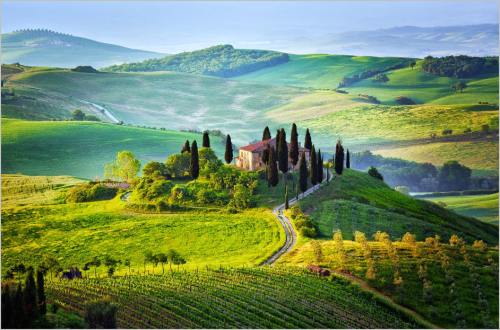 An image from Tuscany, Italy
.
.
Click the link below for images:
.
__________________________________________
August 23, 2022
Mohenjo
Business, Enthralling, Human Interest, Photographs
amazon, business, Business News, current-events, Future, Hotels, human-rights, medicine, mental-health, research, Science, Science News, technology, Technology News, travel, vacation
Click the link below the picture
.
Tschanüff Castle is a ruined castle in the former municipality of Ramosch (now Valsot) of the Canton of Graubünden in Switzerland. It is a Swiss heritage site of national significance.
The Lords of Ramosch first appear in historical records in the 12th century. They were vassals of the Bishop of Chur and the Lords of Tarasp. The oldest part of the castle is the main tower, which was built as a bergfried (a fighting tower without permanent inhabitants) in the 12th century for the Lords of Ramosch. A ring wall was added in the 13th century. On 12 March 1256 Count Meinhard of Tyrol granted the knight Nannes of Ramosch the right to build a castle at Ramosch. Since there was already a fortification, this permission was probably to expand the small tower into a much larger castle. The new castle allowed the Ramosch family to control trade and taxes throughout the Lower Engadine.
On 19 August 1317 Nannes and his brother Johannes split the fief into two shares. The successors of Johannes, Conrad, and Schweiker, quarreled with each other over their inheritance. The conflict grew until in 1365 Duke Leopold of Austria was forced to intervene. The agreement between the brothers stated that they both accepted the Dukes of Austria as their overlord, the castle was to remain open to the Dukes and if they quarreled again the castle and surrounding lands would become property of Austria. Despite the severe conditions, Conrad and Schweiker quickly began fighting again, and in 1367 Schweiker murdered Conrad and fled Tschanüff. As a sign of appreciation for his service in an Austrian war in Italy, the Duke appointed Ulrich of Matsch as owner of Tschanüff. The Matsch family took possession of the castle on 17 February 1369.
The Bishop of Chur also had a claim on the castle and fearing Austria’s growing influence in the region, began reasserting his claim. In 1394 Bishop Hartmann forced the Lords of Matsch to give up the castle. However, in the following year, Matsch attacked and plundered the castle but retreated when the Bishop led an army toward Ramosch. In 1421 a peace treaty gave the castle to the Bishop and the Lords of Matsch were paid 2500 marks for their losses. The Bishops then appointed vogts to rule over the valley for the following centuries. In 1468 the castle was attacked by the League of God’s House during a conflict with the Bishop. It may have been besieged during the Hennenkreig in 1475. During the Swabian War of 1499, the Bishop’s own troops burned the castle to prevent it from falling into the Emperor’s hands. In 1565 rebels against the Bishop attacked, plundered, and burned the outer ward. The Lower Engadine residents were found liable for the damage and ordered to pay to rebuild the castle.
Until the 16th century, the castle was known as Ramosch or Remüs after the Lords of Ramosch. In the 16th century, it began to be known as Tschanüff which was Romansh for Casa nova or New House. This was to distinguish it from the nearby Serviezel Castle.
During the Bündner Wirren in 1622, the castle was captured and burned by troops from Glarus. It was quickly repaired and survived the rest of the tumult without being destroyed. Over the next century and a half, the castle was once again used as the residence of the Bishop’s appointed representative. In 1780 it was abandoned after part of the castle was destroyed in a landslide. Wikipedia
.
 An image of Tschanüff Castle Valsot Switzerland
.
.
Click the link below for images:
.
__________________________________________
August 22, 2022
Mohenjo
Business, Enthralling, Human Interest, Photographs
amazon, business, Business News, current-events, Future, Hotels, human-rights, medicine, mental-health, research, Science, Science News, technology, Technology News, travel, vacation
Click the link below the picture
.
Varenna is a comune (municipality) on Lake Como in the Province of Lecco in the Italian region Lombardy, located about 60 kilometers (37 mi) north of Milan and about 20 kilometers (12 mi) northwest of Lecco.
Varenna was founded by local fishermen in 769 and was later allied with the commune of Milan. In 1126 it was destroyed by the rival commune of Como and later received the refugees from the Isola Comacina, who had met the same fate (1169).
Varenna borders the following municipalities: Esino Lario, Lierna, Oliveto Lario, and Perledo. The main sights are the Castello di Vezio, a small museum dedicated to Lariosaurus (a Middle Triassic sea reptile related to turtles), as well as the beautiful gardens at Villa Monastero. Across the lake in the province of Como are: Bellagio, Griante and Menaggio.
Villa Monastero, in between Varenna and Fiumelatte is nowadays a museum, botanical garden, and convention center. It was founded as a Cistercian monastery in the 11th or 12th century. It is served by Varenna-Esino-Perledo station, on the Tirano–Lecco railway.
Giovanni Battista Pirelli (1848–1932), entrepreneur, engineer, and politician who founded Pirelli & C. in Milan in 1872. Wikipedia
.
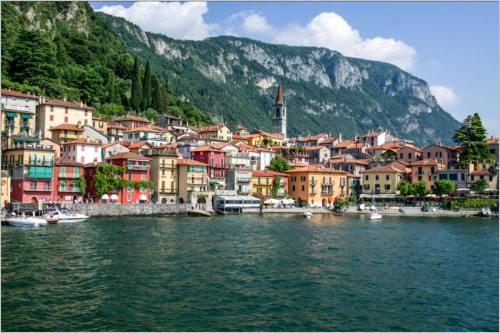 An image from Varenna, Italy
.
.
Click the link below for images:
.
__________________________________________
August 20, 2022
Mohenjo
Business, Enthralling, Human Interest, Photographs
amazon, business, Business News, current-events, Future, Hotels, human-rights, medicine, mental-health, research, Science, Science News, technology, Technology News, travel, vacation
Click the link below the picture
.
The Silvretta Alps are a mountain range of the Central Eastern Alps shared by Tirol, Vorarlberg (both in Austria), and Graubünden (Switzerland). The Austrian states of Tirol and Vorarlberg are connected by a pass road (Silvretta Hochalpenstraße at 2032 m). The majority of the peaks are elevated above three thousand meters and are surrounded by glaciers. Thus, the area is also known as the “Blue Silvretta”.
According to the Alpine Clubs, the Silvretta Alps are outlined from other groups by the following borders: St. Gallenkirch – Ill river as far as Partenen – Zeinisjoch – Zeinisbach – Paznauntal as far as Ischgl – Fimbertal – Fimber Pass – Val Chöglias – Val Sinestra – Inn River from the mouth of the Branclabach to the mouth of the Susasca – Val Susasca – Flüela Pass – Davos – Wolfgang – Laretbach – Klosters – Schlappinbach – Schlappiner Joch – Valzifensbach – Gargellental – St. Gallenkirch.
The Silvretta Alps are surrounded by the Rätikon, Verwall, Samnaun, Sesvenna, Albula and Plessur ranges.
The Piz Buin is not the highest, but the most popular peak of the range. It can relatively easily be ascended from north or south through glaciers and stretches of easy climbing.
The Silvretta is famous for its skiing, especially its many backcountry skiing possibilities. In the 1920s Ernest Hemingway was staying in the region for a winter (he lived at Schruns in Montafon, Austria). Later, he wrote a couple of short stories about his skiing experiences in the Silvretta. Some of these short stories are to be found in A moveable feast. Wikipedia
.
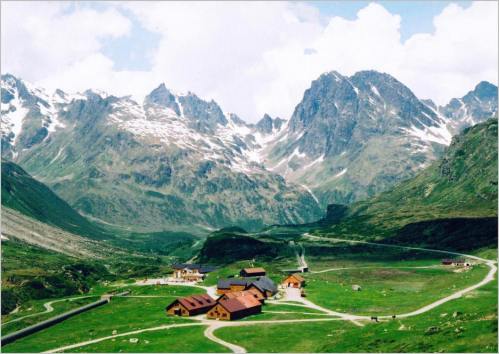 An image from Silvretta Alps
.
.
Click the link below for images:
.
__________________________________________
August 19, 2022
Mohenjo
Business, Enthralling, Human Interest, Photographs
amazon, business, Business News, current-events, Future, Hotels, human-rights, medicine, mental-health, research, Science, Science News, technology, Technology News, travel, vacation
Click the link below the picture
.
Venice is a city in northeastern Italy and the capital of the Veneto region. It is built on a group of 118 small islands that are separated by canals and linked by over 400 bridges. The islands are in the shallow Venetian Lagoon, an enclosed bay lying between the mouths of the Po and the Piave rivers (more exactly between the Brenta and the Sile). In 2020, around 258,685 people resided in greater Venice or the Comune di Venezia, of whom around 55,000 live in the historical island city of Venice (centro storico) and the rest on the mainland (terraferma). Together with the cities of Padua and Treviso, Venice is included in the Padua-Treviso-Venice Metropolitan Area (PATREVE), which is considered a statistical metropolitan area, with a total population of 2.6 million.
The name is derived from the ancient Veneti people who inhabited the region by the 10th century BC. The city was historically the capital of the Republic of Venice for over a millennium, from 697 to 1797. It was a major financial and maritime power during the Middle Ages and Renaissance, and a staging area for the Crusades and the Battle of Lepanto, as well as an important center of commerce—especially silk, grain, and spice, and of art from the 13th century to the end of the 17th. The city-state of Venice is considered to have been the first real international financial center, emerging in the 9th century and reaching its greatest prominence in the 14th century. This made Venice a wealthy city throughout most of its history. For centuries Venice possessed numerous territories along the Adriatic Sea and within the Italian peninsula, leaving a significant impact on the architecture and culture that can still be seen today. The sovereignty of Venice came to an end in 1797, in the hands of Napoleon. Subsequently, in 1866, the city become part of the Kingdom of Italy.
Venice has been known as “La Dominante”, “La Serenissima”, “Queen of the Adriatic”, “City of Water”, “City of Masks”, “City of Bridges”, “The Floating City”, and “City of Canals”. The lagoon and a part of the city are listed as a UNESCO World Heritage Site. Parts of Venice are renowned for the beauty of their settings, their architecture, and artwork. Venice is known for several important artistic movements—especially during the Renaissance period—and has played an important role in the history of instrumental and operatic music, and is the birthplace of Baroque composers Tomaso Albinoni and Antonio Vivaldi.
Although the city is facing some challenges (including an excessive number of tourists and problems caused by pollution, tide peaks and cruise ships sailing too close to buildings), Venice remains a very popular tourist destination, a major cultural centre, and has been ranked many times the most beautiful city in the world. It has been described by the Times Online as one of Europe’s most romantic cities and by The New York Times as “undoubtedly the most beautiful city built by man”. Wikipedia
.
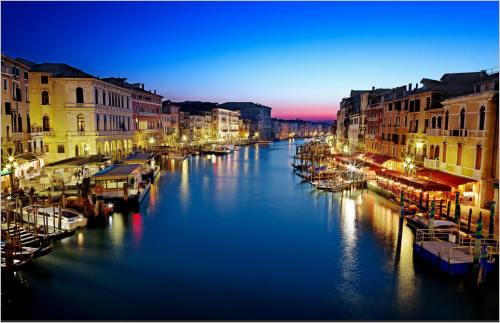 An image from Venice, Italy
.
.
Click the link below for images:
.
__________________________________________
August 18, 2022
Mohenjo
Business, Enthralling, Human Interest, Photographs
amazon, business, Business News, current-events, Future, Hotels, human-rights, medicine, mental-health, research, Science, Science News, technology, Technology News, travel, vacation
Click the link below the picture
.
Seattle is a seaport city on the West Coast of the United States. It is the seat of King County, Washington. With a 2020 population of 737,015, it is the largest city in both the state of Washington and the Pacific Northwest region of North America. The Seattle metropolitan area’s population is 4.02 million, making it the 15th-largest in the United States. Its growth rate of 21.1% between 2010 and 2020 makes it one of the nation’s fastest-growing large cities.
Seattle is situated on an isthmus between Puget Sound (an inlet of the Pacific Ocean) and Lake Washington. It is the northernmost major city in the United States, located about 100 miles (160 km) south of the Canadian border. A major gateway for trade with East Asia, Seattle is the fourth-largest port in North America in terms of container handling as of 2021.
The Seattle area was inhabited by Native Americans for at least 4,000 years before the first permanent European settlers. Arthur A. Denny and his group of travelers, subsequently known as the Denny Party, arrived from Illinois via Portland, Oregon, on the schooner Exact at Alki Point on November 13, 1851. The settlement was moved to the eastern shore of Elliott Bay and named “Seattle” in 1852, in honor of Chief Si’ahl of the local Duwamish and Suquamish tribes. Today, Seattle has high populations of Native, Scandinavian, Asian American and African American people, as well as a thriving LGBT community that ranks sixth in the United States by population.
Logging was Seattle’s first major industry, but by the late 19th century, the city had become a commercial and shipbuilding center as a gateway to Alaska during the Klondike Gold Rush. Growth after World War II was partially due to the local Boeing company, which established Seattle as a center for aircraft manufacturing. The Seattle area developed into a technology center from the 1980s onwards with companies like Microsoft becoming established in the region; Microsoft founder Bill Gates is a Seattleite by birth. Internet retailer Amazon was founded in Seattle in 1994, and major airline Alaska Airlines is based in SeaTac, Washington, serving Seattle’s international airport, Seattle–Tacoma International Airport. The stream of new software, biotechnology, and Internet companies led to an economic revival, which increased the city’s population by almost 50,000 between 1990 and 2000. Seattle also has a significant musical history. Between 1918 and 1951, nearly two dozen jazz nightclubs existed along Jackson Street, from the current Chinatown/International District to the Central District. The jazz scene nurtured the early careers of Ray Charles, Quincy Jones, Ernestine Anderson, and others. Seattle is also the birthplace of rock musician Jimi Hendrix, as well as the origin of the bands Nirvana, Pearl Jam, Soundgarden, Heart, Alice in Chains, Foo Fighters, and the alternative rock movement grunge.
Archaeological excavations suggest that Native Americans have inhabited the Seattle area for at least 4,000 years. By the time the first European settlers arrived, the people (subsequently called the Duwamish tribe) occupied at least seventeen villages in the areas around Elliott Bay.
The first European to visit the Seattle area was George Vancouver, in May 1792 during his 1791–95 expedition for the Royal Navy to chart the Pacific Northwest. In 1851, a large party of American pioneers led by Luther Collins made a location on land at the mouth of the Duwamish River; they formally claimed it on September 14, 1851. Thirteen days later, members of the Collins Party on the way to their claim passed three scouts of the Denny Party. Members of the Denny Party claimed land on Alki Point on September 28, 1851. The rest of the Denny Party set sail on the schooner Exact from Portland, Oregon, stopping in Astoria, and landed at Alki Point during a rainstorm on November 13, 1851. After a difficult winter, most of the Denny Party relocated across Elliott Bay and claimed land a second time at the site of present-day Pioneer Square, naming this new settlement Duwamps. Wikipedia
.
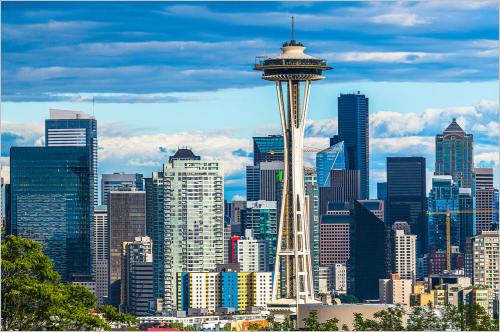 An image from Seattle, Washington
.
.
Click the link below for images:
.
__________________________________________
August 17, 2022
Mohenjo
Business, Enthralling, Human Interest, Photographs
amazon, business, Business News, current-events, Future, Hotels, human-rights, medicine, mental-health, research, Science, Science News, technology, Technology News, travel, vacation
Click the link below the picture
.
Lugano is a city and municipality in Switzerland, part of the Lugano District in the canton of Ticino. It is the largest city of both Ticino and the Italian-speaking southern Switzerland. Lugano has a population (as of December 2020) of 62,315, and an urban agglomeration of over 150,000. It is the ninth largest Swiss city.
The city lies on Lake Lugano, at its largest width, and, together with the adjacent town of Paradiso, occupies the entire bay of Lugano. The territory of the municipality encompasses a much larger region on both sides of the lake, with numerous isolated villages. The region of Lugano is surrounded by the Lugano Prealps, the latter extending on most of the Sottoceneri region, the southernmost part of Ticino and Switzerland. Both western and eastern parts of the municipality share an international border with Italy.
Described as a market town since 984, Lugano was the object of continuous disputes between the Dukes of Como and Milan until it became part of the Old Swiss Confederation in 1513. In 1803, the political municipality of Lugano was created, following the establishment of the canton. Since 1882, Lugano is an important stop on the international Gotthard Railway. The rail brought a decisive contribution to the development of tourism and more generally of the tertiary sector which are, to this day, predominant in the economy of the city.
The toponym is first recorded in 804, in the form Luanasco, in 874 as Luano, and from 1189 as Lugano. German-language variants of the name (now no longer in use) were Lowens, Lauis, Lauwis, Louwerz. The local Lombard form of the name is rendered Lugan. The etymology of the name is uncertain, suggestions include derivation from Latin lucus (“grove”), from a vulgar Latin lakvannus (“lake-dweller”), and from the god Lugus.
The shores of Lake Lugano have been inhabited since the Stone Age. Within the modern city limits (Breganzona, Castagnola, Davesco, and Gandria) a number of ground stones or quern stones have been found. In the area surrounding Lugano, items from the Copper Age and the Iron Age have been found. There are Etruscan monuments at Davesco-Soragno (5th to 2nd century BC), Pregassona (3rd to 2nd century BC), and Viganello (3rd to 2nd century BC). Graves with jewelry and household items have been found in Aldesago, Davesco, Pazzallo, and Pregassona along with Celtic money in Viganello.
The region around Lake Lugano was settled by the Romans by the 1st century BC. There was an important Roman town north of Lugano at Bioggio. There are fewer traces of the Romans in Lugano, but several inscriptions, graves, and coins indicate that some Romans lived in what would become Lugano. Wikipedia
.
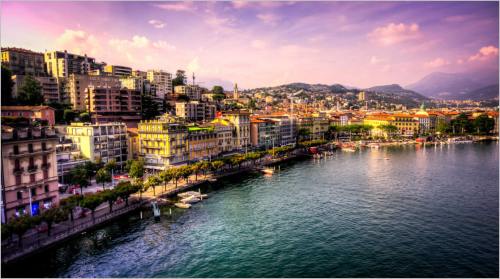
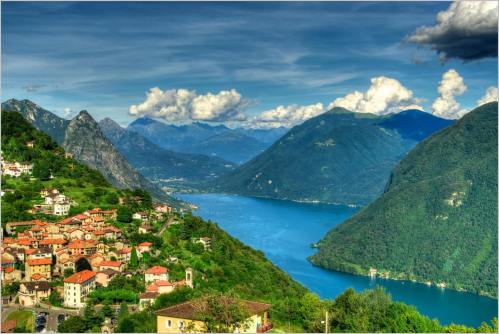 Images from Lugano, Italy
.
.
Click the link below for image:
.
__________________________________________
August 16, 2022
Mohenjo
Business, Enthralling, Human Interest, Photographs
amazon, business, Business News, current-events, Future, Hotels, human-rights, medicine, mental-health, research, Science, Science News, technology, Technology News, travel, vacation
Click the link below the picture
.
Kyoto, officially Kyoto City, is the capital city of Kyoto Prefecture in Japan. Located in the Kansai region on the island of Honshu, Kyoto forms a part of the Keihanshin metropolitan area along with Osaka and Kobe. As of 2021, the city has a population of 1.45 million. The city is the cultural anchor of a substantially larger metropolitan area known as Greater Kyoto, a metropolitan statistical area (MSA) home to a census-estimated 3.8 million people.
Kyoto is one of the oldest municipalities in Japan, having been chosen in 794 as the new seat of Japan’s imperial court by Emperor Kanmu. The original city, named Heian-kyō, was arranged in accordance with traditional Chinese feng shui following the model of the ancient Chinese capital of Chang’an/Luoyang. The emperors of Japan ruled from Kyoto in the following eleven centuries until 1869. It was the scene of several key events of the Muromachi period, Sengoku period, and the Boshin War, such as the Ōnin War, the Honnō-ji Incident, the Kinmon incident, and the Battle of Toba–Fushimi. The capital was relocated from Kyoto to Tokyo after the Meiji Restoration. The modern municipality of Kyoto was established in 1889. The city was spared from large-scale destruction during World War II and as a result, its prewar cultural heritage has mostly been preserved.
Kyoto is considered the cultural capital of Japan and a major tourist destination. It is home to numerous Buddhist temples, Shinto shrines, palaces, and gardens, some of which are listed collectively by UNESCO as a World Heritage Site. Prominent landmarks include the Kyoto Imperial Palace, Kiyomizu-Dera, Kinkaku-ji, Ginkaku-ji, and the Katsura Imperial Villa. Kyoto is also a center of higher learning in the country, including Kyoto University, the second oldest university in Japan.
In Japanese, Kyoto was previously called Kyō (京), Miyako (都), Kyō no Miyako (京の都), and Keishi (京師). In the 11th century, the city was officially named “Kyōto” (京都, “capital city”), from the Middle Chinese kiang-tuo (cf. Mandarin jīngdū). After the seat of the emperor was moved to the city of Edo and that city was renamed “Tōkyō” (東京, meaning “Eastern Capital”), Kyoto was briefly known as “Saikyō” (西京, meaning “Western Capital”). As the capital of Japan from 794 to 1868, Kyoto is sometimes called the thousand-year capital (千年の都).
Historically, foreign spellings for the city’s name have included Kioto and Miaco or Meaco.
Kyoto is located in a valley, part of the Yamashiro (or Kyoto) Basin, in the eastern part of the mountainous region known as the Tamba highlands. The Yamashiro Basin is surrounded on three sides by mountains known as Higashiyama, Kitayama, and Nishiyama, with a height just above 1,000 meters (3,281 ft) above sea level. This interior positioning results in hot summers and cold winters. There are three rivers in the basin, the Ujigawa to the south, the Katsuragawa to the west, and the Kamogawa to the east. Kyoto City takes up 17.9% of the land in the prefecture with an area of 827.9 square kilometers (319.7 sq mi). Wikipedia
.
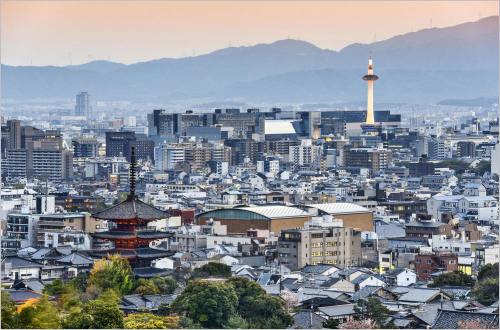 An image from Kyoto Skyline
.
.
Click the link below for images:
.
__________________________________________
August 15, 2022
Mohenjo
Business, Enthralling, Human Interest, Photographs
amazon, business, Business News, current-events, Future, Hotels, human-rights, medicine, mental-health, research, Science, Science News, technology, Technology News, travel, vacation
Click the link below the picture
.
Lecco is a city of 48,131 inhabitants in Lombardy, northern Italy, 50 kilometers (31 mi) north of Milan. It lies at the end of the south-eastern branch of Lake Como (the branch is named Lake of Lecco / Lago di Lecco). The Bergamo Alps rise to the north and east, cut through by the Valsassina of which Lecco marks the southern end.
The lake narrows to form the river Adda, so bridges were built to improve road communications with Como and Milan. There are four bridges crossing the river Adda in Lecco: the Azzone Visconti Bridge (1336–1338), the Kennedy Bridge (1956), the Alessandro Manzoni Bridge (1985), and a railroad bridge.
Lecco was also Alpine Town of the Year in 2013.
Elevated to province by decree of the President of the Republic of March 6, 1992, Lecco obtained the title of city on June 22, 1848.
Known for being the place where the writer Alessandro Manzoni set “The Betrothed”, the city is located in one of the vertexes of the Larian Triangle. It overlooks the eastern branch of Lake Como and is included in the Orobic Prealps, between the Grigne mountain chain and the Resegone.
As strategic crossroads for Valtellina, Lecco assumed increasing importance during the Middle Ages when it was annexed to the Duchy of Milan following the Peace of Constance. During the second half of the 19th century, under the Austrian dominion, the city went through a particularly flourishing period during which palaces and arcades in neoclassical style were constructed. After the Unity of Italy, Lecco established itself as one of the most important industrial centers of the nation thanks to the development of the steel industries, already active in the 12th century. For this reason, Lecco is also called “the Iron city”.
The origin of the toponym Lecco is not certain: it probably has a Celtic origin (Lech or Loch) words that mean lake. Shortly before the year 1000 B.C., some populations of Gauls and Celts migrated to the territory of Lecco for trades. Leucos was the name given by the Gauls who inhabited these areas until Romans transformed the denomination into Leucum under Julius Caesar’s domination around 200 B.C.; so the hypothesis put forward by historians who have identified in Lecco the Roman city founded in 95 b.C. by Licinius Crassus in the Larian area with the name of Leucera was excluded.
Other theories, perhaps legendary, trace etymology back to the Greek therm leukos (white), probably because of the white limestone rocks that can be found in Lecco; from the Latin lucus (forest) and/or lacus (lake). Other theories report a derivation from the Old Indian lokas (country) or Lithuanian laukas (open field). However, the existence of the city was first documented in 845 named Leuco.
.
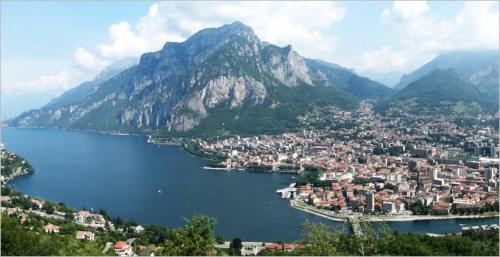 An image from Lecco, Italy
.
.
Click the link below for images:
.
__________________________________________
August 13, 2022
Mohenjo
Business, Enthralling, Human Interest, Photographs
amazon, business, Business News, current-events, Future, Hotels, human-rights, medicine, mental-health, research, Science, Science News, technology, Technology News, travel, vacation
Click the link below the picture
.
Kyoto was the capital of Japan for over a millennium and carries a reputation as its most beautiful city and the nation’s cultural capital. However, visitors may be surprised by how much work they will have to do to see Kyoto’s beautiful side. Most first impressions of the city will be of the urban sprawl of central Kyoto, around the ultra-modern glass-and-steel train station, which is itself an example of a city steeped in tradition mixing with the modern world.
Nonetheless, the persistent visitor will soon discover Kyoto’s hidden beauty in the temples and parks which ring the city center, and find that the city has much more to offer than immediately meets the eye. There are over 2000 temples and shrines in the city, and nobody sees it all in one visit (or two, or three…) – nor should you even try. It would take months if not years to see all that Kyoto has to offer, and many places are especially beautiful during certain seasons, like the plum blossoms, cherry blossoms, autumn leaves, etc. These give very different impressions and appearances, and you can visit Kyoto again and again, yet still, be amazed to see something new. Wikitravel
.
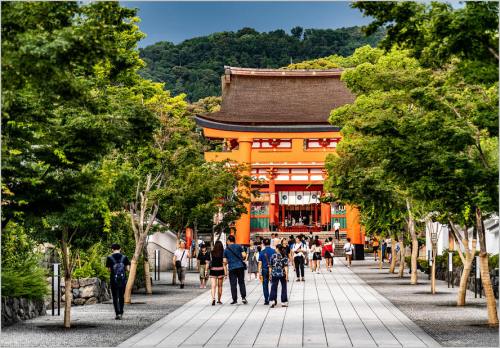 An image from Historic Monuments of Ancient Kyoto
.
.
Click the link below for images:
.
__________________________________________
Older Entries
Newer Entries
 James' World 2