September 16, 2022
Mohenjo
Business, Enthralling, Human Interest, Photographs
amazon, business, Business News, current-events, Future, Hotels, human-rights, medicine, mental-health, research, Science, Science News, technology, Technology News, travel, vacation

Click the link below the picture
.
Düsseldorf; often Dusseldorf is the capital city of North Rhine-Westphalia, the most populous state of Germany. It is the second-largest city in the state and the seventh-largest city in Germany, with a population of 617,280.
Düsseldorf is located at the confluence of two rivers: the Rhine and the Düssel, a small tributary. The -dorf suffix means “village” in German (English cognate: thorp); its use is unusual for a settlement as large as Düsseldorf. Most of the city lies on the right bank of the Rhine. Düsseldorf lies in the center of both the Rhine-Ruhr and the Rhineland Metropolitan Region. It neighbors the Cologne Bonn Region to the south and the Ruhr to the north. It is the largest city in the German Low Franconian dialect area (closely related to Dutch).
Mercer’s 2012 Quality of Living survey ranked Düsseldorf the sixth most livable city in the world. Düsseldorf Airport is Germany’s fourth-busiest airport, serving as the most important international airport for the inhabitants of the densely populated Ruhr, Germany’s largest urban area. Düsseldorf is an international business and financial center, renowned for its fashion and trade fairs, and is headquarters to one Fortune Global 500 and two DAX companies. Messe Düsseldorf organizes nearly one-fifth of premier trade shows. As second largest city of the Rhineland, Düsseldorf holds Rhenish Carnival celebrations every year in February/March, the Düsseldorf carnival celebrations being the third most popular in Germany after those held in Cologne and Mainz.
There are 22 institutions of higher education in the city including the Heinrich-Heine-Universität Düsseldorf, the university of applied sciences (Hochschule Düsseldorf), the academy of arts (Kunstakademie Düsseldorf, whose members include Joseph Beuys, Emanuel Leutze, August Macke, Gerhard Richter, Sigmar Polke, and Andreas Gursky), and the university of music (Robert-Schumann-Musikhochschule Düsseldorf). The city is also known for its influence on electronic/experimental music (Kraftwerk) and its Japanese community. Düsseldorf is classified as a GaWC Beta+ world city.
The first written mention of Düsseldorf (then called Dusseldorp in the local Low Rhenish dialect) dates back to 1135. Under Emperor Friedrich Barbarossa the small town of Kaiserswerth to the north of Düsseldorf became a well-fortified outpost, where soldiers kept a watchful eye on every movement on the Rhine. Kaiserswerth eventually became a suburb of Düsseldorf in 1929. In 1186, Düsseldorf came under the rule of the Counts of Berg. 14 August 1288 is one of the most important dates in the history of Düsseldorf. On this day the sovereign Count Adolf VIII of Berg granted the village on the banks of the Düssel town privileges. Before this, a bloody struggle for power had taken place between the Archbishop of Cologne and the count of Berg, culminating in the Battle of Worringen.
The Archbishop of Cologne’s forces were wiped out by the forces of the count of Berg who were supported by citizens and farmers of Cologne and Düsseldorf, paving the way for Düsseldorf’s elevation to city status, which is commemorated today by a monument on the Burgplatz. The custom of turning cartwheels is credited to the children of Düsseldorf. There are variations of the origin of the cartwheeling children. Today the symbol (Der Radschläger) represents the story and every year the Düsseldorfers celebrate by having a cartwheeling contest. After this battle the relationship between the four cities deteriorated because they were commercial rivals; it is often said that there is a kind of hostility between the citizens of Cologne and Düsseldorf. Today, it finds its expression mainly in a humorous form (especially during the Rhineland Karneval) and in sports.
A market square sprang up on the banks of the Rhine and the square was protected by city walls on all four sides. In 1380, the dukes of Berg moved their seat to the town, and Düsseldorf was made regional capital of the Duchy of Berg. During the following centuries, several famous landmarks were built, including the Collegiate Church of St Lambertus [de]. In 1609, the ducal line of the United Duchies of Jülich-Cleves-Berg died out, and after a virulent struggle over succession, Jülich and Berg fell to the Wittelsbach Counts of Palatinate-Neuburg, who made Düsseldorf their main domicile, even after they inherited the Electorate of the Palatinate, in 1685, becoming now Prince-electors as Electors Palatine. Wikipedia
.
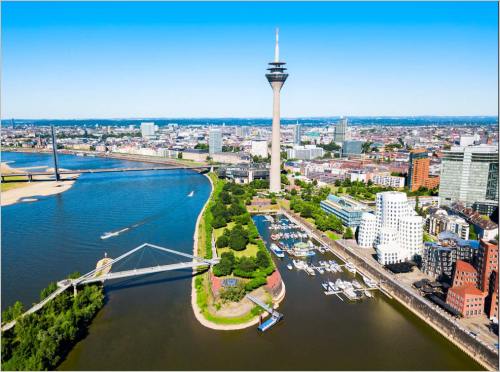 An image from Düsseldorf, Germany
.
.
Click the link below for images:
.
__________________________________________
September 15, 2022
Mohenjo
Business, Enthralling, Human Interest, Photographs
amazon, business, Business News, current-events, Future, Hotels, human-rights, medicine, mental-health, research, Science, Science News, technology, Technology News, travel, vacation
Click the link below the picture
.
Big Bend National Park is an American national park located in West Texas, bordering Mexico. The park has national significance as the largest protected area of Chihuahuan Desert topography and ecology in the United States and was named after a large bend in the Rio Grande/Río Bravo. The park protects more than 1,200 species of plants, more than 450 species of birds, 56 species of reptiles, and 75 species of mammals. Additional park activities include scenic drives, programs led by Big Bend park rangers, and stargazing.
The area has a rich cultural history, from archeological sites dating back nearly 10,000 years to more recent pioneers, ranchers, and miners. The Chisos Mountains are located in the park and are the only mountain range in the United States to be fully contained within the boundary of a national park. Geological features in the park include sea fossils and dinosaur bones, as well as volcanic dikes.
The park encompasses an area of 801,163 acres (1,251.8 sq mi; 3,242.2 km2), entirely within Brewster County. For more than 1,000 miles (1,600 km), the Rio Grande/Río Bravo forms the boundary between Mexico and the United States, and Big Bend National Park administers approximately 118 miles (190 km) along that boundary.
Because the Rio Grande serves as an international boundary, the park faces unusual constraints while administering and enforcing park rules, regulations, and policies. In accordance with the Treaty of Guadalupe Hidalgo, the park’s territory extends only to the center of the deepest river channel as the river flowed in 1848. The rest of the channel and the land south of it lies within Mexican territory. The park is bordered by the protected areas of Cañón de Santa Elena and Maderas del Carmen in Mexico.
According to the Köppen climate classification system, Big Bend National Park has a hot semi-arid climate (BSh).
The park exhibits dramatic contrasts and its climate may be characterized as one of extremes. Dry and hot late spring and summer days often exceed 100 °F (38 °C) in the lower elevations. Winters are normally mild but subfreezing temperatures occasionally occur. Because of the range in altitude from about 1,800 feet (550 m) along the river to Emory Peak in the Chisos Mountains at 7,832 feet (2,387 m), a wide variation in available moisture and temperature exists throughout the park. These variations contribute to an exceptional diversity in plant and animal habitats. Some species in the park, such as the Chisos oak (Quercus graciliformis), are found nowhere else in the United States.
The 118 mi (190 km) of river that form the southern park boundary include the spectacular canyons of Santa Elena, Mariscal, and Boquillas. The Rio Grande, which meanders through this portion of the Chihuahuan Desert, has cut deep canyons with nearly vertical walls through three uplifts made primarily of limestone. Throughout the open desert areas, the highly productive Rio Grande riparian zone includes numerous plant and animal species and significant cultural resources. The vegetative belt extends into the desert along creeks and arroyos.
The park’s Chisos Mountains are sky islands surrounded by desert. A significant part of the park’s tremendous biodiversity is represented by isolated populations of plants and animals found in the Chisos Mountains and in many of the desert springs distributed across the park.
South of the border lie the Mexican states of Chihuahua and Coahuila and newly protected areas for flora and fauna, which are regions known as the Maderas del Carmen and the Cañón de Santa Elena. Wikipedia
.
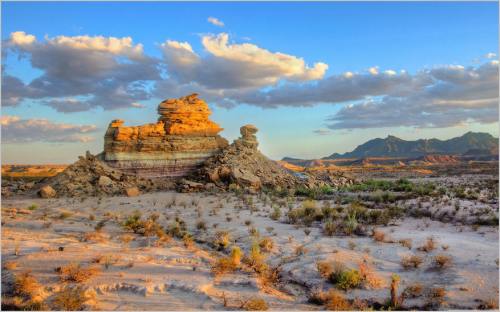 An image from Big Bend National Park Texas
.
.
Click the link below for images:
.
__________________________________________
September 14, 2022
Mohenjo
Business, Enthralling, Human Interest, Photographs
amazon, business, Business News, current-events, Future, Hotels, human-rights, medicine, mental-health, research, Science, Science News, technology, Technology News, travel, vacation
Click the link below the picture
.
Cape Le Grand National Park is a national park in Western Australia, 631 km (392 mi) southeast of Perth and 56 km (35 mi) east of Esperance. The park covers an area of 31,801 hectares (78,580 acres) The area is an ancient landscape which has been above sea level for well over 200 million years and remained unglaciated. As a result, the area is home to many primitive relict species. Established in 1966, the park is managed by the Department of Parks and Wildlife. The name Le Grand is from one of the officers on L’Espérance, one of the ships in the 1792 expedition of Bruni d’Entrecasteaux.
The largely granite shoreline and white sand beaches are picturesque features of the area. The park is a used for fishing, off-roading, tourism, and hiking. Beaches within the Park include those at Lucky Bay, Rossiter Bay, Hellfire Bay, Le Grand Beach, and Thistle Cove. The islands and waters to the south of the park are known as the Recherche Archipelago Nature Reserve, another protected area of the Recherche Archipelago and nearby coastal regions. The Cape Arid National Park is located to the east. The southwest section of the park is dominated by rock outcrops of gneiss and granite. These form a distinctive chain of peaks including Mount Le Grand (345 m), Frenchman Peak (262 m), and Mississippi Hill (180 m, named after the Mississippi, a French whaler). Further inland, the park comprises mostly heath-covered sandplain, interspersed with swamps and pools of fresh water.
The sandplains support dense stands of banksias (Banksia speciosa and Banksia pulchella).
Other flora that can be found around the park include species of Melaleuca, Grevillea, sheoak, Christmas tree, and grass trees. Wildflower blooms peak in the austral spring, lasting until October, and species such as blue china orchid Cyanicula gemmata, Diuris corymbosa, Hakea laurina, Thysanotus sparteus, and Thelymitra macrophylla are represented within the park.
Fauna that are commonly found within the park include bandicoots, pygmy honey possums, ring-tailed possums, quenda, and western grey kangaroos. Some of the relict species with gondwanan links that are found within the park include species of legless lizard, like the common scaly-foot Pygopus lepidopodus, and Delma fraseri Delma australis, and Aprasia striolata. The ancient, although non-gondwanan, blind snake Ramphotyphlops australis is also found within the park. Endemic frogs found within the area include the |quacking frog Crinia georgiana, the banjo frog Limnodynastes dorsalis, and the humming frog Neobatrachus pelobatoides.
.
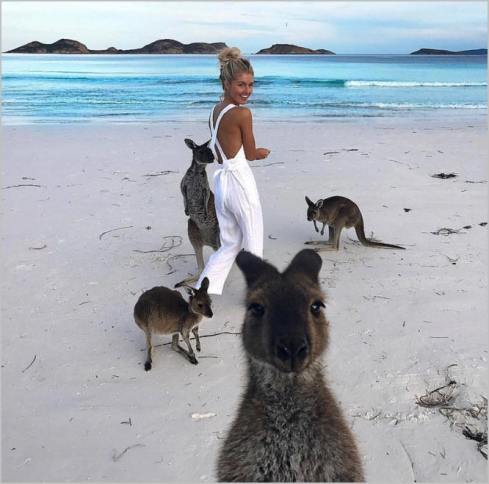 An image from Cape Le Grand National Park
.
.
Click the link below for images:
.
__________________________________________
September 13, 2022
Mohenjo
Business, Enthralling, Human Interest, Photographs
amazon, business, Business News, current-events, Future, Hotels, human-rights, medicine, mental-health, research, Science, Science News, technology, Technology News, travel, vacation
Click the link below the picture
.
Cirrhitidae, the hawkfishes, are a family of marine perciform ray-finned fishes found in tropical seas and which are associated with coral reefs.
The Cirrhitidae were first recognized as a family by the Scots-born Australian naturalist William Sharp Macleay in 1841. It is one of the 5 constituent families in the superfamily Cirrhitoidea which is classified in the suborder Percoidei of the order Perciformes. Within the Cirrhitoidea, the Cirrhitidae is probably the most basal family. They have been placed in the order Centrarchiformes by some authorities, as part of the superfamily Cirrhitoidea, however, the 5th edition of Fishes of the World does not recognize the Centrarchiformes. The name of the family is taken from that of the genus Cirrhitus which is derived from cirrhus meaning a “lock of hair” or “a barbel”, thought to be a reference to lower, unbranched rays of the pectoral fins which Bernard Germain de Lacépède termed as “barbillons”, which means “barbels” in his description of the type species of the genus C. maculatus, and which he thought to be “false” pectoral fins. Another possibility is that the name refers to cirri extending from the tips of the spines in the dorsal fin spines, although Lacépède did not mention this feature.
Genera
The following 12 genera are classified within the Cirrhitidae, containing a total of 33 species:
- Amblycirrhitus Gill, 1862
- Cirrhitichthys Bleeker, 1857
- Cirrhitops J.L.B Smith, 1951
- Cirrhitus Lacepède, 1803
- Cristacirrhitus Randall, 2001
- Cyprinocirrhites Tanaka, 1917
- Isocirrhitus Randall, 1963
- Itycirrhitus Randall 2001
- Neocirrhites Castelnau, 1873
- Notocirrhitus Randall, 2001
- Oxycirrhites Bleeker, 1857
- Paracirrhites Bleeker, 1874
Cirrhitidae hawkfishes are roughly oblong in shape with a body which has a depth which is 21% to 50% of its standard length. They have a fringe of cirri on the rear edge of the forward nostrils. There are two poorly developed spines, on the gill cover. The outer row of teeth on the jaws are canine-like, the longest normally being located at the front of the upper jaw and the middle of the lower jaw. Inside this row, there is a band of bristle-like teeth, wider in the front. The dorsal fin is continuous, having 10 spines and 11-17 soft rays, it has an incision separating the spiny and soft-rayed parts. The anal fin contains 3 spines and 5–7, typically 6, soft rays. There are 14 pectoral fin rays with the lowest 5-7 rays unbranched and normally thickened, with deep notches in the membranes separating these lower rays. There is a single spine in the pelvic fins as well as 5 soft rays. The scales are cycloid and they lack a swimbladder. The color and pattern vary between species. The maximum length attained is around 55 cm (22 in), although around 30 cm (12 in) is more typical. Most species are quite small and colorfully patterned. Wikipedia
.
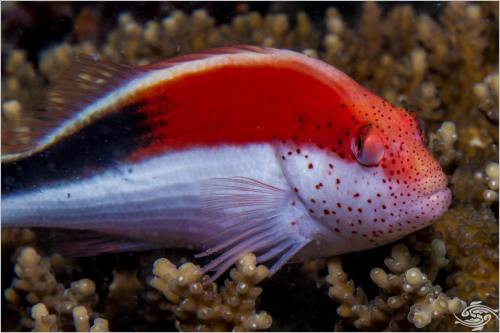 An image of a Hawkfish
.
.
Click the link below for images:
.
__________________________________________
September 12, 2022
Mohenjo
Business, Enthralling, Human Interest, Photographs
amazon, business, Business News, current-events, Future, Hotels, human-rights, medicine, mental-health, research, Science, Science News, technology, Technology News, travel, vacation
Click the link below the picture
.
Tierra del Fuego National Park is a national park on the Argentine part of the island of Tierra del Fuego, within Tierra del Fuego Province in the ecoregion of Patagonic Forest and Altos Andes, a part of the subantarctic forest. Established on 15 October 1960 under the Law 15.554 and expanded in 1966, it was the first shoreline national park to be established in Argentina.
The park has dramatic scenery, with waterfalls, forests, mountains, and glaciers. Its 630 km2 (240 sq mi) include parts of the Fagnano and Roca lakes. The Senda Costera (Coastal Path), connecting Ensenada Bay to Lapataia Bay on Lago Roca, is a popular hiking trail within the park. Forests of Antarctic beech, lenga beech, and coihue in the lower elevations of the park are home to many animal species. There are 20 species of terrestrial mammals, including the guanaco, Andean fox, North American beaver, European rabbit, and muskrat. Among the 90 species of birds are the kelp goose, torrent duck, austral parakeet, Andean condor, blackish oystercatcher, and Magellanic oystercatcher.
The southernmost national park in Argentina, it is listed as an IUCN category II park. The park stretches 60 km (37 mi) north from the Beagle Channel along the Chilean border. Ushuaia, the capital of Tierra del Fuego Province, is 11 km (6.8 mi) from the park. The park can be reached by car or by train. The southern terminus of the Pan-American Highway is located within the park, as is the El Parque station of the End of the World Train.
The park forms the southern portion of the subantarctic forest and is known for its biological richness. The subantarctic forest vegetation is dominated by tree species of coihue, nires, and lenga (a tree or shrub native to the Andes and also known as lenga beech) apart from a profusion of massbed. The flora that characterizes the “Andino-Patagonico” forests, the lenga, is well distributed over the mountain slopes above sea level to a height of 600 m (2,000 ft). Above 600 m (2,000 ft) elevation, the flora consists of altoandina with small little bushes, plants en cojin, and grasses. Wikipedia
.
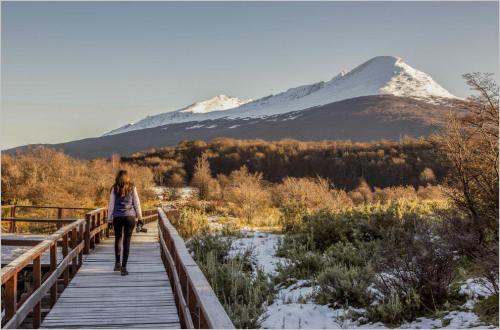 An image from Tierra Del Fuego National Park
.
.
Click the link below for images:
.
__________________________________________
September 10, 2022
Mohenjo
Business, Enthralling, Human Interest, Photographs
amazon, business, Business News, current-events, Future, Hotels, human-rights, medicine, mental-health, research, Science, Science News, technology, Technology News, travel, vacation
Click the link below the picture
.
Castle Hill Lighthouse is located on Narragansett Bay in Newport, Rhode Island at the end of the historic Ocean Drive. It is an active navigation aid for vessels entering the East Passage, between Conanicut Island and Aquidneck Island. The lighthouse has become a symbol of Newport, and a frequent site for wedding photos, proposals, and tourist photos. Although the property is owned by the nearby Castle Hill Inn, the lighthouse is owned by the United States Coast Guard.
Henry Hobson Richardson drew a sketch for a lighthouse at this location which may or may not have been the basis for the actual design. The structure does not include the residence which was featured in Richardson’s sketch. The keeper’s house was built and still stands, near Castle Hill Cove, a few hundred feet away.
The lighthouse was completed in 1890 on property formerly belonging to the naturalist, oceanographer, and zoologist Alexander Agassiz of Harvard University. Agassiz sold the land to the United States Government for the lighthouse for $1. His mansion on the property, commissioned in 1874, is now an inn. It was added to the National Register of Historic Places in 1988 as Castle Hill Lighthouse.
Although the lighthouse building is not open to the public, the shoreline and cliff face where the lighthouse sits are accessible by several footpaths from the Castle Hill Inn and the Castle Hill Cove Marina. The lighthouse is a popular site for tourist photos and wedding shoots, and widely recognizable as a symbol of Newport. While the property is owned by the nearby Castle Hill Inn, the lighthouse itself is owned by the United States Coast Guard.
By 2020, the iconic lighthouse had become streaked with unsightly brown rust, and the Coast Guard indicated that it had no plans to perform any exterior maintenance.
In March 2021, the Castle Hill Inn signed a five-year agreement with the Coast Guard to refresh the lighthouse’s exterior appearance. A local contractor was hired to perform a full power wash, paint, and beautification at a cost of $17,000, just in time for the 2021 summer wedding season. Wikipedia
.
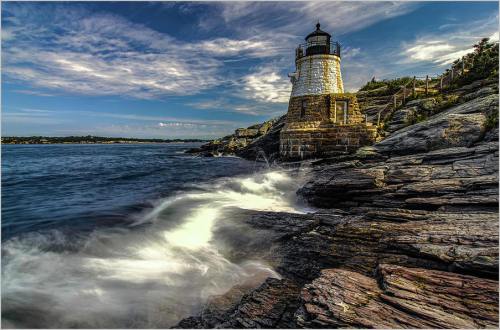 An image of Castle Hill Lighthouse Rhode Island
.
.
Click the link below for images:
.
__________________________________________
September 9, 2022
Mohenjo
Business, Enthralling, Human Interest, Photographs
amazon, business, Business News, current-events, Future, Hotels, human-rights, medicine, mental-health, research, Science, Science News, technology, Technology News, travel, vacation
Click the link below the picture
.
Scotts Bluff National Monument is located west of the City of Gering in western Nebraska, United States. This National Park Service site protects over 3,000 acres of historic overland trail remnants, mixed-grass prairie, rugged badlands, towering bluffs and riparian area along the North Platte River. The park boasts over 100,000 annual visitors.
The monument’s north bluff is named after Hiram Scott, who was a clerk for the Rocky Mountain Fur Company and died near the bluff in 1828. The bluff served as an important landmark on the Oregon Trail, California Trail and Pony Express Trail, and was visible at a distance from the Mormon Trail. Over 250,000 westward emigrants passed by Scotts Bluff between 1843 and 1869. It was the second-most referred to landmark on the Emigrant Trails in pioneer journals and diaries.
Scotts Bluff County and the city of Scottsbluff, Nebraska, were named after the landmark.
Although called “Scotts Bluff National Monument,” the site includes two separate bluffs, “South Bluff” and the northern bluff called “Scotts Bluff.” There are five major outcroppings on the bluffs, known as Dome Rock, Crown Rock, Sentinel Rock, Eagle Rock, and Saddle Rock. The area between Scotts Bluff and the North Platte River is known as the “Badlands.”The collection of bluffs was first charted by non-native people in 1812 by the Astorian Expedition of fur traders traveling along the river. The expedition party noted the bluffs as the first large rock formations along the North Platte River where the Great Plains started giving way to the foothills of the Rocky Mountains. Their findings were not widely communicated because of the War of 1812. Explorers rediscovered the route to the Rocky Mountains in 1823, and fur traders in the region relied on the bluffs as a landmark. European Americans named the north, and most prominent bluff, after Hiram Scott, a fur trader who died in 1828 near the bluffs. The local Native Americans had called it Me-a-pa-te, “the hill that is hard to go around.”
Fur traders, missionaries, and military expeditions began regular trips past Scotts Bluff during the 1830s. Beginning in 1841, multitudes of settlers passed by Scotts Bluff on their way west along the Great Platte River Road to Oregon, and later California and Utah. All these groups used the bluff as a major landmark for navigation.
Although a natural gap existed between South Bluff and Scotts Bluff, the area was not easily traversed. So initially the Oregon Trail passed to the south of the Scotts Bluff area at Robidoux Pass and the Mormon Trail passed to the north of the bluff, on the other side of the North Platte River. In the early 1850s, a road was constructed in the gap, which later became known as Mitchell Pass. Beginning in 1851, this new passage became the preferred route of the Oregon and California Trails; although the Mormon Trail continued to pass the bluff only at a distance. Who built the road through Mitchell Pass about 1850 is unknown, although one possibility includes soldiers from Fort Laramie. Many emigrants preferred this route rather than trying to traverse the badlands on the north side of the bluffs or detouring south to the older trail at Robidoux Pass. Use of the Emigrant Trail tapered off in 1869 after the trail was superseded by the completion of the transcontinental railroad.
.
 An image of Scotts Bluff National Monument
.
.
Click the link below for images:
.
__________________________________________
September 8, 2022
Mohenjo
Business, Enthralling, Human Interest, Photographs
amazon, business, Business News, current-events, Future, Hotels, human-rights, medicine, mental-health, research, Science, Science News, technology, Technology News, travel, vacation
Click the link below the picture
.
Cameroon, officially the Republic of Cameroon (French: République du Cameroun), is a country in west-central Africa. It is bordered by Nigeria to the west and north; Chad to the northeast; the Central African Republic to the east; and Equatorial Guinea, Gabon, and the Republic of the Congo to the south. Its coastline lies on the Bight of Biafra, part of the Gulf of Guinea and the Atlantic Ocean. Due to its strategic position at the crossroads between West Africa and Central Africa, it has been categorized as being in both camps. Its nearly 27 million people speak 250 native languages.
Early inhabitants of the territory included the Sao civilization around Lake Chad and the Baka hunter-gatherers in the southeastern rainforest. Portuguese explorers reached the coast in the 15th century and named the area Rio dos Camarões (Shrimp River), which became Cameroon in English. Fulani soldiers founded the Adamawa Emirate in the north in the 19th century, and various ethnic groups of the west and northwest established powerful chiefdoms and fondoms. Cameroon became a German colony in 1884 known as Kamerun. After World War I, it was divided between France and the United Kingdom as League of Nations mandates. The Union des Populations du Cameroun (UPC) political party advocated independence, but was outlawed by France in the 1950s, leading to the national liberation insurgency fought between French and UPC militant forces until early 1971. In 1960, the French-administered part of Cameroon became independent, as the Republic of Cameroun, under President Ahmadou Ahidjo. The southern part of British Cameroons federated with it in 1961 to form the Federal Republic of Cameroon. The federation was abandoned in 1972. The country was renamed the United Republic of Cameroon in 1972 and back to the Republic of Cameroon in 1984 by a presidential decree by the then president Paul Biya. Paul Biya, the incumbent president, has led the country since 1982 following Ahidjo’s resignation; he previously held office as prime minister from 1975 on. Cameroon is governed as a Unitary Presidential Republic.
The official languages of Cameroon are French and English, the official languages of former French Cameroons and British Cameroons. Its religious population is predominantly Christian, with a significant minority practicing Islam, and others following traditional faiths. It has experienced tensions from the English-speaking territories, where politicians have advocated for greater decentralization and even complete separation or independence (as in the Southern Cameroons National Council). In 2017, tensions over the creation of an Ambazonian state in the English-speaking territories escalated into open warfare.
Large numbers of Cameroonians live as subsistence farmers. The country is often referred to as “Africa in miniature” for its geological, linguistic, and cultural diversity. Its natural features include beaches, deserts, mountains, rainforests, and savannas. Its highest point, at almost 4,100 meters (13,500 ft), is Mount Cameroon in the Southwest Region. Its most populous cities are Douala on the Wouri River, its economic capital and main seaport; Yaounde, its political capital; and Garoua. Limbe in the Southwest has a natural seaport. Cameroon is well known for its native music styles, particularly Makossa, Njang, and Bikutsi, and for its successful national football team. It is a member state of the African Union, the United Nations, the Organisation Internationale de la Francophonie (OIF), the Commonwealth of Nations, Non-Aligned Movement, and the Organisation of Islamic Cooperation.
Originally, Cameroon was the exonym given by the Portuguese to the Wouri River, which they called Rio dos Camarões meaning “river of shrimps” or “shrimp river”, referring to the then abundant Cameroon ghost shrimp. Today the country’s name in Portuguese remains Camarões. Wikipedia
.
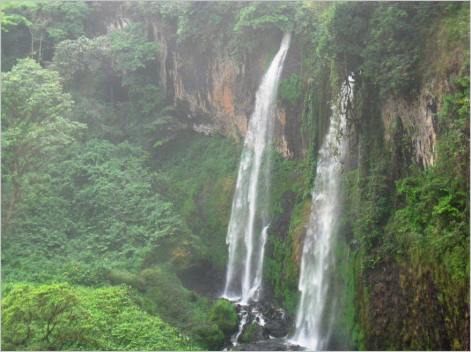 An image from Cameroon Scenery
.
.
Click the link below for images:
.
__________________________________________
September 7, 2022
Mohenjo
Business, Enthralling, Human Interest, Photographs
amazon, business, Business News, current-events, Future, Hotels, human-rights, medicine, mental-health, research, Science, Science News, technology, Technology News, travel, vacation
Click the link below the picture
.
Ciletuh-Palabuhanratu Geopark (Indonesian: Taman Bumi Ciletuh-Palabuhanratu) is a national Geopark at Pelabuhan Ratu of Sukabumi Regency in West Java , Indonesia. It was recognized by UNESCO in 2015 as a national geopark. It was being proposed to become member of Global Geopark Network (GGN) to be recognized UNESCO by 2017.UNESCO has made the park as a part of the Global Geoparks Network in April 2018.
The park has land area of about 128,000 hectares. It is spread over 8 sub-districts and 74 villages of Pelabuhan Ratu.
The park is a popular tourist destination.[3] Attractions of which are,
-
Puncak Darma-It is the highest point of the park.
-
Curug Sodong-waterfall
-
Curug Awang-Waterfall
-
Palangpang Beach
-
Bukit Panenjoan-hill
-
Curug Cimarinjung-waterfall
-
Palabuhanratu Beach
-
Lalay Cave Palabuhanratu
-
Palabuhanratu Thermal Baths
.
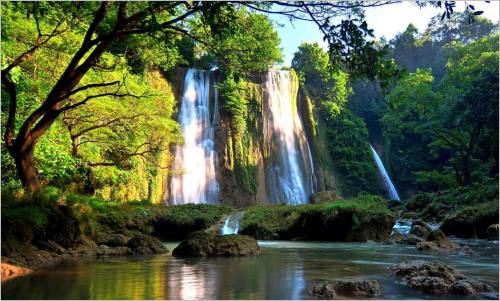 An image from Ciletuh Palabuhanratu Geopark
.
.
Click the link below for images:
.
__________________________________________
September 6, 2022
Mohenjo
Business, Enthralling, Human Interest, Photographs
amazon, business, Business News, current-events, Future, Hotels, human-rights, medicine, mental-health, research, Science, Science News, technology, Technology News, travel, vacation
Click the link below the picture
.
The Cheltenham Badlands are in Caledon, Ontario, on the southeast side of Olde Base Line Road, between Creditview and Chinguacousy Roads. The site occupies an area of approximately 0.4 square kilometers and features exposed and highly eroded Queenston shale. The Cheltenham Badlands are a significant educational site due to the readily visible geologic processes and the red color and the unique topography of the exposed shale make this a popular tourist site. The site is a Provincial Earth Sciences Area of Natural and Scientific Interest (ANSI) since it is considered one of the best examples of “badlands topography” in Ontario.
The Cheltenham Badlands sometimes referred to as the Chinguacousy Badlands, the Red Clay Hills, the Caledon Badlands, or the Inglewood Badlands, are approximately 3.8 km west of highway 10 on Olde Base Line Road near the villages of Inglewood and Cheltenham. The northern boundary of the badlands site is Peel Regional Road 12 (Olde Base Line Road). The total area of the property is 36.6 hectares and the exposed badlands occupies an area of approximately 0.4 square kilometers.
The Badlands are considered part of the Niagara Escarpment, which was designated a UNESCO World Biosphere Reserve in 1990. Acting as a buffer zone between the undeveloped and natural portions of the escarpment and the more developed areas further to the south, the badlands site is designated as an Escarpment Protection Area. Under the Niagara Escarpment Plan, the badlands are also considered an Escarpment Access Park and the main trail of the Bruce Trail system crosses the site and is the starting point for the Caledon Hills Bruce Trail Club section. In addition to being considered a Ministry of Natural Resources and Forestry designated Earth Sciences Area of Natural Scientific Interest, the Cheltenham Badlands are also part of an important groundwater discharge area, the Inglewood Slope Environmentally Sensitive Area, designated by the Credit Valley Conservation Authority. The cold water stream, at the base of the badlands, is a tributary of the Credit River, which drains into Lake Ontario.[citation needed]
The Badlands is an exposed section of the Queenston Formation, which was formed between 420 and 415 million years ago during the Middle and Late Ordovician periods. During this period, the collision of Gondwana into Laurentia resulted in the formation of the Taconic Mountains. The creation of these mountains also resulted in several basins, such as the Appalachian Basin and the Michigan Basin, in the interior of Laurentia. Over time, the erosion of these mountains resulted in the formation of the Queenston Delta, which drained into the Michigan Basin. The deposition of mud eroded from the mountains during the Middle and Late Ordovician period formed the Queenston Shale. The continuous deposition of the mud and sand from the mountains extended the Queenston Delta further into the Michigan Basin; however, as the mountains continued to erode, less and less mud and sand reached the delta, resulting in the formation of inter-layered beds of sandstone, shale, and limestone throughout the Silurian period. These inter-layered beds that overlay the Queenston Shale include Lower Silurian sandstones, such as the Whirlpool Formation, and dolostones, such as the Manitoulin Formation, which can be seen along the Niagara Escarpment. The Queenston Shale overlies the shales and the inter-bedded limestones of the Georgian Bay Formation. At the badlands site, glacial erosion of the overlaying sandstones and dolostones has caused the Queenston Formation to be the first layer of rock to underlie the soil. Wikipedia
.
 An image of Cheltenham Badlands
.
.
Click the link below for images:
.
__________________________________________
Older Entries
Newer Entries
 James' World 2